Morning Report – Here’s Janet! 11/14/13

Vital Statistics:

Last Change Percent
S&P Futures 1782.4 3.7 0.21%
Eurostoxx Index 3041.1 20.0 0.66%
Oil (WTI) 93.35 -0.5 -0.56%
LIBOR 0.238 -0.002 -0.89%
US Dollar Index (DXY) 81.08 0.156 0.19%
10 Year Govt Bond Yield 2.71% 0.01%
Current Coupon Ginnie Mae TBA 105.4 0.4
Current Coupon Fannie Mae TBA 104.5 0.1
RPX Composite Real Estate Index 200.7 -0.2
BankRate 30 Year Fixed Rate Mortgage 4.38
Markets are higher this morning on no real news. Bonds and MBS are flattish.
Wal-Mart cut its profit forecast due to the weaker economy at the lower end of the income spectrum and increased competition from dollar stores.
Finally, some economic data, although nothing market-moving. Initial Jobless Claims came in at 339k, a touch higher than the 330k forecast. Productivity was 1.9% vs Street expectaions of 2.2% and unit labor costs fell .6%. Later on today, we will get the Bloomberg Consumer Comfort index. Philly Fed President Charles Plosser will be speaking momentarily – he is a hawk so bonds could sell off on his comments.
Janet Yellen is scheduled to appear in front of the Senate Banking Committee today. Here are her prepared remarks. First thing off the bat, no mention of QE or tapering. For the most part nothing in the statement suggests any sort of change in direction from the Bernanke Fed. She intends to continue with the policy of keeping the markets informed of the Fed’s thinking, and believes that the dual mandate requires her to boost inflation if it is too low. She is committed to making sure the too big to fail banks are regulated, while at the same time she wants to lower the regulatory burden on small community banks. These sort of hearings are more or less dog and pony shows for the benefit of politicians, not public consumption. They don’t ask questions, they make statements. I don’t expect anything market-moving to come out of this, but just be aware. While there are a few people who want to use her nomination as leverage to advance other items, she should be confirmed easily.
Abby Joseph Cohen loves stocks right here..
Bidding wars on the West Coast are beginning to wane as inventory builds. Expect to see this reflected in the home price indices going forward. This could be a welcome development for the mortgage industry as professionals exit and real buyers (the ones who will need a mortgage) enter.

Morning Report – Mortgage Credit beginning to ease up 11/13/13

Vital Statistics:

Last Change Percent
S&P Futures 1755.5 -9.6 -0.54%
Eurostoxx Index 3006.0 -28.7 -0.95%
Oil (WTI) 93.31 0.3 0.29%
LIBOR 0.241 0.001 0.56%
US Dollar Index (DXY) 81.15 -0.041 -0.05%
10 Year Govt Bond Yield 2.73% -0.04%
Current Coupon Ginnie Mae TBA 105.2 0.2
Current Coupon Fannie Mae TBA 104.2 0.3
RPX Composite Real Estate Index 200.7 -0.2
BankRate 30 Year Fixed Rate Mortgage 4.51
Markets are lower after Atlanta Fed President Dennis Lockhart said a paring of U.S. bond purchases could very well take place next month. Bonds and MBS are up; however.
Mortgage Applications fell 1.8% last week, with purchases down .5% and refis down 2.3%. We had a huge move in rates last week, but it took place on Friday. This week’s numbers will probably be horrendous.
Mortgage Credit Availability increased slightly in October, according to the Mortgage Bankers Association. On one hand, some lenders increased lowered their FICO floor, but others restricted cash-out refis. The net effect was a slight increase in credit availability. FWIW, given the end of the refi boom, it looks like bankers realize they have to go our further on the credit curve. Redwood Trust announced on its conference call that it is diversifying away from strictly high quality jumbos and will look at the non-QM space.
Tri-Pointe Homes reported better than expected sales and earnings, and took up full year guidance. They are buying Weyerhaeuser’s home building unit as well. We are starting to see more M&A in the homebuilding space.
Transunion reported that the national average for 60 day delinquencies is 4.09%. The worst states are the judicial states, while the best are the northern mountain / midwest states. They have a cool interactive map where you can see DQ rates by state.

Morning Report: 5.4% mortgage by the end of 2014? 11/12/13

Vital Statistics:

Last Change Percent
S&P Futures 1763.2 -4.4 -0.25%
Eurostoxx Index 3039.5 -13.3 -0.44%
Oil (WTI) 95.06 -0.1 -0.08%
LIBOR 0.239 0.000 0.00%
US Dollar Index (DXY) 81.12 0.028 0.03%
10 Year Govt Bond Yield 2.77% 0.02%
Current Coupon Ginnie Mae TBA 105.2 -0.8
Current Coupon Fannie Mae TBA 103.9 -0.1
RPX Composite Real Estate Index 200.7 -0.2
BankRate 30 Year Fixed Rate Mortgage 4.39
Markets are lower as bond traders come back from a long weekend. Bonds and MBS continue their post jobs report sell-off.
The Chicago Fed National Activity Index ticked up a bit in September, while the 4 month moving average remained negative.
The NFIB Small Business Optimism Report fell from 93.9 to 91.6. He points out that small business is still struggling. That is an important point to remember – the S&P 500 is not a representative sample of U.S. business. Most of the big S&P names have exposure to fast-growing overseas markets and benefit from all the liquidity being pumped into the system by the world’s central banks. Small business is more affected by weak demand domestically. The government shutdown weighed on sentiment as well.
With not a lot of economic data, Fed-speak becomes more important. Dallas Fed President Richard Fisher told CNBC that the markets should bear in mind that QE cannot last forever. The balance sheet is $4 trillion and there are limits to what the Federal Reserve can do. Minneapolis Fed President Kocherlakota will talk about monetary strategy at 1:00 pm EST and Atlanta Fed President Dennis Lockhart will discuss the economy at 1:50 EST.
Homebuilder D.R. Horton reported earnings in line with estimates. Average selling prices climbed 15% as a combination of tight supply and low inventory allows the builders to hike prices at will. The stock is up in the pre-market.
NAR’s Chief Economist Lawrence Yun is making predictions about 2014. Exiting Home Sales will be flat at about 5.1 million units, prices will rise by 6% and the the 30 year fixed rate mortgage will end the year at 5.4%. New Home construction will increase to meet demand (at some point the builders will stop seeing price increases and will have to pump up volume to achieve growth). Lending standards will continue to ease and an improving job market will increase activity. If cash sales drop as a percentage of total sales, the purchase business should improve, but probably not enough to offset the end of the refi boom.

Morning Report – Jobs day 11/08/13

Vital Statistics:

Last Change Percent
S&P Futures 1741.8 -3.4 -0.19%
Eurostoxx Index 3009.5 -33.4 -1.10%
Oil (WTI) 94.24 0.0 0.04%
LIBOR 0.239 0.001 0.21%
US Dollar Index (DXY) 81.22 0.373 0.46%
10 Year Govt Bond Yield 2.72% 0.12%
Current Coupon Ginnie Mae TBA 105.3 -0.7
Current Coupon Fannie Mae TBA 104.5 -0.7
RPX Composite Real Estate Index 200.7 -0.2
BankRate 30 Year Fixed Rate Mortgage 4.27
Stocks are down in spite of a jobs report that showed a better-than-expected increase in payrolls. Bonds are getting slammed on the number, with the 10-year down 12 basis points.
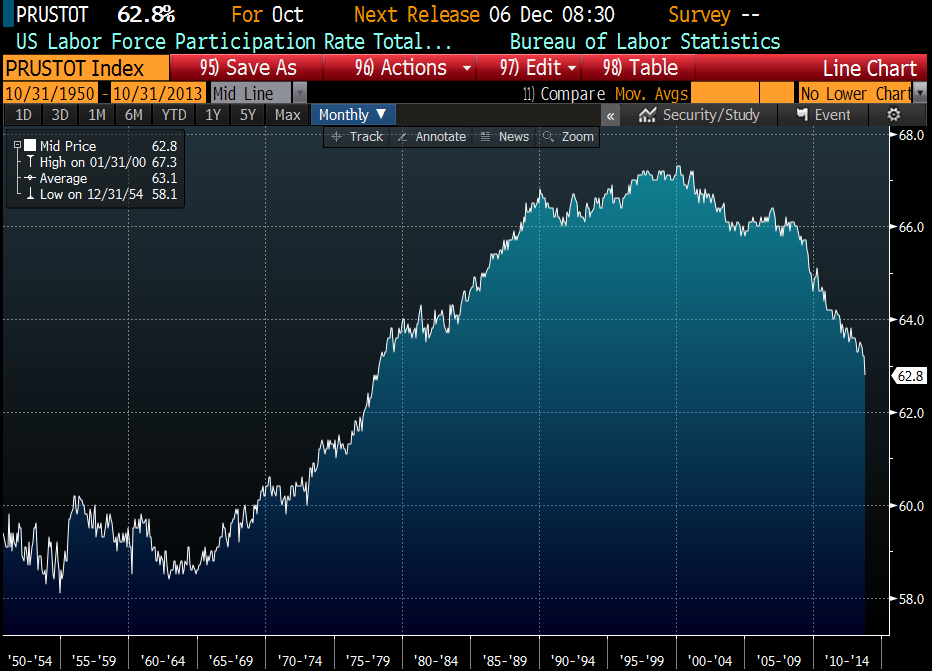
The economy added 204,000 jobs in the month of October, well in excess of the 120k street expectation. September was revised upward. The government shutdown was expected to depress job growth and it looks like that didn’t happen. The unemployment rate ticked up to 7.3% and the labor force participation rate nosedived to 62.8%, the lowest since January of 1978. Average hourly earnings ticked up a tenth of a percent and average weekly hours fell. Overall, the report was a mixed bag, but it does bring back the possibility of a December tapering. Separately, personal Income rose .5% and personal spending rose .2%.
The chart below shows the labor force participation rate since the days of Ward and June Cleaver. The big increase was due to women entering the workforce, which shows how dramatic the decline has been. Roughly half the gains have been taken away.

Twitter’s IPO went swimmingly. It priced at $26 and traded as high as $50. It now sports a 25 billion market cap which works out to 48 times trailing 12 month sales.
Freddie Mac is doing another risk sharing deal as the GSEs try to lower their footprint in the mortgage market.

Morning Report – Nationstar misses 11/07/13

Vital Statistics:

Last Change Percent
S&P Futures 1771.3 5.7 0.32%
Eurostoxx Index 3097.5 41.1 1.34%
Oil (WTI) 94.12 -0.7 -0.72%
LIBOR 0.239 0.000 0.10%
US Dollar Index (DXY) 81.39 0.903 1.12%
10 Year Govt Bond Yield 2.64% -0.01%
Current Coupon Ginnie Mae TBA 106.1 -0.1
Current Coupon Fannie Mae TBA 105.1 0.0
RPX Composite Real Estate Index 200.7 -0.2
BankRate 30 Year Fixed Rate Mortgage 4.28
Markets are higher after the European Central Bank cut rates and we got a surprisingly strong 3Q GDP report. Initial Jobless Claims fell and came in slightly below expectations. Bonds and MBS are down small.
#Twittergoespublicat26.  Symbol is TWTR for those who want to watch at home. This is a punchy valuation at 12.4 time sales. The offering price was increased from $17 to $26, lets see if they got too greedy on the IPO the way Facebook did.
The advance estimate of 3Q GDP came in at 2.8%, well above the Street expectations of 2.0%. Remember, this is the advance estimate and it will be revised twice. Lately, we have seen the advance estimates come in too high, only to be revised downward – for example the first estimate for Q113 GDP was 2.5% and by the third revision it ended up being 1.1%. Given the differential between the Street and the government, I suspect the number will be revised downward.
There had been chatter in the marketplace that Nationstar (NSM)’s pricing had gotten worse and they were backing out of the market. Well, today, we saw that there was indeed something wrong; as the company missed its earnings estimate in a big way. Pro-forma EPS were $1.08 vs the Street at $1.27. They took down guidance for full year 2013 and 2014. They also announced they are selling their wholesale channel to Stonegate (SGM). Some retail The stock is down 8 bucks (about 16%) pre-open.
The mortgage REITs have been announcing earnings and for the most part, they were flat on the quarter with regard to book value per share. They have de-levereraged a lot over the past quarter, and I would almost go as far as to say that their MBS (and TBA) selling is probably close to finished. Many are lowering duration by switching to hybrid ARMs and increasing credit risk while lowering interest rate risk. REIT selling has been one of the reasons why secondary margins have been getting hit across the board.
Fannie Mae reported good earnings per share and will pay Treasury $8.6 billion in the third quarter. The stock is up 6% or so pre-market
Merger mania in the homebuilder space. Earlier this week, Tri Pointe Homes (TPH) announced it is buying Weyerhaeuser’s homebuilding unit for $2.7 billion.  Now Toll Brothers (TOL) is in a deal to to buy Shapell for $1.6 billion to increase its California exposure. As we have seen, financing availability has been a case of the haves and the have nots. If you are big enough, you can get amazing financing terms.

Morning Report – Housing overvalued again? 11/06/13

Vital Statistics:

Last Change Percent
S&P Futures 1764.5 8.0 0.46%
Eurostoxx Index 3056.8 20.9 0.69%
Oil (WTI) 93.94 0.6 0.61%
LIBOR 0.239 0.001 0.40%
US Dollar Index (DXY) 80.54 -0.169 -0.21%
10 Year Govt Bond Yield 2.65% -0.02%
Current Coupon Ginnie Mae TBA 106 0.1
Current Coupon Fannie Mae TBA 105 0.2
RPX Composite Real Estate Index 200.7 -0.2
BankRate 30 Year Fixed Rate Mortgage 4.23
Markets are higher this morning on strength in overseas markets. Market darling Tesla Motors (TSLA) fell in premarket trading after missing its quarter. Abercrumble (ANF) was down 9% after missing as well. Bonds and MBS are up small. At 10:00 we will get the Index of Leading Economic Indicators, which shouldn’t be a market mover
Tomorrow starts the big data, with GDP and then the jobs report on Friday. The bond market has clearly been spooked by the strong ISM numbers and the language out of the FOMC statement.
In politics last night, Chris Christie cruised to a win in New Jersey, while McAuliffe won in Virginia. Dinkins got another term in New York City.
Mortgage applications fell by 7% last week as mortgage rates rose 5 basis points. The purchase index fell by 5.2% while the refi index fell by 7.9%.
Homeprices are 17% overvalued according to Fitch’s models, with much of coastal California > 20% overvalued. Their model is based on unemployment, income, rental prices, population levels, housing units, and mortgage rates. Note that the median house price to median income ratio is back above its historical range again. This is based on NAR’s median house price, which is probably over-emphasizing the red-hot California markets due to its repeat sale methodology. All real estate is local, and I doubt we are overvalued all that much outside of a few markets like Washington DC, Manhattan, and the hot West Coast markets. In the judicial states (primarily in the Northeast) we have yet to see any sort of meaningful rebound in prices.

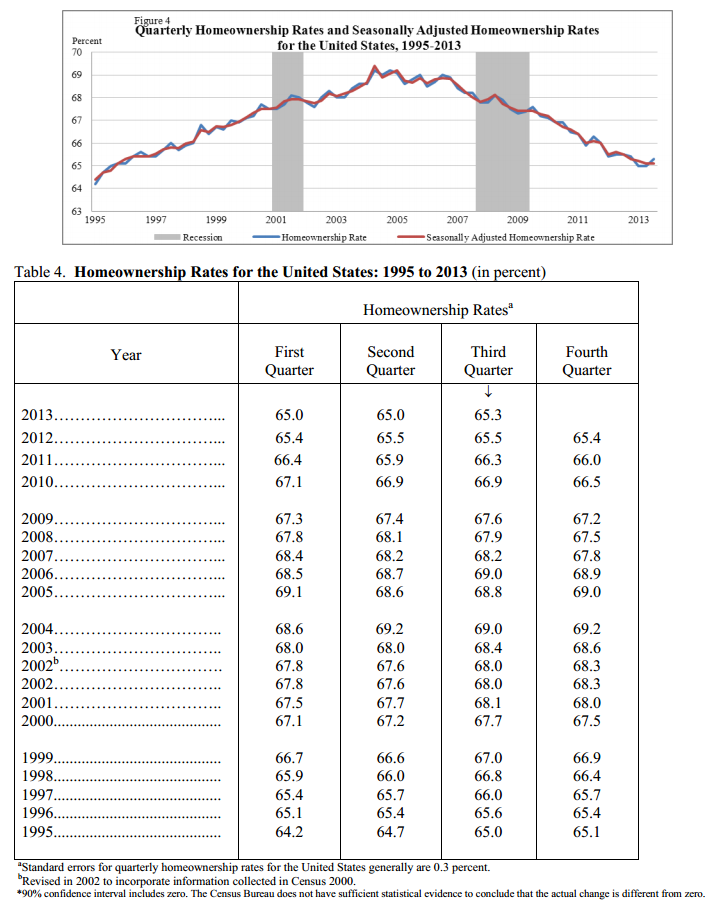
The homeownership rate edged up last quarter to 65.3% from 65% in Q2 and is now back to levels we haven’t seen since the mid-90s, when HUD began to aggressively push to increase homeownership in this country.

Interesting article on the fiscal drag (aka “austerity”) by the AEI. Without the Fed’s stimulus, nominal GDP would have fallen by 2%. Note that most of the drag is coming from the tax increases, not the spending cuts, as the tax hikes have a much higher multiplier than spending cuts. They cite a San Francisco Fed study which found that 90% of the fiscal drag came from increased taxes. This is not surprising as taxes were increased much more than spending was cut, but I found the difference in multiplier interesting. The spending cuts have a .60 multiplier while tax hikes have a 1.8 multiplier. This means that a $1 reduction in government spending reduces GDP by 60 cents, while a $1 increase in taxes reduces GDP by $1.80.

Morning Report – Bay Area Home Prices eclipse bubble highs 11/05/13

Vital Statistics:

Last Change Percent
S&P Futures 1758.0 -5.0 -0.28%
Eurostoxx Index 3032.3 -28.9 -0.94%
Oil (WTI) 94.33 -0.3 -0.31%
LIBOR 0.238 0.000 -0.17%
US Dollar Index (DXY) 80.59 0.032 0.04%
10 Year Govt Bond Yield 2.62% 0.02%
Current Coupon Ginnie Mae TBA 106.3 0.3
Current Coupon Fannie Mae TBA 105.2 -0.1
RPX Composite Real Estate Index 200.7 -0.2
BankRate 30 Year Fixed Rate Mortgage 4.22

Markets are lower this morning on no real news. Bonds and MBS are down. Later this morning, we will get the ISM non-manufacturing survey and the IBD / TIPP economic optimism report.

SAC Capital and the government reached a deal yesterday – Cohen’s SAC Capital and the government settled insider trading charges for $1.2 billion. Cohen personally was never criminally charged. While Steve Cohen avoids jail, the firm will no longer be able to manage money, and once the client funds are withdrawn, no one on the Street will deal with him anymore. So, he can take his billions and go to the beach, I guess. The ultimate arbitrage – Cohen won this game.
The FHFA banned fees on forced placed insurance yesterday. Ultimately this move will result in a little less revenue for servicers.
Did FHA hike premiums just a little too much? It appears so. Wells, Bank of America and TD Bank are now offering loans with as low as a 5% down payment, with a requirement to have PMI until the house has 20% equity (this was the big thing FHA changed – now PMI has to exist for the life of the loan, regardless of the equity). In other words, Wells, B of A, and TD are offering a product similar to old FHA loans. Rising house prices make these worth the gamble. The government has been saying it wants to crowd in private capital; perhaps this is an intended consequence.
The CFPB will hold a hearing in Boston on Wednesday, November 20th at 11:00 am. Richard Cordray will be speaking as well as representatives from consumer groups, industry and the public. These hearings are usually used to announce new initiatives, and we may get the TILA-RESPA integrated disclosures final rule.
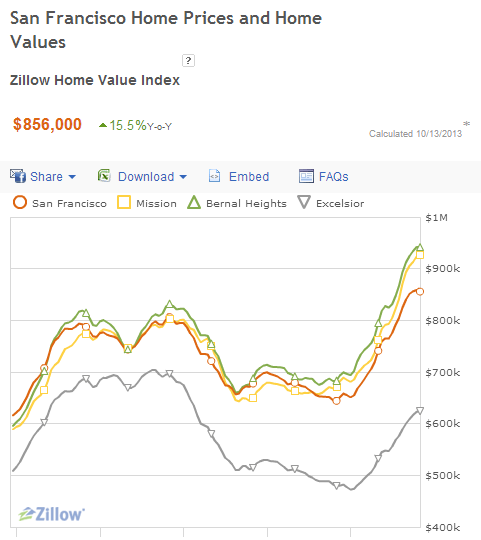
What is driving the growth of home prices in the Bay Area? Chinese money. Bay Area house prices are at all time highs, yes, even higher than the bubble years. Roughly 7% higher.

Morning Report – Deutsche Bank predicting a 2.25% bond yield by the end of the year 11/04/13

Vital Statistics:

Last Change Percent
S&P Futures 1755.0 4.0 0.23%
Eurostoxx Index 3062.3 -5.7 -0.18%
Oil (WTI) 95.64 -0.7 -0.77%
LIBOR 0.238 -0.004 -1.76%
US Dollar Index (DXY) 80.53 0.338 0.42%
10 Year Govt Bond Yield 2.58% 0.02%
Current Coupon Ginnie Mae TBA 106.2 -0.3
Current Coupon Fannie Mae TBA 105.2 0.1
RPX Composite Real Estate Index 200.7 -0.2
BankRate 30 Year Fixed Rate Mortgage 4.15
Markets are up as Twitter increases the price of its IPO from $17-$20 to $23-$25. Bonds and MBS are up as well.
This week promises to be a big one with Friday’s jobs report. The bar is set pretty low – nonfarm payrolls are expected to increase 125k. Given that this report will include the government shutdown, you probably should put an asterisk next to it, but all jobs reports are huge these days. The unemployment rate is expected to tick up to 7.3% from 7.2%. The ADP report, which forecasts the same payroll number came in at 130k, weaker than the 150k estimate. Given the shutdown, I would expect a good jobs report to be bond bearish and a bad jobs report to not necessarily be bond bullish. Weakness would be taken as par for the course given the shutdown, and strength in spite of the shutdown would bring a December tapering back into the picture.
Deutsche Bank is out with a gutsy call in Treasuries – a 2.25% yield on the 10-year by the end of the year. The reason? The economy isn’t growing as strongly as forecast. That said, Friday’s ISM report was reasonably strong, but overall consumer confidence has been dropping, and we didn’t see blockbuster numbers out of the retailers for back-to-school. It certainly makes you wonder what the Fed is looking at when they talk about a strengthening economy. Remember, however the Fed has been consistently high in its economic forecasts for GDP growth. The last time rates were at that level, the Bankrate average 30 year fixed rate mortgage was below 4%.
Homebuilder Tri Pointe Homes is making a big bet on housing construction with its purchase of timber conglomerate Weyerhaeuser’s home-building division. In many ways, this deal simply recognizes the reality that there is a huge advantage to size for the builders. On one hand, you have small builders who are having difficulty borrowing money, and on the other hand the big builders are having money thrown at them by the market. Exhibit (a) for that was KB Home’s (KBH) convertible bond deal earlier this year. 10 year paper, 1.375% coupon, initial conversion premium at 50%.
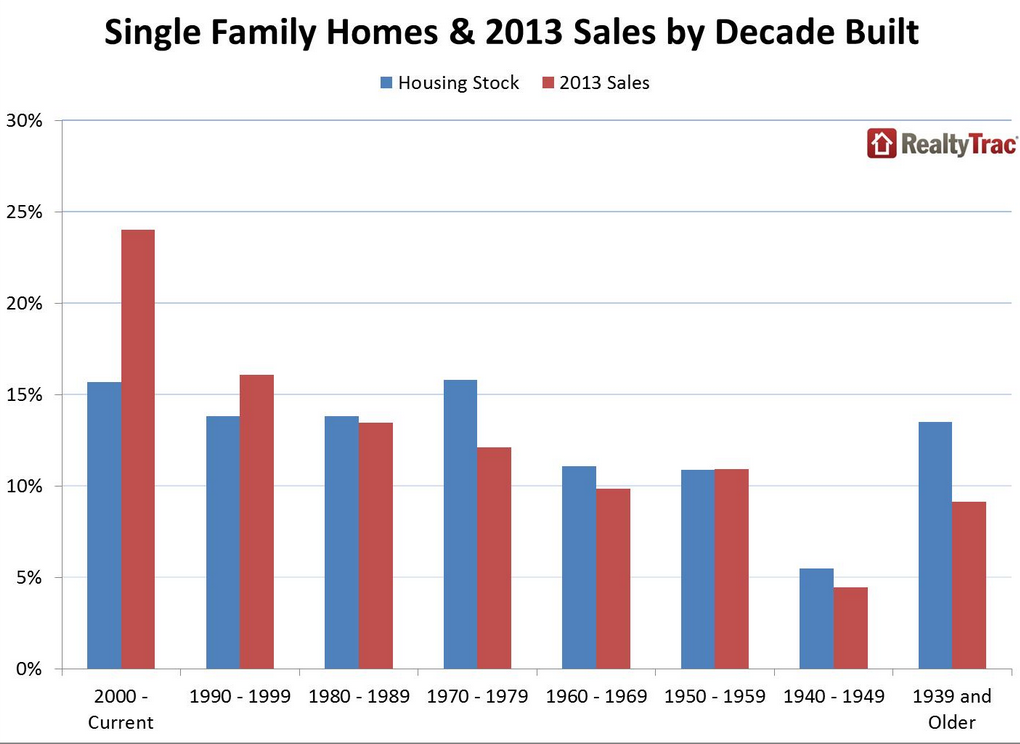
71% of single family homes were built before 1990, according to RealtyTrac’s Aging Home Analysis. This speaks to the merger mentioned above (we have underbuilt for 6 years) and represents an opportunity for 203k loans.

Morning Report – Mel Watt doesn’t get the vote 11/01/13

Vital Statistics:

Last Change Percent
S&P Futures 1755.0 4.0 0.23%
Eurostoxx Index 3062.3 -5.7 -0.18%
Oil (WTI) 95.64 -0.7 -0.77%
LIBOR 0.238 -0.004 -1.76%
US Dollar Index (DXY) 80.53 0.338 0.42%
10 Year Govt Bond Yield 2.58% 0.02%
Current Coupon Ginnie Mae TBA 106.2 -0.2
Current Coupon Fannie Mae TBA 105.2 -0.2
RPX Composite Real Estate Index 200.7 -0.2
BankRate 30 Year Fixed Rate Mortgage 4.15
Markets are up this morning on no real news. The Markit PMI fell in October, but came in a little better than consensus. Bonds continue their post-FOMC sell-off with the 10 year yielding 2.58%. MBS are down a few ticks.
Mel Watt failed to garner the 60 votes needed to move to a final vote, so he will probably end up withdrawing his name for consideration to run FHFA. Watt was considered to be a little too political and there were grave doubts he would be working in the best interests of the taxpayers. Moody’s Chief Economist Mark Zandi has been mentioned as a possible nomination, however he has been a vocal proponent of principal forgiveness and that will be an issue.
The thing to keep in mind about principal reduction is that there are two losers in this situation – the taxpayer who obviously backstops the insurance and the investors who own the paper. The investors who own these mortgage backed securities are mainly pension funds, and they have been quietly urging their representatives in Washington to not go the mass forgiveness route. Think about things from a pension fund’s perspective – the expected rate of inflation for their liabilities has been growing a lot faster than the paltry rate of return they are getting on their assets in this QE-manipulated environment. The dirty little secret of many of these funds is that they are making, shall we say, optimistic assumptions about the expected rate of return on their asset in order to claim they are in fact solvent. Capital losses (even on insured MBS) will happen, which will push them even deeper in the hole. Many of these plans are government / union and many politicians have their own retirement in these plans. So that is a look at the behind-the-scenes issue with the whole FHFA head.
Politically, Acting Chairman Ed DeMarco may in fact make a convenient target for the Left, who can rail against his refusal to entertain principal mods while that the same time offering assurances to their state pension funds that nothing will change. And the Republicans get to do the dirty work. A win all around.
One note, CBO did conduct a study that showed that a mass principal forgiveness program would save the government money, primarily through increased economic growth, however that result depends on the government getting it right in terms of crafting a policy that would not cause a wave of strategic defaults. That is the $10,000 question.
John McCain and Lindsey Graham are going to hold up the nomination of Janet Yellen unless they get more details from the Administration over the Benghazi attacks. In spite of this, Yellen will get confirmed. I don’t anticipate the political sausage-making will affect the bond market at all.

Morning Report – Elizabeth Warren at the MBA conference 10/31/13

Vital Statistics:

  Last Change Percent
S&P Futures  1757.4 -3.2 -0.18%
Eurostoxx Index 3056.4 15.7 0.52%
Oil (WTI) 96.25 -0.5 -0.54%
LIBOR 0.242 0.000 0.04%
US Dollar Index (DXY) 79.99 0.212 0.27%
10 Year Govt Bond Yield 2.50% -0.04%  
Current Coupon Ginnie Mae TBA 106.2 -0.1  
Current Coupon Fannie Mae TBA 105.5 0.2  
RPX Composite Real Estate Index 200.7 -0.2  
BankRate 30 Year Fixed Rate Mortgage 4.13    


Markets are slightly weaker after yesterday’s insufficiently dovish FOMC statement. Initial Jobless Claims came in at 340k, more or less in line with expectations. Bonds and MBS are up. The Street was clearly leaning long going into the statement and it may have simply been a case of “sell the rumor, buy the fact.”
 
I just got back from the MBA conference in DC, and it was great to meet so many people in this business. Needless to say, conversations between different bankers centered around the new rules taking effect on Jan 1. 
 
Elizabeth Warren spoke at the conference and more or less gave the boilerplate liberal take on the crisis: “It was the bankers, affordable housing targets had nothing to do with it, etc…” However, she did address QM, and said that it needs to be strengthened, because the potential liability associated with writing non-QM loans is relatively small, and in good times, lenders can compensate for these possible losses with higher rates or fees.” Clearly she is trying to discourage non-QM loans.
 
Cue Richard Cordray, the head of the Consumer Financial Protection Bureau, who has been trying to disabuse the Street of the idea that non-QM loans are illegal. “Qualified mortgages cover the vast majority of loans made in today’s market, but they are by no means all of the mortgage market. This point is important and it should not be misunderstood. There are plenty of good loans made every years – for example loans made to a borrower with considerable other assets or whose individual circumstances are carefully assessed – that are non-QM because they do not meet the 43% debt-to-income ratio or are non eligible for purchase by the GSEs, but nontheless, are based on sound underwriting standards and routinely perform well over time.” 
 
So, contradictory guidance is coming out of the government. Maybe it is a good cop / bad cop sort of thing. But whatever it is, it is unhelpful. For the people in Washington scratching their collective heads wondering why credit is so tight? Well, there ya go…
 
Oh, and one other thing.. She is pushing for some sort of fair lending review as a condition to continued GNMA and FNMA MBS issuers. Something “clear and enforceable.” Which is really just wealth redistribution in drag. There is this fantasy among some people in Washington that there is this huge reservoir of great opportunities in CRA neighborhoods that are smart loans, but a bunch of stooges in the most competitive industry on the planet are studiously avoiding them because of some sort of latent racism. As if there is some big pile of money that people don’t want because it comes from the wrong zip code. Wall Street often gets it wrong, but it usually falls along the lines of seeing an opportunity where none really exists and not the other way around. Someone should tell these people that FICO and severities matter when pricing credit. 
 
The FOMC decided to keep interest rates unchanged and not to change the pace of asset purchases. After the government shutdown, virtually no one expected a taper at the October meeting. The market focused on the statement that the “Committee decided to await more evidence that progress will be sustained before adjusting the pace of its purchases.” In other words, QE4EVA is off the table. Bill Gross of PIMCO tweeted yesterday: “Think abt this Fed: Capitalism depends on carry. When carry (yld, risk spreads, etc) gets too low, capitalism stalls.”  Think someone is underweight duration right now?
 
Mortgage Servicing Rights (MSRs) are hot, hot hot. Agency REIT giant American Capital (AGNC) is buying Residential Credit Solutions, a mortgage servicer. By the way, AGNC’s third quarter earnings were pretty disappointing. They de-leveraged in a big way (ratio fell from 8.5x to 7.2x), and are now net short TBAs by 7.3 billion.