Morning Report – Luxury building continues to perform well 5/28/14

Vital Statistics:

Last Change Percent
S&P Futures 1908.5 -0.7 -0.04%
Eurostoxx Index 3241.4 -2.9 -0.09%
Oil (WTI) 103.9 -0.3 -0.25%
LIBOR 0.228 -0.002 -0.98%
US Dollar Index (DXY) 80.49 0.139 0.17%
10 Year Govt Bond Yield 2.47% -0.05%
Current Coupon Ginnie Mae TBA 106.8 0.2
Current Coupon Fannie Mae TBA 105.9 0.2
BankRate 30 Year Fixed Rate Mortgage 4.18


Markets are flattish on no real news. Bonds continue their rally, with the 10-year bond trading at 2.47%. MBS are up as well.
Mortgage Applications fell 1.2% last week, as purchases fell 1.1% and refis fell 1.4%. The 10 year bond yield fell a basis point over the week. Refis were 52% of all loans, and ARMs are now 18.5% of the total dollar amount of loans (though only 8.4% of units, so these are mainly jumbos).
Obama has nominated San Antonio Mayor Julian Castro to lead HUD. This is more or less a political appointment, as Castro is viewed as a rising star in the Democratic Party. His confirmation in the Senate should be smooth, and the nomination should not imply any major policy changes out of HUD.
Homebuilder Toll Brothers reported second quarter numbers this morning, and it looks like things are still going swimmingly on the luxury end of things. Revenues rose 53% as deliveries increased 67% in dollar terms and 36% in unit terms. Remember, Toll Brother bought Shapell Homes, so these aren’t necessarily apples-to-apples comparisons. ASPs increased 22% (!) on a year-over-year basis to $706,000. Shapell’s footprint is affluent Coastal California, so that accounts for some of the big jump in ASPs – most other builders are reporting increases in the 9% – 12% range.
Toll CEO Douglas Yearley had this to say: “Demand over the past year has been solid, although relatively flat, compared to the strong growth we initially experienced beginning in 2011, coming off the bottom of this housing cycle. We note that last cycle’s recovery, in the early 1990s, began with a period of rapid acceleration, followed by leveling, before further upward momentum. We believe that we are in a similar leveling period in the early stages of the housing recovery with significant pent-up demand building.”
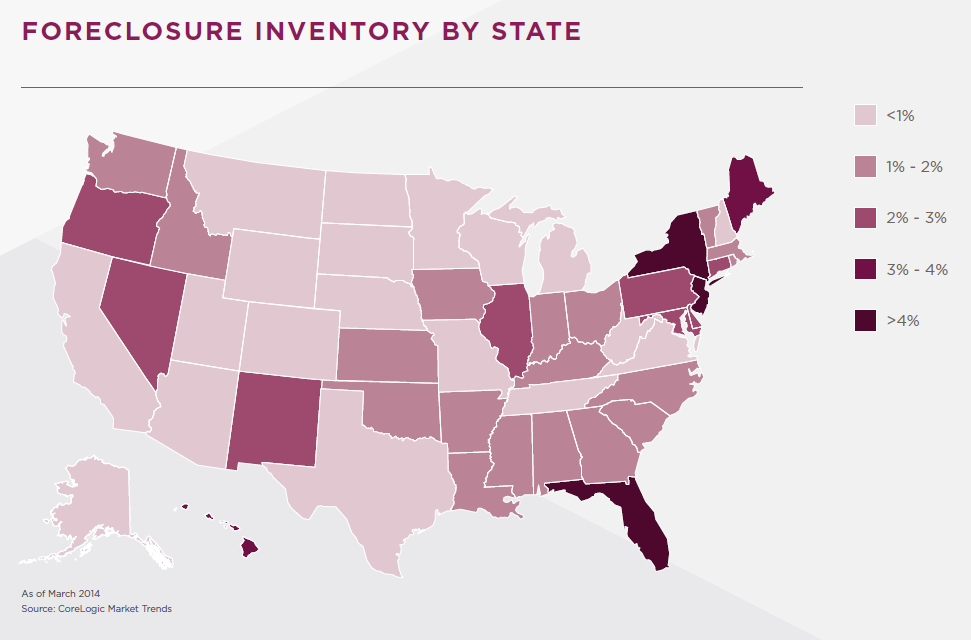
That said, the Fed is still worried about housing, as the sector continues to grow as expected. Unfortunately, the Fed doesn’t have a lot of levers to deal with the underlying issues: low household formation and tight credit. Again, all real estate is local, and the problems are mainly in the Northeast, which is still dealing with a large shadow inventory of foreclosures. In areas where this has been dealt with already (California), there is a tremendous amount of building.

Morning Report – a tale of two real estate indices 5/27/14

Vital Statistics:


  Last Change Percent
S&P Futures  1904.4 7.5 0.40%
Eurostoxx Index 3241.0 0.6 0.02%
Oil (WTI) 104.3 0.0 -0.04%
LIBOR 0.23 0.001 0.22%
US Dollar Index (DXY) 80.33 -0.065 -0.08%
10 Year Govt Bond Yield 2.54% 0.01%  
Current Coupon Ginnie Mae TBA 106.4 0.0  
Current Coupon Fannie Mae TBA 105.5 0.0  
BankRate 30 Year Fixed Rate Mortgage 4.16    


Markets are higher this morning after some good economic data. Bonds are surprisingly up. 
 
Durable Goods orders rose .8% in April and March was revised upward from 2.6% to 3.6%. The Street was looking for a drop of .7%. That said, ex-defense orders were down .8%. Ex-transportation, durable goods orders were up .1%. 
 
In other data, the Markit Purchasing Managers Index came in at 58.6, a strong number. Consumer Confidence rose to 83 in May, and the Richmond Fed Manufacturing Index was flat at 7. I think we got more economic data this morning than we got all of last week.
 
We have a couple of real estate indices this morning as well. The first is the FHFA Home Price Index, which rose .7% in March. According to FHFA, prices are back to July 2015 levels and we are within about 6% of the previous peak. We have a tremendous dispersion of strength between regions, where the Pacific division is up 18% over the past 5 years, while New England is down a couple of percent. 


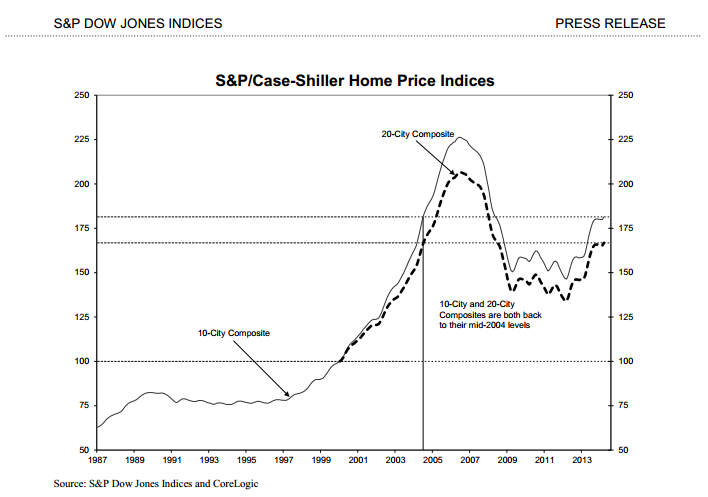
The Case-Shiller index rose 1.24% for March. Prices are back to mid-2004 levels, according to the index, and are still about 20% off their peak in 2006.


So, according to FHFA, we are within 6% of the peak and prices are at mid 2005 levels and according to Case-Shiller, we are within 20% of the peak and prices are at mid 2004 levels. Who is right? The answer is both. Case-Shiller is a broad-based index, while FHFA is narrower. The FHFA index only looks at homes with a conforming mortgage, which means it excludes jumbos and cash sales, which have been historically distressed properties, although that is changing.


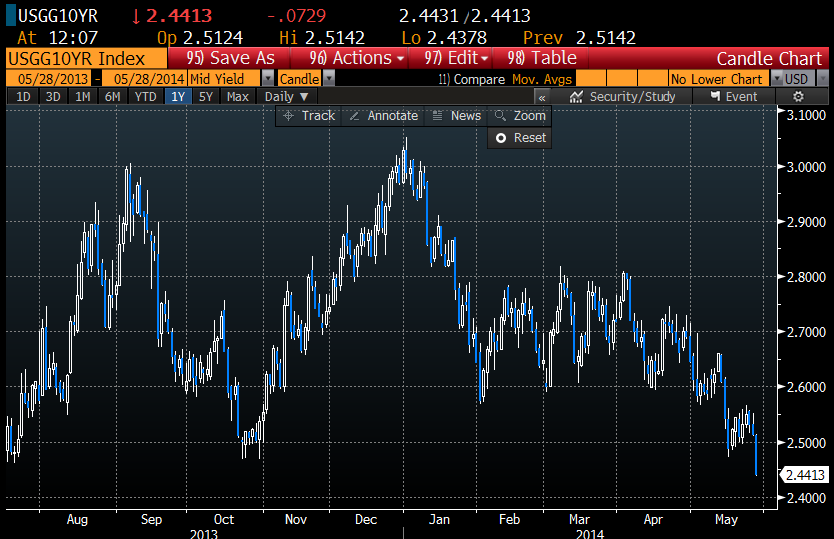
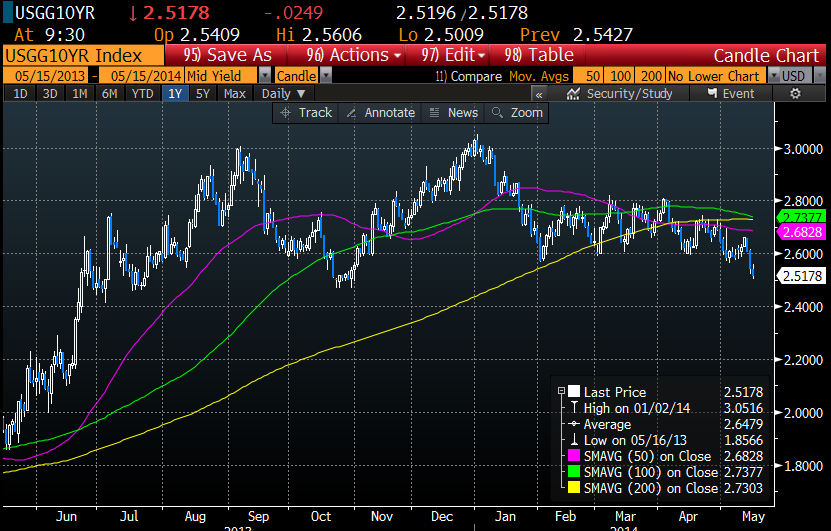
Mohammed El-Arian weighs in on what is going on in the bond market. Speculators are net short Treasuries in a big way, and pension funds are redeploying stock market gains into the bond market. That makes for a tight market. You could almost feel the stops getting triggered a couple of weeks ago when we broke out of our 2.6% – 2.8% trading range:


Always-thoughtful Gary Shilling talks about how a financial crisis in China could be the catalyst for a massive “risk-off” trade, which would mean the rally in bonds could last longer than people think. Note that mortgage REITs (one of the biggest investors in mortgage backed securities) are leaning that way.

Morning Report – Very little construction in the Northeast 5/23/14

Vital Statistics:

Last Change Percent
S&P Futures 1890.5 0.3 0.02%
Eurostoxx Index 3191.9 4.3 0.13%
Oil (WTI) 104.1 0.3 0.31%
LIBOR 0.229 0.002 0.97%
US Dollar Index (DXY) 80.37 0.112 0.14%
10 Year Govt Bond Yield 2.53% -0.02%
Current Coupon Ginnie Mae TBA 106.4 0.0
Current Coupon Fannie Mae TBA 105.6 0.1
BankRate 30 Year Fixed Rate Mortgage 4.17


Markets are flattish this morning on no real news. Bonds and MBS are down. Today should be dull as most of the Street will probably be on the L.I.E. by noon. Bonds close early today.
New Home Sales came in at 433k, an increase from the upward-revised 407k the month before. The vast majority of the new homes are in the South, with 235k. The Northeast is deader than Elvis with only 22k new home sales. (look below for an explanation why). The Midwest and the West had 84k and 92k new sales respectively. Inventory was still low, with 5.3 months’ supply. The median price dropped from $281,700 to $275,800.
A new article out of the New York Fed addresses the hollowing out of the middle class. At least it New York, the jobs lost in the Great Recession have been in middle-skill jobs, like teachers, construction, admin support. Those jobs have not come back. The buckets where jobs are growing have been in the higher-skilled jobs like engineers, financial analysts, etc as well as low-skilled jobs like retail, food service, etc. This is IMO partly the fault of New York State’s extremely borrower-friendly (creditor unfriendly) foreclosure laws. While states like California have worked through their foreclosure inventory and are now building, there is virtually no new construction in New York State. In California, Texas, etc where there is building going on, construction workers are in high demand and wages are increasing. Yet another case of good intentions smacking into the law of unintended consequences.
Does judicial review of foreclosures create deadweight losses? The Federal Reserve Bank of Cleveland asks that question. Anecdotally, I see the effects in New York State, where may homes sit vacant while the foreclosure wends its way through the courts. While there may be a useful part of this, where we ensure we don’t throw people out on the street, many of these foreclosures are vacant. At that point, letting a vacant house sit does no one any good.
Finally, I discuss housing reform, monetary policy, and the homebuilding sector with Louis Amaya on Capital Markets Today. Lots of housing wonky goodness.

Morning Report – Out: Tapering. In: Normalization 5/22/14

Vital Statistics:

Last Change Percent
S&P Futures 1886.0 1.1 0.06%
Eurostoxx Index 3178.4 -8.7 -0.27%
Oil (WTI) 103.9 -0.2 -0.18%
LIBOR 0.227 0.000 -0.09%
US Dollar Index (DXY) 80.17 0.076 0.09%
10 Year Govt Bond Yield 2.54% 0.00%
Current Coupon Ginnie Mae TBA 106.5 0.0
Current Coupon Fannie Mae TBA 105.6 0.0
BankRate 30 Year Fixed Rate Mortgage 4.17


Markets are flattish after retailers Best Buy and Sears missed earnings estimates. Bonds and MBS are flat.
We finally got some economic data this morning, starting with the Chicago Fed National Activity Index, which came in below expectations. Initial Jobless Claims rose from 298k to 326k. The Markit May preliminary PMI came in at 56.2, a little better than expectations and consumer comfort remained on the low side. Finally, the Index of Leading Economic Indicators fell to .4%
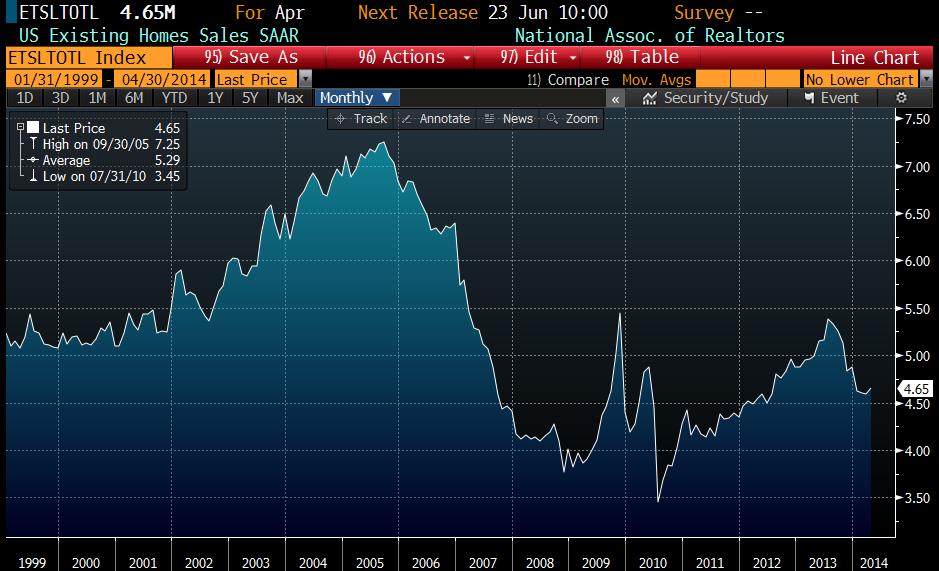
Existing home sales increased to a 4.65 million rate in April, which was an increase from the prior month, but below street expectations. As anyone in the mortgage business can tell you, it is tough out there. Housing continues to punch below its weight and sales continue to be at depressed levels. On the bright side, between 40% and 50% of these transactions are all cash, compared to 20% historically. So, there is a lot of potential business out there, but we need the first time homebuyer to step up.

The new buzzword for the Fed is now “normalization,” which is all honesty is simply a euphemism for “raising rates.” There was nothing earth-shattering in the FOMC minutes yesterday (the bond market barely noticed), but the Fed did muse a bit on how monetary policy will function with a balance sheet the size of Jupiter. People forget that we are truly in uncharted territory here, with a Fed balance sheet of 4.3 trillion in assets vs 900 billion at the beginning of 2008.

The Fed noted the strength in the March industrial data, but did not pick up on the reversal in the April numbers. Even though Q1 GDP growth was below the Fed’s forecast, they chose not to revise their 2014 GDP estimates downward, as they expect a rebound in the second half of the year. Overall, if you look at the trend of the Fed’s forecasts and revisions, GDP, unemployment, and inflation forecasts have been progressively lowered. I almost wonder if the Fed’s economic models were created during an environment where recessions were caused by the classic inflation / inventory buildup cycle and that model is simply irrelevant in this climate, where the recession is caused by a burst asset bubble.
The latest CoreLogic Market Pulse is out, and it has some good articles as usual. They address short sales and the expiration of the Mortgage Debt Forgiveness Relief Act. So far, it looks like the expiration of the tax relief (mortgage debt principal mods are now treated as taxable income, where before they were not) is crimping short sales, exacerbating an already tight inventory situation. Conversely, construction employment is beginning to increase, especially in Florida. I expect construction (especially residential construction) will be the catalyst that sends us from 2% GDP growth to 3% + GDP growth. The homebuilders have been able to report increased revenues primarily by increasing average selling prices. The typical publicly-traded homebuilder was reporting double digit increases in ASPs and high single digit drops in deliveries. Once they hit the ceiling on prices (and traffic patterns suggest we are close), they will simply have to push through volume if they want to report growth. That will begin the virtuous cycle. I was hoping this would be a 2014 event, but it is looking more and more like a 2015 event. CoreLogic also discusses the excuse du jour for weak housing starts – bad weather – and finds that it doesn’t fully explain what has been going on. RTWT.

Morning Report – Back from the secondary conference 5/21/14

Vital Statistics:

Last Change Percent
S&P Futures 1875.2 7.1 0.38%
Eurostoxx Index 3175.2 11.2 0.35%
Oil (WTI) 103.1 0.8 0.75%
LIBOR 0.227 -0.001 -0.33%
US Dollar Index (DXY) 80.15 0.107 0.13%
10 Year Govt Bond Yield 2.55% 0.04%
Current Coupon Ginnie Mae TBA 106.3 -0.1
Current Coupon Fannie Mae TBA 105.5 -0.1
BankRate 30 Year Fixed Rate Mortgage 4.17


Markets are higher this morning on no real news. Bonds and MBS are down. Sorry for the lack of blog posts the last two days, but I was at the MBA Secondary Conference, and there really wasn’t much to talk about anyway. We had no economic data on Monday or Tuesday.
Mortgage applications increased .9% last week. Purchases fell 2.8% while refis increased 3.8%. This is a pretty disappointing number given that the 10 year bond yield fell by 10 basis points and mortgage rates fell 5 – 6 bps. Refis accounted for 52% of loans, and ARMs were 8.1%.
Later on today, we will get the minutes from the April FOMC meeting. I don’t anticipate anything earth-shattering, but I will be interested to see if the big jump in March activity was a one-time event. Certainly some of the April data (industrial production, capacity utilization etc) has been disappointing. I also want to see what they say about housing, especially credit availability.
Speaking of the Fed, there is a lot going on over the next few days, with many speakers, the Stan Fischer confirmation hearings, and the minutes. Hawk Charles Plosser warned that if the economy improves as forecast, the current taper pace may be too slow.
The MBA Secondary Conference ends today, and it seems like the mood was a little brighter than previous years, despite the difficult conditions in the mortgage business. Non-QM loans are being rolled out strictly as a portfolio product for a few lenders, but there is no talk of securitization or anything like that. The first time homebuyer is still a focus for Washington, and non-bank servicers were put on notice that New York State isn’t going away.
Retailer earnings reports are rolling in, and as we have seen, it has been a tale of two markets, with the luxury end (think Tiffany’s) outperforming the discounters (think Target and Wal Mart). In home improvement land, the Home Despot and Lowe’s both missed earnings. Generally, retailers seem to be missing. Tomorrow we will hear from bellwethers Gap and Best Buy. Again, keep in mind that there will be an asterisk with these results as poor weather in the Northeast and the Midwest depressed traffic early in the quarter.


Morning Report – Johnson-Crapo gets out of Committee 5/16/14

Vital Statistics:


  Last Change Percent
S&P Futures  1867.0 -0.3 -0.02%
Eurostoxx Index 3166.2 3.0 0.09%
Oil (WTI) 101.9 0.4 0.36%
LIBOR 0.229 0.003 1.22%
US Dollar Index (DXY) 80.1 0.101 0.13%
10 Year Govt Bond Yield 2.50% 0.01%  
Current Coupon Ginnie Mae TBA 106.4 -0.2  
Current Coupon Fannie Mae TBA 105.4 0.0  
BankRate 30 Year Fixed Rate Mortgage 4.16    


Markets are flattish after a better than expected housings starts report. Bonds and MBS are down
 
Housing starts rebounded in April to a annual rate of 1.07 million, an increase of 13.2% month-over-month. Building Permits increased to 1.08 million, an 8% increase. This is still well below the historical average of 1.5 million units a year, and still a dismal number compared to pre-bust levels. 
 
Johnsnon – Crapo (the GSE reform bill) got out of Committee today, with all the liberals voting against it. The liberals dislike the bill because they want affordable housing mandates. Given the lack of support from liberals, Senate Majority Leader Harry Reid is unlikely to bring the bill to the floor. 
 
The National Federation of Independent Business released their small business confidence survey yesterday, showing that confidence is improving, but still below par. The two biggest problems for small business remain taxes and regulations.

Morning Report – lots of conflicting data 5/15/14

Morning Report

Last Change Percent
S&P Futures 1881.2 -4.1 -0.22%
Eurostoxx Index 3195.1 -15.4 -0.48%
Oil (WTI) 101.9 -0.5 -0.44%
LIBOR 0.226 0.001 0.22%
US Dollar Index (DXY) 80.23 0.152 0.19%
10 Year Govt Bond Yield 2.51% -0.03%
Current Coupon Ginnie Mae TBA 107 0.3
Current Coupon Fannie Mae TBA 105.6 0.1
BankRate 30 Year Fixed Rate Mortgage 4.17


Markets are lower this morning after Wal-Mart missed. Bonds and MBS are up.
Very mixed bag of economic data this morning:
  • Empire Manufacturing 19.01 vs 6 expected (indicates strong economy)
  • Consumer Price Index .3 vs .3 expected (doesn’t tell you anything)
  • Initial Jobless Claims 297k vs 320k expected (great number – indicates strong economy)
  • Industrial Production down .6% vs expectations of flat (lousy number – indicates weakness)
  • Capacity Utilization of 78.6% vs 79.1% (hideous number – indicates weakness)
FWIW, the bond market is taking its cue from the weak industrial numbers and the Wal-Mart miss. Speaking of which – the 10 year bond yield is now pushing 2.5% – LOs if you have any customers who missed their chance to refi last fall, wake them up. The market just let them back in. Don’t look a gift horse in the mouth.

Stonegate Mortgage released their earnings this morning, and they missed on the top line and the bottom line.
Stonegate has been an acquisitive company, so doing apples-to-apples comparisons in order to divine organic growth is difficult. They wrote down their MSR book by $8 million. They have a conference call at 11:00 am (877) 303-5863 if people are interested.. The stock is down a few percent on the open.
FHA is looking for ways to expand credit and has unveiled its “Blueprint for Access.” It is a designed to first time homebuyers, where the borrower goes through a counseling program before buying a home. If they complete the program, they get 50 bps off their upfront FHA mortgage insurance premium and receive a 10 bp reduction in their annual FHA mortgage insurance premium. If they have no serious DQs in their first two years, they get an additional 15 bp reduction in MIP fees. More info will be released in the summer and fall.

Morning Report – Mel Watt speaks at Brookings 5/14/14

Vital Statistics:


  Last Change Percent
S&P Futures  1890.7 -3.6 -0.19%
Eurostoxx Index 3203.4 -8.4 -0.26%
Oil (WTI) 102 0.3 0.30%
LIBOR 0.225 0.002 0.67%
US Dollar Index (DXY) 80.02 -0.119 -0.15%
10 Year Govt Bond Yield 2.57% -0.03%  
Current Coupon Ginnie Mae TBA 106.4 0.0  
Current Coupon Fannie Mae TBA 105.2 0.1  
BankRate 30 Year Fixed Rate Mortgage 4.36    


Stocks are lower this morning on no real news. Bonds are up and the 10 year yield is back at the bottom of its range. LOs, if you have customers that were waiting for better rates, wake them up and tell them that if the range holds, today is about as good as it is going to get.


Mel Watt spoke at Brookings yesterday and the left has to be unhappy because they didn’t get the big things they wanted – principal mods on Fannie / Freddie loans nor did they get an extension of HARP eligibility dates. The highlights were (in no particular order):
  • No principal mods on Fan / Fred loans
  • Housing finance reform is a Congressional responsibility, not a FHFA one
  • No extension to HARP eligibility dates
  • Will provide some reps and warranties relief – 2 DQs in 36 months ok
  • Not lowering conforming loan limits
  • Will try and find a “cure” option for buybacks
  • Some sort of new neighborhood stabilization pilot program, details unclear
  • FHFA is worried about tight credit overlays
  • New securitization platform, will allow private label
  • Expect to see FNMA / Gold spread narrow as they will fall under one security
  • Will continue to shrink Fannie and Fred’s balance sheet to $250B each by 2018
Punch line: For all the sturm and drang, Mel Watt isn’t dramatically different than Ed DeMarco. The left has to be seething.
 
Mortgage Applications rose 3.6% last week. Purchases fell .1% while refis rose 6.8%. Refis are back up over 50% of the volume. Mortgage rates fell 4 bps last week.
 
Inflation picked up a little at the wholesale level, increasing from .5% to .6%, although ex food and energy it was down a little. Not enough to move the markets as inflation is still below the Fed’s target. 
 
FHA is trying to increase access to credit, and they are launching a new program which will offer a 50 basis point reduction in up-front mortgage insurance premium and a 10 basis point reduction in the annual premium for first-time homebuyers who complete the program.  

Morning Report – Eric Holder thinks Wall Street wasn’t the sole cause of the financial crisis 5/13/14

Vital Statistics:

Last Change Percent
S&P Futures 1894.9 2.1 0.11%
Eurostoxx Index 3212.1 5.1 0.16%
Oil (WTI) 101.3 0.7 0.72%
LIBOR 0.224 -0.001 -0.56%
US Dollar Index (DXY) 80.02 0.117 0.15%
10 Year Govt Bond Yield 2.63% -0.03%
Current Coupon Ginnie Mae TBA 106 0.0
Current Coupon Fannie Mae TBA 104.8 0.1
BankRate 30 Year Fixed Rate Mortgage 4.25


Stocks are flattish after a dismal retail sales report for April. Bonds and MBS are rallying on the number.
Retail sales came in at +.1% vs a Street expectation of .4%. Ex-autos and gas, retail sales dropped. March was revised higher, however so the news isn’t all bad. Looks like we had a weather-related rebound in March and sales went right back to their old ways.
Import Prices fell in April, not that the Fed is worried about high inflation or anything. Emerging market economies are slowing down, and they tend to try and export their way out of problems.
Small business optimism increased in April, according to the National Federation of Independent Businesses. This is the first time the index reached 95 since October 2007. Firms added an average .07 workers in April, weaker than March, but it still continues the 7-month string of increasing hires. 57% of firms increased capital expenditures. Credit availability is not an issue.

Is Eric Holder about to finally wind up his punishment of the banks? Interesting quote from Holder: “I am impatient,” Mr. Holder said in an interview. “We’re talking about conduct that contributed to the greatest financial disaster since the Great Depression. Not the sole cause, but contributed to it, so this is a priority, and that’s why I’m dedicating so much time to it.”

“Not the sole cause, but contributed to it.” Has anyone heard any other explanations of what caused the housing bubble and the crisis from the left? The Fed? Nope. The dual mandate? Nope. Housing subsidies? Nope. Affordable Housing Targets? Nope. I would love to hear someone from this administration elucidate some of the other reasons for the crisis, because all I hear is “The Wall Street Sharpies did it.” Of course the the other causes (the dual mandate, do-gooder social engineering gussied up as housing policy) are policies near and dear to the hearts of the left. In fact lack of affordable housing targets are the reason why GSE reform is going nowhere – because the left wants mandates, not just incentives. Proving once again that nobody learned a damn thing from the crisis and that it was explained and prosecuted entirely on ideological lines. Phil Angeledis’ Financial Crisis Inquiry Commission report was a sham that should have been signed Epstein’s mother.

Morning Report – Another slow week on tap 5/12/14

Vital Statistics:

Last Change Percent
S&P Futures 1880.2 6.8 0.36%
Eurostoxx Index 3200.2 16.1 0.51%
Oil (WTI) 100.4 0.4 0.44%
LIBOR 0.225 0.001 0.45%
US Dollar Index (DXY) 79.8 -0.103 -0.13%
10 Year Govt Bond Yield 2.64% 0.02%
Current Coupon Ginnie Mae TBA 106 -0.1
Current Coupon Fannie Mae TBA 104.8 -0.1
BankRate 30 Year Fixed Rate Mortgage 4.22


Markets are higher this morning on strength in commodity prices. Bonds and MBS are down small.
No economic data this morning – we should get delinquencies and foreclosures from the MBA sometime this week. Tomorrow will probably have the most important data for the bond market with retail sales. The Street is expecting a .4% increase in the headline number. We get some inflation data with the CPI and the PPI this week, but inflation isn’t going to move the markets. Finally on Friday we get housing starts and building permits. I feel like Linus in the pumpkin patch waiting for my 1.5 million housing starts print, which has been normalcy over the past 50 years.
Of course the fly in the ointment for housing starts are the Millennial generation, which is depressing household formation and labor mobility. Workers are risk averse and unwilling to move given that companies no longer are willing to pay relocation costs, or even to fly applicants out for an interview. You end up in a situation where you have labor shortages and labor gluts. Of course this dynamic will change once the economy starts moving again, but this is yet another headwind.
Bill Gross cut his holdings of MBS in his Total Return Fund from 23% to 19%. He upped exposure to U.S. corporates and emerging markets debt. Duration was reduced to 4.73 years. This looks like a modest bet on economic strengthening. Separately, Atlanta Fed Head Dennis Lockhart says the economy should hit 3% growth in Q2.