Morning Report – Comparing housing starts to job creation 6/11/14

Vital Statistics:

Last Change Percent
S&P Futures 1941.7 -8.8 -0.45%
Eurostoxx Index 3292.3 -21.6 -0.65%
Oil (WTI) 104.4 0.1 0.06%
LIBOR 0.23 -0.001 -0.22%
US Dollar Index (DXY) 80.72 -0.100 -0.12%
10 Year Govt Bond Yield 2.63% -0.02%  
Current Coupon Ginnie Mae TBA 106.3 0.1
Current Coupon Fannie Mae TBA 105.2 -0.1
BankRate 30 Year Fixed Rate Mortgage 4.21

Stocks are weaker this morning after the World Bank cut its global economic forecast. Bonds and MBS are stronger.


Mortgage applications rose 10% last week in spite of a large increase in interest rates. The 10 year bond yield increased 11 basis points and the Bankrate 30 year fixed rate mortgage increased 2 basis points. Purchases rose 9.3% while refis increased 11%. Refis rose to 53.6% of all applications.


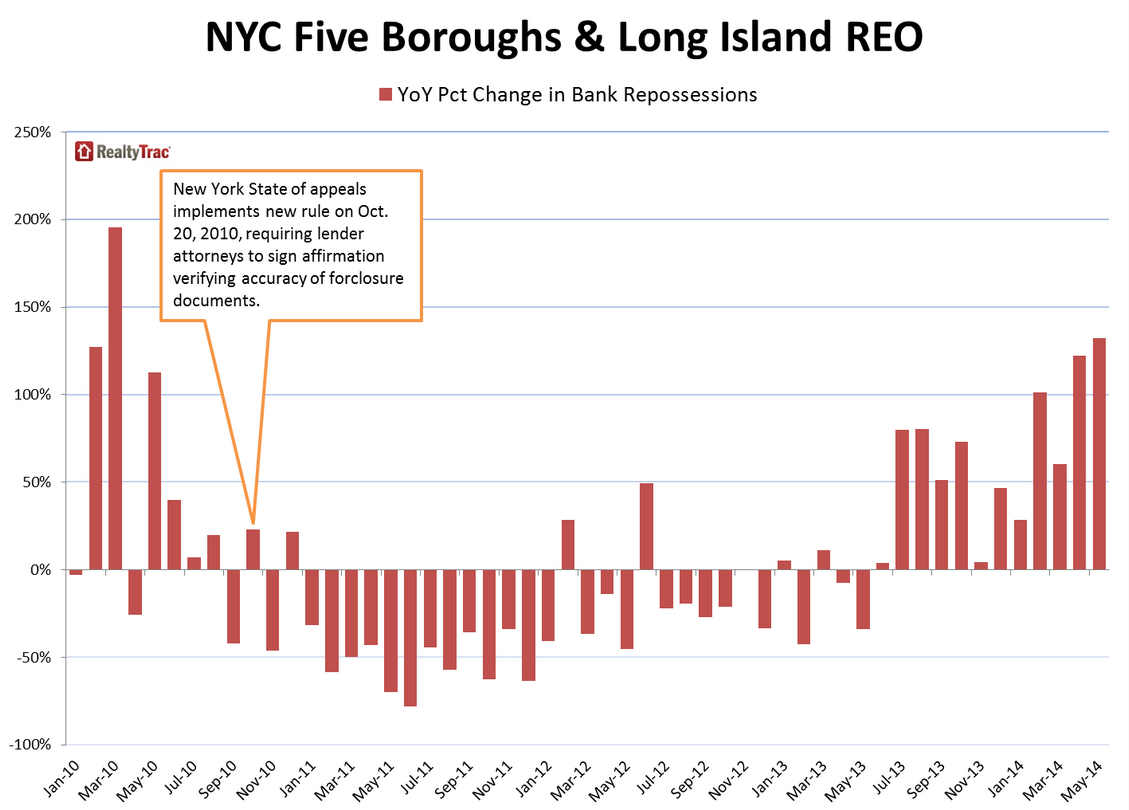
Foreclosure filings decreased 26% in May, according to RealtyTrac. The judicial states are reporting increases in foreclosure activity as they finally begin to address their bloated foreclosure pipelines. We are starting to see increases in foreclosure activity in New York, New Jersey, Connecticut and Massachusetts.


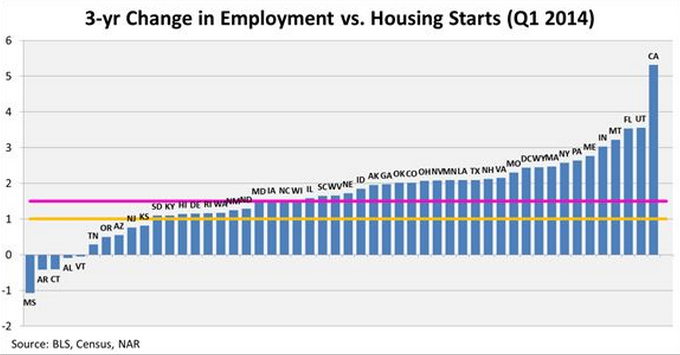
The NAR released a study showing that housing supply remains constrained and 2 factors explain it. First, a lack of housing turnover due to underwater homes. The number of underwater homeowners stood at 6.3 million in Q1, down from 11.8 in Q111, but still elevated compared to historical numbers. This explains why existing home sales numbers have been weak. Second, new construction has been weak since the bust. In fact, new home construction has lagged job growth over the past 3 years by a large factor. These supply constraints are driving price higher. Check out this chart, which looks at the ratio of jobs created to housing starts.

Of course there are caveats with this study, but it still shows how much housing construction is lagging.


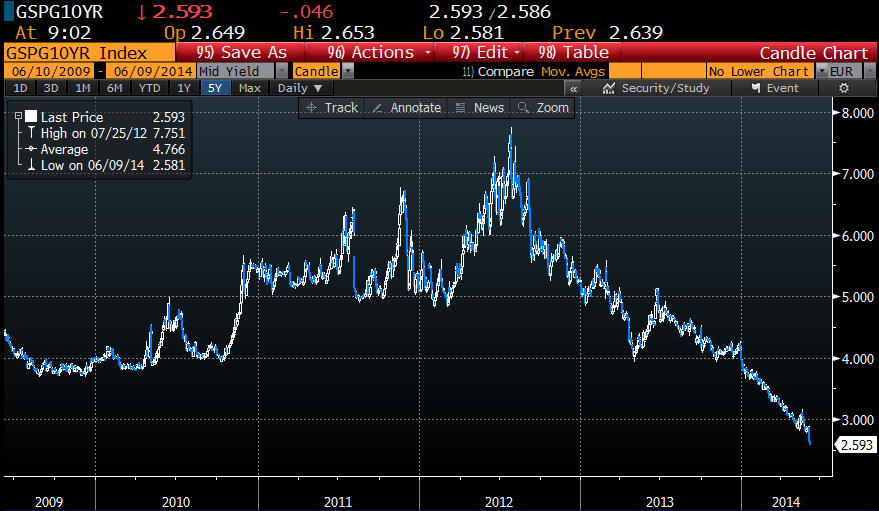
What is going on in the bond market? The rally in bonds has caught many investors off guard and many pros went into this rally underweight bonds to begin with. Perhaps the ECB cutting rates to below zero on deposits is driving it, but the fundamentals in the US argue for higher rates, not lower rates. Bearish interest rate bets in the CME Eurodollar futures are at a record.

Morning Report – How accurate are Zillow estimates? 6-10-14

Vital Statistics

Last Change Percent
S&P Futures 1946.6 -3.6 -0.18%
Eurostoxx Index 3307.5 2.2 0.07%
Oil (WTI) 104.8 0.4 0.34%
LIBOR 0.23 0.000 -0.11%
US Dollar Index (DXY) 80.8 0.146 0.18%
10 Year Govt Bond Yield 2.63% 0.03%
Current Coupon Ginnie Mae TBA 106.4 0.0
Current Coupon Fannie Mae TBA 105.5 -0.1
BankRate 30 Year Fixed Rate Mortgage 4.19


Stocks are taking a breather after setting a record yesterday. Bonds and MBS are down.

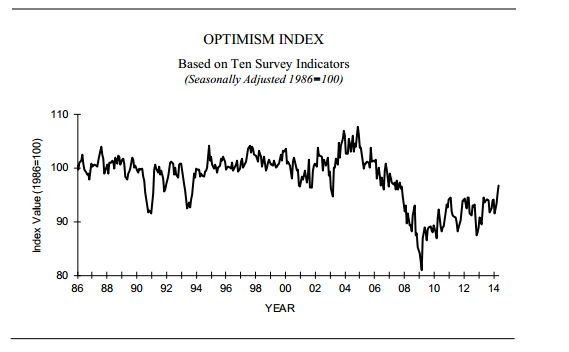
The NFIB Small Business Optimism Report hit its highest level since September 2007, but is still below neutrality, which is considered 100 on the index. Small business increased headcount by .11 workers in May, which extends the streak to 8 months. Still on average companies are not reporting increased sales, which will drive economic growth. Earnings trends are still negative as well. So overall, this report shows small business is approaching normalcy, yet the S&P 500 is at record highs. What gives? Well the S&P 500 has a lot of international exposure, which is where the growth is. Second companies with big market caps can get extremely favorable financing right now, while the smaller businesses still have a tougher time of it. And finally, all that central bank stimulus has to go somewhere, and at the moment that place is U.S. large cap stocks.

The latest Fannie Mae Monthly National Housing Survey is out, and it shows that optimism about the housing market is still close to the highest it has been post-crisis. Respondents thing house prices will increase 2.9% over the next 12 months (FWIW NAR is mid / high single digits). The number of people expecting mortgage rates to increase over the next 12 months has fallen (unsurprising given interest rates have fallen generally) and more people think it is a good time to buy than to sell. People’s expectations of their personal financial situation 12 months out seem to be deteriorating, a worrisome sign. Could be just due to the lousy Q1 GDP, but it bears watching – consumer sentiment is key to the real estate industry, and in fact KB Home CEO Jeff Metzger once said on a conference call that sentiment matters more than interest rates.

Ever noticed that the Zillow Z-Estimates rarely line up with where houses actually trade? It turns out that the Z-Estimates are within 5% of the actual value of the home just about half the time. Two years ago, Z-Estimates were too high, now they are too low. If you have a buyer who is stuck on paying no more than the Z-Estimate for a home, show them this article – the Z-Estimate is probably not realistic. Here is Zillow’s response to the article.

The Obama administration expanded eligibility for the student loan cap, where student loan repayments are capped at 10% of income. Not sure how holders of student loan debt will be treated, but I have been hearing anecdotal evidence that some hedge funds are setting up the Paulson trade in student loan ABS. Student loan debt is undoubtedly one of the biggest issues with the first time homebuyer, and until the first time homebuyer returns, the housing market (and the economy in general) will continue to punch below its weight. Of course this sort of thing simply amounts to a subsidy for higher education, and given that demand for higher education is relatively inelastic, the beneficiaries will ultimately be the universities as they can (and will) raise tuition to capture the subsidy.

Morning Report – Dull week ahead 6/9/14

Vital Statistics:

Last Change Percent
S&P Futures 1946.6 -2.7 -0.14%
Eurostoxx Index 3292.7 -1.5 -0.05%
Oil (WTI) 103.5 0.8 0.79%
LIBOR 0.231 0.001 0.41%
US Dollar Index (DXY) 80.57 0.162 0.20%
10 Year Govt Bond Yield 2.61% 0.02%
Current Coupon Ginnie Mae TBA 106.6 0.0
Current Coupon Fannie Mae TBA 105.5 -0.1
BankRate 30 Year Fixed Rate Mortgage 4.17


Stocks and bonds are down small on no real news. No economic data today.
The week after the jobs report is typically dull, with very little economic data. The highlight of the week will probably be retail sales on Thursday. Earnings season is over, and we aren’t close enough to the end of the quarter for companies to start confessing they will miss their numbers.
Merger Monday is back, with $13 billion in announced deals. With low interest rates and organic growth hard to come by, we will be seeing more and more deals.
In the “it’s hip to be square” category, the Spanish 10 year yields less than the US 10 year. Yes, Spain – the “S” in the PIIGS cohort can borrow money for 10 years cheaper than Uncle Sam. This undoubtedly has to do with Mario Draghi charging banks to hold money at the ECB, but it is still an astounding thing to see.

TBA trading has decoupled somewhat from Treasury trading lately. Last week, the 10 year bond yield increased 11 bps, while Ginnie and Fannie TBAs were flat. The Bankrate 30 year mortgage rate increased 2 bps. Mortgage rates seem to be ignoring the volatility in the bond market.

FHFA is asking for input on the delayed G-fee hike. For those not in the mortgage banking business, G-fees (short for guaranty fees) are the cost of mortgage insurance by the government for conforming mortgages. The borrower pays these costs. Historically the government has undercharged for this insurance, which amounts to a housing subsidy. Of course G-fee increases have been used as a slush fund – two increases were used to fund a payroll tax cut extension – so the perilous state of the FHFA insurance fund is not 100% due to insufficient G fees. But there is no doubt the government underpriced this insurance. FHFA Director Mel Watt put the latest fee increase on hold to study a bit more, and the affordable housing crowd is worried that these increases are making mortgages and housing unaffordable. That said, these hikes are also the process of price discovery, where the government is raising fees to see at what point private capital starts to compete by offering a similar insurance wrap. Once they hit that price, then the idea is to allow private capital to “crowd in” or replace government backed mortgages. Right now, the US taxpayer is backing about 90% of new origination. You can see on the chart below, we have more than doubled the G-fee since the crisis began.


Morning Report – Mortgage credit is easing 6/6/14

Vital Statistics:

Last Change Percent
S&P Futures 1941.9 3.4 0.18%
Eurostoxx Index 3294.1 27.1 0.83%
Oil (WTI) 102.9 0.5 0.45%
LIBOR 0.23 -0.001 -0.43%
US Dollar Index (DXY) 80.34 -0.029 -0.04%
10 Year Govt Bond Yield 2.54% -0.04%
Current Coupon Ginnie Mae TBA 106.6 0.1
Current Coupon Fannie Mae TBA 105.8 0.3
BankRate 30 Year Fixed Rate Mortgage 4.17


Stocks and bonds are rallying as the jobs report comes in more or less as expected.
Nonfarm payrolls increased by 217k in May, more or less in line with the 215k expectation. The unemployment rate was flat at 6.3% and the labor force participation rate remained stuck at its lows – 62.8%. Average Hourly Earnings increased by .2% and average weekly hours were flat at 34.5.
Mortgage credit eased in May, according to the MBA. The higher the index, the easier it is. When you look at the index on a historical basis, you can see credit is still tight.

Federal Reserve Bank of Minnesota Fed Head Narayana Kocherlakota said he believes the central bank will need to keep rates very low for a long time to come, largely due to the Fed’s failure to meet either goal of is dual mandate. The downside: inflated asset prices, high asset return volatility, and hieightened merger activity.

Morning Report – Attitudes about housing 6/5/14

Vital Statistics:

Last Change Percent
S&P Futures 1931.2 5.5 0.29%
Eurostoxx Index 3285.1 47.2 1.46%
Oil (WTI) 102.4 -0.3 -0.27%
LIBOR 0.231 0.001 0.48%
US Dollar Index (DXY) 80.94 0.281 0.35%
10 Year Govt Bond Yield 2.61% 0.01%
Current Coupon Ginnie Mae TBA 106.3 0.0
Current Coupon Fannie Mae TBA 105.3 -0.1
BankRate 30 Year Fixed Rate Mortgage 4.2


Markets are higher this morning after the European Central Bank took some unprecedented stimulus measures. Bonds and MBS are down small, rebounding after an initial sell-off on the ECB’s actions.
The ECB, fearing deflation, cut its deposit rate to -.1%, which means you have to pay to invest your money at the central bank. They are also lowered the benchmark rate to .15% from .25%. The ECB hasn’t ruled out quantitative easing, but the fact that there is no “Euro” sovereign bond complicates things. How will this affect US rates? Hard to tell, but at the margin, it will be dollar positive / euro negative which would be US bond bullish. That said, the direction of US bonds will undoubtedly be driven by tomorrow’s jobs report more than anything.
In economic data this morning, announced job cuts increased 45.5% to 53,000 in May, according to outplacement firm Challenger, Gray and Christmas. Hewlett-Packard largely drove the increase with a plan to cut payrolls by almost 19,000. Transportation, Health Care, Government, and Services rounded out the other job cuts. This is the highest number in 15 months. It is important to distinguish between job cuts and job losses – these numbers come from company press releases, which often never materialize as market conditions change. Second, often these reductions are done by attrition.
Initial Jobless Claims came in at 312,000, another decent number. Later on today, we will get the Household change in net worth from the Fed. This is not going to necessarily be a market-moving number, but changes in it should drive consumption going forward.
The McArthur Foundation released a survey of Americans’ attitudes about housing. The McArthur Foundation leans left, so the survey focuses on lower-income housing issues and slices and dices according to demographics. The punch line from the survey is that most people think affordable housing is hard to come by, and that we are still in the middle of the crisis. However, the biggest conclusion is that homeownership is not viewed as the vehicle to building wealth that it once was, and the public believes that renting has grown in appeal while owning has declined. That said, 70% of non-owners do aspire to own a home, and luckily the age 18-34 cohort – the classic first-time homebuyer – is most keen on owning a home. Only 44% of non-owners over 50 desire to buy a home. A full 2/3 of the public believes it is less likely today than it was 20 or 30 years ago to build equity and wealth through home ownership. Again, we are exiting a once-in-several-generation housing bust and many people who levered up too much / bought more house than they could afford are going to be gun shy. This survey, however speaks to the challenge for many in the mortgage industry – how to change attitudes about housing. We have a housing shortage in this country and home prices / mortgage rates are still highly affordable. Yes housing was a terrible bet in 2005 – 2009. But it isn’t 2005 anymore.

Morning Report – The Fed frets about excessive risk-taking 6/4/14

Vital Statistics:


  Last Change Percent
S&P Futures  1917.9 -3.9 -0.20%
Eurostoxx Index 3240.1 -7.7 -0.24%
Oil (WTI) 102.5 0.1 0.06%
LIBOR 0.227 0.000 0.11%
US Dollar Index (DXY) 80.49 -0.150 -0.19%
10 Year Govt Bond Yield 2.55% 0.02%  
Current Coupon Ginnie Mae TBA 106.5 0.1  
Current Coupon Fannie Mae TBA 105.5 0.1  
BankRate 30 Year Fixed Rate Mortgage 4.18    


Stocks are down (and bonds are up) after the weak ADP jobs report, which is signalling a weak nonfarm payrolls number on Friday. 
 
ADP payrolls came in at 179k, below the 210k expectation. The Street is forecasting 215k jobs for Friday’s report. FWIW, the ADP report has been downright lousy at predicting the big number lately (notwithstanding last month), so I wouldn’t read too much into it. 
 
Mortgage applications fell 3.1% last week, even though mortgage rates fell a couple bps. Purchasese fell 3.6%, while refis fell 2.9%. 
 
The final revision for first quarter productivity came in at -3.2%. Unit labor costs rose 5.76%. Not sure how much of that was driven by obamacare / bad weather. Flattening productivity growth could be a good thing generally, as it means employers have squeezed just about all they can get from current employees and will need to hire more (or spend more on CAPEX). Either one is bullish for the economy.
 
The ISM Services index jumped to 56.3 in May, versus 55.2 in April and expectations of 55.5. Not quite post recession highs, but close. So we continue with the pattern of strong data, weak data. 
 
The Markit US Services PMI and composite PMI were both strong, although a little weaker than April. Still a 58 handle is a good number regardless.
 
The census bureau has a cool application where you can find out all about trends in home construction – things like typical number of bedrooms, number of bathrooms, square footage, amenities. One thing that jumps out is that the luxury end is doing better – we are building less homes under 1800 square feet, and the big percentage growth is in the 4000 + square feet bucket. The smaller starter homes probably won’t get built until the first time homebuyer feels confident enough about the future to buy. Household formation remains depressed, which is keeping housing starts depressed, which is keeping the economy stuck on a 2% growth trajectory instead of a 3% growth trajectory. The turnaround will happen – I thought it would be this year, but it is looking like a 2015 event. I’m starting to feel like Linus in the pumpkin patch preaching about pent-up demand, while waiting for a 1.5 million housing starts print.


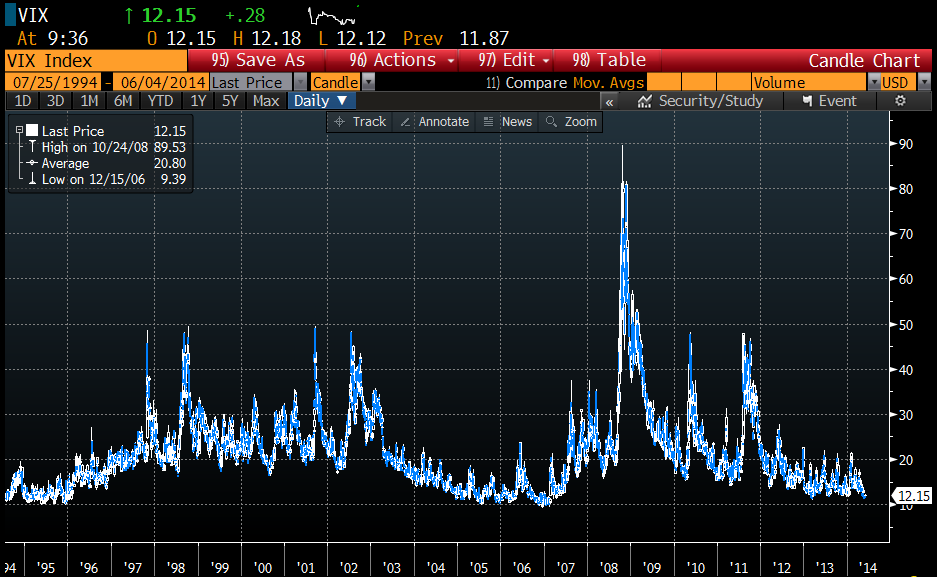
The calm before the storm? The Fed is worried about complacency in the markets. The VIX index has gone 74 straight weeks below its long-run average, which is a similar environment to 2006 – 2007. Junk spreads are widening, and junk issuance is growing as investors reach for yield. William Dudley commented: “Volatility in the markets is unusually low… I am a little bit nervous that people are taking too much comfort in this low-volatility period. As a consequence, they’ll take more risk that really what’s appropriate.” For what its worth, I think the VIX is useful for describing what has already happened in the market, not as a predictor of what is going to happen. Yes, there is the old market saw of “VIX is high, time to buy, VIX is low, time to go,” but a low VIX doesn’t necessarily mean markets are going to fall out of bed – look at the low VIX levels in 94-95, which preceded the mother of all stock market rallies. VIX invariably spikes AFTER the fit hits the shan, not before. It represents market players paying up for option protection, and that is a trailing indicator, not a leading one.


With respect to the junk issuance, investors (in particular defined benefit pension funds and insurance companies) are reaching for yield because the rate of inflation for their liabilities is largely insensitive to interest rates. The actuarial tables couldn’t care less if the Fed is driving down rates via QE – they need to earn X% on their fund to cover expected costs and that’s that. If they can’t get that in Treasuries, they’ll move to assets that can. Invariably that means they have to move out on the risk curve. We have seen this movie before, in the 1950s. FWIW, Dr. Cowbell thinks low rates are here to stay, and that “this time is different.” Most dangerous words in investing, ever. Anyway, it is nice to see the Fed muse about excessive risk taking, although IMO the biggest risk is probably in the so-called “risk free” long bond. 


Morning Report – 40% of modded mortgages are still underwater 6/3/14

Vital Statistics:

Last Change Percent
S&P Futures 1917.9 -3.9 -0.20%
Eurostoxx Index 3240.1 -7.7 -0.24%
Oil (WTI) 102.5 0.1 0.06%
LIBOR 0.227 0.000 0.11%
US Dollar Index (DXY) 80.49 -0.150 -0.19%
10 Year Govt Bond Yield 2.55% 0.02%
Current Coupon Ginnie Mae TBA 106.5 -0.1
Current Coupon Fannie Mae TBA 105.5 -0.2
BankRate 30 Year Fixed Rate Mortgage 4.18


Markets are lower this morning on no real news. Bonds and MBS are down. The automakers will be releasing May auto sales throughout the day – so far GM and Ford have both reported strong numbers.
In other economic data, ISM New York increased from 50.6 to 55.3. April factory orders increased .7% (and March was revised upward from 1.1% to 1.5%). Finally, the IBD / TIPP Economic Optimism Index came in better than expected to 47.7 from 47.
Yesterday, bond traders were given a quite the headfake with two incorrect reports for the ISM Manufacturing Index (a rather important economic indicator). The initial report had the index missing expectations significantly – a reading of 53.2 versus expectations of 55.5. This was a bond bullish number. However, later that morning they corrected the number to 56. Stronger number, so bond bearish. Finally, they got it right and reported the true number 55.4 – more or less in line with expectations. The market was probably more sensitive to this number than it should have been, but April’s economic data has been all over the place, and Friday’s jobs report looms large.
Home Prices increased 10.5% nationwide in April, according to CoreLogic. They are forecasting home price appreciation to moderate over the next year, with a prices expected to increase 6.3%. Excluding distressed sales, prices increased 8.3%. Overall, prices remain 14.3% below their April 2006 peak. Note that the FHFA Home Price Index has us within about 6% of the peak, but FHFA is a subset of the market in that it only looks at homes with conforming mortgages on them. 95% of the MSAs reported price increases.
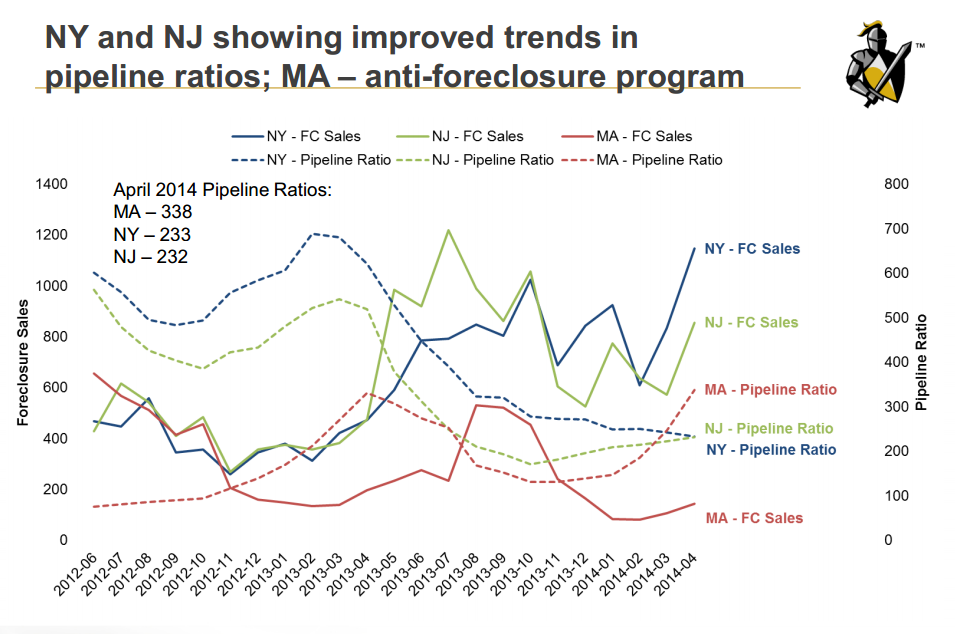
The latest Black Knight Mortgage Monitor is out, with data through April 2014. Roughly 40% of the homes who received mortgage modifications are still underwater. We are finally seeing the judicial foreclosure states work through their pipelines, which is why we are starting to see more home price appreciation there. New York and New Jersey are making progress, while Massachusetts is not (and in fact is suing Fannie and Freddie over resisting their foreclosure prevention program). Sadly, it never seems to occur to politicians that policies designed to prevent foreclosures prevent price appreciation. They have this view that home prices are simply too important to be determined by a mere market.


Morning Report – The bubble in bonds 6/2/14

Vital Statistics:

Last Change Percent
S&P Futures 1922.6 1.1 0.06%
Eurostoxx Index 3248.0 3.4 0.11%
Oil (WTI) 102.4 -0.3 -0.27%
LIBOR 0.227 0.000 -0.11%
US Dollar Index (DXY) 80.52 0.147 0.18%
10 Year Govt Bond Yield 2.50% 0.03%
Current Coupon Ginnie Mae TBA 106.6 -0.1
Current Coupon Fannie Mae TBA 105.8 -0.1
BankRate 30 Year Fixed Rate Mortgage 4.15


Markets are flattish on no real news. Bonds and MBS are down
More disappointing economic data – the ISM Manufacturing report dropped from 54.9 to 53.2 in May and construction spending rose .2%. Both numbers were below expectations.
We will get the jobs report on Friday, and given the almost contradictory economic data we have been getting, I have no idea what to expect. I could see a 100k print. I could see a 300k print. FWIW, the street is at 215k, with a tick up in the unemployment rate to 6.4%.
Cash deals account for 29% of all sales, according to Bloomberg. Retiring baby boomers are choosing to own homes outright, as opposed to having a mortgage. Historically that number has been closer to 20%, and I have seen cash estimates as high as 40%.
In a related note, QE has rendered many economic risk models (particularly the Fed model for stocks) useless. Old definitions of “cheap” and “expensive” no longer apply in a world of unprecedented central bank stimulus and stubbornly low inflation. When investors start re-defining what “cheap” and “expensive” mean (think internet stocks in 1999), that is a signal that we are in bubble territory.
I would like to tie the two articles together – what sort of bet is buying a house with cash? Well, it is a real estate bet- going long real estate. However, by choosing not to get a mortgage, it is also a bond bullish bet, in a way. Lending is the act of going long bonds. Borrowing is the act of going short bonds. IMO, the baby boom is effectively doubling down on the bond bullish bet. They are making a very questionable bet that central banks around the world can stick the landing and exit this unprecedented stimulus without (a) crashing the bond market and (b) creating inflation. IMO, the risks are all to the downside in the bond market, and instead of buying homes with cash, I would be borrowing as much as I could at 4% interest rates. The baby boom drove the stock market bubble in the late 90s, the residential real estate bubble in the 00s, and are drinking the bond market kool aid now. I don’t think this ends well.

Morning Report – More mixed economic data 5/30/14

Vital Statistics:

Last Change Percent
S&P Futures 1911.2 2.1 0.11%
Eurostoxx Index 3240.5 -5.7 -0.18%
Oil (WTI) 102.9 0.2 0.19%
LIBOR 0.227 0.000 -0.11%
US Dollar Index (DXY) 80.45 -0.121 -0.15%
10 Year Govt Bond Yield 2.44% 0.00%
Current Coupon Ginnie Mae TBA 106.8 0.0
Current Coupon Fannie Mae TBA 106 0.1
BankRate 30 Year Fixed Rate Mortgage 4.13


Markets are down small after some disappointing consumption data this morning. Bonds are taking a breather and are down small.
Personal Incomes rose .3% in April, while spending fell .1%. Inflation remains in check. The income number was in line with Street expectations, while the spending number was not. March’s spending number was revised upward from .9% to 1.0%. University of Michigan Consumer Confidence ticked up slightly to 81.9, although it came in lower than expectations.
The ISM Milwaukee report leaped to 63.5 from 47.3 a month ago, while the Chicago Purchasing Manager’s Index increased from 63 to 65.5. These numbers beat expectations handily. April has had some very divergent economic indicators, with the weak industrial data points to some of these other strong indicators.
Refis dropped to 37% of all closed loans in April, according to Ellie Mae. Average FICOs ticked up a point to 726. Average days to close a loan fell to 39.
With rates falling over the past month or two, where are we going to get a wave of refis? The conventional wisdom is 4% mortgage rates. Remember, however the concept of prepayment burnout, which means that each successive dip in rates has less of an effect on refinance activity, mainly because the pool of people with a refinancable mortgage shrinks. That said, home price appreciation is counteracting that effect as people who were underwater last year and unable to refinance are able to take advantage of it this time around.
More speculation on what is going on in the bond market. Interestingly, according to Commitment of Traders data, speccies are increasing short exposure – the bears are fading the rally, not capitulating. Interestingly, the Fed’s balance sheet actually shrunk over the past week – not by a lot – but still it is surprising. At the end of the day, absent some sort of valid technical explanation of the strength, you have to believe the stock market is telling you one thing and the bond market is telling you another.

Morning Report – Terrible revision to Q1 GDP 5/29/14

Vital Statistics:

Last Change Percent
S&P Futures 1911.2 2.1 0.11%
Eurostoxx Index 3240.5 -5.7 -0.18%
Oil (WTI) 102.9 0.2 0.19%
LIBOR 0.227 0.000 -0.11%
US Dollar Index (DXY) 80.45 -0.121 -0.15%
10 Year Govt Bond Yield 2.44% 0.00%
Current Coupon Ginnie Mae TBA 106.8 -0.1
Current Coupon Fannie Mae TBA 106 0.0
BankRate 30 Year Fixed Rate Mortgage 4.13


Markets are higher after some mixed economic data. Bonds and MBS continue their rally.
First quarter GDP was revised downward to -1% (the Street was at -.5%). Obviously the Street is happy to accept the weather excuse and give the market a mulligan. Personal consumption rose 3.1%, and initial jobless claims fell to 300k.
Pending Home Sales increased .4% month-over-month, but fell 9.4% year, over year. They rose .5% in the Northeast, 4.7% in the Midwest, fell .7% in the South and fell 2.6% in the West.
What is going on with bond yields? The economic data has been “meh,” not weak, so why are we below 2.45%? Not sure, most explanations feel like justifications, not reasons. It could be nothing, but keep in the back of your mind that the bond market is telling you something, and you’ll find out the reason for the strength later on. For LOs, this is a good time to wake up borrowers that missed out on refinancing last fall, or buyers who were hoping for a better rate.

Freddie Mac has a new housing index (similar to the NAHB’s Improving Market Index) which shows strength in housing markets. They call it the Multi-Indicator Market Index, and it uses 4 indicators to create the index: purchase applications, payment to income rations, percent of borrowers current on their mortgage, and employment. Nationally, the index shows that the recovery has largely stalled. According to Freddie Mac Chief Economist Frank Nothaft: “Less than half of the housing markets MiMi covers are showing an improving trend, whereas at the same time last year more than 90 percent of these same markets were headed in the right direction.” Since we know that delinquencies have been dropping and the job market has been improving, the culprit is purchase applications. Between higher prices and higher mortgage rates, buyers, especially first time homebuyers, are getting sticker shock. That said, the index ignores cash purchases, and you have to take that into account, so the index is undoubtedly overstating the weakness. Here is an example of the index for Miami and the National MiMi:

There were 48,000 completed foreclosures in March 2014, up 5.9% month-over-month but down 10% year-over-year, according to CoreLogic. Approximately 720,000 homes in the U.S. are in some state of foreclosure, compared to 1.1 million a year ago. The foreclosure inventory is largely concentrated in the judicial states of Florida, New York and New Jersey. Over the past year, the number of seriously delinquent homes fell from 2.33 million to 1.86 million.