Morning Report – Initial Jobless Claims percent lowest since the 60s 8/15/14

Stocks and Bonds are up small on no real news. MBS are flat.

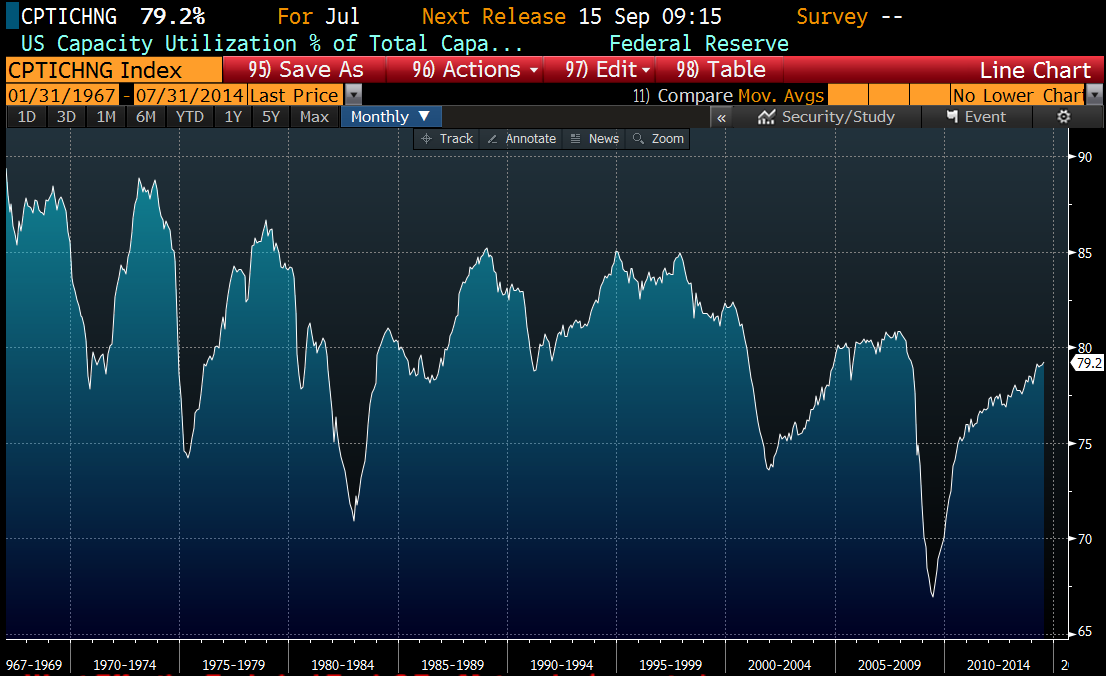
The Empire Manufacturing Survey weakened in August, but is still at reasonably strong levels. Industrial Production rose .4% and Manufacturing Production rose 1% in August. Capacity Utilization ticked up to 79.1%. All-in-all, reasonably strong numbers.

Inflation at the wholesale level remained muted in July, with the Producer Price Index rising .1% month-over-month and 1.7% year-over-year. Lower energy prices depressed the headline number – ex food and energy, we were up .2%, still well below what the Fed would like to see.

Consumer Confidence dipped in August, according to the University of Michigan.

Bloomberg has a good article on the contradictory indications in labor market. Initial Jobless Claims as a percent of the population are about .12% of the population, which is the lowest since the late 1960s. Yet the labor force participation rate is stuck at levels we haven’t seen since the 1970s. Separately, the JOLT job openings rose to 4.7 million, the highest since early 2001. So you have a situation where the numbers are saying one thing, yet common sense tells you the labor market is still very weak. As a result, the hawks have a much different view of what is going on than the doves. The best summation is from Edmund Phelps, a Columbia University Professor: “The difference of opinion is whether we’re in a state that’s about as good as it’s going to get or whether we’re in a very poor state, but with good policies and a bit of luck we’ll be able to do a lot better.” This is essentially the “speed limit” conundrum – has the Great Recession basically lowered the speed limit for the economy? If it has, then there really isn’t much more the Fed can do, and keeping rates at the zero bound is the wrong thing to do. On the other hand, liberal economists want the Fed to keep rates as low as possible for as long as possible, arguing that the Fed can easily deal with inflation if and when it ever comes up.

St. Louis Fed President James Bullard would like to see the Fed start hiking rates in Q1.

Morning Report – Head of the MBA explains why credit is so tight 8/14/14

Markets are flattish on no real news. Bonds and MBS are higher.

Initial Jobless Claims rose to a six week high at 311,000. That said, initial jobless claims are pretty much back to boom-time levels. Consumer Comfort ticked up last week, according to Bloomberg.

Import prices fell .2% month-over-month and rose .8% on an annual basis. Oil drove the decrease. Ex food and fuels, import prices were flat.

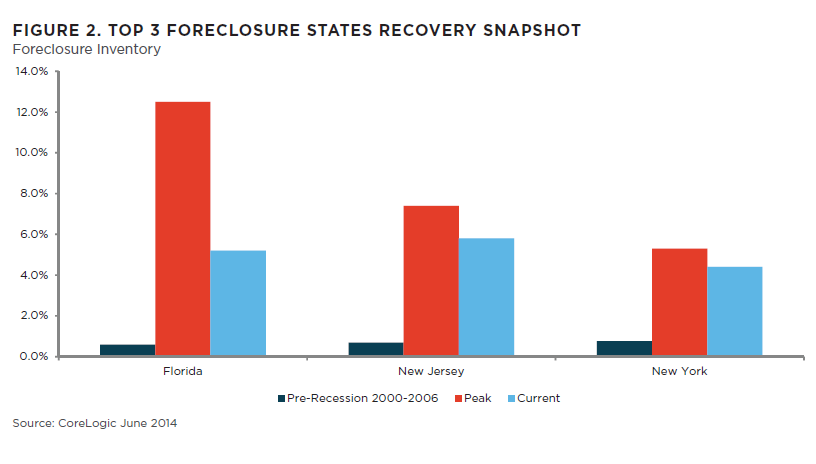
The latest CoreLogic Market Pulse is out. Home prices increased 7.5% year-over year, while foreclosure inventory is down 35%. However, foreclosure inventory is still not far off peak levels in the judicial states of New Jersey and New York.

foreclosure invetory

In another warning sign for the economy, Wal-Mart reported flat same store sales and cut its forecast for the year. The low-end consumer is still trying to pick themselves up off the mat. Health care costs were a factor in the revision as well. Separately, Cisco is cutting 6,000 jobs as it struggles to compete with software that manages data and internet traffic.

The head of the Mortgage Bankers Association schools the left explains why credit is so tight. Having exposure to treble damages (in other words three times the loan value) if a FHA loan goes bad and the government finds an error in your file tends to dissuade people from making these loans and is why Jamie Dimon fired a shot across the bow of the government on FHA loans. Meanwhile, the sky has turned legal pad yellow as the lawsuits against the industry continue unabated.

Morning Report – Disappointing retail sales 8/13/14

Stocks are higher this morning after a disappointing retail sales report means the Fed is not going to be increasing rates any time soon. Bonds and MBS are up.

Mortgage Applications fell 2.7% last week as purchases fell 1% and refis fell 4%. The average 30 year fixed rate mortgage was steady at 4.35% despite a 7 basis point rally in the 10 year. Refis were 54% of loans. We have seen mortgage rates and TBAs not follow the bond market rally lately. TBAs did follow bonds higher, so mortgage rates should have dropped. According to the Fed’s Senior Loan Officer Survey, credit standards are loosening on mortgages, which means more higher rate loans.

Retail Sales were flat in July, below the .2% Street forecast. Ex-autos and gas, they rose .1%, lower than the Street forecast of 0.4%. Soft retail sales are not a recipe for inflation, so the Fed will probably continue to be sanguine about inflationary risks to the economy. Note that we are in the middle of the back-to-school shopping season, which is second only to the holidays in importance and usually predicts whether holiday shopping will be strong or muted.

Note that the Fed is starting to think about the idea of secular stagnation – an idea that was in vogue during the Great Depression and is starting to come back. The idea is that a maturing economy begets a lack of investment ideas, which are necessary to fuel future growth. Fed Vice Chairman Stanley Fischer hinted at the possibility in a recent speech. The upshot: a mid-2015 tightening might be the earliest possibility, and the Fed is probably going to err on the side of being too loose. I continue to believe that the Fed isn’t going to move in a meaningful manner until we start seeing wage inflation of 4%. And we aren’t even remotely close to seeing that.

FHFA is seeking input from market participants on a single TBA for Fannie and Freddie loans. This is part of the move towards a common securitization platform, which is going to be a multi-year project. Expect Ginnie Is and Ginnie IIs to be merged as well, although Ginnie Is have been trading behind IIs for a while now, so it is kind of moot.

We have been hearing about how income inequality has been an issue in this country. It turns out that the income gap between the richest and poorest metropolitan regions is at a record as well. Places like Austin, TX are experiencing a boom, while rust belt cities continue to struggle. The high income areas, like Boston and San Jose are seeing the biggest price appreciation, and the most apartment construction. Which means these areas are seeing the most jobs in construction, which is a big employer of lower and middle income people. The places that need jobs the most – places like Akron OH, for example, are seeing little home price appreciation, and therefore little construction. Which means job growth remains depressed in these areas, and this accounts for the fact that housing starts remain mired at a level that is about 30% below what they should be.

Morning Report – Small Business Optimism still has a ways to go 8/12/14

Markets are lower this morning on no real news. Bonds and MBS are flat

Job openings increased slightly to 4.7 million in June, up about 100k from the May number. The hires rate was 3.5%, and the separations rate was 3.3%. Quits were 1.8% and layoffs were 1.2%. The best industries for hiring: manufacturing, leisure and hospitality, and professional / business services. Construction was actually down a little over the year. FWIW, the home builders have all been lamenting the lack of skilled labor.

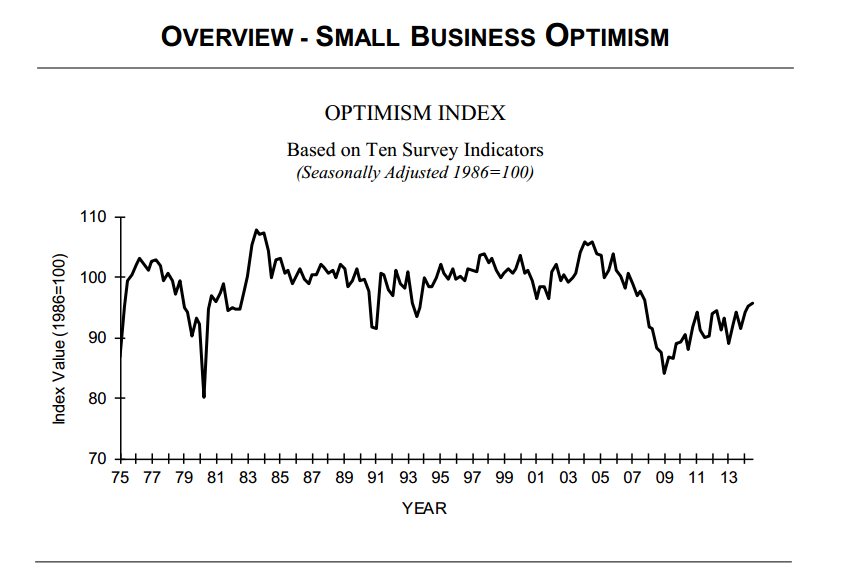
The NFIB Small Business Optimism Index slipped in July from 96.4 to 95.7. We are still well below any semblance of “normalcy” in the small business arena. Small business added .01 workers per firm in July, the 10th consecutive positive month. That said, capital expenditures remain low, and sales are deteriorating. It is hard to reconcile a relatively glum NFIB survey with the idea that the S&P 500 is just off record highs. Does small business need to catch up with the big multinationals, or is the stock market being levitated by the Fed and thus vulnerable once the Fed takes the punch bowl away? IMO the answer is “yes.”

NFIB

Of course the Fed may not be in any rush to raise interest rates. Federal Reserve Vice Chairman Stanley Fischer was warning about slow growth in the future. Bottom line: until you start to see wage inflation, you shouldn’t worry too much about the Fed.

FHA head Carol Galante is stepping down as FHA Commissioner at the end of the year and returning to academia. Biniam Gebre, General Deputy Assistant Secretary for Housing will take over the role as Acting Commissioner.

Bill Gross has been selling Treasuries and MBS in the PIMCO Total Return Fund. He rotated into non-US developed debt and held emerging market debt steady. Good trade as Euro sovereigns have been on a tear lately.

As if the first time homebuyer didn’t have enough issues with student loan debt and tight credit, they face another challenge: limited inventory at the low end of the price range. The number of US homes for sale in the bottom third of the market – below $198,000 – fell 17% in June compared to a year earlier, according to Redfin. The supply rose 3% in the middle market and 15% in the top third. Blame professional investors who are snapping up low-priced properties to turn into rentals. Prices are rising too, with the low end jumping 15%, the middle increasing 13% and the top end increasing 9%.

Morning Report – Is the labor market at a tipping point? 8/11/14

Markets are higher this morning on easing international tensions. Bonds and MBS are flat.

Not a lot of economic data this week – the highlights will be industrial production and capacity utilization on Friday and retail sales on Wednesday. Earnings season is winding down, with mainly the retailers left.

Goldman Sachs looked at student loan debt and the Millennial generation to determine how much student loan debt inhibits home ownership. It looks like $50,000 worth of debt is the tipping point – young adults with more than that in debt have a homeownership rate that is estimated to be 8 percentage points lower than graduates with less than $50,000 in debt. The conclusion of the study is this: The benefits of a college degree outweigh the costs, provided the degree helps boost income, and the student loan debt is not too large.

Bloomberg has a good backgrounder on the changing dynamics of the labor market. The balance of power is shifting more towards employees from employers. The missing piece of the puzzle has been wage inflation, and we may finally be at that point. Separately, eHarmony, the dating site, is getting into the career business.

Confounded by the rally in bonds this year. You are not alone.

Ellie Mae is buying AllRegs for $30 million in cash.

Stonegate reported second quarter numbers last week. Originations grew 37% versus Q1 and were up 59% year-over-year. These are not “apples-to-apples” numbers are Stongate bought Medallian and Nationstar’s wholesale business. Gain on sale margins increased 23 basis points.

Morning Report – Bond market continues to rally 8/8/14

Markets are higher this morning on no real news. Bonds and MBS are higher on international tensions. The 10 year bond yield is sporting a 2.3 handle this am.

Nonfarm Productivity rebounded to +2.5% in the second quarter. The first quarter was revised downward to – 4.5%. Unit Labor Costs rose .6%, while the prior quarter was revised upward from +5.7% to + 11.8%. BLS attributes the increase in costs to the downward revision in productivity and and a big upward revision in compensation from .4% to 4.8%. Not sure why BLS’s initial numbers were so far off.

Gutsy call on the bond market: Komal Sri-Kumar is predicting the 10 year will be trading with a 1 handle in six months. He thinks international tensions will be a drag on consumer confidence and he even suggests the Fed could re-start QE in 2015.

FWIW, economists are predicting 2.9% GDP growth in Q3 and 2.6% growth in Q4.

Wholesale sales and Wholesale inventories both came in lower than expected.

Morning Report – Why the recovery has been so tepid 8/7/14

Markets are higher on earnings and a low initial jobless claims number. Bonds and MBS are down small.

Today is the first Thursday of the month, which means same store sales from the retailers. So far it looks like they are coming in a bit better than expected.

Initial Jobless Claims came in at 289k, the lowest level in 8 years. Bloomberg’s weekly consumer comfort index fell to 36.2.

Mortgage delinquencies fell to 6.04% in the second quarter, according to the MBA. Foreclosures fell to 2.49%.

Fannie Mae earned $3.7 billion in Q2, of which all went to Treasury. They modded 32,000 loans in the quarter as well. Delinquencies dropped to 2.05%.

The next global economic headache is the bursting of China’s real estate bubble and the potential for a protracted slowdown. There is a “buyer’s strike” going on and so far developers are not lowering prices yet. So inventory builds. Inventory is 23 months worth of sales in the top 20 cities. To put that number into perspective, 6 months is considered normal, at least in the US. This is generally how busts begin. If it becomes “the one” then trophy properties in the US, particularly the West Coast will become vulnerable.

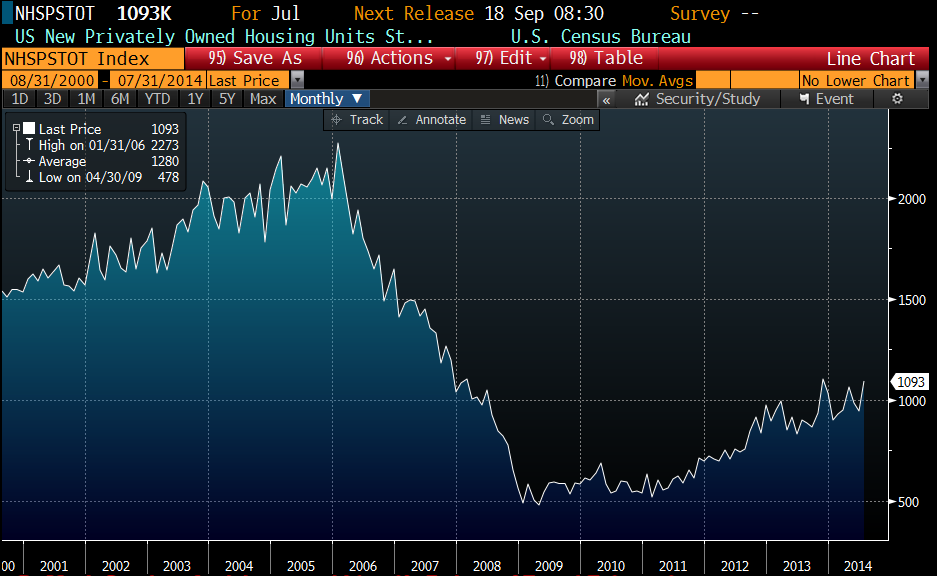
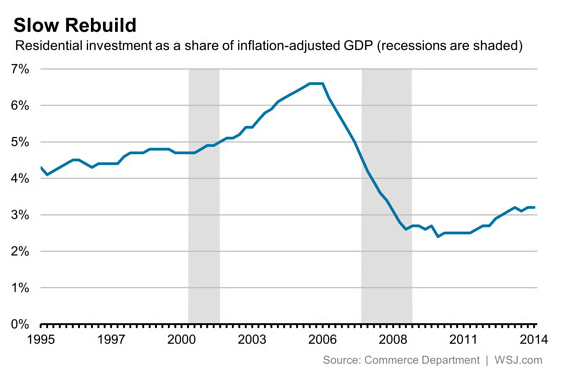
The WSJ has a good piece on the weakness of housing, particularly housing construction. As we know, housing starts have been mired below 1 million units for what seems like forever. Normalcy is around 1.5 million units historically. When you look at residential construction’s contribution to GDP, it is been about 2.5% – 3%, much lower than its pre-bubble level of 4% to 5%. Not only that, but residential construction usually leads an economy out of recession. I had hoped this would be the year starts got back to normalcy, but the homebuilders have seemed content to increase the top line through price hikes, not volume increases.

Residential construction as a percent of GDP

Morning Report – Bonds signalling a slowdown? 8/6/14

Stocks are lower after some bearish economic news out of Europe. Bonds and MBS are rallying. The 10 year bond is right at its May highs.

Mortgage Applications increased 1.6% last week, according to the MBA. Purchases fell 1.3% while refis increased 3.8%. It looks like overall mortgage rates increased 3 basis points or so over the week, while the 10 year was flat. Refis accounted for 55% of all loans, the highest percentage since May.

Wells is getting even more aggressive in the jumbo space. Minimum FICOs for a fixed rate jumbo have been lowered to 700 from 720. They also now do cash-out refis on jumbos and are buying jumbos on second homes on a correspondent basis. This is why the jumbo space is so competitive – banks can subsidize the jumbo mortgage and use that as an opening to pitch other bank services to the customer, particularly asset management.

Walgreen’s has decided to not pursue the tax inversion trade after intense political pressure from Washington. They will still purchase the remaining part of Alliance Boots, but will keep their headquarters in Chicago. This change will cost the company about a billion in excess taxes. If I was an arb, I would be nervously looking at my Abbvie / Shire position, and my Covidien / Medtronic positions, which are blowing out this morning.

Corporate inversions are going to be a political football going into midterms. First of all, nobody likes them. Companies don’t really want to do them, but they have to honor their fiduciary responsibilities. Politicians on both sides of the aisle despise them. The tax code is going to be changed to prevent them in the future. However, Republicans don’t feel much need to negotiate now, as they are pretty much guaranteed to keep the House and may in fact take the Senate. So their negotiating power can only get bigger. The Administration is pushing the “fix the inversion part of the tax code first, and then let’s do full tax reform later” argument. Of course Obama knows that he is going to have to trade closing loopholes for lower rates, so he wants to sneak in a freebie before negotiations start. That is a nonstarter for Republicans. Which gives Obama an opportunity to demagogue the issue and paint Republicans as defenders of corporate tax dodgers as the consolation prize.

Arbs are already reeling as Rupert Murdoch withdrew his offer for Time Warner last night. Fox also announced a big buy back, so arbs are getting killed on both sides of the trade. Tough, tough day to be in the risk arbitrage business…

Watch the data. The latest ISM numbers were quite strong, and Dallas Fed President Richard Fisher is predicting that rates will have to increase sooner than it projected in the June dot plot if this economic strength continues. Remember the Fed’s “dot graph” – the dots for a tightening will move up. Fisher also said that the debate among the central bankers is “coming in my direction.” Bottom line – for the last 6 years you have been able to dismiss the hawks. The ground is shifting.

fed funds dot graph

Counter-argument: The bond market is warning about a slowdown. At least one market strategist thinks the 10 year is heading to 2.2%. True, when the stock market and the bond market disagree, you usually want to side with the bond market. However, you have to keep in mind what is happening overseas and the concept of relative value. The German 10 year Bund yield has hit fresh lows – 1.104%. When rates are falling overseas, they will inevitably drag US Treasuries with them, simply due to relative value. FWIW, I don’t think the US bond market is signalling weakness in the US economy. Nor does Goldman.

Morning Report – Strong ISM numbers 8/5/14

Markets are lower on no real news. Bonds and MBS are down small.

The ISM Non-Manufacturing Index increased to 58.7 in July, a strong number. In fact, this is the highest reading since inception (with the caveat the index started in Jan 2008). Employment ticked up again, and new orders are accelerating. Prices are not increasing.

Factory orders increased 1.1% as well, but the IBD / TIPP economic optimism index declined.

The Fed Senior Loan Officer Survey is out, and it discusses non-QM lending. The majority of banks reported that the rule had no effect on prime conforming mortgages (unsurprising since if it is conforming, it is QM compliant), but about half the respondents indicated QM reduced approval rates on applications for prime jumbo loans and non-traditional mortgages. That said, it is clear from the charts below that credit is easing, and demand is picking up.

Fed SLO

Yet another unintended consequence of financial regulation – closing costs for mortgages have increased 6% YOY and in some places are up 20% +.

Home prices are up 1% month-over-month, and are within 13% of their April 2006 peak, according to CoreLogic.

The out-of-office email reply, deconstructed.

Obama to business: Stop complaining!

Morning Report – Deluge of data 8/1/14

Stocks are lower this morning after yesterday’s bloodbath. Bonds and MBS are up.

The jobs report came in weaker than expected. Payrolls increased by 209,000, and the two-month payroll revision was +15,000. The unemployment rate ticked up to 6.2% and the labor force participation rate rose to 62.9% from 62.8%. However hourly earnings were flat and average weekly hours were flat as well. The lack of wage pressure cheered the bond market, which is clawing back yesterday’s losses. FWIW, the employment cost index showed a .8% increase in wages yesterday (benefits are calculated separately), so the lack of wage growth as reported by BLS is surprising.

By the way, for the bond market to start worrying about wage inflation, you will need to see increases in average wages of about 4%, not the 2% inflation target. Why? Productivitiy, which is running about 2% (notwithstanding the lousy print in Q1). Wage inflation that is offset by productivity increases is not inflationary. So, when you think about the US needing 4% wage growth just to get to the Fed’s inflation target, you can see we have a long way to go.

Still, we aren’t going to see a robust economy until the labor force participation rate gets back to normal levels. As you can see from the chart below, about half of the increase in the labor force participation rate that was attributable to women entering the workforce starting in the 1960s has been given back. That low number represents excess capacity that isn’t being captured with the headline unemployment number. Which is why wage growth is so hard to come by (the other reason being technology).

Labor force participation rate bbg

Personal Spending rose .4% in June, and Personal Income rose .4% as well. The core personal consumption expenditure index rose 1.5% year-over-year, still below the 2% target the Fed would like to see.

The ISM numbers came in stronger than expected, showing that manufacturing continues to do well, A 57.1 number would correspond to GDP growth of 4.6%. Of course manufacturing doesn’t dominate the economy (and employ people) like it used to, but it is still a good, strong number.

Finally, construction spending slipped 1.8% in June after increasing an upwardly-revised .8% in May. Resi construction fell .2% month-over-month but is up 7.1% year-over-year.