Morning Report – Housing Starts rebound 1/21/15

Markets are lower this morning on no real news. Bonds and MBS are flat.

The ECB decision is tomorrow. The market has priced in a lot of optimism for QE, so if they disappoint, rates could reverse hard. Keep in mind that US rates have been pulled down by Europe. The fundamentals of the US economy mean rates should be higher.

A headline just crossed the tape saying the ECB is set to propose QE of 50 billion euros a month through 2016. Assuming they start next month, that works out to be $1.1 trillion – I believe the expectations were for the mid $500s billion. Bonds are not reacting to the news. Again, this is just a leak or speculation, not the actual decision.

Housing Starts rose to 1.09 million in December, an increase from the upward-revised 1.04 million in November. Building Permits fell however.

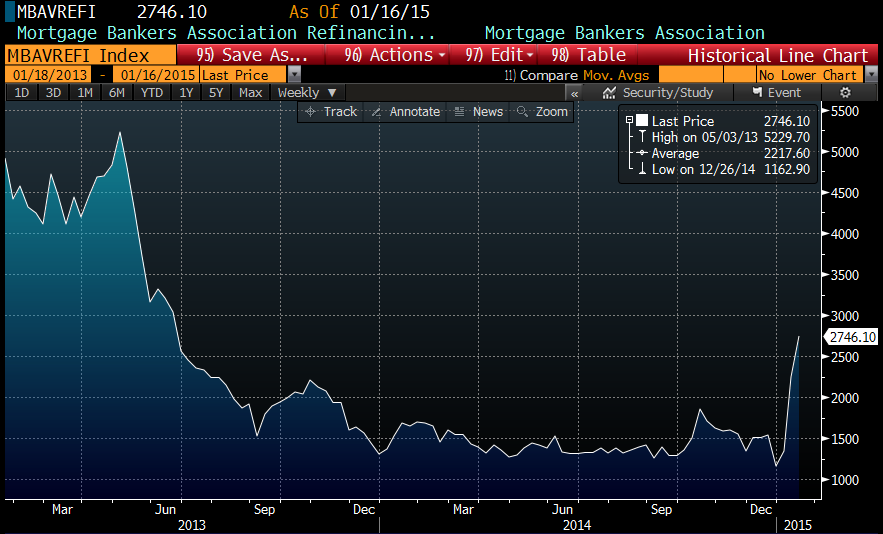
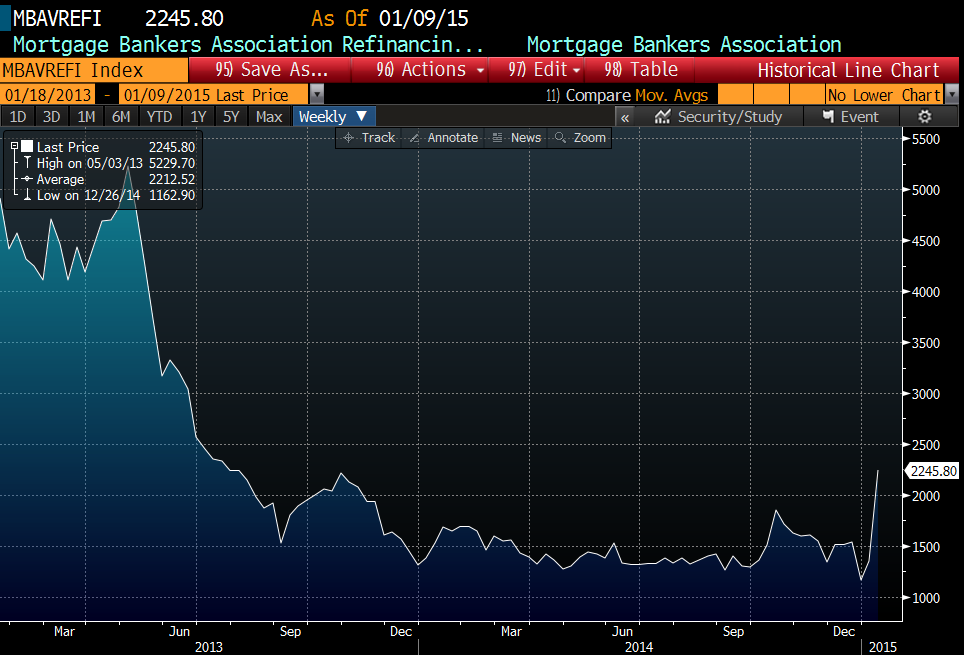
Mortgage Applications rose 14.2% last week following up on an increase of 49% the week before. Purchases fell 2.2% while refis rose 22.3%. Refis are now 74% of all applications, a 10% increase from the beginning of the year. The MBA refi index is the highest it has been June of 2013, when the taper tantrum was beginning.

Obama gave the State of the Union speech last night. If you are interested, here is the take on it. I don’t think he had anything to say affecting housing although he wants to increase the capital gains tax and he vowed not to roll back banking regulations.

The Supreme Court is hearing arguments today challenging the Administration’s novel theory called “disparate impact” to prove discrimination.  Basically, the Administration wants to be able to declare a lender guilty of lending discrimination if the numbers don’t comport with the demographic make-up of their market, even if the lender did not intend to discriminate. The Court is expected to rule in June.

The rise in the dollar has been giving foreign real estate investors sticker shock. Foreign investment demand is behind a lot of the buying in big cities like NY, DC, SF, etc. The woes in Russia are having a big impact as well.

Morning Report – This week is all about the ECB 1/20/15

Markets are higher this morning after better-than-expected growth out of China. Bonds and MBS are up.

We will have some important housing related data this week with the NAHB Homebuilder Sentiment Index today, housing starts & building permits tomorrow, the FHFA Home Price Index on Thursday, and existing home sales on Friday.

The ECB will announce further QE measures this week, so be aware we could see some volatility in the bond market. Investors have been repricing aggressively, so let borrowers know that bond markets are volatile and rate quotes can change in a hurry.

The NAHB Housing Market Index fell to 57 from an upward-revised 58 in December. Traffic was a drag on the index. We are seeing increases in traffic in the Midwest, and declines in the Northeast, South, and West. The index is still close to post-recession highs.

The big takeaway from homebuilder earnings so far has been that price increases are going to be hard to come by and builders are going to become more promotional. They are also going to start shifting production to lower price points – starter homes may be lower margin projects, but you can build a lot of them. Note that in the December Industrial Production indices, construction materials were a big standout. This could portend a stronger building year.

Tonight we will have the State of the Union. Basically, Obama is going to announce a laundry list of liberal priorities that have no chance of being enacted with Republicans in control of Congress. In other words, don’t worry too much about what he has to say. He is going to agitate for higher capital gains taxes , however his centerpiece will be to provide free community college (to help the middle class), and his way to pay for it is to eliminate the 529 College Savings Plan. Of course middle class families have to save for college – they can’t just write a check like the rich, and they don’t qualify for need-based financial aid – so it is kind of ironic that Obama wants to torpedo the way the middle class saves for college in the name of helping the middle class. Of course the cognitive dissonance is irrelevant since this is strictly for show and has absolutely no chance of ever seeing a vote in either chamber. Markets should not react to what he has to say (in fact I suspect only the obama faithful will watch in the first place).

Another proposal slated to come out tonight is some sort of bank tax. SIFMA has already weighed in on it. Again, relax. It is red meat for the base and has zero chance of becoming law.

Morning Report – Buy the Rumor, sell the fact 1/16/15

Markets are flattish as global currency markets continue to digest the move by the Swiss National Bank to remove the cap on the franc. While that isn’t of great importance to US investors, it is important to Euro bond investors, and they are the ones leading the parade these days. Bonds and MBS are down small.

Consumer Price inflation fell in December by .4% due to lower energy prices. Ex food and energy, the index was flat.

More evidence the economy slowed in December: Industrial Production fell .1% and Capacity Utilization fell to 79.7% from a downward-revised 80%.

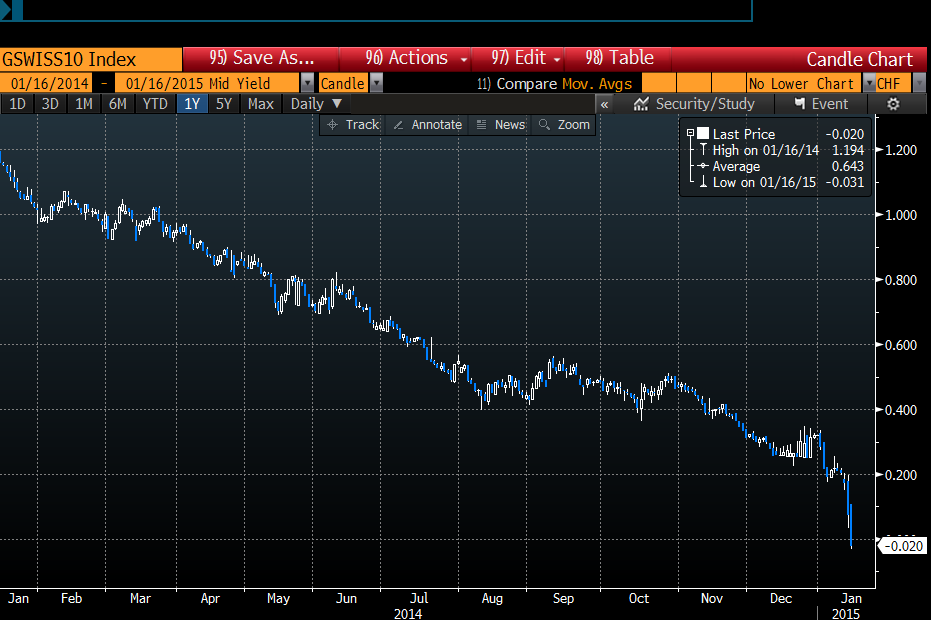
The surprise move by the SNB to eliminate the cap on the franc has caused issues at some broker-dealers that specialize in foreign exchange. People have gotten absolutely blown up in the swiss / euro pair, and some firms (heard FXCM is one) are having capital issues. This is the sort of thing that could snowball, and begin to affect credit markets in the US, but I don’t really anticipate it. Just something to keep an eye on. Fun fact: The yield on the Swiss 10 year bond is negative 2 basis points. For the low, low price of only 2 basis points per year, you get the privilege of letting the Swiss Government borrow your money for 10 years. Don’t believe me? Look:

The ECB is scheduled to meet next Thursday morning and the market are expecting a big announcement regarding QE. Bond markets have priced in A LOT of optimism regarding this event, and if it disappoints, or even comes in as expected, we could see a reversal in interest rates. LOs, this is one thing you should tell any borrowers that are on the fence. These low rates could disappear as quickly as they appeared. There is an old saw in the markets that says “Buy the rumor, sell the fact.” In this case, it means that the move in interest rates may have preceded the event, and the move could reverse afterward. Not necessarily forecasting this is going to happen, but the setup for it looks good.

Lennar reported good earnings yesterday, but the stock was slammed 7% on future margin guidance. We have heard the same thing from Toll and KB Home as well – it is getting hard to raise prices and incentives are increasing. The big price appreciation in new home construction appears to be over. This will probably spill over into existing homes as well. Part of this isn’t all bad news – it also reflects a shift to the lower price points (read starter homes). They may have lower margins, but you can sell a lot more starter homes than you can sell McMansions. The builders are setting themselves up for the return of the first time homebuyer. Given the behavior of the XHB lately, the seasonal “hope springs eternal” trade that lasts from Thanksgiving to New Years appears to be unwinding.

Morning Report – MI and TBAs 1/15/15

Markets are higher this morning as oil rebounds. Bonds and MBS are down.

Initial Jobless Claims came in at 316k, higher than expected, while the producer price index fell .3% in December. The Empire Manufacturing Survey rebounded back into positive territory.

I wanted to talk a little about TBAs this morning given some questions I have had from LOs. (Those of you not in the origination business can skip it). Someone had priced a VA loan last week and found that pricing was worse a week later (not by a little, but by a point), even though the bond market rallied. How was that possible given that the 10 year fell 17 basis points in yield? I will explain. It is a function of the new FHA mortgage insurance premiums.

Some background: The TBA (stands for To Be Announced) is the basic input to a rate sheet. If I was to sell a pool of FHA or VA loans today, the price I would get would be the TBA price plus some carry (interest for a few days). So, when we put out our rate sheets, we start with the TBA prices and then add on our costs to originate, margins, etc.

Look what happened last week. When the government announced lower mortgage insurance premiums for FHA loans, the Ginnie Mae TBAs underperformed versus the Fannie Mae TBAs, which set pricing for conforming loans. The reason for this was the market re-assessed prepayment speeds. By lowing the MI going forward, it made refinancing more attractive. This means that prepayment speeds are increasing and that makes the existing TBAs worth less. Think about it: If you bought a Ginnie 4% TBA for 106, and it prepays in a year, what to you get? Par, or a loss of 6%. The higher up the coupon, the bigger the incentive to prepay is.

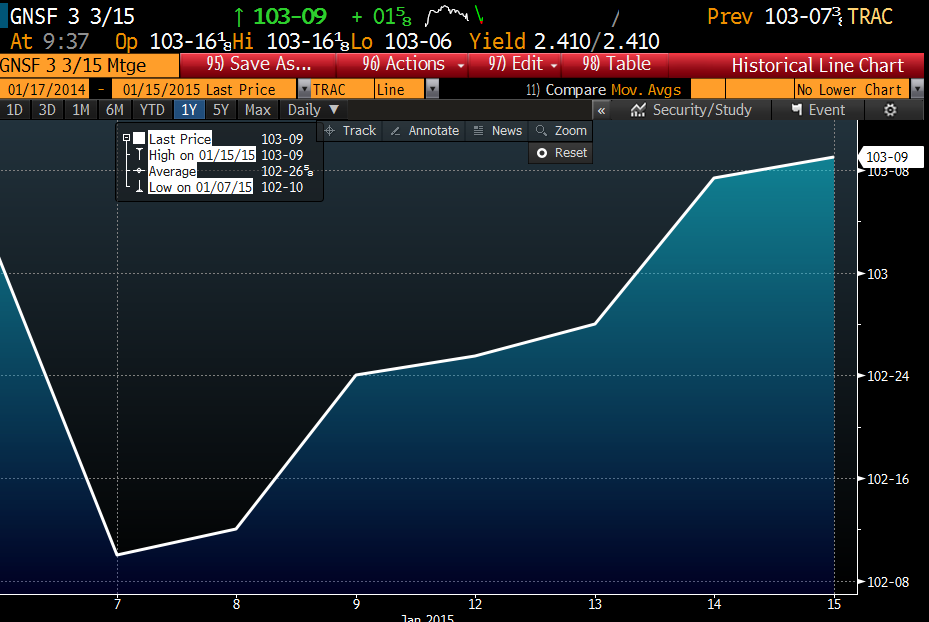
Here are a couple charts of Ginnie Mae TBAs from last week. The first is the March Ginnie Mae 3% TBA. It rose about 9 ticks, following an initial sell-off on the MI news. This underperformed the Fannie Mae 3% TBA by about 9 ticks. Remember, as bond prices rise, yields fall. The falling yield meant that if you quoted a customer a 3.5% FHA or VA loan last week, and locked it this week, the customer would probably have some points coming to them. This was to be expected, since rates fell:

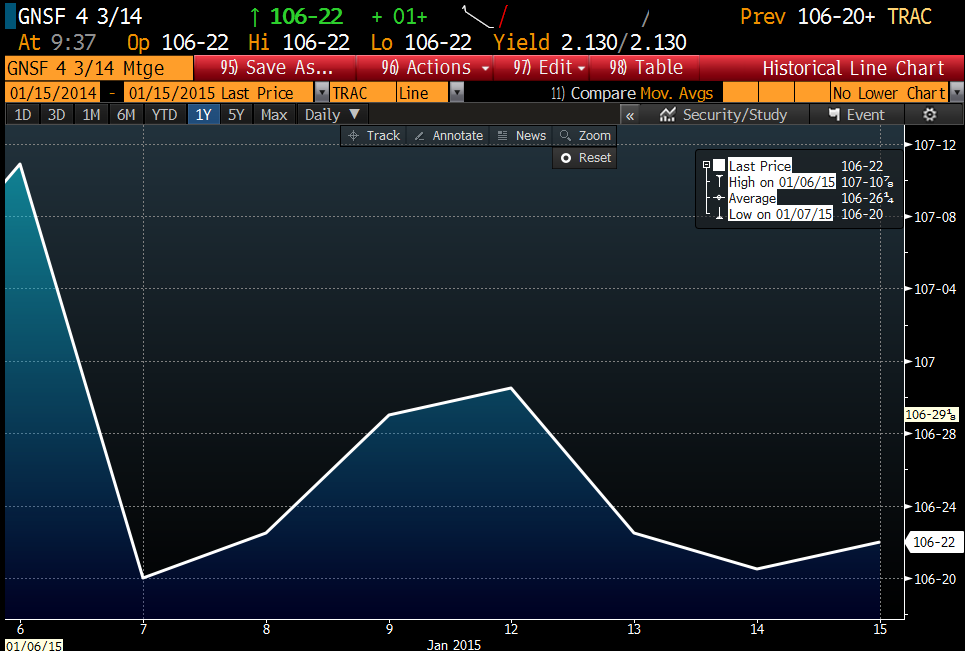
Now, let’s look at what happened to the Ginnie Mae 4% TBAs. This would include loans with rates between 4.25% and 4.625%. The 4% TBA actually fell. By a lot. This means if you quoted a borrower a 4.5% VA loan last week and tried to lock it today, the borrower would have to pay more points. Why? Prepayment speeds. The 4% Ginnie security is much more likely to prepay than a 3% security. Therefore, investors have to price in the new information, and that meant the 4% security was worth less, and that means borrowers are going to be treated as if rates rose, even though they didn’t in the bond market.

Note that the government may have inadvertently increased the risk to the taxpayer on the FHFA insurance fund and gotten nothing out of it. If they cut the MI, but rates increase, they have accomplished nothing except for further subsidizing MI and increasing the risk of a future taxpayer-funded bailout. The law of unintended consequences rears its ugly head once again…

This is real “inside baseball” stuff, but if you wondered about the mechanics of loan pricing and interest rates, hopefully this helped. And if you have a borrower who is asking why there hasn’t been this massive move in FHA and VA pricing since rates fell so much last week, you can explain why.

Morning Report – Weak retail sales 1/14/15

Markets are lower this morning after a lousy retail sales number. Bonds and MBS are up big on the retail sales number and strength in Eurobonds following a court ruling on QE.

Eurobonds are flying as one more hurdle for QE was cleared. The German Bund now yields 42.8 basis points.

Lousy. No other way to put it. Retail Sales fell .9% in December. Ex autos and gas, they were down .3%. The Street was expecting +.5%. To put that number in perspective, the setup for holiday sales was good: falling gas prices gave consumers an unexpected gift, the weather cooperated, and we had an extra shopping day in the season. And in spite of all of that, we put up a lousy number. I am wondering if analysts will start pushing back their estimates of the first rate hike.

Import prices fell 2.5% month-over-month as commodity prices continue to fall.

Mortgage Applications rose 49% last week, the biggest gain since 2008. Rates are the lowest since May 2006, and refis soared. Of course we are coming off of a holiday shortened week, but the moral of the story is that we might be setting up for another refi wave, this time driven by home price appreciation as well as rates. That said, we have a way’s to go to get back to the salad days of early 2013, but this is an encouraging number nonetheless.

KB Home gave the markets a head-fake yesterday, with the stock rallying on the earnings release, only to get slammed on the conference call. After rising a few percent pre-open, KB warned that margins would be under pressure and Q1 would be break-even versus Street expectations of 17 cents. Traffic in Texas remains unaffected by the drop in oil prices, at least so far. The entire sector got taken to the woodshed however. It appears that the builders have chewed through a lot of their inventory of cheap land they bought in the aftermath of the crisis, and are now building on lots bought more recently at higher prices. In spite of all of that, ASPs rose 17% to 351k.

Morning Report – Good numbers out of KB Home 1/13/15

Markets are higher this morning in sympathy with markets around the world. Bonds and MBS are down.

Alcoa kicked off earnings season with a better than expected result, however the stock is unch’d this morning…

Goldman decreased their price target for oil this quarter to $39 a barrel. Speculators are betting that supply will increase even more.

Homebuilder KB Home reported earnings this morning… Orders were up 10%, and earnings beat on a massive tax benefit. Revenues rose 29%, and average selling prices rose 17%. That big jump was due mainly to a greater emphasis on Northern California and away from the Southwest. Gross margins contracted 60 basis points. The stock is up a few percent this morning. The conference call is at 11:30 am (877-269-7756 / 13596999) if you are interested in listening in. We will hear from Lennar later this week.

The NFIB Small Business Optimism survey came in above par for December. This was the highest reading since October 2006. 100 is more or less “normalcy” since the index was created about 20 years ago. Employment was a pleasant surprise, with 54% of firms reporting hiring (or attempts to hire) however the pool of available candidates appears to be a poor fit, as 43% reported few or no qualified candidates for the position:  (“Qualified candidate” –  a candidate with the wisdom of someone in their fifties, the efficiency of someone in their forties, the drive of someone in their thirties and the paycheck of someone in their twenties)

Job Openings were more or less unchanged at 4.8 million in November, according to the JOLTS survey. This is a boom-time level, and is a leading indicator for the labor market.

The IBD / TIPP Economic Optimism Index came in at 51.5 from 48.4.

Good background article on Bill Gross’s exit from PIMCO.

Morning Report – Improving attitudes about the economy 1/12/15

Stocks are higher this morning on no real news. Bonds and MBS are up small.

Earnings season kicks off tonight in the traditional way with Alcoa. This week will be dominated by bank earnings, however we will hear from Lennar and KB Home. Analysts will be focused most on how the slide in oil prices has affected housing markets in Texas. It is probably too early to get a read on the Spring Selling Season, but they may have some anecdotal data. Certainly the precipitous drop in interest rates is a gift that no one expected.

In economic data this week, we have the JOLTs job openings data as well as industrial production. Nothing should be market-moving.

Last week’s FHA announcement caused Ginnie Mae TBAs to underperform Fannie Mae TBAs. At the margin, this means that FHA / VA loans will be somewhat more expensive relative to Fannie Mae loans. The new MI pricing sent fears into the MBS markets that prepayment speeds will pick up. So, for FHA loans the MI may be cheaper, but the rate went up. So it is probably all a wash.

Consumers are still somewhat cautious, according to Fannie Mae in the latest National Housing Survey. While they are tempering their outlook for further home price appreciation, the number of people who believe the economy is on the right track increased 5 percentage points, a big move. Perceptions of credit availability improved, with 52% of respondents believing a mortgage is easy to get versus 44% who believe it would be hard to get. The spread is the biggest in the survey’s history.

Delinquencies ticked up to 6.08% in November, according to the Black Knight Financial Services Mortgage Monitor. That spike could have been caused by technical factors however and might not mean much. The judicial states continue to lead the delinquency league tables. Foreclosure starts fell, however to 73,900, a 35% drop from last year.

Morning Report – Mixed jobs report 1/9/15

Markets are lower after the jobs report. Bonds and MBS are up.

  • Payrolls up 252k (240k expected)
  • Two month revision +50k
  • Unemployment rate 5.6% (5.7% expected)
  • Labor force participation rate 62.7% (back at the lows)
  • Average Hourly Earnings -.2% month-over-month (+ .2% expected)

Overall, the payroll number and the unemployment numbers are positive, while the labor force participation rate and average hourly earnings were disappointing. The labor force actually shrunk by 273,000 workers. Call it a mixed bag.

Credit is getting easier in the mortgage market: The mortgage credit availability index ticked up in December

Morning Report – Dovish FOMC minutes 1/8/15

Markets are higher this morning on optimism about further QE in Europe. Bonds and MBS are down.

Initial Jobless Claims came in at 294k, slightly higher than expected, but below the 300k rate. Challenger Job Cuts increased 6.6%, and the Bloomberg Consumer Comfort Index rose to 43.6.

Freddie Mac announced the US 30 year mortgage is at 3.73%, the lowest since May of 2013. Remind me again of why the Fed bought $4 trillion in Treasuries and MBS…

President Obama announced that FHA is lowering fees. The fee for a FHA loan will drop from 1.35% to .85%. Prior to the crisis, the fee was .55%. The hope is that this will jump-start the housing market and entice the first time homebuyer to return. Certainly the value proposition between buying and renting is highly favorable and rents are increasing. Secondly, he will take aim at lender overlays and direct FHA to cut red tape and provide more clarity to lenders. He will give a speech today in Phoenix, and is supposed to address this initiative further.

The FOMC minutes were taken as slightly dovish by the markets. They mentioned Q3 GDP being large, but attributed it to higher than expected government spending which is unlikely to be repeated. They also didn’t address unwinding their book of MBS and Treasuries, which was mentioned at the June FOMC meeting. The Street is still thinking that rates will start going up at the June meeting, however it seems like the forecast for the rate of increases may be slowing – in other words instead of raising the Fed Funds rate 25 bps at each meeting, raising it 25 bps at every other meeting.

Chicago FRB President Charles Evans (a dove) said yesterday that inflation might not hit the Fed’s target until 2018, and that we should probably not increase the Fed Funds rate until 2016. Certainly falling energy prices gives the Fed more room to maneuver. Certainly the Fed is cognizant of 1937, where they increased reserve requirements (a form of tightening) and sent the economy into a tailspin. This was the “recession in the Depression” where the Dow Jones Industrial Average got cut in half over the course of a year. Incidentally, this was also where the “smart money” got carried out. The smart money was short in 1929, but long in 1937. Bernanke was a student of history and is a Great Depression expert. Janet Yellen is very similar to Bernanke, and it seems is willing to risk higher inflation in order to take a 1937 off the table.

Negative equity fell by $10.2 billion, or 10.3% in the third quarter, according to CoreLogic. 19% of residential mortgages have less than 20% equity, and 2.6% of mortgages have less than 5% equity. Negative equity has been a drag on economic growth in a number of ways – first, it dampens consumer spending, but more importantly, it creates friction in the system, making it difficult for people to leave areas where there are few opportunities and go to where there are more opportunities. Think of unemployed auto workers in the Rust Belt who would gladly take jobs in the energy patch if they could sell their home in Ohio and move to North Dakota.

When talking about cheap energy, everyone likes to talk about oil or gasoline prices, which makes sense – that is the most visible data point. However, natural gas has been absolutely pummeled, trading below $3.00 right now. This means lower electricity prices going forward, and is one of the big reasons why we are seeing manufacturing (especially energy-intensive manufacturing) return the the US.

Morning Report – CoreLogic 2015 Housing forecast 1/7/15

Markets are higher this morning as world equity markets recover and global bond markets take a breather. Bonds and MBS are down

Mortgage Applications rose 11.1% last week, with purchases rising 4.5% and refis increasing 16%. The refi index is bouncing back from a highly depressed Christmas week level, so don’t break out the champagne quite yet. That said, the last time rates were around here, home prices were a lot lower. Cash out refis to pay down credit card debt and HELOCs will be attractive to many borrowers.

Was yesterday’s intraday low of 1.88% on the 10 year a capitulation low? Not sure yet. Remember, the action is being driven by European economic weakness and the prospect of more QE at the ECB. We are just being taken along for the ride. Which means that this gift may be fleeting.

From the recent ISM and factory order data, it looks like things slowed down a bit in December. Do not look for another 5% print on Q4 GDP – most strategists are looking at a growth rate in the mid 2s.

The ADP employment survey reports that 241k jobs were created in December, more or less in line with the Street expectations for Friday’s payroll number. I am hearing anecdotally that the normal seasonal (post-holiday) layoffs are not happening this year as employers hold on to people in anticipation of growth. Remember, the number to watch on Friday is average weekly earnings – that is the most important number.

CoreLogic is forecasting home sales will increase 9% in 2015, housing starts will increase 14% and home price appreciation will moderate…The big story? Employment growth in the Millennial age cohort, which will herald the return of the first time homebuyer.