Morning Report: Small Business Optimism falls 10/10/17

Vital Statistics:

Last Change
S&P Futures 2547.8 4.0
Eurostoxx Index 391.2 0.0
Oil (WTI) 50.2 0.6
US dollar index 86.6 -0.3
10 Year Govt Bond Yield 2.36%
Current Coupon Fannie Mae TBA 102.875
Current Coupon Ginnie Mae TBA 103.938
30 Year Fixed Rate Mortgage 3.9

Stocks are higher this morning after Walmart announced a $20 billion buyback. Bonds and MBS are flat.

Neel Kashkari speaks at 10:00 am.

Small Business Optimism fell in September as the hurricanes hurt retail spending in Texas and Florida. We did see a weakening in the labor market, not just in Florida and Texas, but in 2/3 of all Census regions. The hurricanes will probably boost the economy into Q4 and Q1 next year, but at the moment they are depressing things. 57% of firms are trying to hire, but the vast majority of those are finding few or no qualified applicants.

The US foreclosure and seriously delinquent rate remain very low, according to CoreLogic. The national Foreclosure rate was 0.7%, down from 0.9% last year. The Seriously Delinquent ratio was just under 2%. This is all July data, so pre-hurricane. We are starting to see the effects of the drop in oil prices in some of the energy intensive states like Alaska and Louisiana.

Home Prices continue to rise, jumping 0.9% MOM and 6.9% YOY in August, according to CoreLogic. Their models hold that half of the largest 50 MSAs are now overvalued, which has been driven by low inventory.

Fannie Mae is offering assistance to borrowers affected by the recent spate of hurricanes. Borrowers will be able to temporarily stop making monthly payments for 3 months (up to 12 months) without late fees, negative comments on their credit reports, or a requirement to get back current in one fell swoop.

The IMF took up their forecast for global growth to 3.6% this year and 3.7% next year. At the margin, this means reduced demand for safe haven assets like Treasuries, which would mean higher interest rates going forward. That said, we have several real estate bubbles overseas at the moment, and when they bust, it should be bond bullish (i.e. encourage lower rates).

Morning Report: Strong jobs report 10/6/17

Vital Statistics:

Last Change
S&P Futures 2547.5 -2.5
Eurostoxx Index 390.1 -0.9
Oil (WTI) 49.7 -1.1
US dollar index 87.2 0.2
10 Year Govt Bond Yield 2.38%
Current Coupon Fannie Mae TBA 102.875
Current Coupon Ginnie Mae TBA 103.938
30 Year Fixed Rate Mortgage 3.9

Stocks are lower after the jobs report. Bonds and MBS are down as well.

Jobs report data dump:

  • Nonfarm payrolls -33,000 (100k-150k expected)
  • Unemployment rate 4.2% (4.4% expected)
  • Labor force participation rate 63.1% (62.8% expected)
  • Average hourly earnings up .5% MOM / 2.9% YOY (expectation .3% / 2.6%)

Hurricanes Harvey and Irma are responsible for the weak payroll number, which is the only depressed number in an otherwise strong report. Much of the drop in payrolls was due to a drop in restaurant / bar jobs. If a restaurant was closed due to power outages or evacuation the employees are generally not paid, and therefore won’t show up on the list of jobs.

The critical numbers from the jobs report (which is causing rates to rise) is due to higher-than-expected wage growth and the increase in the labor force participation rate. These point to a tightening in the labor market and an increased likelihood of a rate hike in December. The Fed Funds futures are now predicting a 92% chance of a December hike, up from 80% yesterday.

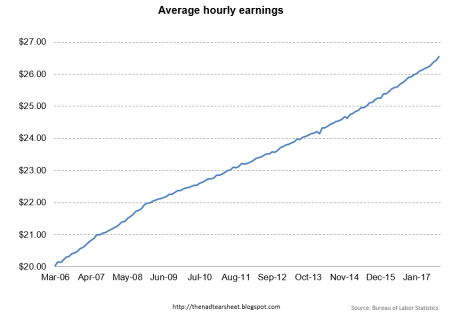
Take a look at the chart of average hourly earnings below. You can see the change in inflection (sharp slowdown in growth) starting in early 2009, however you can also see the change in inflection (that appears to be accelerating) that started in early 2015. We could finally be seeing some wage inflation at long last. Note that there is a possibility that the jump in wages could be driven by the drop in restaurant jobs, which are generally low-paying. That would bump up the average a tad.

hourly earnings2

The NAHB and NAR are parting ways on the issue of the mortgage interest deduction. The MID is slated to become less important as tax reform takes shape. The standard deduction will be doubled, but many popular deductions will go away. For most people, taking the increased standard deduction will make more sense than itemizing. The NAHB is willing to allow the mortgage interest deduction to go away, as long as the low-income housing tax credit remains. The LIHTC is the big driver that makes building affordable housing make sense. NAR, on the other hand is suggesting that losing the MID would cause a 10% drop in house prices. Since Democrats will be uniformly opposed to any changes to the tax code, it will only take a few Republicans in blue states to put the kibosh on this. The MID has survived many attempts to kill it, and it is simply so popular that it may live to fight another day. Note that there are two things to make the MID less and less important: First, with interest rates so low, the actual interest paid is much less than it was, say, 30 years ago. Second, the MID cap is not indexed to inflation, so as house prices rise, the cap will kick in at progressively lower relative levels.

The Fed weighed in on tax reform, saying that it could cause a short term bump in the economy, but will raise the deficit and inflation.  Of course how much it increases the deficit will depend on the economic forecast used. Republicans want to argue that cutting taxes will increase growth, which will increase the taxes received by Treasury (called dynamic scoring). Democrats want to exclude that growth, arguing that it is invariably too rosy. All sorts of think tanks will weigh in on it and you will have to know their political predilections before reading their take. Many think tanks sell themselves as “non-partisan” when they really are not.

Morning Report: Handicapping the next Fed Chair 10/5/17

Vital Statistics:

Last Change
S&P Futures 2538.5 2.3
Eurostoxx Index 390.1 -0.3
Oil (WTI) 50.1 0.1
US dollar index 86.7 0.0
10 Year Govt Bond Yield 2.32%
Current Coupon Fannie Mae TBA 103.05
Current Coupon Ginnie Mae TBA 103.98
30 Year Fixed Rate Mortgage 3.88

Stocks are higher this morning on no real news. Bonds and MBS are flat.

I was at the IMN conference earlier this week, which was very informative. Haven’t heard this much about convexity in a long, long time.

We have a lot of Fed-speak today, with 4 speakers. Powell, Williams, and Harker speak this morning and Esther George speaks after the close. Bonds should be quiet as we await the jobs report tomorrow.

Announced job cuts continue to be low, according to outplacement firm Challenger, Gray and Christmas. Job cuts fell 4.4% in September to 32,346. This number is down 26% from last year. The most movement (in terms of cuts and hiring) remains the retail sector. For the quarter, companies announced job cuts of just over 94,000. Sub-100k quarters are rare: the last one was Q4 last year and then you would have to go back to 2000 to find another. Remember, this stat includes announced job cuts (it counts all the press releases companies do) so these job cuts won’t necessarily materialize.

While online shopping has led to job cuts in bricks-and-mortar stores, those losses are being offset by new jobs in e-commerce. Of course the jobs are very different and require different skill sets, but it kind of looks like a wash

Initial Jobless Claims fell to 260k last week as hurricane-related effects continue to mess with the numbers. Note the ADP Survey (which foreshadows the BLS numbers tomorrow) was weak at 135,000 however hurricane-related effects are probably included in that number as well.

Janet Yellen’s term expires early next year. Here are the most likely candidates to run the Fed going forward. Trump could re-nominate Janet Yellen, however she is a liberal and supports stronger banking regulation. Gary Cohn is another possibility, as Trump prefers business people over academics. Jerome Powell is another possibility, and he would be somewhat more hawkish than Yellen. He is supposedly the choice of Treasury Secretary Steve Mnuchin. Kevin Warsh is more hawksh than either Yellen or Powell and supports financial deregulation. Warsh would probably get some opposition from the left. Finally, John Taylor would be the most hawkish. While politicians might rail against too easy money out of the Fed while on the campaign trail, most prefer dovish types once they are in office. Nobody wants a Fed-induced recession on their watch. The last one we had was 81-82, when Paul Volcker tightened to break the back of 1970s inflation. President Ronald Reagan supported his move, which caused the worst recession (at the time) since the Great Depression.

Online betting site Predict It shows the market’s assessment. Kevin Warsh is in the lead at a 40% chance, while Jerome Powell is at 31% and Yellen is at 10%. Gary Cohn is at 9%.

Philly Fed President Patrick Harker says that the US economy will continue to grow at a subdued 2% rate until we get some sort of pro-growth tax reform out of Washington. He still supports hiking rates in December. The Fed Funds futures have more or less doubled their probability of a rate hike over the past month from around 40% to over 80%.

Donald Trump roiled distressed hedge funds yesterday when he suggested that Puerto Rico might need some debt relief to recover. The Commonwealth’s general obligation bonds fell into the low 30s. At least Trump was nice enough to wait until everyone marked their books for Q3.

Morning Report: Incomes rise but wages flat 9/29/17

Vital Statistics:

Last Change
S&P Futures 2506.8 -1.0
Eurostoxx Index 386.5 0.1
Oil (WTI) 51.6 0.1
US dollar index 86.3 0.0
10 Year Govt Bond Yield 2.31%
Current Coupon Fannie Mae TBA 103.05
Current Coupon Ginnie Mae TBA 103.98
30 Year Fixed Rate Mortgage 3.88


Stocks are flattish on no real news. Bonds and MBS are flat as well.
Personal Incomes rose 0.2%, right in line with estimates. The prior month was revised downward to 0.2%. The increase in personal incomes largely came from increased rental income, transfer payments, and interest income, not wages and salaries. Consumer spending rose 0.1%, while all of the inflation numbers came in a touch light. Weak auto sales drove the low consumer spending number. The personal savings rate was 3.6%. It probably won’t affect any of the Fed’s thinking with respect to a December hike, however the declining annual PCE inflation will concern some of the doves at the FOMC, as will the lack of wage growth. Note that these numbers will have some effects of the TX and FL hurricanes, and BEA is unable to separate them out.
The Chicago Purchasing Manager Index bounced back in September, hitting 65.2, way above expectations. While several regions have been reporting strength, Chicago has been an outlier.
Consumer sentiment slipped slightly in September, showing only a modest impact of the hurricanes, according to the University of Michigan survey.
Donald Trump reportedly met with Kevin Warsh to discuss the Federal Reserve Chairman position. The choice will probably end up either Warsh or Yellen.
Tax reform could be a big boost for the financial sector, especially banks. Since banks generally have fewer deductions than other businesses, a drop in the tax rate disproportionately benefits them. Note that lowering rates will create issues with pass-through small businesses, and could be subject to abuse. Note that the Admin is already softening its stance on state and local tax deductions, which has always been a tough one politically. Given the probability that no Democrats will support tax reform (at least at the individual level), a few blue state Republicans could sink it.
Most renters would like to own a home someday, however the up-front costs are the biggest obstacle. Renters need to be educated more on FHA loans, which are designed specifically to get the first time homebuyer into a home with a minimum down payment.
An improving economy means less payday loans. I wonder how much of this has been due to the CFPB too.

Morning Report: More on tax reform 9/28/17

Vital Statistics:

Last Change
S&P Futures 2499.5 -5.0
Eurostoxx Index 385.4 -0.3
Oil (WTI) 52.4 0.3
US dollar index 86.4 -0.1
10 Year Govt Bond Yield 2.33%
Current Coupon Fannie Mae TBA 103.05
Current Coupon Ginnie Mae TBA 103.98
30 Year Fixed Rate Mortgage 3.88

Stocks are higher this morning after a strong GDP number. Bonds and MBS are down.

Second quarter GDP was revised upward to 3.1%, while the PCE price index was steady at 1%. Consumption was unchanged at 3.3% while after-tax incomes rose 3.3%.  This is a Goldilocks type report for the economy, with strong growth and muted inflation. Residential Construction was a weak spot, falling 7.3%, the biggest drop since 2010.

In other economic data, Initial Jobless Claims came in at 272k, a touch lower than expectations. Claims in Texas are getting back to normal, while claims in Florida are still elevated. Retail inventories rose 0.7% while wholesale inventories rose 1%. Corporate profits rose 7.4%.

Tax reform could cause a quick jump in jobs, assuming it plays out the way its drafters hope. One provision that is getting attention is the accelerated depreciation idea. Accelerated depreciation will let companies expense new capital investment in the year it is made instead of having to depreciate it over a longer time period. The net effect is to make reported profit (and therefore the tax liability) lower than it would otherwise be, and that actually adds to the cash flow of the company. The big question is whether it will encourage job growth, and that is a question that divides economists almost 50/50 and largely falls along ideological lines. Liberal economists believe that this will only reward investors, while more right-leaning economists believe that the tax effect makes some marginal projects begin to make sense economically. If you are a leftie, you think the tax savings will get plowed back into dividends and buybacks. If you are a rightie, you think the tax savings will encourage investment in the business and hiring.

Note that one provision of tax reform includes a repatriation tax credit, which could cause bond yields to rise if companies sell Treasuries en masse to bring cash back to the US. The amount of money isn’t trivial: Microsoft alone holds $133 billion in cash overseas, largely sitting in Treasuries.

Tax reform at the individual level is still sketchy, and it looks like there will be winners and losers. The winners will be people in low-tax states as well as the super-rich. The losers will be upper middle class taxpayers in high tax states like NY and CT. Historically, the upper middle class taxpayer has been the “third rail” of tax reform and it is likely that hitting them will doom tax reform at the individual level. There is probably more support for corporate tax reform given that we have the highest statutory corporate tax rates in the world, and US corporations that don’t have overseas exposure (generally the smaller ones) are disadvantaged relative to the bigger guys.

Equifax’s CEO resigned over the hacking episode and the new CEO has unveiled free credit locking for life. To prevent identity theft, locking means that a new creditor cannot access your credit file unless you specifically request it, for example if you are getting a new car or opening a new credit card. This presumably prevents someone from opening a credit line in your name. So far, we have not heard about issues with mortgage loans and the inability to access credit reports from borrowers who have locked their accounts, but the hack is still relatively recent.

Housing credit risk increased in the second quarter, according to CoreLogic. Credit risk is still within the benchmark range of 2001-2003, before the housing bubble began to inflate in earnest. It seems that there have been two opposing phenomenons going on – first an increase in investor and condo loans has increased credit risk, while better DTIs and FICO scores have lowered it. The average credit score for new mortgages is 745, which is up 9 points YOY. DTI ratios were flat at 36%, while LTV ratios fell from 87.5 to 85.5. The increase in FHA loans over time has increased the number of 95+ LTVs by over 50% since 2001.

Tennessee Senator Bob Corker said he will not stand for re-election. Corker is a big name on the Banking Committee and is instrumental in GSE reform. This will accelerate the push for GSE reform in his last 15 months in office. GSE reform is difficult and cleaves strongly down ideological lines. Bob Corker and Senator Mark Warner came up with a bill that made it out of committee, however the left opposed it. The right wants to limit exposure to the taxpayer and introduce more competition. The left wants to ensure that low-income and targeted lending are not compromised. In the current state, Fannie and Fred remain under conservatorship, with all profits going to Treasury.

Thinking outside the box in Albuquerque:

tacos

Morning Report: Tax reform to be unveiled today 9/27/17

Vital Statistics:

Last Change
S&P Futures 2500.8 5.3
Eurostoxx Index 385.4 1.4
Oil (WTI) 51.9 0.0
US dollar index 86.5 0.4
10 Year Govt Bond Yield 2.29%
Current Coupon Fannie Mae TBA 103.24
Current Coupon Ginnie Mae TBA 104.21
30 Year Fixed Rate Mortgage 3.87

Stocks are up this morning as Washington pivots to tax reform. Bonds and MBS are down.

Janet Yellen spoke yesterday and said that it would be “imprudent” to wait until inflation hits 2% to start hiking rates. Those comments were taken as support for a December hike and the Fed Funds futures took up the odds of a rate hike in December to 81%.

Bonds were also under pressure due to the possibility of some sort of tax deal. Here is a preview of the tax plan. Trump plans on releasing the details today. Apparently the big pieces involve cutting the corporate tax rate falls to 20%, while the top individual income tax bracket falls to 35%. There is an option for Congress to institute a higher bracket. Deductions will be limited while the standard deduction increases. The most contentious deduction will be the state and local tax deduction, which will hit taxpayers in high tax states like NY and CT the most. CT is already reeling from an exodus of high income earners and businesses, and this will only exacerbate that. This won’t be good for real estate prices there. While this is largely going to hit blue states, there are enough Republican House members in blue states to deep-six it unless Trump can get some Democrats on board. No word on eliminating or lowering the cap on the mortgage interest deduction.

Pending Home Sales fell by 2.6% in August, according to NAR.

Mortgage applications fell half a percent last week as purchases rose 3% and refis fell 4%. The hurricanes did depress activity in Florida and Texas, however increasing rates and a lack of home inventory were the biggest drivers.

Durable goods orders rose 1.7% in August, which beat consensus estimates. Ex-aircraft, they were up 0.2%. Capital Goods orders rose 0.9%, which is an indication that business expects to see further activity and is increasing their capacity. The bump in capital goods orders is being driven by the rebound in oil prices and drilling activity in the energy sector. Capacity Utilization rates are still low compared to historical standards.

The bond market has been in a tight range for this entire year. In fact, the 62 basis point range has been the tightest in over 50 years. Historically, that range has been closer to 175 basis points. The article is somewhat misleading, as the range is going to fall naturally when rates fall from 10% to 2%. Using volatility measured in sigma is better. That said, it isn’t just the US bond market: volatility in general is down. The VIX (the volatility measure for the stock market) has been in the single digits. Historically that has been a warning sign (When VIX is high, time to buy. When VIX is low, time to go).

Morning Report: Janet Yellen speaks at 11:50 9/26/17

Vital Statistics:

Last Change
S&P Futures 2495.8 -1.3
Eurostoxx Index 384.1 0.2
Oil (WTI) 51.9 -0.4
US dollar index 86.1 0.3
10 Year Govt Bond Yield 2.22%
Current Coupon Fannie Mae TBA 103.24
Current Coupon Ginnie Mae TBA 104.21
30 Year Fixed Rate Mortgage 3.85

Stocks are lower this morning as we await a Janet Yellen speech at lunchtime. Bonds and MBS are flat.

Janet Yellen will address inflation, uncertainty, and monetary policy at the National Association of Business Economics today. Charles Evans, Lael Brainard, and Loretta Mester also speak this morning. There probably won’t be any market-moving comments, but just be aware.

Charles Evans said he won’t support further rate hikes until we see clearer signs of inflation. This puts him in the camp of Neel Kashkari, who also doesn’t see the need to tap on the brakes. The dot plot from the last meeting showed 11 out of 16 members forecasting a rate hike in December. The Fed Funds futures are pricing in a 3/4% chance of a rate hike. This is the highest we have seen in this contract. Note the futures are predicting nothing happens in the November meeting.

Case-Shiller is out this morning, and home prices are up 5.9% YOY. The Pacific Northwest continues to outperform, with Seattle up 13.5% and Portland up 7.6%. Separately, home prices rose 0.5% MOM and are up 6.2% YOY, according to the Black Knight Financial Services Home Price Index. We are starting to see the areas around DC cool down, while New York (especially upstate) is beginning to pick up.

New Home Sales fell to 560k in August, according to the Census Bureau. This is a drop of 3.4% MOM and 1.2% YOY. Tight inventory remains the biggest problem. The median sales price of a new home was $300,200, and inventory was about 284k or 6.1 month’s worth. The Street was looking for 583k.

Consumer confidence slipped in September, according to the Conference Board. The index came in at 119.8, a touch below expectations. Expectations concerning employment and income contributed to the strong showing.

Morning Report: Tax reform week 9/25/17

Vital Statistics:

Last Change
S&P Futures 2496.8 -2.8
Eurostoxx Index 383.9 0.7
Oil (WTI) 51.2 0.5
US dollar index 85.8 0.3
10 Year Govt Bond Yield 2.25%
Current Coupon Fannie Mae TBA 103.24
Current Coupon Ginnie Mae TBA 104.21
30 Year Fixed Rate Mortgage 3.85

Stocks are down small this morning on no real news. Bonds and MBS are flat.

We have a decent amount of economic data this week, along with a lot of Fed-speak. The big economic news will be the final revision to second quarter GDP and the personal income and personal spending releases. Janet Yellen speaks on Tuesday.

Economic activity slowed in August, according the Chicago Fed National Activity Index. The index fell from 0.4 to -.31, for the lowest reading in a year. Production-related indicators drove the decrease. Employment-related indicators were a mild positive.

The Trump Administration is going to push for tax reform this week. The highlight is a cut in the top rate to 35% and a cut in the corporate income tax to 20%. The cut in the top rate will be paid for in part by limiting deductions for state and local taxes. Chuck Schumer has insisted that “not one penny” of tax cuts go to the top 1%, so that could make the plan doomed. The estate tax will also get the axe. Republicans are working on the procedures to pass this without Democratic votes.

Meanwhile, Obamacare repeal and replace looks like it is going to go down as well.

We are starting to see some of the fallout from the recent hurricanes: Homebuilder D.R. Horton cut its cash flow forecast by 50%. Lennar has also said that the hurricanes will delay deliveries. At the end of the day, there is such high demand for homes that this should be a 1 quarter effect which will be made up in following quarters.

Lenders are easing standards given the increase in interest rates and the corresponding drop in volume. “Lenders further eased home mortgage credit standards during the third quarter, continuing a trend that started in late 2016. In particular, both the net share of lenders reporting easing on GSE-eligible loans for the prior three months and the share expecting to ease standards on those loans over the next three months increased to survey highs,” said Doug Duncan, senior vice president and chief economist at Fannie Mae. “Lenders’ comments suggest that competitive pressure and more favorable guidelines for GSE loans have helped to bring about more easing of underwriting standards for those loans. We believe that the GSEs’ attempts to relieve repurchase concerns and expand credit for creditworthy borrowers have contributed to the easing trend. Meanwhile, market competitiveness also led to the fourth consecutive quarter in which lenders’ net profit margin outlook deteriorated. The share of lenders citing competition from other lenders as the key reason for a negative profit market outlook rose to a new survey high.”

Morning Report: Household wealth increases again 9/22/17

Vital Statistics:

Last Change
S&P Futures 2499.5 -5.8
Eurostoxx Index 382.9 0.1
Oil (WTI) 50.4 -0.1
US dollar index 85.7 0.1
10 Year Govt Bond Yield 2.25%
Current Coupon Fannie Mae TBA 103.24
Current Coupon Ginnie Mae TBA 104.21
30 Year Fixed Rate Mortgage 3.85

Stocks are lower this morning on no real news. Bonds and MBS are flat.

We will have some Fed-speak today, however nothing should be market-moving given how recent the FOMC decision was.

The Markit PMI flash index came in at 54, showing manufacturing remains strong. Separately, businesses expect to see about 1.9% inflation in the coming year, according to the Atlanta Fed.

San Francisco Fed President John Williams sees the Fed gradually raising rates and considers 2.5% on the Fed Funds rate the “new normal.” “Although I do expect us to need to raise rates gradually over the next couple of years, it’s not like we need to raise rates a lot over the next couple of years,” Williams said, adding that the pace “will depend on how the economy progresses.”

US household wealth hit a record in the second quarter as asset price appreciation continued. Household wealth increased to 96.2 trillion. Total debt grew at 3.8% as households and businesses borrowed more than governments. State and local government borrowing actually fell.

Freddie Mac is out with its 2018 forecast, which basically predicts more of the same. Economic growth is expected to hang out in the 2% range, while mortgage rates are expected to rise. The increase in purchase activity will not offset the drop in refis, however and they are forecasting a 6% drop in originations versus 2017. They see home price appreciation of 5%. They expect the limited inventory problem to remain as the aging of the population and limited mobility keep a lid on home sales. They see the 30 year fixed rate mortgage increasing by 40 basis points to 4.4% and only a modest increase in housing starts to 1.33 million.

Ray Dalio of Bridgewater on why the US economy resembles 1937. His point was that the Fed began to remove accomodation from the markets in 1937, which caused (in his opinion) the “recession within the Depression in 1937. While it is possible that monetary policy caused that recession, it is also possible policy had an effect too, especially FDR’s undistributed profits tax, which basically told companies to “use it or lose it” with respect to their retained earnings. It was a political disaster from the start and only lasted two years, but it certainly was an ominous sign for business, which didn’t help release the animal spirits. The Fed is going so cautiously at the moment, I don’t see how they will send us into a recession by overshooting.

Jamie Dimon doubled down on his criticism of Bitcoin, saying cryptocurrencies are a “novelty” and “worth nothing.”

Morning Report: Fed maintains rates as expected 9/21/17

Vital Statistics:

Last Change
S&P Futures 2504.0 -1.3
Eurostoxx Index 382.6 0.6
Oil (WTI) 50.3 0.8
US dollar index 85.8 0.2
10 Year Govt Bond Yield 2.27%
Current Coupon Fannie Mae TBA 103.24
Current Coupon Ginnie Mae TBA 104.21
30 Year Fixed Rate Mortgage 3.85

Stocks are flattish after the FOMC statement contained few surprises. Bonds and MBS are flat as well.

As expected, the Fed made no changes to interest rate policy and left the Fed Funds rate unchanged. They also announced their plan to implement their previously announced reduction in reinvestment in order to shrink their balance sheet. The projections were pretty much the same as they were in June, with the exception of June GDP, which was bumped up a tenth of a percent to 2.4%. Inflation was unchanged at 1.6% and unemployment was unch’d at 4.3%.

The dot plot reduced expected rates in 2018 by 3/16 or about 19 basis points. You can see a side by side comparison of the chart below:

Dot plot comparison jun vs sep

The market reaction to the announcement was a drop in stocks and bonds, with the 10 year yield increasing to 2.27%, up about 3 basis points. The Fed Funds futures took up the probability of a December hike from about 60% to 70%.

Initial Jobless Claims fell to 259k last week as Texas claims fell, more than offsetting the increase in Florida claims.

Home prices rose 0.2% MOM and are up 6.3% YOY according to the FHFA House Price Index. We are still seeing strength out West, however New England is beginning to show some strength after lagging for a long time. The farm belt as well as the NY-NJ-PA area are still bringing up the rear.

The OECD is forecasting that global economic growth will be the fastest since 2011 this year and that growth will accelerate into next year. Ultimately this is good for the US economy, although it won’t necessarily mean lower rates. Even if US growth isn’t enough to push up bond yields, relative value trading by overseas investors could do the job.

In other economic news, the Philly Fed index continued its string of strong numbers, while the Index of Leading Economic Indicators posted a strong 0.4% reading. Expect to see a hit to growth however due to hurricanes Irma and Harvey.

Hurricane Maria, which has just devastated Puerto Rico now moves North close to the Eastern Seaboard. There are still the remnants from Jose just off New England which makes predictions difficult. The East Coast from NC to Maine have at least some risk.

Home equity increased over 10% YOY, according to CoreLogic. Total home equity reached $8 trillion, which is double the level of 5 years ago. Negative equity decreased by 10%, to 2.8 million homes or 5.4% of all mortgages. 750,000 homes regained positive equity. Even if rates don’t go down from here, increasing home equity will create refinance opportunities, especially for cash-outs to refinance credit card debt and refis from FHA to conforming to remove MI requirements. A lot of FHA loans done 4 or 5 years ago now have enough equity to refi into a conforming.