Morning Report: Tax reform week 9/25/17

Vital Statistics:

Last Change
S&P Futures 2496.8 -2.8
Eurostoxx Index 383.9 0.7
Oil (WTI) 51.2 0.5
US dollar index 85.8 0.3
10 Year Govt Bond Yield 2.25%
Current Coupon Fannie Mae TBA 103.24
Current Coupon Ginnie Mae TBA 104.21
30 Year Fixed Rate Mortgage 3.85

Stocks are down small this morning on no real news. Bonds and MBS are flat.

We have a decent amount of economic data this week, along with a lot of Fed-speak. The big economic news will be the final revision to second quarter GDP and the personal income and personal spending releases. Janet Yellen speaks on Tuesday.

Economic activity slowed in August, according the Chicago Fed National Activity Index. The index fell from 0.4 to -.31, for the lowest reading in a year. Production-related indicators drove the decrease. Employment-related indicators were a mild positive.

The Trump Administration is going to push for tax reform this week. The highlight is a cut in the top rate to 35% and a cut in the corporate income tax to 20%. The cut in the top rate will be paid for in part by limiting deductions for state and local taxes. Chuck Schumer has insisted that “not one penny” of tax cuts go to the top 1%, so that could make the plan doomed. The estate tax will also get the axe. Republicans are working on the procedures to pass this without Democratic votes.

Meanwhile, Obamacare repeal and replace looks like it is going to go down as well.

We are starting to see some of the fallout from the recent hurricanes: Homebuilder D.R. Horton cut its cash flow forecast by 50%. Lennar has also said that the hurricanes will delay deliveries. At the end of the day, there is such high demand for homes that this should be a 1 quarter effect which will be made up in following quarters.

Lenders are easing standards given the increase in interest rates and the corresponding drop in volume. “Lenders further eased home mortgage credit standards during the third quarter, continuing a trend that started in late 2016. In particular, both the net share of lenders reporting easing on GSE-eligible loans for the prior three months and the share expecting to ease standards on those loans over the next three months increased to survey highs,” said Doug Duncan, senior vice president and chief economist at Fannie Mae. “Lenders’ comments suggest that competitive pressure and more favorable guidelines for GSE loans have helped to bring about more easing of underwriting standards for those loans. We believe that the GSEs’ attempts to relieve repurchase concerns and expand credit for creditworthy borrowers have contributed to the easing trend. Meanwhile, market competitiveness also led to the fourth consecutive quarter in which lenders’ net profit margin outlook deteriorated. The share of lenders citing competition from other lenders as the key reason for a negative profit market outlook rose to a new survey high.”

Morning Report: Household wealth increases again 9/22/17

Vital Statistics:

Last Change
S&P Futures 2499.5 -5.8
Eurostoxx Index 382.9 0.1
Oil (WTI) 50.4 -0.1
US dollar index 85.7 0.1
10 Year Govt Bond Yield 2.25%
Current Coupon Fannie Mae TBA 103.24
Current Coupon Ginnie Mae TBA 104.21
30 Year Fixed Rate Mortgage 3.85

Stocks are lower this morning on no real news. Bonds and MBS are flat.

We will have some Fed-speak today, however nothing should be market-moving given how recent the FOMC decision was.

The Markit PMI flash index came in at 54, showing manufacturing remains strong. Separately, businesses expect to see about 1.9% inflation in the coming year, according to the Atlanta Fed.

San Francisco Fed President John Williams sees the Fed gradually raising rates and considers 2.5% on the Fed Funds rate the “new normal.” “Although I do expect us to need to raise rates gradually over the next couple of years, it’s not like we need to raise rates a lot over the next couple of years,” Williams said, adding that the pace “will depend on how the economy progresses.”

US household wealth hit a record in the second quarter as asset price appreciation continued. Household wealth increased to 96.2 trillion. Total debt grew at 3.8% as households and businesses borrowed more than governments. State and local government borrowing actually fell.

Freddie Mac is out with its 2018 forecast, which basically predicts more of the same. Economic growth is expected to hang out in the 2% range, while mortgage rates are expected to rise. The increase in purchase activity will not offset the drop in refis, however and they are forecasting a 6% drop in originations versus 2017. They see home price appreciation of 5%. They expect the limited inventory problem to remain as the aging of the population and limited mobility keep a lid on home sales. They see the 30 year fixed rate mortgage increasing by 40 basis points to 4.4% and only a modest increase in housing starts to 1.33 million.

Ray Dalio of Bridgewater on why the US economy resembles 1937. His point was that the Fed began to remove accomodation from the markets in 1937, which caused (in his opinion) the “recession within the Depression in 1937. While it is possible that monetary policy caused that recession, it is also possible policy had an effect too, especially FDR’s undistributed profits tax, which basically told companies to “use it or lose it” with respect to their retained earnings. It was a political disaster from the start and only lasted two years, but it certainly was an ominous sign for business, which didn’t help release the animal spirits. The Fed is going so cautiously at the moment, I don’t see how they will send us into a recession by overshooting.

Jamie Dimon doubled down on his criticism of Bitcoin, saying cryptocurrencies are a “novelty” and “worth nothing.”

Morning Report: Fed maintains rates as expected 9/21/17

Vital Statistics:

Last Change
S&P Futures 2504.0 -1.3
Eurostoxx Index 382.6 0.6
Oil (WTI) 50.3 0.8
US dollar index 85.8 0.2
10 Year Govt Bond Yield 2.27%
Current Coupon Fannie Mae TBA 103.24
Current Coupon Ginnie Mae TBA 104.21
30 Year Fixed Rate Mortgage 3.85

Stocks are flattish after the FOMC statement contained few surprises. Bonds and MBS are flat as well.

As expected, the Fed made no changes to interest rate policy and left the Fed Funds rate unchanged. They also announced their plan to implement their previously announced reduction in reinvestment in order to shrink their balance sheet. The projections were pretty much the same as they were in June, with the exception of June GDP, which was bumped up a tenth of a percent to 2.4%. Inflation was unchanged at 1.6% and unemployment was unch’d at 4.3%.

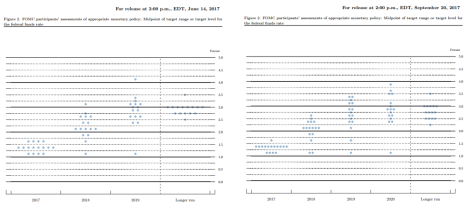
The dot plot reduced expected rates in 2018 by 3/16 or about 19 basis points. You can see a side by side comparison of the chart below:

Dot plot comparison jun vs sep

The market reaction to the announcement was a drop in stocks and bonds, with the 10 year yield increasing to 2.27%, up about 3 basis points. The Fed Funds futures took up the probability of a December hike from about 60% to 70%.

Initial Jobless Claims fell to 259k last week as Texas claims fell, more than offsetting the increase in Florida claims.

Home prices rose 0.2% MOM and are up 6.3% YOY according to the FHFA House Price Index. We are still seeing strength out West, however New England is beginning to show some strength after lagging for a long time. The farm belt as well as the NY-NJ-PA area are still bringing up the rear.

The OECD is forecasting that global economic growth will be the fastest since 2011 this year and that growth will accelerate into next year. Ultimately this is good for the US economy, although it won’t necessarily mean lower rates. Even if US growth isn’t enough to push up bond yields, relative value trading by overseas investors could do the job.

In other economic news, the Philly Fed index continued its string of strong numbers, while the Index of Leading Economic Indicators posted a strong 0.4% reading. Expect to see a hit to growth however due to hurricanes Irma and Harvey.

Hurricane Maria, which has just devastated Puerto Rico now moves North close to the Eastern Seaboard. There are still the remnants from Jose just off New England which makes predictions difficult. The East Coast from NC to Maine have at least some risk.

Home equity increased over 10% YOY, according to CoreLogic. Total home equity reached $8 trillion, which is double the level of 5 years ago. Negative equity decreased by 10%, to 2.8 million homes or 5.4% of all mortgages. 750,000 homes regained positive equity. Even if rates don’t go down from here, increasing home equity will create refinance opportunities, especially for cash-outs to refinance credit card debt and refis from FHA to conforming to remove MI requirements. A lot of FHA loans done 4 or 5 years ago now have enough equity to refi into a conforming.

Morning Report: Awaiting the Fed 9/20/17

Vital Statistics:

Last Change
S&P Futures 2504.5 0.0
Eurostoxx Index 381.8 -0.4
Oil (WTI) 50.0 0.5
US dollar index 85.1 -0.2
10 Year Govt Bond Yield 2.24%
Current Coupon Fannie Mae TBA 103.24
Current Coupon Ginnie Mae TBA 104.21
30 Year Fixed Rate Mortgage 3.85

Stocks are flat as we await the FOMC decision. Bonds and MBS are down small.

The FOMC decision is due out at 2:00 pm EST and Janet Yellen will hold a press conference at 2:30 PM. While no changes in interest rates are expected, there could be some market movement, especially if we see surprising changes to the economic forecast or the dot plot.  At the June meeting, the FOMC was predicting GDP growth of 2.2% for 2017, unemployment of 4.3% and PCE inflation of 1.6%. GDP growth averaged a touch over 2% for the first half, so the Fed is clearly anticipating a stronger second half. The markets are also looking for some guidance on tapering MBS and Treasury purchases. Given how much rates have risen over the past couple of weeks, we could be due for a bit of a “buy the rumor, sell the fact” rally post event.

Mortgage Applications decreased 9.7% last week due to an increase in rates and the effects of Hurricanes Harvey and Irma. Purchases decreased 11% and refis fell 9%. Treasury rates increased 11 basis points. The hurricanes were a big driver of the drop: ex-Florida and Texas, applications increased 13%, however there are all sorts of seasonal adjustments, along with the effect the Labor Day comparison that come into play as well.

Existing Home Sales came in at 5.35 million in August, a drop of 1.7% from the July reading of 5.44 million. SFR sales fell while condos rose. Hurricane Harvey probably had some effect on August sales, however the overriding concern is lack of inventory which fell to 1.88 million homes, which represents a 4.2 month supply at current rates. The median home price rose to 253,500, an increase of 5.6% YOY. The first time homebuyer accounted for only 31% of sales, the lowest in a year. Historically, that number has been closer to 40%.

Hurricane Maria is expected to hit bankrupt Puerto Rico and then move up the East Coast. Most of the spaghetti tracks predict it won’t hit the US East Coast, but it is still very early.

Looking to buy your first house? Trulia advises you to start looking now, as starter home inventory peaks and prices bottom in the seasonally slow period. They find that inventory for starter homes actually rises 7% in fall months and prices are 3% – 4% lower compared to the spring and summer seasons. Separately, tight inventory remains an issue. On a year-over-year basis, starter home inventory is down 20% this quarter, while move up is down 12% and luxury is down 2%. Overall, inventory is down 9% YOY nationally.

In response to Hurricanes Irma and Harvey, HUD, Fannie, and Freddie have provided some disaster relief for borrowers in areas affected by the storms. There will be a 90 day moratorium on foreclosures, as well as increases in SBA loans and 203k loans to help people rebuild homes destroyed in the storm.

Credit card delinquencies are on the rise as consumer borrowing is outpacing income growth (again). Note subprime auto DQs are on the rise too. Mortgage delinquencies are still falling, which is good news.

Morning Report: Housing starts depressed by hurricanes 9/19/17

Vital Statistics:

Last Change
S&P Futures 2504.5 1.8
Eurostoxx Index 382.0 0.0
Oil (WTI) 50.3 0.4
US dollar index 85.3 -0.1
10 Year Govt Bond Yield 2.22%
Current Coupon Fannie Mae TBA 103.33
Current Coupon Ginnie Mae TBA 104.21
30 Year Fixed Rate Mortgage 3.83

Stocks are flat this morning as the Fed begins its meeting. Bonds and MBS are flat as well.

Housing starts for August came in at 1.18 million, a touch above the 1.17 million estimate. Building Permits rose 1.3 million, much better than the 1.23 million the Street was forecasting. The hurricanes did depress starts a bit, as the FEMA disaster areas accounted for about 13% of US building permits. Multi-family starts have been more or less flatlining over the past couple years, while single family has steadily increased. Note that starts will probably be depressed over the near term as construction workers in these already tight markets get drawn into rebuilding projects versus new home construction.

Import prices rose 0.6% MOM and 2.1% YOY as the hurricanes boosted energy prices last month. The Fed will almost certainly consider that effect to be transitory and it won’t affect their inflation out look all that much.

Mortgage fraud risk is up 17% YOY, according to CoreLogic. In the second quarter, over 13,400 mortgage applications (or 0.82%) showed symptoms of fraud, compared to 12,700 (0.7%) a year earlier. “This past year we saw a relatively large increase in the CoreLogic National Mortgage Application Fraud Index,” said Bridget Berg, principal, Fraud Solutions for CoreLogic. “If the factors that influenced the increase continue, including a shift to purchase transactions and growing wholesale channel origination activity, it is likely that mortgage application fraud risk will continue to rise as well. Fraud on cash-out refinance transactions and home equity loans may become more of a factor in the coming years as home values and equity rise.”

30 day + Delinquencies fell to 4.5% in June from 5.3% a year ago. The foreclosure rate of 0.7% was the lowest in 10 years. The range went from 0.1% in the Denver MSA to 2.2% in the Newark MSA. Decent home price appreciation and job growth are pushing delinquencies back down to pre-crisis levels.

The Fed is expected to announce that it will begin to unwind its balance sheet at the September meeting. There seems to be a lot of handwringing in the press over the implications of the Fed ending its “easy money” policy. An important thing to remember is that easy money / tight money isn’t a binary choice. It is a continuum. In all reality, if you were to put Fed policy on a scale of 1 to 10, with 1 being easy money, we are basically moving from 1.0 to 1.1. Real short term interest rates (i.e the Fed funds rate less the inflation rate) are still negative. Long term real rates are barely positive. The Fed will still continue to purchase assets in the open markets, however they will let something like 10% – 20% of maturing assets simply go away. These are truly baby steps intended to cause as little negative impact as possible. The Fed is going very slow and cautiously, and the persistent low inflation numbers give them that cushion.

Morning Report: FOMC week 9/18/17

Vital Statistics:

Last Change
S&P Futures 2501.0 3.8
Eurostoxx Index 381.9 1.2
Oil (WTI) 49.6 -0.3
US dollar index 85.2 0.1
10 Year Govt Bond Yield 2.22%
Current Coupon Fannie Mae TBA 103.33
Current Coupon Ginnie Mae TBA 104.21
30 Year Fixed Rate Mortgage 3.83

Stocks are higher this morning on no real news. Bonds and MBS are down small.

The big event this week will be the FOMC meeting, which starts tomorrow. No changes in interest rates are expected, although the markets expect the Fed to announce their plan to gradually unwind their balance sheet. The market is anticipating a “baby steps” move where they reinvest less than 100% of bonds that are maturing. While it certainly won’t help MBS spreads, it probably won’t have much of an effect on mortgage rates given that QE itself didn’t have a huge impact to begin with.

Homebuilder sentiment slipped in August as the NAHB Housing Market Index fell from 67 to 64. An active hurricane season, along with labor shortages isn’t helping things. Rising costs of building materials is an issue as well.

Trump’s deal with Nancy Pelosi and Chuck Schumer to keep the government open may have increased the chances for tax reform. While the Democrat’s red lines pretty much foreclose anything aside from making the tax code more progressive on the individual side, we might see something on the corporate side. Perhaps the Trump reflation trade isn’t dead yet, but getting to agreement on tax reform will be hard since Democrats and Republicans want fundamentally different things. Here is a good discussion of what could be happening.

The MBA released a white paper on the CFPB, urging them to provide more detailed guidance to the industry as opposed to “regulation by enforcement action.” CFPB Director Richard Cordray has resisted providing guidance to the industry, believing that bright lines merely makes it easier for companies to approach, but not cross the line. The industry argues that the CFPB should provide more guidance as to how it thinks, warn the industry when it is changing rules, abide by its own guidance, and allow due process for the accused.

Here is some background on the Equifax hack. Can Equifax’s data breach affect your ability to buy a home? It probably cannot in the end, if you were a victim of identity theft. Ultimately it will be time consuming and a nuisance, however it can be overcome. Loan Officers should be aware that there could be an uptick in mortgage fraud, so be careful in the near term.

Morning Report: DC focuses on Equifax 9/15/17

Vital Statistics:

Last Change
S&P Futures 2491.5 -2.8
Eurostoxx Index 380.8 -1.0
Oil (WTI) 50.0 0.1
US dollar index 85.0 -0.2
10 Year Govt Bond Yield 2.20%
Current Coupon Fannie Mae TBA 103.33
Current Coupon Ginnie Mae TBA 104.21
30 Year Fixed Rate Mortgage 3.83

Stocks are lower this morning as September options and futures expire. Bonds and MBS are flat.

Retail Sales fell 0.2% last month, and prior months were revised downward. The control group which excludes autos, gas, and building materials fell 0.2% as well. August retail sales included some early hurricane effects, but overall it points to a lousy back-to-school shopping season. I wouldn’t be surprised to see strategists start to cheat down their Q3 GDP estimates. Separately, business inventories rose 0.2%.

Consumer confidence slipped slightly in August, but is still reasonably robust. Consumer confidence is often an inverse of gasoline prices, so this number should fall going forward as gas prices have been increasing.

Hurricane Harvey affected industrial production and manufacturing production, both of which fell in August. Industrial production fell 0.9%, while manufacturing production fell 0.3%. Utilities and mining (really energy production) drove the decrease. September should also come in depressed as well due to Irma. Capacity Utilization fell 0.8% to 76.1%. The national industrial numbers have been exhibiting a bit of volatility over the past few months. Interestingly, the regional Fed indices (like the Empire State Manufacturing Index, which improved to a strong 24.4 reading this morning) have not been confirming the overall weakness.

Bond yields have been rising over the past week as Hurricane Irma had less damage than expected. Inflation numbers have come in slightly strong as well, and Goldman has upped its probability of a rate hike to 60% in December. The Fed Funds futures echo that sentiment right now: over the past week or so, we have gone from a 40% chance of a hike to a 53% chance of a hike.

The FTC announced an investigation into Equifax’s security breach. This is pretty unusual for the agency to comment on ongoing investigations, which demonstrates how seriously the government is taking it. Elizabeth Warren introduced a bill to require credit reporting agencies to freeze a person’s credit for free and would restrict their ability to profitably use that data during the freeze. Chuck Schumer called the security breach “one of the most egregious cases of corporate malfeasance since Enron.” He further said that “the company’s chief executive and board of directors should step down unless they take five steps to correct their mishandling: notify affected consumers; provide free credit monitoring to them for at least 10 years, offer to freeze their credit for up to 10 years; remove forced arbitration clauses from their terms of use; and comply with fines or new standards that come out of investigations.” Here are some tips if you were affected.

North Korea fired a missile last night that flew over Japan before crashing in the Pacific. The missile had a long enough range to hit Guam. US Secretary of State Rex Tillerson called on China and Russia to do more to contain NK. China supplies most of North Korea’s oil and Russia is the biggest employer of their forced labor. Both Russia and China have veto power for any UN sanctions.

Morning Report: Government zeroing in on VA IRRRL churning 9/14/17

Vital Statistics:

Last Change
S&P Futures 2489.0 -6.0
Eurostoxx Index 381.9 0.6
Oil (WTI) 49.8 0.5
US dollar index 85.5 0.0
10 Year Govt Bond Yield 2.20%
Current Coupon Fannie Mae TBA 103.33
Current Coupon Ginnie Mae TBA 104.21
30 Year Fixed Rate Mortgage 3.81

Stocks are down this morning after the Bank of England made no changes to monetary policy. Bonds and MBS are flat.

Inflation at the consumer level was a little hotter than expected, but still came in below the Fed’s target rate. The Consumer Price Index rose 0.4% MOM and 1.9% YOY. Ex-food and energy it rose 0.2% / 1.7%. Damage from Hurricanes Harvey and Irma are creating temporary shortages which is pushing up the price of gasoline as well as some foodstuffs. This should be out of the system by the holiday shopping period and won’t affect the Fed’s thinking.

Initial Jobless Claims fell to 284k last week, as Hurricane Harvey is still keeping jobless claims elevated. We will see a similar effect with Irma as well, though it should be less pronounced. Meanwhile, Target anticipates hiring 100,000 employees for the holiday season.

The government is taking a look at lenders who push veterans to do VA IRRRLs that offer a de minimus benefit to the veteran. They have already addressed part of the issue in the secondary market by creating a separate Ginnie Mae security for VA IRRRLs that replaced a loan less than 6 months old. The IRRRL is subject to abuse since the fee can be financed. It ends up adding thousands to the principal of the loan in exchange for a slightly lowered payment. In a response to Elizabeth Warren GNMA President Michael Bright said they have identified some companies which seem to “churn” VA loans and they have identified some patterns of behavior that they will try to curtail. GNMA didn’t identify which companies they were, but being accused of taking advantage of veterans will be a PR nightmare for some. Serial refinances were a problem with GNMA MBS as well, which depressed the prices of these securities. This drop in price directly translates into higher mortgage rates for unrelated loans, like FHA and non-IRRRL VA loans.

Home prices rose 7.7% in August according to RedFin. The national median sales price was $293k, flat with July. Inventory continues to decline, falling 12.4% YOY, which was the biggest decrease in inventory over the past 2 years. Inventory stands at 2.8 months’ worth, which is well below the 6 months that represent a balanced market with respect to supply and demand. Median days on market fell by 5 days YOY to 39.

In the wake of their hacking attack, Equifax is waiving fees for people who want to put a lock on their credit report. Basically, this allows you to prevent potential lenders from pulling your credit, unless you specifically authorize it. This will help prevent identity theft, however it won’t be completely effective unless you do the same thing at the other two credit reporting agencies: Transunion and Experian. The stock is down 31% since announcing the hack.

Morning Report: Jamie Dimon hates Bitcoin 9/13/17

Vital Statistics:

Last Change
S&P Futures 2490.8 -3.5
Eurostoxx Index 381.0 -0.5
Oil (WTI) 48.7 0.5
US dollar index 85.0 0.0
10 Year Govt Bond Yield 2.17%
Current Coupon Fannie Mae TBA 103.33
Current Coupon Ginnie Mae TBA 104.21
30 Year Fixed Rate Mortgage 3.82

Stocks are lower this morning on no real news. Bonds and MBS are flat.

Mortgage applications increased 10% last week as purchases rose 11% and refis rose 9%. This includes an adjustment for the Labor Day holiday. Rates hit a low of 2.03% last week on fears that Hurricane Irma would cause major damage. Rates have fallen almost 20 basis points since July, although much of that was given back early this week after Irma turned out to be much less destructive than originally feared.

Inflation at the wholesale level increased 0.2% in August and is up 2.4% YOY. Ex-food and energy, it rose 2% YOY, more or less right at the Fed’s target. Surging gasoline prices at the end of the month pushed up the PPI. Note that Hurricane Irma will cause higher food prices, so we may see a temporary spike in inflation over the next few months.

Vikram Pandit (who ran Citigroup back in the day) says that AI and automation will replace up to 30% of all banking jobs, primarily in the back office. For the mortgage business, I suspect we will see AI and automation help increase the capacity of personnel, but not necessarily replace them. Underwriting a mortgage is much more complicated than clearing a foreign exchange trade. Still, there is no doubt that technology is impacting the business.

Cryptocurrencies are all the rage these days, but J.P. Morgan CEO Jamie Dimon thinks they are a fraud on par with tulip bulbs. In fact, he said he would fire any employee trading bitcoin for “stupidity.” His view is that governments will not tolerate an extra-governmental medium of exchange that they cannot control. In fact, China recently shut down its Bitcoin exchanges. Bitcoin prices are up fourfold this year.

Donald Trump is beginning to work on selling tax reform by hosting 3 Democrats to dinner at the White House last night. He is targeting Democrats in states he won. All Democratic Senators except these 3 (Manchin, Heitkamp, and Donnelly) have signed a pledge that they will only support tax reform if (a) it doesn’t add to the deficit, (b) doesn’t increase the burden on the middle class, and (c) goes through the regular order process.

The gap between the homeowner’s and the appraiser’s perception of a house’s value decreased in August, according to Quicken’s Home Price Perception Index. In August, the difference was 1.35%, while in July it was 1.55%. Interestingly, out West, the appraised value is coming in higher than the homeowner’s perception, while in the Midwest and Northeast it is lower. I have to say I am surprised to see that appraisals ever come in higher than the homeowner’s perception, but it does happen. Note that their home value appraisal index (which only tracks appraisal prices) rose 0.2% in August and is up 2.6% YOY, well below the more popular home price indices like Case-Shiller or FHFA.

Morning Report: Small Business Optimism hits 12 year high 9/12/17

Vital Statistics:

Last Change
S&P Futures 2490.0 4.3
Eurostoxx Index 381.8 2.4
Oil (WTI) 48.3 0.2
US dollar index 85.2 0.1
10 Year Govt Bond Yield 2.15%
Current Coupon Fannie Mae TBA 103.33
Current Coupon Ginnie Mae TBA 104.21
30 Year Fixed Rate Mortgage 3.73

Stocks are higher this morning on overseas strength. Bonds and MBS are down.

Small Business optimism remained strong in August, according to the NFIB Small Business Optimism Index. Increases in capital spending and higher sales expectations drove the increase. The index now matches the 12 year high set earlier this year. Interestingly, small business cited “quality of labor” as their second biggest problem, behind higher taxes. 59% reported trying to hire, and of those 88% reported few or no qualified applicants. In fact, both manufacturing and construction reported low labor quality as their biggest problem. Compensation is on the rise, as a net 28% of small businesses reported increasing comp. So, even though we aren’t getting much in the way of legislation out of DC, the drop in new regulations are helping sentiment. A net 9% of firms reported an increase in average selling prices, which is good news to the Fed.

Job openings totaled 6.17 million in July, according the JOLTs report. The quits rate, which is a leading indicator of increasing wages, was steady at 2.2%, and has been in a tight 2.1% to 2.2% range. The Fed watches this indicator closely.

Delinquencies continue to fall, driven by job growth and home price appreciation, according to CoreLogic. 30 day + DQs were 4.5% in June, down from 5.3% a year ago. The foreclosure rate was 0.7%, the lowest level in 10 years. The foreclosure rate varied between 0.1% in Denver and 2.2% in New York – Newark – Jersey City MSA.

Trump is planning on hitting the road to pitch tax reform. He was criticized for not doing more to sell the repeal of Obamacare, so he is trying not to repeat that mistake. Congress has yet to determine the particulars over what individual and corporate rates will be, but the purpose of these rallies is to make the case that we need tax reform to improve our competitiveness. Business friendly groups are also going to spend money on ads pushing for reform.

Banks with exposure to Florida are breathing easier after the damage from Irma turned out to be lower than expected. CoreLogic estimated that uninsured flood losses from Harvey could turn out to be $18-$27 billion.