Morning Report: Longer-term inflationary expectations increase

Vital Statistics:

Stocks are higher this morning on no real news. Bonds and MBS are flat.

Consumer sentiment slipped in May, according to the University of Michigan Consumer Sentiment Survey. This is down 9.1% from April. Consumer expectations fell 11% despite a strong labor market. Inflationary expectations for the near term fell, while longer-term expectations rose to 3.2%, the highest level in 12 years.

We know the Fed pays close attention to the UM inflationary expectations, so this is bad news for those hoping for rate cuts this year.

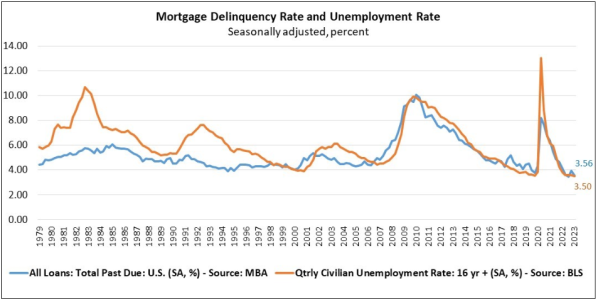
Mortgage delinquency rates fell 3.56% in the first quarter, according to the MBA. This is down 40 basis points from the fourth quarter and 55 basis points from a year ago.

“The mortgage delinquency rate fell to its lowest level for any first quarter since MBA’s survey began in 1979 and was the second lowest quarterly rate overall, just 11 basis points above the survey low in the third quarter of 2022,” said Marina Walsh, CMB, MBA’s Vice President of Industry Analysis. “Mortgage delinquencies and the unemployment rate continue to track each other closely, with the unemployment rate in April falling back to the 54-year low of 3.4 percent set in January. Consistent with the resilient job market, the performance of existing mortgages is exceeding expectations. Across all states, there was an improvement in the first quarter compared to one year ago. Year-over-year delinquencies for all product types – FHA, VA, and conventional – were also down.”

Unemployment and delinquencies correlate pretty tightly:
Fed Governor Michelle Bowman spoke in Germany this morning. Here are her prepared remarks. Her comments were pretty hawkish on monetary policy, and nothing remote suggests rate cuts are coming in the near future, though the Fed Funds futures see cuts as imminent.

In my view, our policy stance is now restrictive, but whether it is sufficiently restrictive to bring inflation down remains uncertain. Some signs of slowing in aggregate demand, lower numbers of job openings and more modest gross domestic product (GDP) growth indicate that we have moved into restrictive territory. But inflation remains much too high, and measures of core inflation have remained persistently elevated, with declining unemployment and ongoing wage growth. And, as senior loan officers signaled beginning last summer, credit has continued to tighten.2 I expect this trend will continue given increased bank funding costs and reduced levels of liquidity.

Should inflation remain high and the labor market remain tight, additional monetary policy tightening will likely be appropriate to attain a sufficiently restrictive stance of monetary policy to lower inflation over time. I also expect that our policy rate will need to remain sufficiently restrictive for some time to bring inflation down and create conditions that will support a sustainably strong labor market.

Morning Report: Another good inflation report

Vital Statistics:

Stocks are lower this morning on no real news. Bonds and MBS are up on the PPI data. The Bank of England hiked by 25 bp this morning.

Inflation at the wholesale level came in at 0.2% month-over-month and increased 2.3% on a year-over-year basis. Ex-food and energy, prices rose 0.2% MOM and 3.4% YOY. These numbers were below expectations, and bonds are rallying on the news.

Initial Jobless Claims rose to 264k last week. You can see in the chart below that the claims are on the way up, after a long period at 50 year lows.

The Fed Funds futures have taken further rate hikes off the table, and are handicapping a roughly 50% chance of a 25 basis point cut at the July meeting.

The FHFA has announced it will rescind the upfront fees based on borrowers’ DTI. “I appreciate the feedback FHFA has received from the mortgage industry and other market participants about the challenges of implementing the DTI ratio-based fee,” said Director Sandra L. Thompson. “To continue this valuable dialogue, FHFA will provide additional transparency on the process for setting the Enterprises’ single-family guarantee fees and will request public input on this issue.”

United Wholesale reported first quarter volume of $22.3 billion, which was a 11% decline from the fourth quarter and 43% decline from a year ago. Gain on sale rebounded to 92 bps from 51 in the fourth quarter. They were still down from 99 bp a year ago. The company forecasts Q2 volume between $23 and $30 billion, with gain on sale margins from 75 to 100 bps.

Western Alliance gave an update on its deposit situation. Total deposits were 49.4 billion, up $1.8 billion from the end of last quarter and up $600 million from last week. Insured deposits are 79% and liquidity covers uninsured deposits by 2x.

PacWest said that deposits fell by 9.5% in the week ended May 5. Available liquidity is about 3x the level of uninsured deposits. The regional banks continue to be under pressure overall, as the S&P SPDR regional bank ETF is down 38% YTD.

Morning Report: Tame CPI cheers markets

Vital Statistics:

Stocks are higher after the Consumer Price Index fell last month. Bonds and MBS are up.

Consumer prices rose 0.4% MOM and 4.9% YOY in April. This was slightly below street estimates. Ex-food and energy, prices rose 0.4% MOM and 5.5% YOY. Shelter was the biggest driver of the increase, followed by used cars and trucks. The shelter component should pretty much disappear as we reach the 2022 peak in house prices in June.

Mortgage applications increased 6.3% last week as purchases rose 5% and refis increased 10%. “Mortgage applications responded positively to a drop in rates last week, as the Fed signaled a potential pause at the current level for the federal funds rate in anticipation of inflation slowing and tightening financial conditions that will slow economic and job growth. Mortgage rates for all surveyed loan types decreased over the week with the 30-year fixed rate at 6.48 percent,” said Joel Kan, MBA’s Vice President and Deputy Chief Economist. “Purchase applications increased 5 percent last week but were still more than 30 percent below last year’s level. Lower rates from week to week have helped buyers in the market, but limited for-sale inventory remains a challenge for many homebuyers. Refinance activity jumped 10 percent to its highest levels since September 2022, although there is only a small pool of borrowers who can benefit from refinancing with rates at these levels.” 

NY Fed Chairman John Williams said that it will take a couple of years for inflation to get back to the Fed’s 2% target. He also cautioned against forecasts for rate cuts this year: “First of all, we haven’t said we’re done raising rates,” Williams told CNBC’s Sara Eisen during a Q&A session after his speech. “We’re going to make sure we’re going to achieve our goals and we’re going to assess what’s happening in our economy and make the decision based on that data. I do not see in my baseline forecast, any reason to cut interest rates this year.”

Loan Depot originated $5 billion in the first quarter of 2023, which was a 23% decrease from the fourth quarter. That said, gain on sale margin increased substantially from 145 to 243 basis points. “The first quarter of this year remained challenging for the housing market as virtually all participants grappled with the impacts of ongoing volatility in mortgage interest rates, persistent cost inflation and the lack of available homes for sale,” said President and Chief Executive Officer Frank Martell. “Although the affordability and availability of new and existing home sales remains challenging for the industry overall, we expect to continue to benefit from seasonally higher revenues and our ongoing cost reduction program. Assuming the expected benefits of continuing seasonal volume increases and cost productivity, we expect to deliver improving financial results over the course of the second and third quarters of 2023.” The company is forecasting for gain on sale to improve again in the second quarter to a range of 240 to 280 basis points.

Morning Report: Lending standards tighten

Vital Statistics:

Stocks are lower this morning on no real news. Bonds and MBS are down.

Banks reported tightening credit standards and weakening demand in the latest Federal Reserve Senior Loan Officer Survey.

“Regarding loans to businesses, survey respondents reported, on balance, tighter standards and weaker demand for commercial and industrial (C&I) loans to large and middle-market firms as well as small firms over the first quarter.2 Meanwhile, banks reported tighter standards and weaker demand for all commercial real estate (CRE) loan categories.”

“For loans to households, banks reported that lending standards tightened across all categories of residential real estate (RRE) loans other than government-sponsored enterprise (GSE)-eligible and government residential mortgages, which remained basically unchanged. Meanwhile, demand weakened for all RRE loan categories. In addition, banks reported tighter standards and weaker demand for home equity lines of credit (HELOCs). Standards tightened for all consumer loan categories; demand weakened for auto and other consumer loans, while it remained basically unchanged for credit cards.”

Small Business Optimism fell again in April, according to the NFIB. The is the sixteenth consecutive reading below the historical average. Quality of labor is the biggest concern, with manufacturing, construction and transportation showing the biggest shortages. Inventories now are too high relative to expected sales. Inflation seems to be waning.

A banking crisis does not appear to be a major risk. The bank failures were not due to bad loans, the usual cause. Defaults will rise as the economy weakens but hopefully not at pandemic levels. The manufacturing sector appears to be in contraction (ISM <50). The service sector is still in growth mode, but much weaker (ISM 51.2, down 3 points). Main street firms have been pessimistic for the last 18 months, with the NFIB Optimism Index at 89 (49 year average = 98). Price raising activity has slowed but remains historically high, and reports of higher labor compensation are sticky at historically high levels. This will make inflation sticky as labor costs are the major operating cost of small firms, especially in the service sector. The economy seems inclined to slow down and this will make raising prices harder and slow inflation. Maybe it’s time for the Fed to pause and let nature (markets) take its course.

Rate lock volume fell 22% in April, according to Black Knight. Part of this is due to more business days in March, however volumes fell 10% even after taking this into account. Overall lock volumes rose 14% over the past 3 months, however they are down about 50% from a year ago.

“Home prices rose a seasonally adjusted 0.45% in March at the national level,” said Walden. “A modest bump in homebuyer demand ran headlong into falling for-sale supply, leading to the third consecutive monthly increase in home prices after they’d been pulling back from recent peaks through the tail end of 2022, essentially nationwide. In fact, just five months ago, prices were declining on a seasonally adjusted month-over-month basis in 92% of all major U.S. markets. Fast forward to March, and the situation has done a literal 180, with prices now rising in 92% of markets from February. Despite the home price strengthening of these past couple of months, the backward-looking annual growth rate continued to cool as the influence of the red-hot spring 2022 market fades in the rearview mirror. Prices are now up just 1.0% year over year, with the annual growth rate on track to fall to roughly 0% by April.  That said, low inventory levels will limit just how far that metric will fall in coming months.”

Morning Report: Regional Banks Rebound

Vital Statistics:

Stocks are higher this morning as the regional banks rally. Bonds and MBS are down.

PacWest cut its dividend to conserve cash, which has caused the stock to rally. Generally dividend cuts are not received well by investors, but PACW is up 21% this morning. Don’t see that too often. Western Alliance is up, along with Comerica and KeyBank.

The week ahead will be generally data-light, with the exception of the consumer price index on Wednesday. The Case-Shiller Home Price Index peaked in June of 2022, so we are pretty close to having the owner’s equivalent rent portion of the CPI fade into the background. The labor market remains super-tight however.

Charlie Munger warned that commercial real estate is going to be a growing problem. ” A lot of real estate isn’t so good any more. We have a lot of troubled office buildings, a lot of troubled shopping centers, a lot of troubled other properties. There’s a lot of agony out there.” Office is clearly a problem, and I don’t see that going away. Apartment supply is elevated as well, especially in urban areas. While nobody is calling this another 2008 problem, valuations are collapsing in the office space.

The pain in the commercial real estate sector, along with the problems with the regional banks will have a further tightening effect on the economy. Credit will become more restricted, which gives the Fed more leeway to stand pat in June. The debt ceiling kabuki theater can also help if the Federal Government manages to actually cut spending. The Federal Government used a lot of fiscal stimulus during the pandemic, and that helped stoke the demand we are seeing now. This is an unappreciated contributing factor to inflation and while the Fed has been taking steps to reduce demand, the Federal government has not.

I am accepting ads for this blog if you would like to make an announcement, highlight something your company is offering or want more visibility. I also offer white-label services which give you the ability to use this content for your own daily emails. The blog has over 5,000 followers and an open rate around 50%. Please feel free to reach out to nyitray@hotmail.com if you would like to discuss this further.

Kelo, 2023 copied right

Will There Finally be Some Development on the Land Condemned in Kelo v. City of New London?

A new development project may finally build new housing on on property whose condemnation for purposes of “economic development” was upheld by the Supreme Court in a controversial 2005 decision.

Ilya Somin | 5.6.2023 5:57 PM

The former site of Susette Kelo’s house, May 2014. Photo by Ilya Somin.

The recent release of Justice John Paul Stevens’ papers have attracted new attention to the Supreme Court’s controversial 2005 ruling in Kelo v. City of New London, the 5-4 decision in which the justices ruled that the condemnation of homes for “private economic development” is permissible under the Takings Clause of the Fifth Amendment, which only allows takings that are for a “public use.” Notoriously, the development project that supposedly justified the condemnations fell through, and nothing was actually built on the property where the dispossessed owners’ homes previously stood. Since the last homeowners were forced out and their houses torn down, the only regular users of the condemned land were a colony of feral cats.

Feral cat on the site of one of the properties condemned in the Kelo case, 2011 (photo by Jackson Kuhl).


That may now be in the process of changing. While I missed the news at the time, in January the Renaissance City Development Association (the private nonprofit development firm formerly known as the New London Development Corporation, which took ownership of the property after it was taken by eminent domain) sold the condemned land to a developer, which may plan to build new housing on it. The New London Day reported some details on January 19:

[A]ll the properties on the Fort Trumbull peninsula are slated for development.

Parcels on the peninsula, which also is home to Fort Trumbull State Park, have been vacant for almost 20 years. The land was cleared for development in a move by the city that led to the landmark 2005 U.S. Supreme Court decision, Kelo v. New London, about the use of eminent domain….

The land is owned and marketed by the city’s development arm, the Renaissance City Development Association.

According to a development agreement between RCDA and RJ Development, parcels labeled 1A and 3C were sold for $500,000 and parcel 4A was sold for $1. The developer agreed to pay a $30,000 deposit to show its commitment.

The agreement states the projects on the property will primarily consist of, but will not be limited to, “the construction of residential units to be offered for market rate sale or rent/lease,” with the associated parking and other improvements.

Parcels 3C (formerly part of a larger unit called Parcel 3) and 4A are the former sites of the residential properties condemned in the Kelo litigation. Susette Kelo’s famous “little pink house,” which became a nationally known symbol of the case, was on 4A.

A later story, published on February 3, provides some additional information, including that the low price of Parcel 4A was because of the “cost of remediating the remaining contamination of soil and groundwater.” That contamination apparently developed during the long period when the parcel lay empty.

I have not been able to find any further  information on what exactly RJ Development plans to build and when construction will be completed. The project is not listed on their website, which does however describe in detail another project they are doing in the area. I have contacted RJ Development to see if they are willing to provide any details. If I learn anything of interest, I will post it right here at the Volokh Conspiracy blog!

Since 2005, several efforts to redevelop the condemned land have fallen through. Hopefully, this one will succeed. But even if it does, I don’t think it will  somehow vindicate the Kelo condemnations. The new development initiative is obviously different from the badly misconceived plan that led to the use of eminent domain over twenty years ago. Moreover, by the time any construction is completed, the land will have lain unused (except by feral cats!) for nearly twenty years. From the standpoint of promoting development, that’s an enormous waste.

The region would almost certainly have been better off economically if the original owners had been allowed to keep living there, paying property taxes, and contributing to the local economy. And that doesn’t even consider the enormous pain and suffering the original development project inflicted on those who lost their homes (including some who sold them “voluntarily” as a result of harassment and the threat of eminent domain). I describe the history of the condemnation process and the harm it inflicted in much more detail in  The Grasping Hand: Kelo v. City of New London and the Limits of Eminent Domain, my book about the Kelo case and its aftermath.

As I have previously emphasized in the book and elsewhere, the flaws in the New London development project don’t necessarily prove that the Court got the Kelo decision wrong. Plenty of unjust and ill-conceived government policies are still legal. But there are in fact compelling reasons to reject the Court’s reasoning, from the standpoint of both originalism and living constitutionalism. At least four current Supreme Court justices have expressed interest in revisiting and possibly overruling Kelo, and I hope it will indeed eventually be overruled. In the meantime, I will do what I can to find out what, if anything, is going to be built on the two parcels.

Morning Report: Another strong jobs report

Vital Statistics:

Stocks are higher after the jobs report. Bonds and MBS are down.

The economy added 253,000 jobs in April, which came in above the 173k estimate. The unemployment rate fell to 3.4%, while average hourly earnings rose 4.4%. The labor force participation rate was unchanged at 62.6% and the employment-population ratio was unchanged at 60.4%.

Overall, this report shows that the Fed’s tightening policy has yet to slow down the labor market much. That said, average hourly earnings and the CPI are trending downward.

Those hoping for the Fed to cut rates in response to the regional banking situation might be disappointed. Former Fed Governor Randy Krozner put it succinctly: The Fed won’t quit until the labor market quits.

The regional banks got slammed again yesterday, with PacWest down another 50% and Western Alliance down 38%. There was a piece in the Financial Times about Western Alliance supposedly exploring strategical alternatives, which the company denied. Given the strong liquidity of some of these banks, the rout in the regional banks seem to be overdone. The regional banks are up pre-market.

The Biden Administration is closely watching the situation in the regional banks looking for evidence of market manipulation by short-sellers. SEC Chairman Gary Gensler put out a statement saying: “As I’ve said, in times of increased volatility and uncertainty, the SEC is particularly focused on identifying and prosecuting any form of misconduct that might threaten investors, capital formation, or the markets more broadly.”

Morning Report: The Fed signals a pause in rate hikes

Vital Statistics:

Happy Dave Brubeck Day. Stocks are lower this morning as regional bank fears continue to simmer. Bonds and MBS are up.

As expected, the FOMC hiked the Fed Funds rate by 25 basis points and signaled they are ready to pause. It removed language referring to further tightening of policy. During the press conference, Powell pushed back on the idea that the Fed was ready to cut rates. If you look strictly at the dual mandate, that makes sense. On a scale of 1-10, the labor market is at a 9.8, while inflation remains way too high. He acknowledged that it will take a while to get us down to 2% inflation, but emphasized the Fed isn’t willing to relax that target to something like 3%. FWIW, inflation averaged about 3% from 1985 – 2000 and I think most people would regard that time period as pretty comfortable economically.

The bond market was already strong due to the regional bank situation, with PacWest falling 50%, so there wasn’t much reaction to the new language on the long end, although the 2 year did rally on the announcement. The Fed Funds futures are now predicting the Fed will do nothing at the June meeting, and there is a 50-50 chance of a rate cut at the July meeting. The futures are not factoring in any more rate hikes, and they see 75 basis points of easing by the end of the year.

Nonfarm productivity fell 2.7% in the first quarter as output rose 0.2% and hours worked increased 3%. Compared to a year ago, productivity fell 0.9%. Unit labor costs rose 6.3%. Productivity is an inflation-killer, so this is bad news for the Fed.

The regional banks are getting slugged again today, with PacWest down another 40%, and First Horizon down big after its merger with TD bank is terminated. Western Alliance is down despite a press release that updated the markets on its deposit situation. Zions is down as well. If anything will push the Fed to cut rates, this is going to be the catalyst.

Job cuts in April fell 25% month-over-month to 66.995. They are still triple the number they were a year ago. Retail led, along with technology. Separately, initial jobless claims rose to 242k.

Mortgage applications decreased last week as purchases fell 2% and refis fell 1%. “Mortgage applications decreased last week, despite rates declining slightly for the first time in three weeks. The 30-year fixed rate decreased five basis points to 6.5 percent, which is still 114 basis points higher than a year ago,” said Joel Kan, MBA’s Vice President and Deputy Chief Economist. “Elevated rates continue to both impact homebuyer affordability and weaken demand for refinancing. Home purchase activity has been very sensitive to rates and local market trends, including the very low supply of existing-home inventory. However, newly constructed homes account for a growing share of inventory, giving more options for prospective buyers. The jumbo-conforming spread continues to narrow, an indication that there is reduced lender appetite for jumbo loans following the recent turmoil in the banking sector and heightened concerns about liquidity. The spread was 13 basis points last week, after being as wide as 64 basis points in November 2022.”

Morning Report: Awaiting the Fed

Vital Statistics:

Stocks are higher as we await the FOMC decision. Bonds and MBS are up.

The FOMC decision is due at 2:00 pm today. Investors will be looking for language that suggests a pause in rate hikes. We are seeing more Fed officials call for a pause given the First Republic situation. The Fed Funds futures are overwhelmingly predicting 25 basis points today, but the June futures are now assigning a below 10% chance of another 25. Late last week, that number was about 25%.

Larry Summers was interviewed on Bloomberg TV yesterday, and the interviewer asked about reports that up to half of US banks would have negative equity if everything was marked to market. I personally have not seen such reports, but that is a remarkable statistic if true.

Larry’s answer didn’t push back against that claim, however he called it somewhat alarmist because it didn’t take into account that many banks have deposit rates below the interest rate earned on these Treasuries and MBS assets, so they are earning a spread and that below-market rate deposits could be considered asset-like. Of course the problem with that theory is that the bank isn’t in control of that asset. It doesn’t get to determine whether it stays on the balance sheet – the depositor does.

Ultimately, we are talking about Treasuries and MBS and these assets are money good. Now commercial real estate (especially office) is struggling and that could dent the banks.

The economy added 296,000 jobs in April, according to the ADP Employment Report. This was well above expectations and is higher than the forecast for Friday’s jobs report. Pay gains overall rose 6.7%, although the pace of gains is moderating. Job changers saw an increase of 13.2%, a percentage point lower than the previous month and the lowest level since November 2021.

“The slowdown in pay growth gives the clearest signal of what’s going on in the labor market right now,” said Nela Richardson, chief economist, ADP. Employers are hiring aggressively while holding pay gains in check as workers come off the sidelines. Our data also shows fewer people are switching jobs.”

Manufacturing jobs fell, as did professional and business services. Leisure and hospitality accounted for over half the job gains.

Between the banking situation and the inflation situation, the Fed is in a bind. The surest way to fix the banking system is to lower rates, while the inflation situation is not fixed yet. The easiest path is probably to pause and wait to see how things shake out.

The services economy improved in April, according to the ISM Services Index. Employment decelerated, while new orders increased. Prices advanced as well. “There has been a slight uptick in the rate of growth for the services sector, due mostly to the increase in new orders and ongoing improvements in both capacity and supply logistics. The majority of respondents are mostly positive about business conditions; however, some respondents are wary of potential headwinds associated with inflation and an economic slowdown.”

Morning Report: Job openings fall

Vital Statistics:

Stocks are lower as we begin the FOMC meeting. Bonds and MBS are down.

Construction spending rose 0.3% MOM in February, according to Census. This was up 3.8% compared to a year ago. Residential construction spending was down 0.2% MOM and 10% on a YOY basis. It is interesting how much single family and multi-family construction spending has diverged.

Lending Tree is down some 22% this morning after reporting a disappointing quarter. Mortgage revenues were down big, but home equity was a bright spot. Given the home affordability problems as well as the lock-in effect (i.e. hate the house, love the mortgage) we are probably going to see more emphasis on reno products, and HELOCs are another good way to do some business while we wait for rates to fall.

Your business runs on financing plus so much more. That’s why Western Alliance Bank’s Specialized Mortgage Services team is standing ready to tailor a suite of banking solutions to your needs, from a strong, stable institution that truly values your business. Our experienced, responsive relationship bankers and treasury management professionals help keep your accounts running smoothly. You’ll find trusted options for treasury management as well as flexible options for warehouse lending, MSR financing, note financing and other mortgage finance products, with speed to approval and certainty of execution. Our products also enable you to conveniently manage custodial and payroll accounts and originate streamlined online wire transfers while taking advantage of competitive rates for business banking.

Our client Ali Vafai, President of The Money Source Inc., says, “Western Alliance is known in the industry as a bank that acts like a partner. It’s one of the main reasons we selected them to do business. And we can say unequivocally that they truly are a great partner. They are transparent, collaborative and always working toward mutually beneficial growth and benefit. It’s reassuring knowing that you have a bank that cares as much about your interests as theirs.”

We’d love to discuss how the powerful combination of Western Alliance treasury management solutions along with traditional warehouse lending, MSR financing, note financing and other mortgage finance products can benefit you. Please contact Jennifer Schachterle (720) 261-5774, Mark Short (469) 702-6212, Chris Martin (480) 341-5483 or Nick Richards (646) 708-1211. Western Alliance Bank, Member FDIC.

The number of job openings decreased to 9.6 million, according to the latest JOLTS jobs report. This was down 384,000 from February and 1.6 million from December 31. The quits rate, which tends to predict wage inflation, fell to 2.5%. The quits rate was 2.9% a year ago.

The job openings rates were highest in leisure / hospitality, especially arts and entertainment. I guess the world needs more poets.