Morning Report: Markets still ignoring DC show 3/6/17

Vital Statistics:

Last Change
S&P Futures 2373.8 -7.5
Eurostoxx Index 373.6 -1.6
Oil (WTI) 53.2 -0.1
US dollar index 91.5  
10 Year Govt Bond Yield 2.48%
Current Coupon Fannie Mae TBA 101.86
Current Coupon Ginnie Mae TBA 103.19
30 Year Fixed Rate Mortgage 4.19

Stocks are lower this morning on overseas weakness. Bonds and MBS are flat.

Fed Funds futures are now fully pricing in a 25 basis point hike at next week’s FOMC meeting. Now that we are in the quiet period, the only market-moving data should be late this week when we get productivity and the jobs report.

Consumer spending has almost fully recovered from the Great Recession, with the February number coming in at $101, the strongest February since 2008.

Factory orders increased 1.2% in January. Consensus was for a 1.1% increase.

Over the weekend, the war between Democrats and Trump intensified, with Democrats calling for Attorney General Jeff Sessions to resign and Trump accusing the Obama administration of tapping the phones of Trump Tower. So far, markets are basically ignoring all of this as a sideshow. IMO, markets are sanguine about this simply because the deepening partisanship makes gridlock even more likely, and therefore a lot of the uncertainty is taken off the table. When and if that ever changes, the canary in the coal mine should be the dollar.

Prepay speeds dropped by 30% in January, according to the Black Knight Financial Services Mortgage Monitor. Delinquencies declined by 4% versus December and are down 17% YOY. That said, foreclosure starts increased largely due to seasonal effects. Note the decline in prepayments was not uniform across the credit spectrum: 720+ FICO prepays declined by 32%, while sub 620 FICO prepays fell by 10%. Even with rates up here, it still makes sense for some borrowers to do cash-out refis in order to consolidate higher interest rate debt like credit cards.

What should you do if you are upside down on your home? Zillow has you covered.

Morning Report: Stocks and bonds telling a different story?3/3/17

Vital Statistics:

Last Change
S&P Futures 2379.0 -3.0
Eurostoxx Index 374.5 -1.1
Oil (WTI) 52.8 0.2
US dollar index 91.8
10 Year Govt Bond Yield 2.49%
Current Coupon Fannie Mae TBA 101.72
Current Coupon Ginnie Mae TBA 103.15
30 Year Fixed Rate Mortgage 4.09

Stocks are still taking a breather after a nice run. Bonds and MBS are down.

The focus today will be all of the Fed-speak, with Janet Yellen and Stanley Fischer speaking around lunchtime. The Fed enters their quiet period ahead of the March FOMC meeting tomorrow. The markets have gone from pricing a March hike as a 30% chance to an almost certainty over the past several weeks.

The ISM Non-Manufacturing index improved in January, as business activity and new orders (especially exports) led the charge. Employment ticked up slightly. The reading of 57.6 was the highest since October 2015.

Ben Carson was confirmed as the new HUD Secretary yesterday on a 58-41 vote. HUD probably won’t have a lot to do with GSE reform, as that is largely a Treasury function. Ben Carson is a neurosurgeon by trade, and his public record on housing was limited to an editorial criticizing Obama’s enforcement of the Fair Housing Act. During his hearing, however he praised the Fair Housing Act as an important piece of legislation. The safety of public housing is a priority for him, and he plans to increase HUD’s efforts to eliminate lead paint, mold, etc from public housing. He wants to continue to advance HUD’s mission of financing low income / credit / first time homebuyers while introducing private capital and protecting taxpayers.

Snap priced its IPO yesterday, where it had a 44% gain on the first day of trading. Many IPOs lately have not seen a big pop on day 1, so this is a bit of an anomaly. The lack of big gains from IPOs represents the drop in commission revenue and the balance of power between issuers and the buy side (a big jump in price on the first day means that the IPO was underpriced and the issuer is leaving money on the table). In the past, the banks were more worried about keeping the big mutual funds happy since they were a steady source of commission revenue, while issuers would typically do a deal and then go away for a while. Nowadays, commissions are basically nothing, so banks are more concerned with keeping issuers happy than they are with keeping, say Fidelity happy. When I started in the business, commissions were 5 cents a share, and bid-ask spreads were an eighth. Today, commissions are less than half a penny a share and bid-ask spreads are 1/10 of a cent on big liquid stocks.

As a general rule, when the stock price is telling you one thing and the bonds are telling you another, go with what the bonds are telling you. We are seeing a bit of that right now with stocks and bonds – as stocks are off to the races on the reflation trade, bonds have been in a range post-election. Bonds are saying either (a) fiscal stimulus is not going to happen or (b) fiscal stimulus isn’t going to work. That is certainly a fair take, and I do think rates have gotten a bit ahead of themselves. On the other hand, interest rates have been so heavily manipulated by central banks over the past decade, that the signal-to-noise ratio is lower than normal. Ultimately this is a criticism of monetary policy has gotten short shrift in the public debate: that interest rates are an important signal that the economy uses to allocate capital. When central banks manipulate rates to help goose the economy, those signals are distorted, and the typical effect is a bubble. Keynes and Hayek explain it to you here.

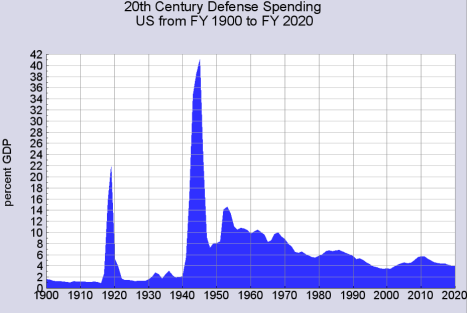
One of Donald Trump’s plans is to increase defense spending. The proposed increase is anywhere from $20 billion to $54 billion, from the current $582 billion level (or 3.1% of GDP). Here is a chart of defense spending over the past century as a percent of GDP in order to put current levels into perspective:

defense-spending

Solid tips for doing your taxes this year.

Morning Report: Initial Jobless Claims at 44 year low 3/2/17

Vital Statistics:

Last Change
S&P Futures 2394.0 0.5
Eurostoxx Index 375.9 0.2
Oil (WTI) 53.0 -0.9
US dollar index 91.9  
10 Year Govt Bond Yield 2.47%
Current Coupon Fannie Mae TBA 101.88
Current Coupon Ginnie Mae TBA 103.28
30 Year Fixed Rate Mortgage 4.09

Stocks are flat this morning on no real news. Bonds and MBS are down small after Fed dove Lael Brainard suggested rates should rise soon.

The Fed funds futures are now assigning a 90% probability of a rate hike at the next FOMC meeting. It was only 30% or so just a few weeks ago.

Fed watcher Tim Duy has a good piece on the Fed’s balancing act and how it relates to November. He was in the “two hikes with an option for a third” camp and thinks the Fed will stand pat in March. He raises a good point on the December dot plot that freaked out bond investors: the most hawkish members that contributed to that plot are non-voters.

Initial Jobless Claims fell to 223k last week, which was the lowest level in 44 years. When you correct for population growth, we are in uncharted territory.

Snapchat priced their IPO at $17 a share yesterday. The company sports a modest 21.4x sales multiple.

Consumer Comfort improved last week, and is at the highest since early 2007.

Donald Trump seems to be settling in on picking Kevin Hassett from the American Enterprise Institute to lead his Council of Economic Advisors. Hassett is known for supporting a “New Deal” style program where the government provides jobs to the long term unemployed. His rationale is that the government gets some value in return, it makes the LT unemployed more attractive to private sector companies, and it probably reduces crime.

While robotics have been displacing manual labor jobs for quite some time, artificial intelligence is replacing white collar jobs as well. In fact, the two professions that have been most insulated from the globalization wrecking ball (law and medicine) are ripe for machine learning and AI. Much of what I used to do as a trader 15 years ago is now completely done by algorithms. This is probably the single biggest reason why wage growth is so hard to find – the competitor to human labor only gets cheaper and better.

As we approach tax season, it pays to look at some of the tax benefits of buying. In 2016, however several tax benefits expired, including the deduction for mortgage insurance, the tax free treatment for forgiven mortgage debt, and the tax break for “green” energy home improvements. The new administration and Congress are looking to simplify the tax code, which means ending some of the social engineering pieces like the green energy home improvements mentioned above. The gist is that tax rates will be lowered, however deductions will be eliminated, and the standard deduction will increase. The mortgage interest deduction, and the deduction for state and local taxes will have the biggest effects.

Morning Report: Risk on feel after Trump speech 3/1/17

Vital Statistics:

Last Change
S&P Futures 2379.5 16.8
Eurostoxx Index 374.6 4.4
Oil (WTI) 54.1 0.1
US dollar index 91.7
10 Year Govt Bond Yield 2.46%
Current Coupon Fannie Mae TBA 101.91
Current Coupon Ginnie Mae TBA 103.41
30 Year Fixed Rate Mortgage 4.09

We have green on the screen this morning as markets liked Donald Trump’s speech to Congress last night. Bonds and MBS are down.

Donald Trump addressed Congress last night (it wasn’t a full-on State of the Union address), and laid out broad brush strokes about his priorities going forward, including tax reform and healthcare. Generally speaking, the speech was well-received, although those looking for policy depth were disappointed. Here is a transcript. Regardless, equity markets liked what they heard and we are off to the races this morning.

On the bond side of things, yields continue to increase, particularly on shorter-term paper as markets handicap a March hike. The 2 year bond now yields 1.31%, which is a post-crisis record.

Mortgage Applications rose 5.8% last week as purchases rose 7% and refis rose 5%. Refis accounted for just over 45% of all applications last week, the lowest since 2008.

Personal incomes rose 0.4% in January, a little better than expected, while personal spending rose 0.2%, which was a little lower than expected. The Personal Consumption Expenditure index, which the Fed prefers to use, rose 1.9% YOY. The core PCE index which excludes food and energy rose 1.7% YOY. Note that the PCE index is generally about 30 basis points behind the Consumer Price Index, simply because of the difference in weightings. Note that the second revision of GDP from yesterday had PCE inflation at 2.2% at the end of December, so we are seeing a deceleration in January.

Manufacturing improved in February, according to the ISM Manufacturing Survey. New Orders rose, while employment fell. The reading for February of 57.7 would typically correspond to a GDP growth rate of 4.5%. While manufacturing isn’t the driver of the economy that it used to be, this is still good news for growth going forward, especially after a pretty weak 2016.

Construction spending fell 1% in January and is up 3.1% on a YOY basis. Residential construction rose 0.3% and is up 5.5% YOY. Donald Trump plans to add $1 trillion in construction spending, although he does not say over what period. As we learned from the Obama stimulus of 2009, infrastructure spending has a long lead time. That said, take a look at the chart below, which is of public construction spending. We have averaged about $300 billion a year in public construction spending over the past 10 years or so, which means an additional trillion over something like 4 years amounts to almost doubling public construction spending. This would mean public construction spending as a percent of GDP would be at a 50 year high.

Delinquency rates continue to fall according to Freddie Mac. The seriously delinquent rate fell below 1% in January, which is down from 1.33% a year ago. The rate peaked in 2010 at 4.2%. Pre-bubble, seriously delinquent rates were in the 60-80 basis point range.