Morning Report: Don’t believe the Chinese stock market indices 7/8/15

Stocks are lower this morning as the sell-off continues in Asia. Bonds and MBS are up small.

Mortgage Applications increased 4.6% last week as purchases increased 6.6% and refis rose 2.7%. Good numbers considering last week was only 4 days.

We will get the FOMC minutes later this afternoon. The items of interest will be the big downward revision in GDP forecasts, and of course any references to Greece. The China situation really was not ripe at that point, so I don’t expect any mention there.

The EU put Greece on the clock, giving them until Saturday to come up with an agreement to stay in the EU. Europe has “a Grexit scenario prepared in detail,” European Commission President Jean-Claude Juncker said last night. Risk arbitrageurs have a term for this: showing them the downside. That is exactly what the EU is doing. The Greek ATMs are limiting withdrawals, however the Greeks have been taking out money for over 6 months, so most of them have an adequate cushion of cash at least for the time being. It won’t last forever, and the EU is pushing the Greeks to make the necessary reforms to stay in the EU. While we haven’t hit Venezuelan type shortages of goods, they are probably a month away.

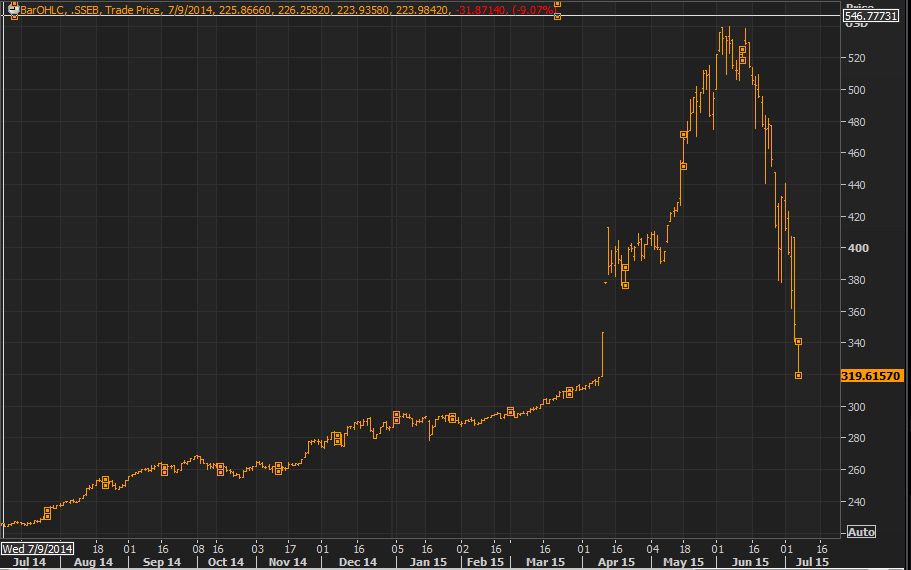
Fun Chinese stock market fact: Last night the Shanghai composite fell 6%. Between the 1,331 stocks that are suspended, and the 747 shares that fell their daily 10% limit, approximately 72% of the index is non-tradeable. The A share index (which only Chinese can invest in) is down 33% since mid-June. The B share index (which foreigners can trade) is down around 43%. So when you hear someone point out that we are really only back to March levels, point out the index level is meaningless right now because 72% of the stocks aren’t trading. Oh, and the Chinese government ordered anyone with a 5% position in any company to not sell for 6 months. This is going to be a titanic battle of wills between Mr. Market and Communist Government.

Don’t forget, any economic pain in China due to the sell-off is going to be felt in commodity prices, which are already reflecting the sell-off. That will be deflationary, which the Fed fears more than inflation. IMO, unless something changes dramatically, the Fed isn’t moving in September. If they truly mean it when they say they are being data-driven, the data is screaming: wait to see what happens first. Even if they do raise the Fed Funds rate a symbolic 25 basis points, just to get off the zero bound, I don’t see how the long end of the curve moves all that much, if at all. Which means mortgage rates are probably not going to be affected.

The Obama administration has ordered HUD to re-integrate neighborhoods, using Federal funding as a carrot. LOs start thinking about FHA opportunities in areas that haven’t historically been jumbo territory. That said, I don’t know how many affluent areas get HUD grants in the first place so not sure how effective that will be. But, it might be an opportunity.

Morning Report – Chinese Stocks Collapsing 7/7/15

Markets are higher this morning as Europe and Greece still try and to seek a solution. Bonds and MBS are up.

Greece and their creditors are basically searching for a way to finance Greece’s next payment (about 3.5 billion euros) to the ECB which is due on July 20. If they default, the die is more or less cast. The final result of this negotiation will not be a bailout, but just a liquidity injection to keep things going for another month. The Greek banks have deferred tax assets and Greek government debt as their capital. They are cut off from global credit markets and have been closed to prevent a bank run. The banking system will have to be nationalized and the Greek government will have to issue some sort of scrip to pay people.

If it weren’t for the Greek Crisis, everyone would be talking about what is going on in China. Their stock market is collapsing, with the Shanghai Composite B share index down 40% in a month.  The Chinese government has been pulling out all the stops to try and support the market – cutting interest rates, increasing liquidity, creating a stock fund to buy up stocks to support the market – and none of it has been working. The Shanghia Composite B-share index dropped another 9% last night as margin traders get liquidated. To stop the selling, the Chinese government has basically suspended trading in 26% of the stocks on the Chinese exchange. Of course this does nothing but delay the inevitable. Chart: Shanghai Composite (B-shares)

Between the Greek and Chinese situations, bonds should be heading higher. We are already seeing the German Bund rally, with the yield having dropped from just over 1% to 66 basis points over the past month. Relative value trades should work US Treasuries higher as well. US investors (and loan officers) should brace themselves for a bumpy ride as the situation in Greece is hardly settled, China is a falling knife, and the Fed is in rate hike mode. Global financial stress is bond bullish, while the Fed’s posture is bond bearish. LOs, tell your borrowers they are playing with fire if they are floating.

That said, I think the overall medium term effect of the stress will be to push rates lower on the flight to safety trade. A struggling China will try and use exports to stimulate their economy, which means the US will be importing deflation. The last thing the Fed will want to do in that situation is to raise rates. As an added bonus, you could see renewed buying in MBS as investors reach for government guaranteed yield. TBA spreads to Treasuries could narrow, which means that mortgage rates could fall as fast or faster than Treasury yields. IMO, the Treasury market has been fading the moves overseas and is behind the curve.

Job openings hit 5.36 million in May, another record in the JOLTS Job Openings index. There definitely seems to be a mismatch between what employers want (someone with the wisdom of a 50 year old, the efficiency of a 40 year old, the drive of a 30 year old and the paycheck of a 20 year old) and what is actually available in the labor market.

Morning Report: Greferendum No 7/6/15

Stocks are down after Greece voted down further austerity. Bonds and MBS are up.

The jobs report last Thursday was okay for the most part. The labor force participation rate hit a new low, however.

The ISM Non-Manufacturing Index came in a little light, but was generally strong. Business Activity accelerated, however that was offset by weakening employment growth. Employment activity in the services sector has been decelerating for months.

The week after the jobs report is usually pretty data-light and this week is no exception. The highlight will be the FOMC minutes on Wednesday.

The immediate fallout of the crisis should be bond (and MBS) bullish. US stocks are down in sympathy with global markets, but there should be almost no exposure here. The ECB will probably take additional measures to boost markets via QE, so that should be stock and bond bullish here.

On to the next crisis, which is the bursting of the Chinese stock and real estate bubbles. China’s government is pulling out all the stops trying to support stock prices (the invisible hand meets the iron fist). In many ways it it reminiscent of the Japanese government in the 1990s, where they tried to artificially support markets through “price keeping operations.” Of course these measures inevitably prevent necessary adjustments from occurring, which is why Japan has stayed in economic stagnation for over a generation.

The Chinese situation has more potential to affect US markets than Greece. Chinese money is behind a lot of the price appreciation in the cities, especially at the high end. Whether it stays or goes will be dependent on what the Chinese government wants.

The long, slow death of a Republic 7/4/15

Three years ago I contributed several pieces to a 4th of July series here at ATiM celebrating American independence. I had hoped they would provide some sense of the way I feel about the birth of America, and perhaps spark those feelings in others, especially about the Founding Fathers who made that birth not only possible at all but an actual reality. Usually when I contemplate the birth of the US on Independence Day, I am genuinely filled with a mixture of gratitude, responsibility, and pride. Gratitude to both the people who risked, and sometimes gave, their lives to make it all happen, and to Providence (to use the lingo of the Founders) for landing me in this, a singular nation with an identity grounded not just in history but in unique philosophical ideals. Responsibility to help protect the legacy that has been given to us. And pride in knowing just what it is that has made this a nation of such promise. This year, however, I feel quite different.

When Ben Franklin left Independence Hall at the end of the Constitutional Convention in 1787, he was asked by a woman outside “Well, Doctor, what have we got? A monarchy or a republic?” Franklin replied “A republic. If you can keep it.” The implication of Franklin’s response was prophetic.

A republic is defined as “a state or nation in which the supreme power rests in all the citizens entitled to vote and is exercised by representatives elected, directly or indirectly, by them and responsible to them.” And it is certainly true that we retain the forms, the institutional manifestations, of the Republic that Franklin and his fellow delegates created. We still have a legislative branch comprised of two elected houses of congress. We still have an executive branch headed by an elected president. We still have a judicial branch headed by a Supreme Court comprised of 9 judges, appointed by the president and approved by congress. We still have the several states, with their own constitutions and forms of government. But we no longer operate under true republican rule, nor are the people any longer committed to protecting against the things that the structure of our government was supposed to protect against. Hence while we retain the forms of a republic, we have forfeited the substance of what it means to be a republic, and have become a nation of the ruled.

In 1887 congress, in its infinite wisdom, decided to create the Interstate Commerce Commission, the first regulatory agency in the nation. Nearly 130 years later we now have countless federal agencies. And I mean literally countless. Any attempt to identify exactly how many federal agencies now exist proves fruitless. Some lists will be qualified as “major” regulatory agencies, so as to be able to provide a definitive list. (14 regulatory agencies on that one.) Others, such as Wikipedia, settle for providing “examples” (28 of them) of “independent” agencies – not to be confused with independent regulatory agencies, it reminds us – a comprehensive list, apparently, being impossible to provide. A totally different Wikipedia entry on federal agencies explains the problem:

Legislative definitions of a federal agency are varied, and even contradictory, and the official United States Government Manual offers no definition. While the Administrative Procedure Act definition of “agency” applies to most executive branch agencies, Congress may define an agency however it chooses in enabling legislation, and subsequent litigation, often involving the Freedom of Information Act and the Government in the Sunshine Act, further cloud attempts to enumerate a list of agencies.

And these agencies, however many there actually are, are not populated with elected representatives. They are comprised of both career bureaucrats and political appointees. They are not us.

It is certainly the case that many of these agencies don’t really exercise any real power. For example the US Women’s Bureau, enabled by Public Law 66-259; 29 U.S.C. 11-16.29, doesn’t seem to do much of anything noteworthy except provide a living for its employees. But many others exercise nearly unchecked power to make laws which are never voted on by congress. The people, us, have virtually no say over these laws. The administrative state rules us. We do not rule it.

Defenders of the administrative state will say that is bunk. They will say that we have authorized these agencies through congress, and that they are merely enforcing laws that congress has written. They will also say that the agencies are not making law, but rather establishing “rules” that define their enforcement policies. That is indeed how the administrative state justifies its existence under a constitution that neither contemplates nor authorizes the existence of a law-making bureaucracy. But reality on the ground shows that it is that justification that is bunk.

An example. The Environmental Protection Agency is right now promulgating “rules” regulating carbon dioxide emissions. It does so ostensibly under the authority of the Clean Air Act which requires regulation of “air pollutants”. The Clean Air Act was written and passed in 1963. For over 40 years no one, not the original authors of the act, not any subsequent congress, not “the people”, not even the EPA itself thought of carbon dioxide as an “air pollutant”. Which is not a surprise at all. Pollution is defined as “the introduction of contaminants into the natural environment that cause adverse change.” But carbon dioxide is a naturally occurring gas the presence of which is vital to life on earth. It is naturally produced by all living beings that have lungs, through the simple act of breathing. It is absorbed by plants during photosynthesis. It is, again, essential to the existence of life on earth.

But due to the rise of “climate change” alarmism, carbon dioxide has now been classified by he EPA as an “air pollutant”. There was no vote. No congressional law. No popular referendum. In fact it wasn’t even the EPA itself that originally designated it as a air pollutant under its authority. It was sued by 11 states which claimed the the Clean Air Act required the EPA to regulate carbon emissions, and despite losing in the lower courts, by a 5-4 vote the Supreme Court ruled in favor of the plaintiffs, forcing the EPA into regulation. Of course, under a new administration that promotes climate alarmism, the EPA has embraced its newfound ability to write legislation regulating carbon. But it is perfectly clear that it is, in fact, writing legislation, not simply enforcing existing law. President Obama essentially ended any pretense to the contrary when he demanded that congress either pass carbon related climate change legislation or face the threat of him doing it unilaterally via the EPA. Which he has now done. One doesn’t ask for new legislation to enforce if one thinks that it already exists and needs to be enforced. The notion that Obama is just enforcing existing law is an obvious ruse.

That is just one particularly infamous example, but this is how the administrative state routinely operates, on big issues and small, constantly writing and re-writing the “rules” to impose whatever desires it currently might have, regardless of whether or not the law itself has changed, and often precisely because the law hasn’t been changed. There are so many regulatory actions that it is impossible for the average citizen to have any idea what his government is doing. The Federal Register publishes between 2,500 and 4,500 new “rules” every single year. The effects of these regulations, laws really, permeates every area of American life. There is not an industry in existence that is left untouched by the federal bureaucracy. Even the most basic and simple of our daily actions are governed by regulatory “rules”.

In Federalist 62 James Madison wrote:

It will be of little avail to the people that the laws are made by men of their own choice if the laws be so voluminous that they cannot be read, or so incoherent that they cannot be understood.

The federal bureaucracy fails on both fronts. Not only is it making laws so voluminous and incoherent that they cannot be read or understood (or even known, to be honest) by the people, but they aren’t even made by men of their own choice. It would be easy to blame this on the institutions of government itself, and certainly there is blame to be laid there. Presidents have routinely expanded executive power through the creative use of the federal bureaucracy. Congress could stop it if wanted to by simply passing laws eliminating the agencies, but instead it does the opposite, not only creating more agencies but writing deliberately vague legislation that invites regulatory agencies to fill in the blanks with its own will. And the Supreme Court has long since ceased apply the law or constitution, choosing instead to rule based on political preferences.

But the real fault lies in we the people. It was the people that elected Franklin Roosevelt 4 times despite his expansive and unconstitutional use and abuse of the federal regulatory bureaucracy to do things that congress would not do. It is the people that elected Barack Obama twice, despite his open contempt for congress’ role as the voice of the people, proclaiming “We’re not just going to be waiting for legislation in order to make sure that we’re providing Americans the kind of help they need. I’ve got a pen and I’ve got a phone.” It is the people that elected a congress that thinks that knowing what is in legislation is what comes after having passed it. Franklin’s cynicism about the people was well founded. He gave us a Republic and we have frittered it away.

On this Fourth of July, our Independence Day, it might be useful to read through the Declaration of Independence, and remember what its purpose was. It was not merely a declaration of America’s independence from Britain, but it was also a justification for the Declaration itself. While the first few lines are the most remembered from grade school civics lessons, the body of the document is comprised largely of a list of transgressions that King George III was said to have rained down upon the colonists, compelling them to revolt. It is worth noting one of them in particular.

He has erected a multitude of New Offices, and sent hither swarms of Officers to harrass our people, and eat out their substance.

A better description of the modern regulatory state has never been written. It is high time we took Jefferson’s lead and declare our independence from it.

Continental Congress Votes for Independence 7/2/15

On this day in 1776, the Second Continental Congress, assembled in Philadelphia, formally adopts Richard Henry Lee’s resolution for independence from Great Britain. The vote is unanimous, with only New York abstaining.

The resolution had originally been presented to Congress on June 7, but it soon became clear that New York, New Jersey, Pennsylvania, Delaware, Maryland and South Carolina were as yet unwilling to declare independence, though they would likely be ready to vote in favor of a break with England in due course. Thus, Congress agreed to delay the vote on Lee’s Resolution until July 1. In the intervening period, Congress appointed a committee to draft a formal declaration of independence. Its members were John Adams of Massachusetts, Benjamin Franklin of Pennsylvania, Roger Sherman of Connecticut, Robert R. Livingston of New York and Thomas Jefferson of Virginia. Thomas Jefferson, well-known to be the best writer of the group, was selected to be the primary author of the document, which was presented to Congress for review on June 28, 1776.

On July 1, 1776, debate on the Lee Resolution resumed as planned, with a majority of the delegates favoring the resolution. Congress thought it of the utmost importance that independence be unanimously proclaimed. To ensure this, they delayed the final vote until July 2, when 12 colonial delegations voted in favor of it, with the New York delegates abstaining, unsure of how their constituents would wish them to vote. John Adams wrote that July 2 would be celebrated as the most memorable event in the history of America. Instead, the day has been largely forgotten in favor of July 4, when Jefferson’s edited Declaration of Independence was adopted.

Hancock’s words have been added as the quotation of the day.

Morning Report: Greece officially defaults 7/1/15

Stocks are up smartly this morning on stronger economic data and the prospect of a solution in Greece. Bonds and MBS are down.

Mortgage Applications fell 4.7% last week as interest rates spiked on the strong personal spending data. Purchase applications fell 4.1% while refis dropped 5.2%. The average 30 year fixed rate mortgage rose to 4.26%.

The ADP employment survey reported that 237k jobs were created in June, higher than the 218k forecast. The Street is forecasting a rise of 230k for the jobs report tomorrow. Challenger job cuts rose to 44k.

Fed St. Louis President James Bullard spoke last night and said the Fed should consider raising rates at the Sep meeting given the strength of the latest economic data.

Vehicle sales will be coming in all day. Early returns are disappointing.

Construction spending rose .8% in May, beating the .5% estimate. Residential construction rose .3%.

The ISM Manufacturing Index rose in June from 52.8 to 53.5. A reading over 50 indicates expansion. This is good news as the decline in oil prices had depressed activity in the oil patch. New orders and employment drove the increase. The 53.5 reading would typically correspond to a GDP growth rate of 3.3%.

Last night, Greece became the first advanced economy to officially default on an IMF loan. Most Greek banks are out of money, and pensioners who are used to getting 600 euros for the month are being given less than a quarter of that – about 120 euros. ATM deposits are being limited to 60 euros a day. The first snap poll of Greek citizens has pretty convincingly rejected the EU’s offer – 53% “no”, 33% yes.

Greece has told Europe that the latest offer comprises the basis of a compromise. The Europeans are going to wait until the results of the referendum are out on July 5. If the voters say “no” to the European demands, Greece will have no other option than to print its own currency to pay workers and pensioners. IMO, a Greek exit will be bond bullish, as it will probably force a policy response out of the ECB and that means more QE.

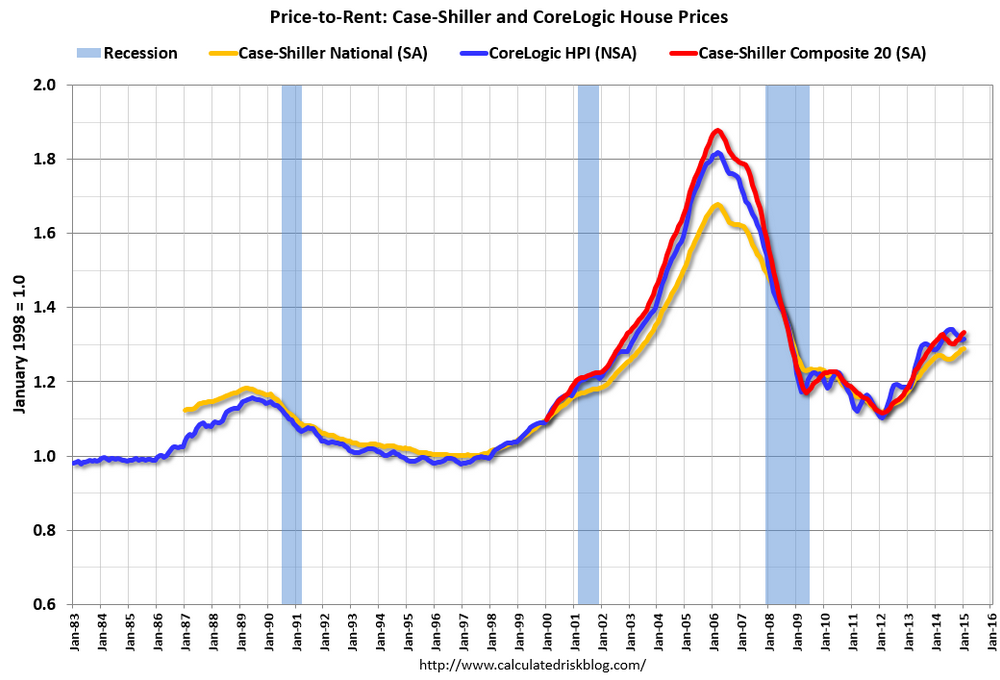
While home prices still remain affordable compared to the bubble years, low inventory has pushed up the price / rent ratio. We are back to late 2003 levels. On a nominal (in other words, non-inflation adjusted basis), prices are approaching peak levels, but on an inflation adjusted basis, they still have a ways to go. Of course wage inflation remains muted, so that will act as a drag on home price appreciation, or at least affordability.

The latest CoreLogic Market Pulse is out, and it has some good stuff on the state of the housing economy. They discuss the most overvalued housing markets, and find 4 are in Texas. Not sure how their index works, but there you go. The other ones are Washington DC (duh), Miami FL (huh?) and Charleston SC (huh?). Overall, prices nationwide appear reasonable and sustainable, with many localities still recovering from the collapse.