I WAS WRONG – Netanyahu won

THE Israeli prime minister, Binyamin Netanyahu, has once again confounded the pollsters. In 1996, opinion surveys predicted he would lose against the then Labour prime minister, Shimon Peres. The exit polls had him trailing. But when the final count came in, Nr Netanyahu had won a famous victory. He repeated a similar feat in the election on March 17th. He had been trailing behind his main challenger, Yitzhak Herzog, the leader of Zionist Union, for much of the campaign. The exit polls had him drawing level. And as the count came in he pulled ahead to score a clear victory, of 30 seats for Likud to 24 for Zionist Union, that will secure him a fourth term. “Bibi! Bibi! Bibi!” shouted his followers as the lead widened

For a time Likud voters seemed to reproach Mr Netanyahu for focusing almost entirely on the Iranian nuclear threat, instead of addressing the rising cost of living, particularly in housing. His  comeback was built on relentless negative final week of campaigning. Mr Netanyahu warned right-wing Israelis that dark international forces – at one point he identified Scandinavian countries as culprits – were plotting to bring down his government. He recanted on his commitment in 2009 to creating a Palestinian state. On election day itself, as citizens were casting their votes, he sounded the alarm over Arab citizens, who were supposedly voting in droves and would usher in a “far-left government”.

Cynical as they may appear, the fear tactics worked. Israelis who planned to vote for other right-wing parties rallied to Likud. Even before the success was clear, Mr Netanyahu declared that “against all odds, a great victory for Likud” had been secured. Mr Herzog, known as “Bougie”, called Mr Netanyahu to congratulate him.

The composition of the government will be decided by the game of post-election bargaining to form a coalition. When the result seemed more evenly matched, President Reuven Rivlin had said he favoured a governnment of national unity between Likud and Zioonist Union. But that seems unlikely given the scale of Mr Netanyahu’s victory.

With nearly all the vote counted, the group of right-wing and religious parties supporting Mr Netanyahu (Likud, Habayit Hayehudi, Yisrael Beiteinu, Shas and United Torah Judaism) had 57 seats – close to 61 seeats needed for a majority in the Knesset. The opposing centre-left bloc that would never support him (Zionist Union, Yesh Atid, Meretz and the Joint List) had 53 seats.

The swing vote is held by Moshe Kahlon, a former Likud minister whose new Kulanu Party received about ten seats. Mr Kahlon’s politics on the Palestinian question are right-wing but he has opposed Mr Netanyahu’s economic policies, and he had made a point of not accepting the prime minister’s offer to become finance minister. Given that gap between Likud and Zionist Union it is hard to imagine him defecting to Zionist Union.

Even if he were to do so, Mr Herzog would still find it nearly impossible to form a majority. The Arab-dominated Joint List, which will be the third-largest party, opposes Mr Netanyahu but Mr Herzog could not form a coalition with them without losing centrist Zionist parties. The ultra-Orthodox parties would not join a coalition that included the resolutely secular Yesh Atid.

Mr Netanyahu has repeatedly ruled out the option of a unity government this option during the campaign. His first telephone call was to Naftali Bennett, leader of the right-wing Habayit Hayehudi, with whom he pledged to work towards forming a right-leaning government.

Morning Report – Housing Starts disappoint 3/17/15

Markets are lower this morning as housing starts disappoint and oil continues to fall. Bonds and MBS are up.

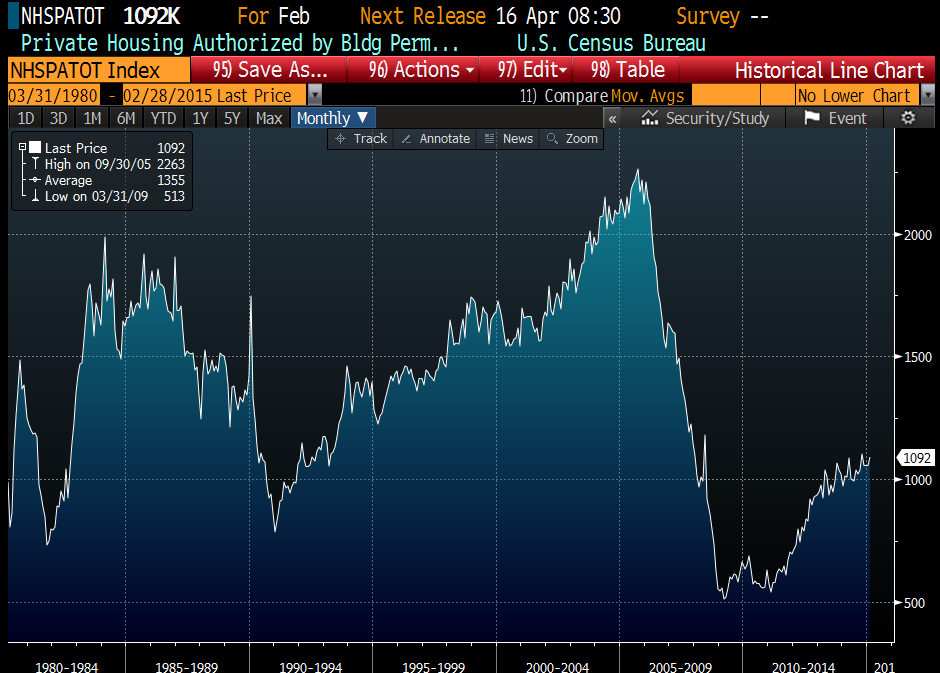
Housing Starts fell to an annualized pace of 897k in February from an upward-adjusted 1.08 million in January. While it is tempting to blame this on the weather (and undoubtedly some of this is due to the weather), you had an 18% drop in the West as well. Building Permits rose to 1.09 million, however from an upward revised 1.06 million. While this is an improvement from the post-bubble years, we are still operating well below historical norms.

Today begins the two-day FOMC meeting. Aside from the word patient, the Street will be focusing on the Fed’s economic projections, particularly inflation. At the December FOMC meeting, the Fed was projecting GDP growth of 2.6% – 3.0%, unemployment of 5.2% to 5.3% and PCE inflation of 1.0% to 1.6%. Given that six of the last seven PPI prints have been negative, it will be interesting to see what the Fed does with their inflation forecasts. If it gets too low, will the Fed hold off raising rates? Certainly the dovish wing of the FOMC will argue for caution.

Great article on the bubblicious tech company valuations. All sorts of games are being played in order to boost the valuations of companies like Uber, AirBnb, Dropbox, etc. Mark Cuban has described the current bubble in these private companies to be bigger than the internet bubble of the late 90s. FWIW, Henry Blodgett (who would know a thing or two about bubble valuations) thinks Uber could go public at $50 – $100 billion in a few years. That makes it worth about the same as Allergan or ConocoPhillips.

Morning Report – All we need is a little patience 3/16/15

Markets are higher as oil continues to fall. Bonds and MBS are up small.

Industrial production rose .1%, lower than expectations, however that was probably due to the weather. Capacity Utilization fell to 78.9%, which was negative as well. Weather probably had a lot to do with the disappointing numbers, but January’s numbers were revised downward in a big way, with industrial production being revised to -0.3% from 0.2% and capacity utilization revised from 79.4% to 79.1%.

Homebuilder Sentiment fell to 53 in March from 55 in February.

This week is all about the word “patient.” The FOMC meets Tuesday and Wednesday and the Street will be keying on the word “patient” – in the context of “The Fed can be patient in waiting to raise rates. Janet Yellen characterized patient to mean “two more FOMC meetings.” In other words, if the word is gone from the statement, the market will take it to mean the Fed is moving in June. Given this is a March meeting, we will have updated projections for GDP, unemployment, and inflation as well as a press conference.

The biggest issue facing the Fed is wage growth. Why are we not seeing wage growth with unemployment pushing “full employment?” It is a vexing question. The answer is that we have a huge reservoir of people who are considered not part of the labor force, but want to be. As these people return to the labor force, wage inflation will remain low until these people are all employed. Mark Zandi of Moody’s believes that this will take about a year, and by this time next year, we will start seeing wage inflation.

US Treasuries are getting a bid courtesy of the Japanese, who are selling JGBs to pick up yield wherever they can. US debt probably provides the best value out there.

OT: Shameless Plug: Did you know financial professionals rock? This one does. Check out my entry for the Jamtrackcentral 2015 guitar solo contest and give me a like. I appreciate it.

Morning Report – 2015 could be the best year for housing since 2007 3/13/15

Markets are lower this morning on no real news. Bonds andMBS are flattish.

Inflation at the wholesale level remains nowhere to be found, as the Producer Price Index fell .5%. You can’t blame this on oil, as the index fell .5% ex-food and energy. Six out of the last seven months have been negative on the headline number.

Consumer sentiment fell to 91.2 from 95.4 in February, according the University of Michigan. Current conditions are down, but expectations fell quite a bit. Does a lot of snow make people depressed?

Freddie Mac is saying that 2015 could be the best year for housing since 2007. Given the carnage in housing over the past 8 years, that is like discussing the best season for the Detroit Lions under Matt Millen. They are forecasting housing starts of 1.18 million, mortgage originations of $1.3 trillion (of which 40% are refis), and home sales of 5.6 million.

The NYT has a good article on parsing the Fed’s language. Next week we will get the FOMC decision, and everyone will be looking for the presence of absence of the word “patient.” (In the context of “the Fed can be patient in raising interest rates.). If that word is removed, the market will take it to mean the Fed will hike rates at its June FOMC meeting. For LOs with borrowers who are floating, let them know that next Wed could be a big day in the bond market.

Morning Report – Retail Sales Fall 3/12/15

Stocks are higher this morning after the big US banks passed their stress tests and raised dividends / buybacks. Bonds and MBS are up.

Retail Sales fell .6% in February. Ex autos and gas, they fell .2%. Poor weather on the East Coast and the West Coast port strike undoubtedly affected these numbers. The port strike is causing retailers to be light on spring inventory, particularly apparel.

Initial Jobless Claims fell to 289k from 320k the week. Import Prices rose .4% in Feb, but are down 9.4% year-over-year. The Bloomberg Consumer Comfort Index rose to 43.3, and business inventories were flat in January.

Are we starting to feel the economic effects of the stronger dollar? Exporters are beginning to cite dollar strength for weakness in their overseas operations.

Morning Report – Housing affordability still above pre-bubble days 3/11/15

Stocks are bouncing back after yesterday’s sell-off. Bonds and MBS are down small.

Mortgage Applications fell 1.3% last week. Purchases were up 1.9% while refis fell 2.9%.

Attitudes about the US economy are finally turning around, according to the Fannie Mae National Housing Survey. More people think the economy is on the right track than the wrong track. Also interesting is that consumers sense that mortgages are becoming easier to get.

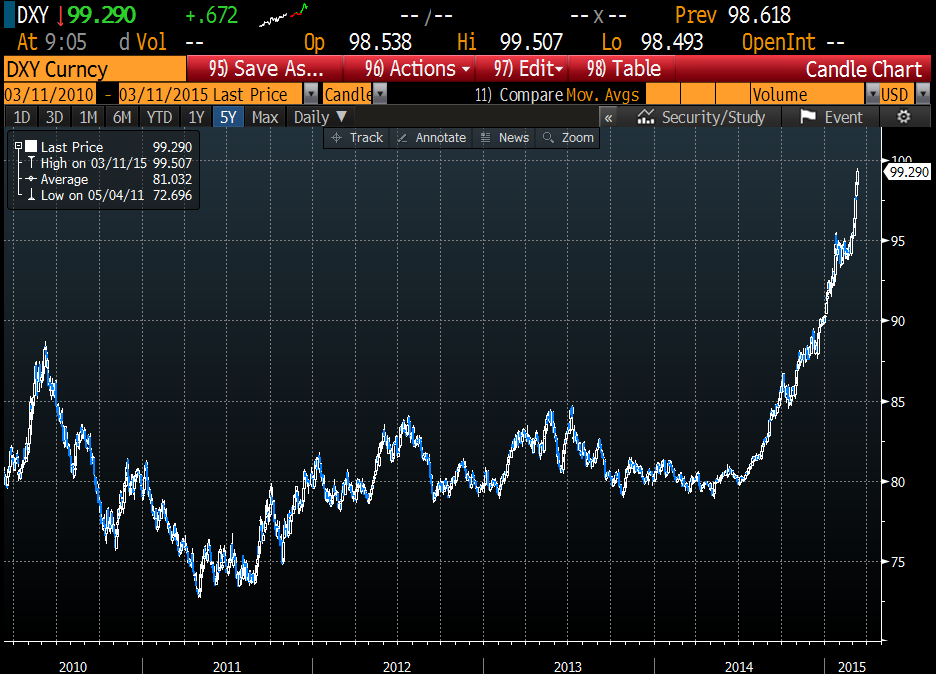
Inflation remains low, partly because the rally in the dollar is keeping a lid on import prices. Ever since the ECB began the march towards full QE, the dollar has been screaming. The dollar is approaching parity on the Euro – start thinking about that summer vacation in the South of France. Fun fact, when the euro was trading around 86 cents on the dollar, you could stay at the Ritz in Paris for roughly about the price of a good business hotel in Manhattan.

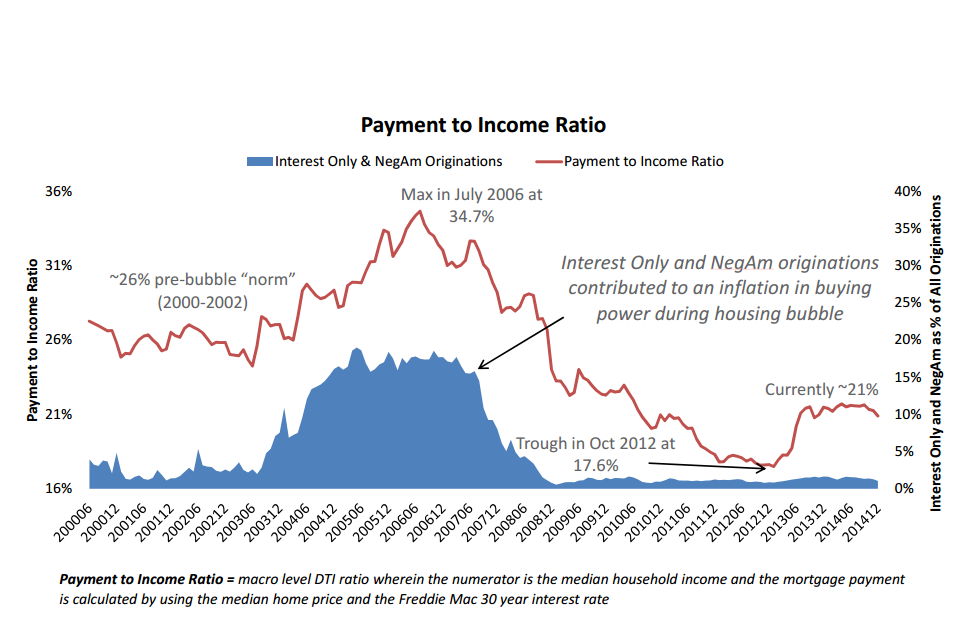
Housing affordability has decreased a bit since the trough of 2012, but still remains well above the pre-bubble years of 2000 – 2002, at least as measured by mortgage payment to income ratio. Pre-bubble, the DTI ratio for the median income and mortgage payment was about 26%. It rose to almost 35% during the bubble, fell to 17.6% in the trough, and is now around 21%. If you look at the chart below, you can see how much interest only and negative amortization loans factored into the bubble years. Pretty amazing to think that almost 1 in 5 mortgages was an IO / neg am during the go-go days of the bubble.

Interesting story about the mess that is Detroit. As downtown begins its gentrification / hipster renaissance, the rest of the city is struggling, and the biggest problem are these sales based on quitclaim deeds, which can leave the buyer with massive liabilities for back taxes.

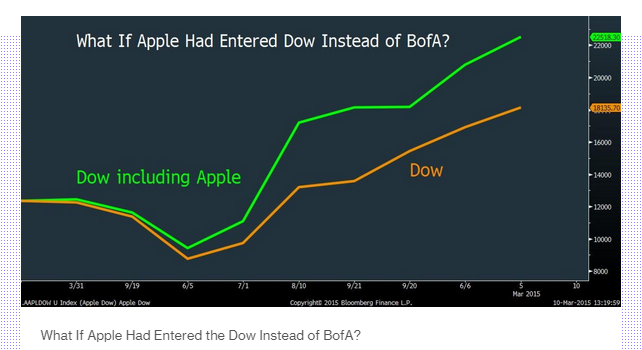
In February of 2008, Bank of America was added to the Dow Jones Industrial Average, just as the financial sector was beginning its swan dive. At that time, Apple was a $100 billion dollar company. What would have happened to the index if Apple was added instead of Bank of America?

Morning Report – More evidence of tightening in the labor market 3/10/15

Markets are lower this morning as commodities fall and the dollar climbs. Bonds and MBS are up as the German Bund hits new highs, with a yield of 26 basis points. German Bund yields are negative through 7 years, as the ECB buys the 5 year at a negative yield.

The continuing rally in European bonds will probably support the US 10 year as global bond managers unload Bunds to the ECB and buy Treasuries instead. The caveat is that inflation has to remain nowhere to be found in the US. Yesterday, Cleveland Fed President Loretta Mester sounded hawkish, saying that at 5.5% unemployment we are close to meeting the Fed’s full employment mandate. Of course this assumes that the current labor force participation rate of 62.8% is the new normal. Color me skeptical – I think a lot of these people who are out of the labor force want to work and will choose to if given the opportunity. This will keep a lid on wage growth.

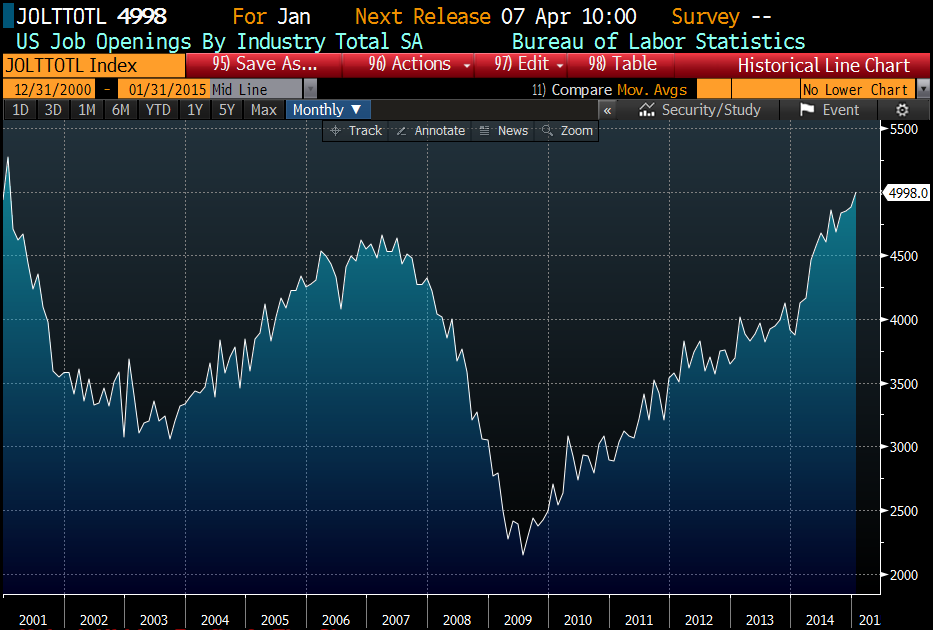
Job Openings remained around 5 million, according to the JOLTs job report. We are back to early 2001 levels. Hires decreased to 5 million and separations were unch’d at 4.8 million. The quit rate was unchanged at 2%.

Small business optimism rose a hair in February, according to the NFIB to 98 which has been the long-term average of the index, including the Great Recession. It is the third highest reading since 2007. We are seeing more evidence of labor shortages, however, with 53% of the respondents trying to hire, but 47% reported few or no qualified applicants. 29% of all owners reported job openings they cannot fill, which is the highest reading since early 2006. That said, sales fell, which could have been weather-related. 60% reported increased capital expenditures, which is the strongest reading since Oct 2007. Inflation remains nowhere to be found, and it looks like business owners are unable to raise prices.

CFPB Director Richard Cordray appeared before the House yesterday to discuss QM, payday lending, and overdraft protection. The discussion fell along usual partisan lines, with Democrats pushing for more consumer protection, and Republicans worried about limiting consumer choice.

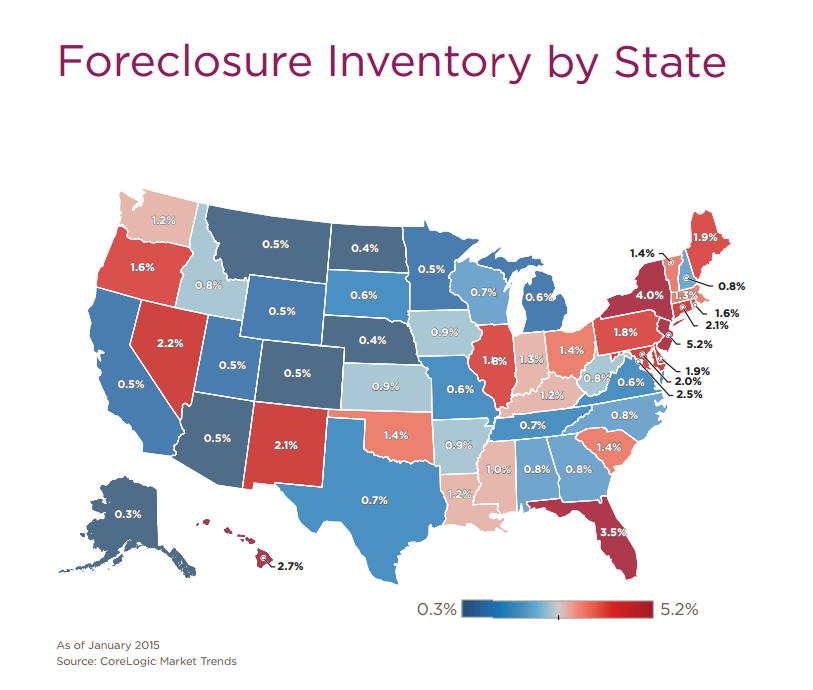
Foreclosures continue to fall, according to CoreLogic. They were down 14.7% month over month and 22% year over year. The seriously delinquent rate of 4% is the lowest since June of 2008. Foreclosure inventory is 549k, down 33% from a year ago.

Morning Report – Mortgage Credit is beginning to ease up 3/9/15

Stocks and bonds are higher this morning after Friday’s bloodbath.

Global bonds are rallying as the European Central Bank begins purchasing German and Italian government debt. Not sure what difference taking the Bund yield from 40 basis points to 30 basis points is going to make, but there you go. I wonder what economics students will think of this episode in 30 years. Grandpa, tell me again about the time when central banks were willing to buy their host country’s debt for dollars on the penny..

The week after the jobs report is typically very data-light, and this week is no different. The big events are retail sales on Thursday, and the JOLTS job openings on Tuesday. Which means bonds will probably be primarily influenced by events out of Europe.

The Bankrate 30 year mortgage rate didn’t move on Friday, but that is hard to believe given the big move up in rates. That said, mortgage rates have been lagging the moves in the bond markets.

Mortgage credit eased up in February, driven by jumbo and 97 LTV conventional. While we are at post-bust highs in credit availability, we are nowhere near where we were during the bubble, or even in the pre-bubble years.

How much do you need to make in the US to buy a house? Good question for the first time homebuyer. The answer is around 48k. Of course all real estate is local, and you need to make 142k to buy a home in San Francisco. Of course you could style in Cleveland on 142k, as you only need 32k to buy a home there.

Morning Report – Decent jobs report. Bonds get crushed. 3/6/15

Markets are lower this morning after a decent jobs report raised fears of a June rate hike. Bonds and MBS are down big.

  • Nonfarm payrolls + 295k (235k expected)
  • Unemployment rate 5.5%, down from 5.7% in Jan
  • Average hourly earnings + .1% MOM / +2.0% YOY
  • Labor force participation rate down to 62.8%.

The payroll number got the attention of the Street, however the drop in unemployment was due to a drop in the labor force. So far, we are not seeing job losses in the oil patch due to lower prices, however employment did fall due to the refinery strike going on. Average hourly earnings are still rising more or less at the rate of inflation, and came in at $24.78 an hour.

This jobs report is strong enough to make it more likely the Fed will start increasing rates in June, and people who were forecasting a 2016 rate hike are probably re-assessing that outlook. Hence the sharp sell-off in bonds.

End of an era: Apple is joining the Dow Jones Industrial average. Exiting is Ma Bell, who joined the index in 1939.

FHFA Chairman Mel Watt spoke at the Goldman Sachs Housing Finance Conference yesterday. Here are his prepared remarks. Main points, FHFA is going to sell non-performing loans to the public, progress continues on a single security for Fannie and Freddie loans. Eligibility for HARP will not be expanded.

Mark Cuban weighs in on technology companies and why he thinks there is a bubble that is worse than the 2000s.

Morning Report – Is China setting up for a 1929 moment? 3/5/15

Stocks are higher this morning after the ECB committed to buy 60 billion euros worth of bonds starting Monday. Bonds and MBS are up small.

Nonfarm productivity fell 2.2% in the fourth quarter, as output increased 2.6% and hours worked increased 4.9%. On a year-over-year basis, it fell .1%. Lower productivity means that wage inflation will become inflationary sooner than it otherwise would. Not sure what is driving the decline.

Unit labor costs rose 4.1%, which was a function of a 1.9% increase in compensation and a 2.2% decline in productivity. Unit Labor Costs are up 2.6% over the last year.

Initial Jobless Claims rose to 320k, and the Bloomberg Consumer Comfort Index rose to 43.5.

Is China setting up for a 1929 moment? Certainly the backdrop is there. This seems to be par for the course, as countries that go through a long secular growth spurt end up having bubbles. It happened to the US in 1929, it happened to Japan in 1989, and it has happened to China. Their government wants to deflate the bubble, as all governments who face this do, however that is easier said than done. The fallout will be felt in the luxury real estate markets in the US and Canada. Think the Bay Area, San Diego, Washington DC, NYC, Vancouver, Seattle. Do the Chinese banks puke Treasuries or do they buy them as a flight to safety? That is the most interesting question.