Morning Report – Big week ahead 6/16/14

Vital Statistics:


Last Change Percent
S&P Futures 1925.0 -3.3 -0.17%
Eurostoxx Index 3263.1 -19.8 -0.60%
Oil (WTI) 107.1 0.2 0.22%
LIBOR 0.231 -0.002 -0.65%
US Dollar Index (DXY) 80.61 0.035 0.04%
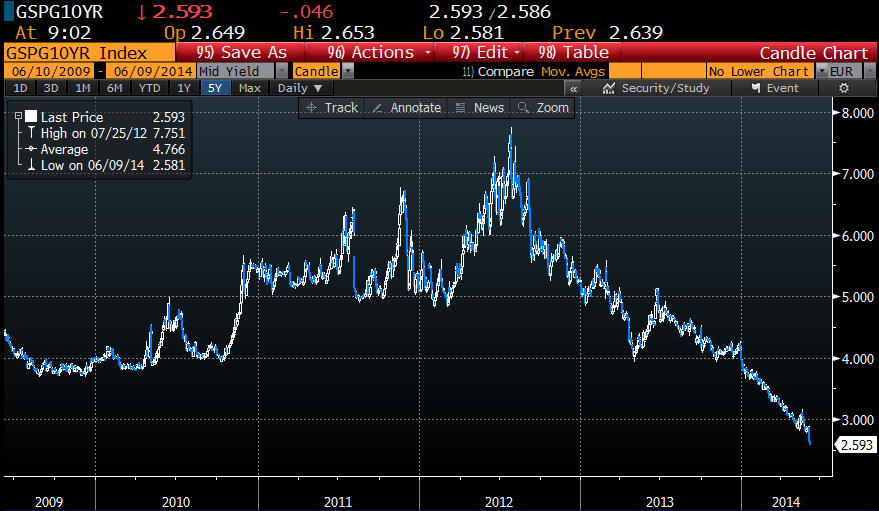
10 Year Govt Bond Yield 2.59% -0.02%
Current Coupon Ginnie Mae TBA 106.5 0.0
Current Coupon Fannie Mae TBA 105.3 0.1
BankRate 30 Year Fixed Rate Mortgage 4.22


Markets are lower this morning on no real news. Bonds and MBS are up
Big week coming up with respect to economic data and potential bond market moves. First, we have some important data today with industrial production / capacity utilization. Tomorrow, we get housing starts and building permits. Finally on Wednesday, we get the results of the FOMC meeting. I believe the Fed will be refreshing its economic forecasts at this meeting as well.
The NAHB Homebuilder Sentiment Index rose to 49 in June from 45 in May. An index level of 50 is considered to be “good building conditions.” The homebuilding industry has a couple of headwinds to deal with – first the lack of skilled labor, and second caution on the part of
Empire Manufacturing came in at 19.28, the highest reading since 2010. New orders drove the increase. Employment conditions continue to improve, as we are seeing a small increase in employment levels and hours worked. The six month outlook remains optimistic.
Industrial Production increased .6% in May. Capacity Utilization rose to 79.1% and Manufacturing production rose .6%. April’s numbers were revised upward. Durable goods production was up 5.3% year-over-year.
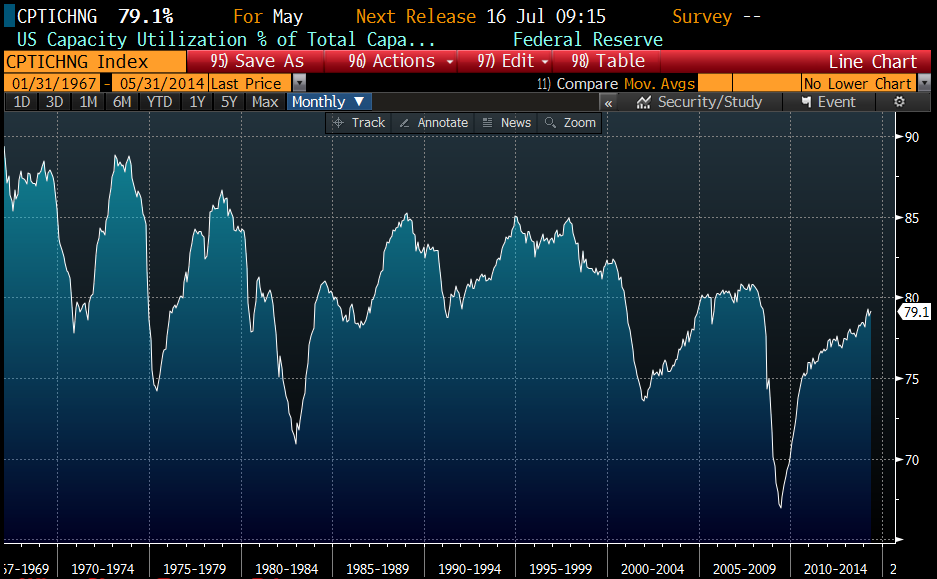
Another Merger Monday with a couple of big deals. Medtronic agrees to buy Covidien for $43 billion and Level 3 agrees to buy TW Telecom for $7 billion. A combination of inflated stock prices and low interest rates pretty much means we should continue to see M&A activity. The Medtronic / Covidien deal is partially driven by tax considerations (remember that obamacare increased taxes on medical device companies), so expect a lot of kvetching out of the left about this deal.
The IMF cut its 2014 growth estimate for the US from 2.8% to 2%. They are forecasting 2015 growth of 3%. They expect the US to maintain ZIRP past mid-2015. Interestingly, the IMF calls for raising taxes, increasing spending, and raising the minimum wage. Christine Lagarde must have been drinking Dr. Cowbell’s kool aid.


Father’s Day Open Thread

Hoping all the Dads here have a nice relaxing day and feel loved, respected and cherished by your children.  As only a half-assed feminist I support the role of Fathers in children’s lives. 🙂  My father was a hard man to live with sometimes, and we had our issues over the years, but I always treasured the discipline and independence he encouraged in me.  We really became best friends again at the end of his life and those memories are very precious to me.

My children have been very fortunate to have such a great father, as are my grandchildren.  They all got lucky and I think my Dad was a great example to my husband, who lost his father when he was quite young, and my son who was greatly influenced by both of them.

Wishing you all a great day!

Lulu

Morning Report – Meet Kevin McCarthy 6/13/14

Vital Statistics:

Last Change Percent
S&P Futures 1925.5 2.3 0.12%
Eurostoxx Index 3277.2 -7.1 -0.22%
Oil (WTI) 106.6 0.1 0.08%
LIBOR 0.232 0.002 0.65%
US Dollar Index (DXY) 80.62 0.048 0.06%
10 Year Govt Bond Yield 2.64% 0.04%
Current Coupon Ginnie Mae TBA 106.1 -0.3
Current Coupon Fannie Mae TBA 105 -0.2
BankRate 30 Year Fixed Rate Mortgage 4.21


Stocks are flattish this morning on no real news. Bonds and MBS are down.
Inflation at the wholesale level remained low in May, with the Producer Price Index coming in at -.2% in May.
Consumer Confidence retreated in June, coming in at 81.2 versus expectations of 83.
It might take 1 – 2 years for housing starts to get back to normalcy. Of course it will all depend on when the first time homebuyer returns.
Meet Kevin McCarthy, one of the possible successors to Eric Cantor’s position of House Majority Leader. He is a classic business Republican who doesn’t have an interest in fighting the social issue battles.
Short note today as there is not a lot going on.

Morning Report – A political shot across the bow 6/12/14

Vital Statistics:

Last Change Percent
S&P Futures 1942.8 -1.1 -0.06%
Eurostoxx Index 3289.7 0.6 0.02%
Oil (WTI) 106.3 1.9 1.78%
LIBOR 0.231 0.001 0.35%
US Dollar Index (DXY) 80.73 -0.055 -0.07%
10 Year Govt Bond Yield 2.63% -0.01%
Current Coupon Ginnie Mae TBA 106.2 -0.1
Current Coupon Fannie Mae TBA 105.1 0.0
BankRate 30 Year Fixed Rate Mortgage 4.22


Stocks are down small after some disappointing economic data. Bonds and MBS are up.
Retail Sales came in lower than expected at + .3% versus Street expectations of +.6%. April numbers were revised upward substantially, however. Ex autos and gas, retail sales were flat in May.
Initial Jobless Claims came in at 317k, a little higher than expected, but still a decent number.
Elizabeth Warren’s bill to refinance student loans died yesterday in the Senate. The bill would have allowed students with private student loan debt to refinance at the current government – set rate of 3.86%. It would have been funded with a new tax on the rich, which meant it was going nowhere. Of course this is naked politicking – the 2% surtax on the rich was a poison pill, and the point of it was to give Democrats an issue to demagogue on in November. I have said it a million times, but if we subsidize college education, and universities capture that subsidy by raising tuition, what have we accomplished? Do these people not realize this? Or do they just not care?
That said, student debt IS a big issue. Until the first time homebuyer manages to get in a decent financial position to buy, the housing market (and the economy) will be sluggish. Of course the way to fix the student loan problem is to have a robust economy and we can’t have a robust economy without a strong housing construction market. So we have a Catch-22. I was hoping that this year would be the breakout year for housing construction, but it is looking like a 2015 event now.
Eric Cantor (the heir apparent to John Boehner’s Speaker of the House position) lost his primary to a relative nobody. The result shocked everyone. What are the takeaways? First, money doesn’t buy you love. Cantor outspent Brat 25:1 and still lost. Second, Brat ran as an anti-Wall Street populist. In an overwhelmingly Republican district. This means that supporting the financial industry politically can be toxic. In other words, the shelling from Washington may not only continue, but it could get worse.
The IMF is warning about housing bubbles all over the world. Where are houses cheapest relative to long-term trends? Japan, S Korea, Germany, and the U.S. Where are they the highest? New Zealand, Australia, Canada, and Belgium. All of this global central bank stimulus has to go somewhere, and housing seems to be the place. If there is one thing Europe needs like another hole in the head, it is to see its housing bubbles in France, Belgium, Norway, the UK and the Netherlands collapse.

Morning Report – Comparing housing starts to job creation 6/11/14

Vital Statistics:

Last Change Percent
S&P Futures 1941.7 -8.8 -0.45%
Eurostoxx Index 3292.3 -21.6 -0.65%
Oil (WTI) 104.4 0.1 0.06%
LIBOR 0.23 -0.001 -0.22%
US Dollar Index (DXY) 80.72 -0.100 -0.12%
10 Year Govt Bond Yield 2.63% -0.02%  
Current Coupon Ginnie Mae TBA 106.3 0.1
Current Coupon Fannie Mae TBA 105.2 -0.1
BankRate 30 Year Fixed Rate Mortgage 4.21

Stocks are weaker this morning after the World Bank cut its global economic forecast. Bonds and MBS are stronger.


Mortgage applications rose 10% last week in spite of a large increase in interest rates. The 10 year bond yield increased 11 basis points and the Bankrate 30 year fixed rate mortgage increased 2 basis points. Purchases rose 9.3% while refis increased 11%. Refis rose to 53.6% of all applications.


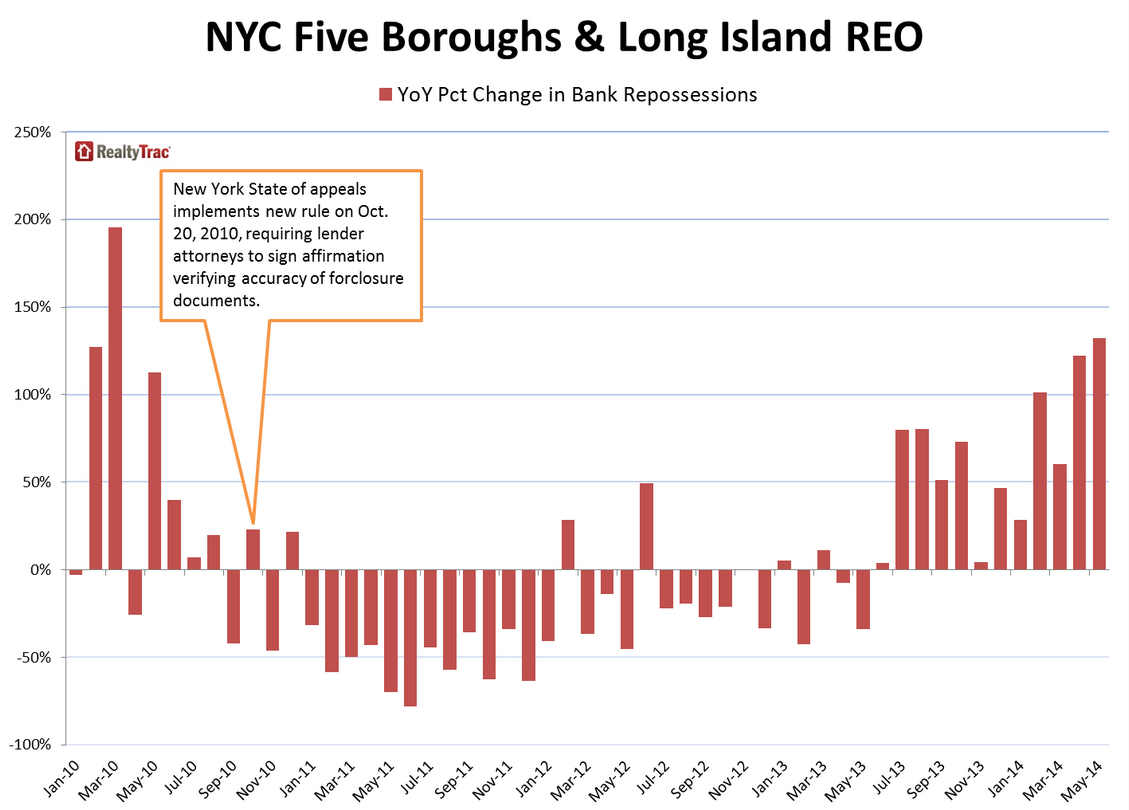
Foreclosure filings decreased 26% in May, according to RealtyTrac. The judicial states are reporting increases in foreclosure activity as they finally begin to address their bloated foreclosure pipelines. We are starting to see increases in foreclosure activity in New York, New Jersey, Connecticut and Massachusetts.


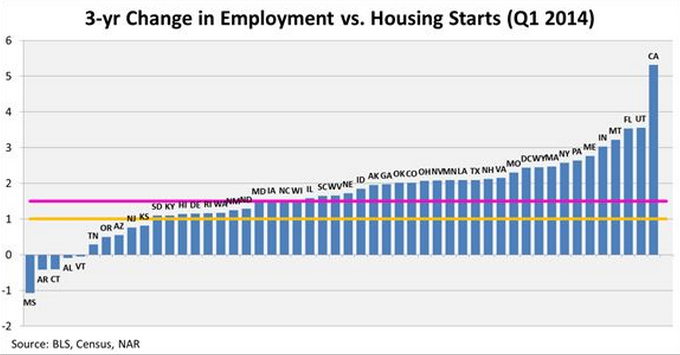
The NAR released a study showing that housing supply remains constrained and 2 factors explain it. First, a lack of housing turnover due to underwater homes. The number of underwater homeowners stood at 6.3 million in Q1, down from 11.8 in Q111, but still elevated compared to historical numbers. This explains why existing home sales numbers have been weak. Second, new construction has been weak since the bust. In fact, new home construction has lagged job growth over the past 3 years by a large factor. These supply constraints are driving price higher. Check out this chart, which looks at the ratio of jobs created to housing starts.

Of course there are caveats with this study, but it still shows how much housing construction is lagging.


What is going on in the bond market? The rally in bonds has caught many investors off guard and many pros went into this rally underweight bonds to begin with. Perhaps the ECB cutting rates to below zero on deposits is driving it, but the fundamentals in the US argue for higher rates, not lower rates. Bearish interest rate bets in the CME Eurodollar futures are at a record.

Morning Report – How accurate are Zillow estimates? 6-10-14

Vital Statistics

Last Change Percent
S&P Futures 1946.6 -3.6 -0.18%
Eurostoxx Index 3307.5 2.2 0.07%
Oil (WTI) 104.8 0.4 0.34%
LIBOR 0.23 0.000 -0.11%
US Dollar Index (DXY) 80.8 0.146 0.18%
10 Year Govt Bond Yield 2.63% 0.03%
Current Coupon Ginnie Mae TBA 106.4 0.0
Current Coupon Fannie Mae TBA 105.5 -0.1
BankRate 30 Year Fixed Rate Mortgage 4.19


Stocks are taking a breather after setting a record yesterday. Bonds and MBS are down.

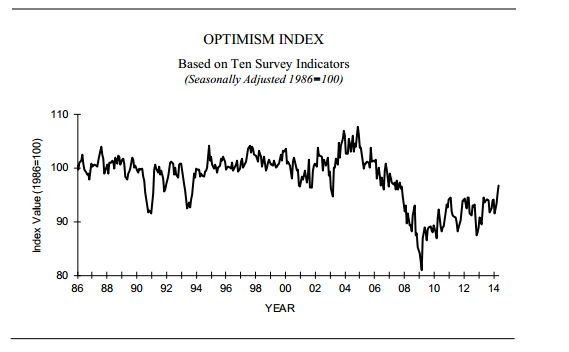
The NFIB Small Business Optimism Report hit its highest level since September 2007, but is still below neutrality, which is considered 100 on the index. Small business increased headcount by .11 workers in May, which extends the streak to 8 months. Still on average companies are not reporting increased sales, which will drive economic growth. Earnings trends are still negative as well. So overall, this report shows small business is approaching normalcy, yet the S&P 500 is at record highs. What gives? Well the S&P 500 has a lot of international exposure, which is where the growth is. Second companies with big market caps can get extremely favorable financing right now, while the smaller businesses still have a tougher time of it. And finally, all that central bank stimulus has to go somewhere, and at the moment that place is U.S. large cap stocks.

The latest Fannie Mae Monthly National Housing Survey is out, and it shows that optimism about the housing market is still close to the highest it has been post-crisis. Respondents thing house prices will increase 2.9% over the next 12 months (FWIW NAR is mid / high single digits). The number of people expecting mortgage rates to increase over the next 12 months has fallen (unsurprising given interest rates have fallen generally) and more people think it is a good time to buy than to sell. People’s expectations of their personal financial situation 12 months out seem to be deteriorating, a worrisome sign. Could be just due to the lousy Q1 GDP, but it bears watching – consumer sentiment is key to the real estate industry, and in fact KB Home CEO Jeff Metzger once said on a conference call that sentiment matters more than interest rates.

Ever noticed that the Zillow Z-Estimates rarely line up with where houses actually trade? It turns out that the Z-Estimates are within 5% of the actual value of the home just about half the time. Two years ago, Z-Estimates were too high, now they are too low. If you have a buyer who is stuck on paying no more than the Z-Estimate for a home, show them this article – the Z-Estimate is probably not realistic. Here is Zillow’s response to the article.

The Obama administration expanded eligibility for the student loan cap, where student loan repayments are capped at 10% of income. Not sure how holders of student loan debt will be treated, but I have been hearing anecdotal evidence that some hedge funds are setting up the Paulson trade in student loan ABS. Student loan debt is undoubtedly one of the biggest issues with the first time homebuyer, and until the first time homebuyer returns, the housing market (and the economy in general) will continue to punch below its weight. Of course this sort of thing simply amounts to a subsidy for higher education, and given that demand for higher education is relatively inelastic, the beneficiaries will ultimately be the universities as they can (and will) raise tuition to capture the subsidy.

Morning Report – Dull week ahead 6/9/14

Vital Statistics:

Last Change Percent
S&P Futures 1946.6 -2.7 -0.14%
Eurostoxx Index 3292.7 -1.5 -0.05%
Oil (WTI) 103.5 0.8 0.79%
LIBOR 0.231 0.001 0.41%
US Dollar Index (DXY) 80.57 0.162 0.20%
10 Year Govt Bond Yield 2.61% 0.02%
Current Coupon Ginnie Mae TBA 106.6 0.0
Current Coupon Fannie Mae TBA 105.5 -0.1
BankRate 30 Year Fixed Rate Mortgage 4.17


Stocks and bonds are down small on no real news. No economic data today.
The week after the jobs report is typically dull, with very little economic data. The highlight of the week will probably be retail sales on Thursday. Earnings season is over, and we aren’t close enough to the end of the quarter for companies to start confessing they will miss their numbers.
Merger Monday is back, with $13 billion in announced deals. With low interest rates and organic growth hard to come by, we will be seeing more and more deals.
In the “it’s hip to be square” category, the Spanish 10 year yields less than the US 10 year. Yes, Spain – the “S” in the PIIGS cohort can borrow money for 10 years cheaper than Uncle Sam. This undoubtedly has to do with Mario Draghi charging banks to hold money at the ECB, but it is still an astounding thing to see.

TBA trading has decoupled somewhat from Treasury trading lately. Last week, the 10 year bond yield increased 11 bps, while Ginnie and Fannie TBAs were flat. The Bankrate 30 year mortgage rate increased 2 bps. Mortgage rates seem to be ignoring the volatility in the bond market.

FHFA is asking for input on the delayed G-fee hike. For those not in the mortgage banking business, G-fees (short for guaranty fees) are the cost of mortgage insurance by the government for conforming mortgages. The borrower pays these costs. Historically the government has undercharged for this insurance, which amounts to a housing subsidy. Of course G-fee increases have been used as a slush fund – two increases were used to fund a payroll tax cut extension – so the perilous state of the FHFA insurance fund is not 100% due to insufficient G fees. But there is no doubt the government underpriced this insurance. FHFA Director Mel Watt put the latest fee increase on hold to study a bit more, and the affordable housing crowd is worried that these increases are making mortgages and housing unaffordable. That said, these hikes are also the process of price discovery, where the government is raising fees to see at what point private capital starts to compete by offering a similar insurance wrap. Once they hit that price, then the idea is to allow private capital to “crowd in” or replace government backed mortgages. Right now, the US taxpayer is backing about 90% of new origination. You can see on the chart below, we have more than doubled the G-fee since the crisis began.


Morning Report – Mortgage credit is easing 6/6/14

Vital Statistics:

Last Change Percent
S&P Futures 1941.9 3.4 0.18%
Eurostoxx Index 3294.1 27.1 0.83%
Oil (WTI) 102.9 0.5 0.45%
LIBOR 0.23 -0.001 -0.43%
US Dollar Index (DXY) 80.34 -0.029 -0.04%
10 Year Govt Bond Yield 2.54% -0.04%
Current Coupon Ginnie Mae TBA 106.6 0.1
Current Coupon Fannie Mae TBA 105.8 0.3
BankRate 30 Year Fixed Rate Mortgage 4.17


Stocks and bonds are rallying as the jobs report comes in more or less as expected.
Nonfarm payrolls increased by 217k in May, more or less in line with the 215k expectation. The unemployment rate was flat at 6.3% and the labor force participation rate remained stuck at its lows – 62.8%. Average Hourly Earnings increased by .2% and average weekly hours were flat at 34.5.
Mortgage credit eased in May, according to the MBA. The higher the index, the easier it is. When you look at the index on a historical basis, you can see credit is still tight.

Federal Reserve Bank of Minnesota Fed Head Narayana Kocherlakota said he believes the central bank will need to keep rates very low for a long time to come, largely due to the Fed’s failure to meet either goal of is dual mandate. The downside: inflated asset prices, high asset return volatility, and hieightened merger activity.

Morning Report – Attitudes about housing 6/5/14

Vital Statistics:

Last Change Percent
S&P Futures 1931.2 5.5 0.29%
Eurostoxx Index 3285.1 47.2 1.46%
Oil (WTI) 102.4 -0.3 -0.27%
LIBOR 0.231 0.001 0.48%
US Dollar Index (DXY) 80.94 0.281 0.35%
10 Year Govt Bond Yield 2.61% 0.01%
Current Coupon Ginnie Mae TBA 106.3 0.0
Current Coupon Fannie Mae TBA 105.3 -0.1
BankRate 30 Year Fixed Rate Mortgage 4.2


Markets are higher this morning after the European Central Bank took some unprecedented stimulus measures. Bonds and MBS are down small, rebounding after an initial sell-off on the ECB’s actions.
The ECB, fearing deflation, cut its deposit rate to -.1%, which means you have to pay to invest your money at the central bank. They are also lowered the benchmark rate to .15% from .25%. The ECB hasn’t ruled out quantitative easing, but the fact that there is no “Euro” sovereign bond complicates things. How will this affect US rates? Hard to tell, but at the margin, it will be dollar positive / euro negative which would be US bond bullish. That said, the direction of US bonds will undoubtedly be driven by tomorrow’s jobs report more than anything.
In economic data this morning, announced job cuts increased 45.5% to 53,000 in May, according to outplacement firm Challenger, Gray and Christmas. Hewlett-Packard largely drove the increase with a plan to cut payrolls by almost 19,000. Transportation, Health Care, Government, and Services rounded out the other job cuts. This is the highest number in 15 months. It is important to distinguish between job cuts and job losses – these numbers come from company press releases, which often never materialize as market conditions change. Second, often these reductions are done by attrition.
Initial Jobless Claims came in at 312,000, another decent number. Later on today, we will get the Household change in net worth from the Fed. This is not going to necessarily be a market-moving number, but changes in it should drive consumption going forward.
The McArthur Foundation released a survey of Americans’ attitudes about housing. The McArthur Foundation leans left, so the survey focuses on lower-income housing issues and slices and dices according to demographics. The punch line from the survey is that most people think affordable housing is hard to come by, and that we are still in the middle of the crisis. However, the biggest conclusion is that homeownership is not viewed as the vehicle to building wealth that it once was, and the public believes that renting has grown in appeal while owning has declined. That said, 70% of non-owners do aspire to own a home, and luckily the age 18-34 cohort – the classic first-time homebuyer – is most keen on owning a home. Only 44% of non-owners over 50 desire to buy a home. A full 2/3 of the public believes it is less likely today than it was 20 or 30 years ago to build equity and wealth through home ownership. Again, we are exiting a once-in-several-generation housing bust and many people who levered up too much / bought more house than they could afford are going to be gun shy. This survey, however speaks to the challenge for many in the mortgage industry – how to change attitudes about housing. We have a housing shortage in this country and home prices / mortgage rates are still highly affordable. Yes housing was a terrible bet in 2005 – 2009. But it isn’t 2005 anymore.

A Surprising Map

religious map