

 Brent Nyitray
 Fairlington Blade
 Let the mutherfuker burn!
 jnc4p
jnc4p Kevin S. Willis
 Michigoose
 lmsinca
 markinaustin
 Arcanaut
 novahockey
 quarterback
 ScottC
 yellojkt
Vital Statistics:
| Last | Change | Percent | |
| S&P Futures | 1917.9 | -3.9 | -0.20% |
| Eurostoxx Index | 3240.1 | -7.7 | -0.24% |
| Oil (WTI) | 102.5 | 0.1 | 0.06% |
| LIBOR | 0.227 | 0.000 | 0.11% |
| US Dollar Index (DXY) | 80.49 | -0.150 | -0.19% |
| 10 Year Govt Bond Yield | 2.55% | 0.02% | |
| Current Coupon Ginnie Mae TBA | 106.5 | 0.1 | |
| Current Coupon Fannie Mae TBA | 105.5 | 0.1 | |
| BankRate 30 Year Fixed Rate Mortgage | 4.18 |

The calm before the storm? The Fed is worried about complacency in the markets. The VIX index has gone 74 straight weeks below its long-run average, which is a similar environment to 2006 – 2007. Junk spreads are widening, and junk issuance is growing as investors reach for yield. William Dudley commented: “Volatility in the markets is unusually low… I am a little bit nervous that people are taking too much comfort in this low-volatility period. As a consequence, they’ll take more risk that really what’s appropriate.” For what its worth, I think the VIX is useful for describing what has already happened in the market, not as a predictor of what is going to happen. Yes, there is the old market saw of “VIX is high, time to buy, VIX is low, time to go,” but a low VIX doesn’t necessarily mean markets are going to fall out of bed – look at the low VIX levels in 94-95, which preceded the mother of all stock market rallies. VIX invariably spikes AFTER the fit hits the shan, not before. It represents market players paying up for option protection, and that is a trailing indicator, not a leading one.
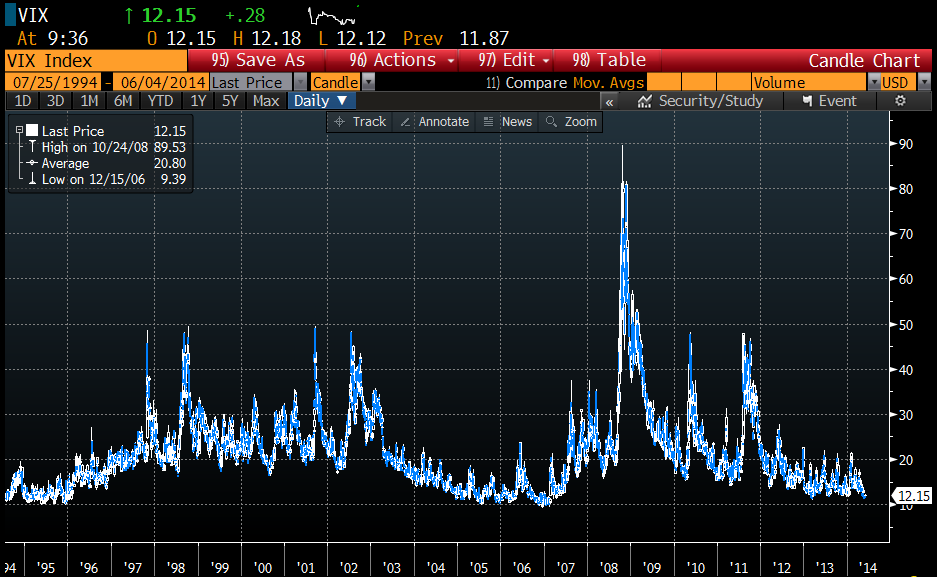
With respect to the junk issuance, investors (in particular defined benefit pension funds and insurance companies) are reaching for yield because the rate of inflation for their liabilities is largely insensitive to interest rates. The actuarial tables couldn’t care less if the Fed is driving down rates via QE – they need to earn X% on their fund to cover expected costs and that’s that. If they can’t get that in Treasuries, they’ll move to assets that can. Invariably that means they have to move out on the risk curve. We have seen this movie before, in the 1950s. FWIW, Dr. Cowbell thinks low rates are here to stay, and that “this time is different.” Most dangerous words in investing, ever. Anyway, it is nice to see the Fed muse about excessive risk taking, although IMO the biggest risk is probably in the so-called “risk free” long bond.
Filed under: Morning Report |
 All Things in Moderation
Apparantly the dead Tea Party ain’t.
LikeLike
On occasion, Vox & Matthew Yglesias can grasp basic economics:
LikeLike
jnc;
On occasion, Vox & Matthew Yglesias can grasp basic economics:
Maybe next we can get them to discuss San Fran rent control.
As an aside, re-reading that piece, it never ceases to amaze me what a caricature the NYT is. They can’t even write a piece pointing out the unintended economic effects of rent control without framing the problems in terms of class struggle. “Things got a little bit out of hand, Jenny. It just greed and those son-of-a-bitch millionaires! I would never hurt you, you know that.”
LikeLike
Then why vote for her?
If you’re a pro-coal D, er, why?
LikeLike
I love you baby! Why do you make me hit you like that?
LikeLike
Smart take.
Has anybody who served with Beegdahl defended him?
LikeLike
Usefull Vox piece showing how the EPA’s proported “flexibility” for the states in the new carbon rules is actually an exercise in micromanagement and lobbying.
http://www.vox.com/2014/6/4/5779052/how-to-figure-out-which-states-get-hit-hardest-by-obamas-climate-rule
LikeLike
Interesting table. Ck out your city.
http://www.fbi.gov/about-us/cjis/ucr/crime-in-the-u.s/2012/crime-in-the-u.s.-2012/tables/6tabledatadecpdf
LikeLike
I always preferred written permission.
http://m.laweekly.com/informer/2014/06/04/verbal-or-written-permission-could-be-required-for-college-sex
With witnesses.
LikeLike
I would have carried permission slips on a tear off pad fifty four years ago if this had been a requirement. An I-message should suffice now. In fact, this would boost smart phone sales to 100% saturation among college age males.
I, (your name here), permit MARKINAUSTIN to engage with me in the following sex acts
(list here in Latin, Spanish, clinical English, or Anglo-Saxon)
on the (list here available dates and possible one hour time frames, or with reference to external events such as hell freezing over)
NO WARRANTY OF MERCHANTABILITY OR FITNESS FOR THE INTENDED PURPOSE IS GIVEN, EXPRESS OR IMPLIED. I AM “WHERE IS, AS IS”. You, on the other hand, must submit your finger nails for inspection prior to first use.
I am above the age of consent, of sound mind, and not encumbered according to the laws in effect in Texas on the date of execution of this document. I have executed this of my own free will.
(Signature) (Date)
State of Texas
County of
Sworn to and subscribed before me this day of , .
_______________________ (STAMP)
Notary Public State of Texas
LikeLike
McWing:
I always preferred written permission.
If I read the law correctly, the only reason the state can mandate this is because universities have become slaves to government spending. “If you want taxpayer money, you must implement these totally insane policies”. Another example of the nefarious nature of government “aid”. The government is like a drug pusher. Get people hooked and then threaten to cut off the supply if they don’t get on their knees and perform.
LikeLike
The problem of withdrawn consent remains.
I am pretty much appalled by the stats on campus sexual assaults. This is a real problem and one that can be addressed from many directions. Permission slips is not one of the brighter ideas, however.
LikeLike
One hour. In her dreams.
LikeLike