

 Brent Nyitray
 Fairlington Blade
 Let the mutherfuker burn!
 jnc4p
jnc4p Kevin S. Willis
 Michigoose
 lmsinca
 markinaustin
 Arcanaut
 novahockey
 quarterback
 ScottC
 yellojkt
Vital Statistics:
| Last | Change | Percent | |
| S&P Futures | 1400.5 | 2.3 | 0.16% |
| Eurostoxx Index | 2427.8 | -4.5 | -0.19% |
| Oil (WTI) | 93.89 | 0.5 | 0.58% |
| LIBOR | 0.438 | 0.001 | 0.17% |
| US Dollar Index (DXY) | 82.69 | 0.293 | 0.36% |
| 10 Year Govt Bond Yield | 1.72% | 0.07% | |
| RPX Composite Real Estate Index | 189.1 | 0.1 |
Markets are grinding higher on no real news. FWIW, the markets seem to be getting back into “risk-on” mode, with the latest rally in the stock market and the sell-off in the 10 year. After breaking 1.40, a few weeks ago, the 10-year is now over 7.2%. MBS are down about 1/4 of a point.
Mortgage delinquencies fell to 7.58%, slightly higher than the street 7.4% estimate. Foreclosures edged down to 4.27%.
The eminent domain issue is becoming bigger as FHFA weighs in. To recap, San Bernardino has proposed to use eminent domain to seize performing underwater mortgages from investors. They would pay the investors a “fair price” – presumably lower than the value of the property – and write down the principal of the mortgage to the market value of the house. SIFMA (who oversees a critical part of the securitization market) warned San Bernardino that if they followed this path that newly-mortgages originated in that area would be ineligible for inclusion into TBA pools, which would make it extremely difficult to get a mortgage there. California Lieutenant Governor Gavin Newsom fired back, telling the organization to “cease making threats to the local officials of San Bernardino County.” Now FHFA has stepped in with a notice expressing “significant concerns” regarding the proposal, which is really more or less theft. Unless the county backs off, this could become to big to ignore, making it an explosive issue (for Democrats, at least) going into the election.
Hey, Fannie made some money. They note that improving home prices, better efficiency in managing REO, and a continued decline in delinquency rates were able to overcome the drain from their legacy book of subprime mortgages bought during the bubble years.
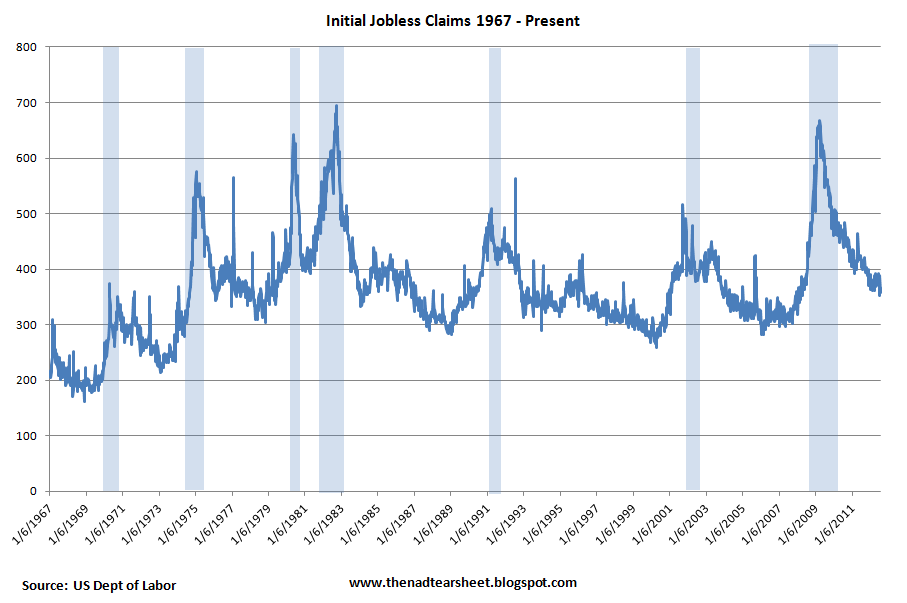
Initial Jobless claims came in at 361k, slightly lower than the 370k street estimate. Initial Jobless claims have fallen back to historical norms. Chart: Initial Jobless Claims 1967-Present
Filed under: Morning Report |


In the good news bad news scenario Chinese inflation dropped last night to it’s lowest level in three years.
In a sign that the whole world is currency and central bank crazy, this is considered good news because it leaves room for more Chinese stimulus:
http://news.yahoo.com/chinas-inflation-falls-giving-room-stimulus-015140331–finance.html
LikeLike
I’m not sure about jobless claims returning to historic norms. Still looks to be about 50k higher than historic average. Also interesting to note the increase in unemployment claims from 71/72 onwards when conscription ended and we switched to an all volunteer armed forces. I wonder if there coincidental. Also be curious to see an overlay of Minimum Wage increases on that to.
Banned, how much reliability do you put in Chinese data reporting?
LikeLike
It’s complete fiction, but it’s consistent fiction usually too, which is really the best case scenario when dealing with any government numbers, especially from authoritarian governments.
Put another way they are as honest as kids on a test if the teacher is in the room and not out in the hallway. For instance some of their coal numbers were revised after it was pointed out in various publications that they contrasted dramatically with other economic indicators.
Something had to give, if you know what I mean.
LikeLike
I just pissed off a few people at Maddow, by asking them to delineate the difference in positions between the Bush and Obama administrations on:
” drugs? guns? Gitmo? Afghanistan? the Patriot Act? Koran burning? unlawful detention of US citizens, assasination by drone? EPA smog rules? fracking? bank fraud? extension of the tax cuts?’
LikeLike
obama gives a good speech about entitlements. that’s basically the difference i think.
LikeLike
I represented China at a Model United Nations back in the 1980s. For research we used my future father-in-law’s subscription to Beijing Review. It was always full of all sorts of rosy economic statistics taken out to five significant digits that everybody knew were all completely fictitious.
LikeLike
yello
they are much better today because obviously we have more interaction with their economy on which to compare statistics.
LikeLike
Re: Mediciad expansion.
New idea kicking around. States pay premiums, etc for low income benes and have them enroll in the exchanges. They’d do this instead of medicaid expansion.
LikeLike
Nova, wouldn’t that require legislative changes?
LikeLike
ha. you’re funny.
the law has limits on what an individual is expected to pay out of pocket. but i’m pretty sure its silent on where those funds come from.
maybe at the state level? new state program?
LikeLike
What if states do nothing like you suggest?
LikeLike
the states are actually pushing this. much cheaper to pay a premium for somebody than put them on Medicaid.
LikeLike
Here’s a really excellent advocacy about why the new IRS rule allowing Fed Premium Support subsidies in Federal exchanges established in States that did not set up State exchanges is illegal.
http://healthaffairs.org/blog/2012/08/01/the-illegal-irs-rule-to-expand-tax-credits-under-the-ppaca-a-response-to-timothy-jost/
LikeLike
NoVa, does the Obamacare law allow it is my question, or would it require some sort of change to the law? And if the IRS rule about Fed Subsidies in Fed run state exchanges is ruled illegal, what would be a states incentive for doing it at all?
LikeLike
“novahockey, on August 9, 2012 at 10:50 am said:
Re: Mediciad expansion.
New idea kicking around. States pay premiums, etc for low income benes and have them enroll in the exchanges. They’d do this instead of medicaid expansion.”
That’s awesome and brilliant. Reminds me of the UN rules to reduce emissions that actually encourage emissions that I linked to yesterday.
The idea that Obamacare is going to reduce the federal budget deficit is absurd:
http://www.newyorker.com/online/blogs/johncassidy/2010/03/obamacare-by-the-numbers-part-1.html
http://www.newyorker.com/online/blogs/johncassidy/2010/03/obamacare-by-the-numbers-part-2.html
LikeLike
“Troll McWingnut or George, whichever, on August 9, 2012 at 11:57 am said:
NoVa, does the Obamacare law allow it is my question, or would it require some sort of change to the law? And if the IRS rule about Fed Subsidies in Fed run state exchanges is ruled illegal, what would be a states incentive for doing it at all?”
I think the law neither allows or disallows it. It’s silent on the question of who pays the subsidized premium.
The IRS rule wouldn’t apply to states that set up their own exchanges. The exchanges and Medicare expansion are separate provisions, but it looks like someone has figured out how to leverage the exchange subsidies to get more federal dollars for the states than they would under the Medicaid expansion. I suppose you could characterize it as subsidy arbitrage.
LikeLike
Gary Johnson update, courtesy of a Sue post on PlumLine.
Johnson gets his own SuperPAC:
http://www.huffingtonpost.com/2012/06/05/roger-stone-nixon-gary-johson_n_1572063.html
And plans to leverage marijuana legalization referendums.
http://livewire.talkingpointsmemo.com/entries/libertarian-candidate-plans-to-leverage-pot-refrenda-in
LikeLike
Uh oh:
“Details about a secretive government program to bail out money-market mutual funds are finally coming to light. (Top mutual funds: Latest data at a glance)
Acting without any explicit Congressional authority, the U.S. Treasury guaranteed in excess of $2.4 trillion of money market funds after the giant Reserve Primary Fund “broke the buck” following the bankruptcy of Lehman Brothers. The program, which ended on Sept. 18, 2009, seems to have successfully prevented a panicked run by money-market fund investors.
But until now, the Treasury has kept the identities of the funds that received government backing and the amounts guaranteed secret. It was not clear how many funds obtained backing or for how much taxpayers were on the hook during the program’s duration. (Read about more questionable programs: ‘Stable Funding’ Might Make Banks Unstable)”
http://www.cnbc.com/id/48578949
LikeLike
i think the law is silent and didn’t envision such a scenario. the law was pretty clear. expand Medicaid.
if the exchanges fall? game over man, game over
LikeLike
money market mutual funds can’t cover their costs with rates where they are..
LikeLike
brent;
I understand why they did it, but the sheer disregard of all penalites built into the system is pretty crazy. Then we wonder why financial institutions have a clear disregard of the law in all it’s forms.
LikeLike
banned:
Then we wonder why financial institutions have a clear disregard of the law in all it’s forms.
I don’t wonder such a thing because I know it is obviously untrue.
I also don’t think it makes a lot of sense to highlight the extraordinary measures that were taken in 2008 and portray them as typical of the way things work. They were extraordinary precisely because they were not at all typical.
LikeLike
There’s genius all around us. One guy in Ezra’column today said we are “outsourcing” our refineries.
I’m not sure whether that indicates a suspicious rise in the number of Chinese in the Galveston area, or the nightly inexplicable loss of large mechanical equipment from there without a trace.
LikeLike
I agree that the law wanted Medicaid expansion. The SC also said that the Federal government can’t force states to do it. If a state doesn’t want to, it doesnt have to, right?
LikeLike
right. the states do not have to do anything with the expansion population. they are under tremendous pressure to do so, particularly from the hospitals, which to be fair have a legit point. they agreed to pay cuts in exchange for increased coverage. those cuts are on autopilot, but the coverage levels might not be there.
Right now, the states are huddling with HHS to figure out what the options are. Full expansion, no expansion, “partial” expansion. what the partial is based on? not sure.
but the states are under no obligation to expand Medicaid. i think they’ll be some sort of action here. the hospitals are shitting themselves. and there’s a hospital in most congressional district … so
LikeLike
Really? How many do you think will go to jail for LIBOR?
I’m guessing the same number that went for the rampant fraud that occurred prior to the financial crisis.
I respect your opinion Scott, but on this matter, the evidence is all on my side.
LikeLike
banned:
but on this matter, the evidence is all on my side.
What are we talking about here, exactly? It’s not clear to me that any laws actually were violated in the LIBOR scandal, but evening assuming there were and assuming that nothing ever happens to those who broke the laws, your hyperbole is not justified. The banking industry is one of the most heavily regulated industries in the country. Given that fact, and given that it is populated with, well, human beings, it is of course going to be the case that laws get violated. But the notion that financial institutions as a class have “a clear disregard of the law in all it’s forms” is just absurd. No one with any familiarity of the lengths to which FIs regularly go to comply with laws and regulations would ever make such a claim.
LikeLike
“Time for a Futures Insurance Fund: CFTC’s Chilton”
http://www.cnbc.com/id/48593752
It was proably time 10 years ago, which means it might actually happen 10 years from now.
LikeLike
“ScottC, on August 9, 2012 at 1:00 pm said:
I also don’t think it makes a lot of sense to highlight the extraordinary measures that were taken in 2008 and portray them as typical of the way things work. They were extraordinary precisely because they were not at all typical.”
It makes sense to the extent that extraordinary measures become standard instead of extraordinary. See the persistence of QE, etc.
LikeLike
jnc:
It makes sense to the extent that extraordinary measures become standard instead of extraordinary. See the persistence of QE, etc.
Yes, I agree. But the measure highlighted by banned is not of that nature, as far as I am aware.
LikeLike
Taibbi gets this one wrong:
This is of course false given the number of people who don’t pay income tax. Taibbi needs to be more precise with either his definition of taxes or taxpayers.
LikeLike
scott:
Yes but drugs are also heavily regulated and yet the most prevalent and persistent subject of law breaking in our society oddly enough for the same reason. The risk reward relationship is completely out of wack. It’s an American tradition really as the state of Rhode Island was the most successful colony financially in the pre Revolution days because they traded with the enemy French and Spanish and smuggled on a epic scale because the cost of getting caught was (as it is today) essentially a tax on the gains, not imprisonment.
Ask Angelo Mozillio who by some calculations got to keep about 60% of the money he made in sub prime fraud AFTER he paid the settlement with the Federal government.
I don’t think that there are board meetings where everybody discusses how to break the law, but as you know the risk of IRS challenges is built into the tax returns of all major corporations as it is in the revenue activities of financial instituions.
LikeLike
banned:
Yes but drugs are also heavily regulated and yet the most prevalent and persistent subject of law breaking in our society oddly enough for the same reason.
The drugs you are presumably speaking about are not “heavily regulated”. They are outright illegal. If they were legal with regulations, there would almost certainly be much, much less of the law breaking you are speaking about.
But that aside, I don’t really understand what your point is. As I said, your hyperbole is entirely unjustified. On the whole FIs go to great lengths to conform with the outrageous number of laws and regulations to which they are subject, as anyone truly familiar with FIs would know. Pointing out the violence that comes with illegal drug dealing doesn’t really speak to that issue in the slightest from what I can tell.
LikeLike
For the days/hours it has left to go before a change, this is the kind of market that smaller investors dream about, one that the big guys are hesitant to short as a whole.
LikeLike
actually scott illegal use of prescrption drugs eclipse all but pot in this country, with Oxycontin being the leader in the clubhouse.
I never wrote anything about violence at all. What I said was that financial institutions make risk calculations of their profit and loss based on marignally if not openly fraudulent activites versus what would happen if they got caught. If you think this isn’t true, read any of the crisis books that has substantial chapters about the conduct of Goldman Sachs. They marginalized all their risk managment people because they correctly assessed that they could make more with MBS than they could lose to the government if “caught”. Actually all houses did so to varying degrees, but as so often happens, GS was more right than everybody else and Lehmann much more wrong.
LikeLike
banned:
actually scott illegal use of prescrption drugs eclipse all but pot in this country, with Oxycontin being the leader in the clubhouse.
OK, but I still don’t understand the relevance of this to your original comment or mine about FI’s.
They marginalized all their risk managment people because they correctly assessed that they could make more with MBS than they could lose to the government if “caught”.
I don’t know exactly what MBS activity you are talking about, but to be clear I am not arguing that no FI ever engaged in regulatory questionable activity. I was just pointing out that your over-the-top rhetoric is unfounded.
Beyond that, your original spoke of the “sheer disregard of all penalties built into the system.”. It seems to me that analyzing the cost of certain penalties and being willing to pay them does not show a any such disregard.
LikeLike
scott:
Perhaps I am simply writing poorly today and tomorrow will be better.
LikeLike
Timely in light of our discussion and as if there were ever any doubt:
“The Justice Department said Thursday it won’t prosecute Wall Street firm Goldman Sachs or its employees in a financial fraud probe.
In a written statement, the department said it conducted an exhaustive investigation of allegations brought to light by a Senate panel investigating the 2008-2009 financial crisis.
The department and investigative agencies ultimately concluded that the burden of proof to bring a criminal case could not be met based on the law and facts as they exist at this time,” the department said.”
http://www.washingtonpost.com/business/justice-dept-says-it-wont-prosecute-goldman-sachs-or-its-employees-in-financial-fraud-probe/2012/08/09/1d02c486-e27f-11e1-89f7-76e23a982d06_story.html?hpid=z5
LikeLike
“I’m just going to ask again: has anyone reported anything about the Democrat’s platform language on detention and civil liberties, and whether it will be as strong as the 2008 language? And: am I the only one who cares about this?”
Bizarre how Greg wants civil liberties language in the platform from a president who has as little regard for them as Bush did.
LikeLike
I think the above is in keeping with Axelrod’s so far very successful strategy of convincing everyone that Obama really hasn’t been president for the last 3.5 years.
It was some other guy who took all those damaging actions against our rights that we have been discussing.
LikeLike
Obama, Not Reid, Should Be Taking on Mitt Romney’s Tax Record
From Taibbi’s pen to Obama’s ear:
Obama is using the contremps over Romney’s taxes to link to a bigger narrative undercutting Romney’s business record by portraying him as a shady tax cheat.
LikeLike
Dredging up Son of Boss 20 years later is reminiscent of the post mortem on Whitewater. Notice how the ad does not place the events “in time”?
I know you do not think this is quality campaigning. But I suppose that no longer matters. WMR repeats weird stuff about BHO all the time, it seems.
There is nothing to see here.
LikeLike
Campaign ads are just one of the reasons I really hate Presidential elections. Luckily for me, being from CA, no one spends too much money campaigning here at that level. The campaigns for governor and senators are bad enough. Whitman spent a ton of money compared to Brown but it didn’t really get her anywhere, although we have certainly had our Republican governors, a few quite memorable. Fiorina’s “demon sheep” ad was pure comedy which was of course the same year. The nastiest campaigning going on here in recent memory though was around Prop 8.
LikeLike