The Value of Lobbying

This article in the Atlantic addresses the “money and politics” problems and touches on what successful lobbyists offer members of Congress: expertise and research. Congressional staffers are not typically paid that well and they’re overworked, so they rely on well funded and staffed people to do their research, draft their white papers, etc. for them. I’d include coalition building in that. The whole thing is worth a read.

The article links to a Ezra Klein piece, also worth reading, on lobbying that includes this nugget from a book that he was reviewing:

The lobbyist today is ethical, and well educated. He or she works extremely hard to live within the letter of the law. More than ever before, most lobbyists are just well-paid policy wonks, expert in a field and able to advise and guide Congress well. Regulation is complex; regulators understand very little; the lobbyist is the essential link between what the regulator wants to do and how it can get done…. Most of it is decent, aboveboard, the sort of stuff we would hope happens inside the Beltway.

Couldn’t have said it better.

Also, every so often a member will gloat that he returned money from his budget that would have been spent on staff. That just tells me he’s not hiring well. You learn very quickly how well or poorly a particular member is staffed.

Morning Report

Vital Statistics:

Last Change Percent
S&P Futures 1402.7 2.7 0.19%
Eurostoxx Index 2576.3 -0.4 -0.01%
Oil (WTI) 106.45 0.4 0.36%
LIBOR 0.4742 0.000 0.00%
US Dollar Index (DXY) 79.593 0.000 0.00%
10 Year Govt Bond Yield 2.34% -0.02%

World equity markets are higher this morning ahead of existing home sales data at 10:00am. Bonds are rallying as well, with the 10 year futures up 11 ticks, retracing some of the pounding it has taken over the last week.

Unsurprisingly, the Mortgage Bankers Association index of mortgage applications was down for the prior week, with refis down big. The average rate on a 30 year fixed rate loan was 4.19%.

The Federal Reserve released its financial statements for 2011 yesterday. Total assets were 2.92 trillion at the end of 2011, an increase of almost 500 billion. Total capital is 53.8B, and they distributed 77.4 billion to the US Treasury. They currently hold 895B worth of MBS, which is down 13% from last year.  So it appears they are not fully re-investing P&I payments.  Maiden Lane has been nearly cut in half and is down to 36B, when you include capitalized interest and all the other variable interest entities.

Speaking the the Fed, the WaPo has an article asking the question if Bernake is aggressive enough regarding unemployment. Naturally the inflation doves think he isn’t. Would QEIII lop a percentage point off of the unemployment rate? It is hard to make an argument that it would. A real market-clearing bottom in housing would do more to get the economy moving than more games from the Fed.

How would the major European banks have fared under the Fed’s stress-tests?  They would have passed, according to analysts at Barclay’s. Surprising result, unless they explicitly did not model another sovereign default.

Amazing video

Total drive by post. I am swamped at work, but this video was too cool not to share.  For whatever reason it would not let me put the video in the post, but if someone else can, please do so.

Bits and Bites: Here Fishy Fishy

I’m a fan of a recipe a friend of mine for sake steamed sea bass. It’s pretty simple. Reduce a cup of clam juice and white wine, toss in some ginger, put some white fish (halibut is wonderful) on a rack on top of it, top with sesame oil, soy sauce, sesame seeds and scallions. Steam for five minutes and serve. It’s particularly good served over sushi rice as the chew of the rice and the flavor of the sauce come together.

I had some mahi mahi in the freezer the other day and took it down with the idea of steaming it in a similar manner. I wanted to make it a complete meal, including the veggies, rather than making a side dish. I recently had the Hong Kong Style Sea Bass at the Carlyle, a favorite restaurant of ours in Shirlington. The fish that night was overcooked (don’t order a dish needing careful timing at 9 p.m. on a Friday), but the idea is great.

I hunted around a little on the web for ideas, using these two dishes as my guideposts. We had some all purposes veggies around that would work well: red onion, red bell pepper, carrots, ginger, scallions. The recipe is quite flexible in this regard as you can vary the veg to whatever you like. My one significant modification was that I wanted to make a proper pan sauce. Hey, it’s an excuse to use some butter. So, here’s what I fashioned.

Asian Steamed Mahi Mahi

 Ingredients:

½ cup white wine

½ cup chicken stock or clam juice

2 cups of thinly sliced root vegetables. I think you could also simply use a bag of whatever you like from the freezer section. Here’s my mixture:

½ lg. red onion, thinly sliced (use white or red if you prefer)

2 medium or 3 small carrots, peeled and thinly sliced (long slices, not quarters)

1 red bell pepper, thinly sliced

1 tablespoon of ginger, you guessed it, thinly sliced

Several cloves of garlic, finely chopped (just to mix it up a little)

One bunch of scallions, sliced lengthwise

Greens – I’ve made this recipe with baby bock choi and it worked well. The white portions went in with the root vegetables and the green portions on top. Spinach and  cilantro work well in this dish as well.

1 pound mahi mahi or other firm white fish

Sea salt (or whatever is your favorite)

1 – 2 tablespoons soy sauce

1 – 2 tablespoons sesame oil

Toasted sesame seeds to garnish

Butter!

Method:

1. Pat fish dry with paper towel, salt lightly and put on plate in refrigerator. I like doing this before starting to chop the vegetables. It gives the fish half an hour to season. Right before you starting cooking, heat the oven to 170 degrees. Put a large plate in the warm oven and turn off the oven. This is for keeping the fish warm while the sauce reduces. Alternately, you could probably put the fish on a warm plate and tent with foil.

2. Heat 1 tablespoon of vegetable oil over medium heat in a heavy bottomed skillet. Once shimmering, add in the red onion and carrots. Once softened (1 – 2 minutes), add in the garlic and ginger and sauté for 30 sec. Add the bell pepper (and whatever other veg you want), stir, and add wine and stock. Simmer broth and vegetables for 5 min. over medium heat.

3. While the vegetables are cooking, take the fish out and cover with sesame oil, then soy sauce. Turn a few times on the plate so that it is thoroughly coated. Arrange fish on steamer rack and top with sesame seeds.

4. Place scallions, cilantro, and any other greens (if using) on top of simmering vegetables. Place steamer rack with fish on top and drizzle with remaining soy sauce and sesame oil.  Cover skillet and steam fish until opaque in center, about 5 min. for fresh fish.

5. Remove steamer rack from pan and place on warm plate. Empty skillet through a mesh strainer into a small sauce pan and set the vegetables aside. Reduce the sauce until slightly thickened. Stir in one to two tablespoons of butter. Monte beurre, as the French would say. It’s gooooooood.

6. Time to plate! Coat a plate with rice. Sticky rice or sushi rice is particularly good. I like doing a thin round on the plate as a base. Then place a portion of vegetables on the rice, followed by one service of fish. Coat the fish with sauce and serve.

Enjoy!

BB

 

Asian Style Mahi Mahi over Sushi Rice

Youth Sentencing

Should the juvenile offender, charged as an adult, be susceptible to life without parole sentencing?  Two cases were before the Court.  Read Lyle Denniston’s review and you will see that the various Justices likely raised every argument you would have raised, among you, among them.

Argument recap: Compromise on youth sentences?

A paragraph to chew upon if you do not read the link:

In the cases of Miller v. Alabama (10-9646) and Jackson v. Hobbs (10-9647), most of the Justices appeared to share the sentiment expressed early by Justice Anthony M. Kennedy that the Court did not want to be forced to choose between two opposite choices: no life-without-parole sentences for any minor, or no limit on the sentence for anyone no matter how young.  And there also seemed to be considerable support for Kennedy’s apparent willingness to focus mainly on the question of whether such a sentence should be mandatory and, if so, whether that should be keyed to a specific age.   Kennedy’s views may be crucial, since he has been the author of the Court’s key rulings on youths’ sentencing.

I am willing to accept that the concept of what constitutes “cruel and unusual” punishment changes over time based on neuroscience.  For an originalist, “cruel and unusual” does not change over time and this case presents no difficulties.  For me it presents difficulties.  However, I am a bit calloused in these particular cases.  In short, once we choose to prosecute a youth as an adult, we place him in the penitentiary system for the term of his sentence.  We do not place him in a home where he is wanted, or in a juvenile justice facility with serious pretensions for education, training, and reconstruction of a life.  In short, once we choose to treat them as adults, I think the die is cast.  I think they are less likely to reform than adult first time offenders, given the reality of the penitentiary as a high school, a college, and a career.  So for me, while the world could be a better and more forgiving place, in our everyday reality, it is not.

I would be more inclined to say that treating any juvenile as an adult offender before the age of 16 is cruel and unusual than I would be to say the life sentence without parole is cruel and unusual.  These are my own musings, not those of any of the Justices, according to Denniston.


Drive by Post: Combining Free Market Insurance with Universal Catastrophic

I’m passing this along because I thought it was an interesting model. Unfortunately, I don’t have the time right now to do a full post on it.

Liberals Are Wrong: Free Market Health Care Is Possible

Georgia Republican Compares Women to Cows and Pigs

This fellow wants to make it illegal to perform a medical procedure to remove a dead fetus from a woman if it’s past 20 weeks.

For pity’s sake. Then he contrasts forcing a woman to wait until she has a miscarriage to remove the dead fetus to cows and pigs delivering still born babies on the farm. Then:

Suggesting that if a cow or pig can give birth to a dead baby, then a woman should too was not enough for Rep. England though. He then delivered an anecdote to the chamber in which a young man who was apparently opposed to legislation outlawing chicken fighting said he would give up all of his chickens if the legislature simply took away women’s right to an abortion.

Yowza. My fellow southerners, endeavoring to prove all the stereotypes true, or perhaps understated.


Morning Report

Vital Statistics:

Last Change Percent
S&P Futures 1396.3 -7.7 -0.55%
Eurostoxx Index 2575.8 -32.6 -1.25%
Oil (WTI) 107.1 -1.0 -0.92%
LIBOR 0.4742 0.001 0.11%
US Dollar Index (DXY) 79.766 0.297 0.37%
10 Year Govt Bond Yield 2.33% -0.04%

Markets are lower this morning on further evidence that the Chinese economy is slowing. Mining giant BHP-Billiton made comments overnight that China’s steel growth has flattened off and its big infrastructure build has come to an end. These comments, combined with increased fuel prices in China sent world equity and commodity markets lower.  Bond futures are higher.

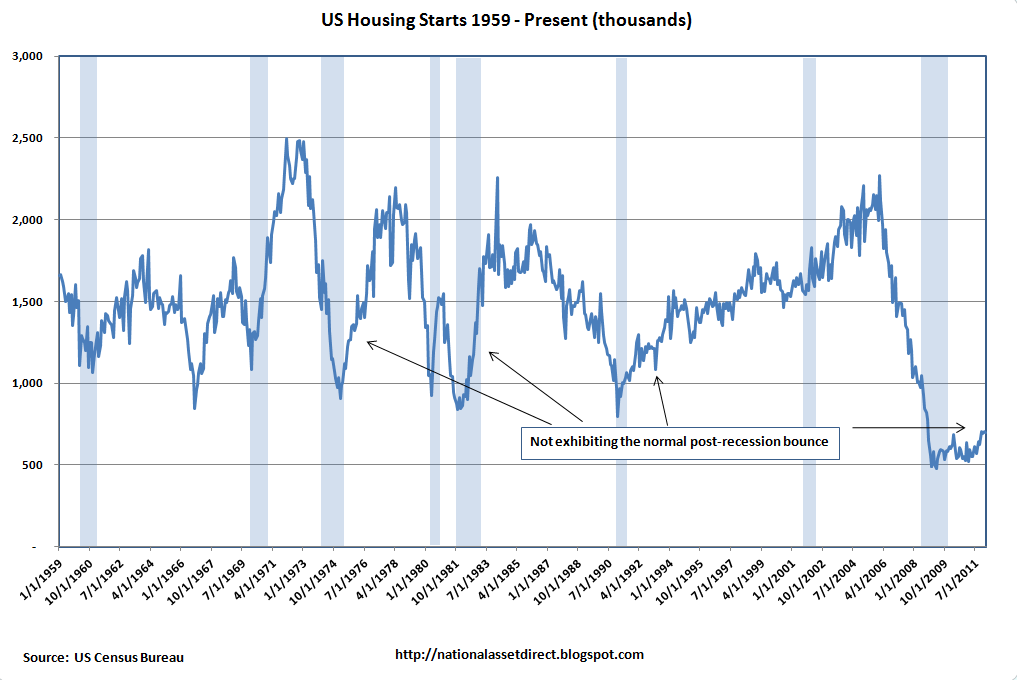
Housing starts came in at 700k, more or less in line with the levels for the past few months, and much lower than the 1.5 million or so that represents “normalcy.” Housing construction has been the achilles heel of the recovery and it looks like that will continue. The National Association of Homebuilders sentiment index continues to improve, but it has yet to be reflected in the numbers.

The FHFA released its fourth quarter Foreclosure Prevention and Refinance Report. HARP and HAMP activity has been declining after peaking in 1H10. Short sales and DILs are playing a larger role, while mods remain the focus. Recidivism rates (the knock on loan mods to begin with) have been steadily decreasing and are now in the 10%-15% range. Foreclosure starts have been falling since 3Q10, while foreclosure sales continue to run well below the start rate.  So while they haven’t been filling up the inventory of foreclosed homes as rapidly as they did in late 2010, they still are accumulating foreclosed property on a net basis. Someday, this inventory is going to hit the market. They provide a nice state-by-state analysis at the end that is worth checking out.

Chart:  Housing starts

Who’s still got game?

Sixteen teams remain.  Which of our astute ATiM’ers have the staying power to win?

Current standings:

  1. USF Baby 129 pts. (9 teams left, 3 of this bracket’s FF teams are still in the hunt)
  2. DogJS 120 pts. (11, 4)
  3. Moderately Yello 116 pts. (9, 3)
  4. MIA#2 105 pts. (10, 3)
  5. MIA#4 103 pts. (10, 2)
  6. ashot 91 pts. (10, 3)
  7. Michigoose#2 88 pts. (9, 2)
  8. Blade Warriors 81 pts. (8, 1)

USF Baby and MIA#2 may be hurting a bit now that a key player on their projected champion (Kendall Marshall of UNC) is likely out with a wrist fracture.  Marshall had 18 points and 11 assists in UNC’s victory over Creighton on Sunday.

Others can still move onto the leaderboard list depending on upsets and the like.

The action moves to the women’s tourney, and we’ll resume our coverage of the men’s games on Thursday.

Survivor or not?

From NPR this morning, an interesting question being posed to SCOTUS about survivor benefits from Social Security for children conceived after the beneficiary’s death:

Two eras clash on Monday at the U.S. Supreme Court, when a law written in 1939 is applied to in vitro fertilization. At issue is whether children conceived through in vitro fertilization after the death of a parent are eligible for Social Security survivors benefits.

[snip]

The government concedes the twins are Robert’s biological children. But the Social Security Administration says that it determines eligibility based on the inheritance laws of each state, and in Florida, where the couple lived, children conceived after the death of a parent cannot inherit property, unless specifically provided for in a will.

Karen Capato counters that under the 1939 Social Security Act, survivors benefits go to any child of a covered individual, and the word child is “plainly defined” as the biological offspring of a married couple. She contends that the section of the law dealing with state inheritance statutes only kicks in when the “biological parentage is disputed.”

Is A Baby Conceived After Dad’s Death A ‘Survivor’?

What do you all think?

Mark adds:

The previous post and comments are found at:  https://all-things-in-moderation.com/2011/11/16/do-the-twins-get-ss-survivors-benefits-i-report-you-decide/

Let me add that NPR did a lousy job of presenting the matter.  This is a statutory and not a constitutional case.  The statute requires that the beneficiary must have been dependent upon the deceased individual at the time of his or her death. Citing a case that held that a fetus in esse at the time of its parent’s death had an expectancy of dependency on that lost parent, the Circuit reversed the trial court on the issue of whether these were children, but remanded for a fact finding as to whether they were dependent on their biological father at the time of his death.  I expect a per curiam decision that this is not a contestable fact issue in this case, and a reinstatement of the denial of benefits. There is no way to stretch from a fetal anticipation of support from a parent who dies during gestation to a fetal expectancy of a parent who does not exist at the time of conception.  The Court need not reach the definition of “children”, so minimalism says they should not address that in this case.  I will go out on a limb and say that there is no way these twins can qualify for benefits.