

 Brent Nyitray
 Fairlington Blade
 Let the mutherfuker burn!
 jnc4p
jnc4p Kevin S. Willis
 Michigoose
 lmsinca
 markinaustin
 Arcanaut
 novahockey
 quarterback
 ScottC
 yellojkt
Vital Statistics:
| Last | Change | Percent | |
| S&P Futures | 1308.3 | -7 | -0.53% |
| Eurostoxx Index | 2435.3 | -25.060 | -1.02% |
| Oil (WTI) | 99.35 | -0.350 | -0.35% |
| LIBOR | 0.5511 | -0.002 | -0.36% |
| US Dollar Index (DXY) | 79.356 | -0.041 | -0.05% |
| 10 Year Govt Bond Yield | 1.92% | -0.01% |
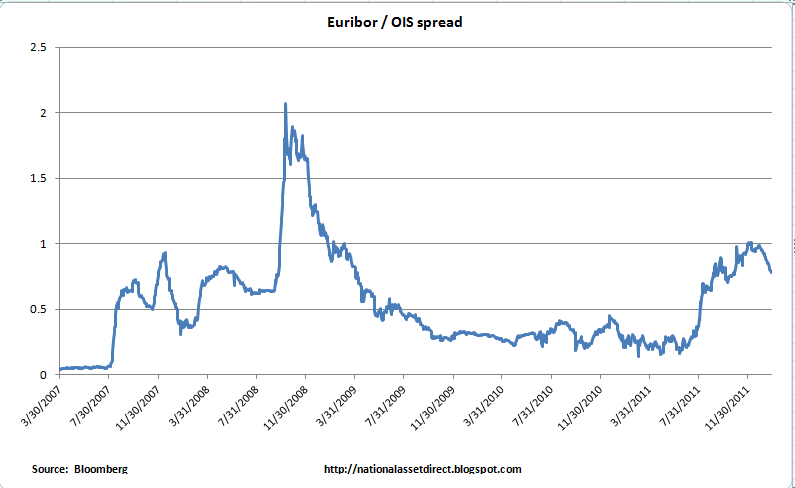
Markets are weaker on a lower-than expected GDP report. 4Q GDP came in at 2.8% vs street expectations of 3%. Consumption and prices were lower than expected as well. No major news out of Europe. EURIBOR / OIS continues to fall – it is now at 77.5 basis points. Remember, 20 bps is more or less post-crisis “normalcy” Pre-crisis normalcy was closer to 7 bps. Note the flat line before mid-2007 and then the spike in 2008. People forget that the crisis began a year before Lehman. Looking back, I remember the crisis began when the banks were stuck with a hung bridge on the Boots LBO. Should have sold everything that day.
Chart: EURIBOR / OIS
The WSJ has an editorial today on the Fed, which I believe nails it. It notes the disconnect between obama’s view of the economy and the FOMC’s view. But, the quote that says it all is this:
“One problem with all of this was pointed out yesterday by Kevin Warsh, who as a Fed governor sat on the FOMC until early last year. Speaking at Stanford, Mr. Warsh said that “exceptionally accommodative monetary policy” has its uses in a crisis or recession. But the Fed’s “recent policy activism—measures that go beyond a central bank’s capacity or traditional remit—threatens to forestall recovery and harms long-term growth.”
That’s a useful warning for markets to hear. Consider that Mr. Bernanke’s transparent goal is to drive down long-term interest rates to reduce mortgage rates to reflate the housing bubble. But intervening so directly to keep rates artificially low has made the bond market useless as a price signal or indicator of risk across the larger economy.”
As others (John / Banned) have noted, low interest rates are not “free.” They are the equivalent of sticking a penny in the fuse box. They may make the immediate problem go away, but they mask the underlying issues, and set yourself up for a major fire later.
In earnings this am, Ford missed and DR Horton beat. D.R. Horton is cautiously optimistic about Spring.
Filed under: Earnings Announcements, Economic data, Economy, Federal Reserve, Financial Crisis |
 All Things in Moderation
As someone who enjoys reading economic/financial news and even theory, to a degree, but is still essentially a “dumbass” when it comes to this stuff, and I don’t know why I keep trying but I do, this piece from Philip Pilkington answered a few questions in a way that made a little more sense to me. Not to say Brent isn’t doing a fantastic job, but sometimes I’m still behind the curve.
Mosler sums it up well:
“Lowering rates in general in the first instance merely shifts interest income from ‘savers’ to borrowers. And with the federal government a net payer of interest to the economy, lowering rates reduces interest income for the economy.”
He then goes on to make the point that we’d have to see borrowers spending more than savers to see any real stimulative effect on the real economy. But alas, such is probably not the case.
“The only way a rate cut could add to aggregate demand would be if, in aggregate, the propensities to consume of borrowers was higher than savers. But fed studies have shown the propensities are about the same, and, again, so does the actual empirical evidence of the last several years. And further detail on this interest income channel shows that while income for savers dropped by nearly the full amount of the rate cuts, costs for borrowers haven’t fallen that much, with the difference going to net interest margins of lenders. And with lenders having a near zero propensity to consume from interest income, versus savers who have a much higher propensity to consume, this particular aspect of the institutional structure has caused rate reductions to be a contractionary and deflationary bias.”
LikeLike
Think of it this way. Money flowing in one direction is taking money from another one.
Picture if you will a rectangular water tank with two separate compartments exactly the same size on a balance like a see saw. At each end, a small hole has been drilled close to the top, out of which water flows at exactly the same slow rate keeping the tank perfectly in balance.
If we pour more water into one end, the outgoing rate of that compartment doesn’t change, however if you pour enough in one end, you tilt the tank so high that water no longer flows out of the other hole at all.
That’s what he saying. Make sense?
LikeLike
John: Isn’t that zero sum?
LikeLike
I supposed you could call it that. I try not to use catch phrases because they usually have popular misconceptions attached to them. For instance I don’t believe I have ever written “liquidity trap” anywhere anytime.
Now If I wanted to complicate the above example, I would have had another tank of water simultaneously filling both tanks at the same rate as the outgoing flow, but then changing THAT tank to favor one side more than the other. But that, while more accurate would confuse the idea more.
LikeLike
I’ll take a stab at it by contrasting taxes and interest rates.
““The only way a rate cut could add to aggregate demand would be if, in aggregate, the propensities to consume of borrowers was higher than savers. But fed studies have shown the propensities are about the same, and, again, so does the actual empirical evidence of the last several years.”
The argument for a progressive tax structure has typically been that raising taxes on the rich and simultaneously lowering them on the poor will stimulate the economy because the marginal propensity to consume is higher for the poor than the rich. In other words, if you cut taxes on the poor, they spend it. If you raise taxes on the rich, they just save less and continue to consume as much as they did before. In other words, there is a multiplier effect. So if you take a dollar out of the pocket of the rich and give it to the poor you will stimulate the economy. Of course this analysis focuses only on the multiplier, and ignores all of the second and third order effects, which can be substantial and counteract the stimulative effect.
However when you consider interest rates instead of taxes, that argument breaks down. There is no similar multiplier effect when you consider “savers” vs “borrowers.” If you cut interest rates, you put more money in the hands of borrowers, but you are taking it from savers. So a dollar goes from the pocket of a retiree and goes into the pocket of a homeowner. The homeowner increases consumption and the retiree decreases consumption by the same amount so there is no net economic effect.
LikeLike
“Robo-Reality: Final Foreclosures Fall as Pipeline Swells”
http://www.cnbc.com/id/46162724
LikeLike
Damn Brent, I wasted an hour building my water tank! LOL
LikeLike
Damn Brent, I wasted an hour building my water tank! LOL
And I went cross-eyed attempting to read and comprehend the two water tank posts.
LikeLike
Sorry banned. I am in fixed-income derivative hell this morning and needed a break
LikeLike
Brent:
I am in fixed-income derivative hell this morning
What happened?
LikeLike
“And I went cross-eyed attempting to read and comprehend the two water tank posts.”
I called a plumber to translate. but he wanted $100 just to take a look.
LikeLike
Thanks again both John and Brent……..I think. At what point does the Fed begin to think that the effect on savers has reached a tipping point? John and several others have mentioned the effect on pensions and fixed income retirees.
LikeLike
John:
There’s a series of books on the fed by Allan H. Meltzer. Isn’t there a single volue that is very good?
LikeLike
Brent:
I am in fixed-income derivative hell this morning
What happened?
Nothing. Just trying to figure out the cost of hedging the convexity risk of a portfolio of newly-originated non-conforming mortgages.
LikeLike
mc:
Don’t know if you saw mine from yesterday on the question. I think you will be better off getting one of the books on the financial crisis than one just one the Fed.
LikeLike
and just for the record, I agree with what Brent said of course, but I was trying to think of a 3D way to show it.
Bottom line Mossler was suggesting that taking money away from savers and giving to borrowers, has no positive effect UNLESS the borrowers spend more afterward, than the savers reduce their spending.
LikeLike
No, I missed yesterday.
I have a book called, I think, The Devil’s Are All Here.
I’ve read the one by the Rolling Stone guy Griftopia.
I wondered if Confidence Men was worth reading.
There may be another one i’ve forgotten.
LikeLike
NoVa- This is OT and maybe too “inside baseball” for others here, but you may appreciate it. I heard a radio advertisement for a local health care system, the Detroit Medical Center, that was named as a Pioneer ACO. My favorite line was something to the effect of “As a Pioneer ACO doctors and physicians will now work together to keep patients healthy.”
This of course begs the question what exactly were they doing before? Were they working to keep us sick? Were they working against each other?
I have less and less hope for ACOs since the CBO came out with their report showing other demonstration projects actually cost more rather than led to any savings.
LikeLike
ash:
LOL
Mc
Andrew Ross Sorkin’s Too Big Too Fail is not only a decent book, but you can find the movie online if you’re pressed for time
LikeLike
I saw the movie. Thanks.
I think the event is still in the news phase rather than the historical phase. It might take time for the players to “settle down.”
LikeLike
“Where they working against each other?”
What a disaster. and I see this both at work and in my EMT runs. patients with 25+ medications and doc 1 has no idea what doc 2 is up to. fragmented care is wasteful and dangerous. it’s why FFS needs to go and serious reformers should be embracing, not running from the “ending Medicare” charge. but nobody wants to take responsibility.
LikeLike
From my above link, notice how much easier it is to clear non-recourse foreclosures than judicial ones:
“To give you an idea of just how much the “robo” scandal is toying with the numbers, LPS compared states that require foreclosures to go through the courts versus states that don’t (judicial versus non-judicial) and found the following:
– 50 percent of loans in foreclosure in judicial states have not made a payment in two years, as opposed to 28 percent in non-judicial states.
– Foreclosure sale rates in non-judicial states are about four times those in judicial states. “
LikeLike
NoVA
it’s why FFS needs to go and serious reformers should be embracing, not running from the “ending Medicare” charge.
I’m not sure I understand this. Can’t FFS be phased out, I agree it needs to go, and Medicare survive? Are they inextricably entwined or just not part of the dialogue in a meaningful way. Even with yours and Ashots updates it’s tough to follow what reforms are part of ACA and what reforms are being promoted behind the scenes.
LikeLike
Imsinca: See Paul Starr’s recent book.
I’m up to the chapter on ACA where those questions will be answered. He details the Romney MA plan as well.
LikeLike
lms — yes, there are loads of options to reform it. but politically, it’s near impossible. see this morning’s Politico as an example.
http://www.politico.com/news/stories/0112/72053.html
Wyden reaches out, gets smacked around by his own party, which would rather have the issue to demagogue, just like the GOP did with those “cutting Medicare” cries during the ACA debate.
I’m working on another Medicare post — so I can address you other reform questions in that. (look for it sometime next week)
The simple fact of it is that for the vast majority of members of Congress, their knowledge of Medicare and Medicaid is “Medicare = old” and “Mediacid = poor.” and that’s it. their health staffers are 22-27 years old and have some more advanced knowledge. but they do know they don’t want seniors calling them daily.
but unless your member is on Senate Finance, Senate HELP, or House Ways and Means, or House Energy and Commerce, they probably just don’t know or have the time to learn. that said, the members and staff on those authorizing committees are well versed and know these programs top to bottom (on both sides, R and D).
LikeLike
it’s why FFS needs to go and serious reformers should be embracing, not running from the “ending Medicare” charge.
Agreed on both ending Fee For Sevice (FFS) and embracing the “ending Medicare” charge. If politicians from both sides are purportedly concerned with our deficit, they should shout from the roof tops that they intend to end the most significant contributor to that deficit and replace it with an entirely new, cheaper alternative. Any politicians that demagogue ending Medicare while also pledging to shrink or eliminate the deficit should be…well… unpleasant things should happen to them including, but not limited to, losing their job.
LikeLike
Thanks mcurtis, not only am I behind in my work, CA current events and keeping up with the political scene, I’m also about 10 books behind in my reading. And we’re heading into the busy season. I’ll add it to my list though. Off to do paper work, I know, I know, I keep saying that.
LikeLike
Thanks NoVA…………….back later. Have a nice weekend.
LikeLike
i’m somewhat convinced that a Dem will have to lead the charge to transition from FFS.
LikeLike
i’m somewhat convinced that a Dem will have to lead the charge to transition from FFS.
You probably have a much better feel for that than I do. However, given the voting tendencies of the mostly elderly Medicare population, it makes sense that Dems would have less to lose. They would need a unified front on this so that they could turn Republican opposition to Medicare reform into an indictment on the Republican position on the deficit. Managing to wrangle everyone into a unified position seems highly unlikely as I’m sure there are a fair amount of Dems who rely on votes from the Medicare population.
LikeLike
ashot and nova, please correct me if I’m wrong. (Heh, as if that is NOT going to happen.) Changing Medicare to a voucher (or whatever terminology you want to use) system a la Paul Ryan’s plan does nothing to change FFS, it just shifts how and by whom those charges are paid?
LikeLike
Turning Medicare into a voucher system just creates another tier where fraud can be introduced, in addition to creating another layer between consumer and provider, and introducing another party both to not receive payment (and thus hold up their payments) and to refuse payment. I suspect it would just be a mess.
LikeLike
okie — I’d have to go back and look at the Ryan plan or the Wyden-Ryan to confirm — but very few private insurers operate on a FFS basis. they’d be buying into some type of manged care.
I think Wyden-Ryan preserved the existing structure for those who opt to choose it, in the thinking that it would eventually be phased out, as very few people under Medicare age have FFS.
LikeLike
Interesting discussion from eslewhere.
Irony
Naming the Buffett rule after a guy worth 39 billion, whose yearly income was 62 million in 2010 according to him, and yet who pays his secretary so little and in such a way that she pays more taxes than him.
Note, Buffet could very easily choose to pay his secretary in ways that would allow her to pay less such as stock options or by creating a trust for her and giving her the yearly income, etc. That’s exactly what he does with his OWN income. He doesn’t’ do so because it would cost more for BH.
Almost no major figure in this country has been so able to control the myth about himself better than Buffet. (Jobs comes close)
LikeLike
banned:
Almost no major figure in this country has been so able to control the myth about himself better than Buffet.
Very much agree. How he managed to keep himself clean in the scandal that brought down Greenberg is beyond me. I’ve talked to people in the industry and they tell me there is almost no chance that if Greenberg was involved in arranging that deal, Buffet was not on the other end of the phone.
LikeLike
Buffett’s “offer” to match any amounts Republicans in Congress pay toward his unpaid “fair share” was classic flimflammery, too.
I’ve really come to think he’s among the biggest phonies walking around. But I suspect that he is so insulated from reality and puffed up by his money that he can’t comprehend the difference between his BS and reality any more. Truly a man caught up in his ego and wealth, and thus the very opposite of the image he portrays.
LikeLike
Dang. I played with my gravatar, and now I am a digital alien.
I tried to do something with it that lms would appreciate.
LikeLike
A couple of links about Ryan-Wyden:
Point and counterpoint op-eds in the New England Journal. AEI vs. Brookings.
LikeLike
So will the reasonable people here please explain to me why it’s so hard to explain to people in general that Buffett, not the government, chooses how much taxes his secretary pays by how he structures his compensation to her?
I mean c’mon, man!
LikeLike
banned:
So will the reasonable people here…
I haven’t seen him in ages.
LikeLike
So will the reasonable people here…
What about the devilishly handsome people?
LikeLike
so basically I got in a bar fight at PL, and JNC pulled me out the door and said time to go home.
Thank you!
LikeLike
JNC pulled me out the door and said time to go home.
I’m just glad you consider this home.
Scott
Fantastic Avatar……too bad qb’s didn’t take yet…..I’m curious now.
LikeLike
I haven’t seen him in ages.
Yeah, where is Mark anyways?
LikeLike
banned. you’re wasting your time over there.
LikeLike
“So will the reasonable people here please explain to me why it’s so hard to explain to people in general that Buffett, not the government, chooses how much taxes his secretary pays by how he structures his compensation to her?
I mean c’mon, man!”
I don’t think they care about the explanation, but rather only in making their point about “Buffett good”, “Romney bad”. Buffett provides a useful foil to separate “good businessmen/capitalists” from “bad businessmen/capitalists”.
Facts are irrelevant. The non sequitur of that thread was bringing the Fair Labor Standards Act into it.
LikeLike
“so basically I got in a bar fight at PL, and JNC pulled me out the door and said time to go home.
Thank you!”
They will also never get the point about it being almost impossible to actually tax carried interest as regular wages due to the ability to restructure the compensation through various methods, including the non-recourse loan example that you cited a few days ago. The only way is to empower the IRS to make arbitrary judgements about what constitutes an improper tax shelter and then fight it out in tax court. See Newt’s S Corporation income structure as an example.
Again, this is why I’m a flat taxer. The only people who win from the current system or the replacement proposals currently under consideration are the tax lawyers and accountants.
LikeLike
@Brent’s 9:30AM
Thanks for that clear concise example of taxes versus interest and multiplier effects.
That was as well done in a couple of paragraphs as I’ve ever seen. With all due respect to john/banned’s fish tank.
LikeLike
Also, new technical term of the day that I had to Google and read about courtesy of Brent:
“convexity risk”
http://www.investopedia.com/terms/c/convexity.asp
LikeLike
What is the deal with these Gravatars? It is there when I look at my profile page.
Do they just not show on posts for a while? How is my Mr. Burns gone (safely in storage, too be back) but the new one not in his place?
Oh well, I should be working anyway.
LikeLike
QB, try clearing browsing history and cookies and sign out and back in. That worked for me.
LikeLike
qb:
When I changed mine it took about 10 mins to show up, but my old one remained in the meantime. Weird that yours reverted to Space Invader, and is taking so long.
LikeLike
I can see it when I hover. You can try re-uploading it to your Gravatar or making sure it’s selected here:
http://en.gravatar.com/emails/
LikeLike
ruk:
there’s probably more than just money making as the reason everybody else in my family became teachers and I did not. LOL
LikeLike
Latest from Matt Taibbi on President Obama’s announcements on the mortgage fraud/securitization/MERS investigations.
http://www.rollingstone.com/politics/blogs/taibblog/is-obamas-economic-populism-for-real-20120126
LikeLike
Facebook IPO next week, Unimagineable riches for some. That also explains the curious rise in MSFT shares recently.
LikeLike
jcn:
can’t understand why he writes for such a throwaway publication. He’s good.
LikeLike
john/banned
I wish to engage you about your contentions vis a vis Buffet and his secretary.
I hope you won’t feel slighted if I don’t call you a f*ucking moron like they did over at that “other” place. LOL
I do not dispute your facts whatsoever….well maybe the latest..just a bit. But yes Buffett pays his secretary the equivalent of me paying our dental assistants $26 a year…in fact it may be worse I haven’t really calculated the ratios.
But my question would be…Why would he pay her more than market value. Now I think a strong case could be made if he were paying her below market value that he was a hypocrite…I don’t know but I suspect he probably pays her very well, but obviously nowhere near what he could afford to pay. Why should he..to make a point? I would make this same observation about Scott’s point that Buffett can always pay more taxes if he thinks his rate is too low…why would he? To make a point?
Buffett cannot single handedly change the deficit, or who is going to pay or it. To me talking about how much he COULD pay his secretary, or how much he COULD pay in taxes is just a red herring. It’s really irrelevant to the actual policy debate.
Now your contention that Buffett could pay his secretary in such a fashion that she could avoid more taxes…really? You used stock options as an example. Are you a bit out of touch with working folks john/banned. I ask this respectfully and without snark.
I’m not going to look up precise figures because I’m busy…but can you understand that the average American is living paycheck to paycheck. And investment in turbo tax would be a big deal for them, much less hiring an actual accountant, much less hiring a GOOD accountant.. They’re just going to short form their way through taxes.
Only wealthy people have no consideration of personal cash flow. In our office I inherited a system where my wife paid staff at the end of the week. We don’t even hold back a week’s pay, (it would certainly make my job easier if we did and that’s another reason, along with expense and flexibility that I don’t subcontract payroll) and if we tried to do that next week it would place a hardship on a couple of our girls.
I think your point about the stock options and tax avoidance is exactly what this entire debate is about. I don’t care that Romney is wealthy, or even that he has parked money in offshore accounts…what disturbs me is that these vehicles for tax avoidance are not available for the average American.
I get to deduct the interest on our cottage on Lake Superior. None of my employees can afford a second home. Does that make me a hypocrite. Perhaps…but if they ended the deductions for second homes tomorrow I would accept that, as long as the unintended consequences (perhaps collapsing real estate values further, didn’t mitigate against it.)
I’m not one to go nuckin futs over Romney’s apparent..shall we say thriftyness with his maids, or getting his property taxes lowered a whopping ten grand..or his tin ear when it comes to “real” everyday Americans. It’s the system that is offensive…not Romney for taking advantage of it…and NOT Buffett for doing the same thing.
LikeLike
ruk:
I would make this same observation about Scott’s point that Buffett can always pay more taxes if he thinks his rate is too low…why would he? To make a point?
No, not to make a point, but because it is the just thing to do, by his own reckoning.
Do you need a law to compel you do to things that you think justice demands? Or would you do them anyway, even in the absence of the law, because you considered it to be the right, just, or fair thing to do? Presuming you agree that beating your wife is wrong, would you do it anyway just because the law allowed it?
To me talking about how much he COULD pay his secretary, or how much he COULD pay in taxes is just a red herring. It’s really irrelevant to the actual policy debate.
If you truly believe this, then, like me, you should think that how much Buffet or his secretary DO pay in taxes is irrelevant to the policy debate.
As I pointed out the other day, Buffet is not making a practical argument about policy. He is making a moral argument. And Obama, by using both Buffet and his secretary as props in the policy debate, is also making a moral argument. One that Buffet, by his actions, manifestly does not believe. (In fact, one that he certainly knows to be false.) He is a charlatan.
LikeLike
RuK: Buffett cannot single handedly change the deficit, or who is going to pay or it. To me talking about how much he COULD pay his secretary, or how much he COULD pay in taxes is just a red herring. It’s really irrelevant to the actual policy debate.
It is irrelevant to the policy debate, but not immaterial to the argument Warren Buffet seems to be making, which is a moral one. If I know I should support my family, I either do it, or I am immoral or unjust by my own reckoning, whether or not there is law compelling me to do so. And I don’t get a pass because I’m urging the government to pass a law to obligate me to do the right thing, but refusing to do so until such time as the law is passed.
As a policy question (is a more or less progressive tax system better for both raising government revenues and providing for a robust economy) no one is obligated, or should be, to lead by example. If the argument is that it is unfair, or unjust, or wrong that you don’t pay more than you do, then either you should be (or you’re a hypocrite), or it’s not really a policy argument at all, and thus should not be used to inform policy decisions. Ergo, the relatively higher percentage paid by Buffet’s secretary is irrelevant to issues of raising government revenues or paying off the deficit, and taxes should be raised or expenses cut to address that—not some gap, much of it easy enough for Buffet to ameliorate, between his pay and his secretary’s.
LikeLike
I think I figured it out. Should arrive soon. ; )
LikeLike
QB
Should arrive soon.
That’s not the way I pictured you in my mind at all…….WOW……..I better be more careful.
LikeLike
ruk:
The universe is pretty limitless how he could pay her and bring her taxes down. After all why do you think he supposedly pays only 16-17%? Think the people repsonsible would have a few ideas about how to change the tax rate on $60,000-120,000? Also, in any such change, do you think the IRS would tackle Buffet and BH over maybe $5000 difference in tax revenue?
Im fine with the rich paying more. I just hate the idea of calling it the Buffett Rule.
LikeLike
Also, new technical term of the day that I had to Google and read about courtesy of Brent:
“convexity risk”
http://www.investopedia.com/terms/c/convexity.asp
In the Investopedia example, they use a generic bond, which is positively convex. Convexity for people holding plain vanilla bonds is a good thing.
Mortgages are negatively convex. That is a bad thing. Ignoring negative convexity is what blew up Orange County in the early 90s.
LikeLike
“What about the devilishly handsome people?”
Indeed Kevin!!! What about us?
LikeLike
“Indeed Kevin!!! What about us?”
It’s not fair. I’m calling Diana Moon Glampers
LikeLike
“jcn:
can’t understand why he writes for such a throwaway publication. He’s good.”
Because they give him the freedom to write about the issues at length and in whatever language he chooses to use.
I disagree with your characterization of Rolling Stone. I’m a print subscriber to it (one of the few print magazines I still subscribe to) and they do true investigative reporting. See for example the article on Stanley McCrystal. They serve as a useful counterpoint to mainstream media being captured by their sources.
LikeLike
“The universe is pretty limitless how he could pay her and bring her taxes down.”
john/banned
Then please educate me. Of course I’m not talking about 60-120,000 I’m talking about the median 51,900 and of course here in Florida we pay in Sunshine (yeah there’s one say to implement tax avoidance lol) and the median is closer to 41,000.
That’s the range of my employees…Florida’s median income. Here is one answer to give you a start.
For dental assistants and hygienists I can give them a “uniform allowance”, but it’s definitely limited..10/week or 20/week max. My office manager who works up front and dresses in street clothes is not eligible for this. After we had to lay off a second assistant my office manager started helping in the back and occasionally puts on a cover up…I could “fudge” that into a “uniform allowance” for her. No taxes on that money at all, not FICA and no income.
Got any other gimmicks for me john/banned…or anyone else for that matter…because our employees are like our family and I truly would love to figure a way to get more bucks in their pockets.
LikeLike
Brent:
Mortgages are negatively convex.
“Negatively convex”? Is that akin to “concave”?
LikeLike
That’s not the way I pictured in my mind at all…….WOW……..I better be more careful.
Gee, I thought it was kind of funny, given recent discussions of images and reps.
LikeLike
qb, I didn’t say I wasn’t laughing. What are we, the two worst comedians in the world? Maybe that’s our problem, we just don’t get each others jokes????????
LikeLike
Brent:
Mortgages are negatively convex.
“Negatively convex”? Is that akin to “concave”?
Nope. Concave is not a financial term. It basically means you get fucked if interest rates go up or down.
LikeLike
Brent:
It basically means you get fucked if interest rates go up or down.
Maybe you should explain why. Pre-payment risk, right?
LikeLike
Q.B. You leave me in a no win position. If I say yeah I like your gravatar then you’ll think I’m trashing your image…if I say I don’t like it..then I’m trashing your taste.
How about..if you like it…I like it.
Have you ever had your wife ask you if a certain dress makes her look fat? Another question best left unanswered.
LikeLike
ruk:
I can’t give specific tax advice for your situation. You have to realize that Buffett has a finger in hundreds of pies, so his options are much greater than your own. The classic tax dodge is the independent contractor route. How it affects your situation I couldnt’ say
LikeLike
“Have you ever had your wife ask you if a certain dress makes her look fat? Another question best left unanswered.”
If in doubt, tell the truth. Better to be respected than loved.
LikeLike
jnc:
Point taken
LikeLike
lms,
Perhaps, although I refuse to accept that we are poor comedians.
I do get a chuckle out of the image of Church Lady versus Terminator.
ruk,
Q.B. You leave me in a no win position. If I say yeah I like your gravatar then you’ll think I’m trashing your image…if I say I don’t like it..then I’m trashing your taste.
Are my devious rhetorical schemes becoming that transparent?
LikeLike
Scott
“Buffet is not making a practical argument about policy. He is making a moral argument”
IMO he is making both! A significant number of economists and others believe that when money get’s concentrated in too few hands it creates a bad economy as measured by the usual makers of GDP etc. You can choose to believe or disbelieve this but i know you realize that many respected folks do believe this. That is the “practical” argument.
You can believe it’s unfair to let the rich simply get richer because they can buy the politicians and get favorable tax codes that benefit them while doing nothing for the average American. If you wish to characterize fairness as an issue of morality I can accept that. Again the majority of Americans do not agree with you. Doesn’t necessarily make you wrong, but I would posit in issues of fairness and morality there is far too much gray and far to little black and white to make pronouncements about who is right and who is wrong.
Although you don’t believe in “societies” acting as individuals…I don’t know how to say this…they at minimum exhibit the characteristics of the majority in any “society”.
The majority in our society feels a progressive tax is fair. Whether we conflate fair with moral is your choice I won’t quibble.
LikeLike
Ruk: “Buffet is not making a practical argument about policy. He is making a moral argument”
IMO he is making both!
I think he is probably making both, but the moral argument fails. I have argued for the idea of a general obligation: I may argue that we have an obligation (if not a moral obligation) to fund the government, and that the wealthy should pick up more of that than they already are. Yet I’m not arguing and individual, including myself, has an obligation to send more to the government willy-nilly, I’m arguing that we have a collective obligation, because unless everybody is contributing, the desired end result—a less-in-debt, service-rich government—is not possible.
I can’t make this argument by comparing my rich guy’s percentage paid to my secretary’s percentage paid, I don’t think. At least, not credibly. If I’m making a function argument—that it’s best for everybody that the rich pay more in taxes—then I can be rich and make that argument consistently without actually paying more myself, because my argument is that everybody who makes above a certain amount should be paying more. If I’m arguing that it’s a moral wrong that my secretary pays more as a percentage than I do, then I think that’s probably another (weaker) argument, where the fact that I do nothing to address this, either by restructuring my secretary’s compensation or sending more money to the government, hurts my argument.
LikeLike
ruk:
IMO he is making both!
Well then consider my arguments against his to be aimed at just the one.
LikeLike
BTW Apologies to Scott and others for not bolding…again I’m no computer whiz. If it’s not a point at the B and clicking it ain’t happening.
And might I ask this question once more. I’ve been around since the days of MS/DOS
If I’m not mistaken Windows is just another program that runs on top of DOS. Hence when my fingers fly sometimes the freaking keyboard commands do things I do not wish.
My question…since I’m a point and click guy is there anyway to disable the keyboard DOS commands?
Do Apple products have the same issues or are there no keyboard commands with Apple?
LikeLike
RUK: Windows is not a program that runs on top of DOS. Since Windows NT and Windows XP, respectively, Windows has run on top of the (then called) NT kernel. DOS runs in emulation. The command line talks to the kernel, and produces DOS like output, but it doesn’t run on top of DOS the way Windows 3.1 did.
My question…since I’m a point and click guy is there anyway to disable the keyboard DOS commands?
Probably. I don’t know what it is, but I imagine Google might help . . .
Apparently KeyTweak does. TuCows has been around forever, but I can’t vouch for this particular program:
http://www.tucows.com/preview/327616
From the documentation:
Simple interface
Ability to Teach remapping by pressing the keys to be remapped
Easy-to-read lists of all current and pending re-mappings
Implementation of Specialty Keys support for certain keyboards
Remove all re-mappings with a single button
Enable/disable annoying keys
Displays what exactly is written to the “Scancode Map” registry value and how to
interpret its binary data
User warnings help ensure Ctrl-Alt-Delete sequence is maintained
LikeLike
Brent:
It basically means you get fucked if interest rates go up or down.
Maybe you should explain why. Pre-payment risk, right?
There is no way to explain this without getting very deep into bond-geek stuff. And I’m not a bond geek. I am a fundamental equity analyst who is looking at this because there appears to be an opportunity in this space and I am the staff propellerhead.
LikeLike
Brent:
There is no way to explain this without getting very deep into bond-geek stuff.
I think that basics are this: When interest rates rise, the mortgage becomes less likely to be pre-paid, so you end up earning a below-market interest rate in a higher rate environment for a longer period of time. When interest rates drop, the mortgage becomes more likely to be pre-paid (as people re-fi), so you end up losing your higher than market interest rate, and will have to re-invest at the current, lower rates.
Hence, whether rates go up or down, you get, as you put it, fucked.
LikeLike
jnc:
You don’t have to pull me out of this bar. They are clearly all white wine drinkers here. LOL
LikeLike
“They are clearly all white wine drinkers here. LOL”
/lines up shots on the bar.
“the desired end result—a less-in-debt, service-rich government—is not possible.”
but that’s not the result all of us want. I’d much prefer a low-cost, low-service government. is it moral to force me to contribute to your preferred vision, when i just want to be left alone?
LikeLike
nova: but that’s not the result all of us want.
Certainly not. But wanting that result is different from wanting a result which makes rich people pay more because their secretary’s pay less, because that would be fair, which is my point.
is it moral to force me to contribute to your preferred vision,
I don’t think it is, thus why making moral arguments for tax policy is, IMHO, not a great idea.
LikeLike
Kevin,
Thanks for the info on MSDOS and keystrokes…I will pursue that.
As to your point that if Buffett himself does consider his argument to be a moral one then at minimum he should make up the difference in his secretary’s taxes..otherwise he is aiding and abetting the immorality.
I’m still not sure we can conflate fair with moral, I have to think so more about that one.
If Buffet is simply making an argument about fairness then I don’t believe he has any obligations to unilaterally remedy any wrongs…but I agree if he thinks what is going on with his secretary is immoral..he should personally give her a refund in the amount of % difference between his taxes and hers.
I accept anybody’s point about all of this “superficial” or ‘showy” stuff being irrelevant..whether it’s Buffett or Romney’s taxes or Buffett’s secretary or Romney’s maids or offshore accounts. May I steal from MacBeth?
“Told by an idiot, full of sound and fury,
Signifying nothing.” .
Again I love rich folks…I’m not that far out of the 1% to not still aspire…although my cake is pretty well baked..if business keeps growing like it has the past three months and the way it is scheduled for the next three months..wifey and I may yet make the 1%…wish us luck.
It’s about the trends, the income disparity, and the ways in which it was created. Some of it happened because of globalization and factors perhaps out of our control, but a lot happened because of the wealthy’s ability to purchase favorable tax law and then to hire very expensive accountants to manipulate that code.
LikeLike
Nova
“is it moral to force me to contribute to your preferred vision,”
It is certainly moral to make you contribute from our collective preferred vision. You have a vote to make it otherwise, if you don’t agree with the result then you are stuck in the same place I am.
Back in the days of Jeremiah Johnson and the rugged mountain men…or back even further in time to rugged individual pioneers libertarianism had a chance to function…it’s mainly a pipe dream in today’s world…although you still have choices..like Alaska, or perhaps some far west sparsely populated states.
Once you cross the line that it’s OK to pay for SOME stuff…then it’s over for libertarianism because we’re then all simply debating over which stuff and how much.
I see your points Nova and again I used to think like you so I can empathize.
If there is a major disagreement for me with your views it’s your constant characterization of Gov’t bad..free enterprise..or private..good. Perhaps I am oversimplifying your views and I’m taking some snark as serious thought.
But we don’t have enough time here to list the successes of Gov’t..the failures of Gov’t..and the successes and failures of “private” business.
IMO there is such a thing as efficient gov’t doing the right thing. Rare perhaps but not non existent. I could say the same thing about private companies…and the bigger the corps are getting, the less competition..they are becoming just as wasteful and inefficient as Gov’t…..just sayin’…your mileage may vary…lol
LikeLike
Scott/Bolder: LOVE the new avatar!
qb: Love yours, too, and if you’d read my FAQ© you’d have known how to make it appear quicker. . . just sayin’! Although I pictured you more as the T-1000 myself. . .
LikeLike
Mike, I’m just back from Houston – long day, two way drive, etc.
This has been a great thread, all.
Brent, John, and Scott, do you know about this guy?
http://dealbook.nytimes.com/2012/01/27/f-b-i-searches-offices-of-n-y-adviser-on-chinese-reverse-mergers/?nl=business&emc=dlbkpma1
How common is using the reverse merger as described to perpetrate a scam? Having done some blue sky litigation in the dim past, I see how this practice could avoid many of the safeguards required by registration and disclosure laws.
I’ll look in in the morning. For now, good night all.
LikeLike