Morning Report: Forbearance requests begin to pile in

Vital Statistics:


Last Change
S&P futures 2725 80.4
Oil (WTI) 26.46 0.49
10 year government bond yield 0.74%
30 year fixed rate mortgage 3.47%


Stocks are sharply higher again this morning as the COVID-19 fever seems to be breaking. Bonds and MBS are down, though MBS are still holding up better than the bond market.


There seems to be a sense that the COVID-19 crisis has passed the exponential growth phase and is entering the manageable growth phase. I suspect we will be talking about getting people back to work by the end of the month. Bottom line, the longer this drags on, the more people are going to ignore the stay-at-home warnings.


Home Prices rose 4.1% in February, according to CoreLogic. That said, it is old data and doesn’t really reflect what may be about to occur. “The nearly 10-year-old recovery of the U.S. housing market has run headlong into the panic and uncertainty from the global COVID-19 pandemic. In terms of home value trends, we are in uncharted territory as we battle the outbreak with measures that are generating a never-before-seen, rapid downshift in economic activity and employment. We expect that many homeowners will initially be somewhat cushioned by government programs, ultra-low interest rates or have adequate reserves to weather the storm. Over the second half of the year, we predict unemployment and other factors will become more pronounced, which will apply additional pressure on housing activity in the medium term.” The NYC metro area is most likely to bear the brunt of any negative price movements due to COVID-19. Note that Connecticut’s price appreciation was negative in February to begin with.


Meanwhile, New Jersey and Florida seem to be most likely to be hit by Coronavirus foreclosures. “Some parts of the country have seen home prices surge way past what average wage earners can afford, while others may be seeing equity lag if prices have flattened out recently or dipped,” Todd Teta, ATTOM’s chief product officer, said in a statement. “Homeowners who bought in the past year, at the top of the market, are more likely to fall into that group.” In New Jersey, five of those counties were in the New York City suburban area. They included Bergen, Essex, Passaic, Middlesex, and Union counties.


Nationstar (aka Mr. Cooper) said that 86,000 people requested forbearance already. Requests ranged from 8,000 – 22,000 a day through last Friday. This represents 2.5% of its customer base. Jay Bray, Mr. Cooper’s CEO said: “It’s frankly frustrating and ridiculous that we do not have a solution in place,” said Bray, talking about an advance facility for servicers “There is going to be complete chaos. We’re the largest nonbank. We have a strong balance sheet, but for the industry as a whole you’re going to start seeing problems soon.” Estimates for the number of forbearance requests range from about 2 million from the government to 12 million from the Urban Institute.


There is a massive moral hazard problem with forbearance that the government just hasn’t thought through. In 2008, you had to prove hardship to get a mod on your mortgage. Now you merely have to attest that you have been affected (and the CARES act says “directly or indirectly”). No proof required. I suspect the government’s 2 million estimate (~4% of homes with a mortgage) is probably too low. Urban Institute’s 24% is probably going to be closer to the mark. The limiting factor on this will simply be staffing for servicers. They probably don’t have have the people to handle 12 million forbearance requests. Heck, they probably don’t have enough for 2. What happens if someone can’t get through to their servicer, stops paying, and never gets approval? Or gets partially through the process, gives up, and stops paying without a plan?


Aggregators are already telling originators that any loan that requests forbearance within the first two weeks of purchase is getting pushed back to the originator. I have already received several unsolicited emails from funds looking to buy this paper. I think GNMA has said that loans in forbearance are ineligible for pooling in GII securities. Warehouse lenders are refusing to fund FHA and VA loans below 640, and aggregators seem to be moving towards a 680 minimum.


Morning Report: Servicer advance line needed

Vital Statistics:


Last Change
S&P futures 2567 84.4
Oil (WTI) 27.46 -0.89
10 year government bond yield 0.65%
30 year fixed rate mortgage 3.44%


Stocks are higher as  early signs show a plateauing in the COVID-19 crisis. Bonds and MBS are down.


Ex-MBA President Dave Stevens penned an editorial in Housing Wire that is worth a read. The CARES act mortgage forbearance policy is wreaking havoc on the mortgage banking system in general. The unintended consequences of this must be dealt with immediately. The servicers are Ground Zero of the crisis, as the CARES act requires them to make advances they don’t have. Ginnie Mae envisions a facility to make advances, but so far the GSEs do not. Also, the government’s estimate that only 750,000 homeowners will take advantage of this program is simply wishful thinking. There are probably 50 million mortgaged properties in the US. 10 million people lost their jobs in the last two weeks.  Dave Stevens argues that the government must establish an advance line facility for Fannie and Freddie loans, and they need to be clear on how advances will be replenished. The cost of not figuring this out is already evident:

Bid-ask spreads have widened, servicing bids have all but dried up or are being severely curtailed, lenders are having to pull back on minimum credit score, maximum DTI, certain loan products, and more. The Jumbo market is all but gone, especially in the third-party channels. In short, any prospective homebuyer right now is more likely to find fewer or no options for mortgage financing. This is greatly the outcome of the massive uncertainty surrounding the rollout of these federal interventions.

We are going to start hearing about some of the more tangible effects when the banks start reporting first quarter earnings in about a week. I can’t imagine what JP Morgan and Wells are going to have to say. Note JP Morgan is already publicly musing about cutting the dividend.


Black Knight Financial Services has a white paper discussing how to navigate the COVID-19 environment.


Bank of America has seen massive demand for the SBA Payroll Protection loans. Bank of America CEO Brian Moynihan said that the bank would serve its borrowing customers (i.e. existing clients) first. There remain issues regarding reps and warrants relief for fraud and money laundering, which have to get solved before the banks will really start doing these.


St. Louis Fed President James Bullard said that the COVID-19 stimulus bill was the correct size, and another one is probably not needed. He envisions the US economy having a sharp rebound once this is over.


New York is beginning to plan for re-opening business.

Morning Report: Banks pan the SBA loan program

Vital Statistics:


Last Change
S&P futures 2517 4.4
Oil (WTI) 28.56 3.29
10 year government bond yield 0.59%
30 year fixed rate mortgage 3.5%


Stocks are flattish after the jobs report. Bonds and MBS are flat as well.


Jobs report data dump:

  • Nonfarm payrolls down 710,000
  • Unemployment rate 4.4%
  • Labor force participation rate 62.7%
  • Average hourly earnings up 3.1%

Job losses were concentrated in the service sector, with leisure and hospitality losing 459k jobs. Health care lost 61k jobs (mainly support people) and construction was down as well. FWIW, the 710k number is probably not representative of what is really going on – it will be the cumulative weekly initial jobless claims, which are at something like 10 million.


The government is supposed to launch its SBA loan program next week. Apparently many banks will be sitting out. The biggest concern will be reps and warrants, especially when it comes to preventing fraud. The banking system remembers well when the Obama Administration used the False Claims Act to extract massive penalties with FHA lending. Many of those banks, like JPM, never returned to the sector. Also, the requirements to prevent terrorist financing and money laundering, which under the best circumstances takes weeks to do. Finally, the rate the banks will be forced to charge will be too low and will cost them money. But there will have to be reps and warrants relief to get banks to participate. They remember what happened in 2009 and 2010 too well.


All of the Fed’s buying has driven its balance sheet up to 5.86 trillion in assets. Before 2008, it was about $800 billion.


While most of us are focused on what COVID-19 is doing to the residential market, the commercial market is even worse. The CMBS market is completely frozen. Multifamily, retail, office tenants etc are simply not paying rent right now, and that is going to cascade onto the balance sheets of the banks.


There had been talk of a Fed facility to allow servicers to borrow to make advances to bondholders. It looks like that isn’t going to happen, at least not yet. Treasury wants to get a read on how many borrowers actually take advantage of the program. The problem is that if you tell someone that they can skip the next few payments on their mortgage, with no hit to their credit rating, no penalties, and the missed payments will just get tacked on to the end of the mortgage, who isn’t going to take advantage of it? A dollar today is worth more than a dollar tomorrow.


Moody’s has downgraded the non-bank mortgage sector from “stable” to “negative” as the financial markets seize up. We have seen the big non-agency mortgage REITs like New Rez, Two Harbors, and Redwood make distressed asset sales in order to meet margin calls.

Morning Report: Coronavirus kills 10 million jobs

Vital Statistics:


Last Change
S&P futures 2452 4.4
Oil (WTI) 22.16 1.89
10 year government bond yield 0.59%
30 year fixed rate mortgage 3.54%


Stocks are flattish after a record 6.6 million people file for unemployment. Bonds and MBS are flat.


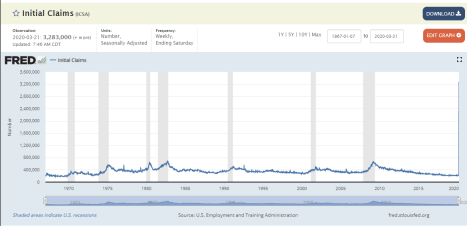
So, with last week’s revised filing of 3.3 million, a total of 10 million people have lost their jobs over the Coronavirus. Compared to the roughly 200k cases in the US, that works out to be 50 jobs lost per case. That puts the cost of social distancing in perspective.


Construction spending fell 1.3% MOM and rose 6% YOY. These are February numbers, so they were still largely unaffected by the COVID-19 crisis.


Pretty much everyone has gone to 680 minimum FICOs on FHA loans now. Secondary bulk buyers are pulling back their bids for all loans as well. Everybody is padding margins to take into account the various risks in the financial system.


Good piece on mortgage forbearance and what needs to be done. Bottom line, you can’t just stop paying your mortgage and assume everything is fine. Call your servicer before you start missing payments. FHFA Director Mark Calabria estimates that 700,000 mortgage will need forbearance. Given that 10 million people lost their jobs in the past two weeks, that number is probably way too low.


New York State has loosened restrictions on in-person showings, appraisals and inspections.


Rent was due yesterday for the nation’s renters. Washington is looking for a way to get some relief to them. New York State is considering allowing the security deposit to take the place of rent. I know that Fannie and Fred are allowing forbearance for multifam investors, but I have not seen anything for 2-4 units specifically. The multifam relief is conditional on a freeze of evictions.

Morning Report: Trouble with some of the non-agency mortgage REITs

Vital Statistics:


Last Change
S&P futures 2438 -89.4
Oil (WTI) 20.46 0.09
10 year government bond yield 0.60%
30 year fixed rate mortgage 3.5%


Stock indices are lower as we kick off the second quarter. Bonds and MBS are up small.


The Fed took up just 53% of the bonds offered to them yesterday. It sounds like they are backing off on their aggressive buying which was triggering margin calls throughout the industry.


Speaking of margin calls, it looks like New Rez has a deal to buy $6.1 billion of non-agency bonds. No price was indicated, but a couple days ago New Rez cut its dividend by 90% and said that book value was down about 25% – 30% from the 12/31 mark.


Impac recently said it would suspend lending operations for two weeks after a whole loan investor went radio-silent about its commitment to purchase whole loans. They have let go most of their employees.


I can’t see how the non-QM market comes out of this as anything more than a portfolio product for banks who have the werewithall to hold the paper. While I would bet the vast majority of these non-QM loans are money good and will perform as expected, they simply aren’t suitable for repo financing. Securitize them or hold them.


The economy lost 27,000 jobs in March, according to the ADP jobs report. In the previous report the economy gained 183k. Small business bore the brunt of the job losses, losing 90k. The Street is expecting a -150k print for Friday’s job report. with the unemployment rate increasing from 3.5% to 3.9%. The government just passed a stimulus bill with aid to help small businesses get through this period. Many are hoping to hold on until the cavalry arrives.


Mortgage applications rose 15% last week as purchases fell 11% and refis rose 26%.

Morning Report: The MBA asks for relief from margin calls from the SEC and FINRA

Vital Statistics:


Last Change
S&P futures 2581 -29.4
Oil (WTI) 20.94 0.89
10 year government bond yield 0.70%
30 year fixed rate mortgage 3.38%


Stocks are down this morning as we wrap up Q1, which was the worse quarter for stocks since 2008. Bonds and MBS are up.


The Fed will buy up to $30 billion in MBS today, along with some CMBS paper. It sounds like the NY Fed heard the pleas of originators and is cognizant of the margin call issue. The MBA issued a letter to the SEC and FINRA asking them to give guidance to broker-dealers to lay off the margin calls: “MBA urgently requests that FINRA and the SEC issue guidance to the nation’s broker-dealers, making clear that margin calls on mortgage lenders’ TBA hedge positions should not be escalated to destabilizing levels,” Broeksmit said. “Absent such guidance and an immediate shift in broker-dealer practices, the U.S. housing market is in danger of large-scale disruption.”


Been hearing chatter that a lot of originators are imposing minimum 680 FICOs on FHA loans. Also, warehouse banks are becoming more reluctant to fund them unless there is a bid in hand for the loan. It makes sense – FHA loans have the lowest margin for safety with 3.5% down and FICO scores that are generally not good enough to qualify for Home Ready or Home Possible.


Goldman is forecasting a Q2 GDP drop of -34% and unemployment hitting 15%. Yikes. That said, the economy should come roaring back in the third quarter as Coronavirus issues fade. The ultimate question: Did all of these small businesses that shuttered over the past month go into hibernation or did they go away? And while the banking sector has so far withstood the impact of the credit crisis, the non-banking sector is a different story. A few non-agency mortgage REITs like Two Harbors and MITT have sold their non-agency bonds to satisfy margin calls. One certainly has to worry about the CMBS mortgage REITs as well as the plain old shopping center and mall REITs. If you are anchored with a grocery story, you might be ok. If you are anchored with a Macy’s however…


KB Home reported better than expected numbers on Friday, and remarked that internet traffic remains up on a YOY basis. Walk-in foot traffic is not as the company has shut down its offices. In some parts of the country construction has stopped, but in most of the US it is still proceeding. Regardless of the Coronavirus issues, it appears that the demand for homes is still there, and we might see an even tighter market in existing homes as would-be sellers take their homes off the market.


Home prices were up 3.9% in January, according to Case-Shiller. An economist from Capital Economics expects a 4% peak-to-trough hit in real estate pricing. It will be interesting to see if home prices take a hit as a result of the Coronavirus. As KB Home mentioned, the existing home inventory should be even tighter, and homebuilders aren’t stuck with a lot of inventory at the moment and they aren’t entertaining price cuts. That said, the NY market may be a bit heavy.

Morning Report: Margin relief, please

Vital Statistics:


Last Change
S&P futures 2545 20.4
Oil (WTI) 20.14 -1.39
10 year government bond yield 0.65%
30 year fixed rate mortgage 3.44%


Stocks are higher this morning as the government extended social distancing for another two weeks. Bonds and MBS are flattish.


Margin calls have been driving the independent mortgage bankers crazy over the past month. The Fed’s dramatic actions in the mortgage backed securities market may have helped liquidity, but it has pushed the IMBs to the wall. The MBA has been in discussions with the Fed and policy makers to make them aware of what is happening.

“While lenders can expect to recognize gains on their pipelines, they will also recognize losses on short TBA positions used for hedging purposes,” MBA said. “These pipeline gains will be recognized over a period of weeks, but the sharp movement in lenders’ hedge positions typically entails daily adjustments and margin calls from their broker-dealer counterparties. Because of these dramatic price changes, broker-dealers’ margin calls on mortgage lenders reached staggering and unprecedented levels by the end of the past week. For a significant number of lenders, many of which are well-capitalized, these margin calls are eroding their working capital and threatening their ability to continue to operate.”

For what its worth, the Fed’s MBS purchase guidance for today. It is “only” $40 billion versus the $50 billion last week. I see a lot of “tentative” notes, so hopefully they will let them breathe a little. Unfortunately, the April 2.5s are 105 bid this morning, so it isn’t a good start. The regulators need to figure something out: either tell FICC to call off the dogs, or perhaps let independent broker dealers assign their short TBAs to Fannie.


Fed MBS purchases


There is talk that Ginnie Mae is going to put out an APM that will allow GNMA to cover advances for servicers who get hit by a wave of DQs. The government has to do something, because non-bank servicers simply don’t have the liquidity to handle it.


Economists forecast that the Coronovirus will cause a record recession and a record expansion all in the same year. Wells Fargo predicts a 15% contraction in Q2, a 6% contraction in Q3 and a 4% expansion in Q4. They are calling for the 30 year fixed rate mortgage to fall to 2.9%.


Zillow is working to cancel all of its existing contracts to buy homes under its iBuyer program. I guess Zillow’s offers are contingent after all, and you have to wonder if paying 7.5% and up is worth it.


New Jersey has instituted a 90 day mortgage holiday for those who have been impacted by Coronavirus. No late fees, no credit hit. Note that the mortgage forbearance plans that have been advertised in the press involve adding the missed payments to the end of the loan. That isn’t necessarily the case. Check with your bank.

Morning Report: Massive mortgage holiday?

Vital Statistics:


Last Change
S&P futures 2530 -78.4
Oil (WTI) 21.84 -0.69
10 year government bond yield 0.75%
30 year fixed rate mortgage 3.44%


Sloppy stock tape as we head into the weekend. Bonds and MBS are up.


The Fed is set to purchase another $50 billion of MBS and TBAs today. Mortgage bankers are getting killed on their hedges and fighting off the margin calls. The Fed and FICC really need to have a conversation about what they are doing.


The FHA market is tightening up dramatically. Sub 620 FICO? Forget about it. Seeing some aggregators add 15 point LLPAs to lower FICO FHAs. Right now, the floor is 660, and rising fast. If the government goes through with its mortgage relief plan, DQs are going way up. The government is planning to set up a facility for servicers to make advances, which should keep the biggest non-bank servicers alive during this period. Suffice it to say government servicing is worthless right now, because in all reality it is nothing more than an unbounded liability stream at this point.


The stimulus bill is headed to the House today. Unfortunately, the House isn’t in session at the moment, so lawmakers are scrambling to figure out a way to get a vote. In the Senate bill, there is a provision for borrowers who are affected by Coronavirus (directly or indirectly) to petition for relief from mortgage payments for up to 6 months (and extendable for another 6). No proof of hardship is required. The servicer has to report the loan as current to the reporting agencies. This language starts on page 565. Needless to say, this is incredibly generous and nobody has any idea of what the unintended consequences of that will be. I cannot imagine that stands as-is, but you never know.


Do renters get a break? The left will scream bloody murder if they don’t. Since relief only extends to primary residences, what does that mean for investment properties? The government really needs to think this through before they completely upend the real estate market.


Some good news: A new study from the University of Washington has Coronavirus deaths at about 81,000 and ending in June. In other words, just a bit worse than a typical flu season. Many of those dramatic “millions and millions are gonna die!!!” studies assume no changes in behavior, which isn’t the case.


Morning Report: Initial Jobless Claims surge

Vital Statistics:


Last Change
S&P futures 2463 -4.4
Oil (WTI) 23.84 -0.69
10 year government bond yield 0.81%
30 year fixed rate mortgage 3.44%


Stocks are flattish as volatility begins to recede. Bonds and MBS are down. The Fed should be buying another $50 billion of MBS today.


Initial Jobless Claims jumped eleven-fold to 3.3 million last week. In a period where it seems like everything is considered “unprecedented,” this one is too.


initial jobless claims bbg


The third revision to fourth quarter GDP was unchanged at 2.1%. Estimates for second quarter GDP at this point are all across the board, but down double digits is certainly a possibility.


The Senate passed the stimulus bill yesterday and the House is trying to pass it without being in session. AOC is supposedly granstanding on this and wants to bring everyone back.


Good explainer on what is happening in the mortgage REIT sector. Essentially, the non-agency REITs are the big buyers of non-QM paper, and they are getting margin calls. While much of this non-QM paper is probably money good, it doesn’t matter. Also, servicers are getting slammed as well. Suffice it to say the buyers of non-QM paper, assuming they make it through this whole thing, are probably going to have a much lower appetite going forward. The non-QM market is probably going to be on hold for a long time. Annaly and AGNC are doing the best in this market, although even they are not immune.


The House’s stimulus bill included language for a Fed servicing advance line to be extended to servicers who go along with the program and let people defer mortgage payments during the crisis. The big Ginnie servicers are going to need the help.


The government is considering taking equity stakes in the airlines as part of a bailout package.


Redfin is seeing a 27% decrease in traffic due to the Coronavirus, but it is still flat on a YOY basis. Remote tours are becoming more popular. Note that all of the ibuyers (Zillow, OpenDoor and Redfin) have all suspended buying.

Morning Report: Fiscal stimulus on the way

Vital Statistics:


Last Change
S&P futures 2422 -19.4
Oil (WTI) 23.61 -0.49
10 year government bond yield 0.85%
30 year fixed rate mortgage 3.44%


Stocks are lower this morning despite a deal on the fiscal stimulus bill. Bonds and MBS are up. The Fed will be continuing its normal $50 billion in MBS purchses this morning.


Congress came to a deal on a stimulus bill which aims to ease as much of the economic shock from Coronavirus as it can. Most Americans will get a $1,200 check, small businesses will get $367 billion in relief and state / local governments will get $500 billion in loans. Unemployed workers will get an additional $600 a week up to 4 months.


Trump says that he wants the “country opened” by Easter in order to salvage the US economy. The idea would be to re-open restaurants and in-person employment in the non-hotspots. Needless to say, health experts are aghast at the idea, and yes, health concerns are a concern. They aren’t the only concern. Of course state governments are going to have the last word on that as well.


A consortium of originators, credit agencies and lobbyists sent a letter to the government discussing relief for homeowners affected by Coronavirus. The idea would be to allow people affected by the crisis to defer mortgage payments for 90 days without interest or penalties. The missed payments would essentially be added to the final payments of the mortgage without interest. Of course servicers are on the hook for the advances, and non-bank servicers don’t have the liquidity to make these advances. The group urges the government to provide some sort of borrowing facility for non-bank servicers to draw upon to make the these additional payments.


The Coronavirus has impacted commercial mortgage backed securities as well. As businesses shut down, they can’t make their mortgage payments. This means that the mortgages securing the complex are having issues. Lots of small business owners are combing over the force majure clauses in their contracts right now. For mortgage bankers, this is an issue because the same folks that buy CMBS often buy RMBS. To make matters worse, some of the biggest buyers of mortgage backed are sovereign wealth funds, and with less goods coming from overseas, the less demand for MBS from foreign funds. The Fed will purchase agency CMBS with the help of Blackrock.


Mortgage Applications fell 29% last week as rate spiked and bottlenecks in the mortgage market increased. “The 30-year fixed mortgage rate reached its highest level since mid-January last week, even as Treasury yields remained at relatively low levels. Several factors pushed rates higher, including increased secondary market volatility, lenders grappling with capacity issues and backlogs in their pipelines, and remote work staffing challenges,” said Joel Kan, MBA’s Associate Vice President of Economic and Industry Forecasting. “With these higher rates, refinance activity fell 34 percent, and both the conventional and government indices dropped to their lowest level in a month. Looking ahead, this week’s additional actions taken by the Federal Reserve to restore liquidity and stabilize the mortgage-backed securities market could put downward pressure on mortgage rates, allowing more homeowners the opportunity to refinance.”


Have been hearing that Fannie cash window pricing was 50 – 200 basis points wider yesterday. FHA rates have been getting smashed on the basically worthless servicing value. Every co-issue partner is on hiatus. Tough to manage a pipeline when the bids for your loans are lower and the NY Fed is pushing your hedge inexorably higher which is driving margin calls. I keep saying the mortgage banking business will feast once this is over, but we gotta get to the table first.