Morning Report: Jobs Day

Vital Statistics:


Last Change
S&P futures 2900 23.1
Oil (WTI) 24.27 0.29
10 year government bond yield 0.66%
30 year fixed rate mortgage 3.36%


Stocks are higher this morning after the jobs report. Bonds and MBS are up.


Jobs report data dump:

  • Nonfarm payrolls down 20.5 million
  • Unemployment rate 14.7%
  • Labor force participation rate 60.2%
  • Average hourly earnings up 4.7% MOM / 7.4% YOY

The report was not as bad as feared. One stat jumped out at me, which is how the COVID Crisis has disproportionately affected lower wage earners. Average hourly earnings increased almost 5%, simply due to hourly workers getting laid off, which means the higher wage people who are able to work from home pull the average up. Average hourly earnings increased to $30.01 an hour in April from $28.67 an hour in March.


That stat may also explain why the stock market doesn’t seem to care all that much about COVID any more. The people who are most affected are the least likely to hold stocks and vice versa. I am hoping however that the stock market, being a forward-looking indicator, is looking over the valley and signalling that this whole thing is on the downside. If so, then we could see a V-shaped recovery as well. FWIW, I don’t think American have the appetite to shelter in place past Memorial Day, regardless of what the health professionals say.


Fannie Mae’s Home Purchase Sentiment Index plunged in April, which isn’t surprising given the jobs report. “The HPSI experienced another unprecedented decline in April, falling to its lowest level since November 2011,” said Doug Duncan, Senior Vice President and Chief Economist. “The 17.8-point decrease reflected consumers’ deepening concerns about both their incomes and the housing market. Attitudes about whether it’s a good time to sell a home fell most sharply, dropping an additional 23 points this month. Individuals’ heightened uncertainty about job security, as registered in the survey over the last two months, is likely weighing on prospective homebuyers, who may be more wary of the substantial, long-term financial commitment of a mortgage. On average, consumers expect home prices to fall 2 percent over the next 12 months, the lowest expected growth rate in survey history. While consumers did grow more pessimistic in April about whether it’s a good time to buy a home, low mortgage rates remain a driver of purchase optimism. We expect that the much steeper decline in selling sentiment relative to buying sentiment will soften downward pressure on home prices.”


Speaking of homebuying, Redfin is resuming iBuying, and Zillow Offers isn’t far behind.

Morning Report: Mortgage Credit Tightens

Vital Statistics:


Last Change
S&P futures 2876 43.1
Oil (WTI) 26.27 2.29
10 year government bond yield 0.69%
30 year fixed rate mortgage 3.36%


Stocks are up this morning on no real news. Bonds and MBS are up as well.


Initial Jobless Claims fell to 3.2 million, taking the COVID total of job losses to 33.4 million.


Challenger, Gray and Christmas reported 671,000 job cuts were announced last month.


Productivity fell 2.5% in the first quarter, which was better than the expectations of a 5.5% drop. While next quarter will be the big test, it certainly looks like businesses are figuring out a way to work around COVID restrictions.


I was listening to Fannie Mae’s Q1 conference call, and their baseline scenario for forbearance is 15%. Their baseline scenario is a second half recovery, with overall negative GDP growth for 2020 and massive growth in 2021.


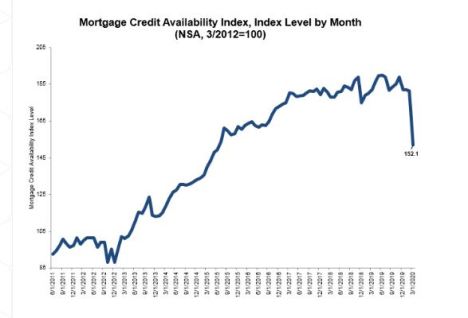
Mortgage Credit Availability fell to a 6 year low in April according to the MBA. “The abrupt weakening of the economy and job market – and the uncertainty in the outlook – drove credit availability down in April for the second consecutive month,” said Joel Kan, MBA’s Associate Vice President of Economic and Industry Forecasting. “The overall index fell to its lowest level since December 2014, and the sub-indexes pointed to tightened credit supply for all loan types. The decline was largely driven by lenders dropping many low credit score and high-LTV programs, as well as further reduction in jumbo and non-QM products.”

To be honest, I was expecting worse. Given the issues with forbearance and cash-outs, it probably will get worse.


MCAI


Treasury is celebrating the sequel to Top Gun by reviving the 20 year bond, last seen when aviator glasses, leather jackets, and Val Kilmer having a career.


Hydrogen for Energy? Splitting Water Molecule on the Cheap

FYI

Water-splitting module a source of perpetual energy

by Mike Williams,  
Water-splitting module a source of perpetual energy
A schematic and electron microscope cross-section show the structure of an integrated, solar-powered catalyst to split water into hydrogen fuel and oxygen. The module developed at Rice University can be immersed into water directly to produce fuel when exposed to sunlight. Credit: Jia Liang/Rice University

Rice University researchers have created an efficient, low-cost device that splits water to produce hydrogen fuel.

The platform developed by the Brown School of Engineering lab of Rice materials scientist Jun Lou integrates catalytic electrodes and perovskite solar cells that, when triggered by sunlight, produce electricity. The current flows to the catalysts that turn water into hydrogen and oxygen, with a sunlight-to-hydrogen efficiency as high as 6.7%.

This sort of catalysis isn’t new, but the lab packaged a perovskite layer and the electrodes into a single module that, when dropped into water and placed in sunlight, produces hydrogen with no further input.

The platform introduced by Lou, lead author and Rice postdoctoral fellow Jia Liang and their colleagues in the American Chemical Society journal ACS Nano is a self-sustaining producer of fuel that, they say, should be simple to produce in bulk.

“The concept is broadly similar to an artificial leaf,” Lou said. “What we have is an integrated module that turns sunlight into electricity that drives an electrochemical reaction. It utilizes water and sunlight to get chemical fuels.”

Perovskites are crystals with cubelike lattices that are known to harvest light. The most efficient perovskite solar cells produced so far achieve an efficiency above 25%, but the materials are expensive and tend to be stressed by light, humidity and heat.

“Jia has replaced the more expensive components, like platinum, in perovskite solar cells with alternatives like carbon,” Lou said. “That lowers the entry barrier for commercial adoption. Integrated devices like this are promising because they create a system that is sustainable. This does not require any external power to keep the module running.”

Liang said the key component may not be the perovskite but the polymer that encapsulates it, protecting the module and allowing to be immersed for long periods. “Others have developed catalytic systems that connect the solar cell outside the water to immersed electrodes with a wire,” he said. “We simplify the system by encapsulating the perovskite layer with a Surlyn (polymer) film.”

The patterned film allows sunlight to reach the solar cell while protecting it and serves as an insulator between the cells and the electrodes, Liang said.

“With a clever system design, you can potentially make a self-sustaining loop,” Lou said. “Even when there’s no sunlight, you can use stored energy in the form of chemical fuel. You can put the hydrogen and oxygen products in separate tanks and incorporate another module like a fuel cell to turn those fuels back into electricity.”

The researchers said they will continue to improve the encapsulation technique as well as the solar cells themselves to raise the efficiency of the modules.

Morning Report: Home Prices holding up

Vital Statistics:


Last Change
S&P futures 2863 30.1
Oil (WTI) 23.15 2.79
10 year government bond yield 0.66%
30 year fixed rate mortgage 3.43%


Stocks are higher this morning as earnings continue to come in. Bonds and MBS are down.


Despite the COVID-19 crisis, home price appreciation is holding up. Prices rose 1.3% MOM in March and are up 4.5% YOY. April might be a better read, but still… D.R. Horton mentioned on its earnings call that pricing is holding up, and while they are offering some incentives (free fridge friday), they aren’t cutting prices to move inventory.


Here are the cities with the biggest drop in new listings. Allentown PA, Milwaukee WI, Scranton, PA, Detroit MI, and Buffalo NY. The Northeast and Upper Midwest seem to have been hit the hardest.


If you look at the CoreLogic map, most of these areas are on the undervalued side.


CoreLogic overvalued metros


Ex-MBA President Dave Stevens weighs in on how the CARES Act drove a massive tightening of mortgage credit. Comments from Mark Calabria about letting servicers fail and musing that borrowers might be better off with a bank servicer were unhelpful to say the least. The added LLPAs on first payment forbearance requests basically killed the cash-out market. He makes a point that Fannie has the liquidity (between its own net worth and the Treasury facility) to extend lines of credit. He makes a great point as well – Fannie was created during the New Deal to smooth the mortgage market during disruptions, and this one is probably the biggest since the New Deal days.

Morning Report: Further stimulus probably not forthcoming

Vital Statistics:


Last Change
S&P futures 2800 -20.1
Oil (WTI) 19.17 -0.79
10 year government bond yield 0.61%
30 year fixed rate mortgage 3.43%


Stocks are lower this morning on no real news. Bonds and MBS are down small.


The big economic event this week will be the jobs report on Friday. The street is looking for a loss of 21.3 million jobs and a 16% unemployment rate.


Meanwhile about half the states are beginning to open. Note that most of the world has begun to relax restrictions as well. New York States has closed schools for the year, and will probably be the last place to emerge from the bunker.


The running joke is that the use of the word “unprecedented” is unprecedented. The dire predictions of the virus never panned out (no millions of deaths). I expect the predictions of lasting economic implications (Great Depression II!!!!) of this are probably going to be just as wrong.


Treasury Secretary Steve Mnuchin is cautious on the need for more Coronavirus aid. As states re-open it may turn out that more aid is not needed. Note that lawsuit relief and vote-by-mail will be two partisan issues that both sides will push. The door might be closed for further relief.


Fannie and Freddie are preparing to cover advances after 4 months, according to the FHFA. “To provide servicers with stability and clarity regarding their payment obligations and to align our servicer advance requirement with Freddie Mac, FHFA’s instructions require that, effective August 2020, we cease requiring servicers to advance missed scheduled principal and interest payments after four months of missed borrower payments on a loan,” Fannie Mae said in its 10-Q filing with the Securities and Exchange Commission. Many consumers believe that the missed payments will just get tacked on to the end of the mortgage. Given Fannie’s cash position and equity that might not be possible without further government support. That will drive the whole request for balloon payments at the end of forbearance. I suspect the government is going to have to make some tough decisions in August. Especially if forbearance doubles.


HELOCs are disappearing quickly. Wells and Chase have already suspended these products, and other lenders will probably follow. Homeowners who are looking for liquidity should think about getting one while the getting is good.


Morning Report: Rent and Mortgage Payments are due

Vital Statistics:


Last Change
S&P futures 2650 -48.1
Oil (WTI) 19.81 1.29
10 year government bond yield 0.61%
30 year fixed rate mortgage 3.43%


Stocks are lower this morning after disappointing comments out of Exxon, Apple and Amazon. Bonds and MBS are flat.


It is May 1. Mortgage and rent payments are due. I suspect we will see a deluge of missed payments. Meanwhile, about half of US states are looking to loosen restrictions.


Construction spending rose 0.9% in March, despite the COVID-19 concerns. The ISM Manufacturing Index fell, but not as much as feared.


Fannie Mae reported net income of $461 million in the first quarter compared to $4.4 billion in the fourth quarter of 2019. Increased provisions for loan losses drove the decline. Fannie estimates that 7% of its book (or about a million loans) is in forbearance right now. Net worth fell by a billion to 13.6 billion. 1 million loans, $13.6 billion in equity.


According to Black Knight, 3.8 million mortgages are in forbearance. 1.7 million are Fannie / Freddie, 1.2 are GNMA and the rest are private label / other. UPB is $238 billion. Black Knight estimates that there will need to be $8 billion in P&I advances and another $1.7 billion in T&I advances.


Many large corporations are thinking of keeping work-from-home a permanent thing. It looks like productivity hasn’t suffered as much as employers have feared, and this could be a win-win for both employers and employees.

Morning Report: The Fed maintains rates at zero

Vital Statistics:


Last Change
S&P futures 2908 -28.1
Oil (WTI) 16.81 3.29
10 year government bond yield 0.61%
30 year fixed rate mortgage 3.43%


Stocks are lower this morning on no real news. Bonds and MBS are flat.


The Fed maintained interest rates at 0% and pledged to continue to do what it can to support functioning markets, including buying agency mortgage backed securities and treasuries. They didn’t specify amounts, just that they wanted to keep orderly markets. As Dave Stevens noted, it is clear the Fed wants to see lower mortgage rates as a way to stimulate the economy. The problem with that of course is that the CARES Act is doing the exact opposite – it is restricting credit more than what happened in 2008. The MBA’s Mortgage Credit Availability index took a nosedive in March, and I think it will be much, much worse in April.

MCAI

Flagstar just announced a 5 point LLPA for cash-out refis. It is clear that these are the next program to go bye-bye, joining jumbos, non-QM, and sub 700 FHA. The law of unintended consequences rears its ugly head once again. I wonder if the government could tweak the CARES Act to make cash-outs ineligible for forbearance. That way the program could still exist and provide relief to people hit by COVID. Presumably if you do a cash-out, you have money to live on, so….


Initial Jobless Claims came in at 3.8 million, pushing the COVID job losses over 30 million.


Personal incomes fell 2% in March and personal spending fell 7%. The personal consumption expenditure index remained under control. I suspect that increasing food prices are being offset by lower energy prices.


Mortgage REITs AGNC and Annaly reported yesterday, and needless to say both were hit hard by COVID. Both have completed their deleveraging, and AGNC noted that its book value per share increased by 8% in April, after declining about 22% in Q1. For the agency REITs, it looks like the crisis is over.


Another round of stimulus may be a bridge too far. Nancy Pelosi wants to force states to vote by mail, and that is a non-starter with Republicans. Mitch McConnell wants lawsuit protection for businesses that remain open during the COVID crisis, and that is a non-starter to Democrats. As Travelers noted on its conference call, trial lawyers smell an opportunity here and are ginning up lawsuits as we speak.

Morning Report: First quarter GDP falls 4.8%

Vital Statistics:


Last Change
S&P futures 2915 48.1
Oil (WTI) 15.71 3.29
10 year government bond yield 0.61%
30 year fixed rate mortgage 3.43%


Stocks are higher this morning despite a disappointing GDP print. Bonds and MBS are up.


First quarter GDP fell 4.8% as the COVID lockdown depressed consumer spending, which fell 7.6%. The price index rose 1.3%, and that will be a number to watch going forward. Inflation is too much money chasing too few goods. We have managed to sidestep inflation in the past because shortages weren’t a problem. Now they are. Do you remember paying a buck a roll for TP last year? How about chicken? It averaged $3.11 a pound last year. At the local Stop and Shop it is now $3.80, and with the Tyson closures it will go higher. The black swan out of this whole thing could be a resurgence of inflation, right when that is the last thing the economy needs. 


The FOMC will make their announcement at 2:00 pm today. Not sure what they can say,(Information received since the Federal Open Market Committee met in March seems to indicate the economy has hit a brick wall and is sinking like an anvil….) and I can’t see it being market-moving. The mortgage industry would love to see something about a servicing advance repo line, but aside from accepting newer forms of collateral I don’t think there is much more they can do.


Mortgage applications fell 3.3% last week as purchases rose 12% and refis fell 7.5%. The refi market continues to tighten as investors add overlays to cash-outs. The strength in the purchase market is encouraging. Separately, the homeownership rate hit 63.5% in the first quarter, the highest since 2013. I think for many urban millennials with families, the COVID Crisis will trigger a flight to the suburbs, which should bump up the homeownership rate going forward.


According to a NPR poll, half of Americans have been financially affected by the Coronavirus. If that is the case, then forbearance numbers are going up.


Consumer confidence fell from 119 to 87, which was worse than expected.


Morning Report: 7% of all mortgages are in forbearance.

Vital Statistics:


Last Change
S&P futures 2912 42.1
Oil (WTI) 12.71 -0.29
10 year government bond yield 0.64%
30 year fixed rate mortgage 3.43%


Stocks are higher this morning as earnings continue to come in. Bonds and MBS are flattish.


7% of all mortgages are in forbearance, according to the MBA. Ginnie Mae loans (FHA and VA) are now at 10%. Fannie loans are 4.6% and Freddie are 5.5%. Private label increased to 7.5%. The FHFA has also released a press release saying that lump sum payments at the end of the forbearance period are not required.


The Economic Policy Institute (a lefty think tank) estimates from a poll that initial jobless claims are understated by 9 – 14 million due to system problems, in other words people who can’t register because the state unemployment sites are overwhelmed with traffic. If they are right, then the actual number of people who lost their jobs due to COVID is about 37.5 million. In other words, about 662 livelihoods per person who has died from the virus.


The COVID lockdown is beginning to affect the food supply as well. At some point the cure is worse than the disease.


The Fed begins the two-day FOMC meeting this week. They can’t do much more monetary policy wise, but it sure would be nice if they announced a facility to allow mortgage bankers to repo servicing advances.


Home prices rose 0.4% MOM and 3.5% YOY in February, according to the Case-Shiller Home Price Index. It will be interesting to see if the COVID crisis affects home prices nationally. FWIW, Pulte said on its conference call that it hasn’t cut prices at all. In some markets where there is excess spec inventory, builders are adding financing incentives, but not breaking price.


We are starting to see warehouse banks curtail high balance loans. Cash-out refis are also getting harder to do. I heard a rumor that Ginnie Mae may also introduce some sort of vehicle to pass some of the forbearance costs onto lenders (perhaps a special pool for forbearance loans). While the government’s forbearance policies may provide relief to homeowners, the unintended consequence is a severe restriction in credit.


One of the big trends in the aftermath of the financial crisis was the Millennial Generation preferring to live in urban walkable areas. COVID-19 might have stuck a fork in that trend. Good news for suburban SFR property owners.

Morning Report: Shelter in place orders are being relaxed

Vital Statistics:


Last Change
S&P futures 2856 28.1
Oil (WTI) 12.71 -4.29
10 year government bond yield 0.63%
30 year fixed rate mortgage 3.43%


Stocks are higher this morning on optimism that we have turned the corner on the COVID-19 crisis. Bonds and MBS are down.


In terms of economic data, the big number will be the first pass at Q1 GDP will be released on Wednesday. The consensus is that GDP contracted 3.8% as consumer spending falls 1.5%. Trump Administration Advisor Kevin Hassett thinks the economy could contract 30% in Q2.


The Fed will have the April FOMC meeting this week, and with rates already at zero, it probably won’t have the impact it normally has. Speaking of the Fed, they are ratcheting back MBS purchases again this week, with only $8 billion a day.


It looks like some states are beginning to relax the shelter-in-place orders, and even New York is looking to ease things in mid-May. If these states end up seeing no big uptick in cases, I expect the rest of the country to follow pretty quickly. Especially if the number of deaths settles in under 100k. FWIW, I think if most of the country is back to normal by Memorial Day, we can take the Great Depression II economic forecasts off the table.


Ex MBA President wrote a scathing editorial in Housing Wire regarding Mark Calabria and how he is the worst person for the job right now. In Mark’s defense, his job is to protect the GSEs and (and therefore the taxpayer), however Dave is correct that taking a cavalier attitude with non-bank servicers is not the best look right now when (a) the government imposed this forbearance period on everyone and (a) the GSEs are part of the government. If the government goes forward and imposes all of these costs on the industry, the least it can do is help mitigate those as much as it can. Perhaps the aid doesn’t need to come from Fannie and Freddie, but the government should provide it from somewhere.


Home price appreciation is slowing, but not dropping yet, according to Realtor.com. Inventory is tight, largely driven by sellers who are pulling their homes off the market. This could be due to fears of not getting the best price, or it could be due to people wanting to keep potentially sick strangers from entering their home.


Pulte noted on its Q1 conference call that pricing is holding up, and cancellations are unexpectedly small – about 2% and only due to job losses. Orders on the other hand are weak. In the first week of March, they got over 800 orders. By the last week of March it was 140.


Rent strikes are beginning to pop up in NYC. This one is not the usual tenant versus landlord situation where there is a dispute over fixing things. This is meant to be a political statement to goad lawmakers into doing something for renters. Bold strategy, Cotton…