Morning Report: Cracks are forming in the labor market

Vital Statistics:

 LastChange
S&P futures3,778-15.75
Oil (WTI)87.620.12
10 year government bond yield 3.77%
30 year fixed rate mortgage 6.59%

Stocks are lower this morning on no real news. Bonds and MBS are flat.

OPEC is cutting production, which will drive up oil prices and make the Fed’s job harder. Some strategists are forecasting triple-digit oil prices as the cuts begin to bite. Supposedly the Administration is looking at releasing reserves from the Strategic Petroleum Reserve, but that will be a temporary band-aid at best. Look for consumer sentiment to turn even more negative as gas prices increase.

Home prices rose 4.2% QOQ and 14.8% YOY in August, according to the Clear Capital Home Data Index. This index is about a month ahead of other home price indices like Case-Shiller and FHFA.

Interestingly, we are seeing the biggest quarterly growth in the Northeast and the Midwest, which have been the laggards over this entire housing upturn. The Midwest makes sense in terms of remote work and low overall prices. The Northeast is strange in that it has lagged the rest of the country, but still has high overall prices.

Speaking of home prices, we are seeing some originators trim their forecasts for the new conforming loan limits. Generally speaking the big correspondents will begin to accept loans under the anticipated higher limits ahead of the formal FHFA announcement in December. This year, correspondents have started accepting loans up to $715k.

PennyMac just backed away from that number and reduced it to $700k and I am hearing more are doing the same.

US based employers announced almost 30,000 job cuts in September, which is up 68% compared to a year ago. “Some cracks are beginning to appear in the labor market. Hiring is slowing and downsizing events are beginning to occur,” said Andrew Challenger, Senior Vice President of Challenger, Gray & Christmas, Inc. “The cooling housing market and Fed’s rate hikes are leading to job cuts among mortgage staff at banks and lenders. The recession concerns are leading to increased uncertainty, and companies across sectors are beginning to reassess staffing needs,” said Challenger.

Hiring plans are also the lowest since 2011. Seasonal hiring for the holiday shopping season should be in full swing at this point, however retailers seem to be taking a wait-and-see approach. Bottom line, the Fed’s tightening is gaining traction.

Separately, initial jobless claims rose to 219,000 last week.

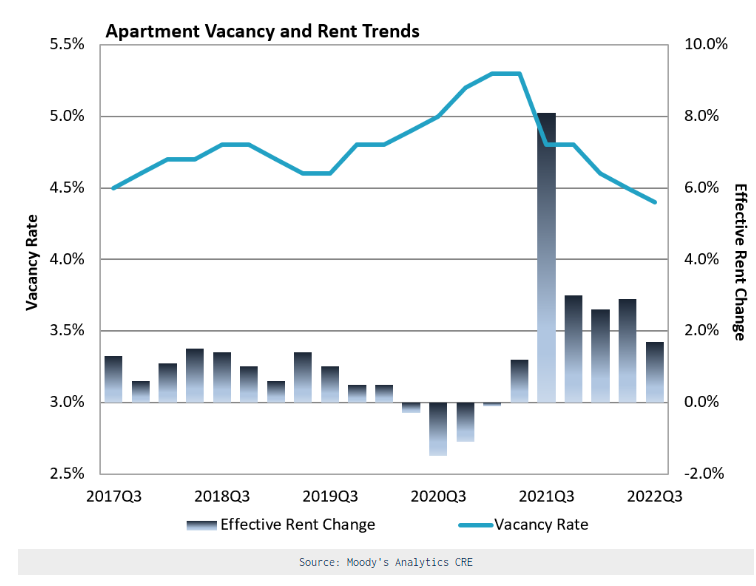
Apartment vacancy rates remain at multi-decade lows, however we continue to see deceleration in rental inflation. Given that rental inflation tends to lag housing inflation by about 21 months, I suspect we might see a re-acceleration in rent prices, especially since homebuilding has been so depressed.
Morning Report: The economy continues to add jobs

Vital Statistics:

 LastChange
S&P futures3,743-59.75
Oil (WTI)86.590.02
10 year government bond yield 3.77%
30 year fixed rate mortgage 6.59%

Stocks are lower as markets adopt a risk-off posture again. Bonds and MBS are down.

The economy added 208,000 jobs in September, according to the ADP Employment Report. Annual pay was up 7.8% on a YOY basis, which will concern the Fed. That said, the pay increase for job changers is beginning to decline. This would comport with the stagnant quits rate we saw in yesterday’s JOLTs report.

The report also noted that it looks like people are returning to the labor market. Demand remains strong from employers. Private employment recently returned to pre-pandemic levels.

The service economy expanded again in September, according to the ISM Services Index, albeit at a slower pace than August. Most of the sub-indices showed declines, although employers still struggle to find employees. The prices index declined as well, which is good news on the inflation front.

“According to the Services PMI®, 15 industries reported growth. The composite index indicated growth for the 28th consecutive month after a two-month contraction in April and May 2020. Growth continues — at a slightly slower rate — for the services sector, which has expanded for all but two of the last 152 months. The services sector had a slight pullback in growth for the month of September due to decreases in business activity and new orders. Employment improved and supplier deliveries slowed at a slightly slower rate. Based on comments from Business Survey Committee respondents, there have been improvements regarding supply chain efficiency, operating capacity and materials availability; however, performance remains less than ideal. Employment continued to improve despite the restricted labor market.”

Higher interest rates continue to depress the mortgage market. Applications fell 14% last week as purchases fell 13% and refinances fell 14.2%. On a YOY basis, purchases are down 37% and refis are down 86%.

“Mortgage rates continued to climb last week, causing another pullback in overall application activity, which dropped to its slowest pace since 1997. The 30-year fixed rate hit 6.75 percent last week – the highest rate since 2006,” said Joel Kan, MBA’s Associate Vice President of Economic and Industry Forecasting. “The current rate has more than doubled over the past year and has increased 130 basis points in the past seven weeks alone. The steep increase in rates continued to halt refinance activity and is also impacting purchase applications, which have fallen 37 percent behind last year’s pace. Additionally, the spreads between the conforming rate compared to jumbo loans widened again, and we saw the ARM share rise further to almost 12 percent of applications.”

Morning Report: Sentiment improves overnight

Vital Statistics:

 LastChange
S&P futures3,74757.75
Oil (WTI)85.351.72
10 year government bond yield 3.60%
30 year fixed rate mortgage 6.64%

Stocks are higher this morning as investors begin to anticipate the end of central bank tightening. Bonds and MBS are up.

Despite the rhetoric from central banks, investors are beginning to anticipate a pivot. Australia’s central bank surprised markets last night with a smaller-than-expected increase in its interest rate. No idea if this is another false dawn, but after a bloody end to Q3, any respite is welcome.

Job openings declined in August according to the JOLTs report. The quits rate was flat at 2.7%. This report is further evidence that the labor market is softening, however it doesn’t indicate weakness or anything like that. The labor market is still quite strong by historical standards.

Home prices dropped 0.98% in August, according to the Black Knight Mortgage Monitor. This is higher than the 0.6% decrease that showed up in the FHFA House Price Index.

“The Black Knight HPI for August marked the second consecutive month that prices pulled back at the national level, with the median home price now 2% off of its June peak,” said Graboske. “Only marginally better than July’s revised 1.05% monthly decline, home prices were down an additional 0.98% in August. Either one of them would have been the largest single-month price decline since January 2009 – together they represent two straight months of significant pullbacks after more than two years of record-breaking growth. The only months with materially higher single-month price declines than we’ve seen in July and August were in the winter of 2008, following the Lehman Brothers bankruptcy and subsequent financial crisis.

Again, for those thinking we are in for a replay of 2006-2008, we aren’t. We don’t have the financial stress that would create the forced selling that characterized the end of the bubble years. I would add, some decline in home prices is expected as part of normal seasonal variation.

The Atlanta Fed’s GDP Now Index now sees Q3 GDP coming in at a positive 2.3%. The personal incomes and outlays report from last week drove the increase.

Morning Report: Manufacturing continues to decelerate

Vital Statistics:

 LastChange
S&P futures3,63837.25
Oil (WTI)84.204.74
10 year government bond yield 3.70%
30 year fixed rate mortgage 6.72%

Stocks are higher this morning on no real news. Bonds and MBS are down.

There is a closed meeting of the Fed at 11:30 this morning. Supposedly about the discount rate, but it is odd. I am wondering if it concerns financial stress which has been triggered by Credit Suisse.

Credit Suisse’s stock has been hammered over the past few months as the bear market sets in and people worry about its credit risk. The CEO sent a memo over the weekend hoping to reassure employees, investors and counterparties over the bank’s risk. It doesn’t seem to have had the intended effect.

Credit Suisse and its issues are a long way away from the US mortgage market, however it is a good canary in the coal mine about overall financial stress. This is particularly important to non-QM lending, however it also can act as a yellow light for central banks. It is something to keep an eye on.

The week ahead will contain the jobs report, along with a slew of Fed-Speak. We will also get the ISM data and construction spending.

The manufacturing economy expanded in September, according to the ISM Manufacturing Index. That said, the expansion is the weakest since May of 2020. New Orders contracted, and employment plans seem to be getting put on hold. Prices are at the lowest level since June 2020.

“Manufacturing expanded for the 28th straight month. Panelists’ companies slowed hiring activity; month-over-month supplier delivery performance was the best since December 2019; prices growth slowed notably (with the index at 60 percent or lower) for the third consecutive month; and lead times continue to ease for capital equipment and production materials. Markedly absent from panelists’ comments was any large-scale mentioning of layoffs; this indicates companies are confident of near-term demand, so primary goals are managing medium-term head counts and supply chain inventories”

Construction spending fell 0.7% MOM but increased 8.5% YOY, according to the Census Bureau. Residential construction fell 1% MOM and is up 12.4% YOY.

Morning Report: Incomes and spending rise

Vital Statistics:

 LastChange
S&P futures3,651-5.25
Oil (WTI)80.760.55
10 year government bond yield 3.71%
30 year fixed rate mortgage 6.68%

Stocks are lower this morning after the personal incomes and outlays release disappointed on the inflation front. Bonds and MBS are up.

Personal Incomes rose 0.3% in August, which was more or less in line with expectations. Personal consumption expenditures rose 0.4% which was better than expected.

The PCE Price Index (which is the Fed’s preferred measure of inflation) rose 0.3% MOM and 6.3% YOY. Both numbers were .1% higher than expectations. Same for the core rate (ex-food and energy) which rose 0.6% MOM and 4.9% YOY.

The core PCE Index is the inflation indicator the Fed prefers to use when making policy. The monthly changes tell the story and are the market’s focus. Does this chart of the monthly core numbers look like a deceleration? IMO, not yet. It looks like the July reading was an outlier, so it doesn’t really hint at a deceleration, at least not yet.

Consumer sentiment decreased in September, according to the University of Michigan Consumer Sentiment Index. The bright spot in the report was the readings on inflationary expectations:

The median expected year-ahead inflation rate declined to 4.7%, the lowest reading since last September. At 2.7%, median long run inflation expectations fell below the 2.9-3.1% range for the first time since July 2021. Inflation expectations are likely to remain relatively unstable in the months ahead, as consumer uncertainty over these expectations remained high and is unlikely to wane in the face of continued global pressures on inflation.

It turns out that the Fed pays close attention to this number, and the 2.7% expected long-run inflation is approaching the Fed’s 2% goal.

Angel Oak laid off about 20% of its workforce and replaced its CEO. The layoffs were mainly in operations in order to get capacity down to the new normal of reduced mortgage origination volume. Non-QM is highly sensitive to dramatic moves in interest rates since TBAs don’t correlate as tightly with this product as they do with other mortgage rates. This means that these loans are unhedgeable, or at least the hedges are imperfect. So when the market makes a dramatic move the market for them sort of dries up.

Morning Report: Second quarter GDP fell

Vital Statistics:

 LastChange
S&P futures3,690-40.25
Oil (WTI)82.660.55
10 year government bond yield 3.78%
30 year fixed rate mortgage 6.64%

Stocks are lower this morning after Chicago Fed President Charles Evans reiterated hawkish comments. Bonds and MBS are down.

Second quarter GDP declined 0.6% in its third revision. This was unchanged from the second revision. Personal consumption expenditures were revised up from 1.5% to 2.0%. The PCE Price Index (i.e. inflation) was revised upward as well from 7.1% to 7.4%. Construction and durable goods manufacturing were drags on GDP.

So far the carnage in the financial markets hasn’t affected the labor market. Initial Jobless Claims fell to 193k last week. Historically sub-200k readings are exceedingly rare.

Finance of America is supposedly shutting down it retail mortgage origination business to Guaranteed Rate. It will also shut down its wholesale channel. This is all speculation – the company is not commenting. It sounds like it will retain the reverse mortgage business, and Incenter which is its MSR business. Capacity continues to be drawn out of the business.

Home affordability is well below historical averages, according to analysis by ATTOM. The combination of rising rates and home prices are the big driver. The bright spot is that incomes are rising as well. In fact, the portion of average wages required to support housing expenses fell from 30.9% to 30%.

“Homeownership remains largely unaffordable for the majority of homebuyers in the majority of markets across the country,” said Rick Sharga, executive vice president of market intelligence at ATTOM. “While home prices have declined a bit quarter-over-quarter, they’re still higher than they were a year ago, and interest rates have essentially doubled. Many prospective homebuyers simply can’t afford the home they hoped to buy, and in many cases no longer qualify for the mortgage they’d need.

Home price appreciation has slowed dramatically in most markets – and there are even price corrections in some areas – as home sales have declined significantly over the past few months,” Sharga added. “But mortgage rates have risen more rapidly and dramatically than they have in several decades, and as a result a monthly mortgage payment today is 35-45 percent higher than a year ago, making affordability too much of a challenge for many would-be buyers.”

Morning Report: New Home Sales rise

Vital Statistics:

 LastChange
S&P futures3,6654.25
Oil (WTI)79.591.07
10 year government bond yield 3.82%
30 year fixed rate mortgage 6.79%

Stocks are flattish this morning after US Treasury yields hit 3.94% overnight. Bonds and MBS are up.

Treasury yields spiked overnight on speculation that the Bank of Japan would intervene to support the yen by selling Treasuries. Regardless, global yields have been on a tear, with the German Bund now yielding 2.15%. Just over six months ago, the yield on the Bund was negative.

New Home Sales rose 29% MOM to a seasonally-adjusted annual pace of 685,000. This was flat YOY. I don’t think this means much in of itself – the standard errors for new home sales estimate are typically huge. I wouldn’t be surprised to see this one revised downward in coming months.

Consumer confidence improved in August, according to the Conference Board. These consumer confidence numbers are highly correlated with gasoline prices, however there is some good news about inflationary expectations.

“Consumer confidence improved in September for the second consecutive month supported in particular by jobs, wages, and declining gas prices,” said Lynn Franco, Senior Director of Economic Indicators at The Conference Board. “The Present Situation Index rose again, after declining from April through July. The Expectations Index also improved from summer lows, but recession risks nonetheless persist. Concerns about inflation dissipated further in September—prompted largely by declining prices at the gas pump—and are now at their lowest level since the start of the year.”

Mortgage applications fell 3.7% last week as purchases fell 0.4% and refis fell 11%. The refi index is 84% lower than it was a year ago. “Applications for both purchase and refinances declined last week as mortgage rates continued to increase to multi-year highs following more aggressive policy measures from the Federal Reserve to bring down inflation,” said Joel Kan, MBA’s Associate Vice President of Economic and Industry Forecasting. “Additionally, ongoing uncertainty about the impact of the Fed’s reduction of its MBS and Treasury holdings is adding to the volatility in mortgage rates.”

The part about uncertainty is important. The Fed was relying on runoff to allow its portfolio of MBS to shrink. With refinances out of the picture, normal purchase activity will have to do the job. Which means the Fed might be pushed to sell some of its portfolio directly into the market. Jerome Powell was asked about that in his press conference following the September FOMC meeting. He basically said that this is nothing they are considering right now.

Speaking about mortgage backed securities, the mortgage REITs have been absolutely pummeled over the past week. AGNC Investment, which buys almost entirely agency securities is down 17% over the past 5 days. Annaly, which just did a reverse stock split is down by 16%. I am wondering if we are seeing margin calls again in the space. The stocks sure are acting like it.

Pending Home Sales slipped 2% in August and are down 24% on a YOY basis. “The direction of mortgage rates – upward or downward – is the prime mover for home buying, and decade-high rates have deeply cut into contract signings,” said NAR Chief Economist Lawrence Yun. “If mortgage rates moderate and the economy continues adding jobs, then home buying should also stabilize.”

Morning Report: Home Prices decline in July

Vital Statistics:

 LastChange
S&P futures3,71444.25
Oil (WTI)78.281.51
10 year government bond yield 3.89%
30 year fixed rate mortgage 6.72%

Stocks are rebounding after yesterday’s bloodbath. Bonds and MBS are down again.

The FHFA House Price index fell 0.6% MOM in July, but is still up 13.9% on a YOY basis. This index only looks at mortgages within the conforming loan limits, so it is more centered on the median home since it ignores the luxury market and cash-only transactions.

“U.S. house price index posted its first month-over-month decrease in July since May 2020 when the U.S. economy experienced lockdowns as a result of COVID-19. This decline was widespread as eight of the nine census divisions saw a decrease,” said Will Doerner, Ph.D., Supervisory Economist in FHFA’s Division of Research and Statistics. “The 12-month change in house prices remains at historically high rates, but the rate of growth continues to moderate across all census divisions.”

The actual FHFA house price index number for July was 395.2. The index level at the end of September 2021 was 353.6. So, if we were to reset the new conforming loan limit for 2023 today, it would come out to $723,341.

This means if the FHFA House Price index declines another 1.1% between August and September, those originators who are funding loans up to $715k in anticipation of the new 2023 limits might have a problem on their hands.

The rise in mortgage rates has more homebuyers backing out of deals. This is most prevalent in some of the hottest markets in the Sun Belt and Florida.

“Some homebuyers are finding that by the time they go under contract and lock in their mortgage rates, rates could be much higher than they were when they toured the home and/or got pre-approved. That can kill the deal because the buyer is no longer financially comfortable with the purchase,” said Sam Chute, a Redfin real estate agent who works with sellers in Miami. “I advise sellers to price their homes competitively based on the current market because deals are falling through and buyers are no longer willing to pay pie-in-the-sky prices.”

Durable Goods orders fell 0.2% MOM in August according to the Census Bureau. July’s numbers were revised downwards. Ex-transportation they rose, and core capital goods orders (a proxy for business capital investment) increased as well.

Morning Report: Fears of another 2008 are overblown.

Vital Statistics:

 LastChange
S&P futures3,704-0.25
Oil (WTI)79.820.76
10 year government bond yield 3.76%
30 year fixed rate mortgage 6.51%

Stocks are flattish this morning on no real news. Bonds and MBS are down.

The upcoming week will will have some housing data with home prices (FHFA / Case-Shiller) and new home sales. We will also get durable goods orders and the final revision for second quarter GDP. Personal Incomes / Outlays will be on Friday. The jobs report will be next week.

There will be a lot of Fed-speak as well.

Economic conditions deteriorated in August, according to the Chicago Fed’s National Activity Index. Production and income data pulled down the index, while employment and consumption helped.

With the potential for a housing downturn (at least with respect to prices) the inevitable comparisons to 2008 are being trotted out. I have said this before, but 2008 was one of those twice-in-a-century moments (a residential real estate bubble) and the facts on the ground today are much different.

The biggest difference between 2008 and today? The vast majority of mortgages are guaranteed by the government. Subprime doesn’t exist. Aside from non-QM (which resembles Alt-A not subprime) every MBS is money good. So we won’t see a banking crisis, and we won’t see forced selling of securities.

Home prices might decline in some overheated markets. But many of those markets saw 30%+ home price appreciation for a couple years in a row. So a 5%- 10% haircut in Phoenix isn’t unreasonable.

The bottom line is that any decline in home prices won’t trigger another collapse because banks don’t have much credit exposure to residential real estate lending. Any exposure will be counterparty risk (i.e. those who had warehouse lines with someone like FGMC).

Bottom line, fears about another 2008 are completely overblown.

Morning Report: More anecdotal evidence of declining inflationary pressures

Vital Statistics:

 LastChange
S&P futures3,733-33.25
Oil (WTI)79.82-3.76
10 year government bond yield 3.71%
30 year fixed rate mortgage 6.40%

Stocks are lower as people adjust to the new reality of higher rates. Bonds and MBS are down.

Goldman has cut their target for the year-end S&P 500 from 4,300 to 3,600. Commodity prices are beginning to reflect the lower-growth forecast, with oil dropping below $80 a barrel. A stronger dollar is part of the explanation too, but this is a global growth story.

S&P Global’s flash PMI registered an improvement in September, however we are still in a weak environment. New orders improved and while pricing pressures were still present, the increase in prices was the lowest since January 2021. This gives us at least some evidence that the Fed’s rate hikes are gaining some traction.

“US businesses are reporting a third consecutive monthly fall in output during September, rounding off the weakest quarter for the economy since the global financial crisis if the pandemic lockdowns of early-2020 are excluded. However, while output declined in both manufacturing and services during September, in both cases the rate of contraction moderated compared to August, notably in services, with orders books returning to modest growth,
allaying some concerns about the depth of the current downturn.


There was also better news on inflation, with supplier shortages easing to the lowest since October 2020, helping take some of the pressure off raw material prices. These improved supply chains, accompanied by the marked softening of demand since earlier in the year, helped cool overall the rate of inflation of both firms’ costs and average selling prices for goods and services to the lowest since early-2021. Inflation pressures nevertheless remain elevated by historical standards and, with business activity in decline, the surveys continue to paint a broad picture of an economy struggling in a stagflationary environment.”

Home flipping volume decreased in the second quarter, according to ATTOM. A total of 115k homes were flip transactions, or about 8.2%. This is a decline from the first quarter, but is still an increase from the second quarter of 2021.

“The second quarter was another strong showing for fix-and-flip investors. The total number of properties flipped was the second-highest total we’ve recorded in the past 22 years, and the median sales price of a flipped property – $328,000 – was the highest ever,” said Rick Sharga, executive vice president of market intelligence for ATTOM. “The big question is whether the fix-and-flip market will begin to lose steam as overall home sales have declined dramatically over the past few months, and the cost of financing has virtually doubled over the past year.”

You can look at the iBuying experience of Zillow and Opendoor to see it can be hard to make money in this business even in the best of markets, let alone when rates are higher and the number of transactions are falling.

Despite recessionary fears, mortgage delinquencies remain near record lows, according to Black Knight. The national delinquency rate fell to 2.79%, which was just a touch above the May 2022 record low. Foreclosure starts did tick up 15% in August, but we are well below pre-pandemic levels.