Filed under: 2012 | 7 Comments »
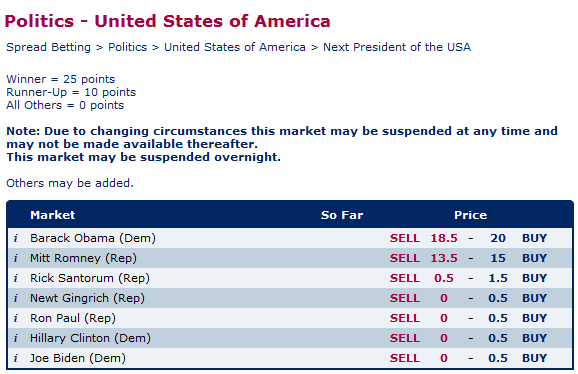
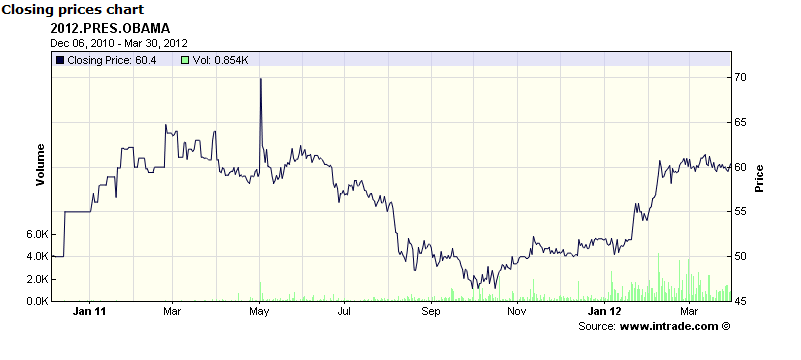
Handicapping 2012
Morning Report
Vital Statistics:
| Last | Change | Percent | |
| S&P Futures | 1403.9 | 5.7 | 0.41% |
| Eurostoxx Index | 2471.7 | 19.0 | 0.77% |
| Oil (WTI) | 103.52 | 0.7 | 0.72% |
| LIBOR | 0.4682 | 0.000 | 0.00% |
| US Dollar Index (DXY) | 78.81 | -0.376 | -0.47% |
| 10 Year Govt Bond Yield | 2.15% | -0.01% | |
| RPX Composite Real Estate Index | 170.13 | 0.4 |
Markets are higher this morning on no major news except for the increase in the European firewall. There is probably an element of end-of-the-quarter window dressing to it as well.
Personal Income came in +.2%, lower than expectations, while Personal Spending increased .8% higher than expectations. Inflation data came in as expected. Overall, no reaction in the futures. Chicago Purchasing Manager, Michigan confidence, NAPM, and some revisions are coming out later this morning.
The NYT notes that Moody’s may lower the credit ratings for B of A, Citigroup, and Morgan Stanley in mid-May. The side effect of this downgrade would be to kill their derivatives businesses, as the lower rating will force them to put up much more collateral against their derivatives books, and force many large buy-side clients to trade elsewhere. This could be the impetus to turn Citi and B of A back into plain old commercial banks.
Goldman is raising money for a new fund to buy distressed home loan bonds without government backing. The documents state this is a bet on improving fundamentals in U.S. housing. The story also goes on to say that Goldman bid on mortgage bonds from AIG in a Feb 8 auction, and decided to hold the merchandise instead of selling it. Most of these bonds are trading in the 50s. Non-agency MBS have done well this year as credit conditions have eased – enough that some funds are paring their bets.
Filed under: Morning Report | 13 Comments »
Morning Report
Vital Statistics:
| Last | Change | Percent | |
| S&P Futures | 1394.3 | -5.9 | -0.42% |
| Eurostoxx Index | 2468.1 | -28.6 | -1.15% |
| Oil (WTI) | 105.23 | -0.2 | -0.17% |
| LIBOR | 0.4682 | -0.002 | -0.32% |
| US Dollar Index (DXY) | 79.244 | 0.118 | 0.15% |
| 10 Year Govt Bond Yield | 2.16% | -0.04% | |
| RPX Composite Real Estate Index | 169.77 | 0.0 |
Markets are weaker as S&P warns that Greece may have to restructure its debt again and a disappointing report from H&M. Best Buy reported better-than-expected earnings this morning and will close 50 stores.
The third revision to 4Q GDP was released this morning, unchanged from the 2nd revision at 3%. Initial Jobless claims were slightly higher than expected at 359,000. Bloomberg Consumer Comfort and Kansas City Fed come out later this morning.
Bill Gross of PIMCO told Bloomberg that the Fed will probably concentrate on supporting MBS once Operation Twist ends in June. He referred to a “sterilized twist” where the Fed would buy current coupon MBS and simultaneously repo out the Treasuries. This would cause MBS spreads to tighten. So even if the sell off in Treasuries continues, mortgage rate may not rise as rapidly.
Bloomberg had a good interview with FHFA Acting Director Ed DeMarco regarding principal forgiveness on underwater homeowners. It certainly does not appear that a mass taxpayer-funded principal forgiveness, (or cramdown for investors) is in the cards. FHFA prefers to mod interest and term first in order to make an affordable payment. If they cut the principal and the house increases in value, the borrower gets all of the benefit. If they don’t cut the principal, then taxpayers share in that upside. Ed has been a pinata to the Left who want mass cramdowns.
American borrowers fear the Repo Man over everyone else, at least according to a TransUnion survey cited in the Washington Post. It used to be that the mortgage payment was the first priority, but with foreclosure pipelines so elongated, the car loan now takes priority.
Dealbook has been the go-to place for all things MF Global. Yesterday, regulators held a hearing with several top executives of MF, who took the Fifth. The CFO has apparently offered a proffer statement, which means he is negotiating to talk.
Filed under: Morning Report | 30 Comments »
Morning Report
Vital Statistics:
| Last | Change | Percent | |
| S&P Futures | 1407.2 | 0.8 | 0.06% |
| Eurostoxx Index | 2522.2 | -3.0 | -0.12% |
| Oil (WTI) | 106.12 | -1.2 | -1.13% |
| LIBOR | 0.4697 | -0.001 | -0.21% |
| US Dollar Index (DXY) | 79.086 | 0.039 | 0.05% |
| 10 Year Govt Bond Yield | 2.21% | 0.02% | |
| RPX Composite | 169.78 | 0.2 |
Markets are flattish after Durable Goods orders, which came in below expectations. February Durable Goods came in at 2.2% vs 3% expectations. Bonds and mortgages are off slightly. June 10-year bond futures are trading at 138 after bouncing off a low of 135-05 last week. Mortgage applications also fell 2.7% for the week ending Mar 23 as the backup in mortgage rates hurt refinancings.
The American Bankers Association released its Real Estate Lending Survey yesterday. The survey of 185 respondents, of which the vast majority are small community banks, said that lending conditions at the end of 2011 are about the same as they were at the end of 2010, with regulatory uncertainty as the main concern. The average delinquency rate fell slightly over 2011.
Is Mark Zandi becoming the Abby Joseph Cohen of real estate and the economy? Seems so. The Washington Post locates a pocket of optimism in real estate, citing Zandi and some Northern Virginia Realtor. Washington DC real estate inhabits a world of its own, so I don’t think it necessarily applies nationwide.
Redwood Trust did another jumbo securitization yesterday, more evidence that the private label market is returning.
Filed under: Morning Report | 2 Comments »
Any of the health care / legal experts care to weigh in on the day’s activities?
Ashot here…I’m adding a first person account from yesterday’s arguments. And here’s the link to the audio.
Impressions from inside the courtroom
Mark A. Hall
Wake Forest University
The room was packed and buzzing with excitement. Some people clearly had slept outside last night. Even some of the attorneys general from the challenger states had to stand in line to get in. In the way into the building, I spotted none other than Ken Cuccinelli, attorney general of Virginia and lead party in the Fourth Circuit case. Sitting in my same row in the courtroom was a virtual quorum of the Senate Finance Committee, including Senators Leahy, Baucus, Grassley, and Kerry.
Solicitor General Verrilli encountered some forceful challenges early on in his presentation In particular, Chief Justice Roberts and Justices Scalia and Alito raised concerns about the slippery slope problem, citing examples such as burial insurance, gym membership, and mandatory cell phones to help with police emergencies.
Perhaps one of the most memorable exchanges, and certainly one that will resonate in the media, involved a question from Justice Scalia asking Solicitor General Verrilli to define the market.
JUSTICE SCALIA: Could you define the market — everybody has to buy food sooner or later, so you define the market as food, therefore, everybody is in the market; therefore, you can make people buy broccoli.
GENERAL VERRILLI: No, that’s quite different. That’s quite different. The food market, while it shares that trait that everybody’s in it, it is not a market in which your participation is often unpredictable and often involuntary.
Students of the Court, and of effective rhetoric, know that how issues are framed is critical to how analysis and decisions proceed. Thus, much of the questioning throughout the morning addressed the issue of which of several markets the Court should regard as being regulated: the insurance market, all health services, or the portion of health services the uninsured people are likely to use. As another example of framing, Justice Alito countered the government’s position that the uninsured force others to pay for their care by noting that most people subject to the mandate are required to pay more into the insurance pool than they are expected to use. Justice Roberts also pointedly observed that the comprehensive insurance mandated by the law includes several services that many people never use, such as pediatric care and substance abuse treatment. So, it appears that cross subsidies are in the eye of the beholder.
None of the Justices appointed by Democratic presidents expressed any substantial concerns about the government’s commerce clause position—suggesting that their votes are secure, as has been speculated. Instead, they appeared to rise to the government’s defense. Toward the end of the first hour, Justice Sotomayor crisply defined the government’s three main lines of defense somewhat more clearly than even the Solicitor General had. About 15 minutes into the argument, Justice Breyer spoke up to offer the government some support. He observed that Congress created commerce where none previously existed when it started the Bank of the US, for instance, which Justice Marshall’s opinion in McCulloch v. Maryland famously upheld under the Necessary and Proper clause.
That was the first of two novel arguments Justice Breyer made that I don’t recall reading in the principal briefs. He also pressed several times an argument that should appeal to public health lawyers: what if there were a rampant contagious disease that threatened 10 million lives; couldn’t the government mandate vaccinations? If so, what does it matter that people who are forced to be vaccinated weren’t engaged in any commercial activity?
About 30 minutes in, the Lochner v. New York case was unexpectedly introduced into the arguments, in the form of questioning from Justice Scalia about whether the term “proper” in the Necessary and Proper clause has independent force. Chief Justice Roberts joined in, noting that the Court had earlier expressed concerns about unwieldy substantive due process jurisprudence only with regard to constitutional limits on states’ police plenary powers, and not with respect to limiting the federal government’s enumerated powers.
Tax arguments, on the other hand, received fairly short shrift in all of the arguments. There seems to be very little support, on either side of the Court’s ideological divide, for sustaining the individual mandate as an exercise of Congress’ taxing power. The challengers also reminded the Court that, if this were a tax, they still contend that it is unconstitutional as an unapportioned “direct tax.”
Both Paul Clement for the states and Michael Carvin for the private parties spoke smoothly and quickly. Justices Sotomayor and Breyer were especially active in challenging their positions, with Justices Kagan and Ginsburg also chiming in regularly. Especially notable, I think, were Justice Breyer’s several references to his concern that barring the federal government from mandating individual health insurance in this case might prevent it from responding effectively to a virulent epidemic.
One of my favorite moments, which drew hearty laughs, was this exchange with Justice Kagan: “Well, doesn’t that seem a little bit, Mr. Clement, [like] cutting the bologna thin? I mean health insurance exists only for the purpose of financing health care. The two are inextricably interlinked. We don’t get insurance so that we can stare at our insurance certificate. We get it so that we can go and access health care.”
I listened most attentively to questions for the challengers from the Court’s conservative wing. All eyes and ears were on Justice Kennedy, as a potential swing vote, and he spoke up early on (about 3 minutes in), raising a key point: is it “true that the noninsured young adult is, in fact, an actuarial reality insofar . . . health insurance companies figure risks? That person who is sitting at home in his or her living room doing nothing is an actuarial reality that can and must be measured for health service purposes; is that their argument?” Justice Kennedy repeated this sophisticated point later: “they are in the market in the sense that they are creating a risk that the market must account for.” And, near the end of the morning’s argument, he interjected (in response to the slippery slope concern that regulating here would allow the government to regulate anything): “I think it is true that if most questions in life are matters of degree, in the insurance and health care world, both markets — stipulate two markets — the young person who is uninsured is uniquely proximately very close to affecting the rates of insurance and the costs of providing medical care in a way that is not true in other industries. That’s my concern in the case.”
Later, Chief Justice Roberts challenged the analogy to requiring people to buy cars, noting that not everyone is in the car market, but they are all in the health care market. He made the same points several times in different ways. For instance, to Mr. Carvin: “I don’t think you’re addressing their main point, which is that they are not creating commerce in health care. It’s already there, and we are all going to need some kind of health care; most of us will at some point.” And, in response to Carvin’s analogy to mandatory mortgage insurance: “I don’t think that’s fair, because not everybody is going to enter the mortgage market. The government’s position is that almost everybody is going to enter the health care market.”
Filed under: Affordable Care Act, Supreme Court | 117 Comments »
Tacos from Above
Start-up wants to deliver tacos via drone helicopter – FAA regs don’t allow for that.
“Current U.S. FAA regulations prevent … using UAVs [Unmanned Aerial Vehicles, like drones] for commercial purposes at the moment,” Simpson said over Gchat. “Honestly I think it’s not totally unreasonable to regulate something as potentially dangerous as having flying robots slinging tacos over people’s heads … [O]n the other hand, it’s a little bit ironic that that’s the case in a country where you can be killed by drone with no judicial review.”
Filed under: innovation, NDAA | Tagged: idiots, NDAA | 5 Comments »
Morning Report
Vital Statistics:
| Last | Change | Percent | |
| S&P Futures | 1413.8 | -1.3 | -0.09% |
| Eurostoxx Index | 2543.8 | 3.9 | 0.15% |
| Oil (WTI) | 107.1 | 0.1 | 0.07% |
| LIBOR | 0.4707 | -0.002 | -0.42% |
| US Dollar Index (DXY) | 79.023 | 0.041 | 0.05% |
| 10 Year Govt Bond Yield | 2.23% | -0.02% | |
| RPX Composite | 169.62 | -0.2 |
Markets are largely maintaining their gains after yesterday’s huge rally. Bonds and MBS are up slightly.
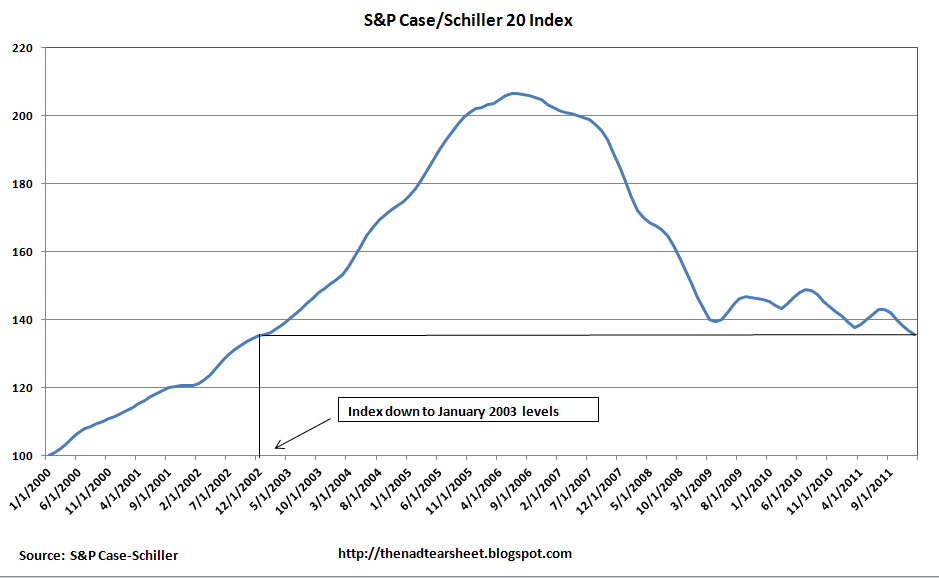
The S&P / Case-Schiller index showed a 3.8% decline year over year. Only Miami, Phoenix, and Washington DC reported increases. Atlanta was the outlier on the downside, with a nearly 15% decline YOY. Note that these are January numbers – Case-Schiller has a couple month lag.
Bloomberg has a story about bidding wars for homes in some parts of the US. While I had heard about bidding wars in the usual places – NYC and DC, this is the first I have heard about bidding wars in places like Seattle. The big question will be whether this is a permanent or temporary phenomenon. Supposedly the settlement with the State AGs ended foreclosure moratoriums, which means more supply is going to be dumped on the market. That said, I am hearing anecdotes of bidding wars in hard hit areas like Phoenix, at least in the $80k – $120k range.
On the other side of the coin, the Campbell / Inside Mortgage Finance survey notes that investors purchases are becoming a larger proportion of home sales, particularly short sales. This is being driven by the long financing timeline. Their Distressed Property Index shows that nearly half of home sales are distressed.
Chart: S&P / Case-Schiller Composite Index
Filed under: Morning Report | 35 Comments »
Morning Report
Vital Statistics:
| Last | Change | Percent | |
| S&P Futures | 1403.7 | 9.6 | 0.69% |
| Eurostoxx Index | 2537.3 | 11.9 | 0.47% |
| Oil (WTI) | 107.2 | 0.3 | 0.31% |
| LIBOR | 0.4727 | -0.001 | -0.11% |
| US Dollar Index (DXY) | 79.272 | -0.073 | -0.09% |
| 10 Year Govt Bond Yield | 2.27% | 0.04% | |
| RPX Composite | 169.79 | 0.1 |
Filed under: Morning Report | 36 Comments »
“…we would be wise to look upon arguments from fairness with a jaundiced eye.”
From The Economist –
The politics of fairness
Fairly confusing
Feb 2nd 2012, 14:31 by W.W. | IOWA CITY
FAIRNESS played a central role in Barack Obama’s state-of-the-union address, and I suspect it will play a central role in the president’s re-election campaign. But what does Mr Obama have in mind when he deploys the f-word? It may not be the case that fairness is, as Scott Adams, the creator of Dilbert, puts it, “a concept invented so dumb people could participate in arguments”. But it cannot be denied that fairness is an idea both mutable and contested. Indeed, last week’s state-of-the-union address seems to contain several distinct conceptions of fairness worth drawing out and reflecting upon.
Toward the beginning of his speech, as Mr Obama was trying to draw a parallel between post-second world war America and today’s post-Iraq war America, he offered this rather stark choice:
We can either settle for a country where a shrinking number of people do really well while a growing number of Americans barely get by, or we can restore an economy where everyone gets a fair shot, and everyone does their fair share, and everyone plays by the same set of rules.
Here we have three distinct conceptions of fairness in a single sentence.
To get a “fair shot” is to be offered the opportunity to participate fully and succeed within the country’s institutions. This is, I think, the least controversial conception of fairness in America’s political discourse. Conservatives who strenuously object to the idea that the American system should aim at “equality of outcomes” will sometimes affirm “equality of opportunity” as an alternative. But this is a mistake. To really equalise opportunity requires precisely the sort of intolerably constant, comprehensive, invasive redistribution conservatives rightly believe to be required for the equalisation of outcomes. If one is prepared to accept substantial inequalities in outcome, it follows that one is also prepared to accept substantial inequalities in opportunity.
Getting a fair shot doesn’t require equalising opportunity so much as ensuring that everyone has a good enough chance in life. The content of “good enough” is of course open to debate, but most Americans seem to agree that access to a good education is the greater part of a “good enough” and thus fair shot. Naturally, there is strong partisan disagreement over the kinds of education reform that will do right by young Americans. And there is also disagreement over elements of a “fair shot” beyond education. For example, many liberals believe workers don’t have a fair shot at achieving a decent level of economic security without robust collective-bargaining rights. And many conservatives believe that an overly-strong labour movement invites outsourcing by raising domestic costs, and thereby deprives American workers of a fair shot at employment. There may be some fact of the matter about which policies are most likely to benefit students or workers. But if one is more fair then the other, how would we know?
What is it to do one’s “fair share”? In small groups, it’s clear enough. If my friend and I are shoveling the front walk, my fair share of shoveling, and his, is about half. Often we adjust for differences in ability. If I am big and strong and my friend is small and frail, his fair share may be as much as he can manage. That won’t mean that the whole remainder is my fair share, though. If we’re going to get the walk shoveled, I may have to do a bit more than my fair share. These things get complicated quickly. That’s why the question of what it means for an American do his or her fair share, qua citizen, is completely baffling.
Suppose I’m a surgeon pulling down six figures. Perhaps doing my fair share is to pay 33% of my income in taxes. But, hey, wait! My sister, who could have been a surgeon, chose instead to make pottery in a little hippie arts colony. She makes only as much as she needs to get by, works relatively short hours, smokes a lot of weed with her artist friends, and pays no federal income tax at all! If paying 33% of the money I make saving lives is doing my fair share, then it’s hard to see how my sister—who could have been a surgeon, or some kind of job- and/or welfare-creating entrepreneur—is doing hers. But if she is doing hers, just playing with clay out there in the woods, benefiting next to no one, paying no taxes, then clearly I’m doing way more than my fair share. Which seems, you know, unfair.
Are you doing your fair share? How would one know? Actually, I just made myself feel slightly guilty for not going to med school and joining Médecins Sans Frontières. But unless government can come up with a way of taxing the leisure of people who aren’t doing as much as they might for kith and country, I reckon I’ll just stick to part-time pro blogging and let all you 9-to-5 suckers finance the necessary road-building and foreigner-bombing.
Playing by the same set of rules—the president’s third notion fairness in the passage above—is at least as important to fairness as the sufficiency of a “fair shot” and the proportionality of a “fair share”. A political economy with rules as convoluted as ours is sure to fail by the “same rules” criterion. Why should people who prefer leisure to income face lower tax rates? Why should parents and homeowners get tax breaks single renters don’t get? Why should young black men get longer sentences than young white women who commit the same crimes? Why should some industries get subsidies unavailable to others? In every case, they shouldn’t. It’s unfair. But it is this sense of fairness I think Mr Obama cares least about.
At one point in his address, Mr Obama says “[i]t’s not fair when foreign manufacturers have a leg up on ours only because they’re heavily subsidized.” I agree. It’s not. But just a few paragraphs earlier, Mr Obama had said:
[N]o American company should be able to avoid paying its fair share of taxes by moving jobs and profits overseas. From now on, every multinational company should have to pay a basic minimum tax. And every penny should go towards lowering taxes for companies that choose to stay here and hire here in America.
… [I]f you’re an American manufacturer, you should get a bigger tax cut. If you’re a high-tech manufacturer, we should double the tax deduction you get for making your products here. And if you want to relocate in a community that was hit hard when a factory left town, you should get help financing a new plant, equipment, or training for new workers.
So my message is simple. It is time to stop rewarding businesses that ship jobs overseas, and start rewarding companies that create jobs right here in America.
On the one hand, Mr Obama argues it’s unfair when foreign government subsidise their manufacturers. On the other hand, he seems to think subsidising American manufacturing is not only not unfair in the same way, but is somehow required by fairness.
It’s this sort of confusion that tempts me to agree with Mr Adams when he argues that fairness is “purely subjective”. But I’ll resist the temptation. I don’t think judgments of fairness are entirely whimsical. It really is unfair to eat more than your share of the cake, or to do less than your share of the shoveling, or to get ahead by flouting reasonable rules to which others faithfully adhere. And it really is unfair that America wields so much geopolitical power; our government really does behave unfairly when it condemns other countries for doing what it does on the world stage. Of course, we didn’t hear the president complaining about this.
I would conclude not that judgments of fairness are purely subjective, but that the rhetoric of fairness is used so opportunistically that we would be wise to look upon arguments from fairness with a jaundiced eye.
Filed under: 2012, politics, taxes | 19 Comments »
Smoking Gun on Corzine and MF?
Apparently the government thinks so…
Wow, Jon. You had it all, money and power. And threw it away.
Filed under: stock market | Tagged: over leveraged | 3 Comments »