Morning Report – Hedge funds betting on Fannie Mae 04/08/13

Vital Statistics:

  Last Change Percent
S&P Futures  1550.9 4.9 0.32%
Eurostoxx Index 2600.8 15.6 0.60%
Oil (WTI) 93.27 0.6 0.61%
LIBOR 0.279 0.000 0.00%
US Dollar Index (DXY) 82.61 0.111 0.13%
10 Year Govt Bond Yield 1.72% 0.01%  
Current Coupon Ginnie Mae TBA 106 0.1  
Current Coupon Fannie Mae TBA 104.3 0.0  
RPX Composite Real Estate Index 190.1 0.4  
BankRate 30 Year Fixed Rate Mortgage 3.54    

Markets are higher this morning on no real news. The Japanese Yen continues to fall, and is now approaching 100 yen to the dollar. The new program of quantitative easing in Japan is re-igniting the yen carry trade, except now the Japanese are borrowing yen to invest in US dollar assets. In case you missed it, Japan’s Nikkei 225 stock market index is up 52% since November. Incredible move. Japan’s QE program will mean incrementally lower rates on US long-dated Treasuries and MBS. Bonds and MBS are flat this morning.

Alcoa kicks off Q1 earnings season after the close today. We will get JP Morgan and Wells Fargo earnings on Thursday before the open.

Friday’s lousy jobs report probably means that any talk of ending QE this summer is probably over. After 3 consecutive economic slumps over the summer months, the Fed is going to stay aggressive. Chicago Fed President Charles Evans said “I’m going to have a lot more confidence if I begin to see indications that growth is well above trend and its going to be sustainable.” The Fed is going to be wary of reducing stimulus given that the fiscal policy has tightened a little bit.

Fannie Mae’s surprise profit has investors re-thinking the theory that they will be euthanized. Hedge funds are jumping into the preferred stock, which was issued in spring of 2008 as Fannie Mae was circling the drain before becoming nationalized. The 8.25% prefs have a $25 face value and were trading at $4.81 on Friday. All of this is predicated on the idea that Fannie Mae will be able to pay back the government. Once that happens, Fannie will restructure, and the bet is that there will be a place in the capital structure for the prefs. Risky bet, obviously, but big upside too.

Morning Report – Dismal Jobs Report 04/05/13

Vital Statistics:

  Last Change Percent
S&P Futures  1537.5 -17.0 -1.09%
Eurostoxx Index 2590.5 -30.9 -1.18%
Oil (WTI) 92.26 -1.0 -1.07%
LIBOR 0.279 -0.001 -0.36%
US Dollar Index (DXY) 82.43 -0.245 -0.30%
10 Year Govt Bond Yield 1.70% -0.06%  
Current Coupon Ginnie Mae TBA 105.8 0.5  
Current Coupon Fannie Mae TBA 104.4 0.4  
RPX Composite Real Estate Index 189.7 0.3  
BankRate 30 Year Fixed Rate Mortgage 3.59    

They’re beating the tape with the ugly stick after a dismal jobs report. The S&P 500 futures dropped from -4 to -16 on the report. The 10-year jumped on the news and is now yielding 1.7%.  It is hard to believe the 10 year was above 2% three weeks ago. MBS are rallying as well, but not as much as the 10-year. 

The March Employment Situation showed the economy added 88,000 jobs in March, well below the 190,000 estimate. February was revised upward to 268,000 from 236,000.  The unemployment rate ticked down to 7.6% from 7.7%, but that was due to a drop in the labor force participation rate, which dropped .2% from 63.5% to 63.3%. This means that the size of the labor pool dropped as more workers simply stopped looking for a job.  Long-term unemployed workers who are not actively looking for a job are not counted as part of the labor force. Wages were flat month-over-month and increased 2% year-over-year. 

The recent rally in bonds pours cold water on the “great rotation” theory –  the idea that 2013 would be the year when investors, particularly big institutional investors, change their target asset allocation and sell bonds to buy equities. So far, it seems like that investors are allocating money equally to both sectors – stock funds have taken in $79 billion while taxable bond funds have taken in $76 billion. Between the Bank of Japan’s QE program, which is driving funds to the US, the Fed’s QE program, and continued investor purchases of bonds, the expected 2013 bloodbath in the bond market may be held off for a while. Meanwhile, mortgage bankers are licking their chops thinking about another refi wave.  

Chart:  US Unemployment rate 1949-Present 


North Korea

From The Economist
Coping with North Korea
Korean roulette

Kim Jong Un has raised the stakes; it is time to get tougher with the nastiest regime on the planet

Apr 6th 2013 |From the print edition

EVEN by its own aggressive standards, North Korea’s actions over the past couple of weeks have been extraordinary. Kim Jong Un, the country’s young dictator, has threatened the United States with nuclear Armageddon, promising to rain missiles on mainland America and military bases in Hawaii and Guam; declared a “state of war” with South Korea; announced that he would restart a plutonium-producing reactor at its Yongbyon nuclear site, while enriching uranium to build more nuclear weapons; and barred South Korean managers from entering the Kaesong industrial complex, almost the only instance of North-South co-operation. All this comes after the regime set off a nuclear test, its third, in February. Tensions are the worst on the peninsula since 1994, when North Korea and America were a hair’s breadth from war.

The questions are what to make of all this, and how to respond. Neither is easy. The White House has tried to play down the aggression, talking of a “disconnect between rhetoric and action”, and some parts are pure bluster. The nuclear threat against mainland America is patently hollow: it will be years before the North has the technology to dispatch nuclear-tipped missiles. North Korea has yet to order a large-scale mobilisation of its 1.1m-strong army. Pyongyang, the capital, does not seem like a city that is about to go to war.

But there are also depressing reasons to take Mr Kim all too seriously. It does not take much to imagine the cycle of provocation and deterrence getting out of hand, especially if South Korea and the United States misjudge North Korea’s actions—or vice versa. And even without nuclear missiles, conflict on the crowded Korean peninsula would be savage. Decrepit North Korea would certainly be outgunned by South Korea and America. But nobody should doubt the cult-like commitment of the North’s armed forces. The human cost of war would be huge: 1.7m men serve in uniform on the peninsula, and North Korean artillery batteries are trained on the megalopolis of Seoul. American generals guess that a conflict could kill at least 1m, including thousands of Americans. Oh, and it would also be curtains for Asia’s thriving economy.

Moreover, Mr Kim heads a regime that cares nothing for its own brutalised people. Some 150,000-200,000 North Koreans—individuals and often whole families—rot as political prisoners in a vast gulag. Farmers are herded into collectives and forced into gruelling manual labour. Women trying to make a living by smuggling refugees across the border with China are shot if they do not know the right people to bribe.

In some ways the North is even scarier under its new ruler than it was under his father, who died in 2011. Early hopes that Mr Kim might prove a youthful agent of change seem entirely dashed by his nuclear explosion and boundless bombast. He is thought to have ordered the sinking of a South Korean naval corvette in 2010, with the deaths of 46 crewmen, and the shelling of a South Korean island later that year. Whereas Kim Jong Il was practised in the calibrated calculation of shaking down the outside world, his callow son has escalated tensions wildly. Nobody knows how to walk him back from the brink.

Doing so depends partly on Mr Kim’s motives. Perhaps aggression is a rite of passage to prove his leadership credentials to the country’s ancient generals. Perhaps he will shrewdly claim he has seen off the imperialist threat and back down. Perhaps he gets a thrill from orchestrating the chaos—as if he were playing a video game. Or, most worrying, perhaps he is out of his depth and therefore more prone to miscalculation.

Whenever Mr Kim’s father ratcheted up tensions, at least the pretence held that a bargain was to be had. In return for aid, oil or respect, North Korea would agree to discussions over dismantling its nuclear-weapons programme. The process was often a charade, but it kept the North engaged and it probably helped slow the development of nuclear weapons, as with the agreement to mothball the Yongbyon reactor in 2007. Now Mr Kim has declared that his nuclear capability is non-negotiable.

No prizes for backing off

What should the West do? In the long term, the best way to destabilise Mr Kim is from within. A new merchant class is emerging—the only prospering bit of the economy. The world must redouble its efforts to engage with these and other possible agents of change. This includes teaching more mid-ranking officials how societies work when they are organised around market economies and underpinned by laws; and funding defector radio stations beaming news back into the North.

That, though, is for the long term. The imperative now is to face down Mr Kim. After all, he has ruled out the only promise worth having (suspending his nuclear programme again). North Korea—and other rogue regimes and would-be nuclear proliferators, such as Iran—need to know that actions have consequences. That is why President Park Geun-hye of South Korea, in turn, was right to make it clear that sneak attacks will be met with a much firmer response than in 2010. America is right to move missile defences to Guam. When it sent two nuclear-capable B-2 bombers to fly over the peninsula it was a warning not only to North Korea, but also a gesture of support to the South. If Ms Park doubts American backing, she will be tempted to seek nuclear weapons herself.

Now more than ever, America needs to cajole China to press for change in its satellite. Apart from humanitarian aid to the North’s stunted people, all other commercial favours towards the regime should be stopped. Sick of Mr Kim and his family racket, China signed up to fresh UN financial sanctions against North Korea after the latest nuclear test. China has the capacity to choke the most iniquitous sources of the criminal regime’s cash. Yet its commitment to enforcing the sanctions seems half-hearted and it appears to have insisted that Shanghai accounts in two of its biggest banks, holding hundreds of millions of dollars on behalf of Mr Kim and his cronies, be excluded from the sanctions. Attempts at changing North Korean behaviour have so far patently failed. But then, as China shows, not everything has yet been tried.

Morning Report – Return of the Yen Carry Trade 04/04/13

Vital Statistics:


Last

Change

Percent

S&P Futures 

1550.7

2.2

0.14%

Eurostoxx Index

2661.8

22.8

0.86%

Oil (WTI)

93.96

-0.5

-0.52%

LIBOR

0.28

-0.001

-0.25%

US Dollar Index (DXY)

83.19

0.469

0.57%

10 Year Govt Bond Yield

1.77%

-0.04%


Current Coupon Ginnie Mae TBA

104.9

0.1


Current Coupon Fannie Mae TBA

103.7

0.2


RPX Composite Real Estate Index

189.4

0.1


BankRate 30 Year Fixed Rate Mortgage

3.68


Markets are giving back some Japan-led gains after Initial Jobless Claims spiked to 385k from 357k. This was the holiday-shortened Easter week, so there is a seasonality adjustment there.  On a non-seasonally adjusted basis, they fell. Bonds and MBS are rallying, with the 10 year yield down to 1.77%.

The Bank of Japan outlined more aggressive monetary actions last night with their own version of quantitative easing. This pushed the Nikkei 225 stock market index up 2%, and caused a sizeable drop in the yen.  This explains the rally in US bonds as Japanese investors flee for the “high yielding” US treasury market.  Don’t laugh – the Japanese 40 year bond (the 2’s of 52) yields 1.34%.  The US 10-year at 1.77%, in the context of a depreciating yen, is reviving the yen carry trade. The Yen Carry Trade is when Japanese investors borrow funds at yen rates and invest in high-yielding sovereign debt. They benefit from the pickup in yield and any favorable currency movements. With the high quality Euro sovereigns yielding even lower than the US, we are the only game in town. Punch line – this will put downward pressure on mortgage rates in the US, at least at the margin.

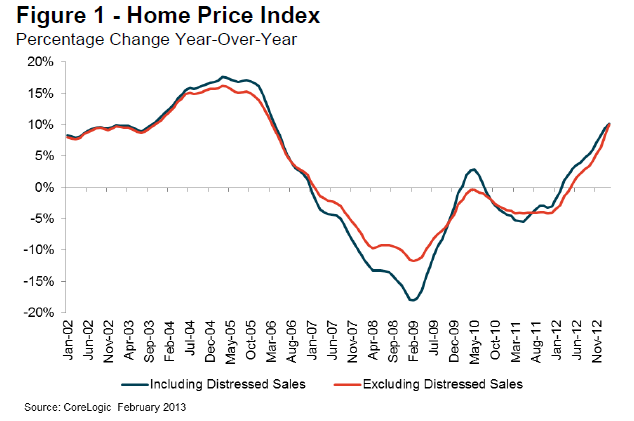
The CoreLogic Home Price Index increased 10.2% on a year-over-year basis in February, the highest increase since March of 2006.  It is the 12th consecutive monthly increase.  The gains were broad based, with 96% of their MSAs reporting gains.  California, Arizona, and Nevada all showed gains in the high teens.   They are forecasting a 2% month over month increase in March, or 12% year over year.

Chart:  CoreLogic Home Price Index 

Image

Hank Paulson, George Bush’s Secretary of Treasury, says that Fannie Mae’s new profitability shouldn’t deter the government from establishing a new platform for mortgage finance. He mentioned the Washington Post article that says the Administration is pushing banks to make home loans to people with weaker credit. Nominated to take over as Treasury Secretary just as the housing bubble was peaking, he can be forgiven for being a little gun-shy on re-inflating the bubble.

San Francisco Fed President John Williams said he is hopeful that “the economy has shifted into high gear” and that the Fed could begin slowing the purchases of Treasuries and MBS this summer, with a full exit by the end of the year.

Finally, you can hear my latest interview on Capital Markets Today, where I discuss real estate pricing, politics, and the economy.

Morning Report – the future of Fannie Mae 04/03/13

Vital Statistics:

S&P Futures  1564.7 0.3 0.02%
Eurostoxx Index 2665.2 -14.6 -0.54%
Oil (WTI) 96.64 -0.5 -0.57%
LIBOR 0.281 -0.001 -0.35%
US Dollar Index (DXY) 82.81 -0.117 -0.14%
10 Year Govt Bond Yield 1.85% -0.01%  
Current Coupon Ginnie Mae TBA 104.6 0.0  
Current Coupon Fannie Mae TBA 103.3 0.0  
RPX Composite Real Estate Index 189.3 -0.2  
BankRate 30 Year Fixed Rate Mortgage 3.69    

Markets are flat after a mixed ADP Employment report.  They forecast that the private sector added 158k jobs in March, below the 200k estimate.  February was revised upward, however to 237k. Mortgage Applications fell 4%.  Bonds and MBS are flat

The Obama administration is pushing banks to lend to borrowers with weaker credit, encouraging them to use FHA loans and to use more subjective judgment in determining whether to offer a loan. Of course the CFPB has already drawn a line in the sand with DTI. Housing officials are urging the Justice Department to provide assurances to banks that they will not face legal consequences if they comply and the borrowers subsequently default. Working against this initiative is that (a) the CFPB has drawn a bright line around the qualifying mortgage and (b) Ginnie Mae will flush an originator when they get 5% to 10% portfolio delinquencies. 

On the other hand, credit IS easing, especially for those who had short sales or foreclosures during the housing bust. Of the 7 million borrowers who had a foreclosure or a short sale, about 1 million are eligible for an FHA mortgage. Second, the return of the private label market (however small) will allow borrowers who don’t fit in the government bucket or the super high quality jumbo bucket to get financing.

Fannie Mae’s record profit has some questioning the future of the housing finance. According to the Administration’s White Paper, the intention seemed to be that the government would euthanize Fan and Fred and replace them with an entity that would act as a re-insurer. However, with more pressing issues facing the Administration, dealing with the GSEs has taken a back seat. In the interim, they are improving their balance sheets and have paid back nearly half of what they owe to the government. And with the stock approaching $1.00, the 4.6 billion shares owned by the government start to become significant. It will become harder to kill the company when the stock is worth some money.  That is obviously what the market has figured out, as the stock has tripled since Fannie announced they will be profitable nearly 3 weeks ago.

Chart:  Fannie Mae Stock Price:


Morning Report – Fannie Mae posts record profit 04/02/13

Vital Statistics:

  Last Change Percent
S&P Futures  1562.2 6.3 0.40%
Eurostoxx Index 2651.8 27.7 1.06%
Oil (WTI) 97.01 -0.1 -0.06%
LIBOR 0.282 -0.001 -0.18%
US Dollar Index (DXY) 82.75 0.016 0.02%
10 Year Govt Bond Yield 1.85% 0.01%  
Current Coupon Ginnie Mae TBA 104.6 0.0  
Current Coupon Fannie Mae TBA 103.3 -0.1  
RPX Composite Real Estate Index 189.5 -1.1  
BankRate 30 Year Fixed Rate Mortgage 3.68    

Markets are higher after Europe returned from a 4 day weekend. Italian sovereign yields are dropping, which is easing concerns about the Cyprus situation. Later this morning, we will get the ISM New York, factory orders and vehicle sales. Bonds and MBS are down small.

Fannie Mae just reported the largest net income in company history.  Good thing they didn’t release this yesterday or nobody would have believed it. They reported net income of $17.2 billion for 2012 and $7.6 billion in the 4th quarter. The refi boom of 2012 has certainly helped them, along with a drop in delinquencies, increasing home prices, and higher sales of Fannie Mae-owned properties. They still owe Treasury $85 billion. Fannie Mae stock has rallied from 30 cents a share two weeks ago to 80 cents a share as of yesterday on reports they will be profitable. The stock is trading up a nickel on low volume pre-market. Every dime the stock increases is roughly half a billion dollars in the US government’s coffers.

The Consumer Financial Protection Bureau has a new one-stop shopping site for financial gripes. They do not verify the facts of the complaints, but they give the company a chance to respond before they put it on their site. If you had ever been mad at your bank and wanted to create a http://www.thiscompanysucks.com website, well, there ya go.

Mohammed El-Arian says that the Cyprus situation is not fixed, just temporarily stabilized. Even if it doesn’t become a systemic problem (read: spread to Italy and Spain) it still could create a systemic threat if enough peripheral countries have issues. The EU seems to be against an Iceland-style fix, where Cyprus leaves the EU and devalues its currency.

Morning Report – Return of the Wealth Effect 04/01/13

Vital Statistics:

  Last Change Percent
S&P Futures  1562.4 -0.3 -0.02%
Eurostoxx Index 2624.0 11.6 0.44%
Oil (WTI) 96.53 -0.7 -0.72%
LIBOR 0.283 -0.001 -0.35%
US Dollar Index (DXY) 82.94 -0.032 -0.04%
10 Year Govt Bond Yield 1.88% 0.03%  
Current Coupon Ginnie Mae TBA 104.4 -0.2  
Current Coupon Fannie Mae TBA 103 -0.2  
RPX Composite Real Estate Index 190.5 -0.3  
BankRate 30 Year Fixed Rate Mortgage 3.67    

Markets are flat this morning as most European markets are closed for the Easter Holiday. We are kind on a lull period until next Monday when Alcoa kicks off earnings season. Bonds and MBS are down small.

The Markit U.S. Preliminary March Purchasing Managers Index rose to 54.9 from 54.3 in February, indicating that the economy is expanding at a faster rate.  Most indicators (new orders, employment, backlog) indicated the economy was expanding and accelerating. The Markit PMI is different than the more widely followed Institute of Supply Management Survey, which uses different weightings. 

NPR has a good backgrounder on how strength in housing feeds other sectors of the economy. Punch line:  the wealth effect, which was given up for dead in 2008 has returned. As home equity grows, people start spending again. 

The Feds are getting closer to Stevie Cohen. They have arrested Micheal Steinberg, one of Cohen’s senior lieutenants, who was implicated in insider trading in Nvidia and Dell. 

Easter Weekend Open Thread

Feel free to add content here, including pictures of Easter Bunnies, egg hunts and/or puppies. The ladies can also post pictures of Stompy Easter Boots!

Happy Easter to all!

Bits & Pieces (Thursday, March 28th, 2013)

The Ukelele Orchestra does Nirvana’s “Smells Like Teen Spirit”. A great cover. BTW, it’s my opinion that “Smells Like Teen Spirit” is probably the most covered song of the 90s, and if it isn’t yet, it will be.

I liked the literal video phenomenon. A while back, I posted a literal video of Tears for Fears “Head over Heels”, which was hilarious and wonderful, and based on a song and a video that’s like 28 years old and has very little commercial value, especially when it comes to doing takedown notices on parodies . . . yet that’s what EMI did, so that awesome video is no longer available. Which is crazy. I understand copyright law, and, yes, it was using the music and video (set to different lyrics) . . . but it was an awesome parody that, at worst, might make people think about Tears for Fears when they hadn’t for 30 years. But whatever. This video parody of Creed’s much more recent “Arms Wide Open” is still up, for now, a feat accomplished by taking their original posting of the video (which was automatically removed), and flipping it horizontally so it doesn’t trigger YouTube’s automagic copyright violation detector.

Although I’m sure it’s just a matter of time before YouTube starts detecting backwards and reversed video and pulling that stuff down automatically as well.

•••

Massachusetts wants to tax you for having a computer and using it to access stuff. Well, actually, they want to tax the people who make that possible for you. Whether the company makes money on the data processing service they are providing or not. Really? A tax on “the cloud”? That’s just stupid.

Some people blame Wal-Mart’s crappy store management on a shortage of cheap labor. Or the minimum wage. Or whatever. However, I tend to suspect there is less a shortage of cheap labor than there is of people who want to labor cheaply at Wal-Mart. When you don’t pay much, having a crappy work environment or poorly managed stores isn’t going to attract the cheap labor that might find more amenable work environments for the same low price.

Also, some of the issue is likely bare bones staffing: underperforming stores don’t hire folks because the sales aren’t there, and the sales don’t come because no one is checking folks out or restocking the shelves or cleaning the aisles.

Dunno. Seems like the free market has an answer: hire a few more folks, maybe pay a little more, get your shelves stocked and stores cleaned and people in the checkout lines, and the sales come, and the profits follow. Not that Wal-Mart is in any danger of declaring bankruptcy.

•••

Apparently George Lucas intended for Indiana Jones to be a pedophile. That adds a new perspective to the character. Who knew?

•••

When blogs become ghost towns . . .

Now, I’ve done it myself, but I never had a huge following. I will occasionally pop back and announce I’ve moved here or there. Or not. Occasionally nurse ideas of going back to the blog, if it’s still there, and just start posting again. Then don’t.

But sometimes fairly popular blogs just stop, or seem to, without a word. I’m a big fan of Blue Sky Disney, which hasn’t had an update in over a month. Nearly two months now. Long delays have happened, but never quite so long, and never without some sort of post. He hasn’t even stopped by to update the comments, and he blogs anonymously so you have no idea if the dude got arrested, was assassinated by the Mickey Mouse Mafia, or just got hit by a truck or had a sudden heart attack. We may never know, and I find that a little disturbing. Anybody else ever had a blog you followed that disappeared, or just stopped, with no explanation?

•••

I was going to post this yesterday, but got distracted. Turns out, the current plan with the unified school system I’m working in (for those interested) is to basically erase all the old jobs under the already determined assistant superintendent positions, and make everybody apply for the new jobs. I believe the CIO, CFO and other similar positions are also already locked in, but everybody else has to reapply for new jobs that won’t necessarily be their old jobs and will likely pay less. Yay! Who says government can’t work like the private sector? 😉

BTW, they still haven’t come up with a name for the new unified school district. And it will open for business as a unified school system next year.

This is going to be a mess.

Morning Report – Undiversified Bond Investment? 03/28/13

Vital Statistics:

  Last Change Percent
S&P Futures  1558.1 1.3 0.08%
Eurostoxx Index 2633.5 21.0 0.80%
Oil (WTI) 96.39 -0.2 -0.20%
LIBOR 0.283 -0.001 -0.35%
US Dollar Index (DXY) 83.07 -0.148 -0.18%
10 Year Govt Bond Yield 1.85% 0.01%  
RPX Composite Real Estate Index 190.5 -0.3  

Markets are flattish on the last trading day of the quarter. 4Q GDP was revised upward from + .1% to + .4%. Personal consumption was revised downward as well.  Initial Jobless Claims rose last week to 357k. Bonds and MBS are flat.

The bond markets close at 1:00 pm EST today. Expect very little action today as traders will probably flatten positions ahead of quarter end.

The Office of Comptroller of the Currency has released the 4Q mortgage performance metrics. 89.4% of all mortgages are current, up from 88.6% last year. Delinquencies and foreclosures are down as the pipeline gets cleared and real estate prices start rebounding. More and more servicers are turning to mods as opposed to foreclosure initiations. The recidivism rate on these mods is around 17%.

The Private Label Securitization market is returning faster than people thought. Prior to this year, the only deals were the occasional Redwood Trust jumbo deal.  JP Morgan recently announced a deal, and now Springleaf plans a $1 billion subprime deal. The palette of products originators can offer is expanding in a big way.

FHFA has made mods easier to do on delinquent mortgages – anyone who is more than 90 days delinquent is automatically eligible for a loan mod. Borrowers do not have to show a financial hardship any more. This will only apply to Fan and Fred loans, and mods will be rate / term, not principal reductions. So this begs the question:  Why won’t everyone stop paying their mortgage in order to get a mod?  FHFA said they would use existing “screening measures to prevent strategic defaulters.”  Whatever that means. 

Is your house an undiversified bond investment? Was house price appreciation driven by falling interest rates? And does that mean that when rates start rising house prices will fall again? I would point out that interest rates aren’t the only factors affecting home prices – population growth, incomes, the availability of credit, and even global capital flows play a role. He does have a point, which is that a rapid rise in home prices like we saw from the early 90’s to 2007 is unlikely to be repeated given that we won’t have the tailwind of falling interest rates to increase affordability. That said, low interest rates can last a long time – from the end of WWI to the mid 60’s, short-term rates were 5% or lower. From 1932 to the mid 50’s, short term rates were under 2.5%.  I would also point out that real estate prices increased during the 1970s, even as short term rates moved up to 15%.