Morning Report – Its Janet 10/09/13

Vital Statistics:

Last Change Percent
S&P Futures 1654.3 3.9 0.24%
Eurostoxx Index 2917.5 14.1 0.49%
Oil (WTI) 103.3 -0.2 -0.19%
LIBOR 0.246 0.002 0.82%
US Dollar Index (DXY) 80.39 0.329 0.41%
10 Year Govt Bond Yield 2.65% 0.01%
Current Coupon Ginnie Mae TBA 105.4 0.0
Current Coupon Fannie Mae TBA 104.5 0.2
RPX Composite Real Estate Index 200.7 -0.2
BankRate 30 Year Fixed Rate Mortgage 4.27
Markets are up small after Alcoa kicked off earning season with good numbers. Bonds and MBS are down small.
Mortgage Applications increased last week by about a percent, according to the Mortgage Bankers Association. The refi index was up about 2.5%, while the purchase index fell small.
The FOMC minutes will be released at 2:00 pm EST. In the absence of economic data this will undoubtedly take on more importance.
In a move that surprised exactly no one, Obama is expected to name Janet Yellen to replace Ben Bernanke when his term expires in January. Basically it means Alan Greenspan’s third term. Yellen is a dove, a bigger dove than Bernanke, who was a bigger dove than Greenspan. Expect fawning support from the media due to the groundbreaking nature of the nomination. (If only Janet Yellen had been running the Fed, we wouldn’t be in this mess – never mind that while Ben Bernanke just spiked the punch bowl, Janet will be adding oxycontin to it.) The extra juice will have the Street singing Dammit Janet.
The shenanigans regarding the debt ceiling are not being felt in the 10-year, but they are being felt in the 1 month T-bill. The yield has increased from almost zero in mid September to 29 basis points currently. Any sort of default will wreak havoc in the repo market as defaulted securities are ineligible to be used for collateral. That has the makings of a credit crunch and bears watching. If there is one thing that is sure to get the market’s attention it would be liquidity problems somewhere because someone can’t roll over their repo lines.

Completed Foreclosures increased to 48,000 in August (up 1.3% month over month, but down 34% on an annualized basis), according to CoreLogic. Shadow inventory was 1.9 million units. Note: The MBA and Corelogic have different methodologies for calculating shadow inventory – The MBA’s estimate is about 50% higher.

Morning Report – NFIB Small Business Pessimism Report 10/08/13

Vital Statistics:

Last Change Percent
S&P Futures 1669.2 1.5 0.09%
Eurostoxx Index 2919.6 -3.5 -0.12%
Oil (WTI) 103.5 0.4 0.43%
LIBOR 0.244 0.000 0.10%
US Dollar Index (DXY) 79.98 0.034 0.04%
10 Year Govt Bond Yield 2.65% 0.02%
Current Coupon Ginnie Mae TBA 105.5 0.0
Current Coupon Fannie Mae TBA 104.9 -0.1
RPX Composite Real Estate Index 200.7 -0.2
BankRate 30 Year Fixed Rate Mortgage 4.27
Markets are flattish this morning on no real news. Bonds and MBS are down. Earnings season kicks off after the close with Alcoa.
China and Japan are warning the US not to default on its debt. China holds just under 1.3 trillion of US Treasuries. Beijing warned that “the clock is ticking” and urged Washington to get its act together to “ensure the safety of the Chinese investments.” The White House says it is open to a short-term increase in the debt ceiling, which may allow us to kick the debt ceiling can to the end of the year while we figure out the government shutdown. However, both sides are dug in, with the White House insisting on a clean debt ceiling increase, and John Boehner insisting that some spending cuts have to be a part of any deal.
Corelogic is reporting there were 48,000 completed foreclosures in August, down 34% year-over-year and up 1.3% from July.The shadow inventory is estimated to be 1.9 million homes. 2.1 million mortgages, or 5.3% of all mortgages are seriously delinquent, the lowest level since November 2008. The Northeast, Florida, and Nevada have the highest foreclosed inventory.
Corelogic also released its 2013 mortgage fraud report. They estimated that $10.5 billion of mortgage applications had fraudulent information in the first half of 2013. The mortgage fraud index decreased 5.6% nationally on a year-over-year basis. They identify six types of fraud – employment, identity, income, occupancy, property, and undisclosed debt. Income fraud is the highest risk, while property fraud is the lowest.
The National Federation of Independent Businesses say that optimism fell in September as pessimism about future business conditions increased. Small business optimism is still well below pre-crisis levels. Keep this in mind when you start hearing blowout earnings numbers from the S&P 500 companies. Many of them are overseas earning stories and you shouldn’t draw too many conclusions from their strength.
Chart: NFIB Small Business Optimism Index

Morning Report – The shutdown and the debt ceiling become joined at the hip 10/07/13

Vital Statistics:

Last Change Percent
S&P Futures 1671.7 -13.1 -0.78%
Eurostoxx Index 2904.9 -23.4 -0.80%
Oil (WTI) 102.9 -0.9 -0.89%
LIBOR 0.243 0.001 0.21%
US Dollar Index (DXY) 79.99 -0.128 -0.16%
10 Year Govt Bond Yield 2.61% -0.04%
Current Coupon Ginnie Mae TBA 105.6 0.1
Current Coupon Fannie Mae TBA 105.2 0.2
RPX Composite Real Estate Index 200.7 -0.2
BankRate 30 Year Fixed Rate Mortgage 4.26
Markets are lower as the government shutdown stretches into Week 2. Bonds and MBS are rallying. Earnings season kicks off with Alcoa tomorrow. We will hear from JP Morgan and Wells on Friday.
On Wednesday, we will get the minutes from the September FOMC meeting. Should make very interesting reading, although the shutdown pretty much means tapering is off the table for a while.
Back of the envelope calculations:  The drop in government spending is about 13% from the shutdown because most government functions, specifically entitlements, are still being done. So, on a 3.8 trillion budget, 13% amounts to just a hair under 500 billion for the year, or about 9.5 billion a week. On a 16 trillion GDP, that amounts to 6 basis points of GDP. Tack on a government spending multiplier of 1.3 and you get about 8 basis points of fiscal drag for each week the government is shut down.
Ginnie Mae has denied rumors that the Ginnie Mae I MBS is about to be sunsetted. Ginnie Mae I securities have usually traded at a premium to Ginnie II MBS but have been trading at a discount since May when rates started backing up. The other security which is rumored to be going away is the Freddie Mac (or Gold) MBS. This would simplify the MBS market into conforming and Ginnie.
The debt ceiling debate is going to get ugly. The Administration has said it will not negotiate on the debt ceiling. John Boehner has said he doesn’t have the votes to pass a clean debt ceiling increase. While it seems easy to just decide which checks to write and which ones not to, it is actually a knotty piece of re-programming at Treasury to do that. And with the government shut down, it is even more difficult. Still nobody thinks the US will fail to make interest and principal payments. The Bipartisan Policy Center has a really good breakdown on the shutdown and debt ceiling issue

Morning Report – warning signs in the money markets 10/04/13

Vital Statistics:

Last Change Percent
S&P Futures 1673.5 3.8 0.23%
Eurostoxx Index 2915.7 13.6 0.47%
Oil (WTI) 103.6 0.3 0.32%
LIBOR 0.243 0.000 0.00%
US Dollar Index (DXY) 79.98 0.233 0.29%
10 Year Govt Bond Yield 2.63% 0.02%
Current Coupon Ginnie Mae TBA 105.6 0.1
Current Coupon Fannie Mae TBA 105.1 0.2
RPX Composite Real Estate Index 200.7 -0.2
BankRate 30 Year Fixed Rate Mortgage 4.25
Markets are higher this morning on no major news. Since we have the government shutdown, the all-important jobs report that was scheduled for this morning will be delayed. Bonds and MBS are down small.
Even though we don’t have any economic data today, we have a lot of Fed-speak. Fisher will talk at 8:30, Dudley at 9:15, Stein at 9:30, Lacker at 12:30, and Kocherlakota at 1:45 (all times EST). With no data to chew on, the market will probably react more strongly to any new revelations than it otherwise would.
With no economic data to analyze, the Fed will almost certainly maintain its present course of asset purchases at the October FOMC meeting. While the Fed does have their own econometric models and independent sources of data, they do rely on inputs from the Federal government agencies. The bigger question is about December. Does Ben Bernanke want to start the tapering process on his watch or throw the whole thing to Janet Yellen? And does Janet Yellen want to taper at all? She may not. This whole shutdown has thrown a wrench in the conventional wisdom over tapering, which means QE may stick around a little while longer than we thought. Doing nothing at the December meeting is still a long-odds scenario, but it is getting less and less so.
The dynamic I would watch in the bond market is that anything that points to a deal would be bond bearish, and continued gridlock is bullish. Here is one area of concern though – the short term Treasury markets. I already discussed the issues with the repo market and here is another: the 1 month T-bill has increased in yield as the debt shutdown has gone on. It is now a higher yield than the 1 year. Heard on the Street has a piece on how a debt ceiling breach will impact the money markets. While no one anticipates another 2008, things could get dicey. If anything is going to push the S&P 500 over the edge and get everyone’s attention in Washington, this will.
Chart: 1 month T-bill yield

We are starting to see the Federal government move towards bringing back items piecemeal. Currently there is are bills that would commit to pay furloughed federal workers their back pay once government gets back up and running. Naturally Democrats don’t like these sort of bills because they want to use the leverage of mad constituents to force Republicans to drop their opposition to a clean continuing resolution. Republicans are taking a page out of the sequester strategy, where they fixed the air traffic controller problems with a simple bill. Behind the scenes, the Tea Party is wearing thin on most everybody and at some point the more senior Republicans are going to say enough is enough. Separately, John Boehner is telling people he will avoid a default on the federal debt. It is looking more and more likely that any sort of deal with be a two-fer, handling the budget and debt ceiling.
HUD has released its own rule on QM – any mortgage (aside from HECMs) that do not meet the points and fees requirements will not be eligible for insurance. This is a proposed rule, which will be open for comment. HUD will handle the points and fees a little differently: Under CFPB, the APR has to be below 150 bps over the average prime rate offer (APOR). Under the HUD proposal, it has to be less than 115 basis points over APOR plus the mortgage insurance premium. This intends to alleviate concerns that higher MIPs are causing loans to breach the threshold. HUD believes MIP will add about 135 bps to APR, so, the punch line is that a loan that is withing 250 bps of APOR would fall within safe harbor.
Banks are abandoning mortgage pre-approvals, according to CNBC and moving towards conditional approvals that usually last about 90 days.

Morning Report – Day 3 and all is well… 10/03/13

Vital Statistics:

Last Change Percent
S&P Futures 1680.6 -2.5 -0.15%
Eurostoxx Index 2911.4 -6.9 -0.24%
Oil (WTI) 103.8 -0.3 -0.26%
LIBOR 0.243 -0.002 -0.61%
US Dollar Index (DXY) 79.89 -0.012 -0.02%
10 Year Govt Bond Yield 2.62% 0.01%
Current Coupon Ginnie Mae TBA 105.4 0.1
Current Coupon Fannie Mae TBA 104.9 -0.1
RPX Composite Real Estate Index 200.7 -0.2
BankRate 30 Year Fixed Rate Mortgage 4.27

Sorry some of this is going to be really “inside baseball” for people in the mortgage business…

Day 3 of the government shutdown. Markets are sanguine. Stocks are down small and bonds / MBS are flat.
Initial Jobless Claims came in at 308k, better than expected. Challenger Job Cuts increased 19% as the financial sector continues to lay off people.
Rob Chrisman is out saying some of the big banks are relaxing their requirements for 4506Ts during the government shutdown. Wells retail will require a signed 4506 but will let the loan close without the transcript. Wells correspondent, however is not doing this. U.S. Bank is temporarily waiving the requirement for transcripts, but will still need the executed form 4506T. Stearns is not requiring an executed 4506T for W2 borrowers. So it seems like the mortgage market will not in fact grind to a halt if the shutdown drags on for a while. There are missives from the other lenders in there as well. At the end of the day, business is down and the 4506T is an investor overlay, not a requirement.
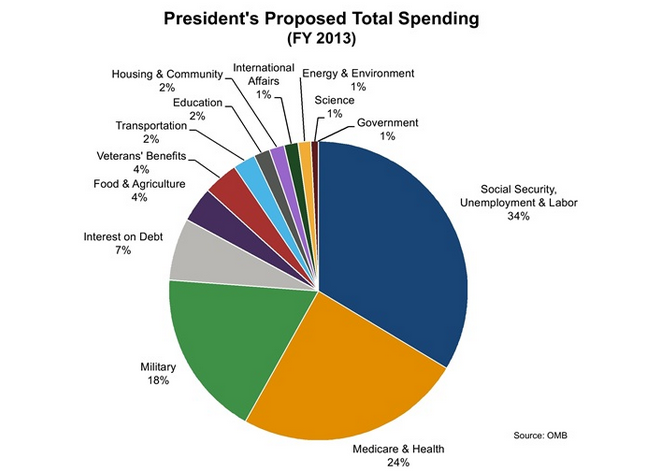
The shutdown debate is now starting to mix with the debt ceiling debate. Remember, the even if we don’t raise the debt ceiling, that doesn’t automatically mean we default. Interest on the debt is about 7% of the US budget. The debt ceiling allows maturing debt to be replaced with new debt. As long as the net balance of debt remains under the limit, we can issue debt just fine. So all that really comes into play is interest, which is only 7% of the budget.
Here is the breakdown of government spending:

Of course the problem is that both sides see each other as villains in a movie and cannot fathom they believe what they do for any reason other than evilness, power hungriness, need for control, greed, stupidity, or naivete. Neither side sees any value whatsoever in the opposing party’s position. As long as the markets behave there probably isn’t going to be a lot of pressure being put on Washington to come to an agreement. Think of the Snicker’s Ad: Not going anywhere?
Assuming we get a deal soon, don’t get lulled by interest rates at these levels. If we get a solution over the weekend, the shutdown will probably be short enough to not have any effect on the economy. Which means we go back to wringing our hands about the Fed and tapering. The trend is up for rates and we are in a counter-trend move. Don’t lose sight of the big picture.

Morning Report – State of play 10/02/13

Vital Statistics:


Last

Change

Percent

S&P Futures 

1676.5

-12.9

-0.76%

Eurostoxx Index

2920.1

-12.9

-0.44%

Oil (WTI)

102.1

0.0

0.05%

LIBOR

0.244

-0.002

-0.61%

US Dollar Index (DXY)

80.12

-0.017

-0.02%

10 Year Govt Bond Yield

2.61%

-0.04%


Current Coupon Ginnie Mae TBA

105.4

-0.1


Current Coupon Fannie Mae TBA

104.9

0.1


RPX Composite Real Estate Index

200.7

-0.2


BankRate 30 Year Fixed Rate Mortgage

4.32


Markets are weaker after the ECB maintained interest rates at current levels and the ADP jobs report came in disappointing. Mortgage Applications fell .4% last week. Bonds and MBS are higher.


Bonds are rallying (interest rates are falling) on the shutdown. What gives? The shutdown means that the Fed is on hold for QE tapering. Certainly an October move is off the table, and perhaps December is as well. Then we get Janet Yellen, who is an even bigger dove than The Bernank. Maybe, just maybe, we can squeeze in one last refi wave if rates drop below 2.5% on the 10 year. 


If the shutdown remains in place, you just got Friday’s all-important jobs report with the ADP number. The economy created 166k jobs last month, while the Street was expecting 180k. The August number was revised downward from 176k to 159k. As we have seen, the financial industry is laying off mortgage origination staff as the refi boom dries up. 


The Washington Post gives you the state of play with the shutdown. Punch Line: there are no high level negotiations happening at the moment. Both sides absolutely despise each other and neither one trusts the other further than they can throw them. Republicans are playing a strategy similar to the sequester. Democrats believed that once people started feeling the effects of the sequester (think business travelers and flight delays) that the pressure would bring everyone to the table. That didn’t happen. Instead, Congress passed a bill requiring the FAA to move funds to keep the air traffic controllers on the job. That took the pressure off and the sequester stayed, much to the chagrin of Democrats. Republicans are planning to submit separate continuing resolutions to fund the most popular government activities and daring the Democrats to vote against them. In other words, this could take some time to play out.


Rob Chrisman has a decent analysis of the shutdown and its effects on the mortgage business.  Here is another. The highlights


  • Lenders needing an executed IRS Form 4506-T only need to have it signed by the borrower not processed by IRS prior to closing. However, the actual 4506-T information must be obtained.
  • USDA loans will be on hold as the Department of Agriculture is closed.
  • VA will remain open.
  • We should also see delays in FHA processing.
  • Fully approved FHA and VA loans will be able to close, but there will be delays in insuring
  • FHA case numbers will be obtainable if processed automatically. Manual processes will not.
  • FEMA flood insurance will not be obtainable


Once we climb continuing resolution mountain, we have to deal with the debt ceiling. Nobody thinks we will miss a principal or interest payment on the debt, but it could potentially affect the economy if the government stops paying some bills. One potential issue is the repo market, which could hit a bump if T-bills become classified as “defaulted securities.” Defaulted securities are unacceptable as collateral for repo transactions (a repo is just a secured loan and is a huge way banks and companies handle cash management). This could start to affect the financial markets and restrict credit. 

Morning Report – Shutdown Breakdown 10/01/13

Vital Statistics:

Last Change Percent
S&P Futures 1677.8 3.5 0.21%
Eurostoxx Index 2908.5 15.4 0.53%
Oil (WTI) 101.8 -0.6 -0.57%
LIBOR 0.246 -0.003 -1.21%
US Dollar Index (DXY) 80.02 -0.197 -0.25%
10 Year Govt Bond Yield 2.63% 0.02%
Current Coupon Ginnie Mae TBA 105.5 -0.1
Current Coupon Fannie Mae TBA 104.8 -0.2
RPX Composite Real Estate Index 200.7 -0.2
BankRate 30 Year Fixed Rate Mortgage 4.28
The government shuts down and markets are up.  Kind of says it all. Bonds and MBS are down small. The markets are sanguine because it means that QE will remain in place.
Shutdowns are not as rare as the media likes to portray: it shut down once under Ford, and HW Bush, twice under Clinton, five times under Carter, and eight times under Reagan. So keep this in mind when you hear all the sturm and drang over how this is “unprecedented” and it will wreck the economy.
So there are two ways out that seem to be within the realm of possibility. The first (and most likely) is that John Boehner relents and allows a clean continuing resolution to the floor of the House and it is passed with moderate Democrats and Republicans. The far left will probably vote against it because they want the sequester cuts repealed and the Tea Party will obviously vote against it. The second (and less likely) is that Obama relents and throws the tea party a bone and disposes of some part of obamacare. The most likely candidate is the medical devices tax which is pretty much loathed universally and has powerful democrats lining up against it. It is unknown if this is enough to get the tea party on board.
The government shutdown started at midnight but most people will not notice. Entitlement checks will still go out, the mail will still get delivered, and government workers are about to take a paid vacation. HUD will still operate for the most part. In mortgage land, big banks like Wells Fargo have told their clients it is business as usual.
Here are some of the impacts on the mortgage business:
  • FHA will continue insuring loans in Lender Insurance and FHA Connection will be operating. DE test cases and HUD insurance processing will be delayed
  • VA – business as usual; minimal disruption
  • Ginnie Mae – Will issue new securities; minimal impact on new issuer processing for at least the near future
  • USDA – no guidance at the moment; expect no new guarantees during shutdown
  • IRS – Apparently no 4506Ts during the shutdown
I noticed yesterday that some on the Street were backing off their FHA and VA pricing a little. The fact that things could get messed up at Ginnie Mae means mortgage bankers are wary of having too much inventory for fear they won’t be able to move it.
What does this shutdown mean for the markets? Well, first of all, you aren’t getting any government data until they are back at work. So no jobs report on Friday, which means the ADP employment report on Thursday will suddenly become a lot more important. A shutdown of any length will almost certainly take the possibility of reducing QE off the table at the October meeting, and possibly the December meeting. So, the longer it goes on, the more bullish it is for bonds.
That said, we will go from this crisis to the debt ceiling crisis. If the government does not get an increase in the debt ceiling, the government will have to prioritize payments. Principal and interest payments and social security payments will take precedence and will almost assuredly be paid, although some are warning that the computer systems at Treasury which pay the nation’s bills will have to re-programmed to allow this intervention. Of course with the government shut down, that becomes more difficult.

Morning Report – Government shutdown looms 09/30/13

Vital Statistics:

Last Change Percent
S&P Futures 1670.9 -15.5 -0.92%
Eurostoxx Index 2882.4 -36.9 -1.26%
Oil (WTI) 101.7 -1.2 -1.15%
LIBOR 0.249 0.001 0.20%
US Dollar Index (DXY) 80.14 -0.382 -0.47%
10 Year Govt Bond Yield 2.61% -0.02%
Current Coupon Ginnie Mae TBA 105.7 0.1
Current Coupon Fannie Mae TBA 104.9 0.1
RPX Composite Real Estate Index 200.7 -0.2
BankRate 30 Year Fixed Rate Mortgage 4.33
Markets are lower as participants contemplate a government shutdown. The Street has viewed this issue as a kabuki dance, but we are now getting to the short strokes. Bonds and MBS are rallying.
Aside from the government shutdown issues, this week also contains the all-important jobs report. The Street is at an increase of 182k and an unemployment rate of 7.3%. St Louis Fed Head James Bullard raised the possibility of tapering at the October meeting. I think if we have any sort of shutdown, tapering will be off the table until the Dec meeting at the earliest. Of course if there is a shutdown, we won’t be getting any economic data this week.
One potential issue coming down the pike is the fee limit on mortgages starting Jan 1. The cap makes sub $100k loans uneconomic for originators. I wonder how the CFPB will handle the sudden unavailability of loans below 100k. Not sure if they thought this through or they just plan on hitting everyone with fair lending / CRA lawsuits.
Housing equity rose 30% or more than $2 trillion over the past year, according to NAR.
Another interesting data point on the manufacturing renaissance in the US – low value added industries like textiles are onshoring. The problem is finding people.

Saturday Open Thread

Just thought I’d post an open thread so that folks can throw anything up. Shamelessly stolen from Ezra Klein’s Wonkblog:

    The Best Sentences We Read Today


— “I’m going to look them in the eye and say, ‘You must be confusing me with someone who gives a f— about your opinion.'”

I hope that link works. I had to google the sentence to get to the article from Wonkblog’s link.

— “So hang on tight because you are going to get some clear and true facts without rumor and innuendo, or any accompanying B.S. and mush.”

— “Chicken-sh— editors who wouldn’t touch stories like that, they love documents, so he changed the whole ball game.”

— “The Administration has had nearly two million minutes to implement this law.”

Lydia DePillis

What else do we have? Both MSU and UM have byes this week, so I don’t have much in the way of football to watch today.

Morning Report – breakdown of the government shutdown 09/27/13

Vital Statistics:

Last Change Percent
S&P Futures 1685.0 -7.5 -0.44%
Eurostoxx Index 2913.5 -9.5 -0.32%
Oil (WTI) 102.8 -0.2 -0.21%
LIBOR 0.248 0.000 0.10%
US Dollar Index (DXY) 80.22 -0.307 -0.38%
10 Year Govt Bond Yield 2.63% -0.02%
Current Coupon Ginnie Mae TBA 105.4 -0.3
Current Coupon Fannie Mae TBA 104.7 0.1
RPX Composite Real Estate Index 200.7 -0.2
BankRate 30 Year Fixed Rate Mortgage 4.28
Markets are lower ahead of Continuing Resolution Weekend. Personal income rose .4% in August, while personal spending rose .3%. The prior months were revised upward. Bonds and MBS are up.
The government’s new fiscal year begins on Tuesday, and unless Congress comes up with a way to keep the lights on the government will shut down. You have all-out war between Democrats and Republicans and a civil war in the Republican party. Here is the state of play: The House passed a continuing resolution that funds the government through the end of the year, but it contains language that de-funds obamacare. The Senate passed a continuing resolution that funds the government through the end of the year, but it removed the obamacare language and sent it back to the House. So that leaves Boehner with 3 possible outcomes: 1) He can convince the Tea Party Republicans to go along with a clean continuing resolution, 2) He passes a bill with primarily Democratic party support (and that support won’t be free, plus it will probably cost him the Speakership), or 3) He attempts to pass a clean CR and it fails, which shuts down the government. Democrats are confident that any shutdown will be a replay of 1995, where the public sided with Clinton. How to handicap it:  I think the fact that the Republican leadership is so vocal against the rebellious Tea Party republicans is important and it brings them on board. #1 is the most likely scenario, followed by #2. If we do have a shutdown, it will be short.
If the government shuts down, what does that mean for the mortgage markets? Ginnie Mae will be open for business, according to HUD’s contingency plan from 2011, which supposedly would be used in this case. I have yet to see what FHA will do. Bottom line, I don’t foresee any major disruptions to the financial markets. Macroeconomic Advisers estimates that a 2 week shutdown will lop .3% off of 4Q GDP. Mark Zandi of Moody’s estimates that number to be 1.4% if it goes 3 – 4 weeks. (Mark, you didn’t get the Treasury Secretary gig – you don’t need to keep carrying water for the Administration).
Pending Home sales fell 1.6% in August, according to the National Association of Realtors. The NAR blames the drop on an acceleration of home sales in early summer, as buyers accelerated purchase decisions as interest rates began to rise. The NAR is anticipating 2014 sales to be flat with 2013 and median existing home sale prices to increase 5% – 6%. Note that almost half of all home sales right now are all-cash transactions and that number is usually close to 20%. So even if existing home sales are flat next year, year over year, the mortgage business could still improve markedly as distressed / cash sales run their course.
The number of loans in the process of of foreclosure at the end of the second quarter decreased 40% to 744k. This is an interesting statistic, MBA estimates the shadow inventory of homes to be 3.3 million. I know MBA also includes 90 day DQs, which may account for some of the difference – 90 day DQs in judicial states which haven’t been permitted to move to the foreclosure process yet. Other tidibits – the overall percent of loans that were seriously delinquent fell from 15% a year ago to 3.8%. Almost 91% of all loans in the report were current and performing.
Does the high shadow inventory number necessarily mean that cash sales will continue to be half of all existing home sales? Probably not. Professional investors who bought property for rentals are noting the increase in prices, and will certainly think about ringing the register. They won’t be selling to other professional investors, so that inventory will be coming soon. Plus, as we have seen in the D, many of these homes will be bulldozed, not sold.