Morning Report – No expanded HARP for you 1/23/14

Vital Statistics:

Last Change Percent
S&P Futures 1828.6 -10.0 -0.54%
Eurostoxx Index 3145.5 -5.8 -0.18%
Oil (WTI) 96.92 0.2 0.20%
LIBOR 0.239 0.002 0.63%
US Dollar Index (DXY) 80.64 -0.528 -0.65%
10 Year Govt Bond Yield 2.81% -0.05%
Current Coupon Ginnie Mae TBA 105.3 0.3
Current Coupon Fannie Mae TBA 104 0.3
RPX Composite Real Estate Index 200.7 -0.2
BankRate 30 Year Fixed Rate Mortgage 4.41
Stocks are lower on overseas weakness. Initial Jobless Claims came in at 326k, a little better than expected. The Markit PMI and the Chicago Fed National Activity Index came in lower than expected. Bonds and MBS are up
Existing home sales increased to 4.87 million in December, below the 4.93 million expectation. The median price increased 9.9% year-over-year to $198,000. All cash buyers remained steady at 32%, and just over 1/4 were first time homebuyers. Days on market jumped from 56 to 72.
The FHFA House Price Index rose .1% in November, which was lower than expected. Year-over-year, prices are up 7.6% and we are within 8.9% of the April 2007 peak. Home prices are at roughly the same level they were in April 2005. This index looks at houses with conforming mortgages only, so it tends to be a little less volatile than Case Shiller, etc which include distressed / cash sales as well as jumbos.
Fifth Third reported that origination volumes fell 46% quarter-over-quarter and 67% year-over-year.
senior Treasury official spoke at the asset backed securities conference in Vegas and gave some insight as to the government’s thinking regarding the mortgage market. Key takeaways:
  • Treasury does not support changing the cut-off date for HARP
  • Treasury  would like to extend HARP to non-conforming loans as a way to deal with the eminent domain issue.
  • Fannie and Fred loans will probably trade in the same MBS at some point
  • The administration thinks mortgage standards are too inflexible, and wants to see more CRA lending.
  • The administration wants to restart private mortgage securitization, but doesn’t know how.
The WSJ has a good article on why hiring is still sluggish in the manufacturing sector, even as production increases. We still have some slack in the system and we probably won’t see a big hiring push until utilization levels are in the low / mid 80s.

Morning Report – credit scores still main impediment to getting a mortgage 1/22/14

Vital Statistics:

Last Change Percent
S&P Futures 1841.6 7.3 0.40%
Eurostoxx Index 3168.0 14.8 0.47%
Oil (WTI) 94.59 0.2 0.23%
LIBOR 0.237 -0.001 -0.21%
US Dollar Index (DXY) 81.3 0.076 0.09%
10 Year Govt Bond Yield 2.84% 0.02%
Current Coupon Ginnie Mae TBA 105.3 0.0
Current Coupon Fannie Mae TBA 104 -0.1
RPX Composite Real Estate Index 200.7 -0.2
BankRate 30 Year Fixed Rate Mortgage 4.39
Markets are flat as the Northeast digs out of a snowstorm. Apparently NYC got hit pretty hard so desks are probably thinly staffed today. Bonds and MBS are down small.
Another day of no economic data, except for mortgage applications, which increased 4.7% last week Purchases dropped 3.6%, while refis climbed 9.9%.
The latest CoreLogic Market Pulse asks where credit is still constrained in the mortgage market. It turns out if you look at the different variables that affect access to credit, low credit scores are the biggest impediment. High LTV loans are actually more prevalent than normal (must be the fact that FHA loans are now a major part of the mortgage market). If you look at the graph below, the red line shows where we are now, the blue line is “normalcy” and the green line is where things got during the go-go days of the bubble.

In the same issue, they say that cash sales made up 37% of total home sales in September. Historically, that number has been closer to 20%. This speaks to the professional investor’s presence in the market, which will undoubtedly wane as prices / interest rates continue to climb. Tomorrow we will get existing home sales. The Street is expecting a 4.93 million annualized pace. That works out to about 3.1 million mortgages. If we get back to our historical levels of cash sales, that would equate to 3.94 million mortgages, or a 27% increase in business, even if existing home sales go nowhere. Given that refis are still 64% of all mortgage applications, that won’t make up for the loss in refi business, but it does soften the blow a little. Of course there is always the potential for FHFA to tweak the HARP eligibility dates, which would boost refi activity.
Mohammed El-Arian resigned from PIMCO, where he was the heir apparent to Bill Gross. Neel Kashkarian (of TARP fame) resigned as well, and plans to run for Governor of California on the Republican ticket. Bill tweets that he is ready for another 40 years. Good for him – it might be that long until we see another bond bull market.
Wells is selling a $39 billion MSR portfolio to Ocwen. Terms were not disclosed.

Morning Report – Low construction hiring the new normal? 1/21/14

Vital Statistics:

S&P Futures 1841.6 7.3 0.40%
Eurostoxx Index 3168.0 14.8 0.47%
Oil (WTI) 94.59 0.2 0.23%
LIBOR 0.237 -0.001 -0.21%
US Dollar Index (DXY) 81.3 0.076 0.09%
10 Year Govt Bond Yield 2.84% 0.02%
Current Coupon Ginnie Mae TBA 105.3 -0.1
Current Coupon Fannie Mae TBA 104 -0.1
RPX Composite Real Estate Index 200.7 -0.2
BankRate 30 Year Fixed Rate Mortgage 4.39
Markets are higher this morning on no real news. We won’t have any economic data until Thursday. We also have a snowstorm targeting the Northeast today, so bond desks will probably start heading home early and tomorrow may be a thin day as people are snowed in.
This week promises to be dull as there are no important economic data points and the FOMC meeting looms large next week. On Thursday, we will get existing home sales and the FHFA Home Price Index.
The WSJ is predicting that next week’s FOMC meeting will be full speed ahead on tapering.
Construction spending continues to increase, but construction hiring is lagging, according to CoreLogic. Is this a new normal? You can see from the chart below that construction spending and hiring used to correlate reasonably well, but but they did not during the recovery. It is certainly possible that the reason for this is that construction firms still had excess capacity and were able to meet the new demand without workers. FWIW, virtually every publicly traded homebuilder has been saying that skilled construction labor is hard to find. Don’t forget that we have underbuilt for 10 years and once household formation begins to recover we will need a lot of new construction.

Morning Report – Why the Community Reinvestment Act is based on flawed logic 1/17/14

Vital Statistics:

Last Change Percent
S&P Futures 1837.7 1.5 0.08%
Eurostoxx Index 3147.5 -2.7 -0.08%
Oil (WTI) 94.69 0.7 0.78%
LIBOR 0.237 0.000 0.11%
US Dollar Index (DXY) 81.05 0.135 0.17%
10 Year Govt Bond Yield 2.83% -0.01%
Current Coupon Ginnie Mae TBA 105.2 0.2
Current Coupon Fannie Mae TBA 104 0.1
RPX Composite Real Estate Index 200.7 -0.2
BankRate 30 Year Fixed Rate Mortgage 4.42
Markets are flattish this morning after UPS missed and housing starts came in a bit better than expected. Bonds and MBS are up.
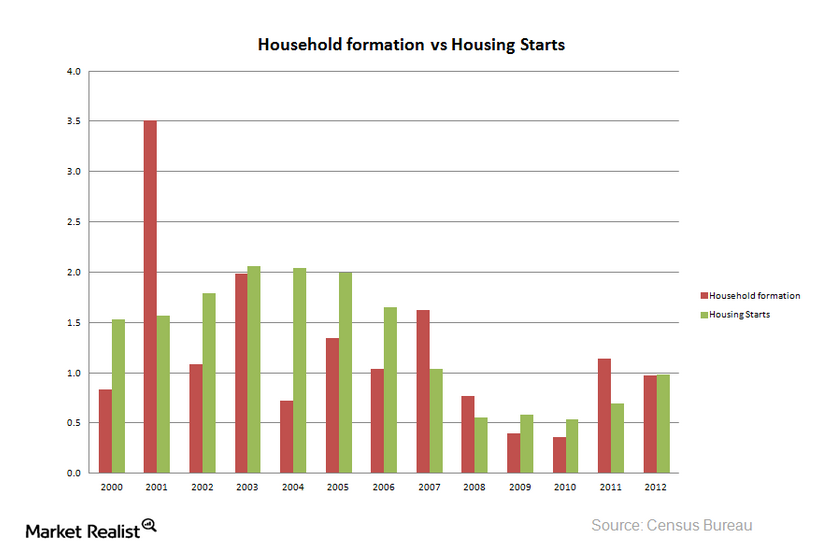
Housing starts came in at 999,000 and building permits came in at 986,000. Single Fam and Multi-fam both fell, although single fam is up year-over-year and multi fam is down. Starts are up small from a year ago, and down from the huge 1.1 million print we saw in November. While a million starts is a champagne-popping number in the context of the Great Recession, it is still a lousy number historically. Pre-bubble, starts averaged about 1.5 million a year, and routinely topped 2 million a year early in recoveries. We have spent years below the nadir or prior recessions which usually exhibited sharp V-type crashes and recoveries. Once household formation numbers recover (and we have tremendous pent-up demand here), we will find ourselves with a shortage of homes.
Household formation vs Housing Starts

Industrial Production came in as expected at .3%, and capacity utilization ticked up to 79.2%. The average since the 1960s has been 80.6%, so we are approaching normalcy here after bottoming at 66.9% in 2009. The prior low was 70.9% during the nasty 81-82 recession. Yet another data point showing just how rough the past 5 years have been.

Freddie Mac has an interesting chart showing how depressed the mortgage business has been, but also why forecasts might be a little too gloomy. They look at home sales relative to housing stock (basically housing turnover) and then compare it to purchase applications. Two things jump out at me: first, turnover (the blue line) is very low at the moment, which probably reflects the underwater borrower phenomenon. People can’t move if they can’t sell. But second, note that as housing turnover increased recently, purchase applications (the green line) remained more or less flat – that is evidence of the cash / professional buyer who has been dominating the marketplace. Both are temporary headwinds for mortgage bankers that will abate as home prices continue to rise. Underwater homeowners will eventually get right-side up and will be able to sell. Professional investors will begin to balk at the higher prices and may even begin to sell. The purchase business will benefit from a number of major big trends going forward: (a) a “payback” of the low household formation numbers over the last few years, (b) increasing turnover as underwater home owners finally get right side up, and (c) the professional investor’s exit from the distressed home market (the green line will catch up to the blue line)

Zillow has a study showing that targeted lending areas had the biggest drops in real estate prices. This is unsurprising given that the chance of a home becoming worthless is higher in places like Detroit or Harrisburg than it is in, say Stamford CT or San Diego CA. Unwittingly the study also proves a point that I have been making for quite some time – that the underlying logic to the Community Reinvestment Act is flawed. Essentially, the CRA says that borrowers with the same characteristics (FICO / LTV) should get the same rate. And if they don’t get the same rate, then that is prima facie evidence of discrimination. That logic is perfectly valid for some forms of credit – particularly credit cards, installment debt, etc. However, mortgages are different. They are secured loans, and when a lender looks at a secured loan, they take into account not only the probability of getting paid (via credit scores), but also the characteristics of the underlying collateral. The CRA proponents assume a house is a house is a house and FICO is all that matters. But the study shows that isn’t the case – the lender has to take into account what happens if they are not paid. And because the underlying homes in targeted lending areas are more likely to have huge price swings (particularly to the downside), when lenders charge more for loans in these areas, they are not guilty of discrimination – they are simply properly pricing risk. Therefore, the CRA isn’t correcting some purported wrong, it is simply an excuse for wealth redistribution.

Morning Report – glum news for the originators 1/16/14

Vital Statistics:

Last Change Percent
S&P Futures 1837.2 -4.4 -0.24%
Eurostoxx Index 3158.1 -10.7 -0.34%
Oil (WTI) 94.17 0.0 0.00%
LIBOR 0.236 -0.002 -0.63%
US Dollar Index (DXY) 80.92 -0.106 -0.13%
10 Year Govt Bond Yield 2.86% -0.04%
Current Coupon Ginnie Mae TBA 105.1 0.0
Current Coupon Fannie Mae TBA 103.8 0.2
RPX Composite Real Estate Index 200.7 -0.2
BankRate 30 Year Fixed Rate Mortgage 4.45
Stocks are lower this morning after a Citigroup earnings miss. Initial Jobless Claims fell to 326k and consumer inflation remains low. Bonds and MBS are up.
Citi reported mortgage originations dropped 43% sequentially and 51% year-over-year. The stock is down 3% pre-open. Separately, Citi sold Fannie Mae MSRs on $10 billion worth of loans. These are mainly delinquent loans.
Flagstar is cutting staff by 17%.
The Fed released their Beige Book survey yesterday afternoon – nothing earth-shattering, though it does appear that things are picking up. Still, the survey is peppered with characterizations such as “modest” and “moderate.” Since the Beige Book surveys are basically a recap of recent economic announcements broken down by Federal Reserve district, it contains no “new news” and is therefore not a market-moving release.
The NYT has a long article on the woes affecting homebuyers and lenders. More and more banks are going to have to rely on the purchase business, which is a different animal than the refi business. The big banks are still shunning those without pristine credit. That said, the big banks are not the only game in town, and this is an opportunity for the smaller lenders to say “they might not give you a loan, but we will.”
Americans’ assessment of their own personal situation ticked down, according to Gallup. 42% of Americans said they were worse off than a year ago, up from 40% last year. This is a surprising result given how much asset prices (stocks and housing) have improved. Maybe the December jobs report wasn’t just a fluke due to bad weather.

Morning Report – Bank of America earnings 1/15/14

Vital Statistics:

S&P Futures 1836.2 3.3 0.18%
Eurostoxx Index 3140.1 20.6 0.66%
Oil (WTI) 93.01 0.4 0.45%
LIBOR 0.238 0.001 0.46%
US Dollar Index (DXY) 81.04 0.377 0.47%
10 Year Govt Bond Yield 2.90% 0.03%
Current Coupon Ginnie Mae TBA 104.7 -0.4
Current Coupon Fannie Mae TBA 103.6 0.0
RPX Composite Real Estate Index 200.7 -0.2
BankRate 30 Year Fixed Rate Mortgage 4.41
Markets are higher after a strong earnings report out of Bank of America. The Empire State Manufacturing Survey came in stronger than expected, and the producer price index showed inflation is still muted at the wholesale level. Bonds and MBS are down small
Mortgage Applications increased 12% last week, although there is a holiday comparison in there so you can’t read too much into it. Both the purchase and refi indices increased.
Bank of America reported originations declined 46% year over year to $13.5 billion.  Lock volume was down 37% from Q3. Their refi / purchase percents were 68 / 32. Headcount declined 14%. The stock is up half a buck pre-open. So we have seen big sequential drops in origination volume from the JP Morgan (down 38%), Wells (down 42%), and Bank of America (down 37%). For those keeping score at home, iSRL’s volume was up 9.5% sequentially. Overall, it looks like the big banks are losing share to smaller rivals.
Looks like extended unemployment benefits remain a tough nut to crack. Democrats in the Senate want to extend unemployment without an offset, while Republicans want a “pay-for.” Boehner is saying a deal without a “pay-for” and “job creation provisions” (read regulatory relief and probably something about Keystons) is DOA in the House. Democrats will continue to bang the inequality drum and push for a hike in the minimum wage and more Federal infrastructure spending.
How I learned to stop worrying and love the taper.

Morning Report – You get to keep your incandescent light bulbs 1/14/14

Vital Statistics:

S&P Futures 1819.2 4.1 0.23%
Eurostoxx Index 3104.5 -7.5 -0.24%
Oil (WTI) 92.1 0.3 0.33%
LIBOR 0.237 -0.002 -0.90%
US Dollar Index (DXY) 80.6 0.088 0.11%
10 Year Govt Bond Yield 2.85% 0.03%
Current Coupon Ginnie Mae TBA 105.4 -0.2
Current Coupon Fannie Mae TBA 104 -0.1
RPX Composite Real Estate Index 200.7 -0.2
BankRate 30 Year Fixed Rate Mortgage 4.42
Stock markets are stronger this morning after a good retail sales report. Bonds and MBS are down.
Retail sales came in at +2% on the headline number, vs. +1% expected. November’s numbers were revised downward. Ex autos and gas, sales increased .6%, vs .3% expected.
We heard from Wells Fargo and JP Morgan this morning – both beat expectations. On the mortgage origination side, Wells originated $50 billion in Q4, down from $80 billion in Q3. For JP Morgan, origination volume was $23 billion, down 42% from Q3.
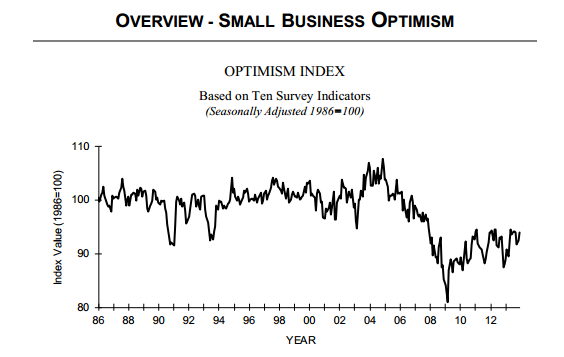
The National Federation of Independent Business optimism survey came in at 93.9, a little better than expected, and just short of the post-crisis peak of 95.4. Still, that number is depressed compared to historical norms. Pre-recession, the index averaged around 100, and numbers in excess of 100 are typical for recoveries. The theme of the this recovery has been the tale of two sectors. The big S&P 500 names have been benefiting from QE and their international exposure, while smaller businesses have not. It is hard to imagine that we can be flirting with record highs on the S&P 500 while smaller business remains in the doldrums. On the plus side, we are seeing some hiring – NFIB owners increased employment by an average of .24 workers per firm in December, the highest reading since Feb 2006. Capital expenditures also increased by 9 percentage points. So not all the news is glum.

It looks like we have a budget deal that relieves some of the sequester spending cuts. The planned military pension cuts were restored, and obama got more spending for his big priority – head start. For Republicans, they got strict rules to prevent the IRS from targeting groups for ideological scrutiny, and specifically banning the agency for targeting citizens “for exercising any right guaranteed under the First Amendment.” They also blocked the new standards that would effectively prohibit the sale of incandescent light bulbs, and pulled out $1 billion from an obamacare slush fund.

Morning Report – dissecting the jobs report 1/13/14

Vital Statistics:

S&P Futures 1832.4 -5.3 -0.29%
Eurostoxx Index 3107.0 2.8 0.09%
Oil (WTI) 91.7 -1.0 -1.10%
LIBOR 0.239 -0.003 -1.14%
US Dollar Index (DXY) 80.72 0.063 0.08%
10 Year Govt Bond Yield 2.86% 0.00%
Current Coupon Ginnie Mae TBA 105.5 0.8
Current Coupon Fannie Mae TBA 103.8 0.1
RPX Composite Real Estate Index 200.7 -0.2
BankRate 30 Year Fixed Rate Mortgage 4.46
Stocks are down small this morning while bonds continue to hold onto Friday’s gains. There is no important economic data this morning with the exception of the budget report sometime later on today.
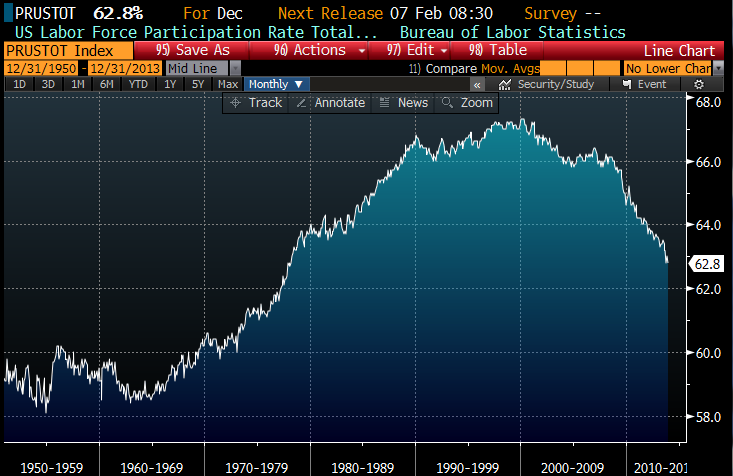
The stock market seems to be taking Friday’s jobs report as sort of a one-off, while bonds seem convinced that it signals something bigger. The most disappointing statistic in the report was the decline in the labor force participation rate to 62.8%, which means last month’s rebound was just a blip. One worrisome stat – the biggest decline in the labor force participation rate came in the 45 – 55 year old cohort. In other words, people in their prime spending years. I personally know a lot of people who were rounding the final turn towards Candy Castle and then drew the candy cane card.
This week begins earnings season, with the big banks reporting. J.P Morgan and Wells report tomorrow, Bank of America is on Wed, Citi is Thursday, and Suntrust is Friday. I’m sure we will hear about all of the woes in the origination business. From what I am seeing, margins have to be terrible for them, and a combination of lower volume and lower margins is a toxic cocktail.
Tomorrow morning we will get retail sales, which will be an important data point, particularly for estimates of Q4 GDP. Later on this week we will get housing starts and building permits. It will be interesting to see whether November’s 1.1 million print was a fluke or evidence of further strength in the housing market.

Saturday Open Thread 1/11/2014

Unlike last weekend it looks like the weather is swinging the other way (at least here in the mid-Atlantic area)–fog and rain here today and tomorrow and then warming up into the 50s early in the week. I’m guessing we have some very confused plant life out there!

Playoffs start in earnest in the NFL, and (since my Packers and the Eagles both lost last weekend) I’m reduced to hoping the Seahawks make it into the Super Bowl.

Happy weekend, all!

Morning Report – mixed jobs report 1/10/14

Vital Statistics:

S&P Futures  1837.4 4.4 0.24%
Eurostoxx Index 3111.5 21.2 0.69%
Oil (WTI) 92.63 1.0 1.06%
LIBOR 0.242 0.000 0.00%
US Dollar Index (DXY) 80.8 -0.207 -0.26%
10 Year Govt Bond Yield 2.90% -0.07%  
Current Coupon Ginnie Mae TBA 104.7 0.2  
Current Coupon Fannie Mae TBA 103.4 0.5  
RPX Composite Real Estate Index 200.7 -0.2  
BankRate 30 Year Fixed Rate Mortgage 4.54    
Markets are stronger after a mixed jobs report. Payrolls expanded at an anemic 74k in December (versus the Street expectation of 197k, and the unemployment rate came in lower than expected, falling to 6.7%. Alcoa kicked off 4Q earnings season with a miss. Bonds and MS are rallying on the news.
 
Headline statistics from the report:
  • Payrolls + 74k vs 197k expected
  • Unemployment rate 6.7% vs 7% expected
  • average hourly earnings + .1% MOM, + 1.8% YOY
  • Average workweek 34.4 hours, down .1 hour
  • Labor force participation rate 62.8% down from 63%.
The low payroll number was blamed on weather, which may explain the moves in the market. Stocks initially sold off hard and then rallied back. That said, even if you exclude the weather related effects, payroll growth was still sluggish. The labor force participation rate moved right back to its lows. The participation rate is back to levels we haven’t seen since the late 70s. To put that in perspective, roughly half of the gains in the labor force participation rate that began in the 1960s with women entering the labor force have been given back. We still have a lot of wood to chop before we get back to a semblance of normalcy. One other observation – ADP has been lousy at predicting the jobs number lately. They had the number at 238k. 
 
Chart: Labor Force Participation Rate 1950 – Present


The jobs report probably does not change the stance of the Fed, and I would expect another $10 billion reduction in QE at the Jan FOMC meeting. 
 
The Mortgage Bankers Association is forecasting $1.2 trillion in origination for 2014, the lowest level in 14 years. Banks will continue to fire people and there is still overcapacity in the system. I wonder what assumptions about cash purchase percentages they are using…