ACA Report Card from The Economist

A mixed report, of course, but as a summary in one place I thought it was useful.  I have read The Economist’s copyright policy and am not reprinting anything from that mag here.  However, I am linking:

http://www.economist.com/node/21618904/print

Morning Report – Did QE inhibit lending? 9/19/14

Markets are higher this morning on no real news. Bonds and MBS are up small.

Not a lot to talk about this morning – Alibaba raises almost $22 billion in its IPO, and the Scots reject independence.

The Index of leading economic indicators came in at .2% for August, a drop from the upward-revised 1.1% in July and Street expectations of .4%.

Did QE actually inhibit lending? David Kelly, chief global strategist at JP Morgan has an interesting theory – that QE pushed rates so low, that it didn’t make sense for banks to lend money at such low levels. He also mentions the Administration’s war on the financial sector, which probably has more to do with it. But he has a point – when the government meddles too much with interest rates, you are going to have unintended consequences.

Morning Report – FOMC data dump 9/18/14

Markets are higher after yesterday’s FOMC statement was still reasonably dovish. Bonds and MBS are down small.

Initial Jobless Claims dropped to 280,000, an extraordinarily low number that is associated with boom times like 1999 and 2005.

Housing starts were disappointing, coming in at 956k, a sizeable drop from the upward-revised 1.11 million in July. The drop was almost all in the multi-fam segment, which tends to be extremely volatile. Building Permits fell as well.

The FOMC statement kept language stating that the Fed Funds target rate should remain at current levels for “a considerable time” after QE ends. The Fed noted there remains “significant under-utilization” of labor resources. That said, the FOMC raised their Fed Funds forecast for 2015 by 1/4 and 2016 by 3/8, according to the dot graph in the projection materials. The Fed took down their unemployment and GDP forecasts for this year and next year as well. On the subject of QE, it should end this year and for the time being, the Fed will continue to re-invest maturing proceeds. They do not intend to sell their MBS portfolio. At the margin, this means lower mortgage rates going forward. Bonds sold off on the statement (probably due to the dot graph), and stocks rallied as the Fed’s posture will remain dovish for the near and intermediate future.

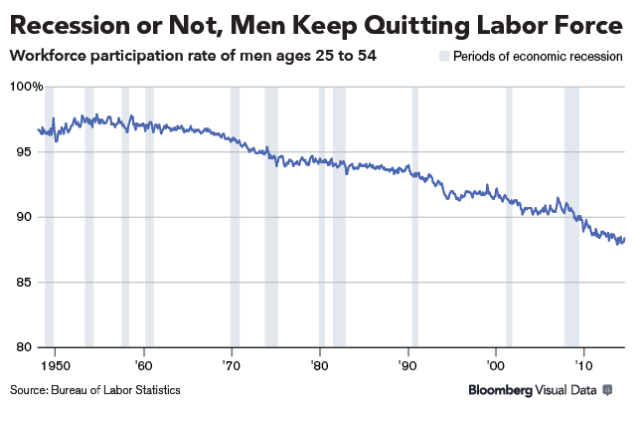
Note that the “significant under-utilization” language is at odds with what the Staff economists believe is going on in the labor market. The Staff Economists discussed the idea that those who are long-term unemployed may turn out to be effectively retired, and if that is the case, then there is less slack in the labor market than previously thought. The Great Recession has put a lot of men in their prime earning years on the sidelines.

I appeared on Louis Amaya’s Capital Markets Today show and discussed the FOMC statement and the economy. You can hear the interview here.

Morning Report – Waiting on the Fed 9/17/14

Markets are flat this morning as we await the Fed’s decision at 2:00 pm. Bonds and MBS are up.

The FOMC decision should be out by 2:00 pm EST. I suspect any surprises will be in the press conference, not the actual release.

The NAHB Homebuilder Sentiment Index rose to a post-bubble high.

Mortgage Applications rebounded 7.9% last week after printing the lowest level since 2001 in the prior holiday-shortened week. Purchases rose 4.8%, while refis increased 10.3%. Interestingly, MBA is reporting the average 30 year fixed rate mortgage rate increased to 4.36% after having been stuck in a 4.25% – 4.30% range all summer. Mortgage rates didn’t really follow bond yields lower ahead of the ECB announcement, but now they are heading higher along with bonds. This could be evidence of (a) capacity having been wrung out of the system, or (b) bankers making loans that they wouldn’t have made a year ago, which carry higher rates.

Inflation at the consumer level remains muted. The consumer price index fell .2% in August as gas prices decreased. Ex-food and energy, it was flat. Certainly not seeing much evidence of inflation.

Lennar reported good numbers, with a 23% jump in new orders, a 29% increase in backlog, Average Selling Prices rose 14% to $332,000. Lennar was one of the few companies that reported increases in deliveries – most had been showing drops in deliveries offset by an increase in ASPs. The stock is up a couple of bucks pre-open.

Good news for builders like Lennar, Pulte, and D.R. Horton who have exposure to the entry-level buyer – the Millennial generation is moving out of Mom and Dad’s basement. This has all sorts of implications for the housing market – they will be the demand for rentals and also for starter homes. We have underbuilt since the bust and demand is starting to come back. Of course we have a long way to go to get to normalcy, but at least we are headed in the right direction. Note the Wells survey from yesterday – many might actually be interested in buying, but they believe (wrongly) that a 20% downpayment and perfect credit is mandatory to get a loan. Education about FHA loans is key.

HUD secretary Julian Castro spoke at the Bipartisan Policy Center 2014 Housing Summit. Here are his prepared remarks. Obviously access to credit is a big concern on the part of HUD, and they are trying to address it by clarifying rules and regulation and putting them in a single resource – the Single Family Handbook, which will address loan defects and how serious they are. Second, they are rolling out a program designed to counsel first time homebuyers, rewarding them with a MI break if they go through the program. I do wonder how much improved access we are going to get with the barrage of lawsuits continuing.

Morning Report – Buybacks are levitating the market 9/16/14

Markets are lower on no real news. Bonds and MBS are up small. Today starts the FOMC meeting.

Inflation at the wholesale level remains under control, with the Producer Price Index coming in flat for the month of August. Ex food and energy, it was up .1% (or 1.8% annualized). Inflation is still below the Fed’s target.

Wells Fargo conducted a survey about homebuying attitudes, and there are some major misconceptions out there. 30% believe only individuals with high incomes can obtain a mortgage. 64% believe they must have a “very good” credit score to buy a home. 44% believe a 20% down payment is a requirement. People really do not know about FHA lending.

CALPERS (the California Public Employees Retirement System) – the biggest US pension fund, is redeeming its hedge fund investments. High costs and low transparency are the stated reason, but another reason is underperformance. Average public pension gains from hedge funds were 3.6% over the past 3 years, vs 10.6% in stocks and 5.7% from bonds.

What is holding up the stock market these days? Buybacks. Interesting stat: companies in Q2 spent 31% of their cash flow on buybacks. This is having an outsized effect as volumes dry up. In Q2, stock market volume averaged just over 6 billion shares a day, the lowest level in 7 years.

Morning Report – Big Week Ahead 9/15/14

Markets are flat this morning ahead of a big week for data and events. Bonds and MBS are down.

Industrial Production fell .1% in August, while capacity utilization dropped by 30 basis points to 78.8%. It looks like the notoriously volatile motor vehicle sector accounted for the decline. The previous month had a big increase in motor vehicles, which it looks like we gave back in August.

The Empire Manufacturing Survey came in at 27.5, a multi-year high.

This week we will have the FOMC meeting, with the decision on Wed afternoon. This meeting will include new projections and also should include a press conference. The Street will be focusing on any changes in the rate projections from the voting members (note that the mix of voting members will turn much more dovish at the beginning of 2015).

One of the interesting features of mortgage rates this summer has been the decoupling from long-term bonds. As rates fell during the summer, mortgage rates stayed stuck at the 4.25% range. Now that bonds are selling off, mortgage rates are still relatively constant. Look at the graph below. The top line is the 30 year fixed rate mortgage according to Bankrate, and the lower line is the 10 year bond yield. The correlation has completely broken down.

I Blame NoVA

http://www.washingtonpost.com/blogs/federal-eye/wp/2014/09/15/how-states-have-gamed-medicaid-for-hundreds-of-millions/?wpisrc=nl_fed&wpmm=1


You healthcare lobbyists should have written a law without loopholes to begin with.


I am curious as to what is the net effect of revenue matching laws.  It seems to me that revenue match for a particular program that bypasses the state’s general coffers might achieve the supposed result of more program funding, but considering how it is normally done, I think it is simply a transfer of deficit raised federal dollars to state general revenues.


We have so many revenue matching programs.  I assume that Highway funding is the largest one, followed by Medicaid.  Or perhaps vice versa.  I believe that in TX all fed revenues into both are used however the Lege desires.


Should a federal/state joint venture like highway construction even have a feature like “revenue matching”?  What purpose does it actually serve?  Assume with me that interstate highways are basically federal responsibilities.  Nevertheless, the R.O.W. impacts are all local, and state and local input are critical to managing the minimum damage to a community.  So cooperation is a legitimate goal, but does revenue matching have anything to do with that?  Is it possible states or localities were blackmailed into supporting the interstate system financially, or else the feds would have drawn the roadway to kill commerce in a town?


The article calls the gaming of Medicaid by the states “waste”.  But it seems to me the structure was established as a “game”.  If you see revenue matching as other than an invitation to increase the federal deficit in order to permit states to have the pleasure of spending money they did not have the pain of raising, explain it to me.


Happy Birthday, ATiM

Today ATiM celebrates its 3rd anniversary. Despite our much reduced daily content, and although I am more often than not disappointed to find nothing new, I must confess that ATiM remains the first website I check every morning, so on my own behalf I want to offer my sincere thanks to all of you who have stuck with it and continue to be daily contributors. I could easily provide a list, but this is supposed to be a happy occasion, so best not to make the depressingly short list too explicit.

One interesting thing worth noting: In my quest to make this anniversary post at least somewhat entertaining by taking a walk down memory lane, I was originally going to link to some of the better threads we’ve had over the last few years, but while searching I discovered that, despite the diminished number of contributors, we did manage to set a new record in 2014 for most comments on a single post. It was McWing’s President’s Day Post which was, ironically, itself devoid of literally any content whatsoever, but managed to produce an impressive 279 comments.

2014 also produced a 242 comment post by Mark, Gay Conservatives Denied ‘Official’ Spot at Texas GOP Convention, which placed in the top 5 of most comments in history.

To be fair, though, neither of these more recent posts can be said to even approach what was the longest thread in ATiM history. That distinction belongs to a memorable thread that was so epic it needed two separate posts by Mich, the first of which alone had the 3rd highest number of comments (252), and the second of which was nearly 70% as long as the first (176), combining for a total 428 comments. I believe that this thread represents the zenith of ATiM’s participation rate.

Anyway, congrats again to ATiM for surviving a 3rd tempestuous year. Here’s to one more.

(Shall we take bets on who is still commenting by September 13, 2015?)

Morning Report – The Fed thinks the labor force participation rate isn’t going to increase meaningfully9/12/14

Markets are flat as we close out a dull week. Bonds and MBS are down amidst a global bond sell-off.

Retail Sales increased .6% in August. Ex autos and gas, they increased .4%. July’s numbers were revised upwards.

Import prices fell .9% in August, driven by a drop in oil prices. Ex food and fuels, import prices were flat.

The preliminary September reading for the University of Michigan Consumer Sentiment indicator showed an increase and hit the high for the past year.

The jumbo securitization market is pretty much dormant, except for the occasional Redwood Trust deal. Only 2.3% of all jumbos originated in the first half of 2014 have been securitized. At the peak of the housing bubble, almost half of all jumbos were securitized. Banks are instead choosing to hold them on their balance sheet. Banks are subsidizing the jumbo mortgage rate in order to bring in the wealthy client and then offer all other sorts of banking services, including the lucrative wealth management business.

Another article about the lowering of the speed limit for the economy. Federal Reserve economists do not expect the labor force participation rate to increased meaningfully as the labor market improves. They argue that the number of people who aren’t working, but would work if conditions were better are relatively small. The upshot is that this paper bolsters the hawk case at the Fed and is ammo for those who want to start raising rates. Not sure dove Yellen will play along, and the voting members will take a dovish turn next year as hawks like Plosser lose their vote.

Morning Report – Another sign of a credit market top 9/11/14

Markets are higher this morning on on real news. Bonds and MBS are rallying.

Initial Jobless Claims came in at 315k, a little higher than street expectations, but still a good number.

The President talked about ISIS last night. It was a declaration of war. Or something. Here are the takeaways.

The Fannie Mae National Housing Survey is out – average home price expectations continue to fall as consumers temper their bullishness on home price appreciation. People still have a dour view on the economy but it is improving slightly. That said, it looks like incomes took a bit of a hit in August.

Bill Gross of PIMCO has been raising cash in his Total Return Fund, selling Treasuries and developed sovereigns. Mortgages as a percent stayed flat at 20%.

Twitter is doing a new convertible bond which are convertible into stock or cash at Twitter’s election. This is rare – usually the choice is the bondholder’s not the issuer’s, at least on senior unsecured paper. This isn’t a convertible pref issue. It will be interesting to see the pricing on this – essentially the holder will be short a put on Twitter stock. If Twitter’s stock craters, Twitter gets to essentially sell stock at current levels. If Twitter stock continues to rally, they can either pay cash, or sell Twitter stock in the market at higher prices, redeem the bonds and pocket the difference between the sales price and the conversion price. The bigger point is that bond issues are getting more and more lopsided in favor of the borrower, and that is a classic market top signal. Investors are reaching for yield and taking risks they are not getting adequately compensated for. Paper like this can go no-bid in a hurry. IMO, the stock market is assuming that the Fed can start raising rates without anyone blowing up. Historically that hasn’t happened.

Foreclosure activity picked up in August, according to RealtyTrac. Activity picked up in the big judicial states like New York, New Jersey, and Connecticut.