Morning Report – FOMC minutes review 5/9/15

Stocks are lower this morning as the ECB raises aid to Greece. Bonds and MBS are flat.

The FOMC minutes really didn’t have much new information in it and bonds ignored the release for the most part. The decision to remove the word “patient” was not intended to signal that a raise is imminent, just that they will continue to be data-dependent. The strong dollar is beginning to have an effect on the economy, or at least the big multinationals. The stronger dollar is what drove them to revise their near-term GDP forecasts down.

They didn’t discuss housing much except to say that the pace of activity was “slow” and noting the decrease in starts. FWIW, the homebuilders seem to be seeing a bit brighter picture. We’ll get a better idea when D.R. Horton and Pulte report in a couple of weeks. Regarding credit, they said that credit conditions were pretty much easy for everything but mortgages, where credit remains tight. For borrowers who can qualify, rates are low.

Alcoa kicked off earnings season last night with a miss on the top line as demand for aluminum is expected to grow at 6.5% in 2015 compared to 9% last year. They see a glut lasting through 2015. Interestingly, Alcoa continues to shutter production while China increases output. They already have tremendous overcapacity in steel, and are contending with a deflating real estate bubble.

Initial Jobless Claims came in at 281k, more or less in line with expectations. The Bloomberg Consumer Comfort Index rose to 47.9. Wholesale inventories rose while sales fell in February.

Consumers are getting a little more bullish on housing, according to the Fannie Mae National Housing Survey. They expect home prices to rise 2.7% over the next 12 months. Last February had a blip where more people thought the economy was on the right track than the wrong track, but it has reverted back to normalcy.

Morning Report – Awaiting the FOMC minutes 4/8/15

Markets are higher this morning as we await the FOMC minutes. Bonds and MBS are up small.

Earnings season kicks off this afternoon with the traditional report from Alcoa. The deluge of releases begins next week with the banks reporting.

The FOMC minutes will be released around 2:00 pm. The markets will be focusing on the discussion around the removal of the word “patient” and will also want to see if the Fed believes that the Q1 weakness was transitory or not. The “weather” excuse has worn out its welcome given that the March data (payrolls especially) came in weaker than expected. The Street has been backing away from their forecast of a June rate hike, and Goldman has it as a toss-up between September and December.

The elephant in the room will be the Fed’s massive bond portfolio. The Fed owns $4.2 trillion worth of Treasuries and MBS. They have already said they do not plan to sell their MBS holdings, but Treasuries are more interesting. As of now, all maturing proceeds are being re-invested back in the market. Next year, about $216 billion will come due, which is about 5 months worth of peak QE buying.

The other big concern at the Fed is the shape of the yield curve. They generally prefer a steeper, upward sloping yield curve. The fear is that an increase in short term rates would make the dollar so attractive that foreign money piles into Treasuries, making the yield curve flatter.

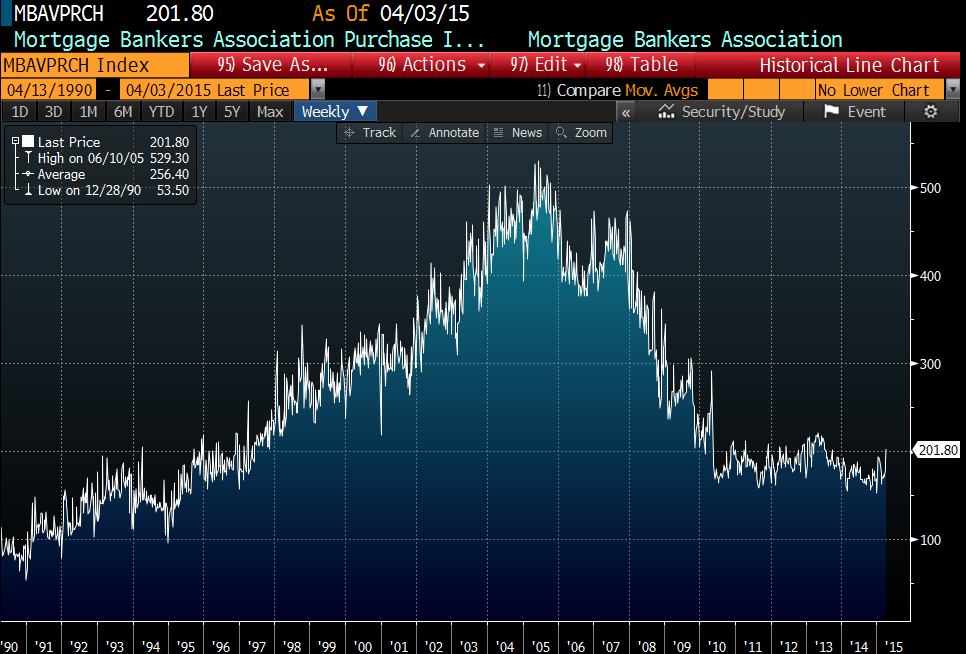
Mortgage Applications increased .4% last week, which is impressive because it was a short week. Purchases were up 6.8% while refis were down 3.3%. Purchases are the highest they have been since early 2013, which bodes well for the spring selling season. That said, we are still way below normalcy, and you would have to go back to 1997 to see similar levels pre-bubble.

Morning Report – The low end of the housing market is outperforming 4/7/25

Markets are flattish this morning on no real news. Bonds and MBS are down small.

The ISM Services index slipped to 56.5 in March, while job openings hit their highest yet at 5.1 million.

It looks like the big bond rally on the weak jobs report was overdone. That said, there is no denying it was a lousy report, with payrolls coming in at 126k versus 245k expected, and the labor force participation rate falling back to its post-disco lows of 62.7%. About the only bright spot was the increase in wages. Can’t blame this jobs report on the weather, although we may be starting to feel the effects of the stronger dollar.

Tomorrow, we will get the minutes from the FOMC meeting last month. The focus will be on the thinking behind the removal of the word “patient.” Given the weakness in the economic data lately, the Fed may choose to make its first move in September.

We are starting to see the low end of the housing market outperform the high end, according to CoreLogic. Prices rose 5.6% in February and remain about 12% below the peak. House prices at the lower price points increased over 9%, while the high end increased about 5%. CoreLogic says this is the hottest price appreciation prior to the Spring Selling Season in 9 years. They are forecasting another 5% increase in prices this year.

OPEN THREAD 4/6/15

Wiscy has a 53% chance against the Dukies, according to Nate Silver.

Doesn’t mean any single game would be close, of course, and Duke beat Wiscy by ten or twelve early in the year (I forget the exact score).


The Economist explains the outlined Iran deal here:

http://tinyurl.com/lu9sbbx


Latest Alzheimers research news is here:

http://tinyurl.com/l9ojy7t


NoVA, did you know that you can watch NHL games on your computer at CBC.com?


I am going off the cable at the end of the month.  Going to use Roku with some subscription services.  Has anyone here already cut the cord to ATT, ComCast, Cox, TWC, Dish, DirecTV?  Tell, please.


Morning Report – ADP Employment misses 4/1/15

Stocks are lower this morning after the ADP jobs data came in light. Bonds and MBS are up.

Construction spending fell by .1% in February and January was revised down by 1.7%. Residential construction continues to lag the economy, however office construction is picking up. Surprising since vacancy rates are still somewhat elevated.

The ISM Manufacturing Index fell to 51.5 in March, showing some of the slowdown is not simply weather-related.

Payrolls increased by 189k in March, according to ADP. The Street is currently predicting that Friday’s jobs report will show an increase of 245k. Note that the government will be open on Good Friday however the stock markets will be closed and bonds will have an early close. We could see some volatility in bonds if the payroll data is unusually weak or wage inflation in unusually high.

It looks like the dumb money is piling into the Chinese stock market, and much of it is leveraged. This was after the government started telling people that stocks were cheap. The government already has problems with an over-built real estate market and is pulling policy levers to support prices. Historically governments have never been able to manage the deflation of asset prices in an orderly manner, and it is unlikely the Chinese government will be able to either. Their banking system is already on shaky ground. What that means for the US is unclear. We should see Chinese money exit the luxury real estate market in the US, but what happens to Treasuries is anyone’s guess.

Student loan debt is a big problem for the first time homebuyer, as everyone knows. At the same time, there is a movement to begin debt strikes, where students refuse to pay back their loans. At the moment, it is limited to the failing private for-profit universities, however if this gains traction, it could spread. The left, led by Elizabeth Warren, has been egging this on a bit, but they are playing with fire. The government backs these loans and will have to eat the losses if this movement grows.

Morning Report – More bond market volatility ahead? 3/31/15

Markets are lower on no real news. Bonds and MBS are up.

Home Prices rose .87% month-over-month and 4.56% year-over-year according to Case-Shiller. This is January data. The West and Southwest continues to outperform the Midwest and Northeast. A measure of housing market “healthiness” indicates the housing market is in the best shape since 2001.

It looks like we are close to an agreement to extend talks with Iran for 90 days and to outline the big steps needed to get a deal. The main sticking points seem to revolve around the actual mechanics of lifting the sanctions. The main thing to keep in mind is that one way or another, the sanctions will probably be lifted and a big new oil producer will begin dumping crude on world markets.

As we get closer to “liftoff,” which is Fed-speak for increasing interest rates, market professionals are worried about the possibility of more volatility in the bond markets. They point to one trading day in October, where the 10 year bond yield traded in a 40 basis point range intraday. A combination of automated trading and the unintended consequences of regulation have hampered liquidity in Treasury markets during periods of volatility.

Speaking of bond market volatility, the government will release the jobs report on Friday as scheduled, however the stock market will be closed and SIFMA is recommending a noon close in bonds. Suffice it to say that trading desks will be thinly staffed and we could see some volatility in rates. I don’t anticipate much of a reaction in the bond market unless payrolls fall off a cliff or we see a big uptick in wages.

Morning Report – Ben Bernanke has a blog 3/30/15

Markets are higher this morning on overseas strength. Bonds and MBS are up small.

Personal Income came in at .4%, higher than the Street estimate. Personal Spending however disappointed. The PCE Core rate (the inflation rate preferred by the Fed) came in at 1.4%, lower than the Fed’s 2% target.

Pending Home Sales rose 3.1% in February, higher than the estimate. The Northeast was affected by the weather, but the Midwest jumped. February is a short month and during the seasonal slow period, so it is hard to read too much into these numbers.

Beard has a blog. Supposedly he will dish on his critics and go after the “audit the Fed” crowd. It might be interesting as a “Talking Points Memo” on monetary policy, where surrogates argue with critics, leaving the official participants out of it.

Morning Report – Q4 GDP disappoints 3/27/15

Markets are lower this morning after the final revision to fourth quarter GDP came in lower than expected. Bonds and MBS are up.

The final revision to fourth quarter GDP came in at 2.2%, flat with the second revision and below the 2.4% street estimate. Personal Consumption was revised upward to 4.4% from 4.2%. The core Personal Consumption Expenditures Index (the preferred measure of inflation for the Fed) came in at 1.1%, well below their 2% target.

The University of Michigan Consumer Sentiment index rose to 93 in March.

At 1:30 Janet Yellen will be speaking in San Francisco about monetary policy. She probably won’t say anything market-moving, but just be aware.

Senate Minority Leader Harry Reid is retiring. NY Senator Chuck Schumer is the favorite to replace him. NV will almost undoubtedly swing Republican. Schumer is generally financial sector friendly, so that should help the business, for what it is worth. Democrats are worrying about 2016 and the fact that their war on Wall Street means banks are pulling back campaign contributions. Also, affordable housing advocates are getting sick and tired of tight credit.

Reinhart and Rogoff have another paper about high levels of government debt. It looks at how governments have handled these situations over the past two centuries. Governments will need to be creative in dealing with it, and the solutions will probably involve confiscatory taxes, default, and inflation.

Morning Report – No we are not in another housing bubble 3/26/15

Stocks are lower worldwide as the Saudis bomb Shiite rebels in Yemen and the semiconductor sector gets taken tot the woodshed. Bonds and MBS are down. The bombing in Yemen is putting a bid under oil.

In economic data this morning, initial jobless claims fell to 282,000 last week from 291,000. This is the lowest reading in 5 weeks. The Markit US Composite PMI rose to 58.5 in March, while the US Services PMI rose to 58.6. Bloomberg Consumer Comfort rose to 45.5 last week.

It is looking like the Germanwings crash was a deliberate act. Note that the new security measures designed to keep bad guys out of the cockpit can also keep the good guys out if the bad guy is already inside.

Senator Richard Shelby suggests that GSE reform probably isn’t happening this year. And since the following year is an election year, you can probably forget about anything happening until 2016 at the earliest.

In the “what passes for analysis” category, CNN wonders if we are in another bubble. Why? Because the Homebuilder ETF (XHB) is back at 2007 levels. Setting aside the idea that ETF valuations can somehow predict where real estate prices go, bubbles require a mindset on the part of buyers and bankers that the asset in question is “special” and cannot fall in value. We will never see another housing bubble in the US, but our grandkids may at some point.

Ara Hovnanian weighs in on the housing market and the state of the first time homebuyer.

Morning Report – Rising Rents are pushing Millennials to buy 3/25/15

Markets are flat this morning on no major news. Bonds and MBS are flat as well.

Mortgage Applications rose 9.5% last week as purchases rose 4.9% and refis rose 12.3%. Refis were 60.5% of all applications last week.

Durable Goods orders fell 1.4% in February. Cap Goods Orders Non-Defense / Ex-air (a proxy for business capital investment) fell 1.4%, while January was revised downward from .6% to -.1%. Corporate America is not increasing capacity at all, and is not pursuing expansion opportunities.

What do companies with cash burning a hole in their pockets do when there are no great expansion opportunities out there? Buy each other. In a bit of a complicated deal, Heinz is buying Kraft. As oil stays down here, I expect to see some deals in the energy patch. The last time oil was this low (aside from the financial crisis days) we saw some huge deals:  Exxon buying Mobil, Conoco buying Philips, and BP buying Amoco.

Rents are rising so fast that they are forcing Millennials to buy houses. In fact, Millennials are now a bigger homebuying cohort than Generation X. Student loan debt remains the biggest hurdle, however. As the economy recovers, a lot of pent-up demand is going to be unleashed. We have gone from a glut of housing to an extreme shortage, which means the builders are going to have to bump up production. The economy is already reasonably strong with only 1.1 million housing starts. If we get back to normalcy (1.5 million), that will provide a big boost. Plus construction employs a lot of people.