Morning Report: Greferendum No 7/6/15

Stocks are down after Greece voted down further austerity. Bonds and MBS are up.

The jobs report last Thursday was okay for the most part. The labor force participation rate hit a new low, however.

The ISM Non-Manufacturing Index came in a little light, but was generally strong. Business Activity accelerated, however that was offset by weakening employment growth. Employment activity in the services sector has been decelerating for months.

The week after the jobs report is usually pretty data-light and this week is no exception. The highlight will be the FOMC minutes on Wednesday.

The immediate fallout of the crisis should be bond (and MBS) bullish. US stocks are down in sympathy with global markets, but there should be almost no exposure here. The ECB will probably take additional measures to boost markets via QE, so that should be stock and bond bullish here.

On to the next crisis, which is the bursting of the Chinese stock and real estate bubbles. China’s government is pulling out all the stops trying to support stock prices (the invisible hand meets the iron fist). In many ways it it reminiscent of the Japanese government in the 1990s, where they tried to artificially support markets through “price keeping operations.” Of course these measures inevitably prevent necessary adjustments from occurring, which is why Japan has stayed in economic stagnation for over a generation.

The Chinese situation has more potential to affect US markets than Greece. Chinese money is behind a lot of the price appreciation in the cities, especially at the high end. Whether it stays or goes will be dependent on what the Chinese government wants.

The long, slow death of a Republic 7/4/15

Three years ago I contributed several pieces to a 4th of July series here at ATiM celebrating American independence. I had hoped they would provide some sense of the way I feel about the birth of America, and perhaps spark those feelings in others, especially about the Founding Fathers who made that birth not only possible at all but an actual reality. Usually when I contemplate the birth of the US on Independence Day, I am genuinely filled with a mixture of gratitude, responsibility, and pride. Gratitude to both the people who risked, and sometimes gave, their lives to make it all happen, and to Providence (to use the lingo of the Founders) for landing me in this, a singular nation with an identity grounded not just in history but in unique philosophical ideals. Responsibility to help protect the legacy that has been given to us. And pride in knowing just what it is that has made this a nation of such promise. This year, however, I feel quite different.

When Ben Franklin left Independence Hall at the end of the Constitutional Convention in 1787, he was asked by a woman outside “Well, Doctor, what have we got? A monarchy or a republic?” Franklin replied “A republic. If you can keep it.” The implication of Franklin’s response was prophetic.

A republic is defined as “a state or nation in which the supreme power rests in all the citizens entitled to vote and is exercised by representatives elected, directly or indirectly, by them and responsible to them.” And it is certainly true that we retain the forms, the institutional manifestations, of the Republic that Franklin and his fellow delegates created. We still have a legislative branch comprised of two elected houses of congress. We still have an executive branch headed by an elected president. We still have a judicial branch headed by a Supreme Court comprised of 9 judges, appointed by the president and approved by congress. We still have the several states, with their own constitutions and forms of government. But we no longer operate under true republican rule, nor are the people any longer committed to protecting against the things that the structure of our government was supposed to protect against. Hence while we retain the forms of a republic, we have forfeited the substance of what it means to be a republic, and have become a nation of the ruled.

In 1887 congress, in its infinite wisdom, decided to create the Interstate Commerce Commission, the first regulatory agency in the nation. Nearly 130 years later we now have countless federal agencies. And I mean literally countless. Any attempt to identify exactly how many federal agencies now exist proves fruitless. Some lists will be qualified as “major” regulatory agencies, so as to be able to provide a definitive list. (14 regulatory agencies on that one.) Others, such as Wikipedia, settle for providing “examples” (28 of them) of “independent” agencies – not to be confused with independent regulatory agencies, it reminds us – a comprehensive list, apparently, being impossible to provide. A totally different Wikipedia entry on federal agencies explains the problem:

Legislative definitions of a federal agency are varied, and even contradictory, and the official United States Government Manual offers no definition. While the Administrative Procedure Act definition of “agency” applies to most executive branch agencies, Congress may define an agency however it chooses in enabling legislation, and subsequent litigation, often involving the Freedom of Information Act and the Government in the Sunshine Act, further cloud attempts to enumerate a list of agencies.

And these agencies, however many there actually are, are not populated with elected representatives. They are comprised of both career bureaucrats and political appointees. They are not us.

It is certainly the case that many of these agencies don’t really exercise any real power. For example the US Women’s Bureau, enabled by Public Law 66-259; 29 U.S.C. 11-16.29, doesn’t seem to do much of anything noteworthy except provide a living for its employees. But many others exercise nearly unchecked power to make laws which are never voted on by congress. The people, us, have virtually no say over these laws. The administrative state rules us. We do not rule it.

Defenders of the administrative state will say that is bunk. They will say that we have authorized these agencies through congress, and that they are merely enforcing laws that congress has written. They will also say that the agencies are not making law, but rather establishing “rules” that define their enforcement policies. That is indeed how the administrative state justifies its existence under a constitution that neither contemplates nor authorizes the existence of a law-making bureaucracy. But reality on the ground shows that it is that justification that is bunk.

An example. The Environmental Protection Agency is right now promulgating “rules” regulating carbon dioxide emissions. It does so ostensibly under the authority of the Clean Air Act which requires regulation of “air pollutants”. The Clean Air Act was written and passed in 1963. For over 40 years no one, not the original authors of the act, not any subsequent congress, not “the people”, not even the EPA itself thought of carbon dioxide as an “air pollutant”. Which is not a surprise at all. Pollution is defined as “the introduction of contaminants into the natural environment that cause adverse change.” But carbon dioxide is a naturally occurring gas the presence of which is vital to life on earth. It is naturally produced by all living beings that have lungs, through the simple act of breathing. It is absorbed by plants during photosynthesis. It is, again, essential to the existence of life on earth.

But due to the rise of “climate change” alarmism, carbon dioxide has now been classified by he EPA as an “air pollutant”. There was no vote. No congressional law. No popular referendum. In fact it wasn’t even the EPA itself that originally designated it as a air pollutant under its authority. It was sued by 11 states which claimed the the Clean Air Act required the EPA to regulate carbon emissions, and despite losing in the lower courts, by a 5-4 vote the Supreme Court ruled in favor of the plaintiffs, forcing the EPA into regulation. Of course, under a new administration that promotes climate alarmism, the EPA has embraced its newfound ability to write legislation regulating carbon. But it is perfectly clear that it is, in fact, writing legislation, not simply enforcing existing law. President Obama essentially ended any pretense to the contrary when he demanded that congress either pass carbon related climate change legislation or face the threat of him doing it unilaterally via the EPA. Which he has now done. One doesn’t ask for new legislation to enforce if one thinks that it already exists and needs to be enforced. The notion that Obama is just enforcing existing law is an obvious ruse.

That is just one particularly infamous example, but this is how the administrative state routinely operates, on big issues and small, constantly writing and re-writing the “rules” to impose whatever desires it currently might have, regardless of whether or not the law itself has changed, and often precisely because the law hasn’t been changed. There are so many regulatory actions that it is impossible for the average citizen to have any idea what his government is doing. The Federal Register publishes between 2,500 and 4,500 new “rules” every single year. The effects of these regulations, laws really, permeates every area of American life. There is not an industry in existence that is left untouched by the federal bureaucracy. Even the most basic and simple of our daily actions are governed by regulatory “rules”.

In Federalist 62 James Madison wrote:

It will be of little avail to the people that the laws are made by men of their own choice if the laws be so voluminous that they cannot be read, or so incoherent that they cannot be understood.

The federal bureaucracy fails on both fronts. Not only is it making laws so voluminous and incoherent that they cannot be read or understood (or even known, to be honest) by the people, but they aren’t even made by men of their own choice. It would be easy to blame this on the institutions of government itself, and certainly there is blame to be laid there. Presidents have routinely expanded executive power through the creative use of the federal bureaucracy. Congress could stop it if wanted to by simply passing laws eliminating the agencies, but instead it does the opposite, not only creating more agencies but writing deliberately vague legislation that invites regulatory agencies to fill in the blanks with its own will. And the Supreme Court has long since ceased apply the law or constitution, choosing instead to rule based on political preferences.

But the real fault lies in we the people. It was the people that elected Franklin Roosevelt 4 times despite his expansive and unconstitutional use and abuse of the federal regulatory bureaucracy to do things that congress would not do. It is the people that elected Barack Obama twice, despite his open contempt for congress’ role as the voice of the people, proclaiming “We’re not just going to be waiting for legislation in order to make sure that we’re providing Americans the kind of help they need. I’ve got a pen and I’ve got a phone.” It is the people that elected a congress that thinks that knowing what is in legislation is what comes after having passed it. Franklin’s cynicism about the people was well founded. He gave us a Republic and we have frittered it away.

On this Fourth of July, our Independence Day, it might be useful to read through the Declaration of Independence, and remember what its purpose was. It was not merely a declaration of America’s independence from Britain, but it was also a justification for the Declaration itself. While the first few lines are the most remembered from grade school civics lessons, the body of the document is comprised largely of a list of transgressions that King George III was said to have rained down upon the colonists, compelling them to revolt. It is worth noting one of them in particular.

He has erected a multitude of New Offices, and sent hither swarms of Officers to harrass our people, and eat out their substance.

A better description of the modern regulatory state has never been written. It is high time we took Jefferson’s lead and declare our independence from it.

Continental Congress Votes for Independence 7/2/15

On this day in 1776, the Second Continental Congress, assembled in Philadelphia, formally adopts Richard Henry Lee’s resolution for independence from Great Britain. The vote is unanimous, with only New York abstaining.

The resolution had originally been presented to Congress on June 7, but it soon became clear that New York, New Jersey, Pennsylvania, Delaware, Maryland and South Carolina were as yet unwilling to declare independence, though they would likely be ready to vote in favor of a break with England in due course. Thus, Congress agreed to delay the vote on Lee’s Resolution until July 1. In the intervening period, Congress appointed a committee to draft a formal declaration of independence. Its members were John Adams of Massachusetts, Benjamin Franklin of Pennsylvania, Roger Sherman of Connecticut, Robert R. Livingston of New York and Thomas Jefferson of Virginia. Thomas Jefferson, well-known to be the best writer of the group, was selected to be the primary author of the document, which was presented to Congress for review on June 28, 1776.

On July 1, 1776, debate on the Lee Resolution resumed as planned, with a majority of the delegates favoring the resolution. Congress thought it of the utmost importance that independence be unanimously proclaimed. To ensure this, they delayed the final vote until July 2, when 12 colonial delegations voted in favor of it, with the New York delegates abstaining, unsure of how their constituents would wish them to vote. John Adams wrote that July 2 would be celebrated as the most memorable event in the history of America. Instead, the day has been largely forgotten in favor of July 4, when Jefferson’s edited Declaration of Independence was adopted.

Hancock’s words have been added as the quotation of the day.

Morning Report: Greece officially defaults 7/1/15

Stocks are up smartly this morning on stronger economic data and the prospect of a solution in Greece. Bonds and MBS are down.

Mortgage Applications fell 4.7% last week as interest rates spiked on the strong personal spending data. Purchase applications fell 4.1% while refis dropped 5.2%. The average 30 year fixed rate mortgage rose to 4.26%.

The ADP employment survey reported that 237k jobs were created in June, higher than the 218k forecast. The Street is forecasting a rise of 230k for the jobs report tomorrow. Challenger job cuts rose to 44k.

Fed St. Louis President James Bullard spoke last night and said the Fed should consider raising rates at the Sep meeting given the strength of the latest economic data.

Vehicle sales will be coming in all day. Early returns are disappointing.

Construction spending rose .8% in May, beating the .5% estimate. Residential construction rose .3%.

The ISM Manufacturing Index rose in June from 52.8 to 53.5. A reading over 50 indicates expansion. This is good news as the decline in oil prices had depressed activity in the oil patch. New orders and employment drove the increase. The 53.5 reading would typically correspond to a GDP growth rate of 3.3%.

Last night, Greece became the first advanced economy to officially default on an IMF loan. Most Greek banks are out of money, and pensioners who are used to getting 600 euros for the month are being given less than a quarter of that – about 120 euros. ATM deposits are being limited to 60 euros a day. The first snap poll of Greek citizens has pretty convincingly rejected the EU’s offer – 53% “no”, 33% yes.

Greece has told Europe that the latest offer comprises the basis of a compromise. The Europeans are going to wait until the results of the referendum are out on July 5. If the voters say “no” to the European demands, Greece will have no other option than to print its own currency to pay workers and pensioners. IMO, a Greek exit will be bond bullish, as it will probably force a policy response out of the ECB and that means more QE.

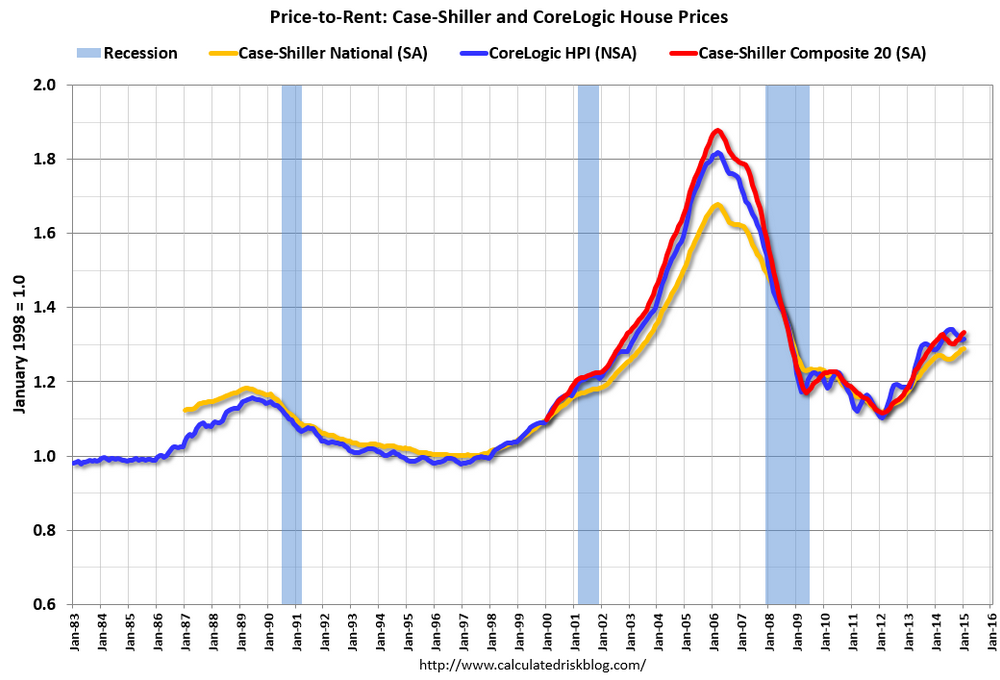
While home prices still remain affordable compared to the bubble years, low inventory has pushed up the price / rent ratio. We are back to late 2003 levels. On a nominal (in other words, non-inflation adjusted basis), prices are approaching peak levels, but on an inflation adjusted basis, they still have a ways to go. Of course wage inflation remains muted, so that will act as a drag on home price appreciation, or at least affordability.

The latest CoreLogic Market Pulse is out, and it has some good stuff on the state of the housing economy. They discuss the most overvalued housing markets, and find 4 are in Texas. Not sure how their index works, but there you go. The other ones are Washington DC (duh), Miami FL (huh?) and Charleston SC (huh?). Overall, prices nationwide appear reasonable and sustainable, with many localities still recovering from the collapse.

Morning Report – Home price appreciation is decelerating 6/30/15

Markets are higher this morning after the Chinese stock market posted an impressive turn-around and rallied 5.5% overnight on hopes the government would do more to support stock prices. Bonds and MBS are down.

Greece’s bailout expires tonight, and they are preparing for life post-bailout. The government has scheduled a referendum for 7/5 to accept or reject the austerity. Mohammed El-Arian lays out the path forward.

After the Greek situation gets resolved, attention will turn to the melt-down in China. Chinese stocks entered bear market territory (notwithstanding yesterday’s humongous rally) and a lot of this rally is being supported by dumb money – margined retail money. People are looking to the government to do something to support the markets, and it feels a lot like the Japanese market did in the 90s, where the Ministry of Finance would call the banks during the lunch break and basically tell them to tear up their sell tickets for the day.

House prices increased 4.9% year over year in April, according to Case-Shiller. Home price appreciation is decelerating as wages fail to keep up with house prices.

Consumer confidence rose to 101.4 in June, according to the University of Michigan.

Obama just increased the cost of labor by demanding that anyone who earns just less than $1,000 a week be eligible for overtime, whether they are managerial or not. The new rules will take effect in 2016. IMO, this will only accelerate the replacement of technology for labor and the Uber-ization of the economy, but I suspect Obama isn’t thinking about that. He is focused on whipping up the base, which is lukewarm with Hillary. With employment costs already soaring from regulatory mandates, I don’t see how this helps overall employment levels. I suspect this is a variation of the French mentality that limiting hours will somehow encourage more hiring. It never ceases to amaze me that the left is completely comfortable with the concept of raising the price of gasoline and cigarettes via excise taxes in order discourage consumption, but yet they somehow imagine the laws of supply and demand are suspended in the labor markets.

Morning Report: Grexit Imminent? 6/29/15

Stocks are down worldwide as Greece imposed capital controls and China enters a bear market. Bonds and MBS are up.

We have a short week coming up, with markets closed on Friday for the 4th of July. The jobs report has been moved up to Thursday. Liquidity could be lighter than normal this week as traders head to the Hamptons for a long weekend.

Greece and their creditors are at an impasse, with the Greek government scheduled a vote to determine whether to accept the creditor demands. The European Central Bank froze their Emergency Liquidity program at the same level as last week, making the Greek banks more or less insolvent. ATMs are out of money and the banks will be closed for the next six days. If they cannot get a deal with creditors, Greece will have to start printing money in order to keep the banks solvent, which would pave the way for their exit from the Euro.

While the Greek economy is only about 2% of the Eurozone (in reality, about the size of Milan or Dusseldorf) their exit will probably be bond bullish. Why? In order to support European banks which hold Greek sovereign debt, the ECB will probably announce further measures to support the banking system, and that means more QE. This will cause the Bund to rally, and relative value trading will pull the US 10 year along for the ride.

ICYMI: Puerto Rico can’t pay their debts, either.

TBAs got clobbered last week, with the Fannie TBA and the Ginnie TBA losing well over a point. This sent mortgage rates up. It may have been an overreaction to the strong personal spending data we got on Thursday, or fears of volatility over the Greek situation, but it is something to keep an eye on.

Pending Home Sales rose .9% in May, which is the highest level in over 9 years. Home Price Appreciation continues to rise about 4 times wage growth, which is an issue.

The Supreme Court ruled that the CFPB could use the “disparate impact” theory in housing discrimination cases. This was unexpected. It no longer matters whether a lender intended to discriminate, all that matters is the numbers. While the Court tried to explain that this doesn’t mean lenders just got quotas, for all intents and purposes, they just did.

My Big Jewish Lesbian Vegan Wedding 6/26/15

JLVWedding-4

Last weekend I was fortunate enough to be invited to the wedding of a childhood friend of my son. She was marrying a woman she had met in college during a course in Feminist Theory and Criticism. They became loser while sitting on the campus safety awareness committee. After some long distance relationshipping, they started dating and moved in with each other about a year ago. I have been looking forward to this wedding for months ever since we got the “save the date” announcement.

It was a milestone for me in JLVWedding-3that I had never been to a Jewish wedding and had always wanted to go to one. Bride A (as I will call her) was Jewish and a woman of deep faith. She is now in rabbinical school. Bride B, my son’s friend, converted to Judaism for her despite being raised lightly pagan. It was NOT a coincidence that the wedding took place on the summer solstice. There was even a solstice altar set up just outside the ceremony area to honor that part of her heritage.

Bride A was dressed in a homemade ivory linen dress with pink flowers in her hair to match her cateye vintage style glasses. Bride B wore gray slacks with a matching vest over a light blue shirt and pink tie. Over her shortly cropped hair she wore a large leaf reminiscent of a yarmulka. The male members of wedding party (the entire wedding party was described as Friends of Honor as oppose to the more common groomsman/bridesmaid designations) had full beards and wore suspenders making them look like hipster artisanal pickle merchants. Even the band had a certain turn of the century look. In some respects the whole event had the vibe of a community theater production of Yentl.

The wedding program included lots of little notes on the elements and traditions of a Judaic wedding which were very helpful. I could

tell that some portions of the ceremony were being altered to accommodate the fact that two women were being married rather than a man and a woman. There was prayer after prayer in both Yiddish and English. There were two large artistically rendered marriage contracts which included their vows. There was a lot of laughing with a touch of tears.

The ceremJLVWedding-2ony was outdoors in a small park with a gorgeous old stone building on the grounds but except for the food service line, all the events were outdoors or underneath a tent. Predicted thunderstorms never arrived and weather stayed clear if June hot. Restroom facilities were two single occupancy bathrooms in the building which, as the program declared, had been “liberated from the gender binary.”

The guests were the usual mix of older relatives, mostly from Bride B’s side since the ceremony was in her hometown, and college friends of the brides. They were dressed in a variety of styles ranging from traditional to formal to casual. One person had both a beard and a dress and I told my wife I’d be disappointed if there hadn’t been.JLVWedding-6

As with all weddings, the reception is where the heavy partying began. Fortunately beer and wine are vegan and were available in abundance. In addition to red and white wine there were two brands of craft brews and PBR available. This gave my son, a professional brewer, a great opportunity for conversational gambits with the guests his age.

The food, as I feared, was the greatest disappointment. In anticipation, I had taken my family out for a Father’s Day barbecue lunch just in case I wasn’t going to get a full meal. The hors d’oeuvres were tasty but disappeared quickly. I was not quick enough to get the tofu spring rolls but the corn fritters and the potato knishes were delish. The main dishes were bland and, as the joke goes, the portions were small too. The best dish was some parpadelle with basil, spinach, artichoke and zucchini. The wild mushroom and tarragon seitan (whatever that is) was also fairly tasty. But overall, I thought a family of vegetarians could have found a more adventurous caterer.

For the wedding reception the band quickly ran through a whirlwind of the presumably standard traditions including ring dances and chair dances and jumping rope. It was all a bit confusing to me but the largely Jewish guest roster seemed to go at them with great gusto.

JLVWedding-5

As with most weddings, the toasts from the fathers were very touching. The father of Bride A was delighted to be gaining a future lawyer as a family member and made a plea that Bride B give corporate mergers a chance for decade or so before going into public advocacy. Father B waxed nostalgic over the childhood memories of teaching Bride B which sports teams to follow and why. (I was told that her vest was lined with silk fabric covered in Orioles logos.) The deepest divisions amongst the families and guest were opposing loyalties to Red Sox, Yankees, or Orioles, although I suspect plenty of Phillies fans were in the crowd as well.

I’ve been to a wide variety of weddings but this one was definitely one of the most festive I have ever been to. It was a day full of prayers. And food. And dancing.

And love.


Morning Report – A generation of renters? 6/24/15

Markets are lower after Greek Prime Minister Tsipras expressed shock that his proposals still do not go far enough to get a deal. Bonds and MBS are up.

Mortgage Applications rose 1.6% last week as purchases rose 1.2% and refis rose 1.8%.

The third revision to first quarter GDP came in at -0.2%. This is an upward revision from the previous -0.7% estimate. A combination of harsh weather, a West Coast port strike, and a slowdown in the oil patch depressed growth. Lower gas prices still are not translating into higher spending at the malls, however. Consumers continue to save / repay debt.

Greece was handed new terms for a bailout. The proposals Tspiras provided do not go far enough, and he took to Twitter to harangue the IMF and the EU. Brave new world: negotiating and posturing via Twitter. “There is still a lot of work to do,” Dutch Finance Minister Jeroen Dijsselbloem, who chairs meetings of his euro-area counterparts, told reporters in Brussels. “We are not there yet.”

Homeownership levels have fallen back to the levels of the early 90s. Millennials are renting in droves. Is this the new face of homownership, or simply the pendulum overcorrecting on the other side? While house prices are back in bubblicious territory (primarily due to a lack of inventory), rates are so low that mortgage payments are still comparable to rents.

Speaking of lack of inventory, homebuilding giant Lennar reported earnings this morning, beating the Street. Revenues increased 30% as deliveries increased 21% and ASPs increased to $348,000. New orders increased 18% in units as well. The stock is up about 5% pre-open. Could housing be the new engine for the economy? Hopefully, as manufacturing seems to be going through a soft patch.

Washington is alleging discrimination in REO, saying that homes in low-income neighborhoods are not being properly maintained. The problem in many of these place, especially in the rust belt, is that the opportunities are so sparse that people are moving out, and no one is moving in. When you have a net outflow of people and an endless supply of vacant houses, these properties become basically worthless. And what bank wants to throw good money after bad maintaining a house that probably will never sell in the first place?

Morning Report: New Home Sales highest in 7 years 6/23/15

Stocks are higher this morning on optimism for a Greek deal. Bonds and MBS are down.

New home sales rose 546k in May, higher than the 523k expectation and the upward-revised 534k April number. We will hear from homebuilding giant Lennar tomorrow. This is the highest number in 7 years, which will hopefully alleviate the problem of low inventory.

Durable Goods Orders fell 1.8% in May. April was revised downward from -0.5% to -1.5%. Capital Goods Orders ex defense and air (which is a proxy for business capital expenditures) rose 0.4% in May after falling a revised 0.3% in April. The low CAPEX numbers were largely driven by the decline in oil prices, which appear to have stabilized.

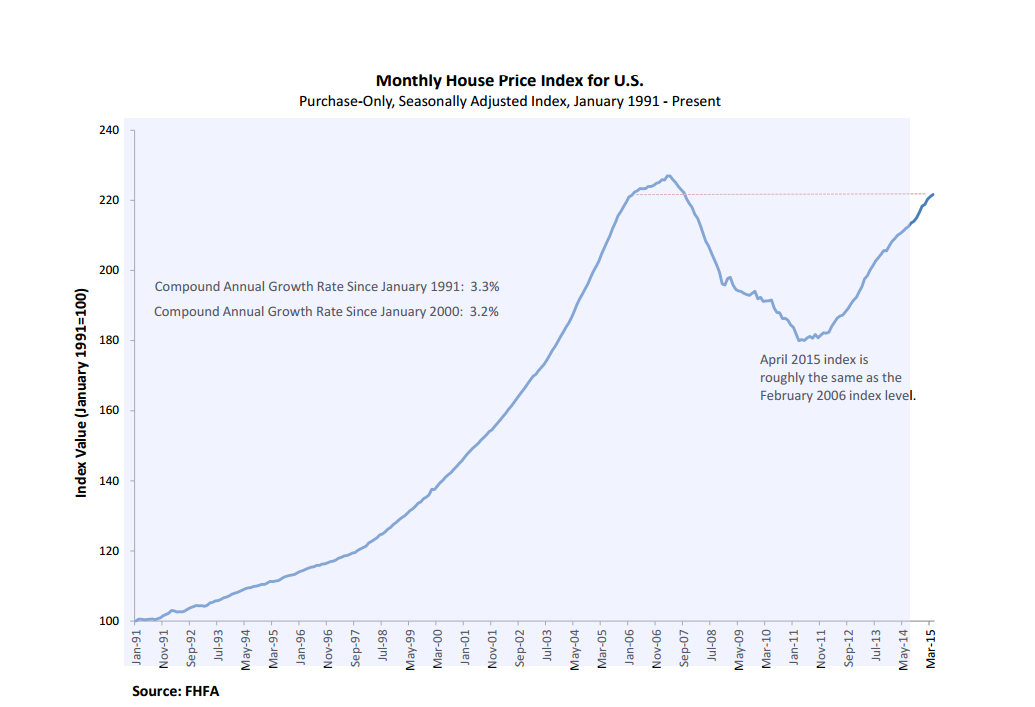
Home Prices rose 0.3% in April, according to the FHFA. The index is now roughly 2.3% below its March 2007 peak and corresponds to Feb 2006 prices. Note the FHFA index is narrower than the other indices like Case-Shiller in that it only looks at homes with a conforming mortgage. As usual, the West coast did the best, while the Northeast lagged.

Tspiras surrenders. That is the headline in Bloomberg regarding the Greek situation. Greece has more or less offered to meet the demands of their creditors. The glass of ouzo is close to being full.

Morning Report – Existing Home Sales rise 6/22/15

Markets are higher this morning after the Greek government offered a new proposal to end the standoff. Bonds and MBS are down

The Chicago Fed National Activity Index improved slightly in May to -.17. The 3 month moving average was also negative, which means the economy is growing a little below trend. Production and Consumption were negative, while employment was positive.

Merger mania in the health insurance space: Cigna rejected an offer from Anthem, and Aetna supposedly approached Humana. Insurers are looking to cut costs.

Existing Home Sales improved 5.1% to 5.35 million in May, according to the NAR. This is the highest since May 2009.  The first time homebuyer accounted for 32% of sales, up from 30% in April, but still below its historical average of about 40%. All cash transactions were flat at 24%, while days on market ticked up slightly to 40 days. The median price of a home rose 7.9% to $228,700. This puts the median home price to median income ratio at 4.3x, which is again stretched and well outside the historical norm of 3.2x – 3.6x.

In political news, the Supreme Court is supposed to rule on King vs Burwell, the case which decides whether states that did not set up exchanges are eligible for federal subsidies. This will dominate the news headlines in Washington if the Court decides the language in the law needs to be changed.