Morning Report: Lennar beats expectations 12/19/16

Vital Statistics:

Last Change
S&P Futures 2256.8 1.5
Eurostoxx Index 359.6 -0.4
Oil (WTI) 51.7 -0.2
US dollar index 93.2 0.1
10 Year Govt Bond Yield 2.55%
Current Coupon Fannie Mae TBA 103
Current Coupon Ginnie Mae TBA 104
30 Year Fixed Rate Mortgage 4.29

Stocks are up this morning on no real news. Bonds and MBS are up as well.

Not much in the way of economic data this morning, however Janet Yellen speaks at 1:30pm EST.

The flash services PMI fell slightly to 43.5.

Today the Electoral College votes for President. The vote will then go to Congress to be certified in early January.

Homebuilder Lennar reported earnings this morning, with revenues up 15%, new orders up 12%, and backlog up 17%. Average selling prices rose only 2.9% to $357k, which indicates that home price appreciation is slowing. The press release didn’t address the cancellation rate, which will probably begin to grow for the builders as higher rates kick in. Lennar has a November 30 fiscal year, so it is probably a little early to see how higher rates are affecting them.

Lenders foresee a drop in margins and demand going forward as rates rise, according to the Fannie Mae Quarterly Lender Survey.  Fully 2/3 of lenders view rates as “not favorable” at the moment. Lenders expect margin compression as well as refi shops cut prices to stay competitive. Lenders do expect to continue to ease lending standards. Lenders also intend to execute more through the GSEs and the government and plan to reduce the number of loans they hold on their balance sheet.

CoreLogic put out its forecasts for 2017. Home price appreciation will slow into 2017 as higher mortgage rates and home prices take a bite out of demand. Credit quality will remain good, however and we will start to see more HELOC activity, while refis will decrease. Vacancy rates will remain low, and rental inflation will be around 3%.

Here is a look at the effects of rising rates for the mortgage lending sector.

Morning Report: Housing starts nosedive 12/16/16

Vital Statistics:

Last Change
S&P Futures 2262.0 3.5
Eurostoxx Index 359.6 0.8
Oil (WTI) 51.1 0.2
US dollar index 93.1 -0.1
10 Year Govt Bond Yield 2.58%
Current Coupon Fannie Mae TBA 103
Current Coupon Ginnie Mae TBA 104
30 Year Fixed Rate Mortgage 4.15

Stocks are up this morning on no real news. Bonds and MBS are flat.

Housing starts fell 19% in November to an annualized rate of 1.09 million, which was way below estimates. Both single family and multi-fam fell, but multi bore the brunt of it. This is 7% lower than a year ago. Building Permits came in at 1.2 million, which was also below forecasts. Housing starts can be volatile and I wouldn’t be surprised to see this number revised upward.

Despite the low housing starts number, homebuilder sentiment is at highs not seen since the bubble years. This increase was probably due to a post-election bounce, however builders remain cautious and starts are way below historical averages. Perhaps a change in the regulatory environment will change that. “This notable rise in builder sentiment is largely attributable to a post-election bounce, as builders are hopeful that President-elect Trump will follow through on his pledge to cut burdensome regulations that are harming small businesses and housing affordability,” said NAHB Chairman Ed Brady, a home builder and developer from Bloomington, Ill. “This is particularly important, given that a recent NAHB study shows that regulatory costs for home building have increased 29 percent in the past five years.”

Donald Trump is close to choosing Larry Kudlow for the role of Chief Economist. The focus for economic growth will move from trying to improve demand to trying to improve productivity. Kudlow is a veteran of the Reagan Administration and is a firm believer in supply side economics. He has been historically a very vocal free trader, but will have to soften that approach in this administration.

Morning Report: The Fed hikes, but the dot plot is the story 12/15/16

Vital Statistics:

Last Change
S&P Futures 2252.8 0.8
Eurostoxx Index 357.0 1.3
Oil (WTI) 50.1 -0.9
US dollar index 93.0 0.6
10 Year Govt Bond Yield 2.58%
Current Coupon Fannie Mae TBA 103
Current Coupon Ginnie Mae TBA 104
30 Year Fixed Rate Mortgage 4.14

Stocks are flat this morning after the FOMC meeting yesterday. Bonds and MBS are up small.

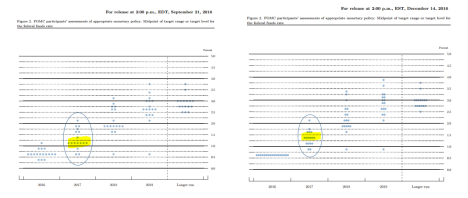
The Fed raised the Fed Funds rate a quarter of a point yesterday as expected, but the dot plot was what garnered all the attention. At the September meeting, the FOMC members were forecasting two more rate hikes in 2017, and now they are forecasting 3. That hit bonds, which sent the 2 year note yield up 12 basis points and the 10 year up 13 basis points. Overall, the language of the statement didn’t change much, and neither did the economic forecasts. Aside from a small uptick in their forecast for 2017 GDP growth, most everything else was the same. You can see the change in the central tendency for 2017 in the comparison of the dot plots below. September’s plot is on the right, and December is on the left. The yellow line represents the central tendency.

dot-plot-comparison-sep-vs-dec

Due to the volatility, most lenders shut down their lock desks, so mortgage rates didn’t really move all that much, but expect to see at least some movement, although mortgage rates tend to lag the moves in the 10 year, sometimes quite substantially. The last few tightening cycles have seen a flattening of the yield curve, so an anticipated increase of 75 basis points in the Fed funds rate doesn’t necessarily translate into a 75 basis point increase in the 10 year. Mortgage rates will almost undoubtedly increase by less than the increase in the 10 year. And if rates are going up for the right reasons (economic growth) that means the purchase business should offset some of the losses of the refi business.

Janet Yellen’s press conference was largely a non-event. She spent it dodging questions about how Donald Trump looks at the world and stressed the Fed will remain data-dependent. The issue of productivity kept coming up, and how Trump will use policies to improve on it (via regulatory reform and corporate tax cutting). Productivity growth should translate into non-inflationary wage growth, which is what everyone is hoping for.

Bottom line: The Fed is going to fade into the background again, and Donald Trump will be driving the news cycle and bond yields. If Congress adds fiscal stimulus, the Fed will probably be more aggressive. Note the dot plot is only a forecast. In fact, many of those dots represent forecasts for people who are not voting members on the FOMC. The Fed might hike 3 times in 2017, but the 10 year yield probably won’t go up as much, and mortgage rates will go up even less. 

Technical analysts are calling for the end of the secular bond bull market which began about 25 years ago.

Inflation at the consumer level increased 0.2% last month, and is up 1.7% YOY. The core rate (excluding food and energy) is up 0.2% MOM and 2.1% YOY. Healthcare and rent drove the increase.

We have some manufacturing data as well: Industrial production fell 0.4% MOM and manufacturing production fell 0.1%. Capacity Utilization was flat at 75%. The Philly Fed manufacturing index jumped to 22 from 10 and the Empire State Manufacturing Index improved to 9 from 6. Finally business inventories fell 0.2%.

Initial Jobless Claims fell 4k last week to 254,000. These are the lowest levels since the early 70s.

The median house price rose almost 8% in November, according to RedFin. According to their numbers, the median house price is 274k and months of inventory is 3.4 (meaning they see the inventory situation much tighter than NAR does in their existing home sales report).

Morning Report: FOMC day – what to watch 12/14/16

Vital Statistics:

Last Change
S&P Futures 2264.8 -3.0
Eurostoxx Index 345.1 -1.4
Oil (WTI) 52.2 -0.8
US dollar index 91.3 -0.1
10 Year Govt Bond Yield 2.44%
Current Coupon Fannie Mae TBA 103
Current Coupon Ginnie Mae TBA 104
30 Year Fixed Rate Mortgage 4.13

Markets are flat this morning as we await the FOMC decision at 2:00 pm EST. Bonds and MBS are up.

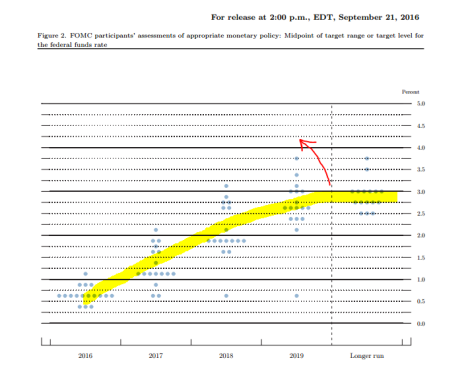
What to look for in the Fed statement: The biggest thing to watch will be the dot plot, which shows the forecasts that various members have for the Federal Funds rate. This is different than the 10 year, which determines mortgage rates. Market participants will compare the September 2016 dot plot with the December 2016 one and look for a shift in the general trend, either up or steepening.

Generally speaking the dot plots have been heading downward over the past several years as the Fed has been consistently high in its estimate for GDP growth. If the new dot plot is more aggressive (say it predicts 3 hikes for 2017, when before it was 2 hikes, then you could see a bond sell-off, which would send rates higher.

dot-plot-annotated

Janet Yellen will have a press conference at 2:30, and will probably do her best to dodge questions about Trump and his influence on the economy.

FWIW, the MBA believes the 10 year will stay below 3% and the mortgage rate will stay below 5% through 2018.

Retail Sales for November disappointed this morning, with the headline number up 0.1% and the core number (ex autos and gas) up 0.2%. November retail sales can be noisy, as more and more shoppers procrastinate. Still, this goes along with the weak Redbook same store sales number yesterday.

Inflation at the wholesale level is on the upswing, according to the Producer Price index. The PPI rose 0.4% MOM and is up 1.3% YOY. The core index is up 0.2% MOM and 1.8% YOY. Inflation remains below the Fed’s target which gives them the room to go slowly with rate hikes.

Mortgage Applications fell 4% last week as purchases fell 3% and refis fell 4%.

First time homebuyers face a shortage of real estate going into 2017, according to Redfin. For starter homes, the problem is acute. Over the past year, prices have risen 7.5% as inventory fell 12%. This increased the percent of income needed to buy a median home in that segment to 38.5%, an increase of about 2 percentage points. They are hopeful that the bottom is in with respect to tight inventory, however some of that will depend on regulatory policies of the new administration. On the plus side, credit will probably ease a bit as the financial system gets more clarity on regulation. On the negative side, immigration limits will exacerbate the construction labor shortage we currently are experiencing.

Morning Report: The FOMC meeting begins 12/13/16

Vital Statistics:

Last Change
S&P Futures 2258.6 8.0
Eurostoxx Index 356.3 2.6
Oil (WTI) 53.1 0.3
US dollar index 91.3 0.0
10 Year Govt Bond Yield 2.44%
Current Coupon Fannie Mae TBA 103
Current Coupon Ginnie Mae TBA 104
30 Year Fixed Rate Mortgage 4.13

Markets are higher this morning as Italian bank Unicredito launches a restructuring plan. Bonds and MBS are up.

The FOMC meeting begins today, with the announcement scheduled for 2:00 pm tomorrow.

Despite the expectation that the Fed will hike rates tomorrow, inflation remains pretty much nowhere to be found. Import prices fell 0.3% last month and are down 0.1% on an annualized basis. Export prices were down 0.1% MOM and down 0.3% YOY.

Holiday shopping is starting out subdued, according to Redbook. Same Store Sales were up 1% for the week ending Dec 10.

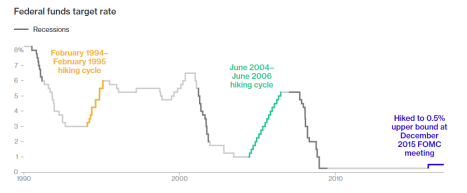
Here is a comparison of the past 3 tightening cycles: 1994-1995, 2004-2006 and the current one. The biggest differences: This tightening is happening much later in the cycle (this second hike is almost 7.5 years since the expansion began), unemployment is much lower (4.9% versus 5.5% and 6.5%) and growth is much lower. Of course the biggest difference is that the prior cycles were implemented in the context of a traditional business cycle, where a buildup in inventory caused a recession. This time around, it is the context of an asset bubble, where a buildup in bad debt caused the recession. These are fundamentally different animals, and explains why the Fed is taking baby steps this time around.

fed-tightening-cycles

One thing to watch after the FOMC announcement: Donald Trump’s twitter feed. Any sort of jawboning of the Fed by Trump will almost certainly affect bonds. In the past, Trump has been hawkish, however now that he is a politician, he might adopt a more dovish tilt, as most politicians do (at least the ones in office).

Fed watcher Tim Duy believes the markets are probably too sanguine about rate hikes in 2017. The markets are looking for two 25 basis point hikes, and he believes the risk is to the upside (i.e. a more aggressive Fed).

Small business optimism picked up in November, according to the NFIB. Expectations for an improvement in the economy and top line growth drove the improvement. We also saw a big uptick in hiring plans, although capital expenditures are still depressed. Business is looking for a cut in corporate taxes and a relaxation of regulations. Remember however, these are expectations, not a description of how business is at the moment.

Zillow has its 6 big predictions for 2017 in the real estate markets. Here are the big themes:

  • Cities will focus on denser development of smaller homes close to public transit and urban centers.
  • The drop in the homeownership rate will reverse as more Millennials become homeowners.
  • Rental affordability will improve as incomes rise and growth in rents slows.
  • New home price inflation will continue, and could be exacerbated by any sort of slowdown in immigration.
  • The suburban population will increase as city-dwellers seek more affordable housing outside of the cities.
  • Home values will grow 3.6 percent in 2017 versus 4.8% in 2016.

There were 30,000 completed foreclosures in October, according to CoreLogic. Foreclosure inventory is down 32% from a year ago. 1 million mortgages were down 90 days + which is a decrease of 25% YOY and is the lowest level since August 2007. Normalcy for foreclosures is around 22,000 a month, so we still have some wood to chop.

Donald Trump has nominated Exxon-Mobil CEO Rex Tillerson to be Secretary of State. Getting this nominee past the Senate will not be a slam-dunk, given his ties with Vladimir Putin and Russia in general. This is even more sensitive given that the CIA thinks Russia might have had something to do with the Wikileaks emails surrounding the DNC.

Separately, Donald Trump cancelled a press conference scheduled for today regarding how he will handle his business interests once he takes office.

Morning Report: How much does Trump change the Fed’s forecasts 12/12/16

Vital Statistics:

Last Change
S&P Futures 2260.0 0.0
Eurostoxx Index 354.0 -1.4
Oil (WTI) 53.5 2.0
US dollar index 91.6 -0.3
10 Year Govt Bond Yield 2.50%
Current Coupon Fannie Mae TBA 103
Current Coupon Ginnie Mae TBA 104
30 Year Fixed Rate Mortgage 4.08


Markets are flat this morning as oil rallies. Bonds and MBS are down,
Slow news day with no economic data this morning. The big event this week will be the FOMC meeting on Tuesday and Wednesday. A 25 basis point hike in the Fed Funds rate is baked in the cake – the market will however focus like a laser on the dot plot and how many hikes are expected for 2017.
In terms of economic forecasting, The Fed was almost certainly assigning a 100% probability of Hillary winning in their September forecasts. Trump’s expected policies (especially a big stimulus plan) would probably cause those forecasts to change. If anything, I would expect the Fed to begin moving the dot graph up, which would be bond bearish. That said, we have had a huge sell-off already, so the move has largely been made.
Overseas, Chinese markets got slammed overnight. The other elephant in the room for the Fed will be the fallout in global markets if China implodes. Luckily, with their capital controls, most of the carnage should be limited to China itself, however any big bust would still have major repercussions for the US dollar, US sovereign debt, and real estate.
Over the weekend, Donald Trump floated Exxon-Mobil CEO Rex Tillerson for Secretary of State, and Texas Governor Rick Perry for DOE. Wouldn’t those choices be better reversed? Donald Trump likes Tillerson because he wants “good negotiators” for the role of State. Separately, Goldman executive Gary Cohn is looking like the nominee for the National Economic Council.

Morning Report: Corporate tax reform 12/9/16

Vital Statistics:

Last Change
S&P Futures 2250.0 2.0
Eurostoxx Index 354.2 2.0
Oil (WTI) 51.3 0.4
US dollar index 91.8 0.4
10 Year Govt Bond Yield 2.41%
Current Coupon Fannie Mae TBA 103
Current Coupon Ginnie Mae TBA 104
30 Year Fixed Rate Mortgage 4.08


Stocks are higher this morning on no real news. Bonds and MBS are flat.
Slow news day.
Consumer sentiment jumped in November from 94 to 98.
Negative equity fell 0.8% from Q2 to Q3, according to CoreLogic. Currently, 8.4% of all mortgaged homes have negative equity, and another 1.6% are near negative equity. In total, 14.6% of all mortgaged homes in the US have less than 20% equity. Home price appreciation has been one driver of this, as well as borrowers who have been switching to 15 year mortgages which pay down principal faster. Over the past year, the average homeowner has picked up $12,500 in home equity.
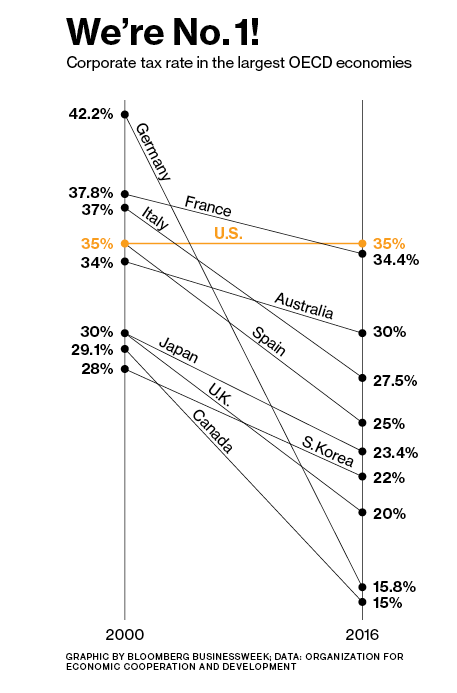
One of the best chances for bipartisanship next year is corporate tax reform. While Republicans and Democrats disagree on how much revenue corporate taxes should bring in, most everyone agrees that our current system isn’t working. Over the past 16 years, virtually all of our competitors cut corporate taxes, however the US has maintained its 35% rate. You can see how much the market has shifted over the past 16 years in the chart below. The new plan would eliminate the incentives that companies use to shift revenues and costs to various jurisdictions in order to minimize taxes. Rates would fall, however interest would no longer be deductible.

A notable bond bear believes the tipping point in the bond market is 3% yields on the 10-year. At yields above that, he believes the stock market and the bond market would suffer a vicious sell-off.

Morning Report: Non-QM AAA rated securitization coming 12/8/16

Vital Statistics:

Last Change
S&P Futures 2238.5 2.0
Eurostoxx Index 351.0 3.0
Oil (WTI) 50.2 0.4
US dollar index 91.3 0.0
10 Year Govt Bond Yield 2.37%
Current Coupon Fannie Mae TBA 103
Current Coupon Ginnie Mae TBA 104
30 Year Fixed Rate Mortgage 4.08

Stocks are up after the European Central Bank extended its quantitative easing plan. Bonds and MBS are down as the ECB lowered the monthly stimulus amount unexpectedly.

Initial Jobless Claims ticked up to 258k last week. We are still bumping around 40 year lows on initial jobless claims..

Nomura lays out 10 “black swan” events that could roil markets in 2017. Black swan events are things that are highly improbable, but not impossible. While most of these are overseas events (China floating the yuan, etc) there are a couple for the US. First would be a jump in US productivity, which would be good news for the economy as a whole, and the second would be a fight between Trump and the Fed, which would be bearish. Trump has been a critic of the Fed’s low interest rate policies in the past, however he is now a politician, and politicians love low interest rates. I wouldn’t be surprised to see a more hawkish nominee for the Fed when Yellen’s term is up, however.

I would add one more: that Donald Trump begins to douse the animal spirits by naming and shaming companies which do things he doesn’t like. Granted, politicians have always intervened in potential plant movings, etc, but they did it quietly behind the scenes, not via Twitter. This could become an issue going forward and would be bearish for the economy and the stock market. Good for bonds, however.

JP Morgan is out with a call saying the Fed will only hike interest rates twice next year – at the June and December meetings. They also are forecasting 1.9% GDP growth for 2017, which is slightly lower than the Fed’s forecast of 2%. They also warn of protectionism and a possible trade war if Trump follows through on renegotiating NAFTA and other treaties, which will be a drag on the economy. They also believe Congress will be willing to pass only a portion of the stimulus that Trump is looking for.

Is the private label securitization market returning? We are starting to see some green shoots, as securitizations of non-QM paper by Caliber and Sterling will get AAA ratings. Over half the loans are in California and the average FICO is 712. The big question is how overcollateralized these bonds are.

Partisan sentiment surveys are partisan 12/7/16

Vital Statistics:

Last Change
S&P Futures 2209.0 -1.0
Eurostoxx Index 346.3 2.0
Oil (WTI) 50.4 -0.5
US dollar index 91.1 0.0
10 Year Govt Bond Yield 2.37%
Current Coupon Fannie Mae TBA 103
Current Coupon Ginnie Mae TBA 104
30 Year Fixed Rate Mortgage 4.1

Markets are flattish this morning on no real news. Bonds and MBS are up small as global bonds rally on speculation the ECB will continue buying bonds into next September.

Mortgage applications fell 0.7% last week as purchases rose 0.4% and refis fell 1%.

Job Openings were little changed at 5.5 million last month, according the JOLTs job openings report. Job openings are more or less at the all-time highs of the index, which goes back to 2000. The quits rate is the key to the report: an increasing quits rate foreshadows wage inflation. So far, the quits rate is pretty much stuck at 2.1%.

Appraisals are coming in light for about 10% – 13% of all contract prices. This is mainly a problem in the hot markets where low inventory is creating bidding wars and buyers overpay.

Sentiment surveys are partisan to some extent. Prior to the election, Republicans were bearish on the housing market and Democrats were bullish. Now that Donald Trump has won, the parties have switched outlooks. It shows why you should generally take these sentiment surveys with a grain of salt. That said, the fundamentals of the housing market are strong with tight inventory and low rates (despite the Fed being in a tightening cycle).

Gallup’s Job Creation Index ticked up last week to 33, which means the percentage of firms planning to increase hiring minus the percentage of firms planning to cut jobs is 33%. Note that this is based on a telephone survey of workers, who may or may not know what their company’s actual plans are.

The post-election sell-off in the bond market has cut the refinanceable population in half, according to Black Knight Financial Services. The last time the refinanceable population was this small, refis were 37% below last quarter’s. The new rules on VA IRRLs will exacerbate that drop in refi volume. Going forward refi volume will be driven more by home price appreciation as people with mortgage rates from they heyday regain the home equity to refinance at today’s rates. Also, with the Fed tightening, now is a good time to look at swapping out from an ARM to a 30 year fixed. If the 35 year bull market in bonds is really finally over, locking in a low rate makes sense.

Mortgage credit availability improved last month according the the MBA. Credit availability increased for all 4 buckets: government, conventional, conforming, and jumbo. While the index has doubled since 2012, it is still at about 20% of the level set during the height of the bubble. It probably won’t increase meaningfully until either (a) the private label market returns, or (b) the government and GSEs increase the credit box.

It is no secret that the real estate sector is still largely done the way it has been for the past 50 years, with agents representing buyers and sellers, along with a largely manual loan process. Now a new firm is looking to use technology to disintermediate realtors. They pay realtors a 1% fee, and the company has just raised $20 million in Series B financing. Its name is Roofstock. It is a niche market – targeting sellers of tenant-occupied properties – however it could catch on.

Morning Report: Productivity Rises 12/6/16

Vital Statistics:

Last Change
S&P Futures 2207.5 3.0
Eurostoxx Index 343.2 2.0
Oil (WTI) 50.7 -1.1
US dollar index 91.0 0.0
10 Year Govt Bond Yield 2.39%
Current Coupon Fannie Mae TBA 103
Current Coupon Ginnie Mae TBA 104
30 Year Fixed Rate Mortgage 4.11

Stocks are lower this morning on no real news. Bonds and MBS are up.

Non-farm productivity improved to 3.1% in the third quarter, breaking out of a long slump. Unit labor costs increased 0.7%. Note that productivity and costs have been kind of oscillating around the zero point for the past several years. This is why wage growth has been going nowhere. New policies in terms of regulatory relief and tax reform could help improve productivity according to St. Louis Fed Head James Bullard.

Donald Trump has been discussing a potential 35% tariff on good imported from companies that offshore jobs. Not sure if this is even going to be legal, let alone legislatively possible. Tariffs are generally good for no one, except perhaps union workers. The last time we had a cocktail of tariffs and Fed tightening (1930), the economic result was nothing to write home about. While Reagan did impose tariffs against Japan, the results were mixed at best.

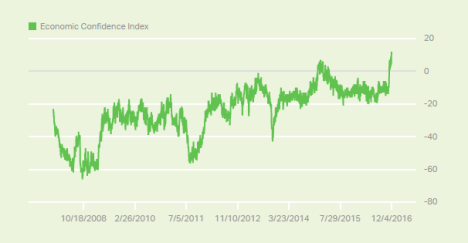
Economic confidence improved markedly in November, according to Gallup and is now at post-crisis highs. It will be interesting to see whether this translates into higher holiday spending. Separately, it could bode well for the Spring selling season, which is just around the corner (basically starts around Super Bowl Sunday).

economic confidence gallup.PNG

Luxury homebuilder Toll Brothers announced better than expected numbers this morning. Deliveries were up 29% in dollars and 22% in units, however we are seeing a moderation in inflation. Average selling prices rose 5.5% to $834k, which is well below the double-digit ASP inflation we have been seeing, especially at the high end. They discussed the Millennials and how they are targeting them: “With the millennial generation now entering their thirties and forming families, we are starting to benefit from the desire for home ownership from the affluent leading edge of this huge demographic wave. In FY 2016, approximately 22% of our settlements included one primary buyer thirty-five years of age or under. (emphasis mine). We are currently courting these customers with our core suburban homes, urban condos and rental apartment properties. We are also introducing a new product line, T|Select by Toll Brothers, which incorporates the elegance and style of a higher-end Toll Brothers home but with fewer structural options, a quicker delivery time and a slightly lower price.”

Home prices rose 1.1% MOM and are up 6.7% YOY, according to CoreLogic. The coasts remain largely overvalued, while the interior is mainly undervalued.

While rising rates are creating worries in the mortgage banking sector of the economy, banks have been on a tear since the election, outperforming the S&P 500 by 11 percentage points. This means the Street is forecasting a big increase in credit and profitability which should offset some of the doom and gloom amongst mortgage bankers. The “tell” will be the return of the private label securitization market, and the follow-on return of the first time homebuyer. Shops that focus on purchase activity should be optimistic about the future.