Morning Report: New Home Sales disappoint 5/23/17

Vital Statistics:

Last Change
S&P Futures 2396.3 3.5
Eurostoxx Index 392.3 1.1
Oil (WTI) 51.1 -0.1
US dollar index 88.6  
10 Year Govt Bond Yield 2.25%
Current Coupon Fannie Mae TBA 102.6
Current Coupon Ginnie Mae TBA 103.81
30 Year Fixed Rate Mortgage 4

Stocks are higher this morning despite a terrorist attack in the UK. Bonds and MBS are up.

New Home sales came in at 569,000, lower than the 620,000 estimate. The median new home sale price was 309k. The average was 369k. New Home Sales are still lagging population growth.

The Richmond Fed Manufacturing Index declined in April as well.

The DC Appeals Court will hear arguments Wednesday to reconsider its decision that the current structure of the CFPB is unconstitutional. If the CFPB loses its case, it will probably have to be re-worked, with a committee instead of a single director who will be accountable to the President. Trump has said he isn’t in favor of killing the agency, but would like to make some modifications.

Merrill Lynch is taking down its inflation forecasts for the year. They are taking their estimate for end of 2017 CPI to 1.9% from 2.3% and its estimate for core PCE to 1.7% from 1.9%. The core PCE is the inflationary index the Fed targets. Merrill is identifying some transitory drivers, so they expect inflation to return to target levels in 2018. Don’t forget, we will get the FOMC minutes tomorrow, which will give some further color on what the Fed was thinking last month, especially given the political environment in DC. Their Fed Funds forecast was based on an assumption that fiscal stimulus will get passed, and that looks impossible at this point.

Minneapolis Fed Head Neel Kashkari wants to see more data before making a decision on a June hike. The June Fed Funds futures are factoring at 78% chance of a 25 basis point hike. Note as well that the yield curve continues to flatten from its post-election steepening. The twos-tens spread (basically the difference between the 10 year yield and the 2 year yield) is the lowest since October.

Trump outlined his proposed budget, which cuts domestic spending by $3.6 trillion over 10 years. His budget doesn’t touch Social Security, Medicare, or defense. This is largely an ideological document that will never pass – in fact one of Obama’s proposed budgets couldn’t muster up even one Democratic vote. There is talk that the budget will cut HUD’s Community Development Block Grant Program, which runs Meals on Wheels and also doles out money for things like bike lanes, public spaces, etc. Based on trial balloons floated earlier in the administration the rest of HUD’s budget looks like it will be untouched.

Morning Report: Why aren’t we seeing wage growth? 5/22/17

Vital Statistics:

Last Change
S&P Futures 2382.3 0.8
Eurostoxx Index 391.4 -0.1
Oil (WTI) 51.0 0.6
US dollar index 88.6 -0.1
10 Year Govt Bond Yield 2.25%
Current Coupon Fannie Mae TBA 103.27
Current Coupon Ginnie Mae TBA 104.21
30 Year Fixed Rate Mortgage 3.94

Stocks are flat this morning on no real news. Bonds and MBS are down small.

Economic activity picked up in April, according to the Chicago Fed National Activity Index. It rose to .49 (better than expectations) and the 3 month moving average rose to .23. Production and employment led the rise, while personal consumption and housing were negative.

We have some Fed-speak at 10:00 EST today along with a bunch after the close. The biggest events this week should be the FOMC minutes on Wednesday and the second revision to Q1 GDP on Friday. We will also get a lot of housing data this week.

One of the biggest issues for the Fed is wage inflation (or the lack thereof). The last time unemployment was this low, we were experiencing 4% wage growth. Why aren’t we now? Here are a few explanations. They revolve around a few different theories. The first is that there has been a structural change in labor economics, and that the tradeoff between unemployment and inflation is over due to globalization, lack of union representation, etc. The second explanation is that wage negotiation dynamics have been colored by the economy since 2008: employers are training people internally instead of hiring outside at a higher price, employees don’t feel comfortable asking for more, productivity is lousy, and the huge reservoir of the long-term unemployed means the market is not as tight as it may appear. The final one is a measurement problem: that the BLS numbers aren’t accurately reflecting the reality of the marketplace. Take construction: Builders constantly complain that they can’t find skilled labor, that they are offering signing bonuses, etc yet when you look at the actual BLS numbers, construction wages are only growing 2.1%. We are seeing in the mortgage business with ops folks as well. So maybe we are starting to see pockets of wage growth, however it isn’t showing up quite yet in the rest of the economy or the numbers.

The drop in construction spending hasn’t only been in housing – it has also been in schools. State and local governments are spending about 1/3 less on school construction than they did before the crisis, yet enrollment is up 4%. This is just another problem for the first time homebuyer – finding affordable homes with good schools.

NAR is predicting 5.6 million home sales in 2017, up 200k from last year, and new home sales of 620k, up from 560k last year. GDP will grow at 2.2% and inflation will remain tame. Sales would be higher if there was more inventory, and the group hopes that regulatory changes, especially with Dodd-Frank will ease up credit for smaller banks, who fund local homebuilders.

Now that the REO-to-rental trade is largely played out, Wall Street is now building houses for rentals. Some are planned communities, where renters get the benefit of living in a single family detached homes, plus they get some of the advantages of apartment living, with gyms and common spaces. They also don’t have to deal with maintenance.  Interestingly, many people intend to rent for only a short time period, but end up staying. For one landlord, 1/3 of the tenants have been on month-to-month arrangements for 7 years. The REITs behind this trade also get discounts from builders, lower maintenance costs, and about a 5% – 8% pickup in rental income for a new house.

Morning Report: Treasury and FHFA disagree on the GSEs 5/19/17

Vital Statistics:

Last Change
S&P Futures 2370.5 6.8
Eurostoxx Index 390.7 1.5
Oil (WTI) 50.0 0.6
US dollar index 88.8 -0.4
10 Year Govt Bond Yield 2.24%
Current Coupon Fannie Mae TBA 103.27
Current Coupon Ginnie Mae TBA 104.21
30 Year Fixed Rate Mortgage 4.03

Stocks are up this morning on no real news. Bonds and MBS are down small.

Slow news day.

No economic data this morning, but we have Fed-speak at 9:45 and 1:40.

Treasury Secretary Steve Mnuchin and FHFA Head Mel Watt disagree on what to do with Fannie Mae’s dividends to Treasury. A week ago, Watt suggested that Fannie and Freddie may have to retain some of their earnings in order to build / maintain their capital base. Yesterday, Mnuchin said that he expected the dividend payments to continue. Despite a Republican president, Mel Watt is going nowhere – his term expires in 2019 and he can only be removed for cause.

Ellie Mae’s Origination Insight Report is out, and it shows that fallout increased, along with the purchase share of mortgages. Cycle times improved by a day across the board.

St. Louis Fed Head James Bullard believes that the unemployment rate could fall further without igniting inflation. He seems to think the new normal is about 2% GDP growth and sees that sort of pace for the immediate future. That will probably be the case until wage inflation picks up, and who knows when that will be?

Guess who’s back? Ex-NJ governor, MF global collapse Jon Corzine, who is apparently fundraising for a new hedge fund…

Morning Report: Odds of a June hike fading 5/18/17

Vital Statistics:

Last Change
S&P Futures 2350.5 -7.0
Eurostoxx Index 387.6 -3.5
Oil (WTI) 48.5 -0.5
US dollar index 89.0 0.1
10 Year Govt Bond Yield 2.19%
Current Coupon Fannie Mae TBA 103.27
Current Coupon Ginnie Mae TBA 104.21
30 Year Fixed Rate Mortgage 4.03

Stocks are following through on yesterday’s sell-off. Bonds and MBS are up again.

Initial Jobless Claims came in at 232k last week which shows that firms are hanging onto their employees. Claims are at a 28 year low. Meanwhile, the Philly Fed Manufacturing Index put in another strong showing.

The index of leading economic indicators increased 0.3% in April after a 0.3% increase in March.  “First quarter’s weak GDP growth is likely a temporary hiccup as the economy returns to its long-term trend of about 2 percent. While the majority of leading indicators have been contributing positively in recent months, housing permits followed by average workweek in manufacturing have been the sources of weakness among the U.S. LEI components.”

The DOJ named ex-FBI Director Robert Meuller to conduct the Russia / DJT investigation. This should (in theory) quiet things down for a while, as it satisfies a key demand from Democrats that someone independent of the White House conduct the investigation. The key question: Is this Watergate or Whitewater?

The DJT turmoil has affected the market’s handicapping of the next FOMC meeting. The odds of a June hike have slipped from 80% to 60%.

Meanwhile, The Bernank finds it strange that markets ignore political risk until the last moment. He also thinks DJT should re-nominate Janet Yellen and downplayed the market risk from the Fed tapering its reinvestment policy.

Household debt has surpassed its 2008 peak, according to the Fed. It came in at $12.7 trillion as mortgage debt and student loan debt increased. Of course the difference between 2008 and today is that home equity is much higher, so it isn’t necessarily a huge cause for alarm.

Morning Report: More Trump Trouble 5/17/17

Vital Statistics:

Last Change
S&P Futures 2386.3 -10.8
Eurostoxx Index 394.6 -1.4
Oil (WTI) 49.0 0.3
US dollar index 89.2 -0.3
10 Year Govt Bond Yield 2.29%
Current Coupon Fannie Mae TBA 102.875
Current Coupon Ginnie Mae TBA 103.938
30 Year Fixed Rate Mortgage 4.04

Stocks are lower as the White House gets embroiled in yet another scandal. Bonds and MBS are up.

Donald Trump has been hit with two damaging press reports over the past two days. The first one claims that he shared classified information with Russian diplomats. The second one is that he urged then FBI director James Comey to drop the investigation of Michael Flynn. The first story (if true) is probably not a crime, however the second one (again, if true) strays close to obstruction of justice. Note that both stories rely on hearsay from anonymous sources – basically some guy heard something from some other guy that Trump said this or that – and WaPo / NYT reported it. Suffice it to say, if this was about anyone else, these stories probably wouldn’t have seen the light of day with such flimsy evidence. Doesn’t mean the stories are not true, but the story’s credibility is falling predictably along partisan lines. That probably won’t change until we have some names to go with the story.

What does this mean for the markets? As I said yesterday, the Trump reflation trade is dead. Nothing is going to get done legislatively in this Congress, unless it can get pushed through on party lines, and GOP moderates are no sure thing. So far the GOP establishment has not sided with Democrats and the press against Trump (they can’t stand either), but their support is getting thinner and thinner. I suspect the next shoe to drop will be a high profile resignation, like Rex Tillerson, or Wilbur Ross, neither of whom needs this amateur hour headache. And that could be the “all-clear” signal for wavering Republicans to jump ship and turn their backs on the White House.

The dollar is beginning to take notice, and is down again today. The bond market continues to rally, and I suspect one of the most crowded trades on the Street (short bonds) is going to get painful. Remember the pre-election bond yield was 1.81%. The stock indices are being supported by a few mega-cap stocks which makes it vulnerable to a sell-off. Remember the old saw “Sell in May and go away?” Might be good advice this year.

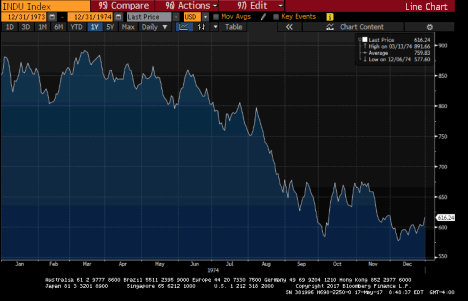
Here is a chart of the Dow Jones Industrial Average for 1974, the year of Watergate:

DJIA 1974

Of course take that chart with a grain of salt. In 1974, the US economy was still reeling from the 1973 oil crisis, so markets were vulnerable to begin with. Second, if you sold the market during the Clinton impeachment kerfuffle you would have been killed (at least for a year or so), but then would have been correct. Note the Clinton impeachment didn’t make a bit of difference to the Fed, which kept hiking rates. That could be a difference this time around, especially if the economic data starts turning down.

Mortgage Applications fell 4.1% last week as purchases fell 3% and refis fell 6%. The refi share of mortgage apps hit a 9 year low at 41.1%. You can see below a chart of the MBA refinance index, which has been crushed since Brexit last June.

Morning Report: Housing starts disappoint again 5/16/17

Vital Statistics:

Last Change
S&P Futures 2399.0 0.5
Eurostoxx Index 395.5 -0.5
Oil (WTI) 49.0 0.1
US dollar index 89.9 -0.1
10 Year Govt Bond Yield 2.34%
Current Coupon Fannie Mae TBA 102.625
Current Coupon Ginnie Mae TBA 103.938
30 Year Fixed Rate Mortgage 4.09

Stocks are flat this morning on no real news. Bonds and MBS are flat as well.

Housing starts for April disappointed, rising 0.7% YOY to an annualized rate of 1.17 million. The Street was looking for 1.26 million. This was the lowest reading in a year. Building Permits rose to 1.26 million on an annualized basis, up 5.7% YOY. It is strange to see disappointing starts alongside the strong builder sentiment number reported yesterday, but builders seem content to build fewer homes and to grow the business by raising prices.

Industrial and manufacturing production came in stronger than expected however, growing 1% in April. Capacity Utilization rose to 76.7%. Auto assembly drove the increase, pardon the pun.

The Washington Post broke a story that Donald Trump shared classified info with Russia. There seems to be a shift in the political winds. You are starting to see mainstream Republicans distance themselves from the Administration. Don’t know if this becomes a stampede, but the crowd is looking for their coats and nervously eyeing the exits. I don’t think this is impeachment material (what he did was legal) however, you can probably stick a fork in the Trump legislative agenda.

The machinations in Washington so far are not affecting the stock market, but the dollar is beginning to take notice. Bonds are not yet reacting however don’t forget the 10 year was trading around 1.8% before Trump’s surprise victory. The Trump reflation trade is running on fumes at this point.

The National Association of Realtors estimates that if the mortgage interest deduction and the state & property tax deduction is eliminated, you would see a 10% drop in real estate values. The Trump plan would double the size of the standard deduction, which will go from roughly 12k to 24k. The increase in the standard deduction will make the mortgage interest deduction meaningless for anyone with a sub $600k mortgage because they will be better off taking the standard deduction. This will eliminate one of the advantages of buying versus renting for first time homebuyers, which in theory should create more renters and less buyers. Given all the other advantages of buying, this will probably be a second-order effect. I have a hard time seeing a 10% drop in prices – the FHFA House Price Index only had a 22% drop peak to trough – and inventories are tight.

Absent any changes to the tax code, NAR is looking for prices to rise 7% – 8% this year.

Ex Fed Head Narayan Kocklerakota recommends that the Fed maintain its balance sheet and not let its QE assets run off as they mature.

Morning Report: Washington eyes contract for deed transactions

Vital Statistics:

Last Change
S&P Futures 2393.0 4.3
Eurostoxx Index 395.1 -0.5
Oil (WTI) 49.5 1.7
US dollar index 89.8 -0.3
10 Year Govt Bond Yield 2.33%
Current Coupon Fannie Mae TBA 102.625
Current Coupon Ginnie Mae TBA 103.938
30 Year Fixed Rate Mortgage 4.09

Stocks are up this morning with oil. Bonds and MBS are down.

Russia and Saudi Arabia made a joint statement saying they intend to keep production down through Q118. This is providing a boost. Separately, China said it intends to import more oil and natural gas from the US.

The Empire State Manufacturing Survey contracted in May after a torrid start to the year. Expectations remain strong however.

Several politicians are urging the FHFA to no longer sell foreclosed homes to firms that intend to follow “rent to own” or contract for deed transactions. The objection to these transactions is that the properties are sold as-is and the onus is on the renter to fix any issues like lead paint. This allows the landlord / lender to skirt property maintenance laws. Ultimately, this could be good for the market in that it brings some much-needed supply to the starter home space (and perhaps demand for 203k loans).

Speaking of first time homebuyers, here are the best cities for them. Needless to say, the big coastal cities are generally not the best places as home prices are elevated there. There is more in the Midwest and the South. There is an interactive map that gives good info on the state of individual markets. Wonder how much size 300k gets you? Depends on the state – on one extreme is Indiana, which gets you almost 3500 square feet. The worst? DC, which gets you 600. Note that 300k is just a hair over the median price in the US.

Homebuilder sentiment rose in April, according to the NAHB. The sentiment index rose to 70, higher than expectations. Note we will get housing starts tomorrow.

Morning Report: Weak retail sales and inflation 5/12/17

Vital Statistics:

Last Change
S&P Futures 2386.0 -5.0
Eurostoxx Index 394.7 0.3
Oil (WTI) 47.9 0.1
US dollar index 90.2 -0.2
10 Year Govt Bond Yield 2.36%
Current Coupon Fannie Mae TBA 102.33
Current Coupon Ginnie Mae TBA 103.78
30 Year Fixed Rate Mortgage 4.08

Stocks are lower this morning as retailer earnings disappoint. Bonds and MBS are up on weak inflation data.

Inflation remains tame according to the Consumer Price Index which rose 0.2% MOM and is up 2.2% YOY. Stripping out food and energy, it is up 0.1% MOM and 1.9% YOY. This 1.9% YOY print in the core CPI is the lowest in almost 2 years.

Retail sales came in lower than expected at 0.4% for April. The control group, which strips out volatile elements like autos, gasoline and building products rose 0.2%. Note that retail sales only captures a part of consumer spending – services are largely ignored. Overall it points to steady consumer demand – nothing great. The mall based retailers have been getting crushed however as Q1 numbers were pretty much abysmal.

Wells Fargo is contemplating doing a private label MBS deal this year. Private label MBS are backed by mortgages without government insurance, and have been mainly limited to the jumbo market since the crisis.

Rising wages helped ease affordability concerns in the first quarter. A total of 60.3% of all homes were affordable to someone earning the median income of 68,000, up from 59.9% in the fourth quarter, according to NAHB / Wells Fargo Housing Opportunity Index.

Good news for the first time homebuyer: entry level salaries for college grads are the highest in a decade.

Morning Report: Starter homes are back 5/11/17

Vital Statistics:

Last Change
S&P Futures 2389.5 -5.8
Eurostoxx Index 394.6 -1.9
Oil (WTI) 48.0 0.6
US dollar index 90.6 0.1
10 Year Govt Bond Yield 2.41%
Current Coupon Fannie Mae TBA 102.06
Current Coupon Ginnie Mae TBA 103.53
30 Year Fixed Rate Mortgage 4.08

Stocks are lower this morning on lousy retailer earnings. Bonds and MBS are down small.

Initial Jobless Claims fell to 236,000 last week which is a 28 year low.

Inflation remains close to the Fed’s 2% target, according to the Producer Price Index. The headline number rose 0.5% MOM and is up 2.5% on a YOY basis, but when you strip out food and energy, it is up 1.9% YOY.

We had some hawkish statements from Boston Fed President Eric Rosengren yesterday, where he urged 3 more hikes this year as the economy is on an “unsustainable pace.” His rationale is the unemployment rate at 4.4%, which is below his estimate for full employment at 4.7%. Of course sub 1% GDP growth is probably “sustainable” ad infinitum, and there is no evidence of much in the way of wage growth. He also doesn’t think the tapering of MBS buying will affect mortgage rates too much, as long as it is gradual.

Inflation isn’t uniform, of course, and the index that measures it has to take this into account. Here is a chart of different goods and services and their inflation rates over the past 20 years:

inflation.PNG

The Canadians have a housing bubble on their hands, and the ratings agencies are getting worried. Canada is bedeviled with the same problem in the US of tight supply, although foreign demand is a big factor as well. Prices in Toronto rose 25% last year. Note that Canada’s economy is highly dependent on strong commodity prices, and indirectly, Chinese demand. If / when the Canadian real estate bubble bursts, it will probably affect property prices in the Pacific Northwest.

More evidence that builders are pivoting away from luxury building and towards more starter homes. In Q1, 854,000 new owner households were formed versus 365,000 new renter households. This is the first time new owners exceeded new renters in a decade. Fannie Mae’s share of mortgages to first time homebuyers has been steadily increasing. We are seeing an increase in the number of new homes smaller than 2200 square feet. Even McMansion giant Toll Brothers is going smaller.

FHFA Director Mel Watt is warning that the continuing sweep of Fannie Mae’s profits to Treasury is risking confidence in the entity. His proposal is to let Fannie Mae retain their earnings in order to re-build its capital cushion. This is to prevent the GSEs from needing another bailout later on. Note that the Obama administration used Fannie’s profits to paper over holes in Obamacare spending.

Morning Report: Comey fired 5/10/17

Vital Statistics:

Last Change
S&P Futures 2391.5 -1.8
Eurostoxx Index 395.9 0.1
Oil (WTI) 46.4 0.6
US dollar index 90.4  
10 Year Govt Bond Yield 2.36%
Current Coupon Fannie Mae TBA 102.6
Current Coupon Ginnie Mae TBA 103.81
30 Year Fixed Rate Mortgage 4.05

Stocks are lower this morning on no real news. Bonds and MBS are up.

Last night, Donald Trump fired FBI Director James Comey. This will excite the chattering classes and provide endless fodder for the media, but it shouldn’t matter much to the markets. At the margin, it will probably push bond yields lower.

Mortgage applications rose 2.4% last week as purchases rose 2% and refis rose 3%. Conforming and jumbo rates were flat, while FHA ticked up a few basis points.

Import prices rose .5% MOM and are up 4.1% YOY. Bonds are shrugging off the data, however it could be a sign of inflation creeping up. We did see a small sell-off in the dollar during April, but nothing of that magnitude. Something to watch.

We will have some Fed-speak this afternoon with Eric Rosengren and Neel Kashkari speaking at 12:30 and 1:30 EST respectively.

With all the data over the past week, Fed Funds futures are moving mainly for the September meeting, which now has a 40% chance of a 25 basis point hike, up from 20% about a week ago. June is currently pegged at 80%. The weak Q1 print so far has not had an effect on trader sentiment.

Good advice for the first time homebuyer who is also saddled with student loan debt. Waiting until the deferral period has passed helps. Also look at FHA loans, however there are caveats.

Boston Fed President Eric Rosengren warns that GSE reform could hit the multi-family market. F&F bear the credit risk of 44% of the multi-fam market, more than all the banks combined.

Job openings in the construction sector are higher now than they were at the peak of the bubble. Yet the hiring rate is just off the lows of the bust. This certainly corroborates the claim that a labor shortage is a big reason why housing starts are still depressed. Lots of skilled labor left the sector after the bubble burst and got jobs in the energy patch. There is only one way to square that circle and that is to raise wages to attract talent. Which means compressing margins if builders are unable to pass on that cost increase. Regardless, it doesn’t bode well for new home affordability unless we begin to see wholesale increases in wages across the US, which hasn’t been happening.