Morning Report: Negative yielding corporate debt

Vital Statistics:


Last Change
S&P futures 3020 5.35
Oil (WTI) 60.39 0.19
10 year government bond yield 2.11%
30 year fixed rate mortgage 4.13%


Stocks are higher as we kick off earnings season. Bonds and MBS are up.


The upcoming week will be dominated by bank earnings. The economic data is unlikely to be market-moving, however we will get some real-estate related data with housing starts and homebuilder sentiment. We will also get retail sales, industrial production and capacity utilization.


Citigroup reported earnings this morning that beat Street estimates. Mortgage banking revenues were down 2% QOQ and down 9% YOY.


Manufacturing activity in New York State rebounded last month, climbing out of negative territory. New Orders were flat, shipments improved, while employment hit the lowest level in 3 years.


Europe is used to negative yields on sovereign debt, with the German Bund yielding -29 basis points. In other words, you are paying 105.25 to get back 100 in 10 years, along with some interest. That is strange enough, in of itself, but how about this? Corporate bonds trading with negative yields. Don’t believe it? US jar maker Ball Corp, maker of the mason jar, trades at a yield of -20 basis points and matures in 18 months. Why would any investor buy that? Because the principal hit will be less than deposit rates of -40 basis points or 18 month German paper yielding -70 basis points. It is a fascinating study of the law of unintended consequences. The whole point of negative interest rates is to push investors to get out of safe haven sovereign debt and take some risk – specifically lending money to businesses that need it. The whole point of this exercise is to increase the amount of credit in the system in order to fuel economic growth. However, instead of providing financing to nascent businesses who could be the growth drivers of tomorrow, they are lending money to a company that makes jars (hardly emerging technology) instead.


A portfolio manager at Janus Capital explained it as follows: “A bond like Ball Corp’s is “a safe place to hang out,” [Janus Capital Portfolio Manager Tim] Winstone said. “And just because something is negative yielding, that doesn’t mean it can’t get more negative yielding.” In other words, we are in greater fool territory. Fun fact: around 2% of the European junk bond market trades at negative yields. In fact, Winstone says that about 24% of the European investment grade market trades at negative yields. It isn’t entirely irrational – money managers are making a bet on further central bank stimulus and are positioning themselves to reap capital gains on negative yielding paper, which means they could end up making a positive return despite a negative yield headwind.


euro corporates


John Maynard Keynes once advocated inflation as the “euthanasia of the rentier class.” In reality it may turn out that negative interest rates will do the job. Fascinating times we live in.

Morning Report: Jerome Powell discusses homebuilding

Vital Statistics:


Last Change
S&P futures 3009 6.5
Oil (WTI) 60.31 0.26
10 year government bond yield 2.14%
30 year fixed rate mortgage 4.11%


Stocks are higher this morning on no real news. Bonds and MBS are down.


Two Fed governors (Bostic and Barkin) pushed back on the need to cut rates to maintain the expansion yesterday. That might have explained the increase in the 10 year yesterday afternoon.


Inflation at the wholesale level rose 0.1% month over month and 2.3% YOY, according to the Producer Price Index. Ex-food and energy, it was flat MOM and up 2.1% YOY. Inflation remains comfortably stuck in a range around 2%.


Jerome Powell mentioned homebuilding in his Humphrey-Hawkins testimony yesterday. He blamed tariffs and labor shortages for the lack of building. That said, the underbuilding phenomenon didn’t just start in the last couple of years – housing starts have been at recessionary levels since 2008, and we have had an acute shortage of housing for at least 7 years. Something else is going on, although immigration restrictions and tariffs certainly don’t help matters. But that isn’t the explanation. When you look at new home sales divided by population, you can see just how much we have underbuilt:


new home sales divided by population


The CFPB has been upping its spending on consumer financial education. Democrats are complaining that it shifts the burden of consumer protection from the financial industry to consumers. That said, the enforcement budget has increased.


Jim Grant argues in the WSJ for a return to the gold standard.

Morning Report: Jerome Powell soothes the equity markets.

Vital Statistics:


Last Change
S&P futures 3002 6.5
Oil (WTI) 60.62 0.26
10 year government bond yield 2.08%
30 year fixed rate mortgage 4.08%


Stocks are higher this morning after Jerome Powell hinted strongly that the Fed would cut rates at the July meeting. The S&P 500 is at record levels and is flirting with the 3000 level. Bonds and MBS are down small.


Oil prices are rallying as tensions rise in the Strait of Hormuz. Iranian considers the Strait to be its territorial waters, and has been hassling warships going through the area for decades. The latest incident involves a British oil tanker. Persian Gulf tensions largely impact North Sea Brent prices more than West Texas Prices (which most of the US uses).


If the Fed is cutting rates, why aren’t yields going lower? Bond yields are higher across the board globally, with the German Bund yielding -26 basis points on hints that the ECB could launch further stimulus plans. The Bund yielded -38 bp last week, so perhaps US bond yields are simply following what international bonds are doing. Don’t forget, the last time the Fed Funds rate was in the 150 – 175 basis point range (May of 2018) the 10 year was about 2.9%. So, the Fed could cut rates 75 bp by the end of the year and we could see yields go nowhere. Look at the chart below, which plots the 10 year bond yield versus the Fed Funds rate:


10 year vs Fed Funds rate


Initial Jobless Claims came in at 209k last week, which was a touch below expectations. Regardless, the last time we were at similar levels was during the Vietnam War when we had a military draft.


Consumer prices rose 0.1% in June, according to the Consumer Price Index. The core CPI, which excludes food and energy rose 0.3%. On a YOY basis, the headline number rose 1.6% and the core index rose 2.1%. That said, the Fed prefers to use the PCE index, which shows inflation to be lower. The CPI overweights housing compared to the PCE, which is why it shows higher levels.


Jerome Powell’s Humphrey-Hawkins testimony dominated the headlines, but the FOMC minutes also confirmed his outlook.

Participants judged that uncertainties and downside risks surrounding the economic outlook had increased significantly over recent weeks. While they continued to view
a sustained expansion of economic activity, strong labor market conditions, and inflation near the Committee’s symmetric 2 percent objective as the most likely outcomes, many participants attached significant odds to scenarios with less favorable outcomes. Moreover, nearly all participants in their submissions to the Summary of Economic Projections (SEP), had revised down their assessment of the appropriate path of the federal funds rate over the projection period that would be consistent with their modal economic outlook.


Separately, Larry Kudlow emphasized that Trump has no plans to fire Powell. The Fed’s independence from politics makes it highly unlikely he could do so in the first place, however Jimmy Carter did do it to G William Miller, kicking him upstairs to Treasury and hiring Paul Volcker to run the Fed.


The first hurricane of the 2019 Atlantic season looks like it will hit Louisiana.

Morning Report: Bonds rally on Powell testimony

Vital Statistics:


Last Change
S&P futures 2975 -6.5
Oil (WTI) 59.12 1.26
10 year government bond yield 2.05%
30 year fixed rate mortgage 4.06%


Stocks are lower as we await Jerome Powell’s Humphrey-Hawkins testimony. Bonds and MBS are flat.


Bonds were initially lower this morning, with the 10-year touching 2.10%. They rallied back after Powell’s prepared remarks were released. Here is the paragraph that probably caused it:


In our June meeting statement, we indicated that, in light of increased uncertainties about the economic outlook and muted inflation pressures, we would closely monitor the implications of incoming information for the economic outlook and would act as appropriate to sustain the expansion. Many FOMC participants saw that the case for a somewhat more accommodative monetary policy had strengthened. Since then, based on incoming data and other developments, it appears that uncertainties around trade tensions and concerns about the strength of the global economy continue to weigh on the U.S. economic outlook. Inflation pressures remain muted.


Powell is scheduled to testify at 10:00 am. Note that we will also get the minutes from the June meeting at 2:00 pm today. Given how jittery the bond market is, we could see some volatility.


The Fed Funds futures turned slightly more dovish with the July futures predicting roughly a 80% of a 25 basis point cut and a 20% chance of a 50 basis point cut. The most likely outcome by the end of the year is a 75 basis point cut. December Fed Funds futures probabilities:


fed funds futures


Mortgage applications fell 2.4% last week as purchases rose 2.3% and refis fell 6.5%. The average contract rate on a 30 year fixed rate mortgage fell 3 basis points to 4.04%. There is some seasonal noise from the July 4 holiday baked into the numbers. Separately, the MBA’s Mortgage Credit Availability Index rose by 0.2% in June. Conventional credit expanded, while government credit contracted slightly. Jumbo credit is the easiest it has ever been, at least since the series started in 2011.


The House passed legislation yesterday which clarifies which VA loans are eligible to be included in Ginnie Mae Securitizations. They also passed a bill which would lower the mortgage insurance premiums for first-time homebuyers who complete a housing counseling course.


Morning Report: Small Business Optimism slips

Vital Statistics:


Last Change
S&P futures 2968 -10
Oil (WTI) 57.95 0.25
10 year government bond yield 2.06%
30 year fixed rate mortgage 4.03%


Stocks are lower this morning as we await a speech from Jerome Powell. Bonds and MBS are down.


Jerome Powell speaks at 8:45 this morning at the Boston Fed regarding stress-testing for the banks. Here are his prepared remarks. He doesn’t address monetary policy.


There were 7.3 million job openings in May, down slightly from April. The quits rate, which tends to lead increases in wages, was steady at 2.3%, where it has been all year. Private sector openings were flat, while government fell by about 40,000.


Small Business Optimism slipped in June, according to the NFIB. This reversed May’s jump, however sentiment is still at historically high levels. Expectations eased for sales and profitability, and the outlook for capital expenditures weakened. The capital expenditure level was the lowest since May 2015. Employment also decreased, however most firms are still in hiring mode, with the availability of qualified labor the biggest issue.


NFIB


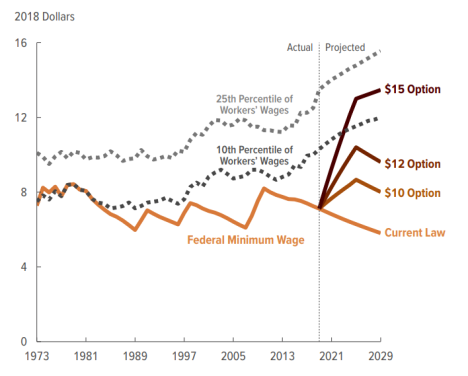
The Congressional Budget Office analyzed the probable effects of raising the Federal Minimum Wage to $15 an hour. Unsurprisingly, they concluded that it would cost jobs, with the median estimate coming in at 1.3 million. The graph below looks at how the constant dollar minimum wage has behaved relative to the bottom 10th and 25th percentile of workers over time.


minimum wage


Mortgage delinquencies are the lowest in 20 years, according to CoreLogic. 30 day DQs fell 0.7% to 3.6%, while the foreclosure rate slipped 0.1% to 0.4%. Delinquencies fell pretty much across the board, with the exception of areas that were affected by natural disasters.

Morning Report: Strong jobs report knocks stocks

Vital Statistics:


Last Change
S&P futures 2982.25 -8.4
Oil (WTI) 57.45 0.2
10 year government bond yield 2.02%
30 year fixed rate mortgage 4.00%


Stocks are lower this morning after Friday’s strong jobs report stoked fears the Fed might not cut rates as much as the market expects. Bonds and MBS are up.


Jobs report data dump:


  • Payrolls up 224,000
  • Unemployment rate 3.7%
  • Labor force participation rate 62.9%
  • Employment-population rate 60.6%
  • Average hourly earnings up 3.1%


Overall, a strong report which should in theory argue against easing rates at the upcoming July meeting. That said, the deceleration in the labor market is being taken as a sign that the Fed needs to act, especially since inflation remains stubbornly below the Fed’s 2% target. The July Fed funds futures are pricing in a 100% chance for a cut, with a 92% chance for 25 basis points, and an 8% chance of 50 basis points.


We don’t have much in the way of economic data this week, however we do have Jerome Powell’s Humphrey-Hawkins testimony on Wednesday and Thursday. Humphrey-Hawkins testimony is usually more about posturing politicians than it is about useful insights, but with the markets on edge about a potential rate cut, we could see some volatility. Expect a lot of questions about Fed independence.


Want to get involved in the property rental business without having to actually buy a house and rent it out? Roofstock could be your answer. It allows individuals to buy into occupied rental properties and allows them to trade out of them after a 6 month lock up period. If you can’t get a bid on Roofstock’s online exchange, they will buy it back at a 7.5% discount.


Deutsche Bank is retreating back to Europe, as it cuts 18,000 jobs and exits a lot of overseas businesses. DB has been underperforming for years, and it looks like its decades-old attempt to become a player on Wall Street and in London are over. It would be cool to see them spin off Bankers Trust, Alex Brown and Sons and Morgan Grenfell, but it doesn’t look like that will happen.

Morning Report: Two new Fed nominees, weak payroll growth.

Vital Statistics:


Last Change
S&P futures 2986.25 6.4
Oil (WTI) 56.75 0.9
10 year government bond yield 1.96%
30 year fixed rate mortgage 4.06%


Stocks are higher this morning as we are approaching detente in the US-China trade spat. Bonds and MBS are higher.


Bonds are rallying globally, with the German Bund yield hitting a record low of -39 basis points. Ex-IMF Chair Christine Lagarde is in the running to replace Mario Draghi as the head of the ECB. She is considered to be more of a politician, so the markets are interpreting her nomination to be bond-bullish. US rates will be influenced by overseas bond markets, so that means lower rates here at least at the margin.


Christopher Waller and Judy Shelton are the latest Trump picks to join the Federal Reserve Board. Judy Shelton has been vocal in criticizing the Fed’s practice of paying interest on excess reserves, and has questioned the effectiveness of the current regime of floating exchange rates versus the gold standard and the gold exchange standards of yesteryear. While there is a 0% chance we go back to some sort of hard-asset backed currency, between the serial bubbles of the past 40 years and the hyper-inflation of the 1970s, the economic record of post-Bretton Woods era (basically from when Nixon closed the gold window) has been mixed.


Construction spending fell 0.8% MOM and 2.3% YOY in May. Residential construction continues to be an issue, falling 0.6% MOM and 11.2% YOY.


Manufacturing expanded in June, according to the ISM Manufacturing report. That said, it decelerated compared to May. Tariffs remain the largest concern. New Orders were flat, while employment and production increased.


Mortgage Applications were more or less flat last week, as purchases increased 1% and refis fell 1%. Mortgage rates were unchanged-to-slightly lower, depending on the product. We have left the tightening-driven doldrums of 2016-2018 and approaching more normal levels. Here is the MBA Mortgage Index going back 20 years to give some perspective:


MBA application index


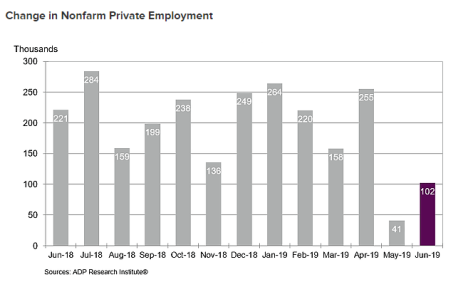
Private payrolls increased by 102,000, according to the ADP Employment Report. This is the second weak-ish reading in a row. Jobs were created in education and health as well as professional and business, while the construction sector lost jobs. Note the Street is looking for 160,000 new payrolls in Friday’s jobs report. Separately, initial jobless claims fell to 221k last week. You can see the drop-off in hiring in the ADP chart below:


ADP report


Morning Report: No changes to GDP

Vital Statistics:


Last Change
S&P futures 2926.25 8.25
Oil (WTI) 59.03 -.35
10 year government bond yield 2.02%
30 year fixed rate mortgage 4.02%


Stocks are higher this morning on news that the US and China will resume trade talks over the weekend. Bonds and MBS are flat.


The third revision to first quarter GDP was unchanged, coming in at 3.1%. Inflation was revised upward ever so slightly, from a core PCE rate of 1% to 1.2%. At this stage of the game, the markets are going to focus on weak economic data, not inflation data. Note the Atlanta Fed is forecasting that second quarter GDP will come in at 1.9%.


Initial Jobless Claims remain low, rising slightly to 227,000.


Donald Trump continues to criticize Fed Chairman Jerome Powell, even going as far as to tweet that ECB President Mario Draghi is better. While it is unlikely Trump would try and fire Powell (or demote him), the legal principle of Fed independence will probably make that difficult.


The VA will now guarantee loans that exceed the conforming loan limit. Veterans will be able to borrow above the $484,350 limit without any down payment. This impetus for this decision was to raise money for veterans who have health issues after being exposed to Agent Orange. The initial idea was to raise the VA loan fee by 15 basis points, however lawmakers decided to raise the funds by increasing the cap.


A new report by Barclay’s and Annaly Mortgage lays out a post-conservatorship world for the US residential real estate finance market. Lawmakers generally agree on the goals of housing reform: protect the US taxpayer, attract private capital, and create a more competitive landscape. Getting there is going to be more difficult as Democrats and Republicans have different priorities. The report looks at things the Administration could do unilaterally via executive order. The first would involve FHFA ordering the GSEs out of non-core markets, such as second homes, jumbo and investor loans. The second would involve the creation of a revolving credit risk transfer facility. A third would involve removing the “GSE patch” which allows Fannie and Fred to originate QM loans at DTI levels private lenders cannot. Finally, there is work that needs to be done at the SEC / SIFMA level that concerns private label securitizations. Ultimately the issue of what to be done with GSEs will have to be solved legislatively. Either they become converted to Federal Government utilities or they become privatized. The privatization route envisions breaking up the duopoly into much smaller guarantors.

Morning Report: Jerome Powell discusses the Fed’s thinking

Vital Statistics:


Last Change
S&P futures 2933.25 11.25
Oil (WTI) 58.88 1.05
10 year government bond yield 2.02%
30 year fixed rate mortgage 4.02%


Stocks are higher on positive news on the the trade front. Bonds and MBS are flat.


Durable goods orders came in lower than expected in May, and April was revised downward. The headline number fell 1.3% and the prior month was revised downward from -2.1% to -2.8%. Ex transportation, durable goods orders rose 0.3%. Capital Goods rose 0.4%, which is one bright spot in the report.


Mortgage applications rose 1.3% last week as purchases fell about a percent but refinances rose 3.2%. The 30 year fixed rate mortgage fell 8 basis points to 4.06%.


Jerome Powell spoke in NY yesterday and addressed some of the issues the Fed is dealing with.

Let me turn now from the longer-term issues that are the focus of the review to the nearer-term outlook for the economy and for monetary policy. So far this year, the economy has performed reasonably well. Solid fundamentals are supporting continued growth and strong job creation, keeping the unemployment rate near historic lows. Although inflation has been running somewhat below our symmetric 2 percent objective, we have expected it to pick up, supported by solid growth and a strong job market. Along with this favorable picture, we have been mindful of some ongoing crosscurrents, including trade developments and concerns about global growth. When the FOMC met at the start of May, tentative evidence suggested these crosscurrents were moderating, and we saw no strong case for adjusting our policy rate.

Since then, the picture has changed. The crosscurrents have reemerged, with apparent progress on trade turning to greater uncertainty and with incoming data raising renewed concerns about the strength of the global economy. Our contacts in business and agriculture report heightened concerns over trade developments. These concerns may have contributed to the drop in business confidence in some recent surveys and may be starting to show through to incoming data. For example, the limited available evidence we have suggests that investment by businesses has slowed from the pace earlier in the year.

Against the backdrop of heightened uncertainties, the baseline outlook of my FOMC colleagues, like that of many other forecasters, remains favorable, with unemployment remaining near historic lows. Inflation is expected to return to 2 percent over time, but at a somewhat slower pace than we foresaw earlier in the year. However, the risks to this favorable baseline outlook appear to have grown.

Last week, my FOMC colleagues and I held our regular meeting to assess the stance of monetary policy. We did not change the setting for our main policy tool, the target range for the federal funds rate, but we did make significant changes in our policy statement. Since the beginning of the year, we had been taking a patient stance toward assessing the need for any policy change. We now state that the Committee will closely monitor the implications of incoming information for the economic outlook and will act as appropriate to sustain the expansion, with a strong labor market and inflation near its symmetric 2 percent objective.

The question my colleagues and I are grappling with is whether these uncertainties will continue to weigh on the outlook and thus call for additional policy accommodation. Many FOMC participants judge that the case for somewhat more accommodative policy has strengthened. But we are also mindful that monetary policy should not overreact to any individual data point or short-term swing in sentiment. Doing so would risk adding even more uncertainty to the outlook. We will closely monitor the implications of incoming information for the economic outlook and will act as appropriate to sustain the expansion.

The Fed Funds futures turned slightly less accomodative after the speech. They are now looking at something like a 70% chance of a rate cut at the July meeting, and the markets are coalescing around 75 basis points in cuts this year.

fed funds futures


The Trump Administration established a White House Council on Eliminating Barriers to Affordable Housing which will focus on removing burdensome regulatory barriers. The council will work to identify federal, state, and local barriers to affordable housing, and will take action to remove federal and administrative regulatory burdens. Note there is no mention of taking action to remove “state and local regulatory burdens,” which is often zoning restrictions. The Obama HUD aggressively sued local jurisdictions to force them to change their zoning laws from single family only to multi-family, but it looks like the Trump Administration won’t be going down that route.

Morning Report: New Home Sales disappoint

Vital Statistics:


Last Change
S&P futures 2955 4.5
Oil (WTI) 57.89 -0.03
10 year government bond yield 2.01%
30 year fixed rate mortgage 4.03%


Stocks are flat this morning on no real news. Bonds and MBS are flat as well.


Fed Chairman Jerome Powell is scheduled to speak at 1:00 pm. These are generally not market-moving events, however given the expectations gulf between the Fed and the markets, it is possible that something could spook investors.


Home prices rose 3.5% in April, according to the Case-Shiller Home Price Index. This is down from a 3.7% annual gain in the prior month. “Home price gains continued in a trend of broad-based moderation,” says Philip Murphy, Managing Director and Global Head of Index Governance at S&P Dow Jones Indices. “Year-over-year price gains
remain positive in most cities, though at diminishing rates of change. Seattle is a notable exception, where the YOY change has decreased from 13.1% in April 2018 to 0.0% in April 2019.

Mortgage rates are driving the deceleration in home price appreciation. That said, these are April numbers, which correspond with a 10 year bond yield about 50 basis points higher than today. It will be interesting to see if home price appreciation starts picking up.


Compare the Case-Shiller numbers to the FHFA House Price Index. In April, home prices rose 5.2% according to that index. The FHFA index ignores cash transactions and jumbos, so it is more weighted towards starter homes. It shows that there is still plenty of strength at the lower price points. Note as well the deceleration in the previously hot markets, especially Left Coast.


FHFA regional


New Home sales fell to an annualized pace of 680,000 in May, according to Census. This is down 7.8% MOM and 3.7% YOY. New Home Sales is a notoriously volatile number, with a wide margin for error, but it looks like builders are still sitting on their hands.


Bernie Sanders promises to forgive student loan debt paid for with a transaction tax. He expects the tax to raise $2.4 trillion. No details on the tax are available, but it will make mortgages more expensive as it would probably increase hedging costs. Also, it will never raise that kind of money since the immediate effect will be to kill high frequency trading, which is more than half the volume on the US stock exchanges. Many of these high frequency traders are liquidity providers who have automated the role of the specialist and market maker of yesteryear. The net effect will be widen bid-ask spreads and increase the market reaction to orders.