My Sign-Off

I totally missed the point of Goose’s question on a previous thread. I do respect Troll and the Tea Party. I’d like to relate my experience of being a Washingtonian during the TP rallies. I saw a lot of folks out and about. My impression was that they were simply good people who care about their country. They’re not my enemy, even though I think they are profoundly mistaken.

So, why does the Fairlington Blade sign his posts with BB? It’s shorthand for buh-bye. Also for BuckyBall. Kraetschmer and Huffman first figured out how to synthesize buckyballs when I was a graduate student. My first big paper was on magnetic resonance spectroscopy of buckyballs and they’ve come back in my career. I recently submitted a paper on a study of zinc phthalocyanine and buckyballs. [Note – if you’ve used blue paint, you’ve used a phthalocyanine.]

Buckyball is shorthand for Buckminsterfullerene. Put in your mind a soccer ball. Black pentagons and white hexagons. Put a carbon atom at every corner. You’ll find that there are 60 corners. A buckyball is a geodesic sphere. It’s also a truncated icoshedron (a 20 sided die for us D&D geeks). Buckminster Fuller was an architect who invented the geodesic dome and so this molecule is named in his honor.

At some point, I decided to have a sign-off. My favorite might be Chevy Chase (I’m Chevy Chase and you’re…. not). Dennis Miller had a pretty good one too (I am out of here). Mine is succinct and says a little about me.

Wait for it.

Buh-Bye

Bits & Pieces (It’s Saturday Night and I’m Feelin’ All Right)

Yes, I’m doing this on Friday. I pre-plan. So what?

First, a History of Apple Design.

You remember the Apple II’s team answer to the Macintosh? Or was the Macintosh Job’s answer to The Lisa? Anyway, I’m referring to The Lisa. It was very Macintosh-y, compatible with much Apple II software, and offered two drives. 
Man, I would have loved to have had one of those 20th Anniversary Macs, back in the day. Gotta love that startup chime.
Next, stuff Apple prototyped but never produced. The slideshow starts around 45 seconds in. Wish they had made some of that stuff.

Someone may need to publish this for me, I’m going to be busy all Saturday. Just FYI. — KW


In Praise of Conflict History

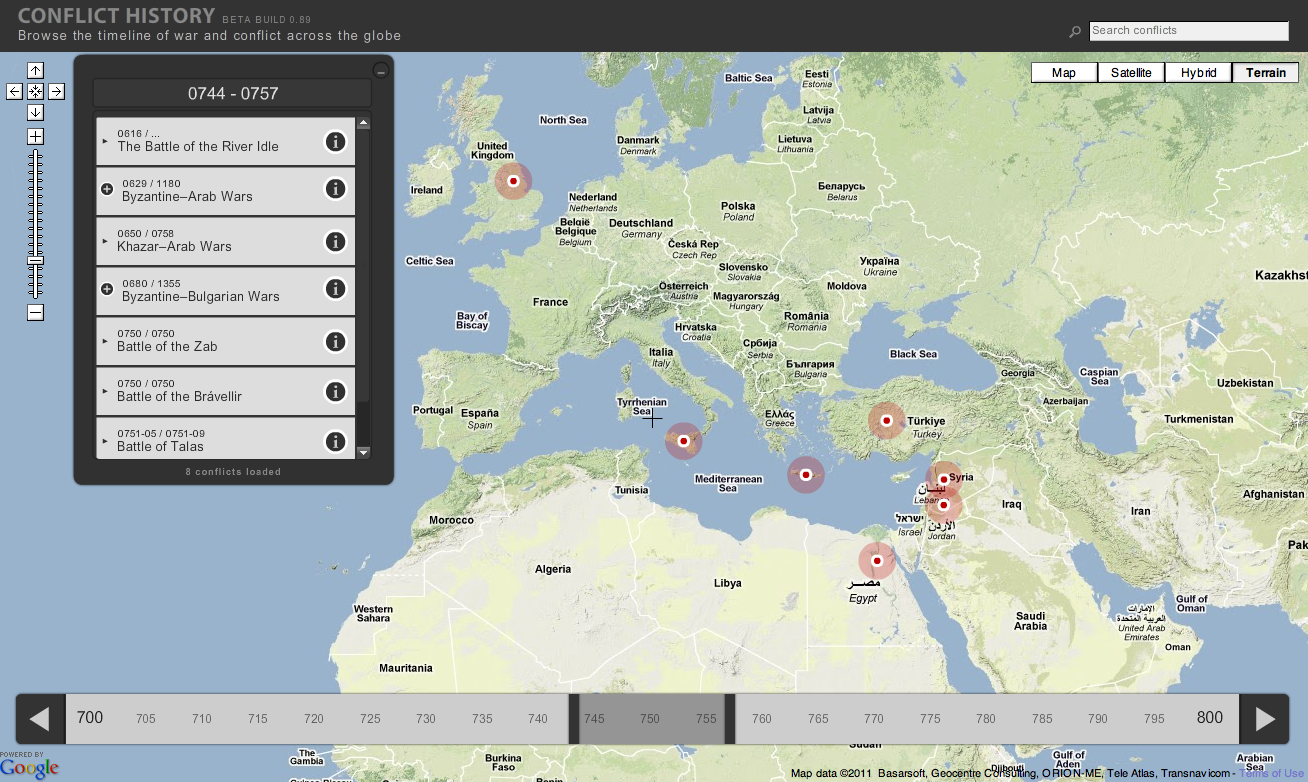
The sins of the internet are of course legion. Many if not all of those sins should be forgiven on account of Conflict History, an interactive website endeavoring to record all conflicts in human history.
As I understand it, the site is still in the beta stage. I have some vague notion of what that means and a clear understanding that the site is just stunning. Choose a period of time ,966-0971 for example, and the site will list the conflicts that occurred and locate them on a world map.
Well worth a butcher’s.
Conflict History

Bits & Pieces (TGIF and RIP Steve Jobs Edition)

Universal will make the film Tower Heist available on demand in two cities, three weeks after it debuts in theaters . . . for $59.99. Universal, for some reason, thinks this is a test of the viability of whether or not being available On Demand (for $60, three weeks after it opens in theaters!) hurts performance in those cities.

A test would be doing this the same day it debuts in theaters, or 3 weeks later but in more than two cities . . . or charging $25 instead of $60. I dunno. I guess it’s good the entertainment industry dips it’s toe in the waters of modernity, but they still don’t look like they know how to swim.

Steve Jobs as Pop Artist. Steve Jobs and the art of simplicity. Steve Jobs was a billionaire. What’s going to happen to that money? You’ll never know. Jobs as visionary. Steve Jobs says we don’t ship junk. Steve Jobs answers an insulting and condescending question at the 1997 WDC with grace and aplomb. Loved that guy. So much.

Steve Jobs talks about Xerox PARC, stealing ideas, critiques Microsoft, and more. I believe this is from when he was trying to get PR attention for NeXT.

Below, a bio of and interview with Steve Jobs. This was maybe a year before Steve Jobs returned to Apple. Listen to his prescription for Apple, which was tanking at the time, to return to its former glory. When he came back, he did exactly what he said should be done—and he was right.

Finally, Steve Jobs 2005 Commencement Address at Stanford.

Procedure Rules!

A couple of years ago as part of my master’s program I took a parliamentary procedures course. It was taught by a guy who works for the Congressional Research Service, which is part of the Library of Congress. The staff there does policy and analysis work on behalf of individual members. It’s kind of an odd little shop in that they don’t post their reports publicly. They kind of become the property of the requesting member of Congress, who then can release them publicly. There’s a site, Open CRS, that posts the reports that it’s able to obtain. CRS believes its mandate is to serve members of Congress and not the public, so it has fought effort to publicly release it’s data.

So, the next time you’re looking for what GAO or CBO are saying about an issue, head over to Open CRS to see what they’ve done.

The other thing about CRS, is that quite a few staffers are parliamentarians. They know every procedure and rule inside and out and the history behind it. The class I took on procedure was fascinating, as was the man who taught it. I think he’s retired now, but he had been with the CRS since at least LBJ’s time in the senate.

I missed whatever happened on the senate floor last night with the so-called “nuclear” option so I can’t comment on that, other than I don’t think you can abuse the filibuster as a rule and I think minority rights are paramount.

But I’m positive each side had CRS whispering in its ear, like the offensive coordinator calling plays into to quarterback.

I’ll close with a little tidbit from the procedure’s class prof on getting legislation through Congress. “You take policy and I’ll take procedure. And I’ll kick your ass. every. single. time.”

Making it About Oneself: Reacting to The Tea Party and Occupy Wall Street

Whatever else The Tea Party and Occupy Wall Street are or are not, they are, for me at least, amusing opportunity for introspection. The Tea Party and Occupy Wall Street, reveal, for me at least, more about myself than anything else.

I blame these groups because, honestly, there just isn’t much there. The Tea Party has the virtue of being specific about wanting to cut spending and slash taxes, but as far as I can see anything that a reasonable person could call a program for governing is something The Tea Party hasn’t offered and has no interest whatsoever in offering. Occupy Wall Street has the virtue of being vague. “It’s not fair”, is , as far as I can tell, the basic cry of Occupy Wall Street and that isn’t a demand for concrete action and policies.

Which is to say that I find it hard to take either of these groups seriously (as far as policy is concerned at least) because neither is offering very much at all.

With nothing really to latch on to, I’m left with a kind of mild fondness for Occupy Wall Street and a kind of mild distaste for The Tea Party.

I equate The Tea Party with deep grouchiness. That’s unfair. That’s kind of the point. And perhaps I’m mistaking grouchiness for serious, passionate concern about unrestrained government spending.

Still, grouchiness. That’s what I think of when I think of The Tea Party.

I equate Occupy Wall Street with youth, energy, and a general earnest desire to improve conditions. Just as unfair. And perhaps I’m mistaking youth, energy, and desire for naivete.

Again, I blame The Tea Party and Occupy Wall Street for this. Apart from any feeling or impressions I have about Plato’s Republic, I have an understanding of it. I understand the arguments, the positions, and have some understanding of the merits and shortcomings of the arguments and positions. I don’t have that with either The Tea Party or Occupy Wall Street, a good indication, to me at least, that neither group has yet put anything serious on the table.

Occupy Wall Street!

Good luck with that.

A number of folks have linked to Paul Krugman’s article praising the Occupy Wall Street protests. He titled it “Confronting the Malefactors”, though, assuming by “malefactors” he means Wall Street bankers, I have to ask: this is confronting them? Really?

Quoth the Krugman:

In the first act, bankers took advantage of deregulation to run wild (and pay themselves princely sums), inflating huge bubbles through reckless lending. In the second act, the bubbles burst — but bankers were bailed out by taxpayers, with remarkably few strings attached, even as ordinary workers continued to suffer the consequences of the bankers’ sins. And, in the third act, bankers showed their gratitude by turning on the people who had saved them, throwing their support — and the wealth they still possessed thanks to the bailouts — behind politicians who promised to keep their taxes low and dismantle the mild regulations erected in the aftermath of the crisis.

I highlighted the bit about reckless lending. Really, that’s what created the crisis? In the mortgage industry, didn’t Fannie Mae and Freddie Mac encourage reckless lending? And how does reckless lending auto-magically translate into AAA ratings for bundles of sure-to-default mortgages, or bundling them and reselling them in what (if I’m not mistaken) was a fairly opaque marketplace? And isn’t reckless borrowing an automatic corollary to reckless lending?

And as for the 3rd act—it was entirely predictable. Of course that’s how it worked out, as many people, both left and right, predicted. Numerous conservative pundits—Rush Limbaugh, to name one—characterized the bank bailout as being necessary to preserve the wealth of the friends and associates of Ben Bernanke and Timothy Geithner. It was such an emergency because if their friends had to lose their second (or 3rd) home in the Hamptons, Bernanke and Geithner’s names would have been mud (that was the Limbaugh theory, anyway).

Given this history, how can you not applaud the protesters for finally taking a stand?

I mean, yeah, sure. But in my experience, they’ll be applauding themselves with enough enthusiasm and vigor for all of us. And of all the things in their lives they could possibly have an actual positive influence on (albeit, a positive influence that does not stroke their egos nearly as effectively), they pick the “influence” equivalent of buying a dozen lottery tickets in order to make their first million. If they tried to start a movement to get folks to pick up litter around their own neighborhoods, they’d probably have a more positive influence. But I suspect Occupy Wall Street (and the attention it’s getting—visiting their grandparents at the nursing home would never get them TV coverage) makes them feel special, and like they are part of a movement, and while I was quite judgmental of that in my college years, I do understand it, and can’t blame them. If can evoke a lot of positive feelings about yourself and your friends, make you feel like you can make a difference (while, ironically, doing nothing that’s actually going to make a difference), releases endorphins, and I’m sure more than a few of those people have gotten laid where the otherwise would have spent their nights alone, commenting on blogs, like . . . well, never mind that. ; )

The people who ought to have taken a stand—our politicians, both left and right—either did not, or did very mildly, with input from their banker friends, lobbyists, and, of course, Wal-Mart (not a slam; you know I love me some Wal-Mart). The resulting legislation was mostly crafted by the winning oligarchs, not by thoughtful bureaucrats attempting to over-regulate the banking sector in order to prevent future financial devastation coming from the same stupid incentive system.

Bear in mind, too, that experience has made it painfully clear that men in suits not only don’t have any monopoly on wisdom, they have very little wisdom to offer.

Says the guy who I almost always see in a suit. Just an observation.

remember how many serious people assured us that there was no housing bubble

And who was yelling from the roof tops that not only was their a real estate bubble, but that a collapse was coming? Glenn Beck. Just noting, for the record.

And . . . here comes the co-option by serious-minded academics and policy people:

A better critique of the protests is the absence of specific policy demands. It would probably be helpful if protesters could agree on at least a few main policy changes they would like to see enacted. But we shouldn’t make too much of the lack of specifics. It’s clear what kinds of things the Occupy Wall Street demonstrators want, and it’s really the job of policy intellectuals and politicians to fill in the details. 

You see what he’s doing there, right? Oh, these fine young people, they are so admirable. I love them so much. Now, that they’ve got your attention, let me tell you what we should do. It will be remarkably similar to what I personally advocate all the time, but it’s all about the young people. Occupy Wall Street!

Finally:

And if the protests goad some politicians into doing what they should have been doing all along, Occupy Wall Street will have been a smashing success.

That would be lovely, but I’m not going to hold my breath.

Big Jobs Number

Nonfarm Payrolls up 103k. Last month’s 0 number revised up to 57k.

Private payrolls (ie excluding government jobs) up 137k, with last month’s number revised up from 17k to 42k. This means that jobs are moving out of the public sector and into the private sector. Which, despite the controversy around saying so, is good news. (Although the revised numbers from last month suggest that the public sector actually added 15k jobs last month.)

Unemployment rate remains unchanged at 9.1%.

Big selloff in bonds as a result. Rates higher. Stock futures up….Dow up 119 and S&P up 15.

All-in, a good and encouraging jobs report this month.

Bits & Pieces (How Thursday Evening Should Have Ended)

All right, I’m doing this one before the Wednesday one goes live. Yes, I’m getting ahead of myself. But there’s a reason for it:

How Toy Story III should have ended. Seriously, it should have.

One of my favorite movies as a kid was Superman: The Movie. And this is how it should have ended:

My favorite trilogy of movies may be Back to the Future (more on that in a moment), but The Lord of the Rings is practically a tie. I love those movies. And this is how the single 45 minute LoTR movie should have ended:

Remember what I said about Back to the Future? I also adore the first two Terminator movies (T3 and T:S both sucked). So, why don’t you make like a tree, and get out of here?
— KW

—Michigoose

The Decline and Fall of Violence

Apropos of the previous post on torture, I might briefly point you at this piece on Marketplace, featuring the Freakonomics guys, Steven Dubner and Steven Levitt. He briefly discusses the drop in violent crime over the past 20 years, but also touches on (too briefly for me) what a peaceful utopia we live in now–and have lived in throughout the 20th century–compared to most of the rest of human history.

http://www.freakonomics.com/2011/10/04/the-decline-and-fall-of-violence/

Or just go straight to the Podcast by clicking here.

I loved the anecdote from Pepys’ diary, where Pepys observes a general being drawn and quartered before going out to a pub and having some oysters.

Don’t miss the Q&A with Steven Pinker, author of the book The Better Angels of our Nature, which inspired this particular piece.

Briefly, the reason crime is down in the past 20 years: more people in prison, the decline of crack cocaine, and the legalization of abortion. Discuss.

Also, pertaining to our discussion the other day about the limits of common sense, they touch on the fact that crime has fallen in concert with a rise and poverty and our bad economy and that, in fact, that’s almost always what happens.