Morning Report – Dovish FOMC minutes 1/8/15

Markets are higher this morning on optimism about further QE in Europe. Bonds and MBS are down.

Initial Jobless Claims came in at 294k, slightly higher than expected, but below the 300k rate. Challenger Job Cuts increased 6.6%, and the Bloomberg Consumer Comfort Index rose to 43.6.

Freddie Mac announced the US 30 year mortgage is at 3.73%, the lowest since May of 2013. Remind me again of why the Fed bought $4 trillion in Treasuries and MBS…

President Obama announced that FHA is lowering fees. The fee for a FHA loan will drop from 1.35% to .85%. Prior to the crisis, the fee was .55%. The hope is that this will jump-start the housing market and entice the first time homebuyer to return. Certainly the value proposition between buying and renting is highly favorable and rents are increasing. Secondly, he will take aim at lender overlays and direct FHA to cut red tape and provide more clarity to lenders. He will give a speech today in Phoenix, and is supposed to address this initiative further.

The FOMC minutes were taken as slightly dovish by the markets. They mentioned Q3 GDP being large, but attributed it to higher than expected government spending which is unlikely to be repeated. They also didn’t address unwinding their book of MBS and Treasuries, which was mentioned at the June FOMC meeting. The Street is still thinking that rates will start going up at the June meeting, however it seems like the forecast for the rate of increases may be slowing – in other words instead of raising the Fed Funds rate 25 bps at each meeting, raising it 25 bps at every other meeting.

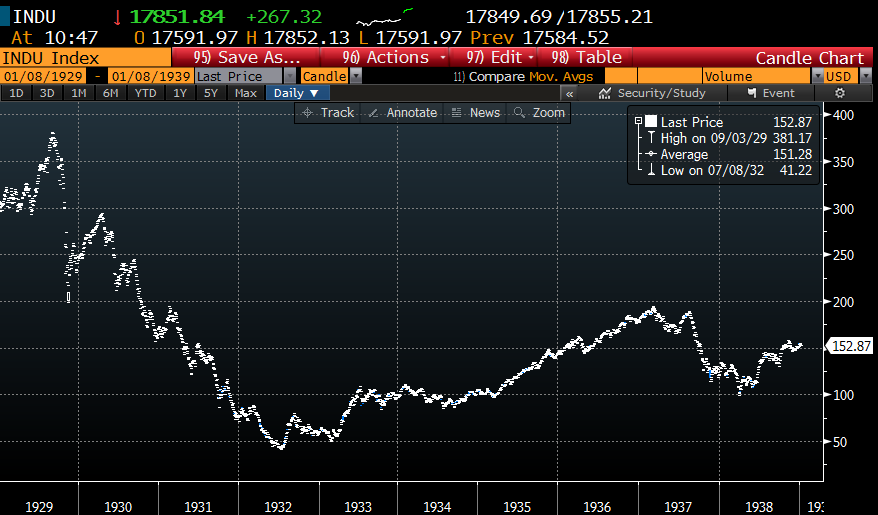
Chicago FRB President Charles Evans (a dove) said yesterday that inflation might not hit the Fed’s target until 2018, and that we should probably not increase the Fed Funds rate until 2016. Certainly falling energy prices gives the Fed more room to maneuver. Certainly the Fed is cognizant of 1937, where they increased reserve requirements (a form of tightening) and sent the economy into a tailspin. This was the “recession in the Depression” where the Dow Jones Industrial Average got cut in half over the course of a year. Incidentally, this was also where the “smart money” got carried out. The smart money was short in 1929, but long in 1937. Bernanke was a student of history and is a Great Depression expert. Janet Yellen is very similar to Bernanke, and it seems is willing to risk higher inflation in order to take a 1937 off the table.
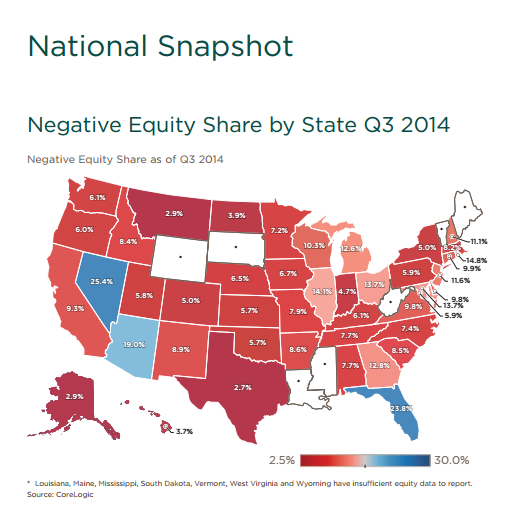
Negative equity fell by $10.2 billion, or 10.3% in the third quarter, according to CoreLogic. 19% of residential mortgages have less than 20% equity, and 2.6% of mortgages have less than 5% equity. Negative equity has been a drag on economic growth in a number of ways – first, it dampens consumer spending, but more importantly, it creates friction in the system, making it difficult for people to leave areas where there are few opportunities and go to where there are more opportunities. Think of unemployed auto workers in the Rust Belt who would gladly take jobs in the energy patch if they could sell their home in Ohio and move to North Dakota.
When talking about cheap energy, everyone likes to talk about oil or gasoline prices, which makes sense – that is the most visible data point. However, natural gas has been absolutely pummeled, trading below $3.00 right now. This means lower electricity prices going forward, and is one of the big reasons why we are seeing manufacturing (especially energy-intensive manufacturing) return the the US.

Morning Report – CoreLogic 2015 Housing forecast 1/7/15

Markets are higher this morning as world equity markets recover and global bond markets take a breather. Bonds and MBS are down

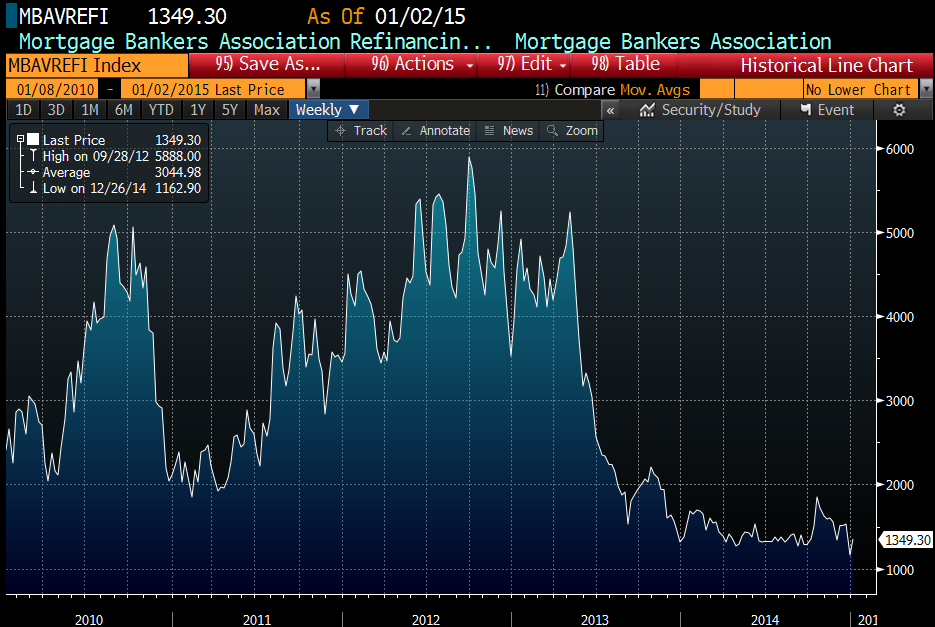
Mortgage Applications rose 11.1% last week, with purchases rising 4.5% and refis increasing 16%. The refi index is bouncing back from a highly depressed Christmas week level, so don’t break out the champagne quite yet. That said, the last time rates were around here, home prices were a lot lower. Cash out refis to pay down credit card debt and HELOCs will be attractive to many borrowers.

Was yesterday’s intraday low of 1.88% on the 10 year a capitulation low? Not sure yet. Remember, the action is being driven by European economic weakness and the prospect of more QE at the ECB. We are just being taken along for the ride. Which means that this gift may be fleeting.

From the recent ISM and factory order data, it looks like things slowed down a bit in December. Do not look for another 5% print on Q4 GDP – most strategists are looking at a growth rate in the mid 2s.

The ADP employment survey reports that 241k jobs were created in December, more or less in line with the Street expectations for Friday’s payroll number. I am hearing anecdotally that the normal seasonal (post-holiday) layoffs are not happening this year as employers hold on to people in anticipation of growth. Remember, the number to watch on Friday is average weekly earnings – that is the most important number.

CoreLogic is forecasting home sales will increase 9% in 2015, housing starts will increase 14% and home price appreciation will moderate…The big story? Employment growth in the Millennial age cohort, which will herald the return of the first time homebuyer.

Morning Report – Home Price Appreciation is slowing in the oil states and DC 1/6/15

Stocks are flattish after yesterday’s bloodbath. The 10 year bond is trading with a 1 handle. Oil is trading below $50 a barrel.

US bonds continue to be dragged lower by bond markets worldwide. You can now get a whopping 29 basis points for lending money to the Japanese government for 10 years. If you invested a million yen in a JGB, your quarterly interest payment would probably not even cover a Venti latte at a Starbucks in Tokyo.

It is looking like the economy took a step back in December, with the ISM Services Index falling to 56.2 from 59.3, and factory orders falling by .7%. I am beginning to wonder if Friday’s expectations might be too high.

Home prices rose .1% month over month in November, and are up 5.5% year over year, according to Corelogic. Growth is slowing in the big oil states and also in Washington DC.

It looks like yesterday’s auto sales were indeed strong. We could have the best year since 2005. I think the average age of an American car is something like 11.5 years, which is a record. We are seriously due for an upgrade cycle. Unfortunately for environmentalists, the low price of gas is encouraging us to buy SUVs and not Prii.

The ground has shifted under cable TV providers. ESPN is going streaming. This is huge and paves the way for a la carte content

Ocwen has been taken to the woodshed after it agreed to sell its government MSR portfolio. The stock is down 77% over the past year. The big question is whether they have a business going forward. At this point, however it is probably trading close to asset value. If Ocwen does a fire sale, that could mean MSR values get hit (as we saw in 2009, 2010). This would mean lower gain on sale (SRPs) which means lower margins for the lenders. Stonegate has been getting hit as well.

Morning Report – The Week Ahead 1/5/15

Markets are lower this morning as oil and the euro continue to slide. Bonds and MBS are up.

The NY ISM came in at 70.8, a very strong number. We are also getting December vehicle sales this morning, and the generally look strong.

This promises to be an eventful week, with the FOMC minutes on Wednesday and the jobs report on Friday. It will be interesting to see how the Fed viewed 3Q GDP at 5% – is this a temporary blip, or the beginning of a more robust recovery. Note the Fed did not change its 2015 GDP estimate, which is still in the range of 2.6% to 3.0%. I would be interested to see their internal forecast for the price of oil, but that won’t be released.

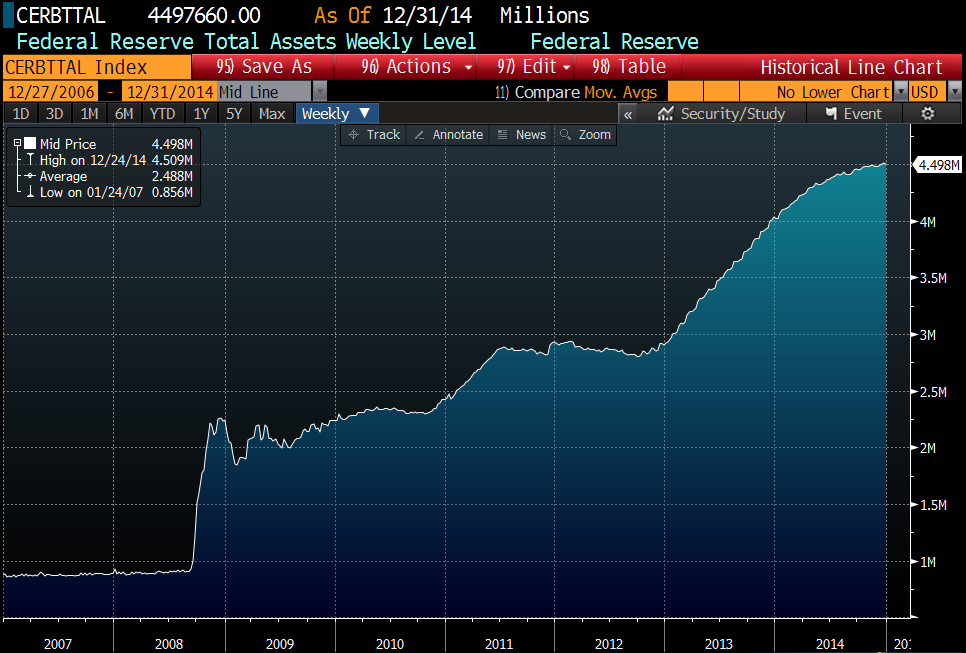
The other focus will be on the Fed’s MBS portfolio: If I were the Fed, I would be very reluctant to continue to purchase MBS at these levels. While QE is officially done, the Fed is still re-investing funds from maturing MBS back into the market. With prepayment speeds picking up, it seems like the Fed has a golden opportunity to shrink its balance sheet with a minimum of disruption to the capital markets.

Chart: Federal Reserve Bank Total Assets 2006 – Present:

While the drop in oil is a good thing for the US, it does pose some risks to the financial system, as emerging market distressed debt continues to get smoked. The banking system is much better capitalized now than it was in 2008 or even the late 90s, when the Asian Tiger crisis threw the markets for a loop. This is already pushing down interest rates worldwide (the flight to quality), so keep in mind the push-pull dynamic happening with US rates – in an economic vacuum, US rates would be much higher due to the recovery, but international worries and relative value trades are pulling them lower. One possible dark cloud – during the Asian Tiger Crisis, the Fed cut rates help ease the pain in the financial system. They don’t have that option this time.

Morning Report – Box Scores for 2014 1/2/15

Markets are higher on no real news. Bonds and MBS are flat.
Box scores for 2014:
12/31/2014 12/31/2014       Change
S&P 500 1848 2059 11.42%
US 10 year yield 3.03% 2.17% -0.86%
Crude Oil $98.54 $52.37 -46.85%
US Dollar Index 80.035 90.269 12.79%
Case-Shiller 165.9 173.4 4.52%
30 year fixed rate mortgage 4.54% 3.99% -0.55%
Federal Reserve Bank Total Assets ($ trillions) 4.03 4.49 11.41%
Clearly the biggest surprise of the year was the drop in interest rates and oil.
Pending Home Sales ticked up .8% in November, according to NAR. They are up 1.7% year over year.
The ISM Manufacturing Index fell from 58.7 to 55.5 in December, while prices paid fell from 44.5 to 38.5.
Construction Spending fell .3% in November.
Happy New Year to all, and may the Fed stick the landing.

Morning Report – US multinationals flocking to Europe to borrow money 12/30/14

Markets are lower this morning on overseas weakness. Bonds and MBS are up.

House prices rose .76% month-over-month in October (up 4.5%) year-over-year according to Case-Shiller. Prices are back to their Autumn 2004 levels.

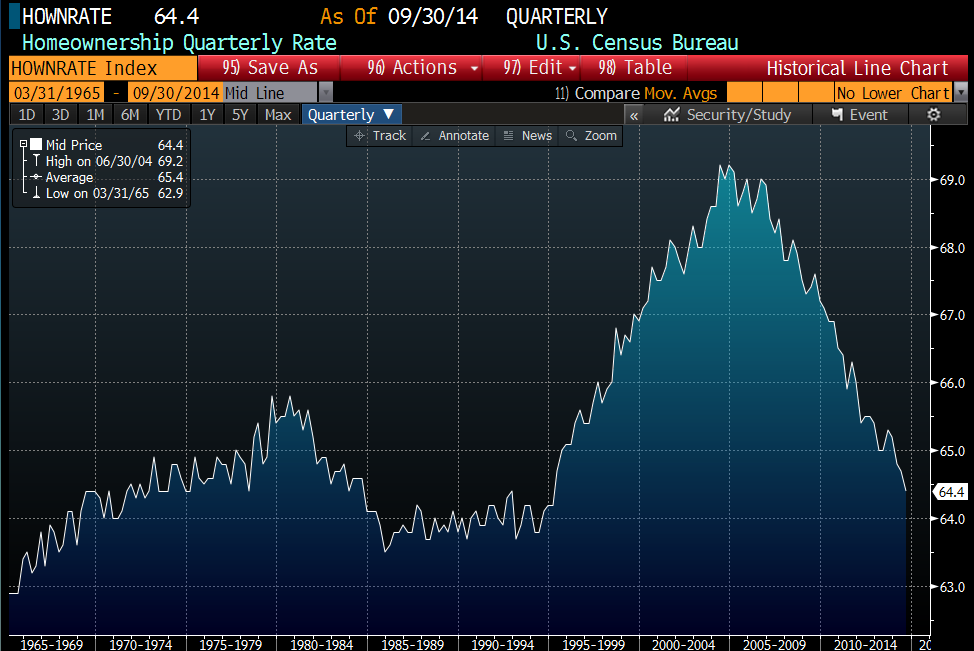
Americans spent about 5% more on rent last year, driven by a 2% increase in the number of renters and a 3% increase in prices. Zillow is predicting that rents will increase by 3.5% next year, while housing prices will increase by 2.5%. Note that the homeownership rate fell to 64.4% in Q3, the lowest since the mid 1990s. Is this number simply a return to normalcy, or are we going to see the homeownership rate increase? Certainly, policy makes a difference, and the government is back in the business of encouraging home ownership. So don’t be surprised to start hearing talk about another secular uptrend in housing…

The prospect of QE has driven risk-free rates lower in Europe, which has lured US companies to issue Euro bonds. The spread between investment grade Euro notes and investment grade dollar notes is currently 211 basis points, an all-time high, and a big increase from 145 bp a year ago. Companies like Apple are issuing billion in euro bonds yielding something like 1.65%. If you wonder why the big S&P 500 companies seem to be doing great, in defiance of what we see around us, here you go. International exposure matters. The local muffler shop cannot borrow at 1.65% while multinationals like Apple can. While the economy is improving, the stock market is painting a non-representative picture of the US economy.

Delinquencies ticked up to 6% in November, according to Black Knight Financial Services. Foreclosure starts ticked down to 73,900. Note Black Knight Financial Services (formerly known as LPS or Lending Processor Services) has filed for an IPO.

Morning Report – The week ahead 12/29/14

Markets are down small on no real news. Bonds and MBS are up.

This week promises to be relatively quiet with the New Year’s holiday in the middle of the week. There might be some volatility in bonds as dealers square up their positions for year’s end.

Greece is back in the news, as political wrangling risks the rescue package they have from the ECB. The 10 year Greek bond yield is up 130 basis points this morning, to 9.8%. At the margin, this will help keep a bid under Treasuries.

Home Prices are up 4.5% year-over-year, according to Black Knight Financial Services, which puts prices about 10% off of their peak levels in June 2006. We will get Case-Shiller tomorrow.

Will 2015 herald the return of the first time homebuyer? It is looking like it might happen, as lending loosens up, the job market improves, and supply comes on line. Note the homebuilders like D.R. Horton and KB Home are rolling out more starter homes.

Holiday spending was strong, according to data released by MasterCard. They saw spending up 5.5%, while the National Retail Federation saw sales up 4.1%. Online sales rose 14%. Pent-up demand is beginning to be satisfied. Low gasoline prices are a big help.

Boxing Day Faux Morning Report

It being Boxing Day in the UK and a Friday for the rest of the world, there is no European markets open and no Asian markets to follow our own. So the US is pretty much dead today, despite being officially open. I posted this mainly to avoid having to despoil the Merry Christmas post with a link to Matthew Yglesias.

Morning Report – Pre-holiday data dump 12/23/14

Markets are higher as decent data comes in. Bonds and MBS are down small. Almost all of this week’s data is being released today. Today is a full day, Wed will be a half day, and Friday will be a full day (so far).

Third quarter GDP was revised upward to to +5% from +3.9%. Personal Consumption was revised upward from 2.2% to 3.2%. Inflation remained unchanged at +1.4%.

Durable Goods orders on the other hand came in weaker than expected, down .7%, after the Street was expecting +3%.

New Home Sales fell to 438k from 458k last month. This is the seasonal slow period, so I wouldn’t read too much into it.

Personal Income rose .4% in November, while Personal Spending rose .5%. The PCE deflator (the preferred inflation measure for the Fed) was down .2% on a month-over-month basis and up 1.2% on a year-over year basis.

The University of Michigan Consumer Sentiment Index ticked down to 93.6 in December. The Richmond Fed Manufacturing Index rose to 7 from 4.

The FHFA Home Price Index rose .6% in October after a flat September. On a year over year basis, home prices increased 4.5%. The index is roughly 5% lower than its April 2007 peak. Remember, this index only looks at homes with a conforming mortgage, so it is a narrower sample than Case-Shiller.

Ocwen stock got slammed yesterday as they announced a settlement with New York State and its founder stepped down. Ocwen will not be able to purchase any more MSRs without New York State approval. They also were fined $150 million. The stock got rocked for 27% yesterday, and is down 70% for the year.The stock is down another 3 bucks (19%) this morning.. This one may be a value trap, folks.

Rick Santelli from CNBC spells out the yield curve flattening scenarios. The yield curve has been flattening (the spread between long term rates and short term rates has been narrowing), and many traders continue to have “flattening” trades on. Essentially, this is what i was talking about yesterday with the Fed – the Fed could raise short term rates yet the 10 year (and mortgage rates) might not move all that much because of global demand for long-term sovereign debt. He also points out the big caveat to this: that ECB President Mario Draghi pursues a less aggressive policy than the market is already pricing in. This would put pressure on Euro sovereigns with microscopic yields (like the German Bund at 59 basis points), and could cause world sovereign bond markets to sell off in a co-ordinated fashion. Remember the economic backdrop in the US: A 5% GDP growth rate and a 2.2% 10 year bond yield are strange bedfellows. Note that a sell off in bonds might not guarantee a rally in the stock market either…

Finally, the MR will be on hiatus for the holidays. Wishing you and yours all the best.

Morning Report – Further home price appreciation probably limited until wage growth returns 12/22/14

This week is for all intents and purposes a two day week. Markets will close early on Christmas Eve and many will take off Friday.

The big deluge of data is tomorrow, with GDP, personal income, personal spending and a host of other indicators.

The risk-on trade continues this morning, with stocks up small and bonds down a tad. Oil continues to fall.

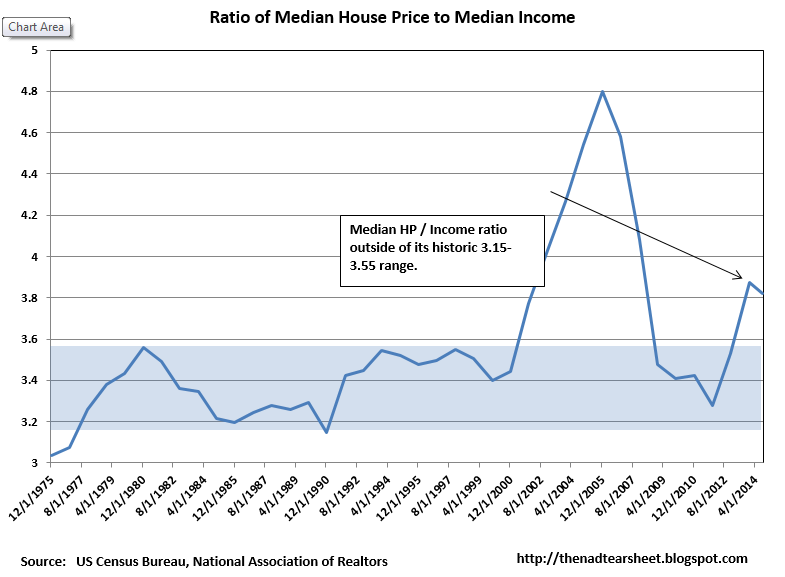
Existing Home Sales fell 6.1% to a seasonally adjusted annual rate of 4.93 million, according to NAR. Housing inventory was tight and bad weather didn’t help things either. The median existing home price was 205,300, which is 5% above November 2013. According to Sentier Research, the median income in the US was $53,700 as of the end of October. This makes the median home price to median income ratio just over 3.8, which is above its historical range of 3.15x – 3.55x. This means home price appreciation is probably going to be hard to come by until wage inflation begins to pick up.

The Chicago Fed National Activity Index hit +.73 in November, which is a very strong reading. Production and employment drove the increase. Housing and Consumption remained small headwinds.

The strength in the US bond market is likely to continue into 2015 as global bond investors see (relatively) high yields underpinned by a strong dollar. The punch line is that even if the Fed starts hiking rates, global demand for the 10 year bond means that mortgage rates could pretty much stay where they are for the time being. In other words, the Fed could hike rates and we could simply see the yield curve flatten. That is good news for the real estate industry, obviously.

One other thing to keep in mind: a flattening yield curve is a classic “tell” that the economy is slowing down, and by all accounts, it looks like the economy is accelerating. This will be another situation where the classic investing playbook isn’t going to help you all that much. In other words, if the Fed starts hiking rates and mortgage rates stay where they are, don’t all of a sudden dump your portfolio and pile into defensives like Proctor and Gamble or General Mills.