Morning Report: Donald Trump “guts” Dodd-Frank!!!! 2/6/17

Vital Statistics:

Last Change
S&P Futures 2286.0 -5.0
Eurostoxx Index 362.3 -1.8
Oil (WTI) 53.7 -0.2
US dollar index 90.6 0.2
10 Year Govt Bond Yield 2.42%
Current Coupon Fannie Mae TBA 102.1
Current Coupon Ginnie Mae TBA 103.2
30 Year Fixed Rate Mortgage 4.19

Stocks are lower this morning as credit spreads widen in Europe. Bonds and MBS are up.

The week after the jobs report is usually data-light and this week is no exception. We have no data this morning, and about the only report of consequence is the JOLTs job opening report tomorrow. All eyes will be on the quits rate, which has been pretty steady. An increase would signal wage inflation ahead.

Goldman strategists are beginning to re-think their initial bullishness on the Trump administration. Instead of tackling things like tax reform, he is spending his energy on immigration and trade. There is a realization that gridlock is going to be the norm for the next two years, and that means no big, sweeping changes. Regulatory relief is still possible, but bureaucrats seem to be preparing to push back against major changes in direction. So the “Trump effect” could end up being a lot smaller than investors (and the Fed) were thinking a month ago. Which means the Fed has more room to be cautious.

MBS investors are beginning to worry about what happens to MBS when the Fed stops re-investing maturing proceeds from its QE portfolio. After all, the Fed has been the biggest buyer of MBS paper. Will the lower demand for mortgage backed securities translate into higher mortgage rates, even if the 10 year goes nowhere? It is possible, however take a look at the chart below: I plotted the 10 year yield and the 30 year mortgage rate, with the difference between the two (the spread) below. The two blue shaded regions were QE1, 2 and 3. The green line didn’t really move all that much during QE. MBS spreads are about where they were prior to QE. Since the Fed isn’t entertaining selling bonds, just not buying them anymore, the pre-QE level of something like 167 basis points is about right. Right now, the spread is 177 basis points, which probably represents some of the lag you see in mortgage rates versus Treasuries. My point is that MBS spreads vary over time, but they have historically been around these levels. I can’t see MBS spreads making or breaking a homebuying decision. They just aren’t that significant.
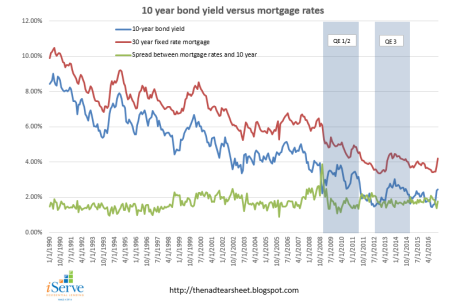
10 year vs mortgage rates.PNG

On Friday, Donald Trump signed an executive order which directed a review of Dodd-Frank. There were the expected breathless headlines in the business press (with a stroke of a pen, Donald Trump eliminates Dodd-Frank, he’s “gutting” Dodd-Frank), however this is just a “review and report back to me” order. A full repeal of Dodd-Frank would be impossible, and probably would not be supported by the industry: after all, they have spent the past 6 years getting compliant with D-F and the last thing they want to do is have to adopt some new system. The unintended consequences will be addressed, but the structure will probably remain in place. These will turn out to be addressing the CFPB and small banking regulation in order to get credit flowing for smaller borrowers, addressing the Volcker rule to encourage market making, and the fiduciary rule, which many financial advisors interpret as a gag order and a limitation of the investment options menu. What does this mean for the mortgage business? Probably not much, although the biggest potential is in an easing of CFPB enforcement and an increase in mortgage products as the private label securitization market returns.

Morning Report: Decent Jobs report 2/3/17

Vital Statistics:

Last Change
S&P Futures 2281.3 4.5
Eurostoxx Index 364.1 2.2
Oil (WTI) 53.8 0.2
US dollar index 90.6 0.1
10 Year Govt Bond Yield 2.47%
Current Coupon Fannie Mae TBA 102.1
Current Coupon Ginnie Mae TBA 103.2
30 Year Fixed Rate Mortgage 4.19

Stocks are up after a decent jobs report. Bonds and MBS are up as well.

Jobs report data dump:

  • Nonfarm payrolls up 227,000
  • 2 month prior revision down 39,000
  • Unemployment rate 4.8%
  • Underemployment rate 9.4%
  • Labor force participation rate 62.9%
  • Average hourly earnings up 0.2% MOM / up 2.5% YOY

Overall, a pretty decent report. Payrolls were much better than expectations, although the downward revision of 40,000 to November offset that somewhat. The employment to population ratio ticked up from 59.7 to 59.9, which is something the Fed pays close attention to. The year-over-year increase in wages took a step back, but part of that is due to very strong January 2016 number which fell off the YOY comparison. In terms of industries, we saw big increases in construction and retail. The oil patch is hiring again as well. In some ways this was a Goldilocks type report: strong enough to make the stock market happy, and weak enough in wage growth to keep bonds from selling off.

The ISM non-manufacturing index took a step back in January from December’s strong pace. Factory orders increased 1.3%.

President Trump has ordered a comprehensive review of Dodd-Frank and suspended Obama’s fiduciary rule executive order which was to take effect in April. The goal of the review is to remove regulatory burdens to the financial industry and to increase investor options, according to an administration official. Areas of focus include reforming the CFPB, the Volcker rule, and the fiduciary order. Critics claim that the CFPB is restricting credit, the Volcker rule is restricting liquidity in the markets, and the fiduciary rule amounts to a gag order for retirement advisors.

US CEOs are meeting with Donald Trump today, as the relationship between the two becomes more tenuous. The problems are twofold. First, the left is organizing boycotts on any company associated with the Trump administration, while culminated in Uber’s CEO resigning from Trump’s business panel after the #deleteUber campaign. Second, fears of immigration limits are worrying many, particularly in the tech space. Finally Trump’s naming and shaming of companies via Twitter is causing uncertainty as well.

Interesting article in the Wall Street Journal about the future of the labor market and the business world’s continued move towards outsourcing, even within the US. Companies like Pratt and Whitney are now using UPS to handle parts of the logistics chain that used to be done by Pratt and Whitney employees. This obviously gives the company more flexibility and they don’t have to deal with the HR issues of hiring and firing. Temporary worker agencies continue to grow and allows companies to have “just in time” employee management. Accenture sees a future where the only full time employees at some companies are C-level: the rest will be temps. I wonder if it will work out the way these companies imagine however. Once these agencies control vast parts of the company’s operations, the agency will be able to hold up a company for higher rates the way unions used to hold up companies for higher wages.

Freddie Mac has a somewhat gloomy outlook for origination next year, forecasting a drop of 25% from 2016’s level of $2 trillion in origination. They see the 30 year mortgage rate averaging 4.4% and total home sales falling from 6 million to 5.75 million. House price growth is expected to moderate to 4.7% from 6%. Freddie Mac is baking in some possibility of expansionary fiscal policy coming out of Washington, especially with respect to tax reform, where an increase in the standard deduction will reduce the incentive to itemize and reduce the subsidy from the mortgage interest deduction. They do point out that increases in interest rates have been generally short-lived over the past 8 years as slow global growth and excess savings find their way into the bond market. Freddie Mac caveats this outlook with the fact that the new administration provides a lot of uncertainty. FWIW, it is looking like it will take 60 votes to get anything done in the Senate, which means a fiscal status quo. That will likely mean only 2 hikes in 2017, not 3. Rates may not be going up as much as people think.

You can see the refinanceable population has decreased significantly as rates have risen:

refinanciable population.PNG

The CFPB had another setback in the PHH case.

Morning Report: 2016 had the lowest homeownership rate since 1965 2/2/17

Vital Statistics:

Last Change
S&P Futures 2267.5 -7.0
Eurostoxx Index 362.7 -0.5
Oil (WTI) 54.0 0.2
US dollar index 90.2 -0.4
10 Year Govt Bond Yield 2.44%
Current Coupon Fannie Mae TBA 102.1
Current Coupon Ginnie Mae TBA 103.2
30 Year Fixed Rate Mortgage 4.16

Stocks are lower this morning on overseas weakness. Bonds and MBS are up.

The Fed maintained interest rates at current levels and made no changes to its reinvestment policy. The statement itself was relatively dovish, which caused a small rally in bonds in the afternoon. The money quote: “In light of the current shortfall of inflation from 2 percent, the Committee will carefully monitor actual and expected progress toward its inflation goal. The Committee expects that economic conditions will evolve in a manner that will warrant only gradual increases in the federal funds rate; the federal funds rate is likely to remain, for some time, below levels that are expected to prevail in the longer run.” There was no mention of Washington, and a slight reference to improving sentiment.

Productivity remains a problem as it increased at an anemic 1.3% pace in the fourth quarter. Output increased 2.2% and hours worked increased 0.2%. Unit labor costs increased 1.7% as wages and compensation increased 3% and productivity increased 1.3%. Part of the problem is that business capital expenditures have been in maintenance mode since the financial crisis. Morgan Stanley believes that sentiment is changing, and that means more capital expenditures going forward. Higher productivity means higher non-inflationary wage growth, which translates into higher standards of living. Note the recent divergence between capital expenditure plans and actual spending.

Announced job cuts increased to 45,934 in January, according to outplacement firm Challenger, Gray and Christmas. The holiday season was atrocious for many bricks and mortar retailers, and some are shuttering stores and declaring bankruptcy. Macy’s accounted for almost a quarter of the layoffs. The energy patch is finally on the mend and hiring again.

Initial Jobless Claims fell to 246,000 last week.

The homeownership rate ticked up to 63.7% in the fourth quarter after hitting a 52 year low in the second quarter. Overall, the homeownership rate for 2016 was the lowest since records began in 1965.

NAR took a look at the aspiring homeowner in its latest survey. Affordability was the #1 reason for people not owning a home, followed by flexibility concerns. That said, 88% of non-owners eventually do want to own a home. There still seems to be a disconnect between what people think they need (as far as a downpayment) versus what is actually required. FHA loans remain the best way to get these people their first home.

Morning Report: Blowout ADP number 2/1/17

Vital Statistics:

Last Change
S&P Futures 2281.5 7.0
Eurostoxx Index 364.3 4.0
Oil (WTI) 53.3 0.5
US dollar index 90.7 0.2
10 Year Govt Bond Yield 2.49%
Current Coupon Fannie Mae TBA 102.1
Current Coupon Ginnie Mae TBA 103.2
30 Year Fixed Rate Mortgage 4.16

Stocks are higher this morning after a good ADP number. Bonds and MBS are down.

The private sector added 246,000 jobs in January, according to the ADP Employment Survey. This is the highest number since June 2016. We saw strong growth in construction jobs and manufacturing, while finance was flat and IT fell. The Street is looking for a 175k nonfarm payrolls in Friday’s report. The ADP number hasn’t been a great predictor of the BLS number for a while, so don’t read too much into it. While strong, this number will probably not change anything with respect to this afternoon’s Fed decision, which comes out at 2:00 pm EST.

Mortgage Applications fell 3.2% last week as purchases fell 6% and refis fell 1%, according to the MBA. The average rate for a 30 year fixed rate mortgage rose 4 basis points. Refis fell below 50% for the first time since 2015.

More evidence that the manufacturing sector is turning around: The ISM Manufacturing index hit a 2 year high in December. Input costs rose to a 5.5 year high, which is spooking the bond market a little this morning.

Construction spending fell 0.2% in December, missing expectations. It is up 4.2% YOY. Residential construction rose 0.4% and is up 3,6% YOY.

Donald Trump nominated Colorado federal appeals court judge Neil Gorsuch to the Supreme Court yesterday to replace Anonin Scalia who died last year. Democrats are vowing to filibuster in retaliation for the treatment of Obama’s nominee Merrick Garland.

Distressed sales fell in October, according to CoreLogic and are now at the lowest levels since 2007. Cash sales came in at 32%, which is still elevated compared to pre-crisis levels. Normalcy is around 25% or so.

The REO-to-Rental trade worked out for Blackstone, culminating in the IPO of Invitation Homes, which raised $1.54 billion in an IPO yesterday. The deal was priced at $20 a share, within the $18-$21 range. The stock begins trading today under the symbol INVH.

Should homebuyers wait until spring to purchase a home? It turns out the best months to purchase are January and February. Less competition means bigger discounts to the asking price.

Morning Report: Wages and Salaries increase 2.3% 1/31/17

Vital Statistics:

Last Change
S&P Futures 2270.3 -5.8
Eurostoxx Index 362.9 0.3
Oil (WTI) 53.0 0.3
US dollar index 90.8 -0.3
10 Year Govt Bond Yield 2.48%
Current Coupon Fannie Mae TBA 102.1
Current Coupon Ginnie Mae TBA 103.2
30 Year Fixed Rate Mortgage 4.16

Stocks are lower as earnings come in (and some are bad). Bonds and MBS are up small.

Employment costs increased 0.5% in the fourth quarter as wages and salaries increased 0.5% and benefit costs increased 0.4%. On a year-over-year basis, wages and salaries are up 2.3%, an uptick from the 2.1% pace a year ago. This report is more or less in line with expectations and shouldn’t have much of an effect on the FOMC’s rate decision. The meeting starts today, with an announcement scheduled for 2:00 pm EST tomorrow.  FWIW, the Fed Funds futures are pricing in a 13% chance of a rate hike tomorrow, and a 50% chance of a hike by June.

Home prices increased 5.6% YOY in November, according to the Case-Shiller Home Price Index. This index has recouped all of its losses from the bubble years. The Pacific Northwest led the charge, with prices increasing double digits in Portland and Seattle. Washington DC and NYC were the laggards.

Here is the income required to buy the median home in various locations. It varies from almost $150k in San Francisco to $34k in Cincinnati. As they say, all real estate is local.

Donald Trump promised to “do a big number” on Dodd-Frank yesterday. While the President is limited in what he can do unilaterally, he can ease the burden somewhat without legislation.

One economic historian thinks the current bond market most closely resembles the late 1960s, as we exited a multi-decade period of low inflation. From 1965-1970, inflation rose from 1.6% to 5.9%, and long term Treasuries lost 36% in real terms. The lesson from the 1960s is that inflation can sneak up on you very quickly. Of course there are fundamental structural differences in the economy that make it harder to see inflation creep up the way it did in the 1960s and 1970s, so it is probably unlikely that we will see any sort of 1970s conflagration. First, the US was insulated from globalization in the late 60s and early 70s as postwar Asia and Europe were still rebuilding. Second, union contracts had automatic cost of living increases which caused wage-push inflation. Today, we don’t have that. In fact, technology is replacing labor, which is pushing costs down, not up. Capacity Utilization rates were in the high 80s back then versus mid 70s now. Inflation is a case of too much money chasing too few goods. We might have too much money at the moment, but we don’t have too few goods. If anything, we have too much money chasing too few assets, which is why we have experienced asset bubbles over the past 30 years, not inflation.

Speaking of asset price inflation, the best investment in inflationary times can be real estate, especially when you use a 30 year fixed rate mortgage.

Single women buy houses as twice the rate of single men. Most likely explanation: kids.

Last week, I participated in a webinar for HousingWire where we discussed interest rates, regulation, and MI. The playback is here.

Morning Report: Incomes and spending rises 1/30/17

Vital Statistics:

Last Change
S&P Futures 2281.5 -7.5
Eurostoxx Index 364.2 -2.2
Oil (WTI) 53.1 0.0
US dollar index 91.4 0.0
10 Year Govt Bond Yield 2.48%
Current Coupon Fannie Mae TBA 102.1
Current Coupon Ginnie Mae TBA 103.2
30 Year Fixed Rate Mortgage 4.16

Dow 20,000 hats are off this morning as corporate earnings continue to come in. Bonds and MBS are up.

Donald Trump temporarily restricted immigration from 7 countries over the weekend until new vetting procedures are put in place. This story dominated the news cycle.

Personal Incomes rose in December by 0.3% while spending rose 0.5%. The core PCE index (the Fed’s preferred measure of inflation) is up 1.7% YOY.

Pending Home Sales increased in December, according to NAR. The challenge for 2017 will be increasing inventory enough to offset higher borrowing costs. NAR is forecasting housing starts to increase 8% this year to 1.26 million. Normalcy is closer to 1.5 million, so we have a ways to go there.

We have a big week for data, with the FOMC meeting and the jobs report on Friday. We also get productivity and employment costs, which is another huge number. We are also in the middle of earnings season with several heavyweights reporting this week.

Steve Mnuchin doesn’t appear to be interested in removing the Volcker Rule, which prohibits banks with FDIC backing to conduct proprietary trading. He does believe that it has restricted market liquidity in its implementation however and he is interested in tweaking it. Overall, it looks like Dodd-Frank will be fixed but not repealed.

A war is brewing over the state of the CFPB. Donald Trump has yet to weigh in on the agency or the fate of Richard Cordray. Also, it is looking like the CFPB will be remade into a bipartisan board as well.

80% of all mortgage borrowers are completely honest on their loan applications, according to a study by UBS. The inaccuracies generally fall into four buckets: overstated income, underreported debt, underreported expenses, and overstated assets.

The NAR’s quarterly survey of mortgage lenders is out, and problems with appraisers (or lack thereof) dominate the headaches. Over half of all respondents reported issues in this area, with 11% characterizing them as significant. One problem is the lack of new entrants, however 28% of lenders won’t accept an appraisal done by a trainee, and 44% require direct supervision of all aspects performed by a trainee. Non-QM lending fell slightly during the quarter, however investor demand for the product is rising. Rising rates are expected to have some effect on purchase demand, however there is such tight supply that it shouldn’t affect volumes overall.

Home prices are now within 0.3% of their peaks on a national level according to Black Knight Financial Services.

Morning Report: GDP disappoints 1/27/17

Vital Statistics:

Last Change
S&P Futures 2294.3 0.3
Eurostoxx Index 366.1 -1.4
Oil (WTI) 53.5 -0.3
US dollar index 91.5 0.1
10 Year Govt Bond Yield 2.51%
Current Coupon Fannie Mae TBA 102.1
Current Coupon Ginnie Mae TBA 103.2
30 Year Fixed Rate Mortgage 4.16

Stocks are flattish after GDP comes in weaker than expected. Bonds and MBS are down small.

Fourth quarter GDP growth came in at 1.9%, lower than the 2.2% Street estimate. For the year, GDP came in at 1.6%. Trade was the big drag, along with Federal government spending. This is the advance estimate and will be subject to two more revisions. Disposable personal income rose 3,7% and the PCE deflator (the Fed’s preferred measure of inflation) increased 2%, right in line with the Fed’s inflation target. Ex-food and energy it increased only 1.3%. The savings rate also fell.

The Fed has been consistently high with its estimates for GDP growth. Check out the chart below. It shows the Fed’s forecast for 2016 GDP starting with the June 2014 FOMC meeting. They started out forecasting 2.75% growth, and it actually came in at 1.6%.

fed-2016-gdp-growth-forecast

Durable Goods orders disappointed in December, falling 0.4% versus expectations of a 2.6% increase. Capital Goods orders (a proxy for business capital expenditures) increased .8%, which was below expectations again.

Consumer sentiment improved in January, according to the University of Michigan survey.

I crunched some numbers looking at the last few tightening cycles, and compared the move in the 10 year bond yield to the move in the Fed Funds rate. During the last 3 tightening cycles (1994, 1999, and 2004) the yield curve flattened, meaning that long term rates went up less than short term rates. In fact, for every percentage point increase in the Fed Funds rate, the 10 year increased by about 34 basis points. The 10 year was at 2.2% when the Fed began its latest hike. With the Fed expecting an increase of 50-75 basis points in the Fed Funds rate this year, we should see an end of 2017 Fed Funds rate of about 2.6% or so. With the 10 year already at 2.5% plus, the market is treating these increases as if they have already been made. The 10 year has gotten ahead of itself a little bit, which means we could see the yield stay at these levels during the year while the Fed Funds rate catches up.

I talked about this and other stuff during the HousingWire 2017 Housing Outlook webinar: Trump’s Mortgage Nation. There is a link in the article for a playback if you missed it. We discussed interest rates, regulation and mortgage interest.

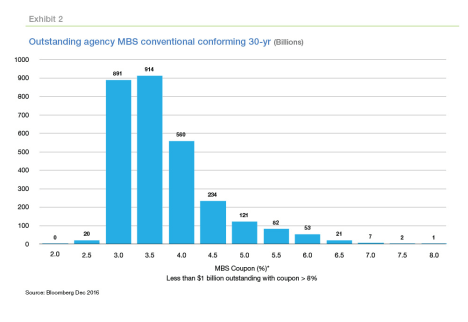
Mortgage backed securities got beat up a little yesterday after Brookings released an article by former Fed Chairman Ben Bernanke that discussed ending the practice of re-investing the cash from maturing bonds and MBS back into the market. The Fed’s balance sheet has been stuck at $4.5 trillion since QE ended, and they purchased about 360 billion worth of MBS last year to maintain their exposure. Given that total originations were probably around $2 trillion, that number is not insignificant. Does that mean spreads will widen once the Fed ends this practice of re-investing maturing proceeds? The short answer is “probably not” The spread between the 10 year and the mortgage rate is about 165 basis points or so. Prior to QE, it was around 166, and you didn’t really see any decrease in that spread when QE was active. The end of reinvestment should be a nonevent for the mortgage market.

Blue Horseshoe loves Annacott Steel

Morning Report: New Home sales drop 1/26/17

Vital Statistics:

Last Change
S&P Futures 2294.5 0.5
Eurostoxx Index 367.7 1.1
Oil (WTI) 53.1 0.3
US dollar index 91.2 0.4
10 Year Govt Bond Yield 2.53%
Current Coupon Fannie Mae TBA 102.1
Current Coupon Ginnie Mae TBA 103.2
30 Year Fixed Rate Mortgage 4.16

Stocks are flattish as earnings roll in. Bonds and MBS are down small.

New Home sales fell pretty dramatically in December, to an annualized pace of 536k from November’s revised 598k number. New home sales is a notoriously volatile number, so don’t read too much into it. The 3 month moving average has been pretty steady for the past 6 months. The median sales price was $322k (up about 7.8%) and the average sales price was $384k (up 7.2%). There were about 259,000 units for sale at the end of December, which represents a 5.8 month supply at the current rate. Sales were flat in the West, rose in the Northeast, and fell in the Midwest and South.

Initial Jobless Claims rose last week to 259k from 239k the week before.

The Chicago Fed National Activity Index improved in December to .14 from -33 the month before. This is a meta-index of about 85 different variables, some of which lag quite a bit. The 3 month moving average was still negative however. Production related indices drove the increase, while consumption and housing became somewhat less negative. Employment was flat.

The Index of Leading Economic Indicators improved to 0.5% in December versus 0.1% in November.

At 2:00 PM EST, I will be participating in Housing Wire’s 2017 outlook webinar, where I will discuss the Fed, interest rates, and why fears of further hikes in mortgage rates might be overblown. Here is the link to the webinar. Other subjects include the regulatory environment in Washington DC as well as the latest developments in mortgage insurance premiums. Registration is free.

Despite the change in MIP, Washington might be coming to a consensus that tight credit in the housing market is a problem and it might be time to roll back some of the more restrictive regulatory policies and begin to encourage homeownership. Now that the housing market is back to record highs, liberals want to see more lending to lower credit / income borrowers and are realizing that bashing the banks isn’t the best way to go about it. On the other side of the aisle, conservatives are becoming more accepting of government social engineering via the housing market and want to see housing starts rebound to some semblance of normalcy. Of course the elephant in the room is the mortgage interest deduction, which could become a casualty of tax reform.

What Dow 20,000 means for mortgage rates. Punch line: not much. It is indicative of the current “risk-on” mentality of investors, where they sell safer assets like Treasuries to buy stocks. At the margin, this does push up interest rates, however that doesn’t necessarily mean mortgage rates move up in lockstep. Note that Dow 20,000 doesn’t have nearly the hype associated with it as Dow 10,000 had. That is the difference between the tail end of a secular bull market and the tail end of a secular bear market. It took the Dow roughly 17 years to double between 10,000 and 20,000. During the 80s-90s stock bull market, the Dow quintupled from 1982-1999. Dow 10,000 was the age of stock split beepers, “poof IPOs,” and companies that found they could double their multiple by adding “.com” to their corporate moniker. This time around, investors are more jaded.

One strategist expects the Fed to begin a rapid-fire 25 basis point every quarter starting in late 2017. The consensus is that the Fed would really like to see the Fed Funds rate at 3%, which it considers a “normal” level. Much depends on what we get out of Washington and whether we get some sort of major fiscal stimulus. Aside from fiscal policy, wage inflation is probably going to be the biggest driver.

Here are the hottest markets in real estate according to Realtor.com. Some markets are what you would expect to see (like San Francisco) while others are surprises (Fort Wayne, IN). As usual, California dominated the list with 8 of the top 10 markets. California’s housing crunch is creating pushback against laws intended to discourage development.

Morning Report: Dow 20,000 1/25/17

Vital Statistics:

Last Change
S&P Futures 2284.3 10.0
Eurostoxx Index 366.3 4.4
Oil (WTI) 52.8 -0.4
US dollar index 91.1 0.0
10 Year Govt Bond Yield 2.49%
Current Coupon Fannie Mae TBA 102.1
Current Coupon Ginnie Mae TBA 103.2
30 Year Fixed Rate Mortgage 4.16

Global stocks are rallying on no real news. The Dow hit 20,000 this morning (CNBC is probably breaking out the champagne as we speak) Bonds and MBS are down on the “risk on” trade.

Mortgage applications increased 4% last week as purchases rose 6% and refis rose 0.2%. This is a 7 month high for purchases.

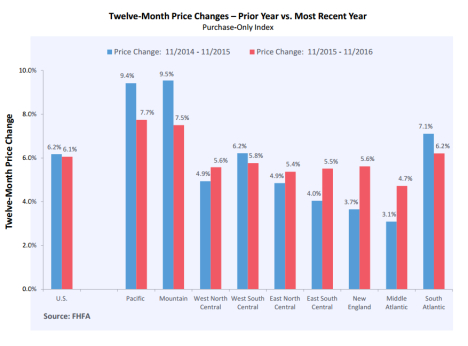
Home prices increased 0.5% in November, and are up 6.1% YOY, according to the FHFA House Price Index. Geographically, the Pacific and Mountain states continue to lead the way, while the East Coast lags, however prices are decelerating out West and accelerating in the East. Prices have more than recouped the losses from the bubble years and are hitting new highs.

fhfa-regional

Further slicing and dicing the home price data, the luxury end of the market continues to lag, while the lower price points are accelerating. Know where is getting killed in this segment? Washington DC. This shift makes sense as the Millennial generation is beginning to reach the family-forming stage and needs starter homes. Starter homes should be a fertile area for the builders over the next decade or so. We are even beginning to see a reduction in the NIMBY-ism in places like California, which face acute housing shortages.

Treasury Secretary Steve Mnuchin supports an independent central bank and is not a member of the “audit the Fed” crowd. Congressional Republicans have been pushing for more Congressional oversight of monetary policy, however independence from politicians is critical for the Fed to do its job. Politicizing the Fed is a recipe for inflation because no politician likes a recession and sometimes they are necessary to suppress inflation. In fact, the last time Congress got involved with monetary policy was the dual mandate, which requires the Fed to minimize unemployment while controlling inflation. Sounds like a reasonable policy, however in practice it has resulted in asset bubble after asset bubble.

House flipping is back to bubble-era levels. Home flippers accounted for 6.1% of sales in 2016, the highest level since 2006 when the number hit 7.3% of sales. Scarce inventory is making a good environment for house flipping, with strong home price appreciation. Eventually builders will begin to meet this demand, however for the moment, home price gambling is a big trade in places like Las Vegas.

Donald Trump met with automotive CEOs yesterday to talk about regulation and bringing jobs back to the US. He cited environmental regulations as a big disincentive to manufacture in the US. Note that there are currently about 300,000 regulations controlling manufacturing in the US. Separately, Trump allowed the permitting process for the Keystone XL and Dakota Access pipelines to begin again.

Morning Report: Home inventory at a record low 1/24/17

Vital Statistics:

Last Change
S&P Futures 2262.5 0.5
Eurostoxx Index 361.2 0.2
Oil (WTI) 53.1 0.4
US dollar index 90.9 0.2
10 Year Govt Bond Yield 2.43%
Current Coupon Fannie Mae TBA 102.1
Current Coupon Ginnie Mae TBA 103.2
30 Year Fixed Rate Mortgage 4.19

Stocks are flat this morning as earnings continue to roll in. Bonds and MBS are down.

Existing home sales fell 2.8% in December to an annualized rate of 5.49 million, according to the NAR. This caps off 2016 as the best year for existing home sales since 2006. The median home price was $232,200, up 4% YOY. Tight inventory remains a problem, with inventory dropping to a record low of 1.65 million homes for sale. This represents a 3.6 month supply, which is well below the 6.5 month supply which represents a balanced market. NAR estimates that housing starts need to be at 1.5 – 1.6 million to keep up with demand and demographic changes, which are historically normal levels. We have been at recessionary levels for the past 8 years. After recoveries, it is not unusual to see starts approaching 2 million. The first time homebuyer accounted for 32% of sales – historically that number is closer to 40%.

Ben Carson has his work cut out for him in terms of easing the regulations that are preventing home construction. Many regulations are local, however which the Federal Government can’t really do much about.

Manufacturing is improving in January according to the flash PMI.

The US dollar hit a 6 week low after Treasury Secretary nominee Steve Mnuchin said a too-strong dollar could hurt the economy. The response was to a written question about a hypothetical 25% rise in the value of the dollar, so don’t read too much into it. That said, the early indication is that the Trump administration wants to talk down the dollar a little. That ultimately will make imports more expensive and exports cheaper however it is unclear what it means for Fed policy. That will depend on a lot of things, particularly whether wages increase or not.

The new administration is going to begin to tackle a re-negotiation of NAFTA within the next 30 days. Here are the different negotiation points. Essentially, Canada wants to stay out of the way, and Mexico wants to keep tariffs out of the equation. Separately, Trump will meet with automotive executives today. It is important to remember that trade barriers weaken the economy by definition, assuming that trading partners retaliate with tariffs of their own. This could lop 25-50 basis points off GDP, which will have implications for the Fed and their tightening plans. If Trump imposes new tariffs, and our trading partners retaliate with tariffs of their own, we will need some sort of fiscal stimulus to offset that drag. If that happens, expect the Fed to go more slowly, which which should be beneficial for interest rates. A lot of moving parts for sure, but uncertainty keeps the Fed on the sidelines. Separately, Trump also officially pulled the US out of the TPP, which probably wasn’t happening anyway.

Any sort of change in trade policy could be accomplished either directly via tariffs or hidden in corporate tax reform. Congress prefers to go the latter route, and that also ensures that any sort of stimulus via the tax code is married to trade barriers.

One of Trump’s first acts was a regulatory freeze, which gives the incoming administration time to review any last-minute edicts from Obama administration. This is something that pretty much every incoming president does, especially if there is a change in party. The MIP reduction probably fell under this freeze, so it may well survive, depending on the state of the FHFA insurance fund and FHA delinquency rates.

Despite all of the uncertainty in Washington, economic confidence is at a post-recession high, according to Gallup. Current conditions and the outlook both improved, making this a little more durable. Confidence goes a long way towards improving the economy and can prove to be elusive.

As the economy strengthens, Fed officials are now thinking about what to do with their $4.5 trillion of Treasuries and MBS, which are a legacy of the QE days. As of now, they are re-investing maturing proceeds to maintain their assets at approximately $4.5 trillion. Normalization of monetary policy certainly includes returning the balance sheet to its pre-QE levels of under $1 trillion, but that may turn out to be a 2018 event.

iServe’s own Mike Macari, Chief Communications Officer, wrote an article for the Scotsman’s Guide with John McDade, discussing VA loans, and why they are so important to our country.

Employment for residential construction remains healthy, according to the NAHB. The number of open construction jobs was 184k in November, according to the JOLTs report, however hiring is seasonal. That number peaked at 225k in July. The spring selling season is just around the corner, beginning in early / mid February. Getting homebuilding back to a sense of normalcy would go a long way towards improving the economy for both buyers and workers.