Morning Report

Vital Statistics

Last Change Percent
S&P Futures 1352.7 5.0 0.37%
Eurostoxx Index 2504.6 16.3 0.65%
Oil (WTI) 101.52 0.8 0.77%
LIBOR 0.4951 -0.003 -0.50%
US Dollar Index (DXY) 79.543 0.159 0.20%
10 Year Govt Bond Yield 1.93% -0.01%

Markets are higher this morning on statements from the Bank of China regarding support for the European bailout and its willingness to help. Concerns about an eventual Greek deal are offsetting some of these gains. Bonds and mortgage backed securities are flat.

Mortgage Loan Delinquencies are increasing again, according to TransUnion. 64% of MSAs reported increases, which was flat compared to Q3, but much higher than Q2.  There are seasonal factors at work here, and the continuing decline in real estate prices are certainly playing a part, but that is not an encouraging data point economically. As if the foreclosure pipeline wasn’t big enough already.

Not that the markets really care, but it looks like we have a payroll tax deal.

The Empire State Manufacturing Index came in at stronger than expected. This is a touchy-feely indicator of general business conditions put out by the New York Fed.  This index is notoriously volatile, so big moves should be taken with a grain of salt, but it shows that the expansion is gaining momentum in New York State.  Separately, industrial production was flat and capacity utilization unexpectedly fell.

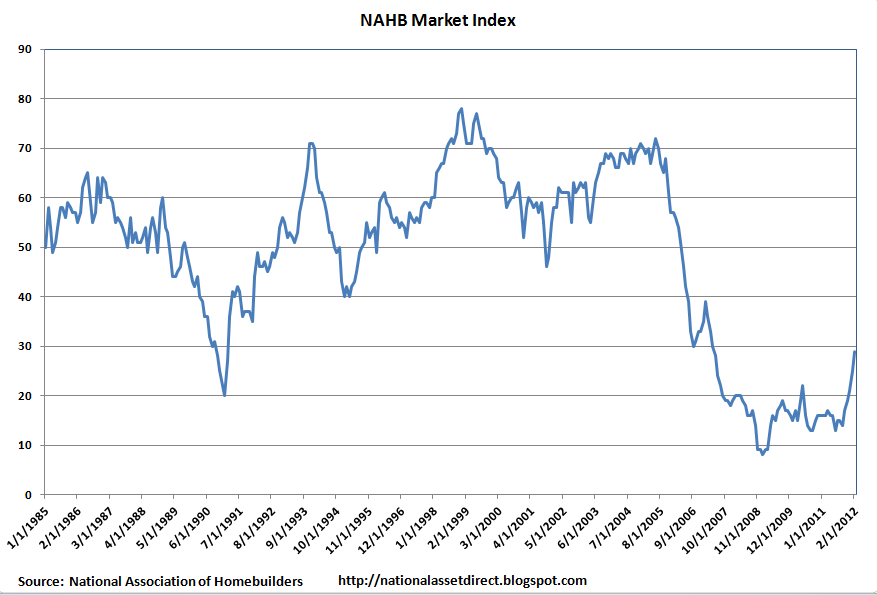
The National Association of Home Builders will release their market index at 10:00 am. Residential construction has been the missing piece of the recovery, but has been showing signs of life lately.  Earnings reports from the homebuilders have been constructive.

The FOMC minutes will be released this afternoon. I am very curious to see why the Fed is behaving as if the economy is rolling over, while the data suggest otherwise.

Last, Ezra Klein at the Washington Post has a story on how the World Cup affects trading.  I can attest to this personally, having been a block trader at Bear Stearns in London for a number of years.  When England was playing a match, the phones would stop ringing and everyone had their backs to their screens, watching the match.  You could actually see major stocks like British Petroleum and Vodafone stop trading.  As an American, it was strange to watch.

****EDIT

The National Association of Homebuilders released their market index at 10:00 am.  The index came in better than expected and it looks like conditions are improving at an accelerating rate.

Chart:  NAHB Market Index:
Morning Report

Vital Statistics:

Last Change Percent
S&P Futures 1308.3 -7 -0.53%
Eurostoxx Index 2435.3 -25.060 -1.02%
Oil (WTI) 99.35 -0.350 -0.35%
LIBOR 0.5511 -0.002 -0.36%
US Dollar Index (DXY) 79.356 -0.041 -0.05%
10 Year Govt Bond Yield 1.92% -0.01%

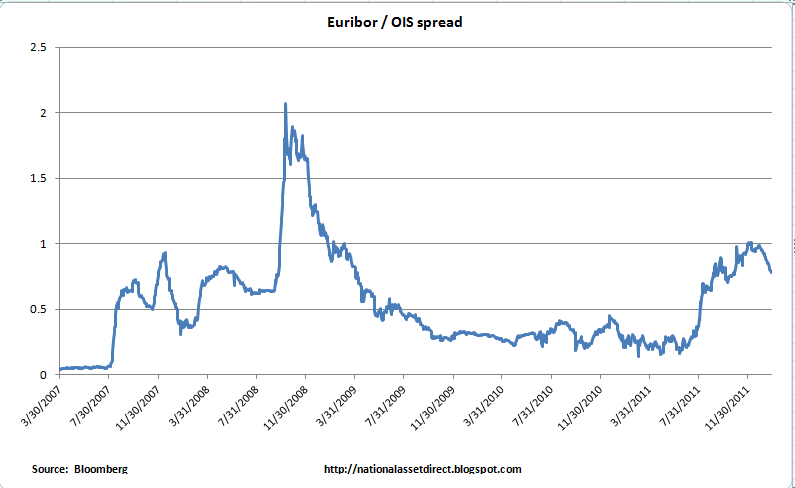
Markets are weaker on a lower-than expected GDP report.  4Q GDP came in at 2.8% vs street expectations of 3%.  Consumption and prices were lower than expected as well.  No major news out of Europe.  EURIBOR  / OIS continues to fall – it is now at 77.5 basis points.  Remember, 20 bps is more or less post-crisis “normalcy”  Pre-crisis normalcy was closer to 7 bps. Note the flat line before mid-2007 and then the spike in 2008.  People forget that the crisis began a year before Lehman.  Looking back, I remember the crisis began when the banks were stuck with a hung bridge on the Boots LBO.  Should have sold everything that day.

Chart:  EURIBOR / OIS

The WSJ has an editorial today on the Fed, which I believe nails it.  It notes the disconnect between obama’s view of the economy and the FOMC’s view.  But, the quote that says it all is this:

“One problem with all of this was pointed out yesterday by Kevin Warsh, who as a Fed governor sat on the FOMC until early last year. Speaking at Stanford, Mr. Warsh said that “exceptionally accommodative monetary policy” has its uses in a crisis or recession. But the Fed’s “recent policy activism—measures that go beyond a central bank’s capacity or traditional remit—threatens to forestall recovery and harms long-term growth.”

That’s a useful warning for markets to hear. Consider that Mr. Bernanke’s transparent goal is to drive down long-term interest rates to reduce mortgage rates to reflate the housing bubble. But intervening so directly to keep rates artificially low has made the bond market useless as a price signal or indicator of risk across the larger economy.”

As others (John / Banned) have noted, low interest rates are not “free.” They are the equivalent of sticking a penny in the fuse box.  They may make the immediate problem go away, but they mask the underlying issues, and set yourself up for a major fire later.

In earnings this am, Ford missed and DR Horton beat.  D.R. Horton is cautiously optimistic about Spring.

Morning Report

Vital Statistics:

Last Change Percent
S&P Futures 1326.3 6.1 0.46%
Eurostoxx Index 2455.9 34.730 1.43%
Oil (WTI) 100.68 1.280 1.29%
LIBOR 0.5531 -0.004 -0.63%
US Dollar Index (DXY) 79.148 -0.328 -0.41%
10 Year Govt Bond Yield 1.96% -0.03%

Futures are higher this morning on strength in Europe and the Fed’s comments.  To be honest, I found yesterday’s language in the FOMC statement to be equity-bearish. They committed to lower interest rates until late 2014, took down GDP estimates, and made scant mention of the recent signs of an accelerating economy.  The Fed looks at economic indicators that are not made public, so we can’t know exactly what they are seeing.  Perhaps their models are telling them that these recent strong data points have been spurious.

I like to listen to conference calls from companies reporting earnings.  And while it is tough to quantify and model body language, it does give a view of the economy going forward.  Apple’s report certainly speaks of a stronger consumer.  The homebuilders have been increasing backlog and activity. United Rentals reported last night a 27% increase in revenues in Q4 and a utilization rate of 69% for FY11, a company record.  While you can object that URI’s numbers are coming from a weak base, you can’t dispute the direction.

One thing is for sure, the Fed wants you out of Treasuries.  They are giving you a good bid to exit the long end of the curve.  They are telling you (through an explicit inflation target) that they intend for you to make a 0% real rate of return on the 10 year bond.  They are paying you nothing to sit in short term paper.  The Fed wants you buying real estate.  They want you buying stocks.  There is an old saw in the market – “don’t fight the fed.” And that may explain yesterday’s equity rally as much as anything.  Heard on the Street this morning this morning interpreted the statement as “We won’t raise rates until the economy is really going.”  And supposedly that gave equity investors a little comfort to put more money to work.

I guess it is time to figure out where the next bubble is going to be.  6 years of rock-bottom interest rates should be a good base for one.  Farmland. Commodities.  You could make the argument that long term govvies are in bubble territory already.  If we start seeing levered Treasury strategy ETFs and structured notes, you’ll know we have crossed the rubicon.

In economic data this morning, durable goods orders were higher than expected at 3%.  Initial Jobless Claims came in at 377k.  EURIBOR / OIS continues to tighten, down to 78.5 basis points.  20 basis points could be considered “normalcy” in the European banking sector.  Still, it has come in over 21 basis points in 6 weeks.