Morning Report: FOMC minutes not as hawkish as feared 8/18/16

Vital Statistics:

Last Change
S&P Futures 2177.5 -2.0
Eurostoxx Index 342.0 1.5
Oil (WTI) 47.0 0.2
US dollar index 85.5 -0.1
10 Year Govt Bond Yield 1.55%
Current Coupon Fannie Mae TBA 103.3
Current Coupon Ginnie Mae TBA 104.2
30 Year Fixed Rate Mortgage 3.5

Stocks are flattish after the FOMC minutes came in less hawkish than feared. Bonds and MBS are up.

Initial Jobless Claims came in at 262k last week.

The Philly Fed Business Outlook Survey came in slightly positive, about in line with expectations.

The FOMC minutes were not quite as hawkish as markets feared. The Fed noted that the two biggest fears at the June meeting (Brexit, which had just happened, and the terrible May jobs report) turned out to be non-events. That said, there is still some debate at the Fed over how much more work they have to do on the employment side of their dual mandate. Some at the Fed point to the unemployment rate and infer their job is largely done, while others point to the low labor force participation rate and say they have more work to do. The lack of language about the risks of the economy being more tilted toward the upside than the downside has been taken as a signal that the Fed isn’t planning to move in September. Bonds rallied somewhat on the minutes, with the 10 year falling to 1.54% and the Fed Funds futures reducing the implied probability of a 2016 hike to a coin toss.

The minutes did discuss housing a bit as well. In terms of housing construction, they noted that housing activity growth had slowed in recent months, which is a fair observation however housing starts have been in a 1.1 million to 1.2 million range for about a year. Not much improvement going on there at all, just steady state. Much of the growth is going to multi-fam construction, not single, however.

In terms of credit, the Fed noted that mortgage credit became somewhat more easy between the June and July meetings. Apparently, a number of large banks said they had eased standards somewhat for GSE loans. Purchase and refi activity picked up as well.

Speaking of GSE loans, everyone in DC realizes that the current state of affairs (with the GSEs as wards of the state) is unsustainable, however no one really knows what to do with them. The US taxpayer bears the credit risk of 90% of all new origination. Republicans would like the government less involved with the mortgage market, while Democrats would like to see them officially nationalized and made a government owned corporation. The point is moot, however in that there is nothing in the private sector capable of replacing them.

Note that Fan and Fred used to be 100% owned by the government (Fannie Mae was a New Deal phenomenon), and LBJ made them a nominally private institution. The reason? Fannie Mae’s debt was becoming a problem for the national balance sheet and was making it difficult to finance the Vietnam war. LBJ wanted Fannie Mae’s debt off the official books of the US Government, so he spun off a piece to private investor. So, yes Virginia, the first user of off-balance sheet financing was Uncle Sam.

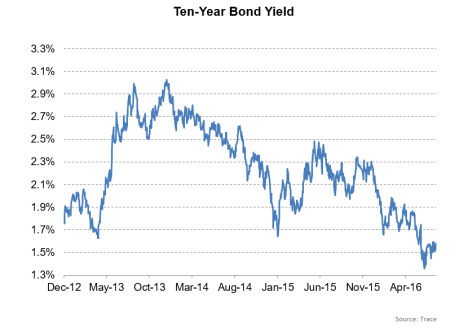
Former Minneapolis Fed Head Narayana Kochlerakota compares the US recovery to that of Europe and Japan. People trumpeting the great performance of the US versus their peers (largely a partisan affair) are ignoring the fact that the US population has been increasing much faster than Europe, so comparing simple GDP growth isn’t really all that meaningful. If you look at employment, the US looks worse. This has big implications for monetary policy. Perhaps QE hasn’t been quite the elixir it has been held up to be. In Japan, banks are running out of JGBs to sell the Central Bank. To me, the glaring observation is that the 10 year bond yield where it was pre taper tantrum (Spring of 2013). It implies they could have achieved the same result doing nothing! As Art Cashin said, the Fed is beginning to resemble Casey Stengal’s 1962 Mets.
10 year NAD

That said, it looks like fiscal policy might be ready to run with the ball. Hillary Clinton and Donald Trump both want to spend more money. Assuming Hillary wins and the GOP keeps the House, we will have to see if she can cut a deal with Republicans to allow for more spending.

Morning Report: FOMC minutes a non-event 7/7/16

Stocks are higher this morning on no real news. Bonds and MBS are down after a stronger-than-expected ADP jobs report

We have a few economic data points this morning. Job Cuts fell 14.1% in June, according to Challenger and Grey. Job cuts fell in the East and Midwest, while rising in the South and the West.

The ADP Employment number shows private companies added 172k jobs in June, above the 160k forecast. May was revised to 168k. Of course last month the ADP number came in at 173k while the official BLS nonfarm payroll number came in at 38k. So ADP has been pretty useless lately

Initial Jobless Claims fell to 254k last week.

The FOMC minutes didn’t really shed much light on the state of thinking at the Fed, other than to say the Fed remains data-dependent. The June FOMC meeting predated Brexit, so in many ways it is a dated view. The participants noted that the labor market weakened while the overall economy was strengthening, and believe that the economy will continue to grow moderately. Given the added uncertainty of Brexit, the FOMC meeting in a few weeks will almost certainly be a non-event, and even tightening in September looks like a tall order.

Morning Report: Treasury yields hit an intraday record low 7/1/16

Vital Statistics:

Last Change Percent
S&P Futures 2090.5 0.3 0.01%
Eurostoxx Index 2888.6 23.9 0.83%
Oil (WTI) 48.03 -0.3 -0.62%
LIBOR 0.646 0.015 2.38%
US Dollar Index (DXY) 95.66 -0.488 -0.51%
10 Year Govt Bond Yield 1.44% -0.03%
Current Coupon Ginnie Mae TBA 106.2
Current Coupon Fannie Mae TBA 105.6
BankRate 30 Year Fixed Rate Mortgage 3.53

Markets are flattish as we head into a 3 day weekend. Bonds and MBS are up.

Bonds will close early today and most of the Street will be on the LIE by noon.

Manufacturing picked up in June, according to the ISM Manufacturing Survey. New orders were up while prices paid fell.

Construction spending fell 0.8% in May versus an expected increase of 0.6%. April was revised downward from -1.8% to -2%. Homebuilding was flat versus April and is up 5.3% on a year-over-year basis.

Vehicle sales are coming in this morning, and they look light generally.

Overnight, the 10 year yield touched 1.38%, which is a record low on the 10 year. It looks like we are getting ready for another refi boom. Vanguard, Blackrock, and Guggenheim are all making the call that Brexit means slower growth and lower rates for the next couple of years. How pension funds and insurance companies, which need to earn 7% or more to keep up with liability growth will do that is beyond me.

Note that the Bankrate 30 year fixed rate mortgage rate is still about 20 basis points higher than the record low set in late 2012. Mortgage backed securities have lagged the move up in Treasuries. Below is a chart of the Bankrate 30 year fixed rate mortgage rate versus the 10 year yield. The top line is mortgage rates, the lower line is the 10 year yield. If you look at the 2012 period, you can see that the 10 year yield bottomed out in July, and started rising into the end of the year. Mortgage rates kept falling throughout the year, bottoming out in December. So, mortgage rates didn’t bottom out until 5 months after Treasuries did.

mortgage rates vs treasury yields

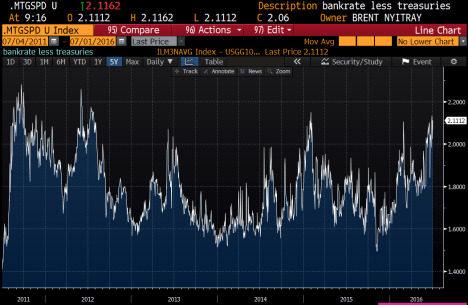
If you plot the difference between the two rates (basically a proxy for MBS spreads), you can see that the current difference is approaching a high again. If this is a truly mean-reverting series, you should expect that gap to close over time, and that will either happen through higher Treasury yields or lower mortgage rates. Given the momentum in the Treasury markets at the moment, it is probably mortgage rates that will have to give. Which means we could have a good refi season into the end of the year.

mortgage spreads.PNG

The worlds’ central bankers are being forced to take the global economy into account more and more. Brexit gives Janet Yellen the excuse to hold off on hiking rates until we see inflation in the US. The ECB and the Bank of England are looking at easing. Could the next move by the Fed be some sort of stimulative measure, like bringing back QE or cutting the Fed Funds rate back down to .25%? It is definitely a non-zero probability.

The discussion draft of the bill to reform the CFPB is out. The main changes would be to bring the agency under Congressional control (it nominally reports to the Fed, but in reality it reports to no one) and to replace a single director with a bipartisan board of 5. It will also make some changed aimed at curbing the most abusive practices of the agency. While the Elizabeth Warren wing of the Democratic party will fight this tooth and nail, the affordable housing lobby is getting sick and tired of tight credit. Note that the President doesn’t think there is an issue, and even if there was, it isn’t his fault. Quote from the article:

Bloomberg Magazine: “Some of the rules put in place have meant it’s harder to get a loan. Something like 58 percent of approved mortgages are going to the wealthiest applicants, and homeownership among African Americans is down. Where’s the balance there?

Obama: “Well, the interesting thing—and we’ve looked at this very carefully—is that there’s no doubt that there’s been some pullback and increased conservatism on the part of lenders. But oftentimes, it’s not justified by the regulations”

Morning Report: Janet Yellen gets more dovish 6/21/16

Markets are up this morning as the market frets about Brexit and Janet Yellen speaks. Bonds and MBS are up small.

The latest polls for Brexit are mixed, and the bottom line is that it is too close to call. If the UK leaves the EU, the most likely effect will be a flight to safety, which would mean global flows to US Treasuries, lowering rates. Some of the forecasts I am seeing would be a sub 1.4% on the 10 year if the UK leaves, or a return to the old 1.7% – 1.9% range if they stay. FWIW, spread betting is common in the UK, and the markets there are much deeper than the political betting sites in the US. Right now, the spread betting markets are assigning a 25% probability of Brexit.

Janet Yellen adjusted her language to be slightly more dovish ahead of her testimony today in front of the Senate Banking Committee. She is exhibiting a little more uncertainty over whether the economy is ready to return to moderate growth. Not sure what changed in the last week or so, but there you go.

Homebuilder Lennar beat estimate this morning as the housing market continues to improve and wage growth begins to appear. Interestingly, they are pulling back a little from the market, it appears: “As this year’s spring selling season improved over last year, our second quarter new orders increased 10% to 7,962 homes year-over-year, while our home deliveries and home sales revenue also increased to 6,724 homes and $2.4 billion, respectively.  As the recovery has continued to mature, we have remained focused on our strategy of moderating our growth rate in community count and home sales, as well as on our soft-pivot land strategy, targeting land acquisitions with a shorter average life.” For some reason, the builders don’t seem to trust this recovery in housing.

Perhaps Lennar’s reticence comes from the attitudes of consumers. A recent survey shows housing affordability remains a big problem. That said, perceptions of real estate as a good long-term investment are improving. They should, since rental inflation is generally outpacing house price appreciation and the buy-rent decision is skewed heavily towards buying. That said, consumers are becoming more pessimistic that the housing crisis is over.

Good breakdown on how big of a boost homebuilding is for the economy. Unfortunately, the only discussion of housing in DC revolves around how hard we should be slugging the banks.

Janet Yellen data dump

Janet Yellen testified in front of the Senate Banking Committee today and overall, there were few surprises. It is becoming clear that she intends to continue most of the Bernanke Fed’s policies, and to be honest I couldn’t find anything she would do differently. Her reception was generally good, and the Senators were respectful. Most of the questioning had to do with banking regulation, income inequality, the existence of asset bubbles and the size of the Fed’s balance sheet.

Here are some of the discussion points:

On current monetary policy: The Fed is seeking a strong and robust recovery, and must not jeopardize it by removing accomodation too early. She does not want to remove support while recovery is fragile. It is costly to withdraw accomodation or fail to provide adequate accomodation, and the Fed has the tools and the will to withdraw accomodation at the right time.

On asset bubbles: The Fed should attempt to detect asset bubbles when they are forming, however the first line of defense should be regulatory. Monetary policy is a blunt instrument and should be used if other measures aren’t working. She won’t rule out using monetary policy to address bubbles, but prefers that we use regulatory measures (such as increased capital requirements, higher risk retention requirements, etc) to prevent bubbles from occurring.  Separately, she sees little evidence that there are bubbles currently forming in the real estate market.

On banking regulation: Too Big To Fail imposes costs on the economy and should be avoided if possible. The government is making progress in handling too big to fail. They will raise capital standards further and the Fed is looking at requiring banks to issue additional unsecured debt at the holding company level to raise capital. She wants to ensure that the system isn’t set up to advantage the larger banks at the expense of the smaller banks.

On communication: In a nod to the volatility of the bond market over the summer, she said that she wants the Fed to communicate as clearly as possible with the markets and will redouble efforts to reduce volatility. This follows Bernanke, and is a departure from the Fed of the past, where they wanted to be as opaque as possible, lest the market anticipate what they were going to do, which would limit the effectiveness.

On QE and the balance sheet: Yellen was asked repeatedly about the effects of QE. She stressed that QE is being done to help the economy, not to help the government finance its deficit. When pressed about the size of the Fed’s balance sheet, she was forced to admit it is unprecedented for the US Central bank, but it was not unprecedented compared to other central banks. She acknowledged there are costs and risks to such a large balance sheet, and opposes any sort of Congressional audit of the Fed lest it reduce the Fed’s independence.

On income inequality: The Democratic Senators pretty much focused on income inequality, and what could be done about it. Yellen acknowledged that asset prices are rising, and that primarily benefits the rich, however the point of QE is to help the economy recover, and the best thing we can do for the middle class is to have a robust economy. She also acknowledged that QE is doing a number on seniors who rely on interest from safe assets to supplement social security. She views income inequality as a serious problem.

On the dual mandate: She stressed that the Fed must prevent inflation that is too low, and that deflation is a terrible thing. She refused to say what she thought “full employment” was, other than to give a range that it is probably in the 5% to 6% range. She also said that fiscal policy was working at cross purposes with what the Fed is trying to do. She also acknowledged that the reported unemployment rate understates the severity of the problem.

Key Takeaways:

While not admitting it, she seems to indicate the Fed goofed when it talked about withdrawing accomodation last June and causing the subsequent bond market sell-off. Expect the Fed under Yellen to be more communicative and she will probably try and clear up the confusion over tapering QE. It certainly seems she intends to err on the side of caution, provided there is no evidence of asset bubbles and inflation is at or below its 2% target rate.

The comment about full employment being in the 5% to 6% range was interesting as well. We spent many years over the past couple of decades with unemployment under 5% (it actually got below 4% in 2000). Does that mean the Fed will begin to start tightening before it ever gets to that level? Perhaps.

On asset bubbles, she does not hold the view that the Fed had a role in inflating the real estate bubble or the stock market bubble. Those bubbles were due to regulatory failure. It is ironic that the Fed has a problem with “too much money chasing too few goods” – in other words “inflation”, but is ok with “too much money chasing too few assets” – in other words a bubble. This is unsurprising; and suggests that the punch bowl might hang around a little longer than expected.

Article I wrote for the Scotsman Guide Dec issue.

http://www.scotsmanguide.com/default.asp?ID=5341

MORNING FILLER 7/31/12

Rs and Ds think they have a six month stopgap compromise on spending that they will get to after their recess, during the last six days of the fiscal year.  Apparently they are staying within the Budget Control Act guidelines they set when they settled the debt ceiling extension.

http://thehill.com/homenews/news/241183-stopgap-spending-to-wait-until-after-august-break?wpisrc=nl_wonk

Apparently flooding the financial world with money from central banks does not increase lending or stimulate the economy.

http://www.bloomberg.com/news/2012-07-30/central-banks-unorthodox-actions-are-cutting-lending.html?wpisrc=nl_wonk

Today would have been Milton Friedman’s 100th birthday.  My own undergraduate education was influenced greatly by Mr. Friedman.  The Economist offers this:

http://www.economist.com/node/21559622

Brent – you were supposed to return yesterday.  If you see this, and let us know when you will return, I will try to post a tres faux morning report until then.  But expecting the real thing, now I will only post filler!

Weekend Report

Fix income inequality with $10 million loans for everyone!

By Sheila Bair, Published: April 13

Are you concerned about growing income inequality in America? Are you resentful of all that wealth concentrated in the 1 percent? I’ve got the perfect solution, a modest proposal that involves just a small adjustment in the Federal Reserve’s easy monetary policy. Best of all, it will mean that none of us have to work for a living anymore.

For several years now, the Fed has been making money available to the financial sector at near-zero interest rates. Big banks and hedge funds, among others, have taken this cheap money and invested it in securities with high yields. This type of profit-making, called the “carry trade,” has been enormously profitable for them.

So why not let everyone participate?

Under my plan, each American household could borrow $10 million from the Fed at zero interest. The more conservative among us can take that money and buy 10-year Treasury bonds. At the current 2 percent annual interest rate, we can pocket a nice $200,000 a year to live on. The more adventuresome can buy 10-year Greek debt at 21 percent, for an annual income of $2.1 million. Or if Greece is a little too risky for you, go with Portugal, at about 12 percent, or $1.2 million dollars a year. (No sense in getting greedy.)

Think of what we can do with all that money. We can pay off our underwater mortgages and replenish our retirement accounts without spending one day schlepping into the office. With a few quick keystrokes, we’ll be golden for the next 10 years.

Of course, we will have to persuade Congress to pass a law authorizing all this Fed lending, but that shouldn’t be hard. Congress is really good at spending money, so long as lawmakers don’t have to come up with a way to pay for it. Just look at the way the Democrats agreed to extend the Bush tax cuts if the Republicans agreed to cut Social Security taxes and extend unemployment benefits. Who says bipartisanship is dead?

And while that deal blew bigger holes in the deficit, my proposal won’t cost taxpayers anything because the Fed is just going to print the money. All we need is about $1,200 trillion, or $10 million for 120 million households. We will all cross our hearts and promise to pay the money back in full after 10 years so the Fed won’t lose any dough. It can hold our Portuguese debt as collateral just to make sure.

Because we will be making money in basically the same way as hedge fund managers, we should have to pay only 15 percent in taxes, just like they do. And since we will be earning money through investments, not work, we won’t have to pay Social Security taxes or Medicare premiums. That means no more money will go into these programs, but so what? No one will need them anymore, with all the cash we’ll be raking in thanks to our cheap loans from the Fed.

Come to think of it, by getting rid of work, we can eliminate a lot of government programs. For instance, who needs unemployment benefits and job retraining when everyone has joined the investor class? And forget the trade deficit. Heck, we want those foreign workers to keep providing us with goods and services.

We can stop worrying about education, too. Who needs to understand the value of pi or the history of civilization when all you have to do to make a living is order up a few trades? Let the kids stay home with us. They can play video games while we pop bonbons and watch the soaps and talk shows. The liberals will love this plan because it reduces income inequality; the conservatives will love it because it promotes family time.

I’m really excited! This is the best American financial innovation since liar loans and pick-a-payment mortgages. I can’t wait to get my super PAC started to help candidates who support this important cause. I think I will call my proposal the “Get Rid of Employment and Education Directive.”

Some may worry about inflation and long-term stability under my proposal. I say they lack faith in our country. So what if it cost 50 billion marks to mail a letter when the German central bank tried printing money to pay idle workers in 1923?

That couldn’t happen here. This is America. Why should hedge funds and big financial institutions get all the goodies?

Look out 1 percent, here we come.

outlook@washpost.com

Sheila Bair is a former chairman of the Federal Deposit Insurance Corp. and a regular contributor to Fortune Magazine.

Morning Report

Vital Statistics:

Last Change Percent
S&P Futures 1359.4 -0.7 -0.05%
Eurostoxx Index 2526.7 -14.9 -0.59%
Oil (WTI) 106.1 -0.2 -0.14%
LIBOR 0.4916 -0.001 -0.20%
US Dollar Index (DXY) 79.286 0.178 0.23%
10 Year Govt Bond Yield 2.05% -0.01%

Markets are weaker this morning on a weaker than expected economic report out of Europe and a lousy forecast from Dell. Mortgage applications fell 4.5% for the week ending Feb 17. Existing Home Sales will be released at 10:00 am.

Obama has laid out the broad brush strokes for a corporate tax overhaul. He plans on lowering the statutory rate to 28%, while eliminating loopholes. His plan will benefit domestic manufacturers and he will target the energy sector for more revenues.  It looks like he is proposing some sort of AMT for corporations, with a minimum tax for overseas earnings. The plan will be revenue-enhancing.

Of course, the devil is always in the details, and hopefully the administration is smart enough to draw a distinction between overseas production meant to be sold overseas and outsourcing to cut costs. He could end up hurting US competitiveness if he doesn’t think this through.

The FHFA sent a letter outlining its plan for the GSEs aptly titled “The Next Chapter in a story that Needs an Ending.” It is a strategic document, not a step-by-step plan. They intend to build a new infrastructure for the secondary market, gradually reduce the footprint of Fannie and Freddie, while maintaining foreclosure prevention activities and credit availability.

With the S&P 500 rallying, bonds have sold off a bit, driving best-ex mortgage rates back over 4%. FWIW (and I am not a big technical analysis guy) it appears the March Treasury futures are stuck in a 140-145 range, which implies a yield range of 1.85% to 2.05%. We are again at the top end of that range. As I have mentioned before, the S&P 500 is right up against resistance and looks like it wants to break out. The Fed has been stepping into the MBS market when rates hit these levels, so we’ll see if that continues.

Morning Report

Vital Statistics:

Last Change Percent
S&P Futures 1341.4 -0.8 -0.06%
Eurostoxx Index 2471.7 -22.2 -0.89%
Oil (WTI) 101.61 -0.2 -0.19%
LIBOR 0.4931 -0.002 -0.40%
US Dollar Index (DXY) 79.952 0.225 0.28%
10 Year Govt Bond Yield 1.96% 0.03%

Global equity markets are weaker this morning as European leaders delay a vote on the Greek bailout until 2/20.  The finance leaders were able to squeeze some more concessions from political leaders, but there are still differences over surveillance and control. Separately, Moody’s threatened a downgrade of the global banking sector. Bonds and mortgage backed securities are slightly lower as well.

GM posted a record profit! I am sure tomorrow’s editorial pages will be filled with columns praising the auto bailout and using this earnings announcement as justification. Well, if you repudiate your debt and get rid of all that pesky interest, you had better post record earnings.  GM’s numbers were still below estimates and the stock is down a couple of percent pre-open. As an aside, Chrysler has to issue senior secured debt at 8%.  That is a usurious rate for senior secured debt. See, that is what happens when you re-order the priority of creditors. Investors remember.

Economic data this morning:  Producer Price Index more or less in line with expectations, running at 4.1% annually.  Initial Jobless Claims continue to fall, coming in at 348k vs 365k expected. We are more or less back in the historical “normal” range. Housing starts came in at 699k, above expectations, but still very low. In prior recessions, housing starts bottomed at 750k – 850k.  The last time we were above 1 million units was June of 2008.  1.5 million is normal. The lack of residential construction has been the achilles heel of the recovery so far.

Chart:  Housing Starts:

The minutes of the FOMC meeting were released yesterday. They really don’t add anything to what was said in the press conference after the rate decision.  The minutes don’t really address the question most had regarding the recent good economic data. “Many participants noted some indicators bearing on the economy’s recent performance had shown greater-than-expected improvement, but a number noted less favorable data…” The tone of the minutes was that the economy was improving, albeit slowly, and there is no reason to take our foot off the gas for the moment.  Maybe the Fed believes the Greek negotiations are simply a big kabuki dance and that a default is unavoidable.

RealtyTrac has released its U.S. Foreclosure Market Report for January 2012. Key Quote: “Although overall foreclosure activity was down from a year ago for the 16th straight month in January, we continue to see signs on a local and regional level that the frozen-up foreclosure process is beginning to thaw.” They predict increasing foreclosures in the coming months especially given the settlements in early Feb between the nation’s largest lenders and 49 state attorney generals. Clearing out the shadow inventory of foreclosed homes is a necessary but not sufficient condition for a recovery in house prices.