Posted on April 7, 2016 by Brent Nyitray
Stocks are lower this morning on no real news. Bonds and MBS are up and the 10 year is flirting with a 1.6 handle
Initial Jobless Claims fell to 267k last week, while consumer comfort dipped slightly.
The Fed re-affirmed their dovish bent in the March FOMC minutes, which were released yesterday afternoon. In discussing the global financial situation, the money quote was: “Nonetheless, many participants indicated that the heightened global risks and the asymmetric ability of monetary policy to respond to them warranted caution in making adjustments to the stance of U.S. monetary policy.” The markets have been saying that via the Fed Funds futures for a while now. An April hike is off the table. With the US economy improving, while the rest of the world deteriorates, the Fed doesn’t have to be aggressive in hiking rates. We are in uncharted territory here with zero and negative interest rates. They are going to be cautious raising rates when the rest of the world is cutting rates. 2016 could be shaping up to be a great year for mortgage bankers.
The German Bund yield is now a single-digit midget, trading at a 9 basis point yield. The Japanese 10 year yield has been negative since February.
Hedge fund giant Apollo is into the “seller financed” market for low income / bad credit borrowers. It is a hybrid purchase / rental model, where the seller keeps the title and the borrower is responsible for upkeep. Some have called this a predatory model. “Whether the process is called a land sale, contract-for-deed, bond-for-title or something else, the idea is the same: While it gives some low-income Americans a path, though long and winding, to homeownership, it can also be a way for investors to profit from borrowers who don’t qualify for mortgages.”
Filed under: Economy, Morning Report | 28 Comments »
Posted on April 6, 2016 by Brent Nyitray
Stocks are higher this morning on no real news. Bonds and MBS are down
Mortgage Applications rose 2.7% last week as purchases fell 2.4% and refis rose 6.8%.
We will get the FOMC minutes later today at 2:00 pm EST. Given the big move downward in rates over the past couple of weeks, look for a rebound in rates if the minutes aren’t sufficiently dovish.
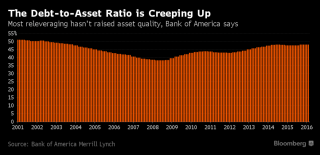
Global bond yields continue to fall. The yield on the Bank of America Global Bond index is 1.3%.
Filed under: Economy, Morning Report | 15 Comments »
Posted on April 5, 2016 by Brent Nyitray
Markets are lower for the second day in a row on global growth concerns. Bonds and MBS are up.
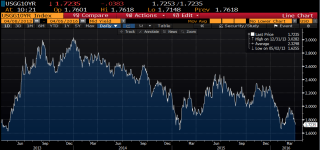
With the latest bond market rally, the 10 year bond yield is a stone’s throw away from the 2013 “taper tantrum” when the Fed began its withdrawal of QE. Part of the reason for the bond rally is the flight to safety in Europe. The German Bund now yields under 10 basis points. Talk about a all-risk/no reward trade. Falling global bond yields are pulling US Treasury yields lower as investors sell European and Japanese bonds to buy US Treasuries. For the mortgage industry, it should mean more refi volume. Since the Fed hiked rates in December, the 10 year yield has fallen 58 basis points. Who’d a thunk?
Job openings fell in February to 5.445 million from 5.6 million the month before. These are still boom-time levels, which begs the question as to why the labor market continues to have such a low labor force participation rate. Many would argue it is a skills gap – the labor people need isn’t what is out there there right now.
Good article on how hard it can be for Millennials to get a mortgage these days if you have bad credit, given the regulatory shelling that has been going on for the past 8 years. There is definitely a cognitive dissonance in DC over the competing goals of increasing access to credit and slugging “unregulated” financial system even harder.
Ever wonder why a government guaranteed mortgage backed security trades for a much higher yield than the corresponding Treasury? The credit risk is the same – i.e. zero – so what is the reason for the difference. I discuss the reason in Rob Chrisman’s blog. Note there is some bond geek math going on in the explanation.
Former Fed Head Narayana Kochlerakota discusses the way we use the financial system for social engineering, and suggests if the government thinks college and housing needs to be subsidized, the answer is to subsidize it directly instead of subsidizing borrowing. FWIW, I have always thought the issue with college tuition inflation is that college is a good with inelastic demand. Colleges don’t compete on price and parents will pretty much pay whatever is asked. When the government subsidizes an inelastic good, the subsidies accrue to the producer, not the consumer. Which means the net effect is that the more the government subsidizes college education, the more colleges raise tuition.
Filed under: Economy, Morning Report | 16 Comments »
Posted on April 1, 2016 by Brent Nyitray
Stocks are lower after the jobs report. Bonds and MBS are flat.
- Payrolls up 215k vs 205k expected
- Unemployment rate 5% up .1%
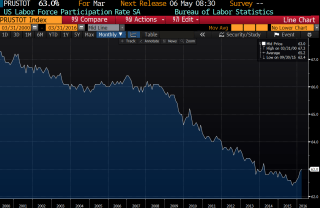
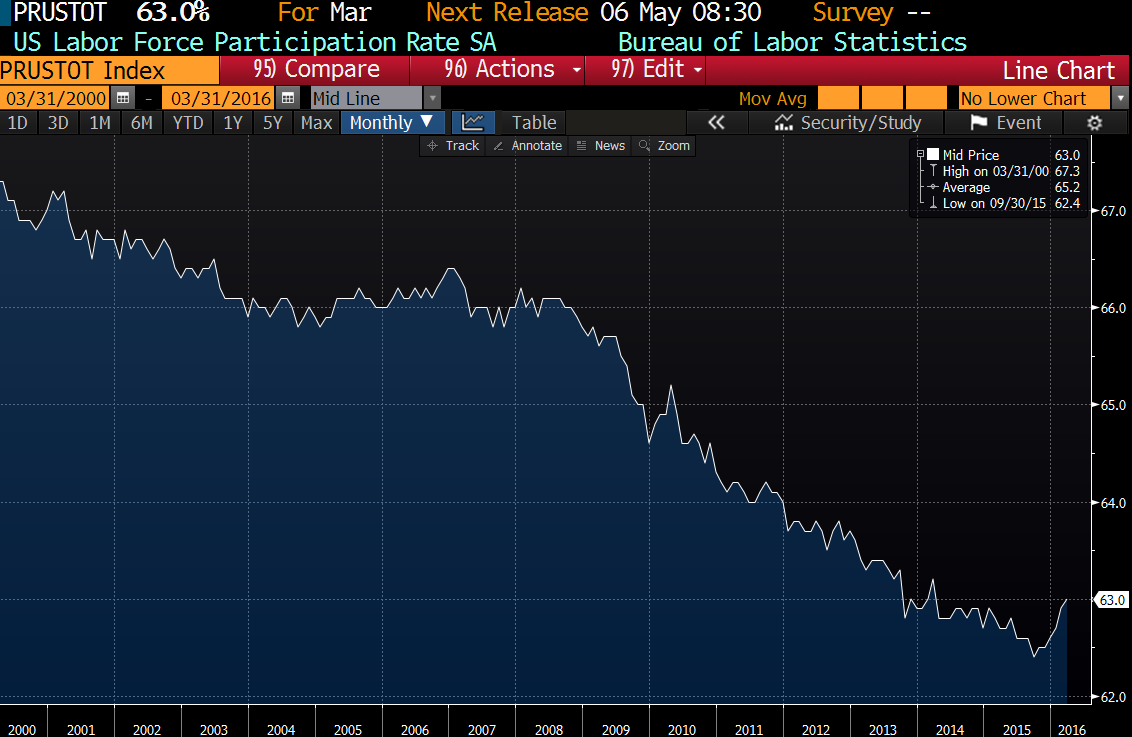
- Labor Force Participation rate 63%
- Average hourly earnings up 2.3% YOY
- Average hourly earnings flat at 34.4
Manufacturing employment fell 29k, while restaurant increased 25k, retail, up 48k and construction up 37k. This is the fifth straight increase in the labor force participation rate, which bottomed out (hopefully) in September. The lower the labor force participation rate, the lower the speed limit for the economy. The improvement in the participation rate drove an increase in the unemployment rate, and this is one of those times where an increase in the unemployment rate is actually a good thing because it means that discouraged workers are now beginning to see enough opportunity out there to look for a job. Remember, if you are unemployed and not actively looking for a job, you are not considered to be part of the labor force, and therefore you aren’t officially “unemployed” according to the government. Wages rebounded from a negative February. Overall, a decent report – the wage growth will certainly push the Fed to take another step towards normalization of interest rates, and a June hike is looking more certain.
Despite the drop in manufacturing employment, the ISM Manufacturing Index increased smartly in March, New Orders and production drove the increase, while employment fell. Prices rose as commodity and raw material prices increased. This level of manufacturing would be consistent with 2% GDP growth. A shortage of skilled labor continues to be a problem.
Consumer Sentiment ticked up in March, according to the University of Michigan to 91.
Filed under: Economy, Morning Report | 14 Comments »
Posted on March 31, 2016 by Brent Nyitray
Markets are flattish on no real news. Bonds and MBS are flat as well.
Initial Jobless Claims rose to 276k from 265k last week.
In other economic data, the ISM Milwaukee rose to 57.8 while the Chicago purchasing Manager Index jumped. Consumer comfort fell however to 42.8.
Job cuts fell 13,4k to 48.2k in March, according to outplacement firm Challenger Gray, and Christmas.
Note that Boeing announced 4500 job cuts yesterday, and the financial industry is going through another round of lay-offs.
Mohammed El-Arian on what to look for in tomorrow’s jobs report. The numbers to watch: wage growth and the labor force participation rate.
TRID issues have shut the jumbo securitization market down for the moment. Non-bank jumbo originators are sitting on the sidelines at the moment because they can’t move their inventory. Another unintended consequence of TRID.
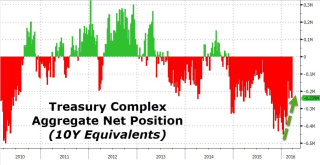
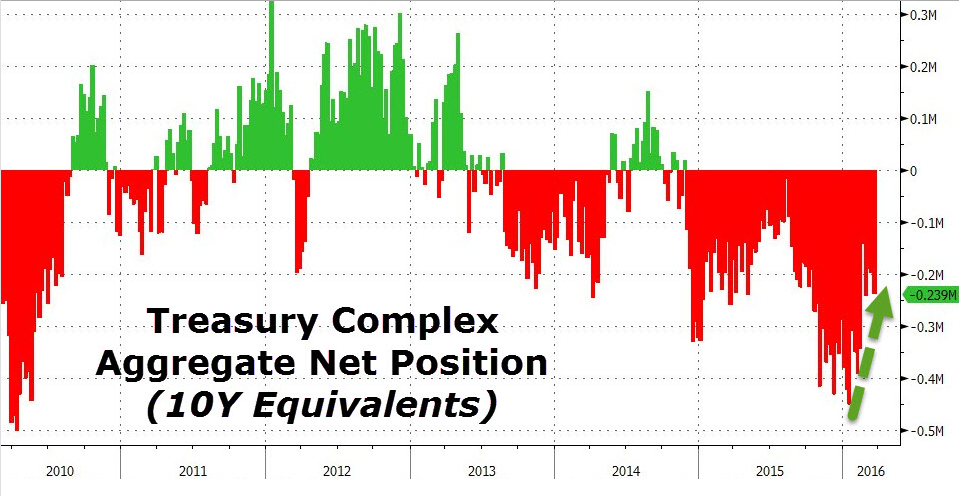
One unappreciated fact relating to the 10 year has been the massive short position that built up in them ahead of the Fed’s hiking rates. Now that the Fed is becoming more dovish, it is creating a short squeeze in Treasuries, which is pushing down rates. The punch line is that the bid under Treasuries (and thus the forces pushing yields down) are somewhat temporary.
Filed under: Economy, Morning Report | 29 Comments »
Posted on March 30, 2016 by Brent Nyitray
Markets are higher following dovish comments from Janet Yellen yesterday. Bonds and MBS are down.
Janet Yellen spoke yesterday in NY and reiterated the dovish statements from the last FOMC meeting. Stocks and bonds rallied on the announcement, with both going out on their highs, although bonds have given back their gains this morning. Fed Funds futures now assign a 0% probability of an April hike. It is very much a Goldilocks moment for stocks, not so much for the economy. For the time being, economic weakness is good news for stocks because it keeps the Fed on the sidelines. As if on cue, Boeing announces it is cutting 4.500 jobs.
Overseas yields are still heading lower, with the German Bund trading at 16 basis points. As long as bond yields throughout the world trade at such low levels, the 10 year will have relative-value trading support. This means that as rates in Europe fall and go negative, investors will swap out of Bunds, which really have nowhere to go but down and buy Treasuries. The world is trading as if inflation is never, ever, ever coming back. There are a lot of “this time is different” stories going around about technology and inflation. It may turn out that the best possible trade is borrowing money for 30 years at 3.375%.
Mortgage Applications fell 1% last week as purchases rose 2.1% and refis fell 3.3%. Refis fell to 52.4% of total loans, compared to 58.6% a month ago.
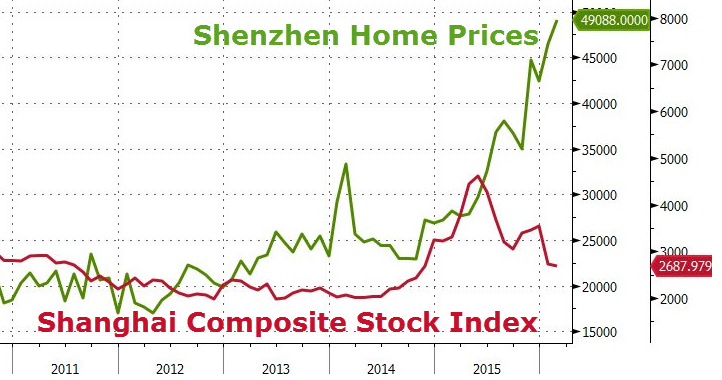
In the Webster’s dictionary under real estate bubble, people should place China. Here is an example of the sort of stuff that is getting built these days. It reminds me of the height of the US property bubble when a thief supposedly broke into a McMansion with a boxcutter. Builders were cutting every corner just to make houses big. I have said this before: China is going to be an epic battle between Mr. Market and Big Communist Government. Compare property prices to stock prices.

Filed under: Economy, Morning Report | 30 Comments »
Posted on March 29, 2016 by Brent Nyitray
Markets are lower this morning on weaker commodity prices. Bonds and MBS are up small.
Pending Home Sales increased 3.5% MOM and are up 5.1% YOY. This is the best number in a year, and points to a strong Spring Selling Season. Lack of inventory remains a problem.
Inflation remains tough to find, but both BlackRock and PIMCO are calling for investors to add an inflation hedge, either by switching out of Treasuries into TIPS or by buying gold.
Barclay’s is calling the latest rally in commodity prices a dead cat bounce, and is calling for a steep decline as fast money exits en masse.
Home prices rose .52% month-over-month according to Case-Shiller. Prices are up 5.4% YOY. Portland, Seattle, and San Francisco reported the biggest gains. Again, tight inventory remains an issue, along with tight credit for the first time homebuyer.
Prices continue to defy gravity in New York City, however the demand for luxury condos is beginning to wane. 423 Park Avenue, now home of the tallest residential building in the Western Hemisphere, has 141 apartments for sale and luxury buyers are beginning to fade as foreign money is hesitant. Yet Manhattan is dotted with cranes, largely building high-end condos.
Homebuilder Lennar reported better than expected earnings this morning. EPS is the highest third quarter number since 2006. Average selling prices increased 12% to $365,000 while new orders increased 10% in units and 15% in dollar volume.
Filed under: Economy, Morning Report | 26 Comments »
Posted on March 24, 2016 by Brent Nyitray
Stocks are under pressure this morning as commodities drop. Bonds and MBS are up small.
Initial Jobless Claims rose to 265k last week while the Bloomberg Consumer Comfort Index ticked up to 44.6
Durable Goods Orders fell 1.8% last month, slightly better than expectations, but when you strip out transportation, the number was a huge miss. Capital Goods orders (a proxy for business capital expenditures) fell 1.8% missing by a country mile.
In other economic data, the Markit PMI numbers were barely expansionary and the Kansas City Fed improved slightly, but is still negative.
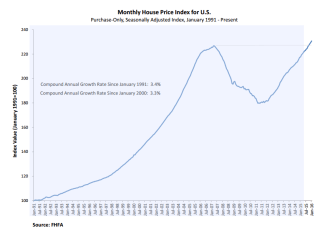
Mel Watt is going to have a decision on principal mods for conforming loans held by the government within the next 30 days. The left has been pushing FHFA to do this for years. Why the (expected) change? Probably the FHFA House Price index, which has now recouped all of its losses from the bubble years. HARP may go away as well – FHFA is toying with the idea of a high-LTV refi.
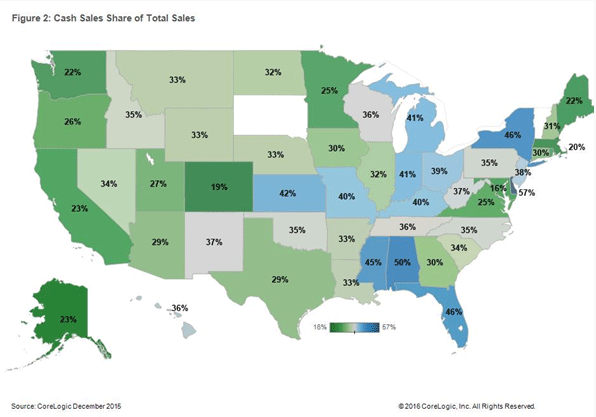
Cash sales are at their lowest level in 7 years, according to CoreLogic. In 2015, they accounted for 34% of all sales. The peak was January 2011 when they hit 47%. Pre-crisis, that number was in the high 20s. Unsurprisingly, the states with the highest foreclosure pipeline and the lousiest real estate markets have the highest cash sales percentages.

Mortgage lenders are on net still easing credit standards, however they are doing it at a slower pace, according to the latest Fannie Mae Mortgage Lender Sentiment Survey.Government loans actually were tightened.
Filed under: Economy, Morning Report | 23 Comments »
Posted on March 23, 2016 by Brent Nyitray
Markets are lower this morning on no real news. Bonds and MBS are up small.
Mortgage Applications fell 3.3% last week as purchases fell 1% and refis fell 4.9%. Despite an 11 basis point drop in the 10 year yield, mortgage rates barely budged, falling only 1 basis point.
New Home Sales ticked up slightly to an annualized pace of 512,000. The increase was driven entirely by building out West where there is an acute shortage of housing. Note that homebuilder KB Home reports after the close tonight. The median sales price increased 2.6% to $301,400.
Hawkish comments out of St Louis Fed President James Bullard: “You get another strong jobs report, it looks like labor markets are improving, you could probably make a case for moving in April,” Bullard, who votes on policy this year, said in a Bloomberg interview in New York Wednesday. “I think we are going to end up overshooting on inflation and the natural rate of unemployment.” Perhaps, but the doves are in control of the FOMC at the moment.
Bullard isn’t the only dissenter, however. Janet Yellen has a bit of a mini-revolt on her hands (as much as central bankers can “revolt” in the first place)
If negative interest rates in Europe and Japan don’t do the trick, then the next step is “helicopter money” which has always been a textbook-only idea but is gaining fans. The government would issue debt directly to the central bank, which would print the cash which the government would immediately spend, bypassing the banking system entirely. The theory is that if there is a liquidity trap (where banks just sit on Treasuries and won’t lend them out), this would inject the money directly in the economy. It would probably require legislation to change the way central banks are run in Europe (and certainly the US), and if there isn’t the political will to do massive Keynsian spending programs, then there won’t be the political will to do this. What are the risks to doing it? Who knows? Weimar Republic-esque inflation is one, but probably the biggest one would be a loss in confidence in central banks globally, which would probably mean a collapse of the banking system worldwide. Anyway, it is just a theory that is gaining some traction, but it probably remains in the textbooks.
And don’t forget – ZIRP and NIRP aren’t “free.” Insurers need to earn a certain rate of return on their money to fund future payouts, and the actuarial tables couldn’t care less than rates are 0%. The latest victim is the oldest insurance company in the world, Lloyds of London who reported a big drop in profits due to sub-par investment returns.
Filed under: Economy, Morning Report | 11 Comments »
Posted on March 22, 2016 by Brent Nyitray
Markets are weaker this morning after a terrorist attack in Brussels leaves 35 dead. Bonds and MBS are up.
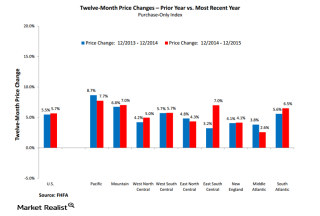
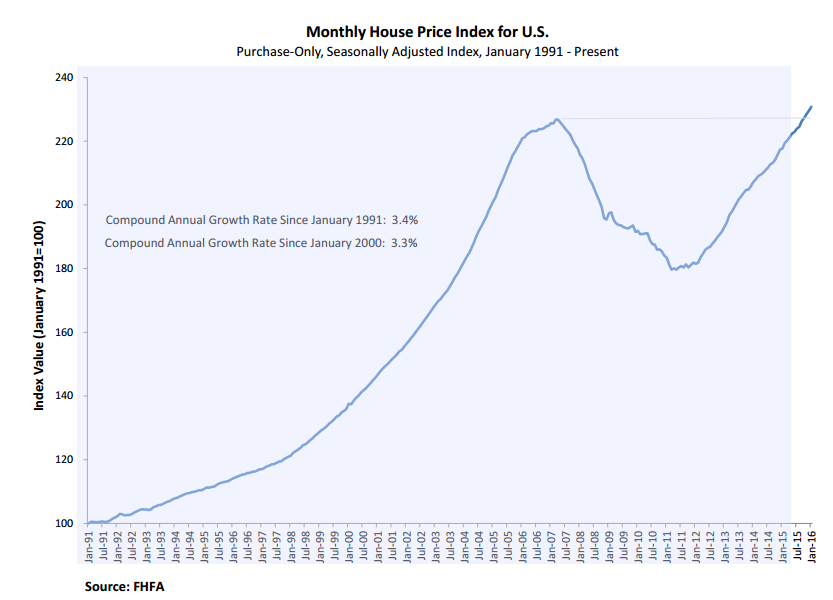
The FHFA House Price Index rose 0.5% last month. House prices have recouped all of their losses from the housing bust and are making new highs. Note the FHFA House Price Index is the only one showing the losses have been recouped – Case Shiller, and Core Logic have not.
You can also see the huge geographic disparity between the different regions in the US. The Northeast (which includes New England and the Middle Atlantic) are picking up the rear compared to the other parts of the country. As someone who grew up in the Rust Belt, I am beginning to notice similarities in the Northeast.
In other economic data, the Richmond Fed Manufacturing Index improved last month, and the Markit US Manufacturing PMI was flat.
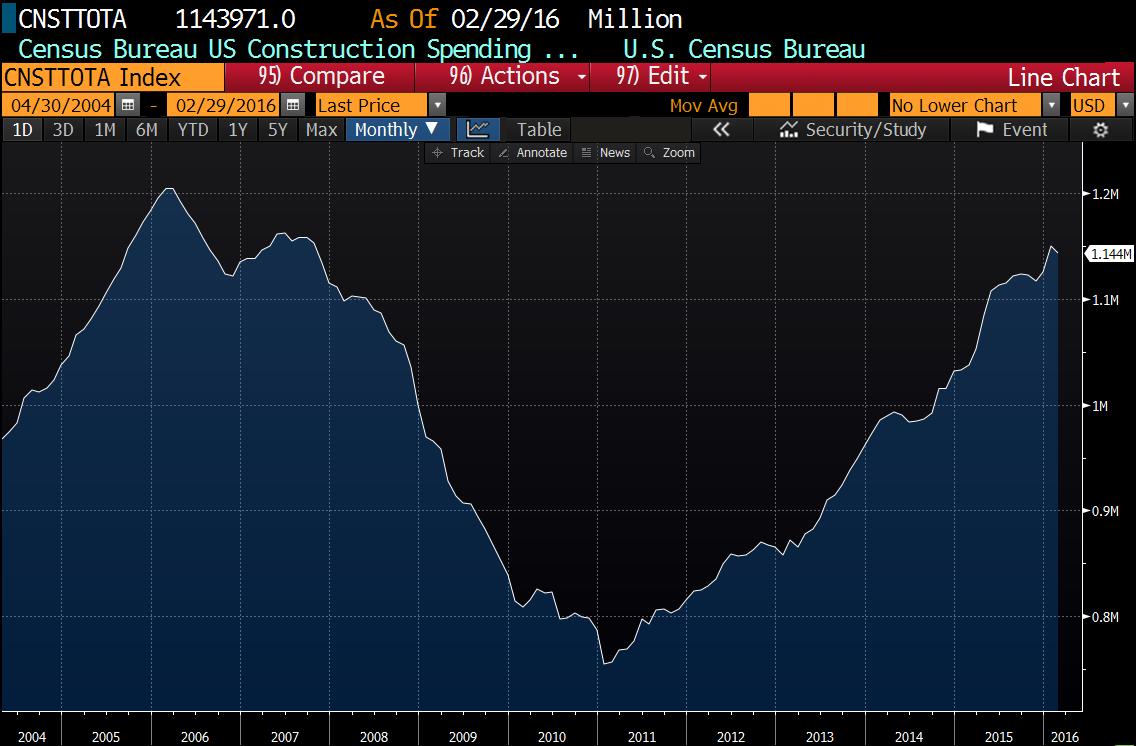
We are well aware there is a problem with the first time homebuyer. They are saddled with large student loan debt, and are under-employed for the most part. The other big issue – low housing inventory is making the starter home unaffordable. When you look at the expensive areas, it gets ridiculous. The mortgage payment for a starter home in San Francisco (admittedly an extreme example) would run someone 110% of median income! I have said it before: the difference between 2% GDP growth and 3% GDP growth is housing. To address the dearth of inventory, we should have a run rate of 2 million starts a year. Yet we remain mired around 1.2 million. It obviously isn’t an oversupply issue – it is a credit issue. Yet the consensus seems to be that the financial sector remains “unregulated” and needs to be reined in. You would think politicians would like to see 3% economic growth but apparently they don’t. All obama seems to care about is racial bean-counting in the burbs..

Over half of US homes are now built in community associations. Issues over the creditor priority HOA claims over mortgages have been an issue in some states, apparently.
More evidence that the cheap labor arbitrage for China is about over.
Filed under: Economy, Morning Report | 12 Comments »


 Brent Nyitray
 Fairlington Blade
 Let the mutherfuker burn!
 jnc4p
jnc4p Kevin S. Willis
 Michigoose
 lmsinca
 markinaustin
 Arcanaut
 novahockey
 quarterback
 ScottC
 yellojkt



 All Things in Moderation