Morning Report: Existing home sales fall on rising prices.

Vital Statistics:


Last Change
S&P futures 2992 -2.25
Oil (WTI) 53.87 -0.64
10 year government bond yield 1.74%
30 year fixed rate mortgage 4.03%


Stocks are flattish as earnings come in. We should be hearing from heavyweights such as Tesla, Boeing, Caterpillar, Ford and Microsoft. Bonds and MBS are flat.


Mortgage Applications fell 12% last week as purchases fell 4% and refis fell 17%. Mortgage rates increased 10 basis points and increased to 4.02%. “Interest rates continue to be volatile, with Brexit votes and ongoing trade negotiations swinging rates higher or lower on any given day,” said MBA Chief Economist Mike Fratantoni. “Last week, mortgage rates jumped 10 basis points and were above 4 percent for the first time since September. The increase in mortgage rates caused refinance applications to drop 17 percent, and by more than 20 percent for conventional loans. Borrowers with larger loans are the most sensitive to rate changes, and with rates climbing higher last week, the average size of a refinance loan application fell to its lowest level this year.”


Existing home sales fell 2.2% in September, according to NAR. Lawrence Yun, NAR’s chief economist, said that despite historically low mortgage rates, sales have not commensurately increased, in part due to a low level of new housing options. “We must continue to beat the drum for more inventory,” said Yun, who has called for additional home construction for over a year. “Home prices are rising too rapidly because of the housing shortage, and this lack of inventory is preventing home sales growth potential.” The median home price increased 5.9% to 272,100 and the supply of available homes came in at 1.83 million units, or about 4 month’s worth of inventory.


Home prices rose 0.2% MOM and 4.6% YOY in August, according to the FHFA House Price Index. Home price appreciation is definitely decelerating this year, compared to 2018, although lower rates will probably re-accelerate growth in the markets with tighter inventory.


FHFA regional


FHFA Director Mark Calabria said that he is willing to wipe out the shareholders of Fannie and Freddie if needed to protect taxpayers. “If the circumstances present themselves where we have to wipe out the shareholders, we will.,” he said at testimony in front of the House Financial Services Committee. He added that he believes that shareholders should have lost their stakes in the GSEs when the government rescued them in 2008. Fannie and Fred were put into conservatorship, with the government owning 79.9% of the companies. This was done largely to prevent disruption to the mortgage market if the companies were to enter formal bankruptcy, and also to prevent the government from having to consolidate all of Fannie’s debt on its own balance sheet. His comments at least leaves the door open for some recovery value for common stockholders if the GSEs are reformed. FWIW, the Obama administration was absolutely steadfast in their belief that the stock was worthless, and a change in administrations will probably return to that stance.


Morning Report: A look ahead to the regulatory environment for the financial industry

Vital Statistics:


Last Change
S&P futures 2996 7.25
Oil (WTI) 53.47 -0.44
10 year government bond yield 1.78%
30 year fixed rate mortgage 3.97%


Stocks are higher this morning on expectations of an orderly Brexit and optimism on trade. Bonds and MBS are down.


Not a lot of market-moving data this week, although we will get a lot of housing indicators, with existing home sales, new home sales, and house prices. Note the FOMC meets next week, and it is looking like a lock that they will cut rates. The Fed funds futures are now handicapping a 91% chance of a cut.


The Index of Leading Economic Indicators declined in September, as trade concerns and manufacturing offset strength in other areas. “The US LEI declined in September because of weaknesses in the manufacturing sector and the interest rate spread which were only partially offset by rising stock prices and a positive contribution from the Leading Credit Index,” said Ataman Ozyildirim, Senior Director of Economic Research at The Conference Board. “The LEI reflects uncertainty in the outlook and falling business expectations, brought on by the downturn in the industrial sector and trade disputes. Looking ahead, the LEI is consistent with an economy that is still growing, albeit more slowly, through the end of the year and into 2020.”


It looks like the structure of the CFPB is going to be decided by the Supreme Court. The issue with the CFPB goes back to its structure, which makes it nearly impossible to remove a director. The idea was to make the CFPB less influenced by politics, however it also makes it completely immune to oversight and accountability. The case will move forward without the support of the government, as CFPB Director Kathy Kraninger doesn’t support the structure of the agency either. If the CFPB’s structure is declared unconstitutional, it wouldn’t mean the end of the agency, it would mean that the single, unfireable director would be replaced by a bipartisan board, which was actually the initial proposal when the CFPB was created during the drafting of Dodd-Frank.


Elizabeth Warren threatened to ban fracking if she wins the presidency. “On my first day as president, I will sign an executive order that puts a total moratorium on all new fossil fuel leases for drilling offshore and on public lands. And I will ban fracking—everywhere.” Needless to say, this would be incredibly disruptive to the US economy as natural gas prices would increase to $9.00 to $15 per mBTU, compared to current prices of around $2.00 – $2.50. Since natural gas is the main way we generate electricity, consumers and industry would feel it immediately, and this would cause uncertainty on steroids, and make Trump’s trade concerns look like a minor annoyance. She would be able to implement many changes via executive order, and she intends to use it. Given that Joe Biden is having trouble fundraising, it is looking more like a lock that she gets the nomination. Even some left-leaning pundits are worried.


What would that mean for the mortgage banking business? Regulations will undoubtedly be tightened, but they probably will affect the bigger banks more than the independent operators. She says she wants to re-implement Glass-Steagall, which is really a solution in search of a problem. However, if she succeeds in raising taxes and energy prices as much as she intends, it would almost certainly be the final nail in the longest running expansion ever, and that means the Fed Funds rate is probably heading back to zero. A return to ZIRP almost certainly means the 10 year will breach the 1.47% low set in 2012, which will would create another refi wave similar to the years immediately after the financial crisis. So, perversely a Warren presidency could be great for the mortgage banking business, as the industry feasts on easy refinances.

Morning Report: Housing starts disappoint again

Vital Statistics:


Last Change
S&P futures 2999 -1.25
Oil (WTI) 54.47 0.44
10 year government bond yield 1.75%
30 year fixed rate mortgage 3.97%


Stocks are lower this morning on weak overseas growth. Bonds and MBS are flat.


Housing starts disappointed again, falling 9.4% from an upwardly revised August number to 1.26 million units. This is up slightly on a YOY basis. Building Permits came in at 1.387 million units, higher than expected but still down 2.4% on a MOM basis. Compared to last year, they are up 9.4%.


Despite the disappointing starts, builder confidence hit an 20 month high. “The second half of 2019 has seen steady gains in single-family construction, and this is mirrored by the gradual uptick in builder sentiment over the past few months,” said NAHB Chief Economist Robert Dietz. “However, builders continue to remain cautious due to ongoing supply side constraints and concerns about a slowing economy.”


Industrial production fell 0.4% in September, and manufacturing production was down 0.5%. August’s numbers were revised higher. Capacity Utilization fell to 77.5%. Tariffs are attributed to the slowdown, but overseas growth in general is weakening. Note China had the lowest GDP growth since the early 1990s. The global slowdown has increased the odds of another rate cut in two weeks, which is up to 87% compared to 28% a month ago.


fed funds futures

Morning Report: Bank earnings looking strong

Vital Statistics:


Last Change
S&P futures 2991 -6.25
Oil (WTI) 52.97 0.14
10 year government bond yield 1.74%
30 year fixed rate mortgage 3.97%


Stocks are lower this morning as bank earnings come in. Bonds and MBS are down.


Retail Sales disappointed, falling 0.3%, which was lower than expected. Ex autos and gas, they were flat, although August numbers were revised upward across the board. The control group was flat, and sales rose 4.1% YOY.


Mortgage Applications rose 0.5% last week as purchases fell 4% and refis rose 4%. “The ongoing interest rate volatility is impacting a borrowers’ ability to lock in the lowest rate possible. Despite a slight rise in mortgage rates last week, refinance applications increased 4 percent and were 199 percent higher than a year ago,” said Joel Kan, MBA Associate Vice President of Economic and Industry Forecasting. “Purchase applications slowed for the second week in a row. While near term economic uncertainty is still a factor, other fundamental issues, such as a lack of housing inventory in many markets, is preventing purchase activity from meaningfully rising. However, purchase applications were still much higher than a year ago. This is a reminder that the purchase environment in 2019 continues to be stronger than in 2018.”


Bank earnings are generally looking good, and mortgage backed securities trading desks are doing well as rates have fallen and volumes have picked up. The other side of the coin is that the drop in rates have negatively affected the values of mortgage servicing rights. Wells is a good example: despite a $127 million increase in origination revenue, total mortgage banking revenue fell by $292 million as their servicing book took a $419 million mark-to-market loss.

Morning Report: Mortgage rates and the 10 year

Vital Statistics:


Last Change
S&P futures 2915 -6.25
Oil (WTI) 53.07 0.54
10 year government bond yield 1.61%
30 year fixed rate mortgage 3.84%


Stocks are down this morning on no real news. Bonds and MBS are down as well.


Consumer inflation was flat in September, and is up 1.7% YOY. The core rate, which excludes some volatile commodities, rose 0.1% MOM and 2.4% YOY. Inflation continues to sit right in the range it has been historically.


Job openings fell from a downward-revised 7.17 million to 7.05 million, while initial jobless claims ticked up to 214k.


Mortgage Applications rose 5.2% last week as purchases fell 1% and refis rose 10%. The rate on a 30 year fixed conforming loan fell 9 basis points to 3.9%. Weaker-than-expected economic data drove the decrease.


Good news for the financial community: Trump is planning to sign a couple of executive orders, which will bring more sunlight on rulemaking, and will permit more public input in the federal guidance. Much of this guidance had been “rulemaking in secret” and this will give companies more of a head’s up when the regulatory agencies plan major changes in guidance. The CFPB sprung a nasty surprise on auto lenders during the Obama Administration, where they determined that any lenders who provide auto loans through dealerships are responsible for “discriminatory pricing.” It is this sort of the thing the order intends to limit.


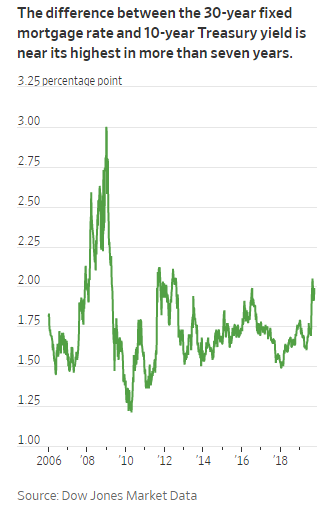
“CNBC is saying the 10 year bond yield is way lower, but I just ran a scenario and my borrower still has to pay a point and a half. What is going on?” This is a common observation these days, and it can be frustrating for both loan officers and borrowers. As the Wall Street Journal notes, that the difference between the typical mortgage rate and the 10 year bond is at a 7 year high. What is going on? First, and most important, mortgage rates are not determined by the 10 year. They are determined by mortgage backed securities, which have entirely different financial characteristics than a government bond. When rates are volatile (i.e. changing a lot in a short time period) mortgage backed security pricing will be negatively affected. In practical terms, it means that when the 10 year bond yield abruptly moves lower, it will take a few days for mortgage rates to catch up, while the time it takes to adjust to big upward moves in Treasury rates is often shorter. It also explains why it can be hard to get par pricing when you have a lot of loan level hits from Fannie (i.e. investment property, cash out refinancing, etc). The “rate stack” gets compressed and MBS investors are wary of buying high coupon securities. Bond geeks have a term for this – negative convexity – but in practical terms it means that moves in the 10 year don’t directly carry over to mortgage rates.


primary market spreads

Morning Report: Housing affordability improves

Vital Statistics:


Last Change
S&P futures 2919 -16.25
Oil (WTI) 52.07 -0.64
10 year government bond yield 1.53%
30 year fixed rate mortgage 3.83%


Stocks are lower this morning on trade concerns and lower than expected inflation readings. Bonds and MBS are flat.


Inflation at the wholesale level came in well below expectations, with the headline producer price index falling 0.3%. Ex-food and energy, it fell by the same amount. On a year-over-year basis, the headline rose 1.4% and ex-food and energy it rose 2%. While the Fed doesn’t pay too much attention to the CPI and PPI, it will certainly fuel fears that they are losing the battle against deflation.


Small business optimism fell in September, according to the NFIB.  “As small business owners continue to invest, expand, and try to hire, they’re doing so with less gusto than they did earlier in the year, thanks to the mixed signals they’re receiving from policymakers and politicians,” saidNFIB President and CEO Juanita D. Duggan. “All indications are that owners are eager to do more, but they’re uncertain about what the future holds and can’t find workers to fill the jobs they have open.” The point about jobs is crucial to understanding the current economic environment. While there are fears that we may enter a recession, they are rare when the labor market is this tight, and we are more likely to see increasing wage growth and consumer spending. Not a recipe for a recession.


NFIB


Home prices rose 0.4% MOM and 3.6% YOY, according to CoreLogic. They anticipate that home price appreciation will approach 6% in the next year, driven by lower rates. Of the top 100 metro areas, 37% are overvalued, while 23% were undervalued. The Rust Belt, interior California, and parts of the Northeast are the most undervalued.


Corelogic overvalued


Speaking of home price appreciation. California has enacted statewide rent control, which limits rent increases to 5%, and makes it harder to evict non-payers. Of course when you have a dearth of housing, artificially depressing the rate of return on that investment is a strange way of encouraging it. But this law is all about messaging, not substance. Notwithstanding the state of CA, housing affordability is at a 3 year high right now, according to Black Knight, driven by lower interest rates. This is quite the reversal from November last year when affordability was at a 9 year low.

Morning Report: Holiday sales looking strong

Vital Statistics:


Last Change
S&P futures 2945 -6.25
Oil (WTI) 53.63 0.84
10 year government bond yield 1.54%
30 year fixed rate mortgage 3.84%


Stocks are slightly lower on trade concerns and weak European data. Bonds and MBS are flat.


The upcoming week should be relatively quiet, with only inflation data and a slew of Fed-speak. Since increasing inflation is no longer front and center of the Fed’s concerns, the CPI and PPI should be non-events. We will also get the minutes from the September FOMC meeting on Wednesday.


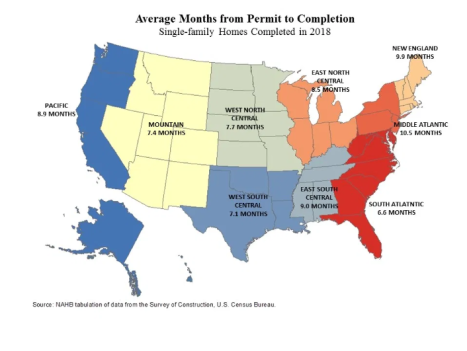
Interesting stat on how long it takes to build a home in different geographic areas. The Mid-Atlantic region (which contains red-tape heavyweights like NY and NJ) is the longest at 10.5 months. The West Coast is right up there as well, at 9.9 months. The Southeast has the shortest timeline at 6.6 months.


new construction times


IPOs have been a treacherous investment over the past few years, as the venture capitalists and early entry investors have been reaping the rewards, at least for some of the biggest names (Uber, Lyft, Slack). We Work recently pulled its IPO as investors balked at the corporate governance issues and cash burn. While not all IPOs have been disasters, historically they have popped about 20% on the first day of trading. Not any more.


The National Retail Federation sees holiday sales at 3.8% – 4.2%, citing trade concerns over holiday spending. This is the low side of the holiday forecasts, which are coming in closer to 5%. The last 5 years have been around 3.7%, so the forecast is for something between “above average” and “great.” Since consumption is about 70% of the economy, we could be looking at better GDP numbers heading into the end of the year, which would put pressure on the Fed to slow down their pace of rate cuts.

Morning Report: Reassuring jobs report

Vital Statistics:


Last Change
S&P futures 2915 4.25
Oil (WTI) 52.60 0.14
10 year government bond yield 1.53%
30 year fixed rate mortgage 3.84%


Stocks are higher after the jobs report. Bonds and MBS are down.


The economy added 136,000 jobs in September, versus Street expectations of 145,000. August’s number was revised upward by 38,000 to 168,000. The unemployment rate fell to 3.5%, which is the lowest in 50 years. The labor force participation rate was flat at 63.2% and the employment-population ratio ticked up to 61%. Average hourly earnings were flat on a MOM basis and up 2.9% YOY.


Overall, it confirmed that we are seeing a bit of a deceleration in the economy, although we are nowhere near a recession. The Fed Funds futures are handicapping a 75% chance of a 25 bp rate cut at the October meeting at the end of the month.


If the unemployment rate is at a 50 year low, we can pretty much dismiss the recession talk as the press generating alarmism to capture eyeballs, right? Not necessarily. We have had recessions in the past with unemployment rates this low. Take a look at the chart below. It plots the unemployment rate and the Fed funds rate. The vertical shaded areas are recessions. You can see that we hit 3.5% unemployment in 1969 and entered a recession soon thereafter. You can see the cause of that recession however in the Fed Funds rate, which went from 4% to 9% in the two years leading up to it. Similarly, we had a recession in 1973 – 75 even though unemployment was in the mid 4% range immediately prior. That one was caused by the Arab Oil Embargo. That said, you can see that most recessions are preceded by a tightening cycle out of the Fed, and that explains why the Fed is now cutting rates – they worry they might have overshot.


unemployment vs fed funds


As home prices increase, many homeowners are considering renovation loans (like 203k or HomeStyle) to increase the value of their house. What are the best renovations, in terms of return on investment? Hint: not a swimming pool. It is a new roof. What about kitchen renovations? Homeowners can expect to recoup about 50% – 60% of the cost in increased home value. Same with bathroom upgrades and master bedrooms. It turns out that mundane upgrades (wood flooring, insulation, roofing) provide more bang for the buck than the more dramatic ones.


Morning Report: Service sector decelerates

Vital Statistics:


Last Change
S&P futures 2885 4.25
Oil (WTI) 52.48 0.24
10 year government bond yield 1.58%
30 year fixed rate mortgage 3.87%


Stocks are higher this morning on no real news. Bonds and MBS are flat.


Announced job cuts fell to 41,557 according to the Challenger and Gray report. This looks at press releases, so they don’t represent actual cuts, just announcements. Retail (which has been a perennial weak spot) dominated, along with trade-related industrial cuts. Separately, initial jobless claims rose to 219,000.


The service sector decelerated in September, according to the ISM non-manufacturing survey. Separately durable goods orders fell slightly. We are definitely seeing a deceleration in business spending, and will see if this is only a temporary bump, or something more permanent.


Fannie and Freddie now guarantee about $7 trillion of mortgage debt, 33% higher than before the crisis. The amount of higher DTI loans is rapidly increasing, due to the GSE patch, which permitted them to do riskier loans. About 30% of GSE loans are high DTI, compared to 16% 3 years ago. FHA is even worse, with 57% high DTI, compared to 38% 2 years ago. “There is a point here where, in an effort to create access to homeownership, you may actually be doing it in a manner that isn’t sustainable and it’s putting more people at risk,” said David Stevens, a former commissioner of the Federal Housing Administration who led the Mortgage Bankers Association until last year. “Competition, particularly in certain market conditions, can lead to a false narrative, like ‘housing will never go down’ or ‘you will never lose on mortgages.’ ” The Trump and the Obama Administrations hoped to attract private capital back into the mortgage market, but so far it has been extremely limited.


New Rez has bought Ditech for $1.2 billion, as it works its way through bankruptcy. New Rez is part of Fortress which has been on an acquisition binge, buying Shellpoint last year. Fortress is owned by Japan’s Softbank.


Interesting stat: Remember the HAMP program, which was treated as a way to prevent foreclosures by modifying mortgages? Turns out that 57% of the modified loans from 2008 to 2013 re-defaulted.

Morning Report: Manufacturing contracts

Vital Statistics:


Last Change
S&P futures 2924 -14.25
Oil (WTI) 53.85 0.24
10 year government bond yield 1.64%
30 year fixed rate mortgage 3.89%


Stocks are lower this morning on overseas weakness. Bonds and MBS are up small.


Manufacturing contracted for the second month in a row, according to the ISM Manufacturing Survey. New orders, production, and employment all fell. Some of this is due to the trade wars, however overseas economic weakness is probably the dominant driver. Historically, this number on the ISM would correlate with GDP growth of 1.5%. In other words, the number isn’t signalling a recession, but it is pointing to a slowdown.


Mortgage Applications increased 8.1% last week as purchases increased 1% and refis increased 14%. “Mortgage rates mostly decreased last week, with the 30-year fixed rate dropping below 4 percent for the sixth time in the past nine weeks. Borrowers responded to these lower rates, leading to a 14 percent increase in refinance applications,” said Joel Kan, MBA Associate Vice President of Economic and Industry Forecasting. “Although refinance activity slowed in September compared to August, the months together were the strongest since October 2016. The slight changes in rates are still causing large swings in refinance volume, and we expect this sensitivity to persist.”


Despite the issues in the manufacturing sector, Freddie Mac expects housing to to remain strong. Overall, government spending and business investment are probably going to decelerate, but this will be offset by a strong labor market and robust consumer spending. Note the uptick in originations. Freddie was initially anticipating this year would be more like $1.6 trillion.


Freddie Mac forecasts


Freddie is forecasting 1.9% GDP growth in Q3 and 1.8% in Q4. What is the risk to these numbers? To the downside, slowing global growth and perhaps political uncertainty – though the markets seem pretty blase about the impeachment drama. To the upside? Homebuilding. Note the strength in the homebuilder ETF (XHB), which has been on a tear. We are approaching the bubble highs, and as the Millennial Generation begins to start families and head to the suburbs, the builders will be busy addressing the dire shortage of starter homes. The post-bubble “new normal” of 1.3 million housing starts a year is anything but normal and we probably need 2 million just to satisfy pent-up and incremental demand.


XHB


ADP reported 135,000 jobs were created in September, which matches the estimate for Friday’s jobs report. Construction reported an increase, while mining and natural resources declined. The service sector continued to add jobs as well.