Bites & Pieces (Appetizers)

We’re having a small party next Saturday and so I’ve been thinking about the menu and what kind of appetizers to serve.  I’ve asked a few family members for suggestions and all of them requested this one.  It’s not the healthiest dish on the planet but since it’s one of those things I only make on rare occasions it falls into the eat in “Moderation” category.  Below I’ll jot down another recipe for an eggplant dip that’s quite a bit more nutritious although Michi may have already given us a similar one.

When I was growing up the popular appetizer at cocktail parties was Rumaki (chicken liver, water chestnut, bacon) so I guess mine isn’t any worse than that.  My father was the Rumaki King and so my sister and I helped make and serve a lot of it…………………………….yuck.

Fried Artichoke Hearts (serves 4 to 6)

Ingredients:

1 can artichoke hearts, not the marinated variety, you can buy them whole or quartered.  Quartered are more work but go further with a crowd.

3/4 cup flour

salt and garlic powder added to flour (dash of salt, 1 tsp garlic powder)

2 eggs lightly beaten

3/4 to 1 cup panko bread crumbs

oil for frying

2 to 3 tablespoons butter

juice of 1/4 lemon

Parmesan, freshly grated or Kraft

Directions:

Drain artichoke hearts.  Measure the seasoned flour and bread crumbs into individual bowls and likewise the eggs.  First coat the hearts with flour, then dip into the eggs coating thoroughly and last, roll in bread crumbs.  I generally do three or four at a time and use a separate fork for each bowl to keep my fingers from building up with all the sticky ingredients.  Place in a single layer on a plate and cover.  Refrigerate for several hours as they are best fried when really cold.

I generally fry them in a hot pan with just a 1/4″ layer of oil on the bottom and flip them several times until they turn a golden brown, but you can deep fry them it you want.  Drain on paper towels for a few minutes and while they’re draining melt the butter and add lemon juice.  Place the hearts into a serving dish and drizzle with lemon butter and sprinkle the top with Parmesan cheese………………Voila!!!!!

Eggplant Dip (Serves 4 to 6)

Ingredients:

5 large eggplants

5 cloves garlic

Juice of 1 large lemon

1 to 2 tablespoons tahini

5 green onions, chopped

salt and black pepper

Directions:

Heat the oven or grill to 400.  Roast whole eggplants on a baking sheet in the oven or directly on the grill for 40 to 50 minutes until soft and let cool.  Scoop out the insides of the eggplants and put them into a bowl, discard the peels.  Mash the eggplant and then let stand for about 30 minutes.  Discard any accumulated juices.

Add the garlic, lemon juice, tahini and green onions to the eggplant and mix together.  Add salt and pepper.  Keep refrigerated until serving.  Serve with crackers, cut vegetable or bread cubes.

And lastly, this piece from the Nation might clarify a few things for the girls here, or at least the ones who used to be here.  I’m not trying to start another fight please, just thought the girls might find something useful from this perspective.

Revisiting the American Dream, or Dusk in America

A little uplifting reading for you.
National Journal: In Nothing we Trust

It’s long but covers Americans’ increasing indifference to our institutions — government, churches, corporations, etc.

Bits & Pieces (Lulu’s Birthday Edition)

Today is our very own lms’s birthday!

Today is also Agnetha Fältskog’s [Anna Ulvaeus] birthday from the group ABBA, so with that in mind. . .

ABBA’s Benny and Bjorn sing Happy Birthday

hoppy birdies, lms!

Mark adds the recipe for traditional Italian Jewish Passover Seder soup, which is somewhat different than northern European Jewish Matzoh ball soup:

Minestra di riso per pesach from Edda Servi

As Edda Servi Machlin notes, though the Ashkenazim consider rice chametz, Italkim do not; this is thus the Italian equivalent of matza ball soup and is served at the Seder. It includes meatballs made from chicken breast and immature chicken eggs, which she suggests be substituted with hard-boiled eggs as they are hard to find. To serve 8:
Prep Time: 30 minutes

Cook Time: 20 minutes

Total Time: 50 minutes

Ingredients:

A whole chicken breast, boned
An egg, lightly beaten
1/4 cup matza meal
1/2 teaspoon salt
A pinch of nutmeg or cinnamon
2 1/2 quarts chicken broth
1/2 cup (100 g) uncooked rice
8 small hard-boiled eggs
Preparation:

Grind the chicken breast. Lightly beat the egg and combine it with the matza meal and 2 tablespoons of the chicken broth. Combine the ground chicken breast and the matza mixture, salt, and spice, and mix thoroughly. Chill the mixture for 15 minutes; in the meantime peel the eggs, discarding the whites, and bring your soup stock to a boil.

Make meatballs no larger than the yolks. Add them and the rice to the soup, and simmer for 15-20 minutes. Place a yolk in each of the soup bowls, ladle the soup over it, and serve.

Happy Penguin Birthday!


Republican War on Women (RWoW)

This deserves a thread of its own.

Google the phrase.

  1. Top 10 Shocking Attacks from the GOP’s War on Women

    pol.moveon.org/waronwomen/

    Stop the Republican War on Women. Redefining rape. Attacking the right to choose. Belitting victims of violence. The Republicans are on a rampage attacking 

This is quite clearly a freighted political catchphrase, intended so by sources like MoveOn and HuffPo.  Like the “War on Drugs” and the “War on Terror” it is intended to limit discussion of issues based on impugning motives.  Scott has been trying to make that point.

If we could define the Republican War on Women as the sum of these actions:

a failed conservative move to cut off U.S. government aid to Planned Parenthood + the Komen decision, since reversed + the attempted but failed roll back of contraception under employer health plans + the all male panel called to testify + the G’town student who was called a “slut” by Limbaugh + Santorum’s money guy’s “aspirin between the knees” comment + the vaginal insert sonogram, since abandoned in VA + the R opposition to extending the funding under the Violence against Women Act + personhood laws (thanks, Ashot), we could probably still talk about the cumulation without calling it war.

We could see it as R strategy to appeal to a fundamentalist base, that has become a bolder strategy as more and more of the active voting base of Rs claim fundamentalist religious principles, which often go far beyond the antipathy to abortion that many non-fundamentalists share.  We could see that fundamentalist faith actually does put women in a secondary role – this is true in all the Abrahamic religions.

We could see that some of the individual issues that have been tarred as part of the RWoW don’t derive their impetus from pandering to fundamentalist religion.  For example, some may derive from the desire to cut the budget.

We would not be surprised that moderate women would have no sympathy for any of the items I listed, and would be moving away from the Rs, unless some other set of issues took priority for them.

IMHO,  resisting the shorthand RWoW is worthwhile just in order to keep the issue conversation alive.  I think the same is true of other uses of the word “war” in a catchphrase intended to inflame emotions – like the WoD and the WoT.  It also cheapens the meaning of the word, fwiw.

Unprecedented?!?!

President Obama is nothing if not bold. Yesterday, in an abuse of language for which there is unfortunately a great deal of precedent, the president opined on SCOTUS’s recent hearing regarding the fate of ACA.

Ultimately I am confident that the Supreme Court will not take what would be an unprecedented, extraordinary step of overturning a law that was passed by a strong majority of a democratically elected Congress

Unprecedented and extraordinary? Really? No law passed by Congress has ever been overturned by the court before?

Politics is politics, of course, and we all know the games of semantic deception that are regularly played by politicians. But, especially for a former professor of constitutional law, this is a particularly embarrassing departure from reality. Doesn’t it debase our politics even more than is already the case to have a Chief Executive who is so shameless in his disregard for the meanings of the words he uses and the reality he pretends to describe?

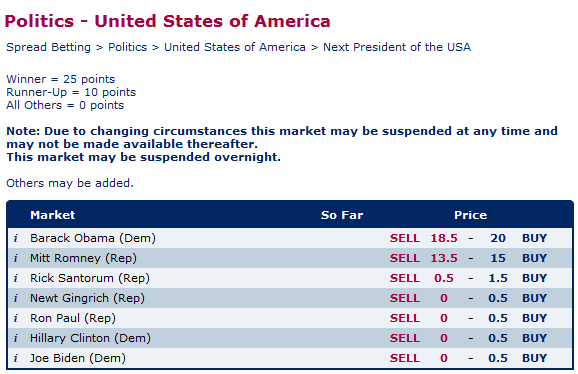
Handicapping 2012

How are the markets currently handicapping the 2012 election?
Intrade currently has obama trading at about 60
Sporting Index (A UK spread betting index) has him at 62.
No, you can’t arbitrage the two.

Sporting Index Markets:
Intrade Obama Chart:

“…we would be wise to look upon arguments from fairness with a jaundiced eye.”

From The Economist –

The politics of fairness

Fairly confusing

Feb 2nd 2012, 14:31 by W.W. | IOWA CITY

FAIRNESS played a central role in Barack Obama’s state-of-the-union address, and I suspect it will play a central role in the president’s re-election campaign. But what does Mr Obama have in mind when he deploys the f-word? It may not be the case that fairness is, as Scott Adams, the creator of Dilbert, puts it, “a concept invented so dumb people could participate in arguments”. But it cannot be denied that fairness is an idea both mutable and contested. Indeed, last week’s state-of-the-union address seems to contain several distinct conceptions of fairness worth drawing out and reflecting upon.

Toward the beginning of his speech, as Mr Obama was trying to draw a parallel between post-second world war America and today’s post-Iraq war America, he offered this rather stark choice:

We can either settle for a country where a shrinking number of people do really well while a growing number of Americans barely get by, or we can restore an economy where everyone gets a fair shot, and everyone does their fair share, and everyone plays by the same set of rules.

Here we have three distinct conceptions of fairness in a single sentence.

To get a “fair shot” is to be offered the opportunity to participate fully and succeed within the country’s institutions. This is, I think, the least controversial conception of fairness in America’s political discourse. Conservatives who strenuously object to the idea that the American system should aim at “equality of outcomes” will sometimes affirm “equality of opportunity” as an alternative. But this is a mistake. To really equalise opportunity requires precisely the sort of intolerably constant, comprehensive, invasive redistribution conservatives rightly believe to be required for the equalisation of outcomes. If one is prepared to accept substantial inequalities in outcome, it follows that one is also prepared to accept substantial inequalities in opportunity.

Getting a fair shot doesn’t require equalising opportunity so much as ensuring that everyone has a good enough chance in life. The content of “good enough” is of course open to debate, but most Americans seem to agree that access to a good education is the greater part of a “good enough” and thus fair shot. Naturally, there is strong partisan disagreement over the kinds of education reform that will do right by young Americans. And there is also disagreement over elements of a “fair shot” beyond education. For example, many liberals believe workers don’t have a fair shot at achieving a decent level of economic security without robust collective-bargaining rights. And many conservatives believe that an overly-strong labour movement invites outsourcing by raising domestic costs, and thereby deprives American workers of a fair shot at employment. There may be some fact of the matter about which policies are most likely to benefit students or workers. But if one is more fair then the other, how would we know?

What is it to do one’s “fair share”? In small groups, it’s clear enough. If my friend and I are shoveling the front walk, my fair share of shoveling, and his, is about half. Often we adjust for differences in ability. If I am big and strong and my friend is small and frail, his fair share may be as much as he can manage. That won’t mean that the whole remainder is my fair share, though. If we’re going to get the walk shoveled, I may have to do a bit more than my fair share. These things get complicated quickly. That’s why the question of what it means for an American do his or her fair share, qua citizen, is completely baffling.

Suppose I’m a surgeon pulling down six figures. Perhaps doing my fair share is to pay 33% of my income in taxes. But, hey, wait! My sister, who could have been a surgeon, chose instead to make pottery in a little hippie arts colony. She makes only as much as she needs to get by, works relatively short hours, smokes a lot of weed with her artist friends, and pays no federal income tax at all! If paying 33% of the money I make saving lives is doing my fair share, then it’s hard to see how my sister—who could have been a surgeon, or some kind of job- and/or welfare-creating entrepreneur—is doing hers. But if she is doing hers, just playing with clay out there in the woods, benefiting next to no one, paying no taxes, then clearly I’m doing way more than my fair share. Which seems, you know, unfair.

Are you doing your fair share? How would one know? Actually, I just made myself feel slightly guilty for not going to med school and joining Médecins Sans Frontières. But unless government can come up with a way of taxing the leisure of people who aren’t doing as much as they might for kith and country, I reckon I’ll just stick to part-time pro blogging and let all you 9-to-5 suckers finance the necessary road-building and foreigner-bombing.

Playing by the same set of rules—the president’s third notion fairness in the passage above—is at least as important to fairness as the sufficiency of a “fair shot” and the proportionality of a “fair share”. A political economy with rules as convoluted as ours is sure to fail by the “same rules” criterion. Why should people who prefer leisure to income face lower tax rates? Why should parents and homeowners get tax breaks single renters don’t get? Why should young black men get longer sentences than young white women who commit the same crimes? Why should some industries get subsidies unavailable to others? In every case, they shouldn’t. It’s unfair. But it is this sense of fairness I think Mr Obama cares least about.

At one point in his address, Mr Obama says “[i]t’s not fair when foreign manufacturers have a leg up on ours only because they’re heavily subsidized.” I agree. It’s not. But just a few paragraphs earlier, Mr Obama had said:

[N]o American company should be able to avoid paying its fair share of taxes by moving jobs and profits overseas. From now on, every multinational company should have to pay a basic minimum tax. And every penny should go towards lowering taxes for companies that choose to stay here and hire here in America.

… [I]f you’re an American manufacturer, you should get a bigger tax cut. If you’re a high-tech manufacturer, we should double the tax deduction you get for making your products here. And if you want to relocate in a community that was hit hard when a factory left town, you should get help financing a new plant, equipment, or training for new workers.

So my message is simple. It is time to stop rewarding businesses that ship jobs overseas, and start rewarding companies that create jobs right here in America.

On the one hand, Mr Obama argues it’s unfair when foreign government subsidise their manufacturers. On the other hand, he seems to think subsidising American manufacturing is not only not unfair in the same way, but is somehow required by fairness.

It’s this sort of confusion that tempts me to agree with Mr Adams when he argues that fairness is “purely subjective”. But I’ll resist the temptation. I don’t think judgments of fairness are entirely whimsical. It really is unfair to eat more than your share of the cake, or to do less than your share of the shoveling, or to get ahead by flouting reasonable rules to which others faithfully adhere. And it really is unfair that America wields so much geopolitical power; our government really does behave unfairly when it condemns other countries for doing what it does on the world stage. Of course, we didn’t hear the president complaining about this.

I would conclude not that judgments of fairness are purely subjective, but that the rhetoric of fairness is used so opportunistically that we would be wise to look upon arguments from fairness with a jaundiced eye.

Super Tuesday

How many of you are in a state that is voting today?  I am.  And you are welcome to call me old-fashioned (because I am officially old now), but I really like going to my neighborhood polling place to vote in person on election day.  It is such an honor to be able to vote that it almost brings a tear to my eye every time.  So I don’t do mail-in or early voting.

Today I voted much later in the day than usual due to scheduled appointments, and got there about 15 minutes before the polls closed (7:00pm CST).  I was the only voter there at the time, so I asked the poll workers if they had a good turnout today.  They said there had been 189 votes.  To put that in perspective, they also said 400-500 is “high” turnout for a presidential general election.  I don’t study that kind of thing, but subjectively that seems to me a pretty good turnout.  Of course, I don’t know how many were Rs and how many were Ds, so I have no idea what that number means (OK has closed primaries).   By the time I got home and turned on the TV, less than 10 minutes after the polls closed and with zero precincts reporting, CBS had already called OK for Santorum.  I found that interesting since I heard/saw local ads for Gingrich and for Romney, but none for Santorum.  OK has 40 or 43 R delegates, I’ve heard it both ways.

Anybody else in states voting today have a report or observation?

Book Review – New ATiM Feature

Welcome to the launch of our first ATiM Book Review.  This is something I’ve been thinking about since we first envisioned ATiM and honestly, I don’t know why it’s taken me so long to get around to it.  I’m going to pull a popular Presidential move and choose our first book by “Executive Order” and have therefore chosen Suite Harmonic by Emily Meier.  Next time we’ll take suggestions and vote or something.  I’m reading I,Judas next, by Mark’s son-in-law, but don’t let that influence your vote.

Emily Meier (AllButCertain here at ATiM) has not only published six books, but has also launched her own publishing company, Sky Spinner Press, in the past year.  Suite Harmonic is her longest novel so we’ll get back together the weekend of April 13th  for a discussion, that should be enough time for everyone to read it.  In the meantime, be thinking of suggestions for our next reading assignment……and try not to think of it as homework.

From a recent interview:

Her honors include Minnesota State Arts Board and National Endowment for the Arts fellowships and Loft Mentor and Loft McKnight awards. Her stories have been published in national literary journals, and she’s won national fiction contests at Florida Review and Passages North. One of her stories is in “The Second Penguin Book of Modern Women’s Short Stories.”

From her website:

During this 150th anniversary year of the beginning of the Civil War, Suite Harmonic:  A Civil War Novel of Rediscovery is the indispensable novel for readers interested in discovering the intense experience of both battlefield and homefront in the teeming world of the Civil War.

Excerpt from Chapter One:

It was eleven charged days since the 25th Indiana, Volunteer Infantry, had left St. Louis on the Continental and traveled with the fleet down the Mississippi. The men had watched warily as flatboats edged between ice floes. They’d rushed to fill buckets to keep the deck wet beneath the boat’s fiery chimneys. Steaming past canebrakes and turkeys perched on tree branches, they’d kept a lookout for guerrillas and spotted herons and red-tailed hawks flying at water’s edge, eyed pignut hickories and saw Judas trees not yet in bud. A steamer suddenly crossed their bow, and the captain reversed engines just in time to avoid a collision.

At Cairo, its broad levee swarming with soldiers, they escorted angry mutineers to quarters. One of them, hearing the west of Ireland in John’s voice, cursed him in Gaelic. At Paducah they saw an otherworldly boat, brightly lit: plumed officers and beautifully gowned women strolling its upper deck. Then, the Iatan had turned from the Ohio into the Tennessee. It had pushed down the western knob of Kentucky. It had steamed into Tennessee. It had entered the Confederacy itself where the citizens weren’t just wavering but gone. When at last the boat came into view of the Stars and Stripes newly flying on Fort Henry after the navy’s victory, a thunderous, foot-stomping yell erupted around John. The wood of the boat shuddered clear through him. He was cheering so loud his throat hurt. A big fight was coming. He knew it. They all did. 

Now, after a night bivouacking at Fort Henry and the march to Fort Donelson and the long, sleepless hours in front of the Confederate rifle pits, the fight had arrived.

You can purchase Emily’s book, Suite Harmonic, from Amazon here, or from her website here.  I hope many of you will read it and enjoy it, and then we can have a lively discussion afterward, beginning the weekend of April 13th.  I’ve added a sidebar under the log in feature as a friendly reminder of our (my) choice of book and the date we’ll have our discussion as well as links for purchasing the book.

Birth Control, ACA, HHS, and the RC Church

Catholic Church Blasts HHS Birth Control Rule

By Emily P. Walker, Washington Correspondent, MedPage TodayPublished: January 30, 2012


WASHINGTON — The Catholic Church is protesting an Obama administration rule that requires nearly all employers — even Catholic ones — who provide insurance to their employees to include coverage of birth control services.

The United States Conference of Catholic Bishops (USCCB) has come down against the administration for not exempting all religious organizations from the rule.

In a video posted to the group’s website, USCCB president Archbishop Timothy Dolan said the “administration is on the wrong side of the Constitution” and that the rule to provide birth control is a violation of the First Amendment of the Constitution, which provides for the free exercise of religion.

Anecdotally, Catholics from the Midwest to the Washington, D.C., area said their churches addressed the issue in the past week via church bulletins that urged churchgoers to contact their members of Congress to support legislation to reverse the administration’s rule.

The Obama administration rule stems from a provision in the Affordable Care Act (ACA) that requires no-cost coverage for preventive health services. The Institute of Medicine (IOM) recommended that the Department of Health and Human Services cover the “full range of FDA-approved contraceptive methods” in order to prevent unintended pregnancies at no cost to the beneficiary, and that includes birth control.

The final rule, issued by the Department of Health and Human Services (HHS) on Jan. 20, says that starting on Aug. 1, 2013, health plans must cover all FDA-approved contraceptives, including hormonal contraceptives such as birth control pills, implanted devices such as intrauterine devices (IUDs), Plan B emergency contraceptives (the “morning-after” pill), and sterilization — all without charging a copay, coinsurance, or a deductible.

The plans will not have to cover abortions, however.

Churches and church-affiliated secondary schools are exempt from the rule, but other organizations with religious affiliations — including universities, charities, and hospitals — must comply. Such organizations petitioned HHS for an exemption after the preliminary rule was issued last summer. As a compromise, they have been given an extra year to comply.

“In effect, the president is saying we have a year to figure out how to violate our consciences,” Dolan said in a statement.

The Catholic Church opposes preventing conception by any artificial means, including condoms, IUDs, birth control pills, and sterilization.

Sister Mary Ann Walsh of the USCCB told MedPage Today that requiring Catholic providers to write prescriptions for birth control would be asking them to violate the church’s teaching.

“If you went to the Jewish deli, you can’t complain because it doesn’t have pork,” she said. “If you went to a Catholic hospital, you shouldn’t be surprised that that a Catholic hospital won’t prescribe contraception and sterilization.”

Walsh said the USCCB supports legislation authored by Rep. Jeff Fortenberry (R-Neb.) that would amend the ACA to permit health plans to refuse to cover specific items, such as birth control or services that “are contrary to the religious beliefs” of the entity offering the plan, without penalty. The bill, HR 1179, would allow those plans to still be considered “qualified health plans” and therefore able to be sold in the health insurance exchanges created by the healthcare reform law.

The bill has 102 sponsors, seven of whom are Democrats.

The Catholic Health Association of the United States declined a request for an interview, but pointedMedPage Today to a statement made by CEO Carol Keehan, who said the group is disappointed that HHS exempted only churches, but not religious hospitals, from its preventive services rule.

“The challenge that these regulations posed for many groups remains unresolved,” Keehan said in the statement. “This indicates the need for an effective national conversation on the appropriate conscience protections in our pluralistic country, which has always respected the role of religions.”

_________________________________________________________________

During the debate in 2009, The Bishops fought to have abortion not covered by ACA and the Catholic hospitals split with them (you can look that up).  The compromise finally went the Bishops’ way on abortion, as I recall.  Birth control, not including elective abortion, of course, remained in ACA, with an exemption for Churches, but not for RC employers or RC Hospitals (which presumably do not want that exemption, judging by 2009’s experience).  Is there some way the Bishops have been subjected to a sneak attack here, or was this a fight that was just going to happen once ACA was implemented, no matter what?  It seems to me that HHS is implementing ACA here as written.  Is there an executive overreach here that I am missing?  Was there reason to think a “church” included a “hospital” affiliated with the RCC?

Your collective input is required for my edification.