Morning Report: Home Prices Rise

Vital Statistics:


Last Change
S&P futures 3235 -5.1
Oil (WTI) 42.34 1.22
10 year government bond yield 0.59%
30 year fixed rate mortgage 3.02%


Stocks are flattish as earnings continue to come in. Bonds and MBS are up after the Trump Administration took steps to close the Chinese Consulate in Houston.


Mortgage Applications rose 4% last week as purchases rose 2% and refis rose 5%. “Mortgage applications increased last week despite mixed results from the various rates tracked in MBA’s survey. The average 30-year fixed rate mortgage rose slightly to 3.20 percent, but some creditworthy borrowers are being offered rates even below 3 percent. As a result, these low rates drove a 5 percent weekly gain in refinances and a robust 122 percent increase from a year ago,” said Joel Kan, MBA’s Associate Vice President of Economic and Industry Forecasting. “There continues to be strong homebuyer demand this summer, as home shoppers have returned to the market in many states. Purchase activity increased again last week and was up 19 percent compared to last year – the ninth straight week of year-over-year increases.”


Home prices fell 0.3% MOM, but are still up 4.9% YOY, according to the FHFA House Price Index. “U.S. house prices posted a small decrease in May compared to April but remained 4.9 percent higher than a year ago,” according to Dr. Lynn Fisher, Deputy Director of the Division of Research and Statistics at FHFA. “The May HPI results are based on contracts for sale signed in late March and throughout April, which was a period when many states announced stay-at-home orders. The number of transactions powering the FHFA HPI in May was down by just over 30 percent compared to a year ago, reflecting the early effects of COVID-19 shutdowns. Based on the rebound in mortgage applications for home purchases and pending home sales in May, we expect the number of transactions increased somewhat in June.”


The number of Americans considering a new home purchase has been relatively unaffected by COVID, at least according to numbers by the NAHB. I guess there is a push-pull effect going on. On one hand, COVID and the riots are pushing renters out of the cities, but on the other hand, economic uncertainty is making potential buyers more cautious.


Chris Waller and Judy Shelton were approved by the Senate Banking Committee to join the Federal Reserve Board. Judy Shelton has expressed support for the gold standard, and has questioned whether bank deposits should be insured. These thoughtcrimes make her toxic for Democrats. The two now go to the Senate for a full vote.


Note we will have the FOMC meeting next week, where further stimulus measures will be discussed. The credit tightening in the mortgage market will almost certainly be an issue, although I don’t know what the Fed can do about that since it is being driven by the CARES Act, not necessarily financial markets.

Morning Report: Forbearances fall

Vital Statistics:


Last Change
S&P futures 3264 20.1
Oil (WTI) 42.34 1.22
10 year government bond yield 0.61%
30 year fixed rate mortgage 3.02%


Stocks are up this morning on stimulus talks in Europe and positive news on a COVID vaccine. Bonds and MBS are up.


Happy half century birthday to Freddie Mac. “As our company celebrates 50 years, we stand on the threshold of a new stage in our evolution as an organization, leading an industry poised for fundamental transformation and playing a critical, stabilizing role during a time of extreme volatility for our country,” said David Brickman, CEO of Freddie Mac.


Economic growth accelerated in June, according to the Chicago Fed National Activity Index. Led by improvements in production- and employment-related indicators, the Chicago Fed National Activity Index (CFNAI) increased to +4.11 in June from +3.50 in May. Three of the four broad categories of indicators used to construct the index made positive contributions in June, and two of the four categories increased from May. The index’s three-month moving average, CFNAI-MA3, moved up to –3.49 in June from –6.36 in May.


FHFA has maintained the same goals for Fannie and Fred in the upcoming year. 24% of mortgages should be from low income borrowers, while 14% of mortgages have to come from low income areas.


Forbearance rates fell to a 2 month low, according to the MBA. 7.8% of mortgages are in forbearance. By source, Fannie and Freddie forbearance numbers are 5.6%, government are 10.3% and non-government guaranteed mortgages were 10.4%. This was the biggest drop in forbearances since they began tracking them.

Morning Report: Median home prices rise

Vital Statistics:


Last Change
S&P futures 3216 2.1
Oil (WTI) 40.34 -0.22
10 year government bond yield 0.61%
30 year fixed rate mortgage 3.02%


Stocks are flattish as we head into the heart of earnings season. Bonds and MBS are flat as well.


Aside from earnings, we should have a quiet week on the data front, with only new home sales on Friday. There will be no Fed-speak ahead of the FOMC meeting next week.


Quicken disclosed that it earned between $3.35 and $3.55 billion in the second quarter, according to its updated prospectus.


The US median home price rose 3% in June, according to Redfin. “The market has remained very competitive even as we’re getting towards the late summer months when things usually begin to cool off,“ said Redfin Detroit agent Tony Orlando. “We saw a spike in homebuying immediately after real estate reopened in May, and ever since then we’ve been busy. At this point, homebuyers are assuming that they’ll have to pay a lot more for a home than they initially expected due to all the competition. Today’s record-low mortgage rates help with that some, but the upfront costs are still a tough pill to swallow.”


Redfin median price


Morning Report: Delinquencies spike in April

Vital Statistics:


Last Change
S&P futures 3200 -19.1
Oil (WTI) 40.74 -0.41
10 year government bond yield 0.61%
30 year fixed rate mortgage 3.02%


Stocks are lower this morning on no real news. Bonds and MBS are up.


Initial Jobless claims came in at 1.3 million. It is surprising to see so many claims given the state of re-opening, however it seems like many small businesses are still closing down as a result of the COVID shutdown. There is talk of additional stimulus out of Washington, along with the end of the additional $600 a week for the unemployed.


Retail Sales increased 7.5% in June, well above the 5.2% forecast. The control group, which excludes gas, autos, and building products rose 5.7%. This is overall good news for the economy as consumption is the biggest driver.


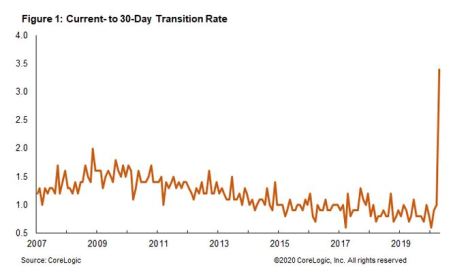
Overall delinquencies rose to 6.1% in April, according to CoreLogic. The hardest hit states were the NYC area: NY, NJ, CT, as well as the deep south states of LA and MS. You can see how fast the DQ rate spiked in the chart below:

30 day DQ


Single family authorizations fell 10% in June, according to BuildFax, although activity might be stabilizing as builders learn to work within the restrictions of COVID. Certainly the demand is there, as first time homebuyers try and escape the cities. Note we will get housing starts and building permits tomorrow.


Morning Report: More bank earnings

Vital Statistics:


Last Change
S&P futures 3229 45.1
Oil (WTI) 40.84 0.61
10 year government bond yield 0.65%
30 year fixed rate mortgage 3.02%


Stocks are higher this morning on promising results from a COVID vaccine study. Bonds and MBS are down.


US Industrial Production rose 5.4% in June, while manufacturing production rose 7.2%. Capacity Utilization increased to 68.6%.


Mortgage Applications rose 5.1% last week as purchases decreased 6% and refis rose 12%. “Mortgage rates continued their downward trend, with the 30-year fixed rate falling 7 basis points to 3.19 percent – another record low in MBA’s survey and 63 basis points lower than the recent high in late March,” said Joel Kan, MBA Associate Vice President of Economic and Industry Forecasting. “The drop in rates led to a jump in refinance activity to the highest level in a month, with refinance loan balances also climbing to a high last seen in March. Despite the decrease in purchase apps, they are still up 15% YOY.


Despite the great performance for the mortgage business in Q2, Chase’s origination volume was down on a sequential basis, from $28.1 billion in the first quarter to $24.2 billion in the second. Given the seasonality of the business this is a surprising result. Originations were more or less flat YOY. The servicing portfolio also fell, from $738 billion to $684 billion. JP Morgan also added another $8.9 billion to loan loss reserves, increasing them to $34.3 billion.


US Bank reported earnings this morning. Earnings were down substantially on increased provisions for credit losses. The residential loan portfolio remains high quality with an average FICO of 768 and LTV of 68%. 90 day DQs were at .17% of the portfolio, which was a slight increase. Mortgage banking revenue increased 64% QOQ to $648 million due to higher volume and gain on sale revenues, which were offset by a falling servicing values.


Citi reported a 5% increase in revenues, but a 74% decrease in EPS due to increased provisions for credit losses. Mortgage origination increased 64% YOY to $6.4 billion. The servicing portfolio declined about 2%.


The rebound in housing caused Fannie Mae economists to revise upward their 2020 GDP estimate from down 5.4% to down 4.2%.

Morning Report: Wells cuts its dividend

Vital Statistics:


Last Change
S&P futures 3148 3.1
Oil (WTI) 39.24 -0.31
10 year government bond yield 0.61%
30 year fixed rate mortgage 3.12%


Stocks are flat as we kick off earnings season. Bonds and MBS are up.


Kind of a mixed bag for bank earnings this morning. We heard from JP Morgan, Citi, and Wells. JP Morgan and Citi beat earnings expectations, but Wells is down on a dividend cut. Wells had warned that a cut was coming, but this one was dramatic: from 51 cents a share to a dime. Wells reported a drop in mortgage banking income from the first quarter due to lower MSR values. Production margin just about doubled from 1.08% to 2.04%.


The Consumer Price Index rose 0.6% MOM and 0.6% YOY. Ex-food and energy, the index rose 0.2% MOM and 1.2% YOY. Higher inflation is actually good news for the economy at this point as the Fed is worried about deflation.


Small Business Optimism increased in June, according to the NFIB. Despite the current slowdown, small business still expects to increase hiring and capital expenditures over the next 6 months.

“Small businesses are navigating the various federal and state policies in order to reopen their business and they are doing their best to adjust their business decisions accordingly,” said NFIB Chief Economist Bill Dunkelberg. “We’re starting to see positive signs of increased consumer spending, but there is still much work to be done to get back to pre-crisis levels.”

NFIB


30 day delinquencies increased to 6.1% of all mortgages during the month of April, according to CoreLogic. This is up 2.5% from April 2019.

“The COVID-19 pandemic has shocked our economic system and led to unprecedented job loss, reducing the ability of affected families to make their monthly mortgage payments. The latest forecast from the CoreLogic Home Price Index shows prices declining in 41 states through April 2021, potentially erasing home equity and increasing foreclosure risk.”

CoreLogic is also predicting that home prices will drop 6.6% nationally over the next year. FWIW, I don’t see that – the supply / demand imbalance doesn’t support it, and neither does the lower interest rates. Perhaps we will see a drop in luxury urban condos due to tougher jumbo guidelines and an exodus from urban areas, but suburban low / mid tier SFR should be just fine.


Those who make the comparison to 2009 – 2010 are missing the fact that we had a glut of properties back then. The situation is the exact opposite here. Home construction has lagged household formation for a decade.


New Home Purchase Applications rose 20% in June, according to the MBA.

“The new home purchase market continues to recover,” said Joel Kan, MBA Associate Vice President of Economic and Industry Forecasting. “Applications surged 20 percent in June, and although this is not adjusted for seasonal impacts, it is another piece of data indicating that homebuying activity that was delayed by the pandemic in March and April is just being realized later in the season. The fact that applications are up over 50 percent from last June further reinforces that point.”


Optimal Blue is being sold to a private equity consortium.


Quicken and United Wholesale are kind of the Spaceley Sprockets and Cogswell Cogs of the D. There has been bad blood between the companies for years. Now, there is a defamation lawsuit over a facebook war and lewd text messages. The brokers versus bankers saga continues….


Morning Report: Inflation is flat

Vital Statistics:


Last Change
S&P futures 3138 3.1
Oil (WTI) 39.84 0.21
10 year government bond yield 0.60%
30 year fixed rate mortgage 3.12%


Stocks are flattish this morning on no real news. Bonds and MBS are up.


Inflation at the wholesale level remains well below the Fed’s target. The Producer Price Index fell 0.2% MOM and fell 0.8% YOY. Ex food and energy, the index was flat. Suffice it to say, the Fed is deeply concerned about this, and this opens the window for further measures to support the economy.


The Trump Administration is looking at another stimulus bill, which would extend unemployment benefits and permit another round of direct payments to individuals. House Democrats want something more sweeping, so we’ll see what actually gets hammered out.


Landlords in Manhattan are being forced to slash rent as vacancies increase. The Escape From New York has put a total of 10,000 apartments on the market, which is an 85% increase from a year ago. The official vacancy rate is 3.7%, however in some buildings it is much higher.


Redfin announced that over half of all transactions were competitive in June. “Bidding wars continue to be fueled by historically low mortgage rates and fewer homes up for sale than almost any time in the last two decades,” said Redfin economist Taylor Marr. “It’s like a game of musical chairs where only the best bidders get a seat. Both renters and move-up buyers who have held onto their jobs are vying for the small number of single-family homes on the market as they realize they need more space for their families.”

Morning Report: Mortgage credit continues to tighten

Vital Statistics:


Last Change
S&P futures 3170 3.1
Oil (WTI) 40.84 0.21
10 year government bond yield 0.65%
30 year fixed rate mortgage 3.12%


Stocks are higher this morning on no real news. Bonds and MBS continue to ratchet higher.


Initial jobless claims fell by 99k to 1.314 million. Despite the improvement in the economy, many retailers who were struggling before the COVID crisis are still cutting jobs.


Despite the improvement in the housing market and the mortgage market, credit availability fell again in June, according to the Mortgage Bankers Association Mortgage Credit Availability Index. “Mortgage credit supply dropped again in June, as investors further reduced their willingness to purchase jumbo loans and those with lower credit scores,” said Joel Kan, MBA Associate Vice President of Economic and Industry Forecasting. “Lenders are navigating a gradual economic and housing market recovery that is still facing headwinds from the ongoing COVID-19 pandemic. Credit supply has fallen over 30 percent since February – before the pandemic – with an 18 percent decrease in government loan availability, and a 57 percent drop in jumbo loan availability.” We will need to see the securitization market turn on before we get a meaningful return to jumbo and non-QM. Low FICO FHA will probably have to wait until forbearance ends.


Fed Head James Bullard sees unemployment dropping down into the 7% – 8% range in 2020.

Morning Report: Construction hiring surges

Vital Statistics:


Last Change
S&P futures 3140 3.1
Oil (WTI) 40.54 -0.21
10 year government bond yield 0.66%
30 year fixed rate mortgage 3.12%


Stocks are flattish this morning on no real news. Bonds and MBS are flat as well.


The “reopening trade” which lifted shares of banks, airlines, and leisure / hospitality companies has faltered a little on fears of a COVID resurgence. This has been pushing bond yields lower. The bank sector continues to struggle.


The MBA reported that the number of loans in forbearance decreased by 8 basis points to 8.39% as of June 28. “We learned last week that the job market improved more than expected in June,” said MBA Chief Economist Mike Fratantoni. “With that as background, it is not surprising that the forbearance numbers continue to improve as more people go back to their jobs. The improvement in the forbearance data was broad-based, with declines for both GSE and Ginnie Mae loans. The decrease in new forbearance requests indicates that further declines are likely in the weeks ahead.”


Mortgage applications increased 2.2% last week as purchases increased 5% and refis rose 0.4%. Note the week had an adjustment for the July 4 holiday. “Mortgage rates declined to another record low as renewed fears of a coronavirus resurgence offset the impacts from a week of mostly positive economic data, such as June factory orders and payroll employment,” said Joel Kan, MBA Associate Vice President of Economic and Industry Forecasting. “Borrowers acted in response to these lower rates, after accounting for the July 4th holiday. Purchase applications continued their recovery, increasing 5 percent to the highest level in almost a month and 33 percent from a year ago. The average purchase loan size increased to $365,700 – also another high – as borrowers contend with limited supply and higher home prices.”


Job openings increased to 5.4 million in May, according to the JOLTS job report. Hires rose to 6.5 million, a series high. Construction hiring saw a huge jump with 673k new hires, although leisure and hospitality was the biggest jump with over a 1.3 million.


Quicken filed its IPO paperwork under the name Rocket Companies. The company originated $51.7 billion in loans in the first quarter of 2020. As you would expect, there are 4 classes of stock, and Dan Gilbert will hold the ones with 10 votes per share (the other class has 1 vote per share). For all intents and purposes, the new shareholders will have zero say in how the company is run. One number jumped out at me: Rocket is valuing its servicing at 2.2x, which is a pretty conservative number.


Morning Report: The service sector rebounded strongly in June

Vital Statistics:


Last Change
S&P futures 3153 -18.1
Oil (WTI) 40.44 -0.21
10 year government bond yield 0.67%
30 year fixed rate mortgage 3.12%


Stocks are lower this morning on overseas weakness. Bonds and MBS are up.


The services economy rebounded in June, according to the ISM Non-Manufacturing Survey. Production-related indicators are leading employment indicators. That said, many of the comments in the survey pointed to higher-then-expected demand and shortages. “Sales have picked up tremendously. Sporadic supply issues. Biggest concern for us is lumber shortages.” (Construction). Overall, the headline number for the index was 57, much higher than the 50 that was expected and is consistent with an economy that is growing quickly. Further evidence that the recession probably ended in early May some time.


CoreLogic is predicting that home prices will fall at an annual rate of 6.6% by May of 2021.

Strong home purchase demand in the first quarter of 2020, coupled with tightening supply, has helped prop up home prices through the coronavirus (COVID-19) crisis. However, the anticipated impacts of the recession are beginning to appear across the housing market. Despite new contract signings rising year over year in May, home price growth is expected to stall in June and remain that way throughout the summer. CoreLogic HPI Forecast predicts a month-over-month price decrease of 0.1% in June and a year-over-year decline of 6.6% by May 2021.

Unlike the Great Recession, the current economic downturn is not driven by the housing market, which continues to post gains in many parts of the country. While activity up until now suggests the housing market will eventually bounce back, the forecasted decline in home prices will largely be due to elevated unemployment rates. This prediction is exacerbated by the recent spike in COVID-19 cases across the country.

While this is certainly possible, the supply / demand imbalance is so stark right now, I suspect that anyone who decides to wait for lower prices will regret it. I could see weakness in the luxury end of the market, where there is more inventory. Certainly urban luxury apartments are going to experience a perfect storm of people fleeing the cities and a potential drop in foreign buyer interest due to the violence. A drop of 6.6% seems aggressive to me.


Zillow Offers resumes activity in 5 more markets. Zillow Offers is a program where the company will purchase a home directly from a buyer, which would allow the buyer to submit a non-contingent offer on their next home. Zillow would then make any necessary repairs, clean and stage the home for sale. I think Zillow charges around 7.5% to do this, which is probably about the cost of the realtor charges and any fix-up costs the seller would have to pay otherwise.


Interesting reaction to COVID-19: Potential buyers need a pre-approval letter to enter the house. “Having a pre-approval letter has long been a preferred requirement by agents when submitting an offer, but having a pre-approval letter before looking at homes given the COVID-19 environment is an absolute must,” says Cara Ameer, a real estate agent with Coldwell Banker Vanguard Realty in Ponte Vedra Beach, Fla. “Sellers and listing agents are cautious about who is coming into their homes, and they want to ensure that only those that are truly qualified are coming through their doors.”