Stocks are flat this morning on no real news. Bonds and MBS are up. It looks like the bond rally is due to fears of weakness in Europe and Treasuries are just correlating with overseas markets.
The week ahead should be relatively eventful with Jerome Powell heading to the Hill for his Humphrey-Hawkins testimony. We will also get the jobs report on Friday. It will be interesting to see whether Powell starts to get some static from lawmakers on overshooting. My guess is that Congress will probably leave him alone as long as the labor market is strong.
I compared the economy of today versus the late 1960s, and I think the similarities are pretty striking. The big question is whether you can have a recession when the labor market is super-strong. The answer may surprise you. It also gives us a template for this year and next.
This article is on my substack: The Weekly Tearsheet. It is meant as a companion to this blog where I do deeper dives into some of the weekly data or other things going on in the markets. I hope you like it and consider subscribing.
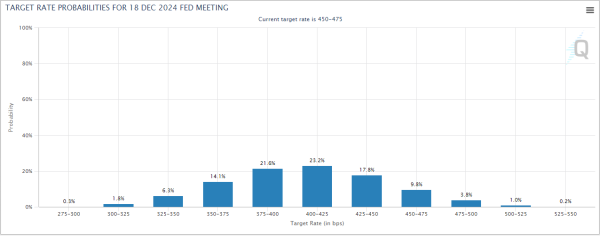
The March Fed Funds futures are now handicapping a 30% chance of a 50 basis point hike. The CME has introduced the 2024 futures as well, which see a December 2024 Fed Funds rate of 4.00% – 4.25% as the most likely outcome next year.
The homebuilders are under pressure this morning as J.P. Morgan downgraded KB Home and D.R. Horton based on valuation. It wasn’t all glum however as Meritage was upgraded to Overweight from neutral.
The homebuilders are the classic early-stage cyclical. The timing isn’t right yet – we have to wait for rate cuts – but we are getting close.
I am accepting ads for this blog if you would like to make an announcement, highlight something your company is offering or want more visibility. I also offer white-label services which give you the ability to use this content for your own daily emails. Please feel free to reach out to nyitray@hotmail.com if you would like to discuss this further.
Stocks are higher this morning despite more hawkish talk from central bankers. Bonds and MBS are flat.
The services economy expanded in February. “Business Survey Committee respondents indicated that they are mostly positive about business conditions. Suppliers continue to improve their capacity and logistics, as evidenced by faster deliveries. The employment picture has improved for some industries, despite the tight labor market. Several industries reported continued downsizing.”
The supplier deliveries index hit the fastest level since 2009, indicating that supply chain issues are mainly in the rear view mirror. The prices index declined, however it is still elevated. One respondent in IT said: “The current dynamics in the marketplace are such that it is getting harder to reduce costs. Most industries are being pinched by inflation and more expensive labor markets. Before, cost reduction was the goal; it’s now cost avoidance. That said, since we’re not able to reduce cost to maintain margins, we have to reduce the employee base more aggressively to achieve margins.”
Fed Governor Christopher Waller sounded hawkish in remarks yesterday: “I would be very pleased if the data we receive on inflation and the labor market this month show signs of moderation,” Fed governor Christopher Waller said in remarks posted on the Fed’s website. “But wishful thinking is not a substitute for hard evidence in the form of economic data. After seeing promising signs of progress, we cannot risk a revival of inflation.”
Nonfarm productivity rose 1.7% in the fourth quarter, according to BLS. This is a big downward revision from the initial 3% estimate. Output was revised downward while hours worked was revised upward. This is generally bad news for inflation, however we are talking about data that is getting pretty far in the past so I doubt it will influence the Fed all that much.
Unit labor costs rose 3.2%, which was driven by a 4.9% increase in compensation and a 1.7% increase in productivity. Manufacturing sector productivity declined 2.7%.
Fannie Mae updated its guidance on appraisals. The use of third-party data and models may now be used in some circumstances in lieu of an on-site appraisal. Fannie is changing the language from “appraisal waiver” to “value acceptance.” This should be good news for companies like Clear Capital who use technology to conduct valuations. DU will implement these changes on April 15.
UWM Corp (the parent of United Wholesale) reported fourth quarter numbers. Originations came in at $25.1 billion in the fourth quarter versus $33.5 billion in the third quarter and $55.2 billion a year ago. Gain on sale margins were more or less flat with Q3 at 51 bps.
The guidance for Q1 is for volume to come in between $16 and $23 billion, with gain on sale between 75 and 100 bps. This should translate into higher production revenue despite the drop in volume.
The Street sees Q1 earnings at breakeven and full year 2023 EPS at $0.20. Not sure how they continue to pay the $0.10 quarterly dividend. The stock yields 9.4%.
If you compare UWM’s numbers to Rocket’s it shows the vulnerability of Rocket’s model in a purchase environment. Rocket’s volumes were down much more dramatically, which shows it can dominate in a refi environment. Brokers, who are much closer to real estate agents, tend to capture more of the purchase business. You will ask your realtor for a lender recommendation in general. It will be interesting to see of Rocket’s ancillary services like Rocket Money will be able to capture some of that purchase business.
Stocks are lower this morning on no real news. Bonds and MBS are flat.
The manufacturing economy improved in February, however it has contracted for the third consecutive month. New Orders and production contracted. Unfortunately, prices increased again which will concern the Fed. This will probably mean that February CPI and PPI reports will be disappointing.
“The U.S. manufacturing sector again contracted, with the Manufacturing PMI® improving marginally over the previous month. With Business Survey Committee panelists reporting softening new order rates over the previous nine months, the February composite index reading reflects companies continuing to slow outputs to better match demand for the first half of 2023 and prepare for growth in the second half of the year. New order rates remain sluggish due to buyer and supplier disagreements regarding price levels and delivery lead times; the index increase suggests progress in February. Panelists’ companies continue to attempt to maintain head-count levels through the projected slow first half of the year in preparation for a stronger performance in the second half.”
Rocket reported an 82% drop YOY drop in revenues during the fourth quarter of 2022. Origination volumes fell 75% YOY to $19 billion. Gain on sale margins also contracted to 2.17% from 2.8%. Unexpectedly high demand for the company’s promotional home purchase product was a driver of the lower margins.
“Last year marked a period of transformation for Rocket. We right-sized our business to respond to a challenging market; we also made key investments to serve our clients better on every step of their home ownership journey,” said Jay Farner, CEO of Rocket Companies. “With foundational pieces of our client engagement program in place, we are focused on expanding our top of funnel, lifting conversion and lowering our client acquisition cost, with the ultimate goal of growing our purchase market share and extending client lifetime value.”
Mortgage applications fell 5.7% last week as purchases fell 6% and refis fell 3%. The uptick in bond yields over the past few weeks drove the decrease. “The 30-year fixed rate increased to 6.71 percent last week, the highest rate since November 2022, which drove a 6 percent drop in applications. After a brief revival in application activity in January when mortgage rates dropped to 6.2 percent, there has now been three straight weeks of declines in applications as mortgage rates have jumped 50 basis points over the past month,” said Joel Kan, MBA’s Vice President and Deputy Chief Economist. “Data on inflation, employment, and economic activity have signaled that inflation may not be cooling as quickly as anticipated, which continues to put upward pressure on rates. Both purchase and refinance applications declined last week, with purchase index at a 28-year low for a second consecutive week. Purchase applications were 44 percent lower than a year ago, as homebuyers again retreat to the sidelines as higher rates crimp affordability. Refinance applications account for less than a third of all applications and remained more than 70 percent behind last year’s pace, as a majority of homeowners are already locked into lower rates.”
The yield curve continues to invert, with the 10s-2s spread at -89 basis points. The last time we were at these levels was during the Volcker tightening regime during the early 1980s.
Construction spending fell 0.1% MOM and rose 5.7% YOY, according to the Census Bureau. Private residential construction fell 0.6% MOM and 3.9% YOY. There is a big divergence between multifamily, which is up 20.6% YOY and single-family which fell 18.4%. That said, single family construction is 3x the value of multi-family.
Stocks are flattish this morning on no real news. Bonds and MBS are down.
Consumer confidence declined in February, according to the Conference Board.
“While consumers’ view of current business conditions worsened in February, the Present Situation Index still ticked up slightly based on a more favorable view of the availability of jobs. In fact, the proportion of consumers saying jobs are ‘plentiful’ climbed to 52.0 percent—back to levels seen in the spring of last year. However, the outlook appears considerably more pessimistic when looking ahead. Expectations for where jobs, incomes, and business conditions are headed over the next six months all fell sharply in February.”
“And, while 12-month inflation expectations improved—falling to 6.3 percent from 6.7 percent last month—consumers may be showing early signs of pulling back spending in the face of high prices and rising interest rates. Fewer consumers are planning to purchase homes or autos and they also appear to be scaling back plans to buy major appliances. Vacation intentions also declined in February.”
Home prices fell 0.1% in December, according to the FHFA House Price Index. For the year, home prices rose 8.4%. “House price appreciation continued to wane in the fourth quarter” said Dr. Polkovnichenko, Supervisory Economist in FHFA’s Division of Research and Statistics. “House prices grew at a much slower pace in recent quarters amid higher mortgage rates and a decline in mortgage applications. These negative pressures were partially offset by historically low inventory.”
You can see a pretty wide skew in the regions. The top performing regions during the pandemic (West Coast and Mountain states) are bringing up the rear, while Florida and the Southeast are the leaders.
The Case-Shiller Home Price Index showed a bigger slowdown in December, with the index falling 0.8%
“The cooling in home prices that began in June 2022 continued through year end, as December marked the sixth consecutive month of declines for our National Composite Index,” says Craig J. Lazzara, Managing Director at S&P DJI. “The National Composite declined by -0.8% in December, and now stands 4.4% below its June peak. For 2022 as a whole, the National Composite rose by 5.8%, the 15th best performance in our 35-year history, although obviously well below 2021’s record-setting 18.9% gain. We could record similar observations in the 10- and 20-City Composites.”
“Prices fell in all 20 cities in December, with a median decline of -1.1%. Moreover, for all 20 cities, year-over-year gains in December (median 4.4%) were lower than those of November (median 6.4%). We noted last month that home prices in San Francisco had fallen on a year-over-year basis. San Francisco’s decline worsened in December (-4.2% year-over-year); its west coast neighbors Seattle (-1.8%) and Portland (+1.1%) once again form the bottom of the league table.
“The prospect of stable, or higher, interest rates means that mortgage financing remains a headwind for home prices, while economic weakness, including the possibility of a recession, may also constrain potential buyers. Given these prospects for a challenging macroeconomic environment, home prices may well continue to weaken.”
Homebuilder Hovnanaian Enterprises reported a 8.8% decline in revenues and a drop in gross margins, which indicates that it had to use promotional incentives to move the merchandise. The cancellation rate rose to 30%.
“High inflation, sharp year-over-year increases in mortgage rates and significant economic uncertainty adversely impacted consumer demand for housing during the second half of 2022,” stated Ara K. Hovnanian, Chairman of the Board, President and Chief Executive Officer. “We are encouraged that the improving tone of the housing market is a good indication that the housing industry is positioned to experience a strong spring selling season. We believe long term fundamentals such as strong employment levels, pent up housing demand from the substantial underproduction of new homes for more than a decade and historically low levels of existing home supply set the stage for a housing market rebound. However, we continue to closely monitor the impact of mortgage rate movements and the actions taken by the Federal Reserve have on housing demand,” concluded Mr. Hovnanian.
Hovnanian is exiting the Minnesota, North Carolina, Tampa and Chicago markets.
Stocks are higher this morning on no real news. Bonds and MBS are up.
The upcoming week will have a lot of data, although it probably won’t be all that market-moving. We will get the ISM data, home prices and productivity. The jobs report will be next Friday, not this one. We will also get earnings from Rocket and United Wholesale.
Pending Home Sales rose 8.1% MOM, but are still down 24% compared to a year ago. That said, NAR doesn’t really see much of a pickup in home sales until 2024. “Buyers responded to better affordability from falling mortgage rates in December and January,” said NAR Chief Economist Lawrence Yun. “Home sales activity looks to be bottoming out in the first quarter of this year, before incremental improvements will occur,” Yun said. “But an annual gain in home sales will not occur until 2024. Meanwhile, home prices will be steady in most parts of the country with a minor change in the national median home price.”
Durable goods orders fell 4.5% in January, according to the Census Bureau. Excluding transportation, durable goods orders rose 0.7%. Core Capital Goods orders (a proxy for corporate capital expenditures) rose 0.8%.
A record 25% of home searchers on Redfin are looking to relocate. Miami is the most popular destination from relocators. While prices have soared in many parts of Florida, they are still way cheaper than the MSAs these people are leaving, especially Coastal California and New York.
“A lot of buyers have flocked into coastal Florida from out of town over the last several months,” said Elena Fleck, a Redfin agent in Palm Beach, which is part of the larger Miami metro area. “Buyers moving in from places like New York and San Francisco are helping the local market recover from last fall’s housing downturn. They’re not nearly as fazed by high mortgage rates because homes here are so much less expensive than their hometowns, and they get larger lots, pools, nice weather and lower taxes.”
Lending Club announced earnings. Mortgage revenue was down over 50% compared to a year ago and profit fell 52%. Home equity products accounted for more revenue than traditional mortgage purchase and refis.
Stocks are lower this morning after another lousy inflation number. Bonds and MBS are down.
Personal Incomes rose 0.6% in January, which was below the 1% street estimate. Personal Consumption Expenditures were robust however, rising 1.8% versus the 1.2% consensus estimate. The increase in consumption was driven by motor vehicles and food services.
The PCE Price Index (the Fed’s preferred inflation measure) rose 0.6%, and the core index (minus food and energy rose the same amount). The Street was looking for 0.4% on both of these, so it another miss. It was also the highest reading since June of 2022. You can see CPI and PCE in the graph below.
So, the CPI, PPI and PCE inflation numbers all rebounded in January. The good news is that consumption remained strong, as did the labor market, so the chance of a hard landing seems remote.
The March Fed Funds futures are now handicapping a 1-in-3 chance for a 50 basis point hike at the March meeting. Note that we will not get the February PCE numbers until after the March meeting, but we will get another look at CPI / PPI.
New Home Sales rose 7.4% MOM to a seasonally-adjusted annual rate of 670,000. This is still down 19% on a year-over-year basis. The median home price was flat on a year-over-year basis to $427,500. The average price fell 5.3% on a YOY basis.
The personal income and outlay number above were confirmed by the University of Michigan Consumer Sentiment Survey. Consumer sentiment rebounded strongly in January, both on a month-over-month basis and an annual basis.
“Consumer sentiment confirmed the preliminary February reading, rising a modest 3% above January. After lifting for the third consecutive month, sentiment is now 17 index points above the all-time low from June 2022 but remains almost 20 points below its historical average. Consumers with larger stock holdings exhibited particularly large increases in sentiment. Overall, February’s reading was supported by a 12% improvement in the short-run economic outlook, while all other index components were essentially unchanged.”
In more bad inflation news, inflationary expectations increased from 3.9% to 4.1%, although longer-term expectations remained at 2.9%. Regardless, January has been awful month for the Fed and its
Stocks are higher this morning on no real news. Bonds and MBS are down again.
Fourth quarter GDP rose 2.7%, in the second revision. Third quarter growth was revised upward to 3.2%. Growth was driven primarily by inventory growth. Services spending rose, driven by housing and health care. Government spending was revised upward as well. Personal consumption expenditures were revised downward from 2% to 1.4%.
The PCE price index was also revised upward by 0.5% to 3.7%. Excluding food and energy, the index rose 0.4% to 4.3%. Needless to say, not good news on the inflation front, however we are talking about data that was far in the past at this point.
The FOMC minutes shed some further light on the comments from Loretta Mester and James Bullard last week. On the decision whether to raise 25 basis points or 50 basis points, they said:
Against this backdrop, and in consideration of the lags with which monetary policy affects economic activity and inflation, almost all participants agreed that it was appropriate to raise the target range for the federal funds rate 25 basis points at this meeting. Many of these participants observed that a further slowing in the pace of rate increases would better allow them to assess the economy’s progress toward the Committee’s goals of maximum employment and price stability as they determine the extent of future policy tightening that will be required to attain a stance that is sufficiently restrictive to achieve these goals. A few participants stated that they favored raising the target range for the federal funds rate 50 basis points at this meeting or that they could have supported raising the target by that amount. The participants favoring a 50 basis point increase noted that a larger increase would more quickly bring the target range close to the levels they believed would achieve a sufficiently restrictive stance, taking into account their views of the risks to achieving price stability in a timely way.
We knew that Mester and Bullard were in the 50 basis point camp, and “a few” implies one more. The Committee noted that we had some welcome inflation prints, but more evidence of stabilization would be needed.
In other economic news, initial jobless claims came in at 192,000 (anything under 200k is exceptional) and the Chicago Fed National Activity index reversed to a positive number, primarily driven by strong employment and consumption data.
The total value of US residential real estate fell by 4.9% (or about $2.3 trillion) from its June peak, according to data from Redfin. “The housing market has shed some of its value, but most homeowners will still reap big rewards from the pandemic housing boom,” said Redfin Economics Research Lead Chen Zhao. “The total value of U.S. homes remains roughly $13 trillion higher than it was in February 2020, the month before the coronavirus was declared a pandemic.”
The Bay Area saw the brunt of the selling. New York City, Seattle and Boise also saw decreases. The suburbs held up better than the cities themselves.
Here is the official notice for the FHA mortgage insurance reduction.
More pain in the commercial real estate sector (particularly office buildings): Columbia Property Trust (owned by PIMCO) defaulted on $1.8 billion in mortgage notes on office buildings in New York City, Boston, and San Francisco. We are also seeing defaults on mortgages for shopping malls. The commercial real estate sector’s pain is being driven by rising short term rates (anyone who has floating rates is feeling the pain) and also a sea-change in office work. Note that S.L. Green keeps hitting new occupancy lows.
The problems in commercial real estate has the potential to impact residential, at least the non-QM sector.
Wells Fargo laid off hundreds of mortgage bankers this week. “We announced in January strategic plans to create a more focused home-lending business,” she said. “As part of these efforts, we have made displacements across our home-lending business in alignment with this strategy and in response to significant decreases in mortgage volume.”
Stocks are flattish after yesterday’s bloodbath. Bonds and MBS are down.
The FOMC minutes will be released at 2:00 pm. We know that Mester and Bullard were considering a 50 basis point hike in February, so it will be interesting to hear if the members were more hawkish than the February press release suggested. Bullard recently said that he sees the Fed Funds rate rising to 5.375%, which presumably means that the terminal Fed Funds rate will be in a range of 5.25%- 5.5%. This comports with the June Fed Funds futures.
Despite the sturm and drang in the bond markets, the Fed Funds futures haven’t changed all that much. The March futures see a 79% chance of a 25 basis point hike and a 21% chance of a 50 basis point hike, while the December futures still see a range of 5%-5.25% as the most likely outcome.
The reversal in rates didn’t help mortgage applications last week. The MBA mortgage application index fell 13.3% as purchases fell 18% and refis fell 2%. The purchase index is 41% lower than a year ago, while the refi index is down 72%. “Mortgage rates increased across all loan types last week, with the 30-year fixed rate jumping 23 basis points to 6.62 percent – the highest rate since November 2022. The jump led to the purchase applications index decreasing 18 percent to its lowest level since 1995,” said Joel Kan, MBA’s Vice President and Deputy Chief Economist. “This time of the year is typically when purchase activity ramps up, but over the past two weeks, rates have increased significantly as financial markets digest data on inflation cooling at a slower pace than expected. The increase in mortgages rates has put many homebuyers back on the sidelines once again, especially first-time homebuyers who are most sensitive to affordability challenges and the impact of higher rates.”
HUD is reducing the mortgage insurance premium for FHA loans. Supposedly the premium is falling from 115 to 85 basis points. This will help affordability issues for this Spring Selling Season, although high prices and rates will matter more.
Luxury homebuilder Toll Brothers announced earnings after the close yesterday. Earnings per share rose, while revenues were up 4%. The cancellation rate was surprisingly low at only 14%. Gross margins rose, so there is no evidence of price-cutting or promotional activity in the luxury home space.
“Since the start of the calendar year, we have seen a marked increase in demand beyond normal seasonality as buyer confidence appears to be improving. We believe the recent pick-up in demand is a sign that the long-term fundamentals underpinning the housing market remain intact. These include favorable demographic and migration trends, a very tight resale market, and growing pent-up demand resulting from over a decade of underproduction. Notwithstanding near-term uncertainty in the economy, we expect these factors will continue to support the housing market well into the future.”
I am accepting ads for this blog if you would like to make an announcement, highlight something your company is offering or want more visibility. I also offer white-label services which give you the ability to use this content for your own daily emails. Please feel free to reach out to nyitray@hotmail.com if you would like to discuss this further.
Stocks are lower this morning on no real news. Bonds and MBS are down.
The upcoming week will be dominated by the FOMC minutes on Wednesday and PCE inflation on Friday. We will also get the second estimate for Q4 GDP and new home sales.
Stocks are somewhat soggy this morning after disappointing 2023 forecasts from bellwether retailers WalMart and Home Depot. Wage inflation with soft demand will combine to reduce earnings.
Rental inflation declined for the sixth straight month, according to CoreLogic. “U.S. single-family rental price growth closed out 2022 at about half of what it was one year ago,” said Molly Boesel, principal economist at CoreLogic. “However, while rent growth has been slowing, it still rose at more than double the pre-pandemic rate. Rental price gains began increasing near the end of 2020 and have risen by about an average of $300 in the past two years. Annual single-family rent growth is projected to slow throughout 2023, but it will likely not decline by enough to wipe out gains from the past two years.”
The slowdown is most pronounced in the higher priced properties, where the top quartile fell from 11.9% annual growth in 2021 to 5.1% in 2022. The bottom quartile saw rent increases of 9.2%. Orlando saw the biggest price increase at 10.8%, while Phoenix saw the lowest at 1.2%.
Rental inflation tends to lag home price inflation by about 21 months, so this phenomenon should take a while to play out. Note the Fed thinks that housing’s impact on the inflation numbers will fade by this summer.
Homebuilder LGI Homes reported fourth quarter numbers that missed Street expectations. Sales fell 39% and net income fell 69%. The cancellation rate rose to 24%, and backlog decreased 66% in units. “We enter 2023 with tempered optimism. Recent lead and sales trends have been very positive. In the first eight weeks of the year, our retail net orders pace has been 7.2 homes per active community, compared to 2.9 in the fourth quarter of 2022. However, mortgage rates are again rising and the Fed’s interest rate path is still uncertain. Therefore, our focus remains on what we control – driving leads through marketing, controlling input costs, starting affordable, move-in ready homes at a disciplined pace and maintaining our strong balance sheet while investing to support our future growth.”
Existing home sales fell 0.7% MOM to a seasonally-adjusted annual pace of 4 million units. This is down 37% compared to a year ago. “Home sales are bottoming out,” said NAR Chief Economist Lawrence Yun. “Prices vary depending on a market’s affordability, with lower-priced regions witnessing modest growth and more expensive regions experiencing declines. Home sales are bottoming out, prices vary depending on a market’s affordability, with lower-priced regions witnessing modest growth and more expensive regions experiencing declines.”
The median home price came in at $359,000 which is an increase of 1.3% compared to a year ago. Prices rose everywhere except the West.
Stocks are lower this morning as markets digest hawkish comments from Fed speakers. Bonds and MBS are down.
We had some hawkish Fed-speak yesterday, and markets are in a risk-off mode.
Cleveland Fed President Loretta Mester gave a speech yesterday. “The FOMC has come an appreciable way in bringing policy from a very accommodative stance to a restrictive one, but I believe we have more work to do. Precisely how much higher the federal funds rate will need to go and for how long policy will need to remain restrictive will depend on how much inflation and inflation expectations are moving down, and that will depend on how much demand is slowing, supply challenges are being resolved, and price pressures are easing. At this juncture, the incoming data have not changed my view that we will need to bring the fed funds rate above 5 percent and hold it there for some time to be sufficiently restrictive to ensure that inflation is on a sustainable path back to 2 percent. Indeed, at our meeting two weeks ago, setting aside what financial market participants expected us to do, I saw a compelling economic case for a 50-basis-point increase, which would have brought the top of the target range to 5 percent“
In a separate speech, James Bullard said: “I was an advocate for a 50-basis-point hike and I argued that we should get to the level of rates the committee viewed as sufficiently restrictive as soon as we could….Inflation remains too high but has declined,” adding that “continued policy rate increases can help lock in a disinflationary trend during 2023, even with ongoing growth and strong labor markets.”
The March Fed Funds futures are now factoring in a 21% chance of a 50 basis point hike at the March meeting. The 10 year yield has moved up dramatically in the past 2 weeks.
Mortgage originations came in at $498B in Q4, according to the Fed. This resembles pre-pandemic volumes. Delinquency rates ticked up as well. Total household debt rose to $16.9 trillion.
The Index of Leading Economic Indicators declined again in January, according to the Conference Board. “The US LEI remained on a downward trajectory, but its rate of decline moderated slightly in January,” said Ataman Ozyildirim, Senior Director, Economics, at The Conference Board. “Among the leading indicators, deteriorating manufacturing new orders, consumers’ expectations of business conditions, and credit conditions more than offset strengths in labor markets and stock prices to drive the index lower in the month. The contribution of the yield spread component of the LEI also turned negative in the last two months, which is often a signal of recession to come. While the LEI continues to signal recession in the near term, indicators related to the labor market—including employment and personal income—remain robust so far. Nonetheless, The Conference Board still expects high inflation, rising interest rates, and contracting consumer spending to tip the US economy into recession in 2023.”