Morning Report 8/14/12

Vital Statistics:

Last Change Percent
S&P Futures 1408.3 5.7 0.41%
Eurostoxx Index 2423.9 7.9 0.33%
Oil (WTI) 93.39 0.7 0.71%
LIBOR 0.437 0.002 0.46%
US Dollar Index (DXY) 82.35 -0.088 -0.11%
10 Year Govt Bond Yield 1.71% 0.04%
RPX Composite Real Estate Index 190.1 0.4

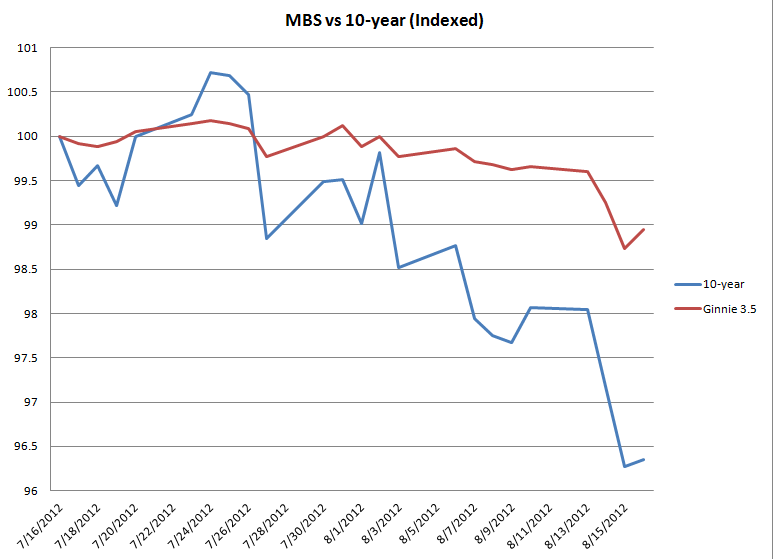
Stocks are up this morning on good retail sales data. Retail Sales increased .8% last month vs an expected increase of .3%. The Despot also reported BTE earnings. The Producer Price Index increased .3%, higher than expectations. Inflation readings don’t matter these days – the only real economic numbers that matter are employment-related. Bonds are off a point and MBS are down about 1/4 of a point.

The National Federation of Independent Businesses reported another decrease in its Small Business Optimism Index, which has been in recession levels since late 2006. About the only positive takeaway from the report is that the credit crunch that started in 2007 is more or less over. 93% of all owners reported that all their credit needs were met or that they were not interested in borrowing. Overall, any growth experienced in the economy has been due to population growth, so the economy is more or less stagnant.

While the NFIB cites a relatively benign credit environment for small businesses, the NY Fed sees continued obstacles to obtaining credit, but notes that there are encouraging signs for the future.

Will Paul Ryan merely rubber-stamp whatever the Street wants? (as is alleged by the obama administration)Probably not. He won’t be as hostile to the Street as obama is, but he is in favor of some sort of Glass-Steagall type regulation. He also dislikes the Resolution Authority which allows the government to take control of failing institutions and wind them down, which he views as cementing TBTF.

Interesting article from the NY Times on the effect technology has had on trading costs and speed. Since 2000, the cost of trading a share in / out with commissions has fallen from 7.6 cents a share to 3.8.  The length of time it takes to execute a trade on the NYSE has dropped from 3.2 seconds to 48 milliseconds. Pretty amazing, really. The article goes on to say that we have probably reached the point of diminishing returns for investments in trading technologies.  I would point out that the bond market has a long way to go.

Morning Report 8/13/12

Vital Statistics:

Last Change Percent
S&P Futures 1400.9 -1.5 -0.11%
Eurostoxx Index 2435.3 12.1 0.50%
Oil (WTI) 93.51 0.6 0.69%
LIBOR 0.435 -0.003 -0.57%
US Dollar Index (DXY) 82.31 -0.244 -0.30%
10 Year Govt Bond Yield 1.66% 0.00%
RPX Composite Real Estate Index 189.6 0.5

The dog days of summer typically bring markets with no real news and no real motion. Today is one of those days. The equity futures are flat, and bonds / MBS are more or less flat as well.

The big news of the weekend was the choice of Ryan for VP.  Is this market-moving?  Not in the least.

Joseph Stiglitz and Mark Zandi are endorsing Senator Jeff Merkley’s plan to establish a trust to buy underwater, but performing, mortgages and refinance them. Of course there are large questions unanswered: At what price will these mortgages be bought?  And who will do the refinancing? If the plan envisions private lenders refinancing underwater mortgages, how does the government propose to deal with put-back risk?

Here is another idea:  Collateral Substitution. If you want to move, you can substitute a house of equal or higher value for the collateral. Suppose you live in a rust-belt city, with limited job prospects and you want to move to North Dakota, where the energy jobs are.  You would be able to sell your current home without having to repay the loan, and then use the proceeds to buy a new home in ND.

Of course, if housing has already bottomed, then perhaps the correct thing to do is absolutely nothing and let the market recover on its own.

We haven’t talked about Facebook for a while. Suffice it to say that the stock didn’t live up to the pre-IPO hype. Starting Thursday, the lockups start expiring, which means pre-IPO investors and employees who were restricted will now be able to sell.

Morning Report 8/10/12

Vital Statistics:

Last Change Percent
S&P Futures 1394.3 -6.3 -0.45%
Eurostoxx Index 2418.2 -18.8 -0.77%
Oil (WTI) 91.79 -1.6 -1.68%
LIBOR 0.437 -0.001 -0.11%
US Dollar Index (DXY) 82.8 0.157 0.19%
10 Year Govt Bond Yield 1.63% -0.06%
RPX Composite Real Estate Index 189.1 0.1

Stocks are taking a breather this morning after a 6-day rally. Chinese and French economic data showed that their respective economies are slowing. Import prices fell 3.2%. Bonds are up 27 ticks and MBS are up about a quarter of a point.

The USDA cut its corn production forecast 17% due to the drought, while corn has  rallied 63% in the last two months. Since corn is also used for feed and is a big input into other foods, price increases will flow through to other foods as well. So if you were wondering why you are spending so much more on groceries (which is our 2nd biggest expenditure after shelter) now you know why. Gas isn’t the only commodity that can influence consumer behavior.

The debate going on regarding house prices centers on this:  Bull Case:  Housing has never been more affordable, prices appear to have bottomed and are increasing.  Bear Case:  Price Increases are due to constricted supply and once the shadow inventory hits the market back down we go.  Freddie Mac Chief Economist Frank Nothaft examines the issue in the latest Freddie Mac US Economic and Housing Market Outlook.  His conclusion is that the shadow inventory is still there, but it has been dramatically reduced. I tend to agree, although there isn’t really a standard definition of “shadow inventory.”  Certainly the red-hot rental market is attracting professional investors, while boomerang college grads are crimping supply. As a trader, my take is that after 6 years, whatever inventory is left is largely in strong hands. I don’t see a capitulation trade happening. I do find his economic forecasts to be way aggressive, though.  He is predicting 2.5% GDP growth through the end of the year, with 2.8% in Q113 and 3.2% in Q213 and mortgage rates gradually ticking up to 4.2% by the end of 2013.  Mortgage origination volumes are set to fall as the refinancing boom runs its course. You can click on the table below to increase the size.

Morning Report 8/9/12

Vital Statistics:


  Last Change Percent
S&P Futures  1400.5 2.3 0.16%
Eurostoxx Index 2427.8 -4.5 -0.19%
Oil (WTI) 93.89 0.5 0.58%
LIBOR 0.438 0.001 0.17%
US Dollar Index (DXY) 82.69 0.293 0.36%
10 Year Govt Bond Yield 1.72% 0.07%  
RPX Composite Real Estate Index 189.1 0.1  


Markets are grinding higher on no real news.  FWIW, the markets seem to be getting back into “risk-on” mode, with the latest rally in the stock market and the sell-off in the 10 year. After breaking 1.40, a few weeks ago, the 10-year is now over 7.2%.  MBS are down about 1/4 of a point. 

Mortgage delinquencies fell to 7.58%, slightly higher than the street 7.4% estimate. Foreclosures edged down to 4.27%.

The eminent domain issue is becoming bigger as FHFA weighs in. To recap, San Bernardino has proposed to use eminent domain to seize performing underwater mortgages from investors. They would pay the investors a “fair price” – presumably lower than the value of the property – and write down the principal of the mortgage to the market value of the house. SIFMA (who oversees a critical part of the securitization market) warned San Bernardino that if they followed this path that newly-mortgages originated in that area would be ineligible for inclusion into TBA pools, which would make it extremely difficult to get a mortgage there. California Lieutenant Governor Gavin Newsom fired back, telling the organization to “cease making threats to the local officials of San Bernardino County.”  Now FHFA has stepped in with a notice expressing “significant concerns” regarding the proposal, which is really more or less theft. Unless the county backs off, this could become to big to ignore, making it an explosive issue (for Democrats, at least) going into the election. 

Hey, Fannie made some money. They note that improving home prices, better efficiency in managing REO, and a continued decline in delinquency rates were able to overcome the drain from their legacy book of subprime mortgages bought during the bubble years.


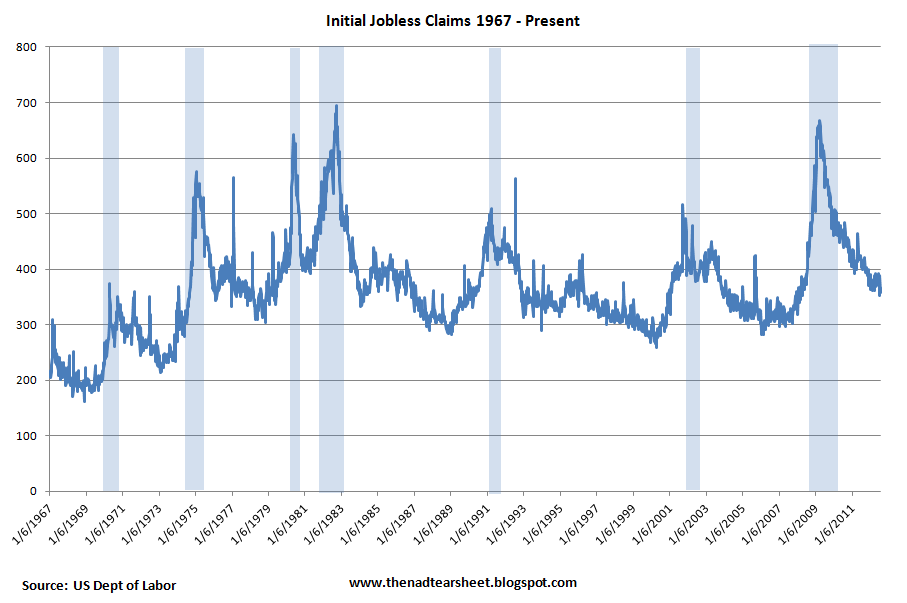
Initial Jobless claims came in at 361k, slightly lower than the 370k street estimate. Initial Jobless claims have fallen back to historical norms. Chart:  Initial Jobless Claims 1967-Present


Morning Report 8/8/12

Vital Statistics:

  Last Change Percent
S&P Futures  1391.7 -5.3 -0.38%
Eurostoxx Index 2418.3 -21.9 -0.90%
Oil (WTI) 93.16 -0.5 -0.54%
LIBOR 0.437 -0.001 -0.25%
US Dollar Index (DXY) 82.46 0.247 0.30%
10 Year Govt Bond Yield 1.62% -0.01%  
RPX Composite Real Estate Index 188.8 0.3  

Markets are weaker this morning on disappointing economic data out of Europe and earnings misses from Disney, McDonalds, and Priceline. Euro sovereign yields are generally lower and the yield on the German two-year remained negative for the 24th consecutive day. US bond yields are slightly lower, and MBS are up a few ticks.

We have had dueling Fedspeak recently, with the head of FRB Boston advocating further QE yesterday and Dallas Fed Head Fisher claiming the Fed has done its job and no more needs to be done. IMO, the Sep and October meetings will be too close to the election to expect much, if anything in the way of policy changes. The Fed is very sensitive to appearing to act politically and usually sits on its hands in the last few months before an election (2008 notwithstanding). 

In economic data, mortgage applications dropped 1.8% last week.  Productivity was a little better than expected, and unit labor costs increased markedly, with a big upward revision in Q1.  Declining profitability and increasing unit labor costs are not a recipe for increased hiring in the near term.

Is the ECB’s version of QE actually increasing the risk of a crisis in Spain and Italy? It may in fact be doing so. By announcing a plan to buy short-term debt from Spain and Italy, it is encouraging these countries to issue more short term paper, which increases their roll-over risk. (Roll-over risk is what happens when you aren’t able to refinance maturing short-term debt).

Corelogic reported a 2.5% annual increase in home prices during the month of June.  Ex-distressed sales, prices increased 3.2%. They are calling the bottom:  “At the halfway point, 2012 is increasingly looking like the year that the residential housing market may have turned the corner. While first-half gains have given way to second-half declines in the past three years, we see encouraging signs that modest price gains are supportable across the country in the second half of 2012.” It is true that some of the recent home appreciation has been due to seasonal factors. but there seem to be other factors at work too – most notably a red-hot rental market. FWIW, Radar Logic (which manages the RPX index) thinks it is all a head fake.

Yet another positive data point for housing – North American rail carloads of lumber increased 10% this year as housing construction rebounds. Housing starts are still way below historical averages and have been there since the end of 2006, so a rebound in starts is nothing to get too excited about. But every little bit helps.

Texas Instruments just issued 7 year paper at 1.65%. After tax, that cost is 1.24%. TXN’s dividend yield is 2.33%.  Is there an arbitrage here?  Is that what is getting the stock market excited?  Food for thought…

Morning Report 8/7/12

Vital Statistics:


  Last Change Percent
S&P Futures  1397.0 7.1 0.51%
Eurostoxx Index 2428.6 29.3 1.22%
Oil (WTI) 92.67 0.5 0.51%
LIBOR 0.438 -0.001 -0.23%
US Dollar Index (DXY) 82.06 -0.203 -0.25%
10 Year Govt Bond Yield 1.61% 0.04%  
RPX Composite Real Estate Index 188.6 0.5  

Stocks are higher this morning on hopes for further stimulus measures out of the ECB after a disappointing factory orders report in Germany. Spanish bond yields continue their descent from their late July highs. The 10-year is down a point and MBS are down about 1/4 of a point. 

FHFA Acting Chairman Ed DeMarco has responded to Congress regarding principal reductions on Fannie and Freddie loans. His reasons for resisting principal reductions are largely due to strategic defaults. In other words, he is afraid that people who are current on their mortgage and can afford the payment will stop paying in order to get a principal reduction.  According to the FHFA study under the most favorable model-based assumptions, it would take anywhere from 3,000 to 19,000 strategic defaults to turn the program into a net loss for taxpayers. Will this satisfy DeMarco’s #1 critic? Alas, probably not.

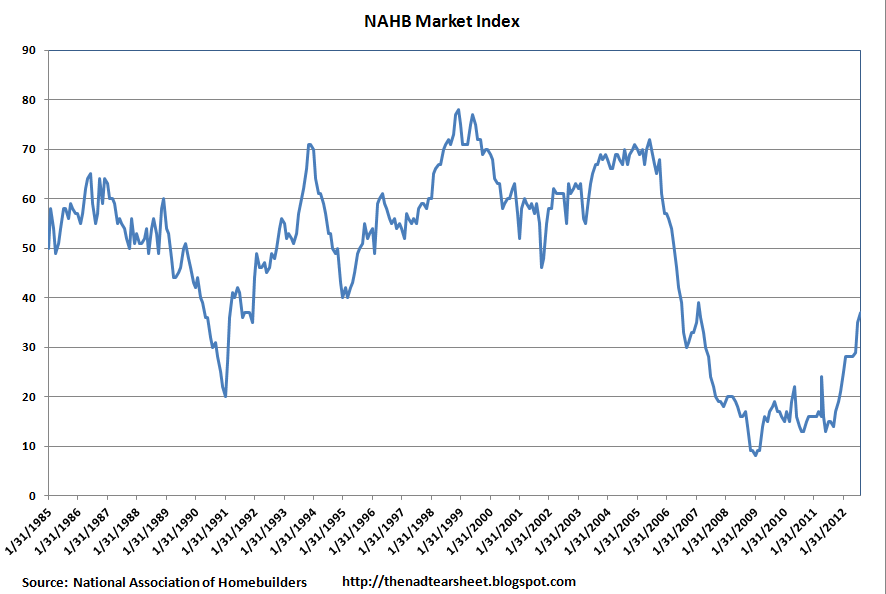
The National Association of Home Builders has released their improving market index, which showed 80 MSAs were characterized as improving (about 25%).  “With nearly one quarter of all U.S. metros currently designated as improving housing markets, there is growing recognition among consumers that now is an opportune time to consider a home purchase”  Of course they are talking their own book, but still it is another positive data point. They do note that the tight lending environment is acting as a drag on activity.

I generally don’t get too political, but the weakest Romney attack award goes to …. Bloomberg with this lame story about the Seat Pagine LBO. For starters, tax evasion is a national sport in the Mediterranean countries, and to think the Italians would be miffed that Bain used an Luxembourg-based entity to minimize taxes is ridiculous.  Second, the consortium was correct to recognize that the internet was about to destroy the value of the yellow pages and a sale, especially when media valuations were sky-high in the late 90s was the right thing to do.  The fact that (a) the Italian government sold before the bubble was inflated and (b) Telecom Italia was in empire-building mode in the dying days of the internet bubble is neither Bain nor Romney’s fault. My favorite line was “Bain got wind of the public action through the Italian unit of Bain & Co…”  How sinister sounding – like Romney got a clandestine call saying “Blue Horseshoe loves Annacott Steel.” It was a public auction, part of a long-term announced plan by the Italian government to sell state assets in order to get their debt levels down for EU integration. I guess I “got wind” of tomorrow’s 10-year Treasury note auction from today’s Journal too. 

Morning report 8/6/12

Vital Statistics:

Last Change Percent
S&P Futures 1391.8 2.8 0.20%
Eurostoxx Index 2387.0 14.5 0.61%
Oil (WTI) 91.27 -0.1 -0.14%
LIBOR 0.439 -0.001 -0.11%
US Dollar Index (DXY) 82.35 -0.024 -0.03%
10 Year Govt Bond Yield 1.55% -0.02%
RPX Composite Real Estate Index 188.1 0.7

Markets are slightly higher this morning on a deal to rescue Knight Capital. There are very few economic releases this week, and Europe should be quiet as we get into August. Bonds are up half a point, while MBS are up a few ticks.

As some lenders exit the correspondent business, others enter. While Bank of America and GMAC are leaving or scaling back, Redwood Trust is applying for Fan and Fred approval in order to increase their focus from just jumbo loans. Redwood Trust is the main issuer of MBS without a government guarantee.

Knight Capital received a $400MM rescue from Getco LLC. Interestingly, the rescue was put together by Knight’s customers who fear too much concentration in market makers. While the trading error that caused it will undoubtedly draw regulatory scrutiny to high-frequency trading. Maxine Waters is already looking to hold hearings on it. Wonder if they will look to the unintended consequences of Reg NMS, which basically destroyed the business model of traditional market-making. HFT is what is left. If investors don’t want to pay commissions or bid / ask spreads, they will probably have to accept the volatility that goes along with computerized trading.

Morning Report 7/31/12

No MR this week either.  Working on the West Coast and the tech gremlins aren’t cooperating.  Will try later this week, but so far having too many difficulties..

Morning Report 7/20/12

Vital Statistics:

  Last Change Percent
S&P Futures  1362.1 -9.8 -0.71%
Eurostoxx Index 2258.5 -44.0 -1.91%
Oil (WTI) 90.8 -1.9 -2.01%
LIBOR 0.452 -0.001 -0.22%
US Dollar Index (DXY) 83.29 0.408 0.49%
10 Year Govt Bond Yield 1.46% -0.05%  
RPX Composite Real Estate Index 184.8 0.0  

Equity markets are weaker this morning in spite of a deal to rescue the Spanish banks and decent earnings reports out of Google and GE.  There is no economic data to speak of.  Bonds are up a point and MBS are up as well.

Bloomberg has a good article discussing the state of the mortgage industry and how much capacity has been drained from it. “Efforts by Obama and Bernake to help homeowners get cheaper loans and spur the economy have been slowed by lack of staff at lenders and less competition.” Fears of buyback risk are also making lenders more cautious. 

SIFMA (which oversees the To-Be-Announced mortgage securities) weighs in on the eminent domain issue. They are instituting a policy that would exclude municipalities that institute eminent domain claims on mortgages from the TBA market.  Without getting into the gory details, the TBA market is the way newly originated mortgages get packaged into Fannie / Freddie / Ginnie mortgage backed securities. Punch line:  It will be very difficult to get a mortgage in San Bernardino because the lender will have a tougher time disposing of the loan.  I am surprised at how little interest the press has shown regarding this issue. 

No MR for the next week – I will be on vacation.

Morning Report 7/19/12

Vital Statistics:

Markets are generally higher this morning on hopes of further stimulus measures and some decent earnings reports out of Ebay and IBM.  Morgan Stanley missed. Spain raised 3 billion euros but paid dearly for it. Bonds are down almost a point and MBS are down a tick or two.

Initial Jobless Claims for the week of 7/14 came in at 386k, more in line with typical readings. Last week’s low 350k print was revised upwards, but still looks like a statistical fluke. Separately, it looks like another round of job cuts is on the way in the banking sector.

In other economic data, existing home sales fell by 5.4% month-on-month to an annualized pace of 4.37MM units.  The Street was expecting 4.62MM. The Leading Economic Indicators index posted a negative number in June, the second negative number in 3 months. 

The Philly Fed survey reported weak business conditions. Ominously, they reported declines in employment and shorter work hours. 

FHA is conducting another mass distressed loan sale. Buyers will not be permitted to initiate foreclosure proceedings for 6 months. The loans are concentrated in hard hit areas like Phoenix, Tampa, Chicago, and Newark.

The Fed is considering another measure to ease up credit – allowing banks to borrow from the Fed at even lower interest rates provided the money is used to lend, not buy Treasuries. The Fed is really scraping the bottom of the barrel at this point – I guess the next step would be to allow the banks to repo the water cooler and office furniture.

Chart:  Initial Jobless Claims: