Morning Report 8/29/12

Vital Statistics:

  Last Change Percent
S&P Futures  1410.4 2.6 0.18%
Eurostoxx Index 2432.9 -9.2 -0.38%
Oil (WTI) 95.95 -0.4 -0.39%
LIBOR 0.422 -0.001 -0.24%
US Dollar Index (DXY) 81.45 0.082 0.10%
10 Year Govt Bond Yield 1.65% 0.02%  
RPX Composite Real Estate Index 192.1 -0.4  

Markets are flattish after 2Q GDP was revised upwards and Mario Draghi defended the ECB’s bond buying program. Pending Home Sales increased 15% YOY in July, another sign of life in the residential real esate market. Bonds and MBS are down slightly.

Second Quarter US GDP was revised upwards to 1.7% from the initial 1.5% estimate as consumer spending was a bit higher than initially thought. The  upward revision was expected so there was no reaction in the index futures. Growth 2% or lower will probably not be enough to lower the unemployment rate 

One of the reasons for the increase in house prices has been the lack of distressed sales. CoreLogic’s latest foreclosure report bears this out, as foreclosures dropped 24% in June from a year ago, which is the lowest level since 2007. That said, the pipeline remains at 1.4 million homes and REO sales have declined while foreclosures have continued.  

Fed-Bashing was one of the themes at the Republican National Convention. Certainly a part of that is driven by the desire to keep Libertarians in the tent in the fear that Gary Johnson could pull a Ralph Nader and peel off enough Republican votes to deliver the election to Obama. Bob Corker wrote an op-ed in the FT criticizing the dual mandate. He does make a good point that bond prices should be important signals to the economy, but that signalling process is broken because of Fed manipulation.  

My gripe with the dual mandate has always been that it encourages bubbles – as long as inflation (as measured by the CPI) is behaving, the Fed must keep the pedal to the metal. Economists have accepted the fact that too much money chasing too few goods is a bad thing, but somehow think too much money chasing too few assets is okay.  Since the dual mandate was enacted in 1978, we have had the following bubbles (or mini-bubbles):


  • Gold and oil in the early 80s
  • Junk bonds in the mid / late 80s
  • Emerging Market Debt in the early 90s
  • Stock Market bubble in the late 90s
  • Residential Real Estate bubble mid 00s


Given that the consequences of getting it wrong are assymetric, maybe it is time to reconsider the dual mandate.  Of course a change in the dual mandate has zero chance of being enacted, but I would like to see the discussion move from theory (market signalling) to practice (the housing bubble).  Of course we can always show people this awesome video.  While it isn’t necessarily all about monetary policy, it does show the perils of a hyperactive Fed.

Morning Report 8/28/12

Vital Statistics:

Last Change Percent
S&P Futures 1405.6 -2.7 -0.19%
Eurostoxx Index 2436.4 -25.4 -1.03%
Oil (WTI) 96.04 0.6 0.60%
LIBOR 0.423 -0.002 -0.49%
US Dollar Index (DXY) 81.46 -0.196 -0.24%
10 Year Govt Bond Yield 1.64% -0.02%
RPX Composite Real Estate Index 192.3 0.2

Markets are flattish-to-down as a positive Case-Schiller reading offsets disappointing economic data out of Japan and Spain. Bonds and MBS are up slightly.

The S&P / Case-Schiller index came in at 142.2 vs expectations of 141.3. The national composite was up 1.2% YOY and up 6.9% vs Q1.

The real estate market is recovering, but where are home prices still getting hit?  Fairfield County, CT, where prices have declined 13% YOY, especially in Greenwich and New Canaan. This of course is due to Wall Street compensation dropping like a stone over the past 5 years and the realization that it may be a while before it comes back. As the article points out, while the events in Europe are an abstraction to most people, they do affect jobs in the financial services industry. Given the fact that entitlement spending is going to crowd out a lot of discretionary spending (especially on defense), it makes me wonder if one of the last high-flying real estate markets – Washington DC – is next.

The WSJ has a fluff piece on Paul Singer, who has been raising a lot of money for Mitt Romney. It repeats the rumor that he might be given a place in a potential Romney administration. However, he originally backed Chris Christie and has been very vocal in pushing for gay marriage so that could be an issue.

Chart:  S&P / Case-Schiller House Price Index:

Morning Report 8/27/12

Vital Statistics

Last Change Percent
S&P Futures 1413.8 4.0 0.28%
Eurostoxx Index 2442.3 8.0 0.33%
Oil (WTI) 97.07 0.9 0.96%
LIBOR 0.425 -0.002 -0.47%
US Dollar Index (DXY) 81.55 -0.044 -0.05%
10 Year Govt Bond Yield 1.67% -0.02%
RPX Composite Real Estate Index 192.1 0.0

Markets are higher this morning on no real news as we head into one of the slowest weeks of the year. The Fed Heads will meet in Jackson Hole this week, although analysts aren’t expecting much in the way of new policy announcements. That said, the article does suggest the Street is leaning heavily towards additional stimulus, so the risk is to the downside in MBS and Treasuries. There doesn’t appear to be any market-moving economic data this week. Oil is moving higher in response to Issac. Bonds and MBS are up slightly.

One of the longest merger kabuki dances ended today, as Hertz finally gets an agreed deal with Dollar. I believe Hertz’s initial bear hug letter was released in 2007 or 2008.

The first read on Back-To-School looks negative. Teen Apparel Retailers may end up missing their comp expectations next Thursday. Some of the names in this space have been flying lately – AEO, GPS, URBN, HOTT, so they may be vulnerable to a disappointment. For those that are more risk averse, you can always short Abercrumble as the stock cannot get out of its own way.

The Republican National Convention is this week and I don’t expect it to matter to the markets one bit. They had to shorten it a day due to Issac.  Greg Valierre of Potomac Research said that 98% of his Wall Street clients are voting for Romney.

Morning Report 8/24/12

Vital Statistics:

Last Change Percent
S&P Futures 1395.9 -4.1 -0.29%
Eurostoxx Index 2417.7 -11.4 -0.47%
Oil (WTI) 95.89 -0.4 -0.39%
LIBOR 0.425 -0.002 -0.47%
US Dollar Index (DXY) 81.56 0.205 0.25%
10 Year Govt Bond Yield 1.63% -0.04%
RPX Composite Real Estate Index 192.1 0.1

Markets are off after a disappointing durable goods report. Between the durable goods report and the cap good report, it showed companies pulled back from making capital investment in July. This put a bid under bonds and the 10 year is now pushing 1.6% after topping 1.8% earlier this week.  MBS are up 1/4 of a point as well.

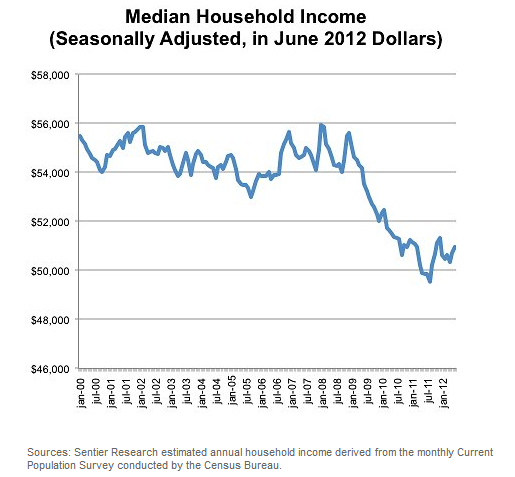
Why does the economic recover not feel like a recovery? One big reason is that incomes are still falling – in fact they have fallen more since the recovery began than they did during the recession. Given the move in the median house price, the median house price to median income ratio has spiked to 3.7x, implying housing is overvalued. FWIW, I am skeptical of NAR’s median house price numbers, which supposedly rose 22% to 189.6 from 154.6 in Jan. Perhaps the lack of distressed sales has caused the median price to shoot up.

Bill Gross said this morning that QEIII is “almost a done deal.” No update on the status of the cult of equities’ demise, though.

Republicans want to study the implications of returning to the gold standard. This is undoubtedly aimed at libertarians who like Ron Paul and may vote for Gary Johnson.  Needless to say, the Nobel Krug Man does not approve.

Chart:  Median income:

Morning Report 8/23/12

Vital Statistics:

  Last Change Percent
S&P Futures  1409.8 -2.5 -0.18%
Eurostoxx Index 2436.2 -16.6 -0.68%
Oil (WTI) 97.49 0.2 0.24%
LIBOR 0.427 -0.004 -0.91%
US Dollar Index (DXY) 81.34 -0.143 -0.18%
10 Year Govt Bond Yield 1.70% 0.00%  
RPX Composite Real Estate Index 192 0.0  

Initial Jobless Claims came in at 372k, a little higher than expected and pretty much in line with the latest trend of 375k / week.  New Home Sales increased to 372k in July

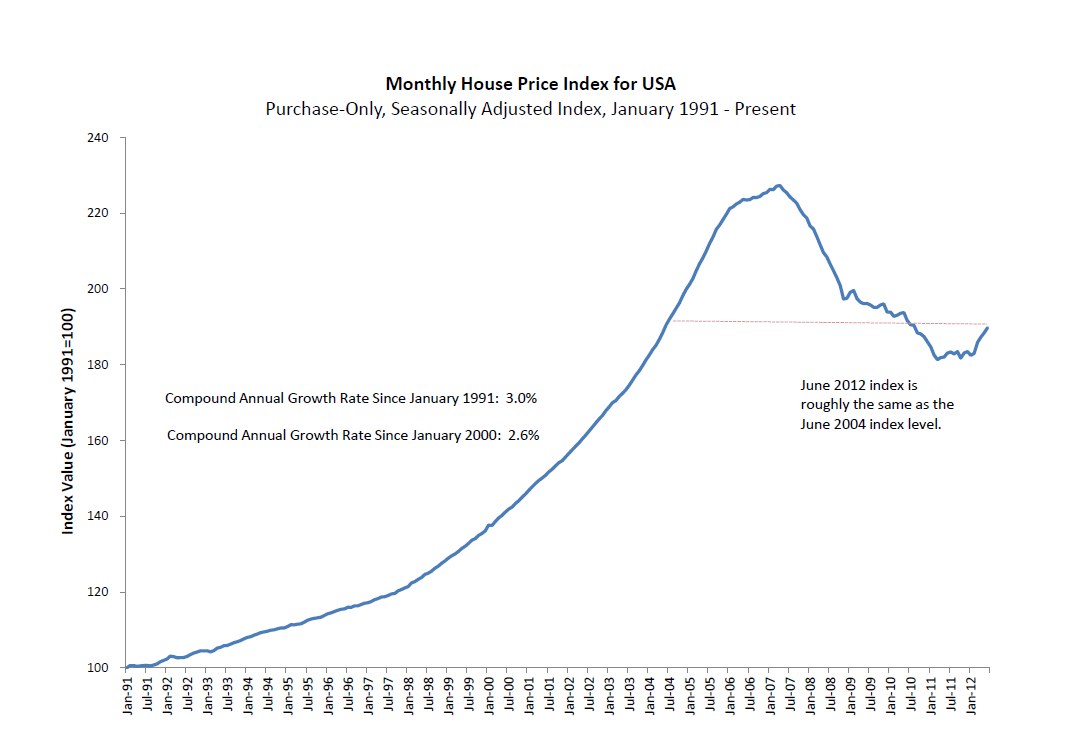
The FHFA Home Price Index increased 3% YOY and .7% MOM. This report only focuses on conforming mortgages, which makes it a more stable index than Case-Schiller or RPX.

The FOMC minutes noted that economic conditions have decelerated from earlier this year and discussed the possibility of another round of quantitative easing.  This drove the 10 year yield from 1.8% to 1.7%. MBS rallied as well.  My view has been that we are getting too close to the election – the Fed wants to appear non-political and definitely does not want to influence elections.  However this morning, St Louis Fed President James Bullard characterized the minutes as “stale,” noting that some of the data lately indicates the economy is getting stronger again.

CBO is forecasting 2.25% economic growth for the rest of the year and unemployment above 8%.  If Taxmageddon is not averted, CBO projects a recession with real GDP declining .5% from Q412 to Q413 and unemployment rising to 9%. If all the tax hikes and spending cuts are held off indefinitely, their projection is pretty much where the economy is now – 1.7% GDP growth with 8% unemployment. So the goalposts are (a) very modest recession vs (b) very modest recovery. Which means interest rates aren’t going anywhere. 

Chart:  FHFA House Price Index

Morning Report 8/22/12

Vital Statistics:

Last Change Percent
S&P Futures 1409.1 -3.4 -0.24%
Eurostoxx Index 2469.1 -21.2 -0.85%
Oil (WTI) 96.73 -0.1 -0.11%
LIBOR 0.431 -0.003 -0.63%
US Dollar Index (DXY) 82.02 0.108 0.13%
10 Year Govt Bond Yield 1.77% -0.02%
RPX Composite Real Estate Index 192 0.2

Stocks are lower this morning on no real news. Dell missed.  Existing Home Sales are scheduled to be released at 10:00 am EST. The minutes of the last FOMC meeting are scheduled for 2:00pm EST. Bonds are up a half a point and MBS are flat.

Mortgage Applications fell 7.4% last week as refis slowed.

Greece needs some breathing room to pay its debts.

FHFA has revised their short sale guidelines to allow homeowners who are current on their mortgage (and have an eligible hardship) to sell their home in a short sale. Importantly, job relocation qualifies, which should help people who are stuck with underwater homes in places with no jobs to leave. Second Lien holders will be given $6,000 to expedite a short sale.

Toll Brothers reported better than expected earnings, with a 41% increase in revenues, 59% increase in backlog, and 66% increase in contract signings.  Toll is in the McMansion business, so it isn’t necessarily representative of the whole market, but it is another positive data point, especially for the jumbo part of the space.  The stock is up a few percent pre-open.

Fannie Mae’s economic outlook for the rest of the year is generally gloomy, although it does predict that housing activity will be a net positive to GDP for the first time since 2005.

Morning Report 8/21/12

Vital Statistics:

Last Change Percent
S&P Futures 1419.6 4.9 0.35%
Eurostoxx Index 2477.1 10.8 0.44%
Oil (WTI) 97.13 1.2 1.21%
LIBOR 0.434 0.000 0.00%
US Dollar Index (DXY) 82.03 -0.422 -0.51%
10 Year Govt Bond Yield 1.84% 0.03%
RPX Composite Real Estate Index 191.8 0.4

Markets are stronger this morning on no real news. There are very no meaningful economic releases this week, except for perhaps the FOMC minutes which come out tomorrow.  The lack of news out of Europe has led to a benign environment for equities, which means that the 10-year continues its sell-off.  MBS are down 6 ticks as well.

HUD is doing another auction of distressed single family loans – $1.7 billion. These are loans primarily in Phoenix, Chicago, Tampa, and Newark. Given the amount of money that’s being raised for distressed real estate, HUD should be shoveling this stuff out the door.  When the ducks are quacking, you gotta feed ’em.

Dick Bove of Rochdale Securities points out that the government’s regulation of the banks is creating an opportunity for the shadow banking system – the firms who operate outside of the banking system (that would be us, for example). While he does worry about this laying the groundwork for the next crisis, in the meantime winners will emerge in the disarray. Take a look at the charts of Nationstar Mortgage (NSM), Impac (IMH), and Redwood Trust (RWT).  These stocks have been screaming. This is actually a very bullish sign for real estate – since the crisis began, the market has been dominated by Ginnie / Fannie loans. A bottom in real estate is the single most important factor to turn things around. The private label securitization market is the second.

The era of frothiness is over (at least according to the Economist).  What is interesting is that real estate is the cheapest relative to incomes in Japan, followed by Germany and the US.  The Canadian real estate bubble still has yet to burst. It will be interesting to see how their banking system handles it.

Morning Report 8/20/12

Vital Statistics:

Last Change Percent
S&P Futures 1412.7 -2.5 -0.18%
Eurostoxx Index 2468.5 -3.1 -0.12%
Oil (WTI) 95.73 -0.3 -0.29%
LIBOR 0.434 -0.001 -0.23%
US Dollar Index (DXY) 82.64 0.040 0.05%
10 Year Govt Bond Yield 1.82% 0.01%
RPX Composite Real Estate Index 191.8 0.4

Markets are weaker this morning on no real news.  The next two weeks should be pretty quiet as August winds down. There are no real market-moving economic releases this week, except possibly the FOMC minutes, which will be released Wednesday afternoon. Bonds and MBS are flat.

The Chicago Fed National Activity index improved slightly in July to -.13, but is still below zero, meaning the economy is growing below trend. June was revised downward. The plus is that the index is still above -.7, the level that starts indicating a recession.

Has Mario Draghi picked up Hank Paulson’s bazooka?  The Bundesbank and the ECB are reacting to a Der Spiegel story which says the ECB is looking to “cap” sovereign interest rates.  Which means they have to be willing to buy any and all government bonds at a set price. The ECB has characterized the article as “misleading.” Paging Mr. Soros…

The latest in the San Bernardino Eminent Domain saga.

Morning Report 8/16/12

Vital Statistics:

Last Change Percent
S&P Futures 1407.1 3.6 0.26%
Eurostoxx Index 2429.5 -0.9 -0.04%
Oil (WTI) 94.65 0.3 0.34%
LIBOR 0.434 -0.001 -0.23%
US Dollar Index (DXY) 82.72 0.077 0.09%
10 Year Govt Bond Yield 1.81% -0.01%
RPX Composite Real Estate Index 190.4 0.3

Stocks are ticking higher this morning in spite of earnings misses by Wal Mart and Sears and some disappointing housing data. Bonds are more or less flat, while MBS are up a tick or two.

Weekly Initial Jobless Claims came in at 366k, more or less in line with expectations and recent history. Housing starts were disappointing at 746k, but an upside surprise in building permits offset that. Housing starts are recovering, but we are still running at half our historical rate, and have averaged a couple hundred units below average over the last 10 years.

Looks like Corzine is going to skate..

The backup in yields over the last few weeks has been dramatic (a range of 50 basis points or so). How have mortgages fared?  Actually, MBS have held up better than long bonds over the past month or so.  Since they underperformed on the the way up, they are outperforming on the way down.  Here is a chart of both securities indexed over the past month:  Note: These are NOT bond prices, they are indices.

Morning Report 8/15/12

Vital Statistics:

Last Change Percent
S&P Futures 1399.7 -1.9 -0.14%
Eurostoxx Index 2425.9 -6.4 -0.26%
Oil (WTI) 92.93 -0.5 -0.54%
LIBOR 0.435 -0.002 -0.46%
US Dollar Index (DXY) 82.68 0.199 0.24%
10 Year Govt Bond Yield 1.76% 0.02%
RPX Composite Real Estate Index 190.4 0.3

Another ho-hum market day with a lot of economic data, but not much action. The CPI showed inflation remains in check, and we had a mixed bag of industrial reports – with positive industrial production and capacity utilization numbers offset by a disappointing Empire State Manufacturing Survey. The bond market continues to sell off and the 10-year bond futures appear to have fallen below the 147 – 153 range they have been stuck in since late May. MBS are down 4 or 5 ticks.

Funds are releasing their 13-Fs right now, which is the list of their holdings. One filing that is always popular is Berkshire Hathaway’s because a lot of investors like the idea of piggybacking Warren’s trades, and also changes can give insight into what Warren is thinking.  In the latest filing, he reduced his exposure to defensive names, like Proctor and Gamble, Kraft, and Johnny John. He increased his holding in Wells and initiated stakes in a couple names in the energy sector – National Oilwell Varco and Phillips 66. It is hard to read much into the report – net equity exposure dropped, but they seem to be taking a more constructive posture towards the economy.

If you are a property seller, Taxmageddon may have some nasty surprises for you. Theoretically, this should pull some sales from 2013 back into 2012. Which means that Fall could be a little better, while the Spring selling season could be a little weaker.

Finally, the National Association of Homebuilders Confidence Index increased in August as the hot rental market is brightening the spirits of the homebuilders. While absolute levels are still depressed relative to historical standards, the rebound has been swift.

Chart:  NAHB Market Index: