Morning Report: Fannie Mae’s 2013 forecast for economics and housing 12/19/12

Vital Statistics:

  Last Change Percent
S&P Futures  1445.2 4.1 0.28%
Eurostoxx Index 2659.8 16.3 0.62%
Oil (WTI) 88.4 0.5 0.53%
LIBOR 0.31 0.001 0.32%
US Dollar Index (DXY) 79.04 -0.319 -0.40%
10 Year Govt Bond Yield 1.82% 0.00%  
RPX Composite Real Estate Index 191.9 0.2  

Markets are higher this morning on optimism over the fiscal cliff.  John Boehner introduced a Plan B yesterday in case bipartisan talks fail, but markets / observers still seem optimistic that a deal can get done. Bonds and MBS are flat

Housing starts came in at an annualized 861k pace in November, somewhat below expectations.  This is undoubtedly a Sandy-influenced number.  Building Permits came in at 899k, above expectations. This is the strongest 3 months in four years. The NAHB Builder Confidence Index rose in Dec. Overall, the housing sector has turned the corner and is now an engine for growth, not a drag. 

Fannie Mae is out with their Economic and Housing Outlook for 2013.  Here is their forecast for 2013:

  • GDP +2.2%
  • Unemployment 7.5%
  • 10 year bond yield: 1.7%
  • Housing starts:  949k
  • House Price appreciation:  + 1.7%
  • 30 year fixed rate mortgage 3.4%
  • Purchase originations + 15%
  • Refinances: – 29%

I am surprised at their forecast for a drop in refis given that they think rates will stay low.  

Peter Eavis of the NY Times discusses the state of play with the qualified mortgage.  Consumer advocates are pushing for a broad definition of a qualified mortgage in order to increase credit availability, but they are are reluctant to give banks any legal protection. The big banks are saying that they won’t relax credit standards unless they are given some protection. Consumer advocates point out that that a shield will still presume the banks have met the standards, and merely allows the consumer to rebut that presumption, which means the lender has the upper hand to begin with.

Given the focus on the election and the fiscal cliff, fears of a European implosion seem to have fallen by the wayside.  The markets seem relatively sanguine about the prospect of a Euro debt crisis as sovereign yields have fallen since early Summer. Here is a chart of the Greek 10-year bond yield, post-re-org:

Actually, it isn’t just Greece – all of the PIIGS are rallying. All things considered this is a huge accomplishment.  Time should have named Mario Draghi Person of the Year instead of Barack Obama.

Morning Report – Reaching across the fiscal abyss 12/18/12

Vital Statistics:

  Last Change Percent
S&P Futures  1431.2 4.2 0.29%
Eurostoxx Index 2637.4 9.4 0.36%
Oil (WTI) 87.76 0.6 0.64%
LIBOR 0.309 0.000 0.00%
US Dollar Index (DXY) 79.49 -0.077 -0.10%
10 Year Govt Bond Yield 1.78% 0.01%  
RPX Composite Real Estate Index 191.7 0.1  

Markets are higher this morning on optimism for a deal on the fiscal cliff. The President made some tax concessions to move closer to Speaker Boehner’s position. The current account deficit increased more than expected to 107.5B.  Bonds continue to sell off, although it looks like the 10-year yield is bumping up against resistance. Certainly the announcement of QE4EVA was a case of “buy the rumor, sell the fact.”  FWIW, that is my gut feeling about stocks and the fiscal cliff as well. 

Both sides are coming closer on a deal to avoid the fiscal cliff.  Obama has lowered his revenue target to $1.2 trillion from $1.4 trillion and moved up the threshold for higher taxes to $400k from $250k.  $1.22 trillion will be cut in spending, from a variety of areas. The second biggest component of “savings” would be interest saved on debt that isn’t going to be issued. Only in DC, would that count. It would also raise the debt ceiling enough to cover two years and the 2014 midterms.  On capital gains, the top tax rate would be 20%. Raising the medicare eligibility age from 65 to 67 seems to be off the table.  The sequester will be replaced by another sequester.  Extended unemployment benefits would continue.  One other surprising tidbit – the President wants to replace the expiring payroll tax cut with other stimulus measures such as infrastructure spending.  Which means everyone’s taxes are going up, not just the rich.

The FHA plans to sell 40,000 non-performing loans over the next year to help improve its finances, which would make them the biggest seller of distressed paper, according to Louis Amaya of National Asset Direct.  One interesting wrinkle is that it is a back-door way to achieve principal mods.  Acting FHFA Chairman Ed DeMarco has steadfastly refused to allow FHA to reduce principal when modifying delinquent loans.  However, if they sell the loans, the investor is free to make whatever modification makes sense.  Under a U.S. Treasury program, investors can be reimbursed as much as 63 cents on the dollar for principal forgiveness.  Steve Schwartzman of Blackstone said they are “loading the boat.” with delinquent loans, both for rentals and a macro bet on a housing recovery. 

At 10:00 am, we will get the National Association of Homebulder’s Housing Market Index.  This is a sentiment indicator of the homebuilders, which has been skyrocketing since housing bottomed earlier this year. According to Trulia, the Millenials are planning to ditch the rentals to buy a house in the next two years. As I have stated in other posts, household formation numbers have been highly depressed during the last 5 years, not because of demographics, but because of the economy. That represents a lot of pent-up demand that will be unleashed as the economy recovers. 

Chris Whalen of Carrington discusses how the lending environment has changed and how the “regulatory arbitrage” favors the smaller independent lenders.  The downside is that mortgages will remain tough to get courtesy of the CFPB, especially in judicial states with high value properties. 

Fun useless link of the day – put your own house in a snow globe.  h/t Rob Chrisman.

Morning Report 12/17/12

Vital Statistics:

  Last Change Percent
S&P Futures  1414.9 5.7 0.40%
Eurostoxx Index 2622.9 -7.6 -0.29%
Oil (WTI) 86.67 -0.1 -0.07%
LIBOR 0.309 0.001 0.32%
US Dollar Index (DXY) 79.58 -0.001 0.00%
10 Year Govt Bond Yield 1.72% 0.02%  
RPX Composite Real Estate Index 191.6 0.4  

Markets are higher this morning after Japan elected Shinzo Abe, who has advocated further fiscal and monetary stimulus.  The Empire Manufacturing Survey showed manufacturing in NY state contracted more than expected. Bonds are down and MBS are down small. 

The negotiations on the fiscal cliff continue. The President has tied any discussions on entitlement cuts to increasing taxes on the rich and an increase in the debt ceiling.  Boehner has proposed a millionaire’s surtax and an increase in the debt ceiling. Of course, Boehner can strike a deal with the President, but that doesn’t mean he can deliver the votes in the House.  

Barry Ritholz has MBIA’s presentation on Countrywide’s fraud.

Samuelson discusses the Fed’s targeting of both unemployment and inflation and lays out some of the unintended consequences.  


Morning Report – Hotel California Monetary Policy 12/14/12

Vital Statistics:

  Last Change Percent
S&P Futures  1412.1 0.1 0.01%
Eurostoxx Index 2628.7 1.1 0.04%
Oil (WTI) 86.4 0.5 0.59%
LIBOR 0.308 0.000 0.00%
US Dollar Index (DXY) 79.91 -0.023 -0.03%
10 Year Govt Bond Yield 1.71% -0.02%  
RPX Composite Real Estate Index 191.6 0.4  

Stock index futures are flat after a benign CPI report.  Of course the Fed explicitly told us that until unemployment drops below 6.5%, they do not care what inflation does. Industrial Production rebounded in November, and Capacity Utilization rose. Bonds and MBS are up small.

Markit’s flash Purchasing Manager’s Index is generally upbeat and shows US manufacturing rebounding in December after reaching post-crisis lows in Aug and Sep. There has been some concern that Q4’s GDP numbers have been goosed by an inventory build, which means we are borrowing growth from next quarter.  FWIW, the report does not bear that out as it shows inventories are falling. The report notes employment is picking up in the manufacturing sector as well.  

CoreLogic’s December Market Pulse is reasonably optimistic on housing.  Punch Line:  Residential Real Estate is finally contributing to economic growth instead of being a drag. While residential real estate is not a massive driver of the economy, it usually is the first to recover after a recession and makes its largest contributions early in the economic cycle. It is the piece of the puzzle that allows us to shift from first to second gear.  

The Man With The Tan – Angelo Mozilo has no regrets about how he ran Countrywide and only agreed to a $67.5 million settlement to protect his children.  (BTW, it looks like Bank of America paid the lion’s share of that) You can read his entire deposition here

Great perspective on the history of banking from my favorite financial author, Jim Grant. “You can have the fear of God or the socialization of risk, but you cannot have both.”

Interview with Dallas Fed President Richard Fisher on the Fed’s “Hotel California” monetary policy.  He lays out the argument that the problem with the economy is not monetary policy, it is regulatory uncertainty out of Washington. He also notes that we are reaching the point of diminishing returns. 

Morning Report – QE4EVA 12/13/12

Vital Statistics:

  Last Change Percent
S&P Futures  1427.7 0.5 0.04%
Eurostoxx Index 2625.6 -4.8 -0.18%
Oil (WTI) 86.29 -0.5 -0.55%
LIBOR 0.308 -0.002 -0.48%
US Dollar Index (DXY) 79.87 0.058 0.07%
10 Year Govt Bond Yield 1.71% 0.01%  
RPX Composite Real Estate Index 191.3 0.5  

Markets are flat after a mixed bag of economic data.  Retail sales increased .3% in November vs an expectation of .5%.  Initial Jobless claims fell to 343k and were well below the 369k expectation. The Producer Price Index showed inflation running lower than anticipated. The Bloomberg Consumer Comfort Index fell.  Bonds are down a few ticks and MBS are flat. 

As expected, the Fed announced a Treasury buying program in its FOMC statement. $45 billion per month, until unemployment drops below 6.5% and inflation stays below 2.5%.  Bernake was careful not to characterize the 6.5% unemployment rate as NAIRU – or the non- accelerating inflation rate of unemployment. They took down their GDP projections from September, with their 2013 GDP forecast falling to a range of 2.3 – 3.0 from a range of 2.5 – 3.0.  They also took down unemployment as well, to a range of 7.3% to 7.7% from a range of 7.6% – 7.9%.  Inflation forecasts were lowered as well. Here is a video of the press conference.  Bonds reacted negatively to the announcement.  Biggest takeaway – the Fed has the pedal to the metal and they are writing the book as they go along. 

Looks like no progress so far on the fiscal cliff. A recent poll shows overwhelming support for increasing taxes on the rich.  Business execs have been lobbying for a deal. Liberals are fighting spending cuts. Bernake mentioned in his press conference that the Fed does not have the ability to offset the negative effects to the economy if we go over. 

delay in BofA’s jumbo deal shows just how hard it is to bring private capital back into the mortgage market. Private Label Securitizations were $3.5 billion this year, versus $1 trillion in 2006. Blame Dodd-Frank’s proposed “skin in the game” rules, which combined with accounting and other requirements would require banks to hold capital against all of the underlying loans. 

Transunion is forecasting mortgage delinquency rates to fall to 5.06% at the end of 2013 from 5.32% today. RealtyTrac reported foreclosure starts are at a 71 month low.

From the Department of Irony:  it turns out that the government’s exit from GM hinges on the success of its newly-unveiled full size Silverado pickup.  I could have sworn I heard many in Washington claim that the reason GM hit the wall was because they were making these huge vehicles that “nobody wants.” 

Morning Report: 12^3 edition 12/12/12

Vital Statistics:

Last Change Percent
S&P Futures 1433.3 1.8 0.13%
Eurostoxx Index 2629.5 5.4 0.21%
Oil (WTI) 86.35 0.6 0.65%
LIBOR 0.31 0.000 0.00%
US Dollar Index (DXY) 79.95 -0.116 -0.14%
10 Year Govt Bond Yield 1.66% 0.00%
RPX Composite Real Estate Index 191.1 0.4

Markets are up slightly this morning ahead of the FOMC statement this afternoon. Mortgage Applications were up 6.2% last week. Right to Work was passed in Michigan. Bonds and MBS are flat.

The FOMC statement is due out at 12:30, and at 2:15, the Bernank begins his press conference. Things to look for:  New Treasury purchase plan to replace Operation Twist, 2013 GDP forecast, any comments on its outlook for housing. The WaPo speculates that the Fed will shift more buying to Treasuries than mortgages, and it looks like Bill Gross concurs, as he is lightening up his MBS position.

Looks like FHFA Acting Director will be out of a job soon. This will undoubtedly pave the way for a mass principal forgiveness / underwater refis on Fannie and Freddie loans. Mortgage-Backed securities will be vulnerable to news of more interventionist policies out of FHFA, so beware as you could have Treasury pricing and MBS pricing diverge.

While individual tax rates are going up as part of the fiscal cliff, corporate tax rates may be going down. Obama earlier this year proposed lowering the corporate tax rate to 28% from its current 35%.  The lower rates would be offset by eliminating some deductions and the net revenue would be the same. I would argue that we are at the point on the Laffer Curve where lowering rates would actually raise revenues as it would eliminate some of the transfer-pricing games companies play to declare as much income as possible overseas. The poster child of these transfer pricing games is GE, which paid no US income taxes in 2010. Or Google, which shifted $9.8 billion in revenues to a Bermuda shell company, which allowed it to avoid paying roughly $2 billion in taxes.

Dodd-Frank implementation could stall for a while after Mary Schapiro steps down as Chairman of the SEC, leaving the commission deadlocked with 2 democrats and 2 republicans.  Politically divisive issues like prop trading and restrictions on executive pay will have to wait until a fifth commissioner is nominated and confirmed.  Fun fact:  The SEC has finalized just 32 of the 95 rules that the 2010 law required.

The Fed has been quietly telling the big banks:  No more mergers. Banks that hold 10% of US deposits are already capped in size, but now it looks like the biggest banks just below that threshold are now prohibited from growing by acquisition. Fed Governor Dan Tarullo gave a speech which discusses the TBTF problem and examines various alternatives (re-instate Glass Steagall, capping non-deposit liabilities, etc.)

Morning Report – NFIB Small Business Pessimism Survey 12/11/12

Vital Statistics:

  Last Change Percent
S&P Futures  1423.2 3.0 0.21%
Eurostoxx Index 2615.1 19.1 0.73%
Oil (WTI) 85.78 0.2 0.26%
LIBOR 0.31 -0.001 -0.32%
US Dollar Index (DXY) 80.09 -0.236 -0.29%
10 Year Govt Bond Yield 1.65% 0.03%  
RPX Composite Real Estate Index 190.8 0.3  


Markets are higher this morning on optimism for a deal on the fiscal cliff and a better-than-expected report on German investor confidence. The US government exited its AIG position. UBS will begin charging clients for deposits in swiss francs. Bonds and MBS are down.

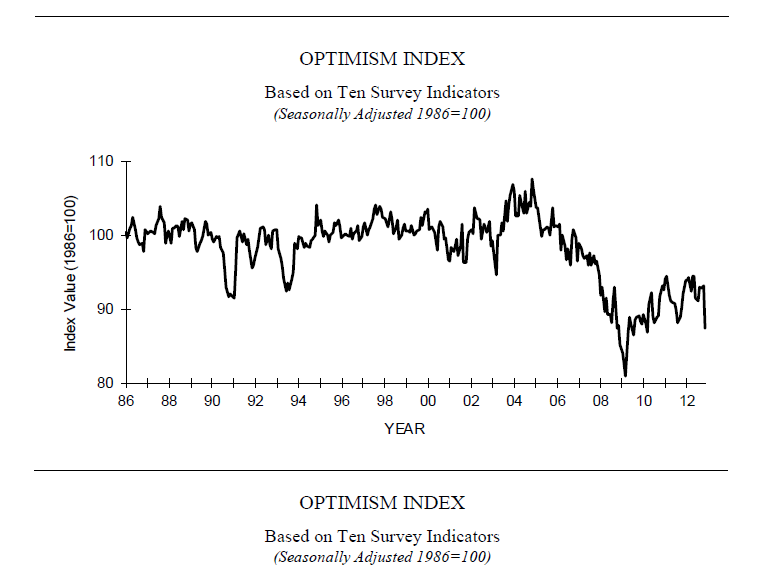
The NFIB Small Business Survey fell off a cliff in November to 87.5. The survey blames the election, not Sandy. If people though uncertainty over the election was the cause of the nascent slowdown, this survey shows that it wasn’t.  Of course there is a correlation and causation effect happening here:  Does uncertainty cause a lousy economy, or does a lousy economy increase the risk that politicians will do something stupid? 

Chart:  NFIB Small Business Optimism:

Part of the reason for falling optimism is falling profits.  One claim constantly thrown out is “Profits are at record levels, why aren’t people hiring?”  Maybe it is because they are not, at least not in the small business arena.  This is even more profound when you consider that taxes are going up.  Small business should be pushing as many expenses as possible to next year in order to minimize their 2013 tax bite, which means that profits should be increasing now as their expenses are deferred.  Which means that underlying business profitability may in fact be lower.  

Chart:  NFIB Small Business Earnings:

Note that Bill Dunkelberg is a free-market sort of guy, so the language of his survey will reflect his political leanings.  That said, the numbers are what the numbers are. 

Ezra Klein of WaPo sums up where things really stand in the fiscal cliff negotiations.  The White House needs (a) an increase in tax rates for the rich, (b) a long-term solution to the debt ceiling, and (c) an extension of unemployment insurance. Republicans need something on the entitlement front – either an increase in the medicare eligibility age or a change in inflation calculations for Social Security. 

The change in inflation calculation involves a going to a “chained CPI.” One of the historical criticisms of the Consumer Price Index is that it fails to take into account the substitution effect, which means that as relative prices increase, consumers substitute cheaper goods for higher priced goods.  In other words, if the price of beef rises, consumers substitute chicken for beef. Since the CPI is based on a static basket of goods, it fails to take into account the fact that the basket of goods changes as relative prices change, which means that it overstates inflation.  The chained CPI is an attempt to correct for this. 

Today begins the two-day meeting of the FOMC. The Street is expecting that the Fed will announce an open-ended Treasury Purchase program, which could push its balance sheet to almost $4 trillion. The estimate is that the latest round of QE will add $500B in Treasuries to $620B in mortgage backed securities.  It will be interesting to see if the Fed notes its frustration that consumer borrowing rates are not falling in lockstep with mortgage backed securities.  It would be even more interesting if there was some acknowledgement of G-fee increases, which explain the reason why. 

Morning Report – Does uncertainty drive the economy, or vice versa? 12/10/12

Vital Statistics:


Last

Change

Percent

S&P Futures 

1414.5

-1.5

-0.11%

Eurostoxx Index

2578.6

-22.8

-0.88%

Oil (WTI)

86.63

0.7

0.81%

LIBOR

0.311

0.001

0.32%

US Dollar Index (DXY)

80.35

-0.062

-0.08%

10 Year Govt Bond Yield

1.61%

-0.01%


RPX Composite Real Estate Index

190.5

-0.4


Markets are mixed this morning as optimism on the fiscal cliff is overshadowed by European events.  Mario Monti is resigning, creating an opening for Silvio Berlusconi to return.  Italian bond yields are up 31 basis points to 4.83%.  Japan is officially in a recession again (its third in the last four years) as 3Q GDP shrank at a 3.5% annualized rate. Bonds and MBS are up small.

Generally, we have a data-light week coming up, with inflation numbers dominating.  The FOMC rate decision is Dec 12.

The details of a deal on the cliff are taking shape.  On the revenue side, either a “split the difference” between the current top rate and 39.6%, or a redefinition of what is considered “rich,” to 375k – 500k. Entitlement cuts will be part of the package.  Ezra Klein reported Friday that the deal will probably be an increase in the top rate to 37% and an increase of the Medicare eligibility age to 67. Both sides seem to be inching closer together, and we’ll see if Boehner can pull his caucus together when they meet on Wed. 

Ever since the financial crisis began, “uncertainty” has become the buzzword thrown out to explain why the economy continues to limp along. Two professors from Chicago and Stanford tested the hypothesis that uncertainty is driving the economy by regressing economic variables against the number of times the word “uncertainty” was mentioned in the press.  They found a statistical relationship between the two, and estimate that the upturn in uncertainty caused a 16% drop in private investment and 2.3 million jobs. Of course there is a big risk of confusing correlation and causation.  Does uncertainty cause a bad economy, or does a bad economy increase the risk that government will do something (either good or bad) in an attempt to fix the economy?

New lawsuits continue to be filed against the banks for the sins of the subprime crisis. Some in the banking industry fear the cost could reach $300 billion. Investors are now suing the trust banks for failing to police issuers.  This is a new front, as the trust banks merely hold the securities and collect / disburse payments for a nominal fee.  Servicers, are you next?

Capital Markets Today

Interview I did with Capital Markets Today where I discuss the fiscal cliff, the economy, and real estate.

Edit:  Updated link

Morning Report – Jobs Day 12/07/12

Vital Statistics:

  Last Change Percent
S&P Futures  1418.5 5.5 0.39%
Eurostoxx Index 2593.6 -9.8 -0.38%
Oil (WTI) 86.71 0.5 0.52%
LIBOR 0.31 -0.001 -0.32%
US Dollar Index (DXY) 80.48 0.225 0.28%
10 Year Govt Bond Yield 1.62% 0.03%  
RPX Composite Real Estate Index 190.9 -0.1  


Markets are higher after a better-than expected jobs report.  Nonfarm payrolls increased by 146k in November vs an expectation of 85k.  October was revised down from 171k to 138k.  The unemployment rate dropped from 7.9% to 7.7%, but this was driven by a drop in the labor force participation rate from 63.8% to 63.6%. Surprisingly, Sandy didn’t appear to have much of an impact on the numbers. Still the headline numbers look good, and that is driving the index futures higher.  Feels like the Street was leaning short going into the numbers.  Bonds are down a point and MBS are down 7 ticks.


Small Business Hiring Plans hit post-recession low. Hiring plans are as low as they were in late 2008.  Resolution of the election “uncertainty” doesn’t seem to be having an effect, at least not yet.  We’ll see if resolving the fiscal cliff changes anything; my guess is that it won’t. 

The National Association of Homebuilders added 76 MSAs to their Improving Markets Index. The recent housing strength is spreading across the country. They note that “overly tight mortgage lending standards” are the one thing that is holding back progress.

HUD Secretary Shaun Donovan told the Senate Banking Committee that FHA is committed to selling at least 10,000 distressed loans per quarter over the next year, and it will raise the annual insurance premium paid by borrowers by 10 basis points. 

If the Fed adds another Treasury-buying program to compensate for the end of Operation Twist, they will almost certainly have to re-write their exit plan.  The sheer size of the numbers (estimates are that the Fed will have to sell $2 – $3 trillion worth of assets over several years.  If the Fed attempts to dump mortgage backed securities en-masse, it will exacerbate the increase in borrowing rates that will already be taking place.