Morning Report – Fannie Mae posts record profit 04/02/13

Vital Statistics:

  Last Change Percent
S&P Futures  1562.2 6.3 0.40%
Eurostoxx Index 2651.8 27.7 1.06%
Oil (WTI) 97.01 -0.1 -0.06%
LIBOR 0.282 -0.001 -0.18%
US Dollar Index (DXY) 82.75 0.016 0.02%
10 Year Govt Bond Yield 1.85% 0.01%  
Current Coupon Ginnie Mae TBA 104.6 0.0  
Current Coupon Fannie Mae TBA 103.3 -0.1  
RPX Composite Real Estate Index 189.5 -1.1  
BankRate 30 Year Fixed Rate Mortgage 3.68    

Markets are higher after Europe returned from a 4 day weekend. Italian sovereign yields are dropping, which is easing concerns about the Cyprus situation. Later this morning, we will get the ISM New York, factory orders and vehicle sales. Bonds and MBS are down small.

Fannie Mae just reported the largest net income in company history.  Good thing they didn’t release this yesterday or nobody would have believed it. They reported net income of $17.2 billion for 2012 and $7.6 billion in the 4th quarter. The refi boom of 2012 has certainly helped them, along with a drop in delinquencies, increasing home prices, and higher sales of Fannie Mae-owned properties. They still owe Treasury $85 billion. Fannie Mae stock has rallied from 30 cents a share two weeks ago to 80 cents a share as of yesterday on reports they will be profitable. The stock is trading up a nickel on low volume pre-market. Every dime the stock increases is roughly half a billion dollars in the US government’s coffers.

The Consumer Financial Protection Bureau has a new one-stop shopping site for financial gripes. They do not verify the facts of the complaints, but they give the company a chance to respond before they put it on their site. If you had ever been mad at your bank and wanted to create a http://www.thiscompanysucks.com website, well, there ya go.

Mohammed El-Arian says that the Cyprus situation is not fixed, just temporarily stabilized. Even if it doesn’t become a systemic problem (read: spread to Italy and Spain) it still could create a systemic threat if enough peripheral countries have issues. The EU seems to be against an Iceland-style fix, where Cyprus leaves the EU and devalues its currency.

Morning Report – Return of the Wealth Effect 04/01/13

Vital Statistics:

  Last Change Percent
S&P Futures  1562.4 -0.3 -0.02%
Eurostoxx Index 2624.0 11.6 0.44%
Oil (WTI) 96.53 -0.7 -0.72%
LIBOR 0.283 -0.001 -0.35%
US Dollar Index (DXY) 82.94 -0.032 -0.04%
10 Year Govt Bond Yield 1.88% 0.03%  
Current Coupon Ginnie Mae TBA 104.4 -0.2  
Current Coupon Fannie Mae TBA 103 -0.2  
RPX Composite Real Estate Index 190.5 -0.3  
BankRate 30 Year Fixed Rate Mortgage 3.67    

Markets are flat this morning as most European markets are closed for the Easter Holiday. We are kind on a lull period until next Monday when Alcoa kicks off earnings season. Bonds and MBS are down small.

The Markit U.S. Preliminary March Purchasing Managers Index rose to 54.9 from 54.3 in February, indicating that the economy is expanding at a faster rate.  Most indicators (new orders, employment, backlog) indicated the economy was expanding and accelerating. The Markit PMI is different than the more widely followed Institute of Supply Management Survey, which uses different weightings. 

NPR has a good backgrounder on how strength in housing feeds other sectors of the economy. Punch line:  the wealth effect, which was given up for dead in 2008 has returned. As home equity grows, people start spending again. 

The Feds are getting closer to Stevie Cohen. They have arrested Micheal Steinberg, one of Cohen’s senior lieutenants, who was implicated in insider trading in Nvidia and Dell. 

Morning Report – Undiversified Bond Investment? 03/28/13

Vital Statistics:

  Last Change Percent
S&P Futures  1558.1 1.3 0.08%
Eurostoxx Index 2633.5 21.0 0.80%
Oil (WTI) 96.39 -0.2 -0.20%
LIBOR 0.283 -0.001 -0.35%
US Dollar Index (DXY) 83.07 -0.148 -0.18%
10 Year Govt Bond Yield 1.85% 0.01%  
RPX Composite Real Estate Index 190.5 -0.3  

Markets are flattish on the last trading day of the quarter. 4Q GDP was revised upward from + .1% to + .4%. Personal consumption was revised downward as well.  Initial Jobless Claims rose last week to 357k. Bonds and MBS are flat.

The bond markets close at 1:00 pm EST today. Expect very little action today as traders will probably flatten positions ahead of quarter end.

The Office of Comptroller of the Currency has released the 4Q mortgage performance metrics. 89.4% of all mortgages are current, up from 88.6% last year. Delinquencies and foreclosures are down as the pipeline gets cleared and real estate prices start rebounding. More and more servicers are turning to mods as opposed to foreclosure initiations. The recidivism rate on these mods is around 17%.

The Private Label Securitization market is returning faster than people thought. Prior to this year, the only deals were the occasional Redwood Trust jumbo deal.  JP Morgan recently announced a deal, and now Springleaf plans a $1 billion subprime deal. The palette of products originators can offer is expanding in a big way.

FHFA has made mods easier to do on delinquent mortgages – anyone who is more than 90 days delinquent is automatically eligible for a loan mod. Borrowers do not have to show a financial hardship any more. This will only apply to Fan and Fred loans, and mods will be rate / term, not principal reductions. So this begs the question:  Why won’t everyone stop paying their mortgage in order to get a mod?  FHFA said they would use existing “screening measures to prevent strategic defaulters.”  Whatever that means. 

Is your house an undiversified bond investment? Was house price appreciation driven by falling interest rates? And does that mean that when rates start rising house prices will fall again? I would point out that interest rates aren’t the only factors affecting home prices – population growth, incomes, the availability of credit, and even global capital flows play a role. He does have a point, which is that a rapid rise in home prices like we saw from the early 90’s to 2007 is unlikely to be repeated given that we won’t have the tailwind of falling interest rates to increase affordability. That said, low interest rates can last a long time – from the end of WWI to the mid 60’s, short-term rates were 5% or lower. From 1932 to the mid 50’s, short term rates were under 2.5%.  I would also point out that real estate prices increased during the 1970s, even as short term rates moved up to 15%. 

Morning Report – Are we back in a real estate bubble? 03/27/13

Vital Statistics

  Last Change Percent
S&P Futures  1550.7 -6.5 -0.42%
Eurostoxx Index 2597.6 -43.6 -1.65%
Oil (WTI) 95.95 -0.4 -0.40%
LIBOR 0.284 0.000 0.00%
US Dollar Index (DXY) 83.21 0.328 0.40%
10 Year Govt Bond Yield 1.86% -0.05%  
RPX Composite Real Estate Index 190.8 -0.2  

Markets are lower this morning as Euro sovereign yields widen on the Cyprus situation. Mortgage applications rose 7.7% last week. This is the last full trading day of the week (Thurs is a half day), so volume should start to dry up as traders square their books for quarter-end and leave for the long weekend.  Bonds and MBS are up on the flight to safety trade.

We will have some Fed-speak today with Rosengren of Boston, Pianalto of Cleveland, and Kocherlakota speaking at various events during lunch. Hints about QE could move MBS, so watch your locks.

Consumer confidence fell in March to 57.9 from 61.4 a month earlier. The report blames Washington for the decrease. You certainly wouldn’t guess it from watching the stock market indices.  It will be interesting to see how the spending numbers shake out. 

New Home sales fell 4.6% MOM in February, but were up 12.3 YOY to a seasonally adjusted annual rate of 411,000 units. The median sales price was $246,800, an increase of 3% YOY. There definitely seems to be a bifurcation of the market, where existing homes are rising at a high single digit rate, yet the new home market is experiencing more modest price increases. Investor activity is probably driving the difference, as professional investors are purchasing distressed property for rentals, while new home sales are driven by actual homeowners. Volume is picking up, with the  sales in Feb up 13% from last summer. 

Bob Schiller pointed out that the latest housing data should be approached with caution. He points out that markets like Phoenix and Las Vegas are “frothy” and says that the recovery may even be a bubble. FWIW, I disagree that we are in another bubble – bubbles are psychological phenomenons that start with the view that “this time is different” and that the asset in question can only go up. That was the view of residential real estate in 2006.  It isn’t now. Our grandkids may experience another real estate bubble, but we won’t. Schiller believes that it will take 40 years for home prices to rise to pre-2007 levels. Yes, that is an eye-opening forecast, but he is talking about inflation-adjusted numbers. 

The government wants to impose a surcharge (through higher capital requirements) for the too big to fail banks. This will undoubtedly be another impetus for the big banks to break up voluntarily. 

Morning Report – Case-Schiller 03/26/13

Vital Statistics:

  Last Change Percent
S&P Futures  1550.2 3.3 0.21%
Eurostoxx Index 2637.9 -11.4 -0.43%
Oil (WTI) 95.58 0.8 0.81%
LIBOR 0.284 0.001 0.18%
US Dollar Index (DXY) 82.87 0.039 0.05%
10 Year Govt Bond Yield 1.93% 0.01%  
RPX Composite Real Estate Index 191 0.2  

Markets are higher this morning after a positive durable goods report, which showed orders increased 5.7% in Feb. January was revised higher.  Bonds and MBS are down small.

The S&P / Case-Schiller index of home values increased 8.1% YOY , better than the 7.9% estimate. The month on month index rose as well.  For the first time since the housing bust, we have not seen a seasonal drop in house prices.  The New York MSA finally reported positive returns. House prices are back to their Autumn 2003 levels.

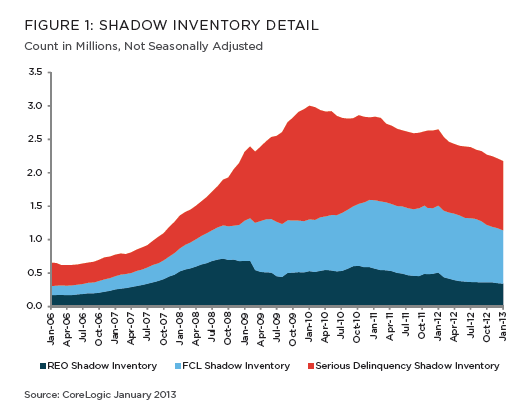
CoreLogic reported that shadow inventory (the number of homes that are seriously delinquent, in foreclosure, or REO, but not listed on the MLS) is down 28% from its peak three years ago when it stood at  3 million units. The current 2.2 MM units is down 18% from last year and represents 9 month supply.FL, NY, CA, NJ, and IL account for half of the shadow inventory. 

The Cyprus rescue, while small in actual dollar terms, may have reverberations all across the euro zone. Under the rescue plan, senior Cypriot bond holders will take haircuts and uninsured depositors will be wiped out. This sets a precedent – that all stakeholders can be targeted – which will probably cause even bigger outflows the next time another Euro country gets in trouble. Given that Cyprus instituted capital controls so that investors can’t take money out means that the exit door will be very narrow the next time someone gets in trouble.

Morning Report – Blackstone vs the first time home buyer 03/25/13

Vital Statistics:

  Last Change Percent
S&P Futures  1557.4 5.4 0.35%
Eurostoxx Index 2711.9 30.2 1.13%
Oil (WTI) 94.42 0.7 0.76%
LIBOR 0.283 -0.002 -0.53%
US Dollar Index (DXY) 82.52 0.147 0.18%
10 Year Govt Bond Yield 1.96% 0.04%  
RPX Composite Real Estate Index 190.7 -0.5  

Markets are higher after Cyprus agreed to shut its second-largest bank in exchange for a 10 billion euro bailout. Of course Russian money will flee the country, and Russian banking was the only thing keeping that economy afloat. So, I am sure we will be revisiting this issue in the near future. Bonds and MBS are down on the “risk-on” trade.

This is a short week, so expect activity to wind down as traders square their books for quarter end, and many take Thursday off.  In economic data, we have durable goods, new home sales, and Case-Schiller tomorrow. We will get the final revision to 4Q GDP on Thursday. 

The Chicago Fed National Activity Index came in at +44 in February from -.49 in January.  This is a broad-based index that focuses on 85 different indicators of economic activity. Since the individual monthly indices can be volatile, you want to focus on the 3 month moving average, which has been above zero (absolute historical trend) for the past 4 months. The main takeaway from the index is that we are performing slightly above trend, and that inflation is well-contained. 

The Wall Street Journal has an article this morning talking about how professional investors are impacting the real estate market. In hot markets like Orange County, professional investors make up about 22% of all sales. During the bubble years, they were about 10%.  They are having the effect of taking affordable housing off the market. This has had the added effect of improving the quality of neighborhoods as they have taken the abandoned homes off the market and maintaining them. Blackstone has bought $3.5 billion worth of homes so far and is buying more than $100 million a week. Of course the loser in all of this is the first time homebuyer, who already has to deal with a lousy job market and a tight credit market, and now faces bidding wars for a starter home from firms like Colony and Blackstone. These investors may find that being in the rental business is a lot harder than it looks and could turn net sellers are rental yields fall and home prices increase. 


Morning Report – Phoenix Phannie 03/22/13

Vital Statistics:

  Last Change Percent
S&P Futures  1542.1 3.0 0.19%
Eurostoxx Index 2683.9 -0.1 0.00%
Oil (WTI) 92.88 0.4 0.47%
LIBOR 0.285 0.001 0.18%
US Dollar Index (DXY) 82.58 -0.164 -0.20%
10 Year Govt Bond Yield 1.92% 0.01%  
RPX Composite Real Estate Index 191.2 -0.6  

Markets are higher this morning after luxury retailer Tiffany reported better than expected earnings, and Cyprus moves towards a resolution. There are no economic releases this morning. Bonds and MBS are up small.

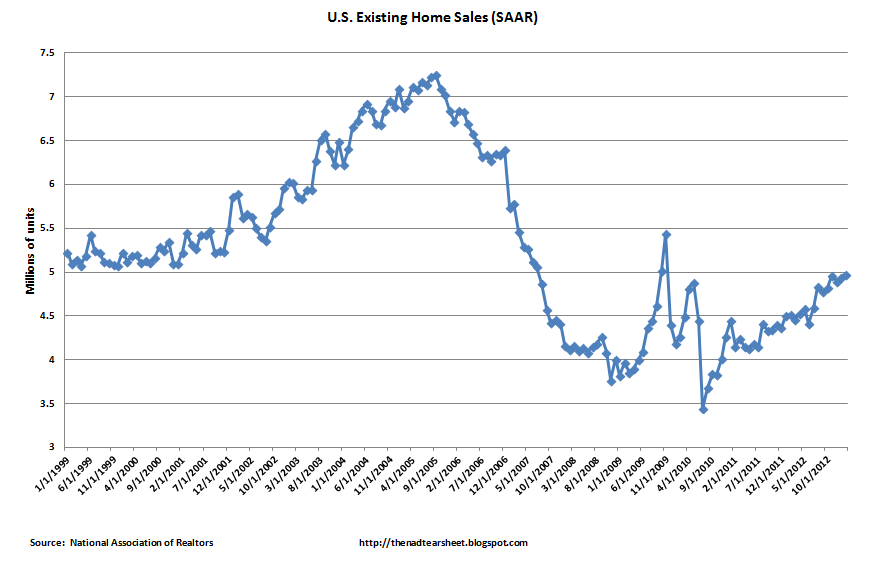
Existing Home sales rose.8% to a seasonally adjusted annual rate of 4.98MM, a 10% annual increase, according to the National Association of Realtors. Some stats from the release:

  • The median house price rose 11.6% to $173,600
  • Distressed sales accounted for 25% of all sales
  • Professional investors purchased 22% of all homes
  • The first time homebuyer accounted for 30%
  • Short sale haircuts were 15%, while foreclosure haircuts were 18%
  • Time on market fell 24% to 74 days
  • Cash-only transactions were 1/3 of all transactions.
Chart:  Existing Home Sales.  Approaching normalcy:

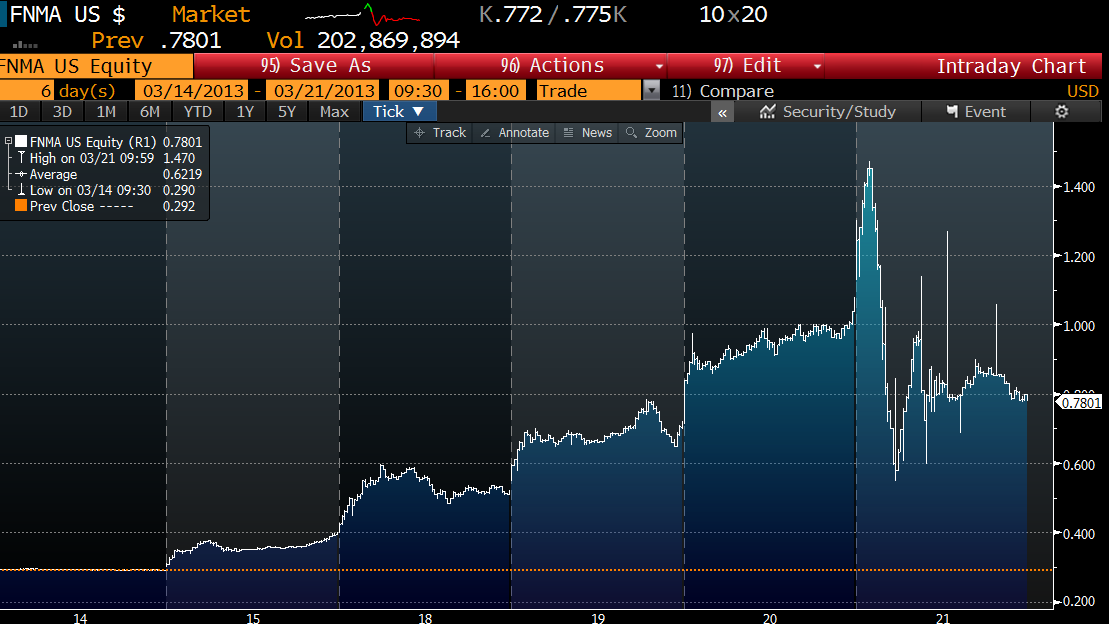
One feature of the financials lately has been the resurrection of many stocks given up for dead.  The first one was Impac, which is up 5-fold since August of last year. Then came Radian. Well, guess who is back? Fannie Mae (FNMA), who is up 3-fold since last week when it delayed filing its 10-K and said it expects to post a profit. Also, the “Jumpstart GSE Reform Act” was introduced at the same time, which would require Congressional approval for the government to unload its Fannie Stock. I am hearing that there is action in the Fannie prefs as well. Yes, it is up on volume, too – 94MM shares traded yesterday.

You are seeing the same action in Freddie Mac stock as well – FMCC.


Morning Report – FOMC statement 03/21/13

Vital Statistics:

  Last Change Percent
S&P Futures  1549.2 0.1 0.01%
Eurostoxx Index 2687.4 -21.5 -0.79%
Oil (WTI) 93.4 -0.1 -0.11%
LIBOR 0.284 0.000 0.00%
US Dollar Index (DXY) 82.77 -0.014 -0.02%
10 Year Govt Bond Yield 1.95% -0.01%  
RPX Composite Real Estate Index 191.8 -0.5  

Markets are flat this morning after Oracle’s miss.  Initial Jobless Claims came in at 336k, more or less in line with last week. The Markit PMI came in a little better than expected. Bonds and MBS are up small.

Nothing earth-shattering came out of the FOMC statement or the press conference yesterday. In the projections section, they have taken down the GDP estimate for 2013 slightly, moving the top end of the range from 3.0% to 2.8%.  They also have decreased 2013 unemployment estimate a little, taking the range midpoint from 7.55% to 7.4%.  Whether that is being driven down by a pessimistic labor force participation rate or optimistic hiring plans is unclear. Overall, it was a “steady as she goes” sort of statement. People who want to compare this statement with the previous one can do so here. Bernake’s body language suggested that he isn’t interested in staying on after his term expires in Jan 2014. Early favorite to replace The Bernank:  Geithner. Janet Yellen and Larry Summers are the other names mentioned.

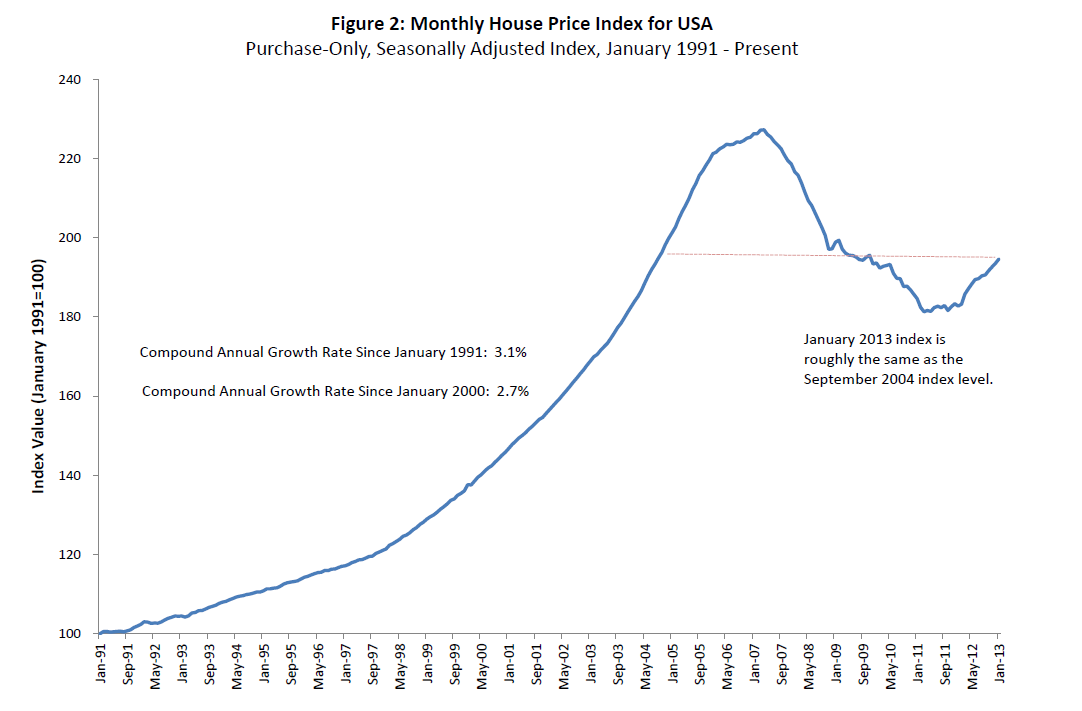
The FHFA House Price Index increased .6% in January, just missing the +.7% estimate. New England fell .7%, while the Pacific division rose 1.6%.  The index focuses solely on houses purchased with conforming loans, so in some ways, it is more of a “central tendency” index in that distressed and jumbos are excluded. 

Chart:  FHFA House Price Index:

Ellie Mae’s Origination Insight Report showed that the purchases increased from 27% to 32% of all originations as interest rates backed up last month.  FHA increased its share to 20% while conventional fell to 71%.  Days to close fell from 54 days to 50, and it appears that credit is starting to ease up a bit as the average FICO fell from 749 to 745. Pull-through increased to 56.8% from 55% in January.

Signs of life in the private label market:  JP Morgan is marketing a $616MM prime RMBS offering, its first post-crisis deal.  Everbank is marketing a $308.4MM offering. I don’t see anything on EDGAR yet, so I’ll try and get a flavor of what they are selling and pass it on.

The Senate passed a continuing resolution to keep the government funded through the end of its fiscal year. The House is expected to vote on it today. Some of the sharp edges of the sequestration were filed down in the process. No one is expecting a government shutdown. On to the debt ceiling in August.

Market darling Lululemon has a transparency issue.  No not that kind..

Morning Report – Detroit is the best Midwest market 03/20/13

Vital Statistics:

  Last Change Percent
S&P Futures  1548.9 6.7 0.43%
Eurostoxx Index 2705.4 33.5 1.25%
Oil (WTI) 92.95 0.8 0.86%
LIBOR 0.284 0.002 0.71%
US Dollar Index (DXY) 82.73 -0.264 -0.32%
10 Year Govt Bond Yield 1.94% 0.03%  
RPX Composite Real Estate Index 192.3 -0.3  
S&P futures are rallying after Cyprus rejected a bank deposit tax designed to help keep it in the euro. Investors are betting that the ECB will continue to support the country’s banking system. Given the “risk on” feel, bonds and MBS are down.
 
Mortgage applications fell 7.1% last week. Fedex missed and guided down. Fedex can usually be taken to be an economic bellwether, but this miss was due more to overseas problems and pricing pressures. I would not take this news to mean that Fedex is forecasting a deceleration in the economy. 
 
The Fed will release the FOMC decision today around 2:00pm. Nobody expects any major policy changes; the focus will be on when QE ends. Economists are predicting the Fed will start withdrawing from the market  in Q4. It probably won’t be an abrupt withdrawal – they will slow the pace of purchases and re-evaluate at the next meeting. The Bernank will hold a press conference today at 2:30. 
 
Homebuilder Toll Brothers CEO Douglas Yearley said on Bloomberg TV that there is “no inventory on the market” and the company feels “really good” about Spring. Detroit (yes, Detroit) is their best market in the Midwest. NoVa, DC remain strong (so no sequestration fears panning out). He sees orders up 49% this spring. 
 
Sen Bob Corker (R-TN) is hoping to see the GSEs have a technocrat, not a politician in charge of the agencies. The WH has been considering Rep Mel Watt (D-NC) to lead FHFA. The current left vs right battle in this issue centers around principal reduction mods for Fan and Fred loans. Ed DeMarco, the current head of FHFA, has been resisting calls to reduce principal for Fan and Fred loans. The main reason – the fear that principal mods could trigger a wave of delinquencies as the “not-so-needy” figure out they can reduce their mortgage balance by simply refusing to make their payments. Second, Republicans rightly point out that the GSEs have been used as a tool of social policy and that there have been some unintended consequences. The job of the FHFA director is to look out for the taxpayers, not conduct social engineering, and if nominated, Rep Watt faces a tough road to confirmation. There is very little consensus between Democrats and Republicans over what the replacement for the GSEs should look like.
 
Abby Joseph Fink?  Blackrock CEO Laurence Fink is predicting a 20% rise in the stock market this year. He also says that Cyprus is a “$10 billion issue” that is more of a symbolic than real economic issue. 

Morning Report – Why are the homebuilders blue? 03/19/13

Vital Statistics:

  Last Change Percent
S&P Futures  1550.2 3.4 0.22%
Eurostoxx Index 2696.2 -9.3 -0.34%
Oil (WTI) 93.9 0.2 0.17%
LIBOR 0.282 0.002 0.71%
US Dollar Index (DXY) 82.66 -0.032 -0.04%
10 Year Govt Bond Yield 1.94% -0.02%  
RPX Composite Real Estate Index 192.6 -0.2  

Markets are firmer this morning in spite of the continuing problems in Cyprus. The FOMC meeting starts today, with the rate decision expected tomorrow. The market will be focusing on the Fed’s body language regarding the strength of the recovery and the end of QE.  Bonds and MBS are up on the flight to quality trade.

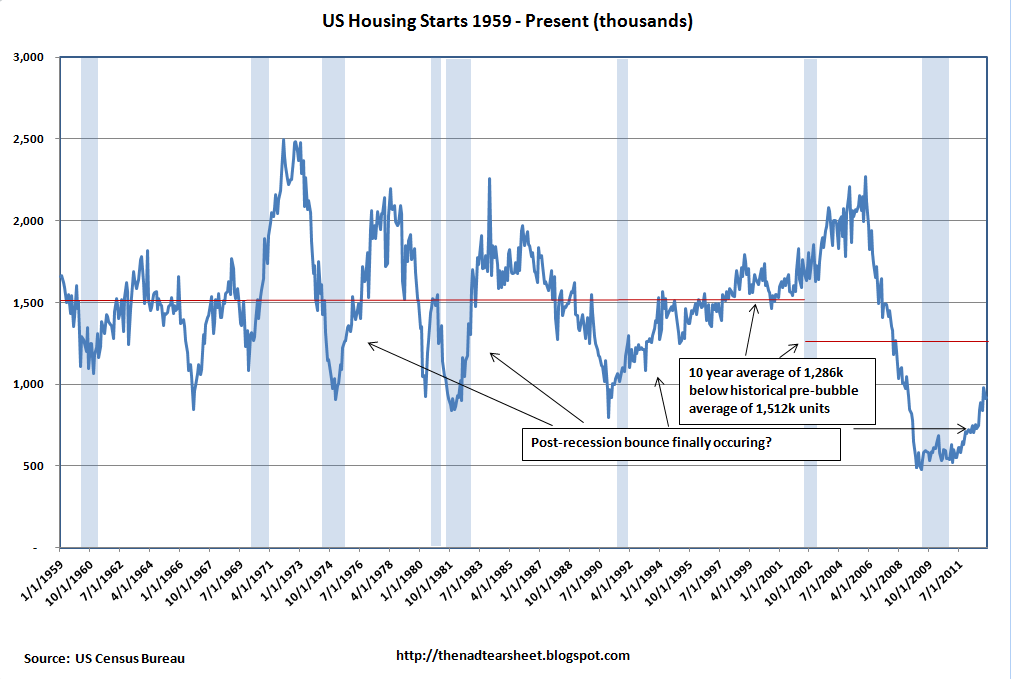
Housing starts climbed to a 917,000 annual rate in February. Muti-fam starts continue to be in the 36% – 37% range as builders feed the red-hot rental market. Housing starts are still running at about 60% of historic levels (about 1.5MM units) going back to the late 50s. For the past 10 years, we have averaged 1.3 million units a year, which includes the meat of the housing bubble and the bust. We have been underbuilding for some time now.

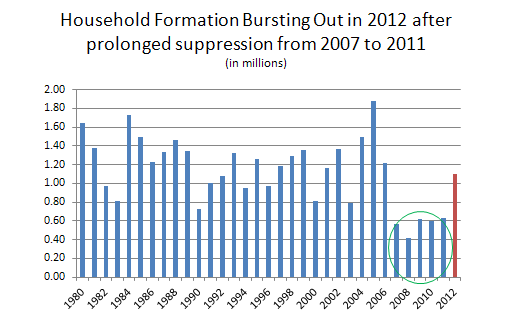
The fact that we have underbuilt for so long partially explains why the rental market is so hot. This demand was masked for quite some time due to the recession as household formation numbers plummeted. 

Many would-be first time homebuyers graduated college and returned to their parents’ house after an unsuccessful job search.  Others moved in with roommates to minimize costs. That drop in household formations does not represent a demographic shift, it represents a temporary economic phenomenon.  It also means there is a lot of pent-up demand that is going to be released as the economy recovers. While a lot of that will go into rentals, the first time homebuyer (creditors willing of course) is about to return to the housing market and that will allow the move-up buyer to sell. This has been one of the biggest sticking points for the market – a lack of first-time homebuyers.

So, with this economic backdrop, why did the homebuilders report a drop in confidence last month?  The National Association of Home Builders / Wells Fargo Housing Market Index of builder sentiment had been on a tear since early 2012 as the homebuilders began sticking their heads above the parapet. The problem is not demand for new homes; it is problems in the the supply chain, along with rising costs for materials and labor. In an earlier post, I talked about how the shortage of construction workers was making lives difficult for homebuilders. This is reflected in the builder sentiment survey. They also mention the gripe everyone else is making – appraisals – and a tough credit market for borrowers who don’t fit in the GSE / GNMA box.

Bottom line: if you have made a bit of dosh trading the homeboys or the XHB, it might be time to start ringing the register….