Morning Report: Home prices continue to rise 5/25/16

Stocks are higher this morning as emerging markets rally. Bonds and MBS are down.

Mortgage Applications rose 2.3% last week as purchases rose 4.8% and refis rose 0.4%. The average 30 year fixed rate mortgage rose 3 basis points to 3.85%. The average jumbo rate increased 8 basis points to 3.82%.

Home prices rose 0.7% in March, according to the FHFA House Price Index. “While the overall appreciation rate was robust in the first quarter, home price appreciation was somewhat less widespread than in recent quarters,” said FHFA Supervisory Economist Andrew Leventis. “Twelve states and the District of Columbia saw price declines in the quarter—the most areas to see price depreciation since the fourth quarter of 2013. Although most declines were modest, such declines are notable given the pervasive and extraordinary appreciation we have been observing for many years.” Interesting to see prices begin to decline in some states.

A US appeals court threw out the $1.27 billion judgement against Bank of America for Countrywide’s sins related to the “hustle.” The 2nd U.S. Circuit Court of Appeals in New York said the proof at trial was insufficient under federal fraud statutes to establish liability. No comment yet from Manhattan U.S. Attorney Preet Bharara.

Hillary Clinton is trying to take Donald Trump to task over comments made as the real estate bubble was bursting. Not sure how much traction that is going to get, however she had a conference call with reporters to push the message. Separately, the Republican party is beginning to unite behind Trump.

Morning Report: Home prices continue to rise

Stocks are higher this morning as emerging markets rally. Bonds and MBS are down.

Mortgage Applications rose 2.3% last week as purchases rose 4.8% and refis rose 0.4%. The average 30 year fixed rate mortgage rose 3 basis points to 3.85%. The average jumbo rate increased 8 basis points to 3.82%.

Home prices rose 0.7% in March, according to the FHFA House Price Index. “While the overall appreciation rate was robust in the first quarter, home price appreciation was somewhat less widespread than in recent quarters,” said FHFA Supervisory Economist Andrew Leventis. “Twelve states and the District of Columbia saw price declines in the quarter—the most areas to see price depreciation since the fourth quarter of 2013. Although most declines were modest, such declines are notable given the pervasive and extraordinary appreciation we have been observing for many years.” Interesting to see prices begin to decline in some states.

A US appeals court threw out the $1.27 billion judgement against Bank of America for Countrywide’s sins related to the “hustle.” The 2nd U.S. Circuit Court of Appeals in New York said the proof at trial was insufficient under federal fraud statutes to establish liability. No comment yet from Manhattan U.S. Attorney Preet Bharara.

Hillary Clinton is trying to take Donald Trump to task over comments made as the real estate bubble was bursting. Not sure how much traction that is going to get, however she had a conference call with reporters to push the message. Separately, the Republican party is beginning to unite behind Trump.

Morning Report: New home sales spike 5/24/16

Markets are higher this morning on no real news. Bonds and MBS are down.

New Home Sales came in much stronger than expected, at an annual rate of 619,000. This is the highest level since early 2008. While it is premature to bust out the champagne quite yet (prior to the bubble, the last time sales were this low was the early 90s), it is an encouraging sign. The Spring Selling season got off to a somewhat slow start, but seems to be picking up momentum. Note this number has an unusually wide margin for error this month, so expect a revision.

Speaking of new home sales, we got second quarter numbers out of Toll Brothers this morning. Earnings beat on the top and bottom lines, with revenues increasing 31% in dollars and 9% in units. Interestingly, average selling prices of signed contracts were flat. Contracts only rose 3%, and the problems were in California, with not enough inventory for sale. They continue to build out their urban apartment segment and plan to expand it to smaller cities and suburbs.

The Richmond Fed manufacturing index fell in May to -1 from 14.

More millennials are living with their parents than they are with a partner or significant other, for the first time in the modern era. This is probably a reflection of a lot of things – from the weak economy to people getting married later in life. However, it does represent pent-up demand for housing.

Foreclosure starts fell to 58,700 in April, the lowest level since 2006. Delinquencies increased slightly, but are still down 10% YOY. The active foreclosure inventory fell below 600,000 for the first time since 2007. The Northeast still has some wood to chop in terms of liquidating foreclosures.

Morning Report: Lending Club is tarnishing the rest of the fintech industry 5/23/16

Markets are flattish this morning on no real news. Bonds and MBS are flat as well

Not a lot of data this week – the biggest number will be the second revision to first quarter GDP later this week. The Street is forecasting GDP rose 0.9%. We will also get pending home sales and new home sales.

Pain in the junk bond market is spreading to the non-commodity space as retailers are beginning to take it on the chin.  This is one issue that could certainly cause the Fed to maintain low interest rates. Pain here is generally considered bond bullish as well, which means it is a catalyst for lower mortgage rates.

Mohammed El–Erian says that the markets are still not fully pricing in two more hikes this year. He believes the Fed has a small window in which to pursue normalization and they intend to take advantage of it.

Lending Club’s woes are putting a wet blanket on the rest of the fintech industry. The industry is going from playing offense in Washington to playing defense. The regulators are hungry to bring this industry to heel.

Morning Report: The Fed has a credibility problem 5/20/16

Stocks are up this morning as commodities rally. Bonds and MBS are slightly lower

Existing Home Sales rose to an annualized pace of 5.45 million in April, according to the NAR. The median home price rose to $232,500, an increase of 6.3% YOY. Total inventory is 2.14 million homes, which represents a 4.7 month supply at the current pace.

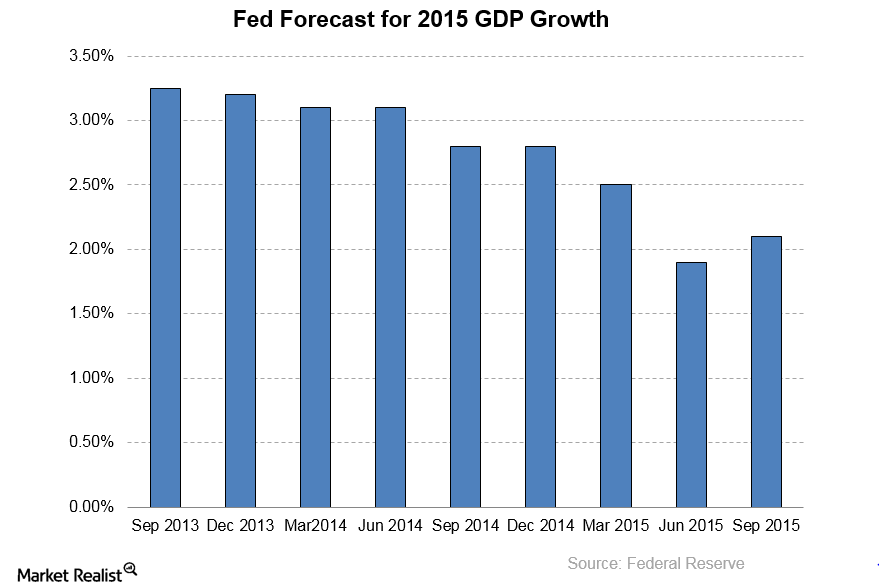
One of the Fed’s problems right now is credibility. As the minutes from Wednesday showed, the markets have been relatively complacent about the possibility of a Fed move. Part of that is certainly the Fed’s own doing, as they have tried to prep the markets for a rate hike several times over the past year or so, only to decide that the economy isn’t strong enough to withstand a rate hike. Here is the problem:

This is what the Fed’s forecast for 2015 GDP growth at all of the FOMC meetings starting in September 2013. As you can see, the Fed has been consistently high in its forecast for GDP growth. So, they begin to prep the markets for a rate hike based on their forecast that GDP will improve to a 3%+ rate of growth, and then back off when we start getting real numbers. I suspect the reason is because the Fed’s models are based on the garden-variety business cycle, where inventory build drives the process. We are in the aftermath of an asset bubble, and the problem here isn’t excess inventory – it is excess debt. And aside from the 1930s and Japan’s current experience, we don’t have a lot of experience with it.

Everyone knows auto loans are the new subprime, as low interest rates have pushed investors into riskier and riskier paper. Eight year car loans with rates around the current mortgage rate are common now. The other new issue: negative equity.

Separately, the CFPB is going after auto title loans as well as payday lenders. Is the government basically setting the stage such that the unbanked have nowhere to go to get credit? Many would like to see the post office become a bank.

Morning Report: FOMC minutes shock the bond market 5/19/16

Markets are lower this morning after the FOMC minutes shocked bond markets yesterday. Bonds and MBS are down.

The sentence that sent bonds reeling: Some members expressed concern that the likelihood implied by market pricing that the Committee would increase the target range for the federal funds rate at the June meeting might be unduly low.” The FOMC minutes caused a 7 basis point spike in the 10 year and a 6 basis point spike in the 2 year. The Fed Funds futures contracts (which is what the “likelihood implied by market pricing” phrase alludes to) moved from a 10% chance of a June hike to a 25% chance of a June hike and a 60% chance of a hike by September. Earlier this year, the futures were basically betting the Fed would be on hold for the rest of the year. The markets were perhaps a little too complacent about another rate hike. That said, the Fed has set up the markets for rate hikes several times over the past year or two only to get cold feet.

In terms of the economy, the members and the staff noted that the labor market continues to improve despite a deceleration in economic growth. Inflation remains well below the Fed’s target, however they attribute that to commodity price movements, which are transitory.

The minutes also mentioned that residential mortgage credit was getting a little looser on the government side, but also noted that non-traditional and credit-challenged borrowers still face tight credit conditions. The corporate bond market has improved after a slow January and February.

In economic news today, the Chicago Fed National Activity Index rose to .10 from a downward-revised -.55 in March. The 3 month moving average is still negative, meaning the economy is growing slightly below its long-term trend. Separately, the Philly Fed Business Outlook Index fell to -1.8.

Initial Jobless Claims fell to 278k from 294k last week. As a general rule, people are hanging onto their jobs these days.

The Bloomberg Consumer Comfort index was flat last week at 44.5.

The Index of Leading Economic Indicators rose from 0.2% to 0.6% in April. The FOMC minutes mentioned the Fed expects growth to accelerate into the second half of the year.

Interesting stat: The number of homes worth $1 million has doubled in the last 4 years. Of course 2012 was pretty much the bottom of the real estate market, and it has been the big urban areas like San Francisco and Manhattan that have led the charge higher. Heck, in San Francisco, the median home price is over $800k.

And that ties into….a lack of starter homes.  Homebuilders are having a tough time making starter homes work financially. Increased regulatory and compliance costs, mandated open space, lower density, higher land prices, and fees imposed by counties and cities are all combining to make affordable starter homes impossible to build. Indeed, the number of starter homes is at a historical low and falling. Here are some industry quotes: “When you start with a high land basis, it’s very hard to end up with a purchase price that the first-time buyer finds affordable,” said Stuart Miller, CEO of Miami-based Lennar. “No. 1, you see it in just the pure requirements. Those requirements can be a very lengthy list of things you maybe wouldn’t have seen 10, 15, 20 years ago. But you’re also seeing it in fees that counties and cities impose on new home construction. Fees can be anywhere from $50,000 to $100,000 per home to build,” said Taylor Morrison’s Bodem. “Things like that ultimately get passed on to the consumer and the price of housing. That’s one reason why you see the cost of housing so expensive, especially here in Southern California.” I have said it before, housing is the #1 thing keeping GDP growth around 2% instead of 3%.

Turn times increased for refis last month, according to the Ellie Mae Origination Insight Report. Time to close all loans was steady at 44 days, but refis increased from 41 to 44. Turn times are now below where they were pre-TRID.

Morning Report: Housing starts still in a range 5/18/16

Was at the MBA conference Monday and Tuesday, so no report the last two days. People are still buffaloed by regulation. They staged a debate between David Axelrod and Laura Ingraham. She got in some digs on Hillary, but there was no discussion of regulation in the financial sector, which was a shame. Met someone from Fannie Mae who is trying to get lenders to make sub 600 FICO loans and is struggling to get lenders to go there. The government simply has no clue how lenders think…


The other sad thing was the MBA leader Dave Stevens who consistently cautioned the industry to not push back against the government regarding regulation. We have to advocate for ourselves “behind the scenes.” Or else the consumer advocates will eat us up. What is the industry asking for? What special favor are we requesting? Clarity on the regulations and not regulation by enforcement action. I guess that constitutes rent seeking in this day and age..

Stocks are lower this morning on Fed worries and emerging market woes. Bonds and MBS are flat

We will get the minutes from the April FOMC meeting today at 2:00 pm EST. The markets have been focusing like a laser on any sort of Fed-speak, so this could present the possibility of some volatility in the bond markets. Just be aware.

Yesterday, Atlanta Fed President Dennis Lockhart and San Francisco Fed member John Williams said that two hikes this year may be the proper course.

Mortgage Applications fell 1.6% last week as purchases fell 5.8% and refis rose 1.4%.

We had some housing data earlier this week. First, the NAHB Housing Market Index was steady at 58. This is the homebuilder sentiment index. After peaking in late 2015, it has fallen slightly. Builders are certainly happy with mid single-digit increases in average selling prices, but they aren’t pumping out more units yet.

The drop in sentiment is evident in housing starts, which continue to be mired in the 1.1 million to 1.2 million unit range. In April, starts rose to 1.17 million from an upward-revised 1.1 million. Building permits rose to 1.1 million. It is amazing that we have such low inventory of homes and yet starts are around 25% less than historical, pre-bubble numbers. That is even more dramatic when you factor in population. We have only approached the lows from the 81-82 recession, which was a bad one.

Morning Report: Retail Sales come in better than expected 5/13/16

Stocks are lower this morning on no real news. Bonds and MBS are up small.

Retail Sales increased 1.3% month-over-month, topping Wall Street forecasts. Autos, grocery and online led the charge. Ex-autos, gas and building materials, it increased 0.9%. We have had a laundry list of retailers miss earnings lately (Macy’s, JC Penney, Kohls, Nordstrom), so investors were probably expecting the worst. Given all of the weak economic data lately, this is one decent data point. We are seeing some sell-side firms take up Q2 GDP estimates on the number.

The chart below is retail sales as a percentage of GDP. It is not a seasonally adjusted number, so holiday spending accounts for the spikes. However, you can see that post the real estate crash, retail sales have been a much smaller percentage of GDP than they were for the 90s and the bubble years. Perhaps spending during the 90s and the bubble years was driven by the cash-out refi and now that is gone. If so, that would certainly help explain why growth has been so tepid. Or it simply means the Great American Deleveraging Process has further to go.

Inflation at the wholesale level remains well below the Fed’s target. The Producer Price Index rose 0.2% in April and is up 0.9% year-over-year.

Business inventories climbed 0.4% in March, while consumer sentiment jumped.

Janet Yellen doesn’t rule out the possibility of negative interest rates, however they would be a last resort.

The National Association of Homebuilders estimates that 14 million people are priced out of the housing market due to government regulation.

Morning Report: Delinquencies flat 5/12/16

Markets are higher this morning as commodities rally and the UK central bank maintained interest rates. Bonds and MBS are down small.

Mortgage delinquencies were flat at 4.77% in the first quarter, according to the MBA. The foreclosure percentage fell to 1.74% from 1.77%. We are back to pre-crisis levels in delinquencies.

Initial Jobless Claims rose by 20k to 294 last week, the highest level in over a year. We are seeing more and more evidence that the US economy might be slowing a little.

The other evidence of a slowdown? Lousy earnings from the retailers. Macy’s got slammed by 15% yesterday on lousy numbers. Today’s victim is Kohls, down over 7%.

Consumer comfort slipped to 41.7 from 42, according to the Bloomberg Consumer Comfort Index.

Interesting article on the dynamic that is driving long term yields lower: Right now, there is about $9 trillion worth of government bonds out there with negative yields. This is pushing investors to buy longer-dated stuff in order to get a positive yield.  Japan recently sold 30 year bonds at a yield of 31.9 basis points, which makes sense given that everything with maturities of 15 years or less is negative. Spain sold 50 year bonds and Italy is exploring a 50 year bond sale. Given the strong US dollar, and the 10 year’s yield of 1.75%, any slowdown in the US economy should result in tremendous demand for US treasuries. Which means low mortgage rates are probably here to stay. Also, it looks like the slowdown in US corporate issuance is over.

Import prices rose 0.3% on a month over month basis, but are down 5.7% year-over-year. Yet another indication that inflation is going nowhere.

Reuters did a poll of economists, and about 1/3 think the Fed will hike rates in June. Traders are handicapping an 8% chance via the Fed Funds futures.

Interesting article on the new hard money lenders in the WSJ. (Behind the paywall unfortunately). They are lending money in the high single digits. There seems to be an arbitrage between underwriting and the box that bank mortgages will fit in. In other words, banks will decline a loan for a technical reason, which makes the loan unsaleable. These people look beyond that and decide if the risk is worth taking. If the rate is 10%, they might be getting compensated for that risk.

Morning Report: the third party election 5/11/16

Stocks are lower this morning on no real news. Bonds and MBS are flat.

Slow news day, with no economic data

Mortgage Applications rose 0.4% last week as purchases rose 0.4% and refis rose 0.5%. Refis accounted for 52.8% of all originations.

Bernie Sanders and Donald Trump won their respective primaries in West Virginia yesterday. Hillary looks to have sewn up the Democratic primary, despite Bernie Sanders’s determination to play it out. Neither Trump nor Hillary are especially popular in their respective parties. 2016 could be the year of the third party candidate, with Sanders supporters going for Green Party candidate Jill Stein and establishment GOP voters siding with Libertarian candidate Gary Johnson.

Stonegate Mortgage announced earnings yesterday, missing estimates on both the top line and the bottom line. Originations decreased by 15%, while the company took a $36 million writedown of its MSR portfolio. The write-down lowered revenues to $5 million from $47 million at the end of the fourth quarter. Originations decreased 15% to $1.94 billion sequentially and fell 26% on a YOY basis. The stock is trading at $4.16 early, down 28% in May alone.