Morning Report: Housing starts fall 6/16/17

Vital Statistics:

Last Change
S&P Futures 2433.8 1.8
Eurostoxx Index 388.2 2.2
Oil (WTI) 44.9 0.4
US dollar index 88.5 -0.1
10 Year Govt Bond Yield 2.17%
Current Coupon Fannie Mae TBA 103.31
Current Coupon Ginnie Mae TBA 104.375
30 Year Fixed Rate Mortgage 3.89

Stocks are higher this morning on no real news. Bonds and MBS are flat.

Slow news day.

Housing starts fell in May to an annualized rate of 1.09MM. This is a 5.5% drop from April and a 2.4% drop YOY. Building Permits fell as well. Both single-fam and multi-fam segments fell. Builders claim that a lack of skilled labor and available land are causing the problem.

The lack of building is pushing rents higher, and the number of people who spend 50% or more on of their income on housing is at a record level. The issue is a big problem in many metro areas, however outside of those areas affordability is better. There is also a huge difference between MSAs, with places like the Bay Area completely unaffordable compared to the Rust Belt, where prices have yet to recover their bubble peaks.

Amazon is buying Whole Foods..  I guess you’ll soon be able to get your artisanal tortilla chips delivered by drone to your house.

Morning Report: Fed hikes, but is a credibility problem brewing? 6/15/17

Vital Statistics:

Last Change
S&P Futures 2420.0 -15.3
Eurostoxx Index 384.3 -3.3
Oil (WTI) 44.6 -0.2
US dollar index 88.6 0.5
10 Year Govt Bond Yield 2.16%
Current Coupon Fannie Mae TBA 103.31
Current Coupon Ginnie Mae TBA 104.375
30 Year Fixed Rate Mortgage 3.95

Stocks are lower this morning after the FOMC raised rates yesterday. Bonds and MBS are down after rallying yesterday.

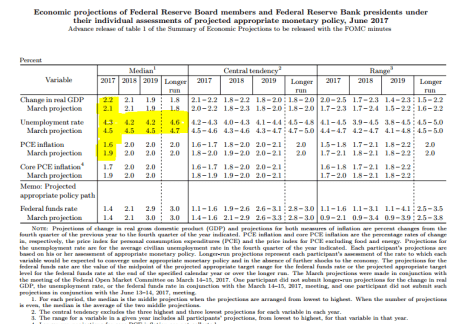
As expected, the FOMC raised the Fed Funds rate by 25 basis points and continued its policy of re-investing maturing bonds from QE back into the market. Neel Kashkari dissented, preferring to maintain the current Fed Funds rate. The dot plot basically did not change meaningfully from March to January. The projections did change, as the unemployment forecast for 2018 and 2019 was revised downward from 4.5% to 4.2%. Bonds reacted negatively to the move, but that was colored by the fact that bond yields were already down 10 basis points on the day due to the weaker than expected CPI and consumer spending numbers. The highlighted areas on the projection below show the major changes.

FOMC projections - June 2017

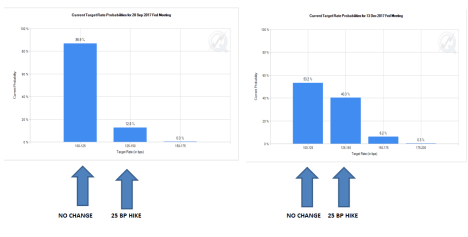
The Fed Funds futures are predicting a less than 15% chance of a rate hike in September, however. In fact, the Fed funds futures are handicapping a 50% chance of no more rate hikes this year.

Fed Funds probability CME

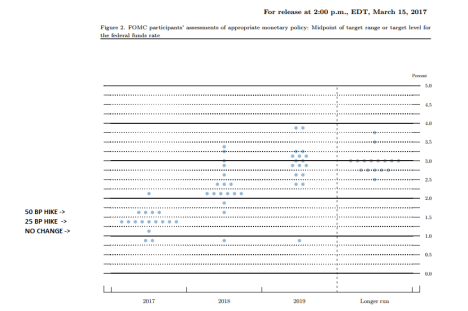
Compare the Fed Funds futures implied probability to the latest dot plot. The labels on the side show what each forecast is.

dot plot June 2017

Note that 14 out of the 17 FOMC members think the Fed is going to hike at least another 25 basis points this year. In fact, 4 out of 17 think that will be the case, while the market gives it about a 6% chance. There is a big disconnect happening between what the Fed is saying it will do and what the market thinks they will do. Not necessarily saying the Fed has a credibility problem, but the markets and the FOMC don’t seem to be on the same page.

In other economic data, initial jobless claims fell to 237k last week, which is more evidence that the labor market is strengthening into the summer months. The Philly Fed report showed continued strength in manufacturing, while the Empire State Manufacturing Survey picked up strength as well.

Industrial production was flat in May after a big upwardly-revised jump in April. Manufacturing production slipped 0.4%, while capacity utilization ticked down 0.1%. Big picture: April was a huge jump in all indices and May gave back a little.

The NAHB Housing Market Index slipped a little in May, but builder sentiment is still buoyant.

Wells is being sued for allegedly changing the terms of loans for customers in bankruptcy. They lowered the payments, but extended the term without the borrower’s knowledge, nor Court approval, the suit alleges. The stock is down slightly pre-open, more or less in line with the market.

Morning Report: Bond yields hit a 2017 low on weak data 6/14/17

Vital Statistics:

Last Change
S&P Futures 2440.8 2.8
Eurostoxx Index 390.4 1.7
Oil (WTI) 46.1 -0.4
US dollar index 87.9 -44.0
10 Year Govt Bond Yield 2.14%
Current Coupon Fannie Mae TBA 103.31
Current Coupon Ginnie Mae TBA 104.375
30 Year Fixed Rate Mortgage 3.95

Stocks are higher this morning ahead of the Fed decision. Bonds and MBS are up, with the 10 year hitting a 2017 low. That sound you hear this morning is the sizzle of bond bears getting roasted over the fire.

The Fed decision is scheduled to be released at 2:00 pm EST, and there will be a press conference as well. There could be some bond market volatility around that time, so be aware. Things to watch for: a move down in rate forecasts on the dot plot, and discussion about unwinding the balance sheet.

Mortgage Applications increased 2.8% last week as purchases fell 3% and refis rose 9%. The drop in purchase applications is largely due to technical adjustments to the index due to the Memorial Day holiday. Unadusted, the index was up 19% and is up 8% YOY. The refi percent increased to 45.4%, which was the highest since November. As home price appreciation continues, borrowers with sufficient equity should consider refinancing out of FHA into conventional to save on MI.

Lower energy prices moved inflation lower in May. The Consumer Price Index fell 0.1% last month and is up 1.9% on a YOY basis. Ex-food and energy, prices rose 0.1% and are up 1.7% YOY. These numbers were lower than street expectations.

Retail sales fell 0.3% MOM and are flat on a YOY basis. Lower gasoline prices, along with slower motor vehicle sales drove the drop. The core control group was flat, but April was revised upward from 0.2% to 0.6%. On a YOY basis, they were up 3.8%.

Brokers pretty much got decimated after the financial crisis, but they are coming back, slowly but surely. While subprime is a maybe 2% of what it was during the go-go days, the infrastructure is getting built back. One of the biggest challenges is finding brokers who remember how to do subprime loans.

Another big question regarding the mortgage market: Where are the boomerang buyers? The people who bought during the boom years, and were foreclosed on early in the bust are now seeing that foreclosure fall off their credit reports. So far, they have been slow to materialize, however high home prices, low affordability, and competition are playing a part.

Morning Report: Treasury releases its initial report on financial regulatory reform 6/13/17

Vital Statistics:

Last Change
S&P Futures 2431.8 5.3
Eurostoxx Index 388.7 2.1
Oil (WTI) 45.9 -0.2
US dollar index 88.4 -0.1
10 Year Govt Bond Yield 2.22%
Current Coupon Fannie Mae TBA 103.47
Current Coupon Ginnie Mae TBA 104.33
30 Year Fixed Rate Mortgage 3.93

Stocks are higher as the Fed begins its 2-day FOMC meeting. Bonds and MBS are down small.

Producer prices were flat last month on a MOM basis and are up 2.4% YOY. The core rate is up 2.1%, which is more or less in line with the Fed’s target. Note this index measures inflation at the wholesale level, not the consumer level which is what the Fed focuses on.

Small Business Optimism was flat in May and is still much higher post-election. Small businesses expect to make additional hires and increase capital spending, though earnings trends are still net negative. How about this? The net hiring activity (.34 workers per firm) is close to a 43 year high. The report shows that small businesses are increasing compensation to retain and attract workers, although finding quality, qualified workers is a problem – the second biggest one. Taxes and regulation were #1 and #3. A year ago, taxes and regulation were #1 and #2, with poor sales coming at #3. It looks like wage inflation is building at long last, which is exactly what the economy needs, although it will concern the Fed somewhat.

A better economy means lower delinquencies. 30-60 day DQs dropped down to 2000 levels, while LT DQs fell to a 10year low.

Last night the Trump Administration released its report on core principles for financial regulatory reform. Any changes to the regulatory system will be generally slow, as rule changes require comment periods and coordination between the different agencies. The Treasury Department principles don’t necessarily eliminate the Obama Administration’s regulatory regime, but they sand down some of the more sharp edges and attempt to eliminate some of the unintended consequences. Ultimately, ending regulation by enforcement action will go a long way towards increasing capital availability. Needless to say, Democrats are panning the report, however that could be just partisan boilerplate posturing. The need to ease the regulatory burden on small banks is a bipartisan view. Changing the Volcker rule regarding proprietary trading is a different animal, as are changes to CRA enforcement and the CFPB.

Speaking of regulation, iServe Chief Communications Officer Mike Macari and I penned an article for the California MBA discussing regulation and how it is inhibiting housing growth. When regulatory costs tack on an extra 30% to the price of a starter home, it is difficult to make that starter home affordable for someone in their 20s or early 30s. I have said it before: the difference between 2% GDP growth and 3% GDP growth (or the difference between a “meh” economy and a boom) is housing starts. Starts should be around 2 million per year, and we are barely half that. Home construction employs a lot of people and generates a lot of ancillary jobs as well.

Morning Report: NAR studies the drivers of the low homeownership rate 6/11/17

Vital Statistics

Last Change
S&P Futures 2426.3 -4.3
Eurostoxx Index 387.1 -3.3
Oil (WTI) 46.6 0.8
US dollar index 88.4 -0.1
10 Year Govt Bond Yield 2.21%
Current Coupon Fannie Mae TBA 103.47
Current Coupon Ginnie Mae TBA 104.33
30 Year Fixed Rate Mortgage 3.89

Stocks are lower this morning amidst a global tech stock sell-off led by Apple. Bonds and MBS are down a tick or two.

The big event this week will be the FOMC meeting which starts Tuesday. The announcement will come at 2:00 pm on Wednesday. The Fed Funds futures are pricing in a 96% chance of a 25 basis point hike in the Fed funds rate. We will also have a Bank of England and a Bank of Japan meeting this week.

Merrill Lynch is looking for the Fed to hike 25 basis points, but they think the focus of the press conference will be on balance sheet normalization. While there is the possibility that weak economic data on Wed morning (CPI and retail sales) could prevent the Fed from hiking that is a long shot. Merrill is also looking for the Fed to cheat down their inflation projection for 2017 to 1.7%, although they expect 2018 to be unchanged at 2%. They also note that inflows into bond funds have been elevated as bond bears throw in the towel on the Trump reflation trade.

A group called “Fed Up” which includes liberal economists like Joseph Stiglitz and even includes former Fed President Narayana Kochlerakota is urging the Fed to increase its inflation target from 2% to something higher. The group notes that fiscal policy is almost impossible in this political environment, so higher inflation could act as a buffer against recessions. They are also concerned that the Fed’s tightening could send the economy into a recession. Note that Barack Obama stacked the Fed with doves already, so if the Fed is reticent to do this now, it probably isn’t going to happen as Donald Trump starts replacing members.

Market strategists have been cheating down their end of year target rate for the 10 year bond yield, and it now stands at 2.7%, about 50 basis points higher than it is currently. The lowest forecast in the data set is 1.9%. China is prepared to buy more Treasuries to stabilize the yuan market, and developed market bond fund managers are finding relative value in Treasuries, which have sold off more than other developed countries.

The NAR wrote a white paper detailing the barriers to homeownership and many of the reasons are pretty well-known. The biggest constraints are tighter mortgage lending, student loan debt, affordability issues, and a lack of supply. They take a look at the QM and ATR rules and conclude that these rules are actually hurting mortgage availability when they were intended to ease the burden on lenders:

“Though each individual provision included in the new regulations that banks must adhere to may not cause much burden for lenders in isolation, the combined impact of the numerous regulatory changes generated a multiplicative effect that is contributing to an environment of extreme caution among mortgage lenders. One such regulation that contributes a number of strenuous lender requirements is the ability-to-repay rule, detailed in the Dodd Frank Act and enforced by the Consumer Financial Protection Bureau (CFPB). The rule stipulates that lenders must ensure that borrowers are able to make timely monthly payments. While the intention behind the rule is to ensure borrower credit-worthiness and avoid the worst abuses that led to the housing bubble, the rule essentially requires lenders to document every potential element of borrower risk, no matter how small. Effectively, many lenders are forced to document issues that have little to do with lending risk, simply to remain in compliance. Additionally, the rule makes the lender liable for issues that may cause a borrower to not repay a mortgage in the future, exposing lenders to potential future litigation, the risk, scale and cost of which are largely unknown”

The paper then goes on to look at other regulatory costs, and concludes that regulatory costs and uncertainties have combined to increase average credit scores, which is shutting many creditworthy borrowers out of the market because their loan circumstances don’t “fit inside the box.” I would add that the private label MBS market is still a shadow of its pre-crisis self, which means that these loans have to be retained on a bank’s or REITs balance sheet. This limits the available credit, however the most puzzling aspect is that a lot of lenders want to get into the non-QM business, but the demand for non-QM credit has been disappointingly small. People are ramping up the non-QM product, but the loans just haven’t been there yet.

Morning Report: Comey Day 6/8/17

Vital Statistics:

Last Change
S&P Futures 2434.5 2.5
Eurostoxx Index 389.4 0.2
Oil (WTI) 45.5 -0.3
US dollar index 88.2 0.2
10 Year Govt Bond Yield 2.19%
Current Coupon Fannie Mae TBA 103.47
Current Coupon Ginnie Mae TBA 104.33
30 Year Fixed Rate Mortgage 3.92

Stocks are up small after the ECB decision. Bonds and MBS are down.

James Comey testifies today at 12:30 pm EST. Here are his prepared remarks. Punch line: Nobody looks good in this situation, but nothing impeachable. There is a small chance that something could come out in questioning, but this should be a non market-moving event.

Initial Jobless Claims fell to 245k last week. Jobless claims are hovering around lows not seen for 45 years.

Bill Gross sees the bond market as fraught with risk – the worst since 2008 – but he says he feels required to stay invested. His concern is not necessarily risk within the financial system, but simply the prices people are willing to pay for risk. As he says, people are not buying low and selling high – they are buying high and crossing their fingers. His view is that central banks are behind this mindset, which has been a common objection for decades (remember the “Greenspan put?”). That said, the Fed is systematically removing that support, which should help risky asset prices normalize. Any sort of pullback in asset prices will inevitably be Treasury bullish, which means lower mortgage rates.

Meanwhile, Paul Singer of Elliott fame is very concerned about the current state of the market. He notes that the leverage in the system is higher than 2008. Yes, that is true, however the assets being leveraged today are much higher quality than they were a decade ago. Think of it this way: You borrow 95 cents on the dollar to buy a Treasury bond. Yes, you are leveraged, but the asset you hold is pretty low risk. Can you lose 5% on that asset? Maybe, but you probably won’t. In 2008, people were borrowing 90 cents on the dollar to buy MBS backed by no-doc pick-a-pay loans. Can you lose more than 10% on that asset? Easily. Which is a more risky trade? Yes, the leverage today is higher (95 cents on the dollar versus 90 cents on the dollar), however the underlying assets being leveraged are much safer. Note that Paul is a bit of a perma-bear who has hated the stock market since 1982.

Case in point: Over 9 million borrowers have regained equity in their homes since the 2008 crisis. Negative equity fell to 3.1 million homes, or about 6% of mortgaged properties. The biggest markets with negative equity? Miami, Las Vegas, and Chicago.

Higher home prices have begun to temper homebuyer bullishness, according to Fannie Mae’s Homebuyer Sentiment Index. The net number of people who believe now is a good time to buy fell 8 percentage points to a record low, while the number of people who believe now is a good time to sell hit a record as well.

The House is looking to reform the National Flood Insurance Program, which is heavily subsidized and currently running a $25 billion deficit. Reforming it will be tough without imposing sticker shock on many homeowners.

Morning Report: Financial reform looks to pass House 6/7/17

Vital Statistics:

Last Change
S&P Futures 2432.0 1.3
Eurostoxx Index 390.4 1.6
Oil (WTI) 47.7 -0.5
US dollar index 88.1 0.1
10 Year Govt Bond Yield 2.15%
Current Coupon Fannie Mae TBA 103.47
Current Coupon Ginnie Mae TBA 104.33
30 Year Fixed Rate Mortgage 3.92

Stocks are flat this morning on no real news. Bonds and MBS are up small.

Mortgage Applications increased 7.1% last week. There was an adjustment made for the Memorial Day holiday. Purchases rose 10% while refis increased 3%. Mortgage rates fell to the lowest levels since November, however the refi share of applications fell again to 42%.

HSBC is calling for a 1.9% 10 year yield by the end of the year. This call is well below the average Street consensus view of a 10 year yield around 2.7%. Given the fact that nothing much is changing between Trump and Obama policy-wise (at least as far as legislation that will be passed) that probably is the right call. That move will be good for mortgage origination activity, however it will generally be bad for banks which rely on a big spread between short-term rates and long-term rates. Given that the Fed does tend to follow the markets, it will be interesting to see if they continue on their plan of 3 hikes this year.

House Democrats look like they aren’t going to offer much in the way of resistance to the financial deregulation bill (the CHOICE act). The bill is expected to pass the House this week on a party line vote, but Democrats have chosen not to force their Wall Street friendly members to walk the plank for the banks. The bill will go to the Senate, where it will undoubtedly need 60 votes to pass and will be watered down. There is a good chance that something will pass, as there is a pretty much bipartisan consensus that Dodd-Frank imposed too big of a regulatory burden on smaller banks.

Gallup’s Job Creation Index ticked up to a record last week. In May, 46% of respondents said their company was hiring, a 1% uptick from April, while the number of respondents who said their company was laying off workers was steady at 9%. The East Coast is lagging the rest of the country, which makes sense in that it is the most levered the financial industry which has been going through a wrenching technologically-driven transformation over the past 20 years. In fact, states like Connecticut (which have historically funded the majority of their budget on taxes from Fairfield County) are having major issues as the tax receipts have fallen off a cliff. This helps explain why the Northeast real estate indices have lagged the rest of the country (especially if you strip out New York City).

Realtors reported low inventory as a major issue in the latest survey. Lender closing delays was also cited as a major issue.

Morning Report: Job openings hit a record high 6/6/17

Vital Statistics:

Last Change
S&P Futures 2428.3 -6.3
Eurostoxx Index 389.5 -2.6
Oil (WTI) 47.4 -0.1
US dollar index 88.1  
10 Year Govt Bond Yield 2.15%
Current Coupon Fannie Mae TBA 102.6
Current Coupon Ginnie Mae TBA 103.81
30 Year Fixed Rate Mortgage 3.9

Definitely a risk-off feel this morning as we head into the UK elections, James Comey’s testimony, and the ECB meeting later in the week. Bonds and MBS are up as we begin the Fed blackout period with the the 10 year bond yielding around 2.15%.

Job openings hit a record of 6 million, according to the JOLTs job openings survey. The quits rate was flat at 2.1%. The quits rate is the most important number in this report (every FOMC statement will reference it) as it is a harbinger for future wage growth. Overall, it shows that there is strong demand for employees, however there is still a mismatch between what employers want and what is available. The reservoir of the long-term unemployed will probably continue to keep a lid on wage growth, however we are seeing wage inflation in certain disciplines that are in low supply (mainly skilled labor).

The Trump reflation trade looks dead and the 10 year bond yield looks to be heading back to pre-election levels. If you look at a Fibonacci chart of the 10 year yield, pretty much all the support levels have been broken.

The death of the Trump Reflation Trade is affecting economic confidence as well, at least according to the Gallup US Economic Confidence Index. It is still well above pre-election levels and historical norms but it has given back a lot of the post-election froth. Trump is ready to pivot to infrastructure spending, and the Democrats have historically wanted to spend on infrastructure as well, however they philosophically don’t like the fact that much of this uses the private capital and prefer to use direct government spending on their priorities like mass transit. Given that mass transit is almost entirely a blue-state phenomenon, that is going to get very little interest from Red state Republicans. Maybe there is some common ground, but it is going to hard to find.

Case in point: Many want to see high speed rail in the US. Fine, but when airlines are offering $50 fares, it is going to be impossible to compete. Note that Donald Trump proposed to privatize air traffic control, in order to get private capital to spend the money to update the system.

Home prices rose 6.9% last month according to the CoreLogic Home Price Index. Rents increased 3%. Scarcity remains the biggest issue driving home price appreciation, as lower mortgage rates have fed a buying frenzy. The West continues to lead the charge.

Despite the Fed rate hikes, financial conditions are the loosest in 3 years. Definitely a disconnect is going on between Fed intentions and actual market behavior.

Regulatory reform is probably going to be smaller for the financial sector than imagined. After spending billions to come into compliance with Dodd Frank, banks are loath to see a new regulatory regime.

Morning Report: Productivity flat 6/5/17

Vital Statistics:

Last Change
S&P Futures 2435.8 -2.0
Eurostoxx Index 391.8 -0.7
Oil (WTI) 47.1 -0.5
US dollar index 88.3  
10 Year Govt Bond Yield 2.18%
Current Coupon Fannie Mae TBA 102.6
Current Coupon Ginnie Mae TBA 103.81
30 Year Fixed Rate Mortgage 3.9

Stocks are lower this morning after we saw terror attacks in London. Bonds and MBS are down as well.

Four nations over the weekend cut diplomatic ties with Qatar, one of the Middle East’s biggest financial centers. The issue is over political interference, terrorism, and ties with Iran. Oil is selling off on the news.

The week after the jobs report is generally data-light and that is the case this week as well. We are entering the blackout period for the Fed ahead of the FOMC meeting, which means no Fed-speak either. Should be a relatively calm week.

Nonfarm productivity was flat in the first quarter as unit labor costs rose 2.2%. Productivity is the biggest driver of wage increases (because it is generally non-inflationary) and the lack of productivity has been a big reason why wages have been going nowhere for the past 10 years.

Factory orders fell 0.2% last month, despite strength from aircraft orders. The ISM services index came in at a strong 56.9, just missing Street expectations.

The Fed Funds futures are now pricing in a 96% chance of a rate hike next week. The implied probability of rate hikes continues to increase as the yield curve flattens. This means the long end of the curve (which is the biggest influence on mortgage rates) is sanguine about the economy and the risk of inflation.

How regulation is impacting the supply of starter homes by increasing the cost to build them. In the DC area, about $75 of the price of a new home is driven by government mandates. Meanwhile, D.R. Horton is in a bidding war for Austin Texas based Forestar.

Morning Report: Jobs report misses and rates fall 6/2/17

Vital Statistics:

Last Change
S&P Futures 2434.3 4.8
Eurostoxx Index 394.3 2.6
Oil (WTI) 47.4 -1.0
US dollar index 88.5  
10 Year Govt Bond Yield 2.16%
Current Coupon Fannie Mae TBA 103.33
Current Coupon Ginnie Mae TBA 104.25
30 Year Fixed Rate Mortgage 3.94

Stocks are up this morning despite a miss on the jobs report. Bonds and MBS are up.

Jobs report data dump:

  • Nonfarm payrolls up 138k
  • Unemployment rate 4.3%
  • Employment to population ratio 60%
  • Labor force participation rate 62.7%
  • Average hourly earnings up 2.5% YOY
  • Average workweek 34.4 hours

The payroll number was a big miss from the 185k expectation, and differs wildly from the ADP payroll number yesterday of 253k. Yet another instance where the ADP number and the official BLS number aren’t even close to each other. Yes, the ADP number is meant to track the final revised BLS number, so it is possible that the BLS payroll number gets revised upward in the next two months. The labor force participation rate fell to 62.7% from 62.9% which was a disappointment as well. The unemployment rate fell to 4.3%, which is a 16 year low. The labor force shrunk by 430k people, while the number of people employed fell by 233k. The overall population increased by 180k. The two numbers the Fed pays the most attention to (employment / population ratio and hourly earnings) are certainly not pointing to any sort of inflation acceleration.

Despite the payroll number, the Fed Funds futures increased their probability of a June hike to 93%. The 10 year continues to rally, and we are at the lowest yields since early November. The Trump reflation trade continues to deflate, at least as far as bonds are concerned.

Construction spending continued its zigzag pattern, falling 1.4% MOM but increasing 6.7% YOY. Residential construction fell on a MOM basis but is up 16% YOY. Public residential construction fell.

The ISM Manufacturing Index ticked up last month, led by increases in new orders, production, and employment. The prices index fell by a lot, however which again shows the lack of inflationary pressures in the supply chain. The current levels so far in the PMI index correlates with a historical GDP growth rate of around 4%. While manufacturing isn’t the driver of the economy it used to be, it still matters.

Announced job cuts at Ford pushed up the Challenger job cuts number, but otherwise job cuts are largely small.

Donald Trump announced he will pull the US out of the Paris Accord yesterday. This will take years, so in the meantime expect no effects on oil prices or the economy.

Investment bank Moelis, along with Blackstone and Paulson fund management have reportedly put out a detailed blueprint to bring the GSEs out from under government control. Treasury Secretary Mnuchin as well as the MBA are cool to the idea, because existing stockholders will benefit, when in reality they would have been wiped out back when the GSEs went under conservatorship.

Home sizes are shrinking for the first time since 2009. This is mainly due to a change in the hombuilder mix. Post-crisis, the only segment of the homebuilding market that was working was the luxury end. Now, starter homes are becoming the focus, which is dragging average sizes lower. Home sizes are still larger than the bubble peaks were.

Small business lending fell in April.