Morning Report: Decent jobs report 7/7/17

Vital Statistics:

Last Change
S&P Futures 2415.8 7.3
Eurostoxx Index 379.5 -0.9
Oil (WTI) 44.6 -0.9
US dollar index 88.3 0.1
10 Year Govt Bond Yield 2.38%
Current Coupon Fannie Mae TBA 102.88
Current Coupon Ginnie Mae TBA 103.75
30 Year Fixed Rate Mortgage 4.06

Stocks are higher this morning after a decent jobs report. Bonds and MBS are down.

Jobs report data dump:

  • Nonfarm payrolls up 222,000
  • Unemployment rate 4.4%
  • Labor Force Participation rate 62.8%
  • Avg weekly earnings up .2% MOM and 2.5% YOY

Overall, it is a decent report. The payroll number was a bit higher than expectations. The wage numbers are certainly nothing to get the Fed worried about inflation, although we still aren’t making much headway on bringing the long-term unemployed back into the labor force. Bringing those folks back into the workforce is the key (along with improving housing construction) to improving the economy from “meh” to “boom.”

The bifurcation in the employment market between those with jobs and those without is evident in what recruiters are saying: It is the hottest market in memory for some headhunters and things are definitely candidate-driven. Companies have been loath to give raises for over a decade, but they may be forced to in order to attract / retain talent.

Ray Dalio and Jeffrey Gundlach believe the top is in for the bond market (in other words, rates are going higher) and that stocks are vulnerable. Being short bonds is probably one of the biggest fast-money / wiseguy trade on the Street right now. Note however that notwithstanding the pop in yields over the past week or so, most of these guys are lugging a losing position.

Federal Reserve Governor Jerome Powell called the current US housing system unsustainable, and pointed directly at Fannie and Fred. Here is the problem: US mortgage rates are artificially low, and that is due to government subsidies. The 30 year fixed rate mortgage is a distinctly American phenomenon. In the US, the taxpayer bears the credit risk and the lender bears the interest rate risk. Loans are guaranteed by the government, which means the lender gets paid even if the borrower stops paying. The 30 year fixed rate means the borrower has no interest rate risk – it doesn’t matter where rates go, their rate stays the same. Everywhere else, the lender bears the credit risk and the borrower bears the interest rate risk (because everywhere else the rate floats with interest rates after a certain time period). Without the government backing, no lender would make loans at the rates Fannie and Fred can offer. His point is that real estate prices are based on subsidized borrowing rates and that makes the real estate market more susceptible to downdrafts. Nothing is going to change however – the US residential real estate finance market has been largely the same since the New Deal and there really is no replacement for it. Just remember this any time someone blames 2008 on the “free market.” There is nothing, absolutely nothing “free market” about the US residential real estate market. There hasn’t been since the Great Depression.

Morning Report: Balance sheet normalization this year 7/6/17

Vital Statistics:

Last Change
S&P Futures 2419.3 -8.8
Eurostoxx Index 379.0 -4.0
Oil (WTI) 45.9 0.7
US dollar index 88.3 0.1
10 Year Govt Bond Yield 2.37%
Current Coupon Fannie Mae TBA 102.88
Current Coupon Ginnie Mae TBA 103.75
30 Year Fixed Rate Mortgage 4.06

Stocks are down this morning along with overseas markets. Bonds and MBS are down as European bond markets sell off.

The German Bund is getting whacked this morning after a lousy French auction and is up 10 basis points in yield to 55 bps. The Bund yield is at the highest level since early 2016, and this is pulling yields higher globally.

The FOMC minutes didn’t reveal anything market-moving. The Fed still plans to raise interest rates gradually, and there is some disagreement between members over when and how to begin balance sheet normalization (which is their term for letting bonds mature and not re-investing the proceeds). It looks like they will gradually reduce reinvestment activity, not stop all at once. The proposed idea would be to reduce reinvestment of Treasuries by $6 billion a month and increase that in increments of $6 billion every 3 months until they hit $30 billion. For MBS, it will be $4 billion a month, increasing in $4 billion increments every 3 months until they hit $20 billion a month. The FOMC members were divided over timing, with some wanting to move in Q3, while others want to begin in Q4.

The September Fed Funds futures didn’t move in response to the minutes, but the December futures did move more towards a higher probability of a rate hike. December is pricing in a 42% chance of no changes, a 47% chance of a 25 bp hike and a 10% chance of a 50 bp hike.

The overall economic outlook was positive, however residential investment “appeared to be slowing after increasing briskly in the first quarter.” The Fed suspects that weather, along with homebuyers getting ahead of expected interest rate increases drove the bump in Q1. The staff also noted that the market seems to be handicapping a smaller chance of fiscal expansion.

Mortgage Applications increased 1.4% last week as purchases 3% and refis fell 0.4%. The refi share continues to decline and the ARM share is ticking up slightly, however it is still in the single digits.

The ADP payrolls number came in lower than expected, at 158,000 versus expectations of 180,000. The consensus for tomorrow’s payroll number is 170,000. Note that lately the ADP number has been a lousy predictor of the BLS numbers.

Employers are hanging on to their employees, according the Challenger and Gray Job Cuts report. While job cuts continue in retail, overall they remain low, at 31k. Note that these numbers come from press releases, where companies announce job cuts they expect to make. They aren’t actual job cuts. Meanwhile, initial jobless claims ticked up slightly to 248k.

Redfin has filed for an IPO. For those keeping score, Blue Apron has been an unmitigated disaster, trading at $8.31 a share after going public last week at $10.

Morning Report: Fed minutes this afternoon 7/5/17

Vital Statistics:

Last Change
S&P Futures 2421.5 1.5
Eurostoxx Index 379.4 -1.3
Oil (WTI) 46.3 1.4
US dollar index 87.7 0.1
10 Year Govt Bond Yield 2.30%
Current Coupon Fannie Mae TBA 102.88
Current Coupon Ginnie Mae TBA 103.75
30 Year Fixed Rate Mortgage 4

Stocks are up small after the long weekend. Bonds and MBS are down.

At 2:00 pm we will get the minutes from the June FOMC meeting. There is the always the possibility of market movement from these things, so just be aware. Here are the things the markets will be looking for.

Construction spending was flat MOM in May and up 4.5% YOY. Private residential construction was up 11% YOY.

Manufacturing continues to accelerate, according the ISM PMI report, which hit a 3 year high. The index level would historically correspond with a 4.6% increase in GDP. The average for the first half of the year would correspond to a 4.1% increase in GDP. Of course manufacturing doesn’t have the share of GDP it used to, but it is a good indication that things are getting better.

Bond yields have been backing up, largely on overseas events. Bonds in Europe are selling off and dragging US yields higher on the relative value trade. The current projections for the upcoming FOMC meetings have become slightly more in favor of rate hikes, but we are still looking at no change at the July meeting, and only a 18% chance of a hike in September. The markets are also looking to the September meeting for more clarity regarding balance sheet reduction.

Home Price appreciation continues to accelerate, as the CoreLogic home price index rose 1.2% MOM and is up 6.6% YOY. Rental inflation rose 3.1%, so the increase in home prices is a bit of a double-edged sword. Those who already own homes are getting the benefit of home price appreciation while the first time homebuyer is squeezed.

Upcoming changes that will affect mortgage credit. Tax liens and civil judgements will be expunged from credit reports, which could amount to a 20 point increase in FICOs for some people. Second, Fannie Mae is increasing the DTI ratio from 45 to 50 in order to take into account high levels of student loan debt.

HUD is recommending that Fannie Mae tweak upward its affordable housing goals for 2018-2020. Most goals are unchanged, but a couple were pushed up slightly.

Morning Report: Blue Apron IPO demonstrates shift on Wall Street 6/30/17

Vital Statistics:

Last Change
S&P Futures 2423.5 3.8
Eurostoxx Index 382.0 1.3
Oil (WTI) 45.2 0.2
US dollar index 87.8 0.1
10 Year Govt Bond Yield 2.28%
Current Coupon Fannie Mae TBA 102.88
Current Coupon Ginnie Mae TBA 103.75
30 Year Fixed Rate Mortgage 4

Stocks are higher this morning after yesterday’s bloodbath. Bonds and MBS are down as well.

Should be a relatively quiet day ahead of the July 4 weekend. Expect liquidity to dry up in the bond market as most of the Street will be on the LIE by noon.

Consumer sentiment increased in June, according to the University of Michigan survey, while the Chicago PMI also jumped.

Personal incomes rose 0.4% in May, while spending rose 0.1%. Inflation remained muted as the core PCE index (the preferred inflation measurement for the Fed) rose 0.1% MOM and 1.4% YOY. The increased spending was driven primarily by utility spending, so it isn’t that great of an indicator for the economy going forward. The savings rate increased to 5.5%, and has rebounded from the lows of the bubble years. The increase in the savings rate represents the de-leveraging of the American consumer, which does depress GDP in the near term.

Regulatory issues are restricting mortgage credit, according to Treasury. This is causing people at the lower end of the credit spectrum to be shut out of the mortgage market. The recommendations largely involve clarifying QM and TRID rules to make them less uncertain, which drives risk-averse behavior out of lenders. They also propose a moratorium on new servicing rules. They also recommend revising or repealing the residential mortgage risk retention requirement, which has more or less shut down the private label MBS market. The goal of this is to (a) increase credit, and (b) draw private capital into the market. As of now, the US taxpayer bears pretty much all of the credit risk of new origination.

Unicredito Bank’s Chief Economists sees the US unemployment rate falling to 3%. If you believe the Phillips Curve, that level should trigger inflation, however we have so much slack in the labor market with the long-term unemployed we still might not see much wage inflation. Janet Yellen has already said the Fed is willing to let the employment market “run hot.” At any rate, the Fed is just moving from “ultra-accommodative” to simply “accommodative.”

Blue Apron priced its IPO at the lower end of its reduced range and broke price (i.e traded lower than the IPO price) in the aftermarket. Old-timers might remember the days when something like that was a huge embarrassment for the issuing bank. For the most part, getting in on a IPO typically meant at least a 20% pop on the first day of trading. The behavior of APRN represents the change in the landscape in investment banking over the past 20 years. 20 years ago, IPOs were priced that way in order to reward the buy side for their trading business. Since issuers used investment banking services only sporadically, and the investment banks dealt with the big mutual funds every day, the banks were more concerned with making sure that the buy side was happy and therefore under-priced IPOs (which means the issuer was leaving money on the table). Fast forward 20 years, and trading commissions are now 5% – 10% of what they used to be. Nowadays the banks are more worried about keeping the issuers happy, which means IPOs are no longer underpriced. Which is why IPOs are no longer the free money trade they used to be.

Morning Report: Bond Yields rise on hawkish central bankers 6/29/17

Vital Statistics:

Last Change
S&P Futures 2443.8 5.0
Eurostoxx Index 384.9 -0.9
Oil (WTI) 45.3 -5.4
US dollar index 87.9 -0.1
10 Year Govt Bond Yield 2.27%
Current Coupon Fannie Mae TBA 103
Current Coupon Ginnie Mae TBA 103.81
30 Year Fixed Rate Mortgage 3.91

Stocks are higher this morning after the big banks announced increases in dividends and buybacks in response to passing their stress tests. Bonds and MBS are down after hawkish comments from central bankers globally.

In the past few days, the Bank of England, the Bank of Canada, and the ECB have warned that short term rates are heading higher. This has sent the 10 year bond yield up over 10 basis points, and has really clobbered the German Bund, which now yields 44 basis points. The Fed Funds futures have tweaked their assessments of the September and December meetings, with the markets now handicapping a 18% chance of a Sep hike (up from 12%) and a 57% chance of a hike in December (up from 50%).

The third and final revision to first quarter GDP came in at 1.4%, an upward revision of 0.2%, as personal consumption was revised upward from 0.6% to 1.1%. The inflation indicator fell from 2.2% to 1.9%. Know what bumped up the consumption numbers? RVs. If it weren’t for Winnebagos, GDP would have grown less than 1%.

Initial Jobless Claims ticked up slightly to 244k, while corporate profits were up 12% YOY.

The head of the NYSE thinks short sellers are “icky” You want icky? Here’s icky.

Good info: 15 money-saving tips for first time homebuyers. Also questions any homebuyer should ask the seller before taking the plunge.

Hottest real estate markets in June 2017. Mainly the usual suspects, but there are signs of life in the Rust Belt: Columbus OH is #5 and Detroit is #6.

Morning Report: Pending Home Sales fall 6/28/17

Vital Statistics:

Last Change
S&P Futures 2424.0 3.5
Eurostoxx Index 384.6 -1.4
Oil (WTI) 44.1 -0.2
US dollar index 88.3 0.0
10 Year Govt Bond Yield 2.21%
Current Coupon Fannie Mae TBA 103
Current Coupon Ginnie Mae TBA 103.81
30 Year Fixed Rate Mortgage 3.91

Stocks are up this morning after the ECB said that they will continue to stimulate the economy. Bonds and MBS are down

Last week was bad for mortgages as applications fell 6%. Purchases were down 4% and refis were down 9%. The index was up 10% from a year ago, however. The refi share fell a point to 45.6%. Note that applications have an income skew: starter home buyers are still aggressive, while it is the jumbo space that is taking a breather.

Pending Home Sales fell 0.8% in May, which was the third consecutive monthly decline. Lawrence Yun, NAR chief economist, says it’s clear the critically low inventory levels in much of the country somewhat sidetracked the housing market this spring. “Monthly closings have recently been oscillating back and forth, but this third consecutive decline in contract activity implies a possible topping off in sales,” he said. “Buyer interest is solid, but there is just not enough supply to satisfy demand. Prospective buyers are being sidelined by both limited choices and home prices that are climbing too fast.”

As demand for mortgages falls and competition increases, lenders are looking to ease lending standards to capture business, according to the latest Fannie Mae Lender Sentiment Survey. The net share of lenders reporting demand growth fell to a 2 year low, while the number of lenders who expect to ease standards rose to a 2 year high.

More on inventory woes. Trulia found that over the past year, the inventory of starter homes has fallen by 16%. The inventory of move-up homes has fallen by 13%, and the number of luxury homes has fallen by 3.9%. Inventory is so tight in California that only 25% of the homes for sale remain on the market for over 2 months. Trulia’s recommendation to buyers: Move fast, make multiple offers, and be willing to adjust to the seller’s timetable.

Redifin looked at 11 metro areas and found that 33% of the people who bought a home in the past year made an offer without visiting the property. Note to LOs who are worried about rates: Only 5% of the respondents said they would cancel their purchases if mortgage rates topped 5%. The metro areas were Baltimore, Boston, Chicago, Dallas-Fort Worth, Denver, Los Angeles, Portland, San Diego, San Francisco, Seattle and Washington, D.C.

A new ransomware attack is hitting Europe. It is similar to the Wanna Cry attack a few months ago. So far it has not been reported in the US, but it has hit big European companies like advertising giant WPP and shipper Maersk, which has shut down shipping terminals worldwide. The cost to decrypt your machine is $300 in bitcoin. Obviously don’t open suspicious attachments – and also note that the hackers are getting better and better at disguising these attachments. For example, an email might appear to be coming from a vendor you work with frequently, but if you check the actual email address it is clear that it isn’t actually from that vendor.

Separately, it is good news the hackers are asking for a fixed dollar value of Bitcoin, since is has been on a tear the past couple of months.

Janet Yellen said that another 2008 style crisis is not likely in our lifetimes. While she attributes that to regulation and increased capital, the real reason is that only residential real estate bubbles cause this sort crisis. Residential real estate bubbles are the Hurricane Katrinas of banking and economics, and they really only come around ever few generations. That said, we will undoubtedly see another 2008 style financial crisis – it just won’t be in the US. China has an immense real estate bubble and is trying to find a way to deflate it slowly. Canada has one as well, although it is probably tied pretty closely to Chinese money.

MBA head Dave Stevens and ex-FHFA head Ed DeMarco will testify in front of the Senate today on housing reform.

Morning Report: Seattle home prices up 13% 6/27/17

Vital Statistics:

Last Change
S&P Futures 2433.8 -2.3
Eurostoxx Index 386.3 -2.7
Oil (WTI) 44.0 0.6
US dollar index 88.4 -0.3
10 Year Govt Bond Yield 2.17%
Current Coupon Fannie Mae TBA 103.31
Current Coupon Ginnie Mae TBA 104.375
30 Year Fixed Rate Mortgage 3.91

Stocks and bonds are lower this morning as we have a lot of central bankers speaking today.

Home prices rose .5% in April and are up 5.7% YOY, according to the Case-Shiller Home Price Index. Seattle home prices rose almost 13%, while Portland and Dallas rose over 9%. They ask the question whether we are in another bubble, which we are not. Bubbles are fundamentally psychological phenomenons, where both investors and lenders view an asset as “special” and argue that it cannot fall in price. While home prices may be reaching unsustainable levels, the lending side of the business is emphatically not exhibiting bubble-like behavior. Credit is still tight for anything that doesn’t fit in the government / GSE box. In fact, the government would like lenders to take more risk than they are willing to take at the moment.

Consumer confidence rose in June, while the Richmond Fed Manufacturing index improved.

Fannie Mae’s latest Housing Outlook is out, and they are predicting 2% GDP growth for 2017. For Q2, they are forecasting 2.9%. Housing will continue to be held back by labor and land shortages, however mortgage rates will remain supportive of the housing market in general.

Senators Bob Corker and Mark Warner are working on a plan to break the Fannie / Freddie duopoly. The plan would split the single-family and multi-family lines and break the single family up into more independent firms. The broad guidelines are to increase competition, reduce barriers to entry, reduce risk to the taxpayer, and to maintain the 30 year fixed rate mortgage. The most difficult part will be dealing with low-to-moderate income support, where there are genuine philosophical differences between Republicans and Democrats.

The bloom is off the rose for the post-election surge in confidence, according to Gallup. The economic confidence index stayed at 3 last week, off of its March high of 15, but still above the pre-election level of -11. Much of this breaks down along partisan lines, with Democratic voters the most gloomy about the economy and Republican voters most confident. Before the election, this dynamic was reversed – with Democrats optimistic and Republicans pessimistic.

Morning Report: Inflation-adjusted home prices throughout the years 6/26/17

Vital Statistics:

Last Change
S&P Futures 2442.5 7.5
Eurostoxx Index 390.7 3.1
Oil (WTI) 43.1 0.1
US dollar index 88.7 0.1
10 Year Govt Bond Yield 2.15%
Current Coupon Fannie Mae TBA 103.31
Current Coupon Ginnie Mae TBA 104.375
30 Year Fixed Rate Mortgage 3.91

Stocks are higher this morning on good economic news overseas. Bonds and MBS are flat.

Not a lot of important data this week, although we will have a lot of Fed-speak tomorrow. Personal Income and Personal Spending on Friday will be the biggest event.

Durable Goods orders fell 1.1% last month, as aircraft orders (which are notoriously volatile) fell again. Ex transportation, they were up .1% MOM and 5.5% YOY. Capital Goods orders (which is a proxy for capital expenditures) fell .1% MOM and is up 5% YOY.

Economic Growth slowed in May, according to the Chicago Fed National Activity Index. This looks like a bit of a reversal from a strong April reading. Production indicators drove the decrease, while employment and housing contributed.

The recent rally in the markets could provide another justification for rate hikes, according to NY Fed President William Dudley. “When financial conditions ease, as has been the case recently, this can provide additional impetus for the decision to continue to remove monetary policy accommodation.”

Note the language “remove monetary policy accommodation.” To the Fed, they are still stimulating the economy, and they are dialing back that accommodation, not tightening in the classic sense.

On an inflation-adjusted basis, home prices have been outstripping inflation for decades. In the 1940s, the median house price (inflation adjusted to 2000 dollars) was $30,600. The median home price in 2000 was almost 200k, inflation adjusted. If you look at non-inflation adjusted numbers, the median home price in 2000 was $2938, and the median income was $956, making the median house price to median income ratio 3.07x. Generally speaking, that ratio is in the 3.1x – 3.6x range historically. It did peak at 4.8x in 2005, and we are back to elevated levels again.

Speaking of inflation, while things like healthcare, college tuition have outstripped inflation, technology has driven it lower. Check out this Radio Shack Flyer from 1991. Everything on that page cost over $3,200 and all that functionality can now be found on your smartphone. (Yes, even the CB can be monitored via browser). Here is what your phone may be able to do in 10 years.

radio shack

Delinquent GSE mortgages are at the lowest level since 2008. DQ GSE loans were 1%, while DQ FHA loans were 4%. DQs overall were 2.8%.

Morning Report: New Home Sales beat expectations 6/23/17

Vital Statistics:

Last Change
S&P Futures 2433.0 1.3
Eurostoxx Index 387.2 -1.3
Oil (WTI) 42.9 0.1
US dollar index 88.7 -0.1
10 Year Govt Bond Yield 2.15%
Current Coupon Fannie Mae TBA 103.31
Current Coupon Ginnie Mae TBA 104.375
30 Year Fixed Rate Mortgage 3.92

Stocks are flattish after the Fed gave a clean bill of health to the banks it stress-tested. Bonds and MBS are up small.

One year ago today, the UK voted to leave the EU, which ignited a big rally in the bond market and pushed the 10 year down to a 1.37% yield.

New Home Sales ticked up in May to a seasonally adjusted pace of 610k. This was up 2.9% MOM and 8.9% YOY.  The median new home sales price was $345,800 and the average price was $406,400. There are 268,000 new homes for sale at the moment. The 610k print was pretty much the average for the US from 1965-1995. New home sales peaked at over 1.3 million during the bubble years, but we are still a long way from normalcy, given population growth and obsolescence.

new home sales fred

34 systemically important banks passed their stress tests yesterday. The banks are getting better at passing these exams, and the sense is that the Trump Administration will nominate someone to the Fed who will dial back these exams a bit. Next week, the Fed will release its comprehensive capital review, which will determine whether the big banks can increase their dividends or buy back stock.

Here is a good way to determine how tight a local housing market is: compare the ratio of new jobs to new building permits. In the Bay Area, that ratio is 6.4x: over the past 5 years, that MSA has added 373,000 new jobs, but has issued permits for only 58,000 new units. Lack of land, along with regulatory issues are holding back building there. In less constrained MSAs (both land and regulation) like Houston, the ratio is 1.3x. For the whole US, the country added just about 2.2 million jobs in 2016 and building permits totaled about 1.2 million, or a ratio of 1.8x.

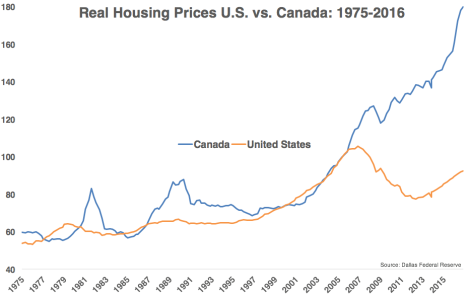
The Canadian housing bubble continues to defy gravity, but the signs are there that its days are probably numbered. Warren Buffet took a 38% stake in troubled Canadian lender Home Capital and agreed to provide a $2 billion line. You can see from the chart below how far the Canadian bubble has exceeded the US one: Note that these are inflation-adjusted indices which is why US prices appear to have not recouped the losses from the bubble years. They have on a nominal basis, but not an inflation-adjusted basis.

canada real estate

The current median house price in Canada is about 520k and the median income is about 76k, putting the median house price to median income ratio at 6.8x. The US ratio peaked at 4.8x, which gives you some idea of how far prices have gone up North. Once the bubble bursts, it is bound to have some knock-on effects in the US, especially at the high end of the market which is probably more linked to China’s bubble than people care to admit.

The US Government has recommended that the new benchmark short term rate become the Treasury repo rate instead of LIBOR, which is subject to manipulation (as we saw in the UK). Not sure how this will affect current adjustable rate mortgages, but new ones will probably lose LIBOR and will use constant maturity treasuries or some alternative index.

Morning Report: Home price appreciation is accelerating 6/22/17

Vital Statistics:

Last Change
S&P Futures 2431.8 -1.8
Eurostoxx Index 387.6 -0.9
Oil (WTI) 42.9 0.4
US dollar index 88.8 -0.1
10 Year Govt Bond Yield 2.15%
Current Coupon Fannie Mae TBA 103.31
Current Coupon Ginnie Mae TBA 104.375
30 Year Fixed Rate Mortgage 3.92

Stocks are lower this morning as oil turns into a bear market. Bonds and MBS are up small.

Initial Jobless Claims rose 3000 last week to 241k, while the index of leading economic indicators rose again. The LEI report noted that pretty much everything is improving, except for housing and the manufacturing workweek.

Home Prices rose 0.7% in April, according to the FHFA House Price Index. On a YOY basis, they are up 6.8%. As inventory gets tighter, price increases are accelerating, which is a problem as house prices are now pretty stretched versus incomes. The West Coast is still experiencing close to double digit growth, while home price inflation in the Upper Midwest and Northeast lag the rest of the country.

Some Trump advisors are recommending that Janet Yellen be replaced when her term ends in February. Yellen is a dove, and Trump recently seemed to reverse his pre-election view on interest rates. As a general rule, politicians love dovish Feds, so this is unsurprising. Treasury Secretary Mnuchin says Trump “hasn’t given this much thought” since it is so far away. Among the other names being mentioned include Stanford’s John Taylor, Columbia’s Glenn Hubbard, and former Fed governor Kevin Warsh.

As rates have fallen, prepayment speeds have increased, which is generally good news for originators, but bad news for those who own servicing. Delinquencies have reversed their calendar-driven April rise as well, according to Black Knight Financial Services. In fact, loans 90 days down or in foreclosure hit a 10 year low.

The average closing rate for a mortgage inched up in May, according to the Ellie Mae Origination Insight Report. The typical FICO rose a point to 723, with an 80 LTV. The closing rate hit 70.4%.

What are the priorities for the MBA in the upcoming year?  Removing regulatory barriers to housing, GSE reform, GNMA servicing, and much more.