Morning Report: Existing Home Sales fall 8/24/17

Vital Statistics:

Last Change
S&P Futures 2447.0 5.5
Eurostoxx Index 375.8 1.8
Oil (WTI) 47.7 0.3
US dollar index 86.1 0.1
10 Year Govt Bond Yield 2.19%
Current Coupon Fannie Mae TBA 103.09
Current Coupon Ginnie Mae TBA 103.97
30 Year Fixed Rate Mortgage 3.89

Stocks are higher this morning on no real news. Bonds and MBS are flat.

Today starts the Fed conference in Jackson Hole. No major speeches are planned for today, however Janet Yellen speaks tomorrow. There is the possibility of some volatility around then. The big question will be whether Yellen is nominated for another term or will she be replaced when her term expires next year. National Economic Council Chairman Gary Cohn is the name most mentioned as a replacement. Donald Trump criticized the Fed’s low interest rate policy while on the campaign trail, but it will be interesting to see if he nominates a hawk. Most politicians prefer doves when push comes to shove.

Initial Jobless Claims fell to 234k last week. The labor market remains strong as companies hang on to their workers.

Existing home sales fell 1.3% in July, according to NAR. This is up 2.1% YOY, but is the lowest number of 2017. Lawrence Yun, NAR chief economist, says the second half of the year got off on a somewhat sour note as existing sales in July inched backward. “Buyer interest in most of the country has held up strongly this summer and homes are selling fast, but the negative effect of not enough inventory to choose from and its pressure on overall affordability put the brakes on what should’ve been a higher sales pace,” he said. “Contract activity has mostly trended downward since February and ultimately put a large dent on closings last month.” The median house price was $258,300 which is up 6.2% YOY. Unsold inventory is down to 4.2 month’s worth, from 4.8 months a year ago.

What are the most active real estate markets right now? Colorado Springs, Chicago, and Reno. Least active? San Francisco, where the average house price is now over a million. Much of the Northeast is cold as well. What makes a market active? Access to both good jobs and affordable homes.

Big money managers are swapping corporate debt for mortgage backed securities, particularly subprime MBS from before the crisis. Corporate debt simply got too expensive, and MBS got too cheap. The supply of subprime MBS has been shrinking however as loans get paid off, and non-agency MBS outstanding are about 25% of what they used to be. For fixed income managers, MBS have outperformed most everything this year. The appetite for MBS paper is encouraging, as it would open up the origination business to more outside-the-box product and allow credit to be extended to borrowers who have been more or less shut out of the market post-crisis.

A reduction in the mortgage interest deduction is on the table as part of tax reform. The talk is that the cap would drop from $1 million to $600k or so. Toll Brothers CEO Doug Yearley said reducing the MID would be bad policy and would discourage homeownership. Of course Toll is in the McMansion business, so he is talking his book a little. Bob Shiller thinks the effect would be de minimus as it would only affect something like 4% of taxpayers.

Morning Report: Are we headed into a recession?

Vital Statistics:

Last Change
S&P Futures 2443.0 -9.8
Eurostoxx Index 374.4 -1.5
Oil (WTI) 47.7 0.3
US dollar index 86.1 0.3
10 Year Govt Bond Yield 2.20%
Current Coupon Fannie Mae TBA 103.09
Current Coupon Ginnie Mae TBA 103.97
30 Year Fixed Rate Mortgage 3.89

Stocks are lower this morning after Donald Trump threatened to shut down the government over a wall. Bonds and MBS are up small.

Mortgage Applications dipped half a percent last week as purchases fell 2% and refis rose 0.3%. The average rate on a 30 year fixed was unchanged, while jumbos dropped 5 basis points. Mortgage rates are back at the lows of November 2016.

New Home Sales slipped to 571,000 in July, which was lower than expectations.

For all the talk about Millennials wanting to stay in cities, many are beginning to move to the suburbs. I guess it was only a matter of time. That age cohort is now the biggest group in the housing market. They are starting later than previous generations, however and the median age for a first time homebuyer is 33, which has been inching upward for decades. So, for all the handwringing articles about this generation being reluctant to buy houses, it turns out that they are pretty much like every generation before them: preferring to live in urban areas until they get married and have kids. That said, they are largely renters for the moment, as a combination of a dearth of starter homes and high student loan debt keeps them from buying. Eventually builders will realize there is an opportunity in starter homes, but as of now they are remaining lean and are stymied by regulation and a lack of skilled labor.

Several investment banks are warning that we are approaching the tail end of the expansion and are heading for another recession. They note that global correlations (in other words markets all moving together) has broken down and is back at levels we saw back in 2005. They also cite the fact that companies that beat earnings estimates are not seeing the sort of pop we are used to seeing. We also could be seeing a downturn in profits just as equity valuations reach stretched levels. FWIW, the fact that we are not seeing inflation provides some comfort. Most recessions in the past were driven by an overheating economy (low unemployment, high resource utilization) which caused inflation and tightening from the Fed. We aren’t seeing that at all today – in fact the fear is that inflation is too low. The Fed has been increasing rates not to slow the economy, but to eliminate some of the distortions caused by rates sitting at the zero bound. While you can’t rule out some sort of black swan event (some sort of shock that comes out of left field) the imbalances that usually precede Fed-driven recessions simply aren’t there at the moment, aside from a low unemployment number.

Morning Report: Homebuilders overvalued? 8/22/17

Vital Statistics:

Last Change
S&P Futures 2432.3 4.3
Eurostoxx Index 374.4 1.6
Oil (WTI) 47.4 0.0
US dollar index 86.2 0.3
10 Year Govt Bond Yield 2.21%
Current Coupon Fannie Mae TBA 103.09
Current Coupon Ginnie Mae TBA 103.97
30 Year Fixed Rate Mortgage 3.89

Stocks are higher this morning on no real news. Bonds and MBS are lower.

House prices rose 1.6% in the second quarter and are up 6.6% YOY, according to the FHFA House Price Index. The fastest growth was out West, with Washington up 12.4%. The weakest areas were in the Northeast and Mid-Atlantic, particularly CT.

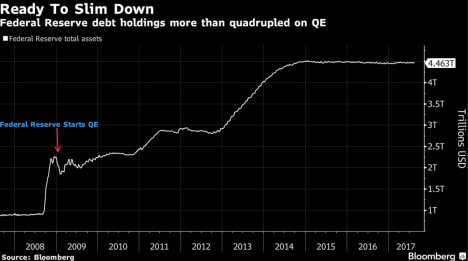
Morgan Stanley is warning that stocks and corporate bonds could be vulnerable once the Fed begins to let its portfolio of Treasuries and MBS run off. A committee of investors and banks hypothesized that corporate credit spreads could widen as much as 135 basis points. Will that have the same effect on mortgage backed securities spreads? Quantitative easing itself didn’t move in spreads all that much, so I cannot imagine something that will amount to a tiny fraction of that having much impact either. The Fed’s balance sheet is now about $4.5 trillion. Pre-crisis it was under $1 trillion. Many market observers think the Fed may never be able to get its balance sheet back down to where it was pre-crisis.

Fed assets bbg

Tensions with North Korea and fears of a debt ceiling standoff have pushed down the market’s assessment of future Fed Funds hikes. The December Fed Funds futures are now predicting a 62% chance of no hike versus a coin toss about a week ago.

The government plans to try and get some sort of tax reform done this year, however it will be difficult. We are much more likely to see some sort of “tax reform light” which probably won’t have a massive impact on the economy in the near term. The first order of business is to fund the government and to get an increase in the debt ceiling. Meanwhile, Bridgewater CEO Ray Dalio is taking off risk due to political polarization and buying gold.

The DOJ ended the Obama Administration’s Operation Choke Point, which was sold as an attempt to prevent banks from funding fraudulent actors, but in reality was just an attempt to prevent banks from doing business with payday lenders, which the Administration opposed on ideological grounds. The idea was to hopefully drive payday lenders out of business by making them unable to find banks to service them.

Luxury homebuilder Toll Brothers reported earnings this morning, and the stock is down a touch pre-market. Average selling prices fell due to a change in product mix. ASPs for signed contracts were flat and contracts were up 25%. Could we be seeing exhaustion, pricing-wise- at the high end of the market? Perhaps, but Robert Toll, Chairman of the Board said: “We believe our industry has room to run. Single-family housing starts, at 811,000, are still well below the 50-year industry average of 1.02 million units. The home ownership rate is on the rise but also still below historic norms. Interest rates remain low, unemployment is low, and more and more buyers are entering the upscale market. Based on these trends, we believe Toll Brothers is well positioned for future growth.”

Despite the lousy housing starts numbers, homebuilder stocks have been on a tear, rising 31% this year. Part of this was due to corporate tax reform – since homebuilders generally have little to no international exposure, a drop in the statutory rate would boost their earnings the most, compared to someone like Apple who has international entities all over the world. Builders have been struggling with their own issues however, especially a shortage of skilled labor. Many of the skilled laborers who worked in homebuilding during the boom either retired or went to work in different industries. Second, construction materials (aka sticks and bricks) are rising as well, and any sort of trade war with Canada will affect framing lumber prices. One thing to remember about homebuilding is that it is a very cyclical business, and during booms, multiples compress. The average homebuilder P/E is about 11 right now, and during the go-go years, it got down to 8.5. In other words, you could be right on earnings increasing, but wrong on the stock price as it goes nowhere while earnings grow. The other side of that argument is that there is so much pent-up demand for housing right now that a slowdown is simply not on the horizon.

A new lending firm claims it can cut the closing process down to 8 days, and the borrower never has to speak to a loan officer. The industry average is 43 days.

Morning Report: Fed “halfway there” in terms of rate hikes 8/21/17

Vital Statistics:

Last Change
S&P Futures 2426.8 0.0
Eurostoxx Index 374.1 -0.1
Oil (WTI) 48.7 0.1
US dollar index 86.1 0.0
10 Year Govt Bond Yield 2.18%
Current Coupon Fannie Mae TBA 103.09
Current Coupon Ginnie Mae TBA 103.97
30 Year Fixed Rate Mortgage 3.88

Stocks are flat this morning on no real news. Bonds and MBS are flat as well.

Very slow news day, as the chatter relates primarily to the eclipse today.

The Chicago Fed National Activity index slipped a bit in July, indicating the economy is growing more or less on its historical trend line. Employment-related indicators were a plus, while consumption related indicators were a drag.

Not a lot of data this week, but there will be a conference of central bankers at Jackson Hole this week. The subject will be focused on regulation and financial stability so I don’t expect much in the way of market moving data. Janet Yellen will speak on Friday.

San Francisco Fed President John Williams says the “normal” Fed Funds rate should be about 2.5% or so. In other words, we are about halfway there. To put that number in perspective, it used to be in the 5% to 6% range before the financial crisis.

As we head into September, the debt ceiling fight will take center stage. This has usually been a contentious issue and this time should be no different. Nancy Pelosi is rumored to be demanding some sort of censure for Trump regarding his Charlottesville comments as the price of Democratic Party support. If so, this one could go down to the wire. Remember the last time we had a government shutdown, we were unable to get tax transcripts from the IRS for a couple of weeks. Take this into account and order before the debt ceiling deadline if you can.

The NY Fed bumped up its estimate for Q3 GDP to 2.1% from 2%. Note the Atlanta Fed is forecasting 3.7% GDP growth. Industrial metals have been on a tear, which is a tell for global growth.

Nationstar is now officially Mr. Cooper.

Morning Report: Canadian RE bubble dwarfs US 8/18/17

Vital Statistics:

Last Change
S&P Futures 2432.0 2.5
Eurostoxx Index 374.0 -2.8
Oil (WTI) 47.2 0.1
US dollar index 86.1 -0.3
10 Year Govt Bond Yield 2.16%
Current Coupon Fannie Mae TBA 103.09
Current Coupon Ginnie Mae TBA 103.97
30 Year Fixed Rate Mortgage 3.88

Stocks are higher this morning after yesterday’s sell-off. Bonds and MBS are flat.

There is a risk-off feel to the market as the current situation in Washington DC plus the terror attacks in Spain are causing investors to sell stocks and buy bonds. The post-election low on the 10 year was 2.14%, and we are getting close. Loan officers, maybe take a look at some old refi candidates that might have missed the boat and see if there is interest again.

Freddie Mac is introducing an automated appraisal alternative for some purchases and refis. “Freddie Mac’s automated collateral evaluation (ACE) assesses the need for a traditional appraisal by leveraging proprietary models and using data from multiple listing services and public records as well as a wealth of historical home values to determine collateral risks.” ACE has been available for some refis since June, but will also be available for some purchases starting in September. This is one way to alleviate the problem of appraiser shortages.

Freddie Mac has issued their outlook for the rest of 2017. Highlights include

  • Housing starts will remain low, and should come in below 1.24MM (which is the long-term average).
  • Home sales will hit 6.2 million and mortgage rates will stay below 4%.
  • House price appreciation will come in at 6.3% for the year.
  • Cash sales as a percentage of sales will remain elevated in the high teens. This is lower than the peak of 35%, but higher than the historical average of about 10%. This difference translates into about $172 billion in fewer originations.

Freddie Mac explains what is going on with the cash sales: “Usually, not many people like to invest a lot of cash into real estate, which is illiquid and has high transaction costs. However, in the current, highly-competitive housing market, a cash offer is an effective way to gain an advantage over other bidders. In a cash sale, the seller doesn’t have to worry about the buyer’s ability to obtain a mortgage or the chances that an appraisal will come in below the agreed sales price. And each cash sale means one less mortgage origination.”

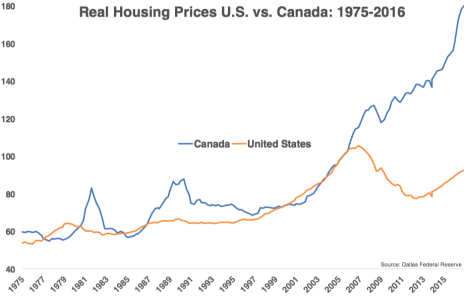
The Canadian real estate bubble will probably not affect the US all that much, however it could have an impact on higher priced properties, especially on the West Coast. Here is a chart comparing the US bubble to the Canadian one:

Canadian real estate

Note that the Canadian real estate market doesn’t have CDO squareds, NINJA loans, pick-a-pay mortgages, or anything like that. Perhaps bubbles are caused by something else – like too much money chasing too few assets…

Home sales fell 3.5% in July, according to Redfin as tight inventory continues to be a problem. Inventory fell 11%, and many buyers are pulling back from the market, waiting for new inventory. You can see just how much inventory has been falling on a YOY basis below.

Morning Report: FOMC minutes slightly dovish 8/17/17

Vital Statistics:

Last Change
S&P Futures 2460.8 -6.5
Eurostoxx Index 378.5 -0.6
Oil (WTI) 46.6 -0.2
US dollar index 86.5 0.2
10 Year Govt Bond Yield 2.24%
Current Coupon Fannie Mae TBA 103.09
Current Coupon Ginnie Mae TBA 103.97
30 Year Fixed Rate Mortgage 3.88

Stocks are lower this morning after WalMart missed earnings. Bonds and MBS are up.

The FOMC minutes from the July meeting showed that some member are still worried about inflation being too low, while some are worried about overshooting the inflation target. “Many participants, however, saw some likelihood that inflation might remain below 2 percent for longer than they currently expected, and several indicated that the risks to the inflation outlook could be tilted to the downside. Participants agreed that a fall in longer-term inflation expectations would be undesirable, but they differed in their assessments of whether inflation expectations were well anchored. One participant pointed to the stability of a number of measures of inflation expectations in recent months, but a few others suggested that continuing low inflation expectations may have been a factor putting downward pressure on inflation or that inflation expectations might need to be bolstered in order to ensure their consistency with the Committee’s longer-term inflation objective.” This statement was taken as dovish and bonds rallied a few basis points on it. The rest of the minutes were uneventful as nothing much had changed economically from the June meeting. There were a few members who wanted to announce the change in balance sheet policy at this meeting but most wanted to wait. That probably means that we will get no hike and an announcement on balance sheet reduction at the September meeting. We didn’t see any reaction in the Fed Funds futures either, with December still a toss-up.

Initial Jobless Claims fell to 232k last week, which remains near historical lows. The last time we were at similar levels, the population was much smaller and there was a military draft going on.

Industrial Production rose 0.2% last month, while manufacturing production fell 0.1% Lower auto production drove the decline. Capacity Utilization was unchanged at 76.7%. There is still a lot of slack in manufacturing, which is why capital expenditures have been so low. Separately, the Philly Fed Manufacturing Survey increased.

Average home sizes grew in the aftermath of the housing boom, as only the luxury end of the sector was working. With Millennials not in a position to buy, aging boomers were the only game in town. From the bottom, average square footage increased from 2388 square feet to 2,622 square feet. However we are seeing this reverse as builders pivot to selling more starter homes. Average and median home size is still above the 2006 peak however.

Household debt increased in the second quarter to $12.84 trillion, which is up about 15% from the post-bubble trough. Mortgage balances increased, however new origination fell as higher interest rates took a bite out of refis. Auto loans increased, as incredibly easy financing is being used to sell cars these days, and credit card balances increased as well. 90 day delinquencies declined to 1.5% of all mortgage loans outstanding.

Morning Report: Housing starts disappoint 8/16/17

Vital Statistics:

Last Change
S&P Futures 2468.0 4.3
Eurostoxx Index 379.3 2.8
Oil (WTI) 47.7 0.2
US dollar index 86.7 0.1
10 Year Govt Bond Yield 2.28%
Current Coupon Fannie Mae TBA 103.09
Current Coupon Ginnie Mae TBA 103.97
30 Year Fixed Rate Mortgage 3.88

Stocks are higher this morning on no real news. Bonds and MBS are down.

The big event of the day will be the release of the FOMC minutes at 2:00 pm EST. The Street will be looking for more info on how the Fed plans to wind down its QE portfolio. Investors will also be parsing the statement for clues regarding the Fed’s stance on the current status of low inflation. While inflation remains low if measured against the Fed’s inflation target, we are starting to see wage inflation. The hawks on the Committee will push to get ahead of that, while the doves (like Yellen) will prefer to let the labor market “run hot” for a while. The minutes will probably not be market-moving, but just be aware if you are locking around that time.

The minutes will be interesting given the recent GDP forecasts out of the Atlanta Fed, which have Q3 growth coming in at 3.7%, and are predicting a much stronger second half to the year. You could really start to see a battle between the hawks and the doves. The Fed Funds futures contracts are still predicting no move in September and a 50-50 chance of a hike in December.

Mortgage Applications fell 0.1% last week as purchases fell 2% and refis increased 2%. Mortgage rates continue to tick lower, with the 30 year fixed rate mortgage down to 4.14%, the lowest since November.

Housing starts disappointed last month, coming in at 1.15 million, down 4.8% MOM and 5.8% YOY. The notoriously volatile multi-family segment drove the decrease, as single family starts were more or less unchanged. The Street was looking for 1.22 million units. Building permits came in at 1.22 million, lower than estimates as well. They were down 4% on a MOM  basis but were up 4% on a YOY basis.

Where is the growth in housing construction? Texas. Of course Texas didn’t really experience the bubble type behavior the way states like California, Arizona, and Florida did. This may be because Texas has more restrictions on cash-out refinances than other states. Here is a chart of where the action is (and is not)

Morning Report: Retail sales come in strong 8/15/17

Vital Statistics:

Last Change
S&P Futures 2469.0 5.5
Eurostoxx Index 376.7 0.6
Oil (WTI) 47.2 -0.4
US dollar index 86.6 0.3
10 Year Govt Bond Yield 2.25%
Current Coupon Fannie Mae TBA 103.09
Current Coupon Ginnie Mae TBA 103.97
30 Year Fixed Rate Mortgage 3.88

Stocks are higher this morning on no real news. Bonds and MBS are down.

Retail Sales came in stronger than expected, with the headline number increasing 0.6% and the control group increasing the same amount. The Street was looking for a 0.3% increase. On a year-over-year basis, sales rose 4.2%. The Atlanta Fed is predicting a big uptick in growth from Q2 to Q3, and retail sales will be a big driver. We are entering the back-to-school shopping season, which is second only to the holiday season in importance for the retail sector. Consumption is about 70% of GDP, so as retail sales go, so goes the economy.

The Empire State Manufacturing Survey shot ahead again last month, hitting the highest level in 2 years. Meanwhile, inflation remains under control as import prices rose 0.1% last month and are up 1.5% YOY. Business inventories also rose .05%.

The NAHB Housing Market Index rebounded in August to 68, which is getting close to its highs. The NAHB says that labor shortages are worse in July than they were a year ago. In some trades, 3/4 of all builders surveyed report either “serious” or “some sort” of shortage of labor. The last time we saw these sorts of levels was in late 2000, just as the real estate market was heating up. This will limit building and keep home prices well-supported.

The Despot reported better than expected earnings as homeowners continue to invest in their appreciating homes. They are looking for comparable store sales to increase 5.5% and took up earnings guidance. Note that contractors are using Amazon more and more, so be careful with the stock.

Down payments are at the lowest levels in 7 years, with the growth mainly occurring in the high single digits are, not at the 3.5% area. It looks like the growth is coming from Fannie and Fred’s low downpayment programs, which are wresting share from FHA. Performance on these loans will probably be determined by the continued price appreciation in the US housing markets. While general riskiness is higher than it was 5 years ago, it is nowhere near the risk we had during the go-go years.

The Trump Administration is trying to pivot to tax reform after the debt ceiling is handled. Both NAR and NAHB have come out against any sort of plan to eliminate the mortgage interest deduction. Trump’s plan is to eliminate the deductions for state / local taxes as well as the mortgage interest deduction in exchange for doubling the standard deduction. NAR is warning that this will hit housing prices, however with inventory so tight, I cannot see that happening. FWIW, if you were ever going to eliminate the mortgage interest deduction, now would be the time to do it, since rates are so low. Mortgage interest is around 70% of the first year’s mortgage payment today. 30 – 35 years ago, it was above 90%. NAR sees about half the people currently taking a deduction to stop. Of course their tax bill isn’t necessarily going up – they will find that taking the standard deduction will be more advantageous than indexing.

Home sales and prices are slipping in Canada, which has a real estate bubble bigger than the one we had in 2006. Fallout from the Canadian bubble bursting will probably affect pricing in places like Seattle, which has been red-hot for the past couple of years.

Morning Report: Credit scores and debt service 8/14/17

Vital Statistics:

Last Change
S&P Futures 2454.0 14.0
Eurostoxx Index 375.2 3.1
Oil (WTI) 48.7 -0.2
US dollar index 86.2 0.2
10 Year Govt Bond Yield 2.21%
Current Coupon Fannie Mae TBA 103.197
Current Coupon Ginnie Mae TBA 104.068
30 Year Fixed Rate Mortgage 3.92

Stocks are higher this morning as tensions between the US and North Korea seemed to ease a bit over the weekend. Bonds and MBS are down.

Not a lot of data this week (nor is there any Fed-Speak). The highlight should be housing starts on Wednesday.

The St. Louis Fed is forecasting 3.7% GDP growth for Q3, while the Atlanta Fed is forecasting 4% growth. Seems surprisingly high, but we will get an idea of how realistic that is when retailers report same store sales for August, which covers the back-to-school shopping season.

These GDP forecasts (if they end up playing out) should boost rates higher over the near term. This will be offset by international tensions (and a general sense of uncertainty in DC) which will pull rates lower. There is no real way to forecast how things will shake out, but just be aware that this push-pull effect should make for increased rate volatility over the near term.

With the Fed on hold until December, the markets are turning to the debt ceiling, which should hit in late September / early October. You are starting to see a tick up in the yields of 3 month T-bills maturing in late September. The debt ceiling has always been a bit of an annual kabuki dance, this time around the unpredictability of things in DC is making traders a little more worried.

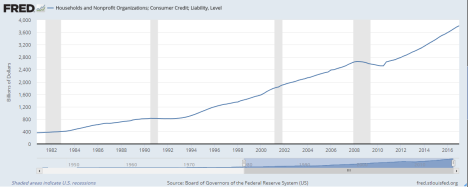
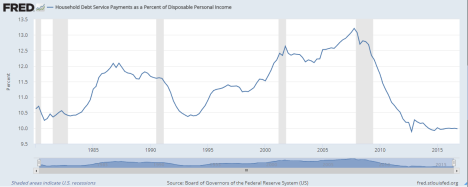
Average credit scores have eclipsed their October 2006 peak, hitting 700 this year. It is interesting to see that US consumer debt levels are at all-time highs, however debt service is at a low. Debt service is one’s mortgage, car, installment, and credit card debt as a percentage of income. Check out the charts below:

Consumer credit:

consumer credit

Debt service:

debt service

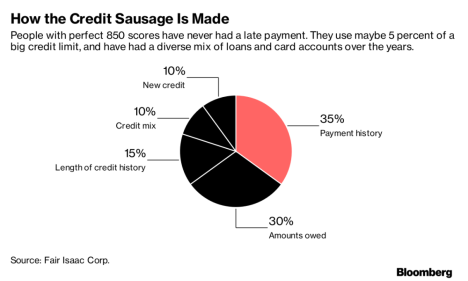
These two charts demonstrate just how much interest rates matter (and why owning a home isn’t quite as unaffordable as the home price indices suggest). If you want to see what determines how Fair Issac (of FICO fame) determines your score, here is a handy chart. The single best thing one can do is make timely payments, followed by reducing the amount they owe.

credut scores

Morning Report: Neel Kashkari to business: stop whining 8/8/17

Vital Statistics:

Last Change
S&P Futures 2474.0 -3.3
Eurostoxx Index 381.1 -0.9
Oil (WTI) 49.4 0.0
US dollar index 86.2 -0.1
10 Year Govt Bond Yield 2.26%
Current Coupon Fannie Mae TBA 103.197
Current Coupon Ginnie Mae TBA 104.068
30 Year Fixed Rate Mortgage 3.92

Stocks are lower this morning on no real news. Bonds and MBS are flat.

Job openings increased by 461,000 to hit 6.2 million in June, according to the JOLTS job openings report. The quits rate was steady at 2.1% (or about 3.1 million people). The quits rate is an important number to the Fed and often signals impending wage growth. The quits rate was the lowest in the Northeast, at 1.7% while the highest in the South at 2.5%.

Small business optimism increased in July, according to the NFIB. Small business continues to hire, adding .21 workers on average over the past several months. Finding qualified workers remains a problem, and 87% of those trying to hire found few or no qualified applicants. Apparently drug use remains a big issue – getting workers who can pass a drug test can be difficult. Regarding the political environment in DC, while there has been no movement on anything legislatively, there have also been no new regulations put in place, and we are seeing some regulations from the Obama administration reversed, which is having a positive effect on sentiment.

Minneapolis Fed Head Neel Kashkari spoke yesterday of the tight labor market and dismissed the idea that there is a labor shortage. “Are you really struggling to find workers? If so, the proof for me is you are raising wages. If you are not raising wages, then it just sounds like whining,” he said. While Kashkari is definitely the dove on the committee, if that sentiment is any indication of the rest of the FOMC, they will be content to nudge up the Fed Funds rate at their current cautious pace until they see wage growth.

China is trying to take away the punch bowl and reduce overseas investment, in an effort to prevent them from experiencing a bust similar to Japan’s in the late 80s. I guess they see parallels between Mitsubishi paying $2 billion for the Rockefeller Center, which ended up going bankrupt a few years later. While I think they are barking up the wrong tree here (industrial policy and a residential real estate bubble are the real issues) it will have some knock-on effects perhaps in our markets. The Chinese withdrawal is probably going to hit the Canadian residential real estate market hard, and you are already seeing transactions dry up in Toronto. Chinese money will be most felt in the ultra-expensive urban areas like Seattle, New York City, and San Francisco. If China does in fact go through a Depression, they will probably try and export their way out of it, which means less inflation in the US, and lower interest rates, at the margin.

The Fannie Mae Home Purchase Sentiment Index ticked off of record highs last month as high prices and tight inventory led to a record low of people saying now is a good time to buy. Granted, the index only goes back to 2012, but it does show how high prices are scaring buyers away. Those that say it is a good time to sell also saw a big decrease, which was the main driver of the reading. That is surprising since you would think that tight inventory + demand would equal a great seller’s market. Not sure what would be causing that.

Delinquency rates are improving for the industry according to the latest CoreLogic Loan Performance Insight Report. 30 day + DQs fell to 4.5% in May, which is down 0.8% from last year. The number in foreclosure fell 0.3% to 0.7%. About the only place you are seeing increases in delinquency are the fracking areas (South Dakota, Louisiana, some parts of Texas) which have been affected by falling oil prices.