Morning Report: The CFPB has two directors 11/27/17

Vital Statistics:

Last Change
S&P Futures 2601.0 0.0
Eurostoxx Index 385.7 -1.0
Oil (WTI) 58.3 -0.7
US dollar index 86.2 -0.2
10 Year Govt Bond Yield 2.33%
Current Coupon Fannie Mae TBA 102.651
Current Coupon Ginnie Mae TBA 103.494
30 Year Fixed Rate Mortgage 3.9

Stocks are flat this morning after the US comes back from a long weekend. Bonds and MBS are up.

Retailers are rallying this morning on expectations of a strong holiday shopping season. Meanwhile, Bitcoin is pushing $10,000.

New Home Sales rose 6.2% MOM and almost 19% YOY, according to Census and HUD. The median sales price was $313k, while the average was $400k. Inventory is at 4.9 months’ worth.

We have a good amount of data this week, although the jobs report will not be released this Friday. We get new home sales today, house prices tomorrow, GDP on Wednesday, Personal Incomes / Spending on Thursday, and the ISM data on Friday. Janet Yellen will also speak on Wednesday.

Richard Cordray resigned from the CFPB last week and Donald Trump nominated Mick Mulvaney to lead the Bureau. Outgoing Director Cordray nominated Obama appointee Leandra English (a career civil servant in the Elizabeth Warren mold) to replace himself and the agency is suing the Trump Administration to prevent him from nominating Mulvaney. So, for the moment, the agency has two directors.

While there is partisan rancor over who will lead the CFPB, Trump’s nominee to lead the Fed, Jerome Powell, expects to have a smooth path to confirmation.

Tax reform will be front and center this week as the Senate hopes to vote this Thursday. If the Senate passes a bill, the House and the Senate will need to come to an agreement between their respective bills. Trump hopes to sign something by the end of the year.

Who would be the biggest losers in the tax bill? The very rich in Greenwich, CT and Manhattan. This is the last thing Connecticut needs – their entire state is largely financed by the rich in Fairfield County. Goldman Sachs estimates that NYC could lose 4% of their top earners. The most likely beneficiary? Florida. The rarefied air of the Northeast luxury market will take a hit (it was already moribund before people were talking about eliminating the state and local tax rate), although inventory is so tight it probably won’t affect the lower price points.

The NAR has released a study claiming that tax reform will hit real estate prices overall by 10%. The fear is that it will discourage homebuilding which will sap the economy of strength. It is true that economic growth has been tepid over the past decade as homebuilding contracted, but will the changes in the tax code matter all that much? I am skeptical that lowering the MID cap from $1 million to $500k will matter all that much, given the median home price in the US is under $250k. The median income in the US is under $60k as well and most people will be better off just taking the increased standardized deduction. So while they may “lose the mortgage interest deduction” it is a moot point – the increased standard deduction replaces it. But yes, I would expect to see some sort of effect at the top 10% of the market, but that should be about it. As far as homebuilding, I think the builders will shift their focus from luxury to starter homes, where the demand is. As a matter of policy, if you wanted to get rid of the mortgage interest deduction when it causes the least amount of economic pain, you would do it when the economy is expanding and interest rates are low. Interest as a percent of your mortgage payment is the lowest in 50 years.

Morning Report: Existing home sales fall 11/21/17

Vital Statistics:

Last Change
S&P Futures 2590.3 8.3
Eurostoxx Index 388.5 2.1
Oil (WTI) 56.2 -0.3
US dollar index 87.4 -0.1
10 Year Govt Bond Yield 2.36%
Current Coupon Fannie Mae TBA 102.651
Current Coupon Ginnie Mae TBA 103.494
30 Year Fixed Rate Mortgage 3.9

Stocks are higher this morning on overseas strength. Bonds and MBS are flat.

Existing Home Sales rose 0.7% in September, according to NAR. This was the second slowest this year, behind August. Overall, sales were down 1.5% YOY. Tight inventory and the hurricanes affected sales. The median home price increased 4.2% YOY to 245k. Inventory was 4.2 month’s worth. First time homebuyers fell to 29% of sales, driven by a dearth of inventory at the lower price points. The NAR also puts in a plug for maintaining the mortgage interest deduction and the state / local tax deductions, as eliminating them will make homeownership more expensive. “There’s no way around the fact that any proposal that marginalizes the mortgage interest deduction and eliminates state and local tax deductions essentially disincentives homeownership and is a potential tax hike on millions of middle-class homeowners,” said Brown. “Reforming the tax code is a worthy goal, but it should not lead to the middle class, who primarily build wealth through owning a home, footing the bill. Instead, Congress should be looking at ways to ensure more creditworthy prospective buyers are able to achieve homeownership and enjoy its personal and wealth-building benefits.”

Economic activity picked up in October, according the Chicago Fed National Activity Index. Production-related indicators drove the increase. Employment-related indicators were positive, but less so than September. The economy definitely seems to be accelerating.

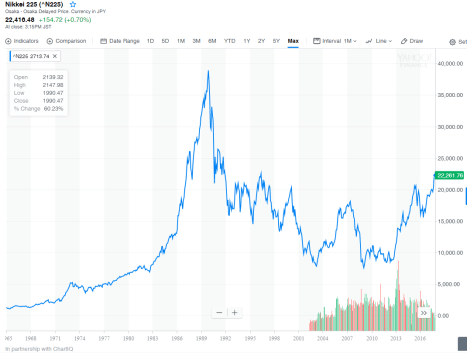
What is driving global growth? China and India for the most part, but it looks like Japan is waking from its long slumber at last. Japanese growth has been missing since the early 90s and is transitioning from being a drag on global growth to a driver of it. Don’t forget, Japan is the third biggest economy in the world and has been largely moribund since the early 90s. Want to see what a real bear market in stocks looks like? Take a look at the long term chart of the Nikkei 225: The Nikkei is hitting 20 year highs, and is still 43% below its 1989 peak.

Nikkei

The Japanese resurgence will probably mean higher interest rates, at least at the margin, as well as higher commodity prices. Much of this will depend on what happens in China, which has a massive real estate bubble and will probably have to go through a secular recession like the US did in the 30s and Japan did for the last 2 decades.

Janet Yellen said she will resign her position on the Federal Reserve Board once Jerome Powell is sworn in. “As I prepare to leave the Board, I am gratified that the financial system is much stronger than a decade ago, better able to withstand future bouts of instability and continue supporting the economic aspirations of American families and businesses,” Yellen said in her resignation letter. Her term officially expires in 2024, but it is rare for an ex-chairman to stay on. Donald Trump will have four open positions to fill, leaving him with the ability to make his mark on the Fed.

Morning Report: Goldman sees 3.7% unemployment in 2018 11/20/17

Vital Statistics:

Last Change
S&P Futures 2576.3 0.0
Eurostoxx Index 385.1 1.3
Oil (WTI) 56.3 -0.3
US dollar index 87.2 0.1
10 Year Govt Bond Yield 2.34%
Current Coupon Fannie Mae TBA 102.651
Current Coupon Ginnie Mae TBA 103.494
30 Year Fixed Rate Mortgage 3.9

Stocks are flat this morning on no real news. Bonds and MBS are flat as well.

Slow news day.

This week should be relatively quiet with the Thanksgiving holiday. There won’t be any market-moving economic releases, and the only thing out of the Fed will be the minutes from the November meeting on Wednesday.

The Index of Leading Economic Indicators came in at 1.2%, doubling the Street estimate of 0.6%.

Goldman is extremely bullish on 2018, as they see the job market getting even tighter and wage growth accelerating. They see the unemployment rate falling to 3.7% in 2018, and to 3.5% in 2019. They are forecasting 4 rate hikes as well, which is well above what the Fed Funds futures are predicting. The Fed Funds futures are pricing in between 1 and 2 hikes in 2018 (assuming that December is a given).

More than half the refis in October were FHA / VA loans. This is due as much to home price appreciation as interest rates. Borrowers can save money by refinancing into a conventional loan once they have 20% equity. Loan officers, take a look at the FHA loans you did a few years ago and look for opportunities.

Tax reform is scheduled for an 11/30 vote in the Senate, as Congress takes this week off. The upper middle class is probably going to benefit the least from tax reform, and Republicans are going to test the theory that they are indeed the third rail in US politics. The upper middle class consists of what demographers call the HENRYs (high income, not rich yet), who may appear to be rich according to the numbers, but often live in high cost areas and have lifestyles more similar to the middle class than the rich. We could see home price appreciation begin to moderate in some of the suburbs around DC and NYC. It probably won’t affect California as much, as the CA real estate market inhabits its own universe.

Morning Report: Housing starts improve 11/17/17

Vital Statistics:

Last Change
S&P Futures 2584.5 -0.5
Eurostoxx Index 384.3 -0.6
Oil (WTI) 56.0 0.9
US dollar index 87.3 -0.1
10 Year Govt Bond Yield 2.37%
Current Coupon Fannie Mae TBA 102.651
Current Coupon Ginnie Mae TBA 103.494
30 Year Fixed Rate Mortgage 3.9

Stocks are flat this morning on no real news. Bonds and MBS are down small.

Housing starts came in just shy of 1.3 million, the highest print in a year. This is up 14% from last month, but down 3% from a year ago. Building Permits came in at 1.3 million as well. Both numbers were driven by a big jump in multi-family, while single-fam continues to gradually move higher. We are still below historical numbers: From the late 50s through 2002, starts averaged 1.5 million a year. When you factor in population growth, that average is way too low for today. We probably should be pushing 2MM a year in order to keep up with population growth and to fix the inventory problem.

The House passed tax reform yesterday, and now all eyes turn to the Senate, where the latest bill made it out of Committee and is scheduled for a vote after the Thanksgiving holiday. Then begins the hard work of reconciling the House and Senate versions. The Senate bill has some high profile opposition, which makes passage difficult. This is still a very fluid situation.

Donald Trump will nominate OMB Chairman Mick Mulvaney to be the interim head of the CFPB. Mulvaney is a reliable conservative, who has a healthy skepticism of government regulation. He is expected to name another Chairman or Committee to run it, while he maintains his focus on OMB. Names mooted for the role include George Mason University professor Todd Zwyicki and ex-Congressman Neugebauer.

A study concludes that homeownership doesn’t increase wealth as much as renting and investing the savings in the stock market. The critical part of the argument is investing the savings in the stock market. I haven’t read the study, but I wonder if they are using absolute house prices instead of what you actually put up. If the house appreciates 5% a year, and you only put down 20%, what is the best number for determining your return? The it amount of the house or the amount you actually put up? Is the proper return 5% / 100% or is it 5% / 20% (or 25%)?

Morning Report: Richard Cordray resigns 11/16/17

Vital Statistics:

Last Change
S&P Futures 2572.0 7.0
Eurostoxx Index 382.0 -1.9
Oil (WTI) 55.4 0.1
US dollar index 87.3 0.0
10 Year Govt Bond Yield 2.34%
Current Coupon Fannie Mae TBA 102.688
Current Coupon Ginnie Mae TBA 104
30 Year Fixed Rate Mortgage 3.87

Stocks are higher this morning on no real news. Bonds and MBS are down small.

Some economic data this morning: Initial Jobless Claims rose to 249k last week, which is still a remarkably low number. We are starting to see wage inflation at the blue collar level. Manufacturing is still strong in the Northeast, with the Philly Fed index coming in at 22.7. Inflation remains on the low side, although import prices did increase by 0.2% MOM / 2.5% YOY on a weaker dollar. Finally, industrial and manufacturing production came in higher than estimates, while capacity utilization improved to 77% from 76.4%. All of these data point to less slack in the economy.

Homebuilder sentiment bounced back in November, according to the NAHB. The index rose to 70  from 68 in October. The index hit a post-recession peak of 71 in early 2017, and the last time above that level was in late 2005. Builders are happy, bit supply remains low. In fact, inventory is so low in San Jose, days on market is less than two weeks, and prices rose almost 20% to hit a median value of over $1 million.

CFPB Chairman Richard Cordray announced his resignation yesterday and said he will be stepping down at the end of the month. The speculation is that he will challenge John Kasich for governor of Ohio. No word on who might replace him. What’s Angelo Mozillo up to these days?

The House is scheduled to vote on tax reform today, while the Senate continues to work on it. Public support for tax reform remains weak, probably because there hasn’t been a plan yet to actually sell to the public – it remains in such a state of flux nobody knows what it will actually entail. The latest potential provisions include sunsetting the individual tax cuts, removing the Obamacare mandate, and cutting Medicare. While these may or may not be smart things to do, Congress and the WH need to be singing from the same sheet of music, which they aren’t. Meanwhile, opponents have been able to run stories against it largely unopposed. Ironically, tax reform in the Senate will probably hinge on two Republicans who will not be facing re-election again in their lives: John McCain and Jeff Flake. I stand by my initial thoughts on this – that the only thing that has a chance of passing is something small and largely symbolic. Re-doing the corporate tax code should be a bipartisan endeavor with comment periods, a visible public debate, etc.. Not finalizing a plan hours before the vote.

Home equity wealth hit a new high of $13.9 trillion, half a trillion over the 2006 high and double the low at the nadir of the Great Recession. It is important to remember that these are nominal numbers (in other words, not adjusted for inflation). Inflation-adjusted home prices still have yet to recoup their highs, in fact they are still 17% below their peak levels. This is why affordability remains decent in spite of the nominal home price indices hitting new highs. It is also why articles in the financial press warning of a new real estate bubble are complete and utter nonsense.

Morning Report: Inflation at the consumer level increases moderately 11/15/17

Vital Statistics:

Last Change
S&P Futures 2567.0 -11.0
Eurostoxx Index 380.9 -3.0
Oil (WTI) 55.1 -0.6
US dollar index 87.0 -0.4
10 Year Govt Bond Yield 2.32%
Current Coupon Fannie Mae TBA 102.688
Current Coupon Ginnie Mae TBA 104
30 Year Fixed Rate Mortgage 3.87

Stocks are lower this morning as a risk-off feel is dominating the markets. Bonds and MBS are up.

As stocks swoon, we should continue to see mortgage rates tick lower, at least at the margin. We came close to positive reprices yesterday.

Mortgage Applications increased 3.1% last week purchases increased 0.4% and refis increased 6%. There was no adjustment for the Veteran’s Day holiday, and the 30 year fixed rate mortgage was unchanged at 4.12%.

While inflation may be picking up at the wholesale level, it hasn’t translated to the consumer level, at least not yet. The consumer price index rose 0.1% MOM and is up 2% YOY. Ex-food and energy, it was up 0.2% MOM and 1.8% YOY. The Fed is targeting 2% inflation, so they still have more work to do there. It probably won’t change much in the way of the Fed’s thinking, which is still on a gentle path of increasing interest rates. The Fed Funds futures are currently predicting a 100% chance of a hike in December, with 92% predicting a 25 basis point hike and 8% predicting a 50 basis point hike.

Retail sales moderated in October after spiking in September on strong gasoline sales. Retail sales increased 0.2%, while sales less autos and gasoline rose 0.3%. The control group was also up 0.3%. Separately, Target forecasted moderate holiday spending growth, although that could be specific to that company, which is locked in a price war with Wal-Mart and Amazon.

Manufacturing in New York State decelerated last month but is still historically strong according to the Empire State Manufacturing Survey put out by the New York Fed. Employment continue to expand, albeit at a slower pace than last month.

Household debt balances increased in the third quarter, according to the latest Fed data. Overall debt rose to just under $13 trillion, which eclipses the high set in 2006. Mortgage debt is still lower than the peak levels, however, while non-housing debt is higher. We are seeing an increase in the share of auto debt, as well as student loan debt. If you look at the historical charts, you can see just how dramatically credit scores have improved for mortgage debt.

The Senate has added a twist to tax reform. In order to come within the statutory limits for the national debt, they have added a wrinkle to save money: eliminating the individual mandate for Obamacare. This supposedly increases savings by some $300 billion. Some of those savings may be used for additional tax cuts. This will make tax reform an easier push legally, but will probably push some of the more liberal Republicans away from it. The Republican majority in the Senate will probably get even narrower, with the special election in Alabama looking like a D pickup.

Morning Report: Inflation is picking up 11/14/17

Vital Statistics:

Last Change
S&P Futures 2577.0 -5.0
Eurostoxx Index 384.4 -1.8
Oil (WTI) 56.5 -0.3
US dollar index 87.5 0.0
10 Year Govt Bond Yield 2.39%
Current Coupon Fannie Mae TBA 102.875
Current Coupon Ginnie Mae TBA 103.938
30 Year Fixed Rate Mortgage 3.87

Stocks are lower on overseas weakness. Bonds and MBS are flat.

Inflation at the wholesale level picked up in October, according to the Producer Price Index. The headline number rose 0.4% MOM and 2.8% YOY on services inflation, which is being driven (hopefully) by increased compensation. The core rate was up 0.2% MOM and 2.3% YOY.

Small business optimism picked up in October on strong labor readings. The average firm added .17 workers, while job openings stayed in record territory. In fact, the inability to find qualified workers was the second biggest headache for small business. As an aside, I wonder if this is an inability to find qualified workers, or an inability to find qualified workers who can pass a drug test. A net 27% of firms reported increasing compensation.

People are spending money on their homes. The Despot reported strong Q3 earnings with comparable store sales up 7.9%, despite the hurricanes. I guess when inventory is as low as it is, people will remodel their current home instead of moving. 203ks anyone?

Loan delinquencies are falling, according to CoreLogic, however we are seeing a bump up in the oil patch states, especially around Houston and in Alaska. 30+ DQ rates fell 0.6% YOY to 4.6% in August. These were the lowest numbers in a decade, however the hurricanes will probably bump up those numbers in the next few readings. The number in foreclosure fell to 0.6% from 0.9% a year ago.

The Senate came to an agreement to limit some of the post-crisis financial regulation for small and medium sized banks. The threshold for additional scrutiny was increased from $50 billion in assets to $250 billion in assets. Some larger banks who have a more traditional business like US Bancorp and PNC, were hoping for some relief, but didn’t get any. “This is the first proposal that has a legitimate shot at making it to the president’s desk,” said Milan Dalal, an attorney at lobbying firm Brownstein Hyatt Farber Schreck in Washington and a former aide to Sen. Mark Warner (D., Va.), who backed Monday’s deal.

Morning Report: What does the flattening yield curve mean? 11/13/17

Vital Statistics:

Last Change
S&P Futures 2572.5 -7.0
Eurostoxx Index 384.9 -3.8
Oil (WTI) 56.9 0.1
US dollar index 87.7 0.0
10 Year Govt Bond Yield 2.38%
Current Coupon Fannie Mae TBA 102.875
Current Coupon Ginnie Mae TBA 103.938
30 Year Fixed Rate Mortgage 3.95

Stocks are lower this morning after General Electric cut its dividend in half. Bonds and MBS are up.

We will have a lot of data this week, along with a plenty of Fed-Speak. None of the data should be all that market-moving, but watch the inflation numbers on Tuesday and Wednesday. We will also get housing starts and industrial production.

Many market participants are watching the slope of the yield curve and warning that it could be indicating a recession ahead. The slope of the yield curve is most often measured by the difference between the 10 year bond and the 2 year bond (the 2s-10s spread). The 10 year rate is usually higher than the 2 year rate, but that relationship can move around a lot, especially when the Fed is active. Most are using comparisons from the beginning of the year, which is somewhat exaggerated by the initial post-election jump in rates. The Trump Reflation Trade turned out to be relatively short-lived, and it exaggerated the slope of the yield curve. That said, we have typically seen a curve flattening during tightening regimes. Some participants are predicting the curve could invert next year, if the Fed can’t get inflation to rise. But supposedly the fast money is playing the yield curve flattening trade and this is one of the biggest trades on the Street.

One effect of a flattening yield curve will be to make the early payment pickup in ARMS less dramatic than it otherwise would be. ARMS are based off of LIBOR, while the 30 year rate is based more on the 10-year. If LIBOR is rising relative to the 10 year (which you would expect to see in a flattening yield curve environment) then borrowers would be better off refinancing out of an ARM and into a 30 year fixed. In a tough environment, this can be a way to get some loans in the door, along with the FHA to conventional without MI refi.

Tax reform will influence the shape of the curve as well. If tax reform doesn’t get done this year, it probably is doomed for the immediate future, as midterm elections will dominate 2018. One strategist sees a 15% correction in the stock market if tax reform doesn’t get done. Expectations for a corporate tax cut boosted the S&P 500 by 20% this year. Note that earnings have been increasing for the S&P 500 as well, so that provides support for valuations. Look at the chart below: The blue line is the absolute level of the S&P 500, while the orange line is earnings per share. Granted, the stock market theoretically looks at forward earnings and not contemporaneous or past earnings, but as long as earnings keep rising, the stock market

Morning Report: Fannie Mae pilots a new construction loan program 11/9/17

Vital Statistics:

Last Change
S&P Futures 2578.8 -12.3
Eurostoxx Index 391.2 -3.2
Oil (WTI) 56.9 0.1
US dollar index 87.8 0.0
10 Year Govt Bond Yield 2.34%
Current Coupon Fannie Mae TBA 102.875
Current Coupon Ginnie Mae TBA 103.938
30 Year Fixed Rate Mortgage 3.95

Stocks are lower this morning on overseas weakness. Bond and MBS are down.

Initial Jobless Claims rose to 239k last week. We are at levels not seen since the Vietnam War.

Fannie Mae is working on an initiative to increase affordable housing, by increasing access to construction loans. Under the program being considered, lenders will be able to sell construction loans to Fannie Mae on the day construction begins instead of the day construction is completed. This will alleviate the issue of lenders having to hold a construction loan on their books for months and hopefully spur more construction activity. This will probably have only a marginal impact on housing supply, as the supply issue is being driven more by labor and land shortages, as well as regulation.”

Meanwhile, NAR is warning that the GOP tax plan will bring affordable housing construction “to a halt.” The Low Income Housing Tax Credit will remain in place, however the private activity bonds used to finance affordable housing construction will be eliminated. Second, as tax rates fall, the value of the tax credits used to encourage affordable housing construction will fall in value. Affordable housing advocates estimate that tax reform will cut affordable housing construction by 2/3.

Fannie Mae’s Home Purchase Sentiment Index fell from its highs in October. “The modest decrease in October’s Home Purchase Sentiment Index is driven in large part by decreases in favorable views of the current home-buying and home-selling climates, a shift we expect at this time of year moving out of the summer home-buying season,” said Doug Duncan, senior vice president and chief economist at Fannie Mae. “Indicators of broader economic and personal financial sentiment remain relatively steady. Overall, these results are consistent with our view that the housing market will continue its slow, upward grind through 2018.” Despite the strong employment numbers lately, the survey saw an increase in the number of people worried about their jobs.

The NYSE just launched FANG futures, which are led by Facebook, Amazon, Netflix, and Google. Definitely a bull market phenomenon – reminds me of stock split beepers, which were advertised in Barrons back in the late 90s.

Some market watchers are warning that the flattening yield curve is signalling a recession. The favorite metric is the 2s-10s spread or the difference in yield between the 10 year bond and the 2 year bond. While a flattening yield curve is often associated with longer-term economic weakness, it is also associated with Fed tightenings. In fact, the yield curve has flattened in every tightening cycle since 1980. That said, nothing in the data suggests the economy is weakening – if anything the economy is accelerating. The Fed is tightening in order to bring its unusually accommodative policy back to a semblance of normalcy, not to fight inflation (despite what they are saying about it). They are being extremely cautious and are doing everything they can to prevent a Fed-induced recession.

Morning Report: FHA prepay speeds rise 11/8/17

Vital Statistics:

Last Change
S&P Futures 2584.3 -2.5
Eurostoxx Index 393.8 -0.9
Oil (WTI) 57.1 -0.2
US dollar index 87.8 -0.1
10 Year Govt Bond Yield 2.31%
Current Coupon Fannie Mae TBA 102.875
Current Coupon Ginnie Mae TBA 103.938
30 Year Fixed Rate Mortgage 3.95

Stocks are flat this morning on no real news. Bonds and MBS are down.

Mortgage applications were flat last week as the purchase index increased 1 percent and the refi index decreased 1%. The average 30 year fixed rate mortgage fell 4 basis points to 4.18%.

The House and Senate continue to work on tax reform. Here is the latest state of play. Biggest difference between the House and Senate is the state and local tax deduction, where the Senate bill excludes all state / local / property taxes, and the House bill which allows some deductions. Lawmakers are still working on a way to prevent companies from taking advantage of lower-tax jurisdictions overseas to shelter income. Accountants and lawyers are still getting their arms around what the proposals actually entail, and as expected it will be complicated. The estate tax will probably survive in some form in the Senate.

Capital One (What’s in your wallet?) is exiting the mortgage origination business. “These businesses are in a structurally disadvantaged position, given the challenging rate environment and marketplace,” Sanjiv Yajnik, president of financial services at Capital One, said in a memo to employees. “These factors do not allow us to be both competitive and profitable for the foreseeable future.”

Mortgage Credit availability decreased slightly in October, especially on the jumbo side of things, according to the MBA. This indicates that lenders are tightening standards a little. The index has been pretty much flat for the past year.

Many FHA borrowers are refinancing into conventional mortgages, which has resulted in higher prepayment speeds than expected for FHA loans. This is low-hanging fruit for loan officers: home prices appreciation has been strong enough for most MSAs that someone who did a 3.5% down FHA loan a few years ago may be eligible for a 20% conventional and no longer have to pay MI. Serious delinquencies fell for FHA loans as well, from 5% to 4.3%.

Problems in fin-tech land? Lending Club down 20% pre-open on lousy guidance.