Morning Report: Stirrings of inflation at the wholesale level 12/12/17

Vital Statistics:

Last Change
S&P Futures 2666.3 1.8
Eurostoxx Index 390.4 1.4
Oil (WTI) 58.4 0.5
US dollar index 87.3 -0.1
10 Year Govt Bond Yield 2.39%
Current Coupon Fannie Mae TBA 102.531
Current Coupon Ginnie Mae TBA 103.591
30 Year Fixed Rate Mortgage 3.88

Stocks are up this morning as we begin the FOMC meeting. Bonds and MBS are flat.

Inflation at the wholesale level came in slightly above forecast according to the Producer Price Index. The headline number was 0.4% MOM and 3.1% YOY. Ex-food and energy, it rose 0.3% / 2.4% and ex-food, energy, and trade services it was up 0.4% / 2.4%. This report confirms building inflationary pressures in the system. It won’t have an effect on this Fed meeting, but it is something to watch.

Speaking of inflation, one of the bigger complications for the Fed is the effect of Amazon on price discovery. Amazon (and the Internet in general) allow consumers to compare prices easily, something that was not possible a generation ago. Goldman tried to estimate the effect of the internet on core CPI, and they found it to be about 0.1%. All of the Fed’s inflation models were conceived pre-internet. While price comparison on the web is not the only reason why inflation is low, it is a new factor. Deflation is generally experienced in the wake of asset bubbles – Japan has experienced it for a generation, the US had low inflation from the Depression that lasted until the 60s, and we have had persistently low inflation since the residential real estate bubble burst. Low productivity hasn’t helped either, as productivity growth drives wage inflation.

Small business optimism hit the highest level in 34 years on tax reform according to the NFIB. “We haven’t seen this kind of optimism in 34 years, and we’ve seen it only once in the 44 years that NFIB has been conducting this research,” said NFIB President and CEO Juanita Duggan. “Small business owners are exuberant about the economy, and they are ready to lead the U.S. economy in a period of robust growth.” While small business didn’t add any workers last month, hiring plans increased, and difficulties in finding workers remains a big problem.

CoreLogic reported that delinquency rates in July were the lowest in a decade. The foreclosure inventory rate was 0.7%, down from 0.9% a year ago and is the lowest level since 2007. Delinquency rates are the lowest in the West, while New York has the highest. The Northeast judicial states like New York, New Jersey, and Connecticut still have a foreclosure inventory to work through. Lower oil prices were beginning to push up DQ rates in places like Alaska and Louisiana.

Congress hopes to pass tax reform by Christmas. The bill is in committee right now, where the House and Senate are trying to reconcile their differences.

Bitcoin mania: People are taking out mortgages to buy bitcoin. This will not end well. That said, can bitcoin double from here? Of course. Can it go to zero? Of course.

Morning Report: Job openings at 6 million 12/11/17

Vital Statistics:

Last Change
S&P Futures 2651.8 0.8
Eurostoxx Index 389.0 -0.2
Oil (WTI) 57.5 0.2
US dollar index 87.2 -0.1
10 Year Govt Bond Yield 2.37%
Current Coupon Fannie Mae TBA 102.625
Current Coupon Ginnie Mae TBA 103.625
30 Year Fixed Rate Mortgage 3.92

Stocks are flat this morning after a bomb went off in New York City’s Penn Station. Bonds and MBS are up small.

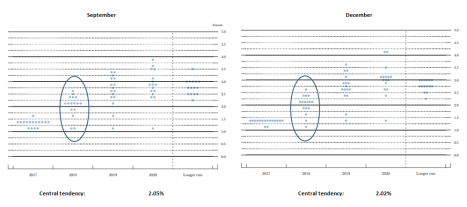
This week will be dominated by the FOMC meeting on Tuesday and Wednesday. The markets are forecasting a 25 basis point hike in the Fed Funds rate, but the economic forecasts will be the focus, as well as the dot plot. It will be interesting to see the 2018 GDP forecast. The Fed was consistently high in their GDP estimates during the Obama administration, however their 2.1% forecast for 2017 looks to have been way light, given that the NY Fed just upped its Q4 GDP estimate to 3.92%. That would put 2017 GDP growth just shy of 3% for the year.

Job openings were largely unchanged at 6 million in October, according to the JOLTS survey. The hires rate increased to 5.6 million. The quits rate was unchanged at 2.2%. The quits rate is the most important number in this release, as increases in the rate usually correspond to increases in wage growth.

So far, the Fed’s tightening has had almost no effect on the market. In the old days, a couple Fed Funds hikes and you would start to see a slowdown. If anything, the economy is accelerating, not decelerating. JP Morgan believes that we won’t see a meaningful effect on the economy until we get to a real 1% Fed Funds rate, where “real” means inflation-adjusted. Currently, the Fed Funds real rate is negative (inflation is higher than the Fed Funds rate). Once the Fed Funds rate is 1.5% higher (or around 2.5%, we should see an impact, which makes that a 2019 event, not a 2018 event.

35% of new home sales in October were for homes that hadn’t even begun construction, the highest number since 2005. Shortages of skilled labor, along with increasing commodity prices are preventing new home sales and housing starts from being high enough to meet demand. Housing will almost certainly be the engine to propel US economic growth over the next few years.

Last week, a news story suggested that the Trump CFPB would back off the banks, referring mainly to Wells Fargo. He then tweeted that the story is false, and if anything, he would increase penalties on the banks for bad behavior.

Morning Report: Movement on housing reform 12/8/17

Vital Statistics:

Last Change
S&P Futures 2647.0 7.8
Eurostoxx Index 389.5 3.1
Oil (WTI) 57.6 0.9
US dollar index 87.3 0.0
10 Year Govt Bond Yield 2.38%
Current Coupon Fannie Mae TBA 102.625
Current Coupon Ginnie Mae TBA 103.625
30 Year Fixed Rate Mortgage 3.92

Stocks are higher after a strong jobs report. Bonds and MBS are down small.

Jobs report data dump:

  • Payrolls up 228,000
  • Two month revision up 38,000
  • Unemployment rate 4.1%
  • Labor Force participation rate 62.7%
  • Average hourly earnings up 2.5% YOY

Overall a strong report, and probably good for the markets. The modest wage inflation will keep the Fed cautious, while slack continues to be taken up. That said, a rate hike is more or less a certainty next week. We probably won’t see any big pickup in wage inflation until the labor force participation rate gets back up to the 65% – 66% level.

In other labor news, job cuts increased slightly according to outplacement firm Challenger, Gray and Christmas, while initial jobless claims fell to 236,000.

Consumer sentiment edged up slightly in November, according to the University of Michigan survey.

Congress came up with a deal to keep the lights on for two weeks. The debt ceiling will have to be raised at some point, although the government can use cash on hand and other extraordinary measures to get through until Spring. Expect to see some conservative Republicans to balk at additional spending, which makes bringing aboard some Democrats a necessity. A deal with Democrats will involve an equal hike in defense and non-defense spending as well as some sort of immigration deal. A shutdown doesn’t seem to be in the cards, at least not yet.

With all the commotion going in Washington right now, it is easy to forget about housing reform, but Bob Corker and Mark Warner are beginning to come to a consensus over what the future of housing finance should look like. Fannie and Fred will remain, but the government will make it easier for new competitors to enter the market. Jeb Hensarling of Texas has moderated his stance on government guarantees of mortgages, which helped move things along. The goal is to keep the mortgage market more or less as-is for borrowers, while increasing competition in the secondary market and bolstering taxpayer protection. In one wrinkle, the Fannie Mae preferred shareholder might get some sort of recovery. The prefs were up 24% on the news, while the common fell slightly.

The FHA will no longer insure mortgages for properties that include Property Assessed Clean Energy (PACE) assessments.”FHA can no longer tolerate putting taxpayers at risk by allowing obligations like these to be placed ahead of the mortgage itself in the event of a default,” said U.S. Department of Housing & Urban Development (HUD) Secretary Dr. Ben Carson. “Assessments such as these are potentially dangerous for our Mutual Mortgage Insurance Fund and may have serious consequences on a consumer’s ability to repay, or when they attempt to refinance their mortgage or sell their home.” Dave Stevens of the MBA also welcomed the decision.

Ginnie Mae is tightening requirements on securitizations in order to combat the high prepayment speeds that the securities have been experiencing. They targeted VA IRRRLs last year by making IRRRLs that refinanced a loan less than 6 months old ineligible for standard securitizations. Ginnie is now including cash-out refis and FHA streamlines as well. Some MBS strategists have predicted that this will weaken demand for the higher coupon Ginnie Mae securities, which would mean that borrowers get less and less of a pickup in points for going higher in rate.

Morning Report: Productivity increases 12/6/17

Vital Statistics:

Last Change
S&P Futures 2625.0 -3.3
Eurostoxx Index 384.5 -2.3
Oil (WTI) 56.9 -0.8
US dollar index 86.8 0.0
10 Year Govt Bond Yield 2.32%
Current Coupon Fannie Mae TBA 102.625
Current Coupon Ginnie Mae TBA 103.625
30 Year Fixed Rate Mortgage 3.88

There is a slight risk-off feel to the market today as stocks are lower and bonds rally.

Mortgage Applications rose 5% last week as purchases rose 2% and refis rose 9%. The average 30 year fixed rate mortgage dropped a basis point to 4.19%.

The economy added 190,000 jobs last month according to the ADP Employment Survey. The Street is looking for 204,000 jobs in this Friday’s payroll report. This ADP number is more or less close to the average for the past year. Moody’s Chief Economist Mark Zandi is warning that the job market could overheat next year, as he sees the unemployment rate going below 4%. Will that cause the Fed to start hiking rates more aggressively? Perhaps, but until we start seeing broad-based wage inflation and begin to see it flow through to prices the Fed will probably be content to gradually normalize policy and not push the economy into a recession.

Productivity rose 3% in the third quarter, according to BLS, as output increased 4.1% and hours worked increased 1.1%. Generally speaking productivity increases drive wage increases, although that relationship has broken down somewhat over the past 15 years or so. Unit labor costs declined 0.2% as the increase in productivity offset the 2.7% increase in wages. At a recent CEO roundtable, labor costs have taken over regulation as the top concern of Corporate America. Tax reform will probably encourage more capital investment to make workers more productive, and that should translate into wage inflation, although not necessarily into a larger number of workers.

As tax reform gets resolved, the next issue will be funding the government. It won’t take many conservatives to balk at funding the government to make Democrats necessary to keep the lights on. Democrats want some sort of immigration deal to go along with voting for a continuing resolution, which will be a non-starter for many Republicans. Don’t forget the last time we had a government shutdown, you couldn’t get 4506-Ts from the IRS, loan officers, plan accordingly.

Ray Dalio of Bridgewater warns that tax reform will cause an exodus from high tax states like California, New York, New Jersey, and Connecticut. Many big names in the hedge fund business have already relocated to Florida, where there are no state income taxes. Connecticut will be especially vulnerable, as it gets most of its revenue from one county. Meanwhile, NAR and Trulia warn that tax reform will hit property values in these high tax states, and will exacerbate the inventory shortage as it will discourage sellers. As I have said before, it may affect the higher end of the market in these areas, but the sub $750,000 sector should be fine. If anything, it might encourage those that are thinking of buying a million dollar home to lower their price point, which would increase demand in that sector. As a general rule, the multi-million sector in the Northeast has been moribund to begin with, and the multi-million sector in the West has been driven by foreign money and stock market appreciation.

Affordable Housing Advocates are also staunchly opposed to the new tax bill. Many for simple ideological reasons, however tax reform will affect the value of the tax write-offs that act as the incentive to build affordable housing. It will make affordable housing construction less attractive (and may turn it into a money-losing enterprise). Some groups claim that the home price appreciation has been so fast (especially in California) that it is creating a homelessness problem. A lack of affordable housing has been an issue for a long time, and tax reform certainly won’t make it less of one.

The hurricanes accounted for 10% of the country’s mortgage delinquencies. This is going to be a huge headache for lenders with servicing portfolios in Texas and Florida.

The emergence of fraud and swindles usually signals the top of bubbles. Liar loans and CDO squareds were the bell ringing at the top of the US residential real estate market. It looks like we are getting to see some of this in China as well, which has a residential real estate market of epic proportions. When China’s residential real estate bubble finally bursts, it will be a massive battle of wills between Mr. Market and Mr. Big Government. When Japan’s bubble burst, the government used all sorts of ham-handed methods to prevent a crash, and I wouldn’t be surprised to see China try some of the same things. Once China’s bubble bursts, they will export deflation to the world, which will keep inflation in check in the US, however it will also sap global growth. Luckily Japan seems to be picking up at long last (almost 30 years).

Morning Report: Toll Brothers misses 12/5/17

Vital Statistics:

Last Change
S&P Futures 2642.0 3.8
Eurostoxx Index 386.6 -0.9
Oil (WTI) 57.3 -0.2
US dollar index 86.7 0.1
10 Year Govt Bond Yield 2.39%
Current Coupon Fannie Mae TBA 102.625
Current Coupon Ginnie Mae TBA 103.625
30 Year Fixed Rate Mortgage 3.88

Stocks are higher this morning on no real news. Bonds and MBS are flat.

Toll Brothers announced earnings this morning that missed analyst expectations. The sector has been on a tear this year, so weak earnings are expected to be punished by the markets. Revenues increased 9% and earnings increased 68%. The company used a lot of its cash to repurchase stock and bonds, which isn’t a great sign for future growth. Generally when companies are seeing great opportunities, they re-invest in the business. When they don’t, they buy back stock. The street didn’t like the guidance, and the stock is down about 6% pre-market.

Toll is in the luxury end of the housing market, covering McMansions in urban areas out West and luxury apartments in the East. The change in the mortgage interest deduction is probably going to impact demand. Note that the builders that focus on entry-level building are doing much better. For the past 10 years, the luxury end of the market was the only part that was working. Now the market is shifting to the first time homebuyer.

Speaking of the luxury end of the market, the New York Times frets about the effect tax reform will have on New York City. It turns out that 40,000 residents in New York City account for half the city’s revenue. If they leave, it will have a huge impact on the city’s finances. The people most affected will be those making over $200,000, and in a high cost area like New York City and the suburbs, that is not rich by any stretch of the imagination.

Factory orders fell 0.1% in October, ending a generally good month for manufacturing. Capital Goods orders were strong however, and that points to a stronger Q4 and 2018. Capital Goods orders are generally associated with business expansion, capacity increases, and modernization.

The services economy decelerated in November from a record in October, according to the ISM Non-Manufacturing Survey.

Tax reform heads to committee to resolve the differences between the House and Senate versions. Here are the biggest sticking points. The committee starts work on Monday, with an eye to have a final vote in Mid-December.

Home prices rose 0.9% MOM and are up 7% YOY, according to CoreLogic. The fastest growth continues to be in the West and Mountain states. Much of the Midwest remains undervalued while we are seeing overvaluation in places like Florida, Texas, and the West Coast. Note that fears about climate change are not evident in Florida real estate.

First time homebuyers are still relatively uninformed about mortgages. According to a recent survey, 20% of Americans think it is impossible to get a mortgage with less than 5% down, despite the fact that FHA goes down to 3%, VA allows nothing, and the GSEs have 3% down products. Most people get their information on the Internet, and surprisingly almost nobody gets their mortgage information from the CFPB.

How did HAMP and HARP help struggling homeowners? It turns out, not much. In fact, borrowers who had a principal reduction had pretty much the same default rates as borrowers without a principal reduction. These reductions were big: 32% or about $112,000 on average. These results pour cold water on the strategic default theory, which says that borrowers will choose to toss the keys to the bank once the home value is less than their outstanding mortgage. FWIW, I think the defaults in 2006 were strategic defaults, as the economy had yet to roll over and professionals were playing the greater fool game. Note that modifying a mortgage payment to a percentage of income didn’t really help either. The punch line is that many defaults were caused by a short term blip in a borrower’s financial situation – often an unexpected expense like a medical bill – and servicers should work on creating a solution to help the borrower over that hump and then re-evaluate.

Morning Report: Tax reform passes 12/4/17

Vital Statistics:

Last Change
S&P Futures 2657.5 13.5
Eurostoxx Index 388.0 4.0
Oil (WTI) 57.8 -0.6
US dollar index 86.7 0.3
10 Year Govt Bond Yield 2.39%
Current Coupon Fannie Mae TBA 102.625
Current Coupon Ginnie Mae TBA 103.625
30 Year Fixed Rate Mortgage 3.88

Stocks are higher this morning after tax reform passes in the Senate. Bonds and MBS are flat.

This week should be pretty quiet with the exception of the jobs report on Friday. We are in the quiet period ahead of the FOMC meeting next week, so we won’t be getting any Fed-speak.

Tax reform passed over the weekend in the Senate. Now comes the reconciliation between the House and Senate versions. The winners in this bill? Banks, as they generally have fewer deductions and end up paying the high statutory rate. The corporate AMT remains at 20%. The losers? Health insurance companies that will see the healthier and younger eschew health insurance because the mandate is gone. Note however that the penalty for not carrying insurance under Obamacare was pretty small to begin with – so it probably won’t make that big of a difference when all is said and done.

One potential wrinkle in the tax reform bill seems to have been fixed, and that is the treatment of mortgage servicing rights. The tax bill would have made mortgage servicing rights taxable upon creation, which would have been negative for smaller independent mortgage originators. It looks like there was an amendment to eliminate this. Like many things in the tax bill, it will take some time to digest what the provisions were.

Note that while the stock market has cheered tax reform, bonds and currencies are largely ignoring it. Good news for originators who don’t need higher rates. It is early days, however.

Stocks on Friday had a swoon mid-day on an ABC report that Mike Flynn was directed to make contact with the Russians. This was supposedly the smoking gun in the Trump – Russia collusion story. It turns out that Flynn was told to make contact after the election, which is what you would expect to see from an incoming administration in transition. The reporter from ABC was suspended for the story, although it certainly gave stock investors heartburn for a day.

One columnist is a bear on the builders after tax reform. FWIW, I think that the absolute dearth of inventory will dominate any secondary effects from the tax bill. He notes that household formation did lag for the Millennial generation, and that student loan debt is an issue. That said, the financial difference between renting and buying is still very favorable towards buying given that interest rates are low and rental inflation is high. Second, the economy is accelerating (the Atlanta Fed just took up its estimate for Q4 GDP to 3.5%) and wage inflation seems to be coming back. The article does make a good point: that the homebuilding business is highly cyclical – and during booms P/E ratios will compress. That said, we haven’t had a homebuilding boom in 12 years, which is a long, long time.

Morning Report: Corporate taxes and inflation 12/1/17

Vital Statistics:

Last Change
S&P Futures 2645.0 -3.0
Eurostoxx Index 386.0 -0.7
Oil (WTI) 57.8 0.4
US dollar index 86.8 0.1
10 Year Govt Bond Yield 2.39%
Current Coupon Fannie Mae TBA 102.625
Current Coupon Ginnie Mae TBA 103.625
30 Year Fixed Rate Mortgage 3.88

Stocks are falling victim to profit-taking (and possibly window-dressing) on the first day of the month. Bonds and MBS are up.

Manufacturing slipped in November, according to the PMI Manufacturing Index. The ISM Manufacturing index moved slightly lower as well.

Construction spending rose 1.4% MOM and 2.9% YOY in October.

Negotiations continue on tax reform as Republican Senators made a lot of progress overnight. Issues about a financial trigger are separating fiscal hawks from conservatives. Probably the best summation of play:“We’re trying to get to a point where nobody is going to get exactly what they want but enough to get the bill passed,” Senator Thom Tillis of North Carolina said. Republicans need to have something to show in 2018, and this is something. At the end of the day, it will probably be more symbolic than substantial, at least on the individual income tax front. Cutting corporate taxes will almost certainly help the economy however.

Here is the thing to keep in mind about corporate taxes: Transfer pricing matters. Transfer pricing is how firms with international arms allocate revenues and expenses. For example, expenses like investor relations, legal, etc are used by the international arms as well and some of those costs should be allocated to them. If the company has operations in high tax and low-tax jurisdictions, they have the incentive to allocate all of their costs to the high tax jurisdiction and all of their revenues to the low tax jurisdiction. This minimizes US income and maximizes foreign income which results in companies making low payments to the IRS and high payments to foreign tax authorities. The US tax code effectively subsidizes foreign governments! It also locks up cash overseas, as companies have to pay US tax on that income once it is repatriated, which is even more of an incentive to shift earnings overseas. We have the highest corporate tax rate in the world, but the effective US tax rate is about what everyone else pays. If we equalize our corporate tax rate to the rest of the world, that incentive to play games with revenue and expense goes away. Which is why you could, at the margin, see revenues increase despite cutting corporate taxes.

After tax reform, the focus in Washington turns to funding the government. Democrats are demanding action on immigration in exchange for yes votes on a continuing resolution. For all the posturing over these things, they invariably get resolved.

Booms don’t last forever, and neither do busts. After experiencing a generation of deflation, Japan is beginning to see the stirrings of inflation. Imported deflation from Asia has been a bit of a free lunch for the US as it allowed the Fed to be about as easy as it wanted without triggering inflation – at least inflation as measured by the Consumer Price Index. IMO, if Japan is recovering for real, and the Chinese economy maintains strength (i.e. their real estate bubble doesn’t burst) then inflation is probably set to return. A Japanese recovery is a bit of a sea change for the Fed, and the return of the world’s second biggest economy will gobble up the glut of capacity we currently have. This could force the Fed to act more quickly than it otherwise would.

What does inflation mean for the US? First of all, more consumer comfort. An economy with low inflation and low wage growth is much more uncomfortable than an economy with moderate inflation and moderate wage growth. While this may seem counter-intuitive (if wages and prices are rising together, who cares what the rate is?) it matters because of debt. Rising wages and prices means that the relative size of a household’s debt decreases over time. While this won’t necessarily apply to floating rate debt like credit card debt, it will apply to things that are fixed, like car loans, student loans, and mortgages. Worries about 1970s style hyper-inflation in the US are also overblown. That phenomenon was largely due to the oil shocks and a host of other issues (capacity constraints) that are no longer applicable.

Of course what is great for a borrower is necessarily bad for a lender (or people who own long-duration assets, like banks and insurance companies). I wouldn’t rule out a hiccup in bank earnings or insurance company earnings, but I can’t see anything systemic like we had in 2008. I do wonder how much this will affect the $4.5 trillion of assets owned by the Fed.

Overall, higher inflation will be good for the real estate market, as it means higher prices and higher employment. Higher inflation is most beneficial to the first time homebuyer.

Morning Report: Personal Income rises 11/30/17

Vital Statistics:

Last Change
S&P Futures 2633.3 8.3
Eurostoxx Index 389.2 1.2
Oil (WTI) 57.8 0.5
US dollar index 86.8 0.1
10 Year Govt Bond Yield 2.39%
Current Coupon Fannie Mae TBA 102.625
Current Coupon Ginnie Mae TBA 103.625
30 Year Fixed Rate Mortgage 3.88

Stocks are higher this morning as tax reform looks more likely. Bonds and MBS are flat.

Initial Jobless Claims fell 2,000 last week to 238,000.

Personal incomes rose 0.4% in October and personal spending rose 0.3%. The savings rate ticked up to 3.2%.  Inflation remains in check, with the core rate rising 0.2% MOM and 1.4% YOY. It probably won’t make any difference to the Fed, which is pretty much set to hike interest rates next month for the second time this year.

The core PCE (the inflation measure preferred by the Fed) has been pretty much below the Fed’s target for almost a decade, except for a blip in 2012.

Tax reform has begun debate and some hope to see a vote in the Senate tonight. One of the biggest sticking points is the idea of a trigger, which would increase taxes if there is a revenue shortfall. We have had all sorts of spending triggers before (the Medicare “doc fix” is the classic one), but they invariably get ignored. Here is the issue with a revenue trigger. Suppose the US enters a recession, and revenues fall (as they almost always do). The bill would require the government to hike taxes in response, which is exactly the wrong thing to do as it adds another drag to the economy. In other words, it would never happen. Again, I am skeptical that such a large undertaking could be done on a tight timeline without much debate, but you never know.

Morning Report: New FHFA limits 11/29/17

Vital Statistics:

Last Change
S&P Futures 2627.8 3.0
Eurostoxx Index 386.4 1.5
Oil (WTI) 57.6 -0.5
US dollar index 86.5 0.0
10 Year Govt Bond Yield 2.37%
Current Coupon Fannie Mae TBA 102.938
Current Coupon Ginnie Mae TBA 103.75
30 Year Fixed Rate Mortgage 3.89

Stocks are higher this morning on overseas strength. Bonds and MBS are lower.

The second estimate for third quarter GDP was revised upward from 3.0% to 3.3%, in line with expectations. The price deflator was revised downward by 10 basis points to 2.1% and spending was revised downward as well.

Mortgage Applications fell 3% last week as purchases rose 2% and refis fell 8%. There was an adjustment for the Thanksgiving Day holiday. Rates were more or less unchanged.

Corporate Profits rose 10% in the third quarter, an improvement from the 7.4% increase in the second.

Bitcoin hit $10,000 last night, and is a fascinating Rorsach Test for one’s political and monetary views.

The FHFA increased their conforming loan limits to $453,100 yesterday and the high balance limit to $679,650.

Growth is accelerating not only in the US, but globally as well. Goldman and Barclay’s are forecasting that global growth will hit 4% next year, the highest since 2011. Strategists are betting that Japan (the second biggest economy) has finally turned the corner, at long last. This will probably not be great for interest rates however. That said, until inflation returns, slow and steady increases will be the name of the game and the origination business might still do just fine as a wave of first time homebuyers enter the market.

Last night a Federal Judge denied the CFPB’s request for a temporary restraining order to prevent Mick Mulvaney from assuming the role of acting director for the CFPB. His first act was to institute a hiring freeze and a moratorium on new regulations.

Jerome Powell faced the Senate yesterday, and for the most part things stuck to script. He said that the case was strong for a rate hike in December, but he didn’t offer much in the way of specific policy guidance. Many Senators wanted him to opine on tax cuts, but Powell wouldn’t go there.

The MBA is calling on the Senate to change a provision that requires lenders to pay tax on the mortgage servicing right up front, even though it is a non-cash item. It wasn’t specifically directed at MSRs – it was directed at anything that is an accrual. The fact that independent mortgage originators have accumulated so much servicing has bothered many in DC, and this provision would probably encourage more of them to sell servicing to the big banks. It won’t be good for MSR valuations, that is for sure. The MBA makes this point, and also says that small independent originators will have a more volatile income stream, as an MSR portfolio has a counter-cyclical effect on the mortgage origination business. I don’t think this was necessarily a policy intention and it is an excellent example of why you don’t push through tax reform on an expedited timeline without public comment, etc.

NAR is out with their “game changers for 2018.”  They are predicting that supply will finally begin to catch up with demand and that home price appreciation will moderate. The effect will be felt at the middle to high end ($350k+) range as that is where the building has been and demand for starter homes will only increase as the Millennials age and get jobs. Tax reform will have a potential impact, however that will only be at the higher tiers.

Morning Report: Jerome Powell testifies in front of the Senate 11/28/17

Vital Statistics:

Last Change
S&P Futures 2604.8 3.0
Eurostoxx Index 386.4 1.5
Oil (WTI) 57.6 -0.5
US dollar index 86.5 0.0
10 Year Govt Bond Yield 2.32%
Current Coupon Fannie Mae TBA 102.938
Current Coupon Ginnie Mae TBA 103.75
30 Year Fixed Rate Mortgage 3.89

Stocks are up this morning on no real news. Bonds and MBS are up small.

Jerome Powell will testify in front of the Senate today. Here are his prepared remarks. With respect to monetary policy, he had this to say: “If confirmed, I would strive, along with my colleagues, to support the economy’s continued progress toward full recovery. Our aim is to sustain a strong jobs market with inflation moving gradually up toward our target. We expect interest rates to rise somewhat further and the size of our balance sheet to gradually shrink.” He discusses the dual mandate, and his interpretation of that: “maximum employment, meaning people who want to work either have a job or are likely to find one fairly quickly; and price stability, meaning inflation is low and stable enough that it need not figure into households’ and businesses’ economic decisions.”

In other words, he is pretty much going to vote to continue the same path of Janet Yellen and Ben Bernanke. He thinks inflation is too low, and we are not yet at full employment. However, we are closer to our goals and therefore it is time to remove some of the emergency measures we took during the crisis. Monetary policy is not going to become more hawkish in any meaningful way.

On the regulatory front, he had this to say: “As a regulator and supervisor of banking institutions, in collaboration with other federal and state agencies, we must help ensure that our financial system remains both stable and efficient. Our financial system is without doubt far stronger and more resilient than it was a decade ago. Our banks have much higher levels of capital and liquid assets, are more aware of the risks they run, and are better able to manage those risks. Even as we have worked to implement improvements, we also have sought to tailor regulation and supervision to the size and risk profile of banks, particularly community institutions. We will continue to consider appropriate ways to ease regulatory burdens while preserving core reforms–strong levels of capital and liquidity, stress testing, and resolution planning–so that banks can provide the credit to families and businesses necessary to sustain a prosperous economy. In doing so, we must be clear and transparent about the principles that are driving our decisions and about the expectations we have for the institutions we regulate.”

On this issue, he is probably very close to Yellen, however he is presenting a more business-friendly face. He wants to ease regulatory burdens where appropriate, and to give (hopefully) brighter lines about what the regulators want than previously.

The issue of regulatory transparency falls along two schools of thought. First, the attitude of the Obama administration (and many regulators on the left) is that regulators should disseminate general principles and not specific guidance (bright lines). Their logic is that the financial sector will figure out a way to game the system, so the easiest way to prevent that is to make the lines so blurry that bankers will not approach them. It definitely makes the system safer, however the downside is that compliance officers end up running the banking system. Most bankers refer to compliance as “the business discouragement unit” because the incentives for compliance offers are to focus solely on the downside. It makes banks risk averse and therefore restricts credit.

The attitude of those on the right is that there are diminishing returns to that framework in terms of safety at the expense of credit expansion (and overall economic growth). So their view is to give the banks brighter lines so that the lawyers (who are risk averse) are no longer making the capital allocation decisions. The plus side is higher growth, however the downside is that banks game the system and take too much risk.

I suspect both Yellen and Powell are pretty similar in their regulatory approach, but Powell will probably be a touch more banker-friendly. Of course for the banking sector, the Fed is just one regulator, and they have all the state regulators, plus the CFPB to consider so any change will probably be minor if recognizable at all. So punch line: don’t expect to even notice the difference between Powell and Yellen.

In other news, home prices continued to rise in September, with the FHFA house price index up 0.3% MOM / 6.3% YOY and the Case-Shiller index up 0.5% MOM and 6.2% YOY. While the Pacific and Mountain states continue to experience strong growth, we are seeing a pickup in New England and the Middle Atlantic states. These are the judicial states which still have been still working through their foreclosure inventory.

Inventories fell at both the retail and wholesale level in October, which means Q4 GDP will start off with an inventory drag. Note we will get the second revision to Q3 GDP tomorrow morning.

The Senate continues to work with tax reform. Here are the 8 Senators who can make or break tax reform and what they are looking for. In one group are the deficit hawks. The CBO estimate is that this will add $1.4 trillion to the national debt, before taking into account any improvement in growth. Some are looking for some sort of trigger that will bump tax rates back up if the revenue is not there. Others worry about the effect tax rate uncertainty will have on corporate behavior. Another group worries that tax reform will benefit large multinational corporations at the expense of small business. And finally, there are the ones that don’t support eliminating the individual mandate in Obamacare to fund tax cuts (Collins and McCain). The inability to repeal and replace Obamacare is making tax reform so much more difficult. We’ll see what happens, but I suspect we can’t thread the needle here.

Morgan Stanley is advising clients to bet on a yield curve flattening via the 2 year and 10 year spread. Right now the 10 year is trading at 2.32% and the 2 year is at 1.74%. They are forecasting that the difference in yields (currently 58 basis points) will go to 0 next year. Continued demand from global central banks will support demand for government debt to begin with, and if growth comes in stronger than expected, short rates will increase faster. If growth comes in lower than expected, then demand for duration will keep the 10 year yield low. Note this strategist at Morgan Stanley is a huge bond bull, and was calling for a 1% 10 year bond in 2016 before the surprise election of Donald Trump destroyed that forecast.