Morning Report: Jamie Dimon discusses the state of affairs 4/5/18

Vital Statistics:

Last Change
S&P futures 2660 13.5
Eurostoxx index 373.93 6.6
Oil (WTI) 63.22 -0.16
10 Year Government Bond Yield 2.81%
30 Year fixed rate mortgage 4.41%

Stocks are higher this morning on no real news. Bonds and MBS are down.

Initial Jobless Claims increased to 242k last week. Job cuts also jumped to 60k from 30k according to outplacement firm Challenger, Gray and Christmas. Retailers (probably Toys R Us) drove the increase. This is the biggest jump in 2 years.

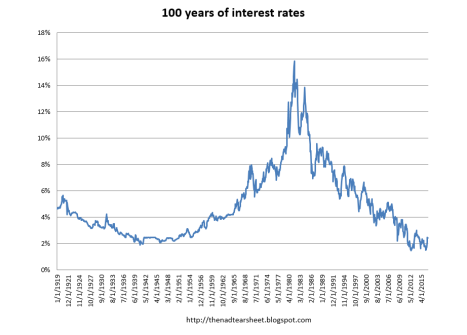
JP Morgan CEO Jamie Dimon discusses the state of the economy in his annual letter to shareholders. He argues with normal growth and inflation around 2% (the current state of affairs) historically, we would expect to see short-term rates around 2.5% and the 10 year trading around 4%. He argues that QE (both here and abroad) is what is suppressing the 10 year yield. That will reverse for the Fed this year, and in the near future overseas. There will be some countervailing forces at work, but we are in such uncharted territory that no one knows how it will turn out. Dimon then starts discussing the surprise 1979 rate hike (100 basis points on a Saturday!) and talks about how the Fed Funds rate then opened 200 bps higher that Monday. Just for the record, I want to put this chart out there – interest rate cycles are long. We are probably a generation (or two) from that sort of situation again, at least if historical observations are any guide.

100 years of interest rates

Dimon makes another point in his letter about the state of the financial system. On one hand, it is much more stable and well-capitalized. Money market funds have higher restrictions, and there is much less leverage in the system overall. That said, post-crisis policy has removed the counter-cyclical levers in the financial system. First of all, the Volcker rule has meant less market-making. Investors have noted that it is much harder to trade securities, especially the less liquid ones. In a downturn, expect to see many securities go no-bid. In other words, investors will be stuck riding something down. Second, the newer bright lines means that banks will not be able to use their reserves to step in and lend. In Reminiscences of a Stock Operator, there was a credit crunch and banks were fully lent out to the reserve point. J.P. Morgan exhorts the banks to use their reserves. That is what they are for! And finally, in a swipe at the Obama Administration, the big banks are not going to agree to buy out the failing ones. JP Morgan bought Bear at the height of the crisis, as a favor to the Bush Administration. The Obama Admin then slammed them with fines for all of Bear’s sins.

We aren’t going to see much in the way of inflation without wage growth, and at least one economist (Noah Smith) is arguing that we aren’t seeing any because employers have too much market power. He also argues that minimum wage laws are not job killers, at least in the aggregate, despite what Econ 101 would say. His argument is that if employers do have market power, then they are earning a higher return than they would otherwise accept on their workforce. In other words, you could force them to hike wages, and they still will make enough that it won’t make sense to fire people. He then cites the usual Rx for increasing wages: higher minimum wage laws and more unions. The question is then where employers have market power. Perhaps in one-company towns that could be the case. But en masse? Possible, but not probable.

The trade deficit increased again in February, giving ammo to those who agitate for a trade war. A trade war could have an effect on interest rates. Right now, China sends us ships of stuff (phones, plastic goods, all sorts of things). In return (they aren’t giving it away), they have to take something. Right now, they largely take things like agricultural products. We would prefer it if they bought even more stuff. Since they aren’t, the get US dollars instead, which they then invest in Treasuries and other US assets. If trade decreases with China, they will theoretically buy less Treasuries, and that would mean higher interest rates, at least at the margin. To put this in perspective, the trade deficit with China in February was $29 billion. During QE, the Fed was buying $45 billion in Treasuries and MBS a month. So that isn’t chump change.

It is important to understand that we are in a negotiation phase with China, that many of these things are just proposals. Historically, these things get solved by a meaningless pledge that allows the US to claim victory, but doesn’t really make that much of a difference. As China gets richer, it will undoubtedly purchase more US goods and services. However, the savings rate is sky-high there – which means that consumption is low. They are in building mode.

Ginnie Mae has noted the abuses in VA IRRRLs and is taking action against some lenders. New Day and Nations Lending are no longer eligible to issue securities into multi-issuer pools. They will only be able to issue spec pools, which will trade at a discount.

Morning Report: Strong payrolls offsets trade volatility 4/4/18

Vital Statistics:

Last Change
S&P futures 2576 -38
Eurostoxx index 365.5 -3.53
Oil (WTI) 62.56 -0.95
10 Year Government Bond Yield 2.75%
30 Year fixed rate mortgage 4.41%

Stocks are lower this morning on trade war fears. Bonds and MBS are up.

While the drop in the futures is pretty dramatic, the market is basically just giving back the end-of-day ramp yesterday after the Administration said there is nothing imminent with Amazon. We are coming out of a long period of low volatility in the stock market, and volatility begets volatility. The silver lining is that Treasuries love stock market volatility, so they stand to benefit at the margin.

Mortgage Applications fell 3.3% last week as purchases fell 2% and refis fell 5%. “Heading into the holiday weekend, mortgage application volume fell a bit both for purchase and refinance volume,” said MBA Chief Economist Mike Fratantoni. “Mortgage rates were little changed for the week, despite the increase in financial market volatility. Potential homebuyers may be a little rattled by the swings in the stock market the past few weeks, but the job market continues to strengthen, which should power demand through the spring season. The main uncertainty remains whether enough listings will be available to meet this demand.”

Factory orders increased 1.2% in February, a bit lower than the Street estimate of 1.7%.

The ISM Non-Manufacturing Index dipped in March to 58.8 last month. Interesting comment from a builder: “The unbelievable amount of market volatility in construction-related materials that started with lumber continues with the tariffs on steel and aluminum. Accurate, long-term planning has become incredibly difficult, as distributors that historically held costs for at least 30 days are now, in some cases, committing to only seven days, as prices can change drastically in that time.”(Construction). Increasing housing starts has been a manana story forever, and it looks like that might be the case again this year.

Street estimates for Friday’s payroll number might be too low, at least if you look at the ADP number, which came in way stronger than expected at 241,000. The Street is looking for an increase of 175k in Friday’s report. While the ADP number doesn’t track the BLS number as tightly as you think it should (it actually tracks the revised number, not the preliminary one), it does indicate that trade issues haven’t affected employment, at least not yet. Manufacturing payrolls increased by 29k (strongest in 3 years), but remember that there are winners and losers in a trade war with China. For every steelworker, there are many more who work for a manufacturer that uses steel as an input. Construction employment was up smartly as well.

Wilbur Ross said that the US may end up negotiating with China on trade. In other words, all of this is simply a negotiating tactic.

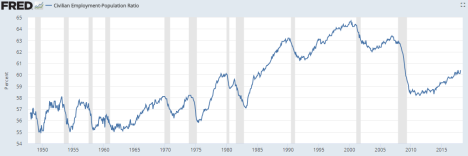
Regardless of the payroll number, the main focus is wage inflation these days, so even if you get a big payroll number you might not see much of a reaction in the bond market if average hourly earnings are only up a little (consensus is 0.3% MOM / 2.7% YOY). Higher wages are fighting to chart below, which is the employment-population ratio. The most striking feature is how dramatic the Great Recession was. Most of the 30 increase in the ratio which was driven by women entering the workforce was given back.

employment to population ratio

The Fed has a model which looks at demographics and that ratio, which predicts a drop in the ratio due to the retirement of the baby boomers. In fact, that model shows that we are much closer to full employment than the chart above suggests.

Lennar reported first quarter earnings this morning. It it hard to read too much into the numbers: there are tax charges from tax reform and a partial quarter for the CalAtlantic deal, so the increases in orders, backlog, average selling prices, etc aren’t really comparable to other builders. Lennar also launched a second multi-family fund, while it is looking to sell Rialto, its commercial real estate arm.

San Francisco Fed Chairman John Williams has been nominated to take over the NY Fed. This makes him Vice Chairman of the FOMC as well.

Vehicle sales rebounded last month, which should boost Q1 GDP estimates.

Spotify went public yesterday without the services of an investment bank. Not sure that we are quite ready to write the epitaph for investment banking, but this is a big deal.

Morning Report: CoreLogic: Half of MSAs are overvalued 4/3/18

Vital Statistics:

Last Change
S&P futures 2589 14
Eurostoxx index 368.88 -2
Oil (WTI) 63.15 0.14
10 Year Government Bond Yield 2.76%
30 Year fixed rate mortgage 4.41%

Stocks are rebounding after yesterday’s bloodbath. Bonds and MBS are down small.

No economic data today. Neel Kashkari speaks at 9:30 this morning.

The replacement for LIBOR begins trading today, when the New York Fed begins listing its new Secured Overnight Financing Rate. The NY Fed will also publish a couple other rates: the Broad General Collateral Rate and the Tri-party General Collateral Rate. Details can be found here. The appeal of SOFR will be that it is based on arms-length transactions and not quotes from banks that may or may not be real.

Prepayment speeds collapsed in early 2018 as rates rose, according to Black Knight Financial Services. Prepayment speeds are generally a proxy for refi activity, which has dried up as more of the refi opportunities are out-of-the-money. From this point onward, refi activity will be driven by home price appreciation more than interest rates. As home prices rise, the opportunity will be cash-outs, FHA with MI to conventional without MI, and ARMS into 30 year fixed. As the yield curve flattens, the relative decrease in the monthly initial ARM payment decreases.

Home equity topped $5.4 trillion last quarter and beat the record set in 2005. 75% of that is in mortgages that are out-of-the-money, or below the current 30 year fixed rate mortgage.

Home Prices rose 1% in February and are up 6.7% YOY, according to CoreLogic. They are forecast to be flat in March and up 4.7% YOY. Much of the torrid growth has been in the West / Mountain states, especially WA, NV, ID, and UT. Affordability has fallen and home price appreciation is expected to slow going forward. About half the MSAs are now overvalued, as home price appreciation and mortgage rates have outstripped income growth.

Morning Report: Trade tensions and construction employment 4/2/18

Vital Statistics:

Last Change
S&P futures 2633 -10
Eurostoxx index 370.87 1.61
Oil (WTI) 64.92 0
10 Year Government Bond Yield 2.77%
30 Year fixed rate mortgage 4.45%

Stocks are lower this morning after investors come back from the long Easter weekend. Bonds and MBS are up.

The big event will be the jobs report on Friday. The Street is looking for 167,000 jobs, which seems small, however weather-related effects in the Northeast and Midwest are undoubtedly driving some of that. The consensus for wage growth is 0.2% MOM and 2.7% YOY. This number is the one that matters the most as far as the bond market. Until the report bonds will probably take their cue from the equities market, zigging when stocks zag.

Inflationary pressures can come from strange places. In the US, spot trucking freight rates are up 28% as driver shortages and new technology limit hours. So far, retailers and producers have not passed this cost on to consumers, but at some point they will. Even long-term rates, which are more stable than spot rates, are up 12%. Note that this is with moderate diesel prices – it isn’t fuel driven.

Trade tensions with China are increasing, as the Chinese imposed some restrictions on US agricultural exports which kick in today. China is urging more trade talks to prevent further damage. A trade war will have a push-pull effect on the US economy: on one hand, higher tariffs on imported goods will increase inflation, however trade wars also act as a damper on economic activity which should keep the Fed at bay. Since inflation remains well below the Fed’s target I suspect they will focus more on the depressing effects on a trade war than they will on the potential inflationary pressures of one.

The Fed studied how student loan debt impacts homeownership and found that as student loan debt increases, the person’s likelihood of owning a home decreases. This shouldn’t be much of a surprise, but it does show that the increase in salary from having a college education isn’t offsetting the increase in debt, at least when you look at debt to income ratios.

For new graduates looking for a job, head to the Midwest. There are more job openings there than there are unemployed workers.

Construction spending increased 0.1% MOM and 3% YOY in February, according to Census. This was a touch below consensus. Residential construction increased 0.1% MOM and 5% YOY.  The National Association of Homebuilders conducted a study on where the construction workers are in the US, and unsurprisingly most of them are out West, where the fastest growth appears to be.

Manufacturing eased slightly in March, according to the ISM report, however it is still quite strong. The potential tariffs are beginning to concern businesses. One quote from the report: “Much concern in the industry regarding the steel and aluminum tariffs recently [imposed]. This is causing panic buying, driving the near-term prices higher and [leading to] inventory shortages for non-contract customers.” (Machinery). Others mentioned it will take a few weeks to gauge the impact of tariffs. That said, the reading of 59.3 is usually associated with real GDP growth pushing 5%, so it is still a strong report despite the decrease.

Morning Report: Personal Incomes and Spending rise 3/29/18

Vital Statistics:

Last Change
S&P futures 2609 5
Eurostoxx index 370.62 1.36
Oil (WTI) 64.88 -0.37
10 Year Government Bond Yield 2.77%
30 Year fixed rate mortgage 4.45%

Stocks are higher this morning on end of month / quarter window dressing. Bonds and MBS are up.

Stocks are set to break a 9 quarter winning streak. The market leaders – the FAANG stocks – have been taking a beating as Facebook gets hit on data issues, and Amazon finds itself in the Administration’s doghouse.

The bond market will close early today, at 2:00 pm EST. Get your locks in early, as secondary marketing types will probably build in a margin cushion to protect themselves over the long weekend.

Personal Income rose 0.4% in February, while personal spending rose 0.2%. The Personal Consumption Expenditure Index rose 0.2% MOM and 1.8% YOY. The core PCE index (the Fed’s preferred measure of inflation) was up 0.2% MOM and 1.6% YOY. The core PCE numbers were a touch higher than the Street was looking for, and everything else was in line. The savings rate rose. Bonds are rallying a bit on the report.

Initial Jobless Claims fell to 215,000 last week, barely missing the late February number of 210,000. We haven’t seen these levels since the early Carly Simon’s “Your’e So Vain” topped the charts. When you take into account population growth the number is even more dramatic.

The FHFA announced that Fannie and Freddie will be issuing a new uniform mortgage backed security beginning in June of 2019. “The transition to the new, common security requires planning, investment, and preparation by a wide variety of market participants,” said FHFA Director Melvin L. Watt. “We have now set the specific date that the Enterprises will start issuing the UMBS and I urge the industry to get ready now to ensure smooth, successful implementation.” This will help bring Fannie and Freddie pricing more in line with each other.

Is fintech reaching parts of the market that have not been fully served by traditional banks and lenders? The Philly Fed finds some evidence that it does, particularly in areas where there is high lender concentration (i.e. only a few banks) and areas that don’t have much in the way of banks.

Barclay’s Bank agreed to pay $2 billion in civil penalties to settle an investigation concerning RMBS issued during the bubble years. “In general, the borrowers whose loans backed these deals were significantly less credit-worthy than Barclays represented,” the Justice Department said in a statement Thursday. Barclay’s had committed to keep the settlement under $2 billion in 2016, but the Obama Justice Department balked.

A Reuters poll of 75 bond strategists suggests that fears of oversupply in the Treasury market are overblown. They are looking for an increase of 40-50 basis points in the 10 year bond yield in 2018. Considering that we are already up 30 basis points this year, we probably aren’t looking at major increases from here – maybe we will find a range of 2.8% to 3% and bounce around.

Morning Report: Fourth quarter GDP revised upward to 2.9%

Vital Statistics:

Last Change
S&P futures 2623.25 8
Eurostoxx index 366.29 -1.28
Oil (WTI) 64.88 -0.37
10 Year Government Bond Yield 2.77%
30 Year fixed rate mortgage 4.45%

Stocks are lower this morning following yesterday’s sell-off. Bonds and MBS are up on the risk-off trade.

The market leaders (in other words the FAANG stocks) are getting taken to the woodshed on Facebook is down about 20% from mid-February. Is it time to rename the index fAANG?

Mortgage applications rose 4.8% last week as purchases rose 3% and refis rose 7%. Despite the jump in refis we are still at lows not seen for a decade.

Q4 GDP was revised upward by 40 basis points to 2.9% in the third and final revision. The Street was looking for an upward revision of 20 bps. Consumption was bumped up 20 bps to 4%, while the price index was unchanged at 2.3%. Inventory was increased as well. For 2017, GDP increased 2.3% compared to 1.7% in 2016.

Pending Home Sales rose 3.1% in February, according to NAR. Despite the gain, it is still over 4% lower than a year ago. That said, February 2017 was exceptionally strong. Expect to see a decrease in March, at least in the Northeast, after a series of storms.

Home Price appreciation continues as the Case-Shiller Home Price Index increased 6.3% YOY in January. Seattle led the group, increasing almost 13%, followed by San Francisco and Las Vegas. All MSAs reported year-over-year gains. The smallest increases were in the Washington DC and some of the Midwest.

Increasing real estate prices are pushing up home equity, which grew over $15,000 on average in the fourth quarter, according to CoreLogic.  It was biggest in California, where it jumped $40,000. This is the biggest increase in 4 years, and should bump up consumer spending. Since home equity is considered more permanent than stock market equity, it should affect consumer spending more.

Consumer confidence slipped a little in March, but is still at elevated levels. The tax cuts are helping to offset some of the losses in the stock market. Generally speaking, consumer confidence indices are inverse S&P indices, so expect them to fall if this sell-off continues.

As the Spring Selling Season takes shape, we are seeing the biggest home price appreciation at the middle and lower tiers of the market, where there is the biggest supply problem. While mortgage rates are rising, so far they aren’t making a dent in housing demand. Surprisingly, Moody’s thinks the tax new tax law will dampen home price appreciation about 4% over the next few years, due to the changes in the mortgage interest deduction (which will pretty much only affect the high end in certain states) and increased interest rates due to rising deficits. Perhaps. At any rate, I think the supply / demand imbalance is the biggest driver of home prices, and that will probably get worse before it gets better.

Morning Report: LIBOR’s replacement debuts next week 3/26/18

Vital Statistics:

Last Change
S&P futures 2636.75 38.75
Eurostoxx index 368.03 2.21
Oil (WTI) 65.81 -0.07
10 Year Government Bond Yield 2.85%
30 Year fixed rate mortgage 4.46%

Stocks are higher this morning on optimism that a trade war with China can be averted. Bonds and MBS are down.

We will have a short week, with the bond market closed on Friday. On Thursday, we will have an early close. There will be a lot of Fed-speak this week, although not much in the way of market-moving reports.

Economic growth picked up in February according to the Chicago Fed National Activity Index. Production and employment-related indicators drove the increase.

San Francisco Fed Chairman John Williams is the front-runner to replace William Dudley at the New York Fed. Policy-wise he is considered a centrist, although not necessarily a markets guy. He is a long-term macro sort of guy – he doesn’t keep a Bloomberg terminal on his desk – which makes him somewhat of an odd pick to run the NY Fed which is all about markets.

Speaking of the NY Fed, it is set to launch its replacement for LIBOR next week – the SOFR (or secured overnight funding rate). Regulators are looking for a replacement for LIBOR after it was found that banks were manipulating it in order to help their own proprietary positions. LIBOR is a reference rate for many adjustable rate mortgages, as well as lines of credit so its replacement will affect the mortgage industry. The big difference between the two is that LIBOR is set based on the forecast of bankers, while SOFR will be based on actual transactions in the money markets. This makes it much less susceptible to manipulation.

Bond market observers will be watching as the Fed auctions off almost $300 billion in paper this week, with the biggest 2 year auction since 2014. Amid weakening demand for US Treasuries, the results could buffet rates a bit. Note China has threatened to stop buying US Treasuries in response to tariffs.

Mortgage banking profits fell in the fourth quarter to $237 a loan from $929 in the third quarter. This was the lowest reading since Q1 when it hit $224. Higher costs and decreasing volumes drove the decrease. Margins also fell as banks cut margins in a more competitive environment. 56% of the firms in the study reported positive pre-tax profit in the quarter, down from 77% in the prior quarter.

California is mulling a new idea to increase the supply of homes on the market, by giving a tax break to people 55 and older who downsize and move to a new county. Many homeowners are reluctant to move because they will get hit with higher property taxes on the new property.

Morning Report: Durable Goods orders rise 3/23/18

Vital Statistics:

Last Change
S&P futures 2648.75 5
Eurostoxx index 365.94 -3.21
Oil (WTI) 64.54 0.24
10 Year Government Bond Yield 2.84%
30 Year fixed rate mortgage 4.46%

Stocks are higher this morning after yesterday’s bloodbath. Bonds and MBS are down small.

Troubles with Facebook and the potential for a trade war with China caused a 3% decline in the stock market yesterday. This pushed the 10 year bond yield down towards 2.8%.

New Home Sales came in at 618k, more or less flat on a MOM and YOY basis.

Durable Goods orders came in much stronger than expected, increasing 3.1% MOM and almost 9% YOY. Ex-transportation, they rose 1.9% MOM and 8.1% YOY. Core Capital Goods orders (a proxy for business investment / capital expenditures) rose 1.8% MOM and 8% YOY. We might see some strategists bump up their Q1 GDP numbers on that reading.

KB Home reported first quarter earnings that missed on the top line; however the stock was up regardless after hours. Operating Margins improved, driven by an increase in gross margins. Bottom line numbers are not really comparable given the big adjustment to deferred tax assets as a result of the corporate tax cut. It is interesting to see an increase in gross margins, which have been falling pretty much across the industry. Perhaps it is a sign that home price growth is again outstripping cost growth (particularly labor and commodities).

The Senate passed a $1.3 trillion spending bill that will keep the government open. Donald Trump is mulling a veto over wall funding, but that is probably just noise.

Historically, house prices and the homeownership rate have correlated rather closely, but that broke down after house prices bottomed in 2012. What is going on? The first question to ask is whether the increase in homeownership that started in the mid-90s was due to increasing home prices or something else. We know that the Clinton Administration began to pull on some policy levers (and jawbone the GSEs) to increase lending to underserved markets and areas.

The wealth that was being created in the stock market rally probably helped as well. Easy credit during the bubble also pulled some people into the housing market as well. Once the bubble popped, many people lost their homes and became renters. Finally, tight supply in the aftermath of the bubble is preventing many from buying, and professional investors who are buying starter homes to rent them out are exacerbating the problem.

Prepayments hit a 4 year low, according to Black Knight Financial Service’s First Look on February mortgage performance data. Foreclosure starts fell 25% MOM after spiking in January. Hurricane-related delinquencies fell.

Realtor.com says that this Spring Selling Season is set to become one of the most competitive ever, with lots of buyers who were unable to find anything last year competing with new homebuyers. How are homebuyers reacting to the environment? Increasing down payments, increasing earnest money, and bidding through the asking price.

Morning Report: The Fed hikes rates 25 basis points as expected 3/22/18

Vital Statistics:

Last Change
S&P futures 2699 -19
Eurostoxx index 371.42 -3.54
Oil (WTI) 63.42 1.36
10 Year Government Bond Yield 2.84%
30 Year fixed rate mortgage 4.46%

Stocks are lower this morning after the Fed hiked rates and the Bank of England decided to stand pat. Bonds and MBS are up.

In a unanimous decision, the FOMC hiked the Fed Funds rate 25 basis points yesterday and released its new dot plot and projections. The projection materials showed a meaningful hike in projected GDP: from 2.5% to 2.7% in 2018 and from 2.1% to 2.4% in 2019. They also took down their estimate for unemployment: from 3.9% to 3.8% in 2018 and from 3.9% to 3.6% in 2019. They also cut their long term estimate of the unemployment rate from 4.6% to 4.5%. The dot plot bumped up their projections for the Fed funds rate across the board, by about a quarter in 2018 and 2019 and by 3/8 in 2020. The Fed funds futures didn’t move much. The May futures are predicting no change, the June futures are predicting a 78% chance of another 25 basis point hike, and the Dec futures are predicting a 42% chance of another 25 basis point hike.

Note the dot plot comparison and how the interest rate forecasts inched up: Bill Gross isn’t buying the forecast. He thinks a Fed Funds rate above 2% when inflation is only 2% will be too destabilizing in such a highly leveraged world. Of course Bill is probably talking his book a bit too.

Home prices rose 0.8% MOM and 7.3% YOY according to the FHFA House Price Index. The Middle Atlantic and Midwest lagged while the West Coast and Mountain states led.

Initial Jobless Claims ticked up 3k last week to 229,000.

The Index of Leading Economic Indicators came in much stronger than expected in February. January was revised upward as well.

The Trump administration plans to announce $50 billion in tariffs against the Chinese for intellectual property violations. The US accuses China of using foreign investment restrictions to force US companies to share technology.

Fannie and Fred are stepping up their purchases of affordable housing loans under their “duty to serve” mandate. Between them, they will buy roughly 8,400 more loans for manufactured, rural, and affordable housing. The problem with these areas (especially rural areas) is that the low loan balances make the loans themselves less profitable. On the other hand, low balance loans generally have higher servicing values, all things being equal. The GSEs are targeting Appalacia, the lower Mississippi Delta, and Native American areas.

Loan gestation times fell to 42 days in February, according to the latest Ellie Mae Origination Insights Report. This is a big drop on a year-over-year basis as well, which strips out some of the seasonality issues. Credit scores also fell a touch.

Morning Report: Existing Home Sales rise 3/21/18

Vital Statistics:

Last Change
S&P futures 2719 -3.75
Eurostoxx index 374.05 -1.52
Oil (WTI) 63.42 1.36
10 Year Government Bond Yield 2.90%
30 Year fixed rate mortgage 4.46%

Stocks are lower as we await the FOMC decision. Bonds and MBS are down.

The FOMC decision is scheduled to be released at 2:00 pm EST. This will be Jerome Powell’s first rate hike and press conference, so the markets will be hanging on his every word. Here are some of the things the Street will be focusing on. The biggest will be the dot plot for the rest of the year. Do the tax cuts and planned infrastructure spend push the Fed to bump up their consensus of 3 hikes this year to 4%? If so, that is bearish for bonds (higher rates). Another will be the long term neutral Fed Funds rate, which currently stands at 2.8%. Do they move it up to 3%? That sort of revision would be taken as hawkish as well and would push rates higher. Finally, the long-term unemployment rate is currently set at 4.6%, which implies the current rate of 4.1% is too low. If they move down the longer-term unemployment rate, that could be interpreted as dovish.

While most mortgage market participants are rightly focused on the 10 year bond yield, there is another rate that is gathering attention – LIBOR. LIBOR has been rising steadily over the past 18 months, and and 3-month LIBOR is at levels not seen since 2008. LIBOR and the 1 year T-bill rate are the reference index in many adjustable rate loans. What does this mean for the mortgage industry? Funding costs are rising, while volumes are falling. Not a good mix for profitability. Also note that this is yet another reason for borrowers with ARMs to consider a refi into a 30 or 15 year fixed rate mortgage. Long-term rates have been much more stable than LIBOR, and therefore the relative attractiveness is increasing.

Note that increasing short-term rates are having a spill-over effect onto other asset classes. Long-term bonds have had no competition from money market instruments for a decade. That is changing.

Mortgage Applications fell 1% last week as purchases rose 1% and refis fell 5%.

Existing home sales rose 3% in February to a seasonally adjusted pace of 5.54 million. This is up 1.1% YOY. The median home price rose 5.9% to $241k. Total housing inventory stood at 1.59 million, which is 8% lower than a year ago.  The first-time homebuyer accounted for 29% of sales, which is down from 31% a year ago, and well below the historical average of 40%. Days on market fell to 37. The average contract rate for a 30 year mortgage increased 3 basis points to 4.33%. Distressed sales fell to 4%. Overall, it is the same story – tight inventory and rising prices.

For the first time homebuyer, this is bad news, as most of the inventory is at the high end, not the low end. Starter homes in the Bay Area are over $800k, and engineers in Silicon Valley are struggling to pay the rent. Starter homes account for 22% of the inventory, while luxury accounts for almost 60%.

Meanwhile, construction job openings are the approaching post-recession highs. Lack of labor remains the biggest issue for construction companies.

Congress seems close to a deal to keep the government open after funding expires on Friday.  Fiscal conservatives will be unhappy, as the trade seems to be higher military spending for higher non-military spending. For originators, the biggest issue with a government shutdown is the inability to get 4506-T reports out of the IRS.